
Allusions in The Taming of the Shrew Explanations

- Slides: 10
Allusions in The Taming of the Shrew Explanations and Analysis of
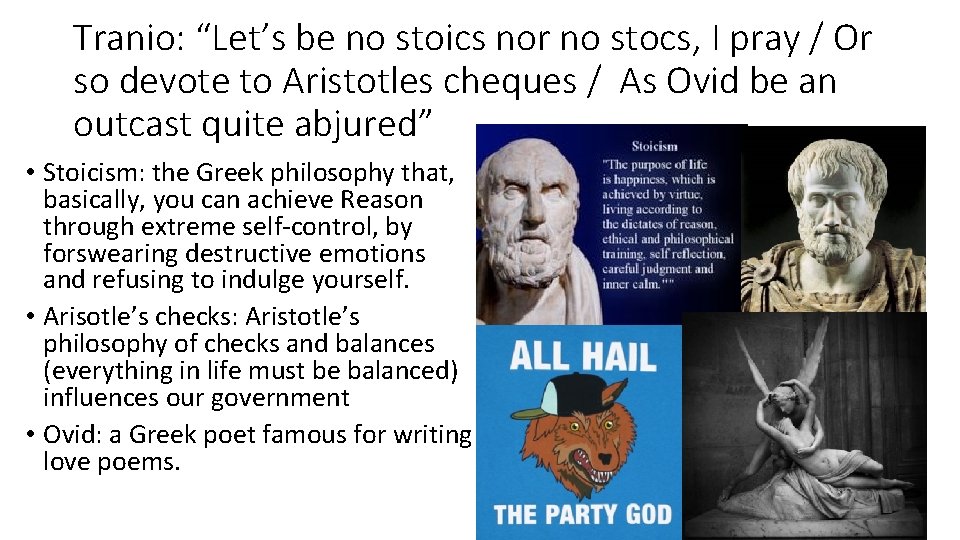
Tranio: “Let’s be no stoics nor no stocs, I pray / Or so devote to Aristotles cheques / As Ovid be an outcast quite abjured” • Stoicism: the Greek philosophy that, basically, you can achieve Reason through extreme self-control, by forswearing destructive emotions and refusing to indulge yourself. • Arisotle’s checks: Aristotle’s philosophy of checks and balances (everything in life must be balanced) influences our government • Ovid: a Greek poet famous for writing love poems.
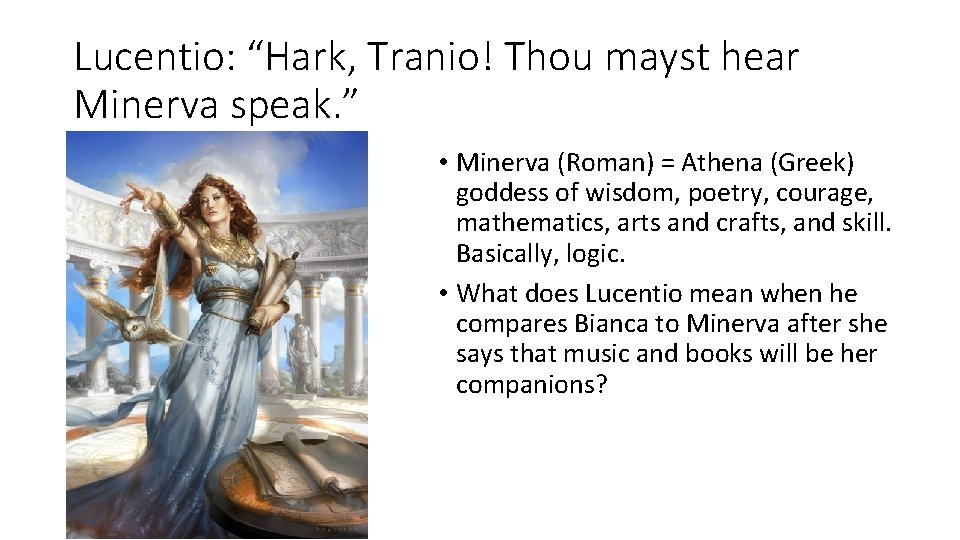
Lucentio: “Hark, Tranio! Thou mayst hear Minerva speak. ” • Minerva (Roman) = Athena (Greek) goddess of wisdom, poetry, courage, mathematics, arts and crafts, and skill. Basically, logic. • What does Lucentio mean when he compares Bianca to Minerva after she says that music and books will be her companions?
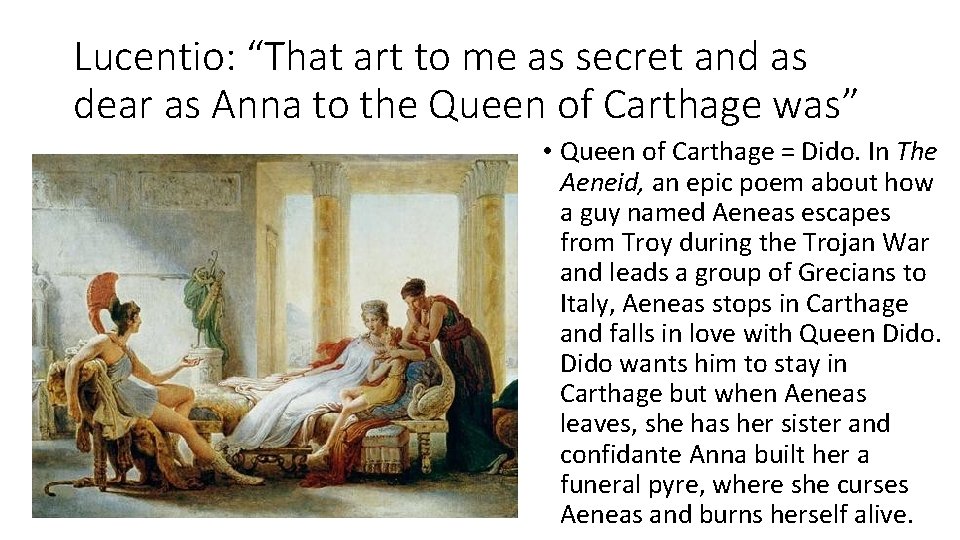
Lucentio: “That art to me as secret and as dear as Anna to the Queen of Carthage was” • Queen of Carthage = Dido. In The Aeneid, an epic poem about how a guy named Aeneas escapes from Troy during the Trojan War and leads a group of Grecians to Italy, Aeneas stops in Carthage and falls in love with Queen Dido wants him to stay in Carthage but when Aeneas leaves, she has her sister and confidante Anna built her a funeral pyre, where she curses Aeneas and burns herself alive.
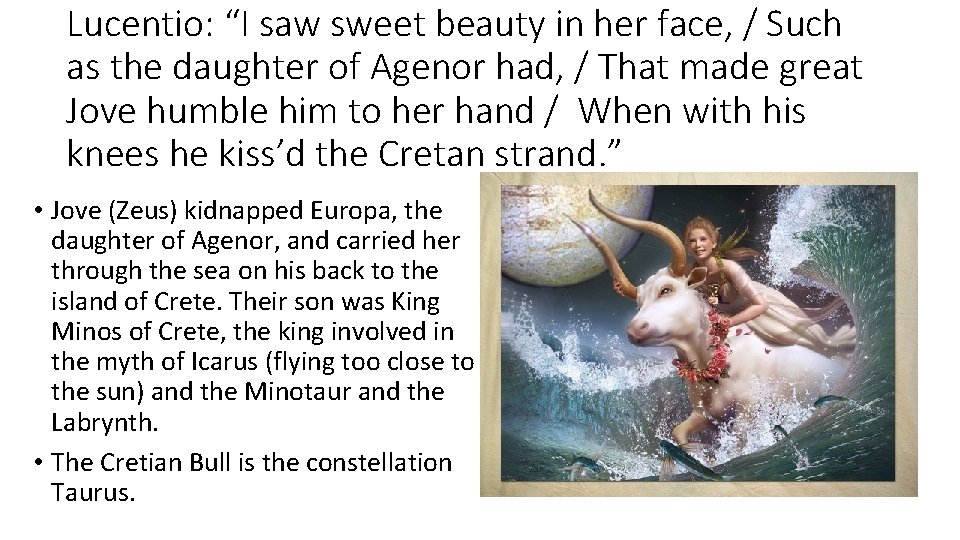
Lucentio: “I saw sweet beauty in her face, / Such as the daughter of Agenor had, / That made great Jove humble him to her hand / When with his knees he kiss’d the Cretan strand. ” • Jove (Zeus) kidnapped Europa, the daughter of Agenor, and carried her through the sea on his back to the island of Crete. Their son was King Minos of Crete, the king involved in the myth of Icarus (flying too close to the sun) and the Minotaur and the Labrynth. • The Cretian Bull is the constellation Taurus.
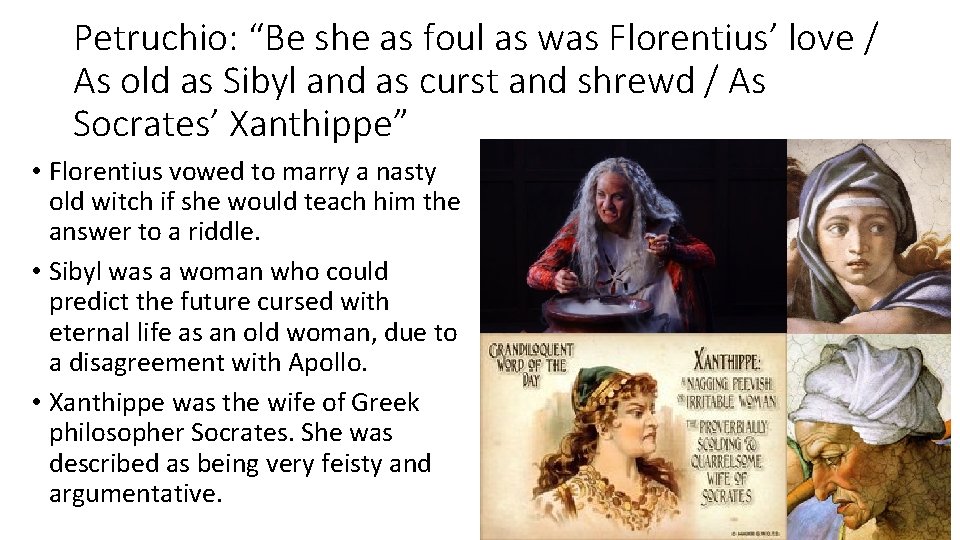
Petruchio: “Be she as foul as was Florentius’ love / As old as Sibyl and as curst and shrewd / As Socrates’ Xanthippe” • Florentius vowed to marry a nasty old witch if she would teach him the answer to a riddle. • Sibyl was a woman who could predict the future cursed with eternal life as an old woman, due to a disagreement with Apollo. • Xanthippe was the wife of Greek philosopher Socrates. She was described as being very feisty and argumentative.
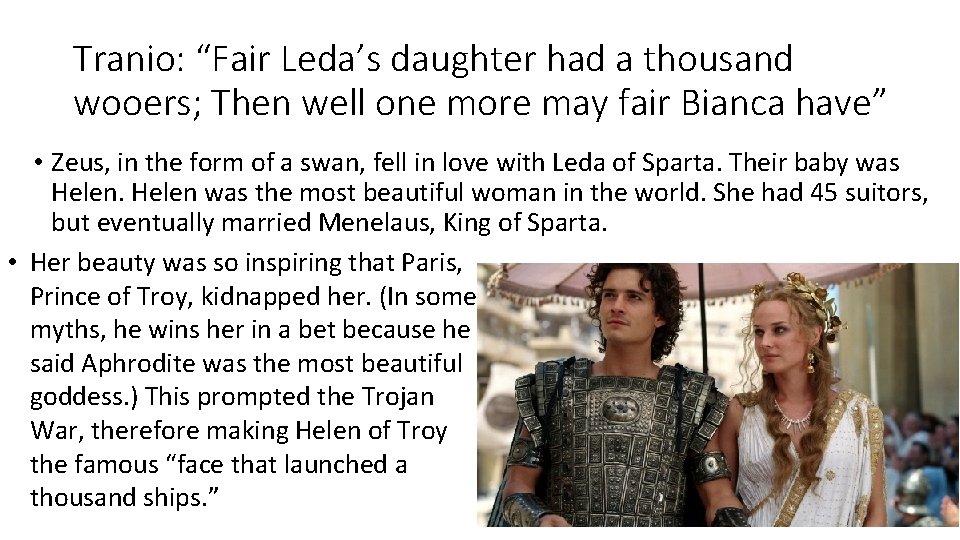
Tranio: “Fair Leda’s daughter had a thousand wooers; Then well one more may fair Bianca have” • Zeus, in the form of a swan, fell in love with Leda of Sparta. Their baby was Helen was the most beautiful woman in the world. She had 45 suitors, but eventually married Menelaus, King of Sparta. • Her beauty was so inspiring that Paris, Prince of Troy, kidnapped her. (In some myths, he wins her in a bet because he said Aphrodite was the most beautiful goddess. ) This prompted the Trojan War, therefore making Helen of Troy the famous “face that launched a thousand ships. ”
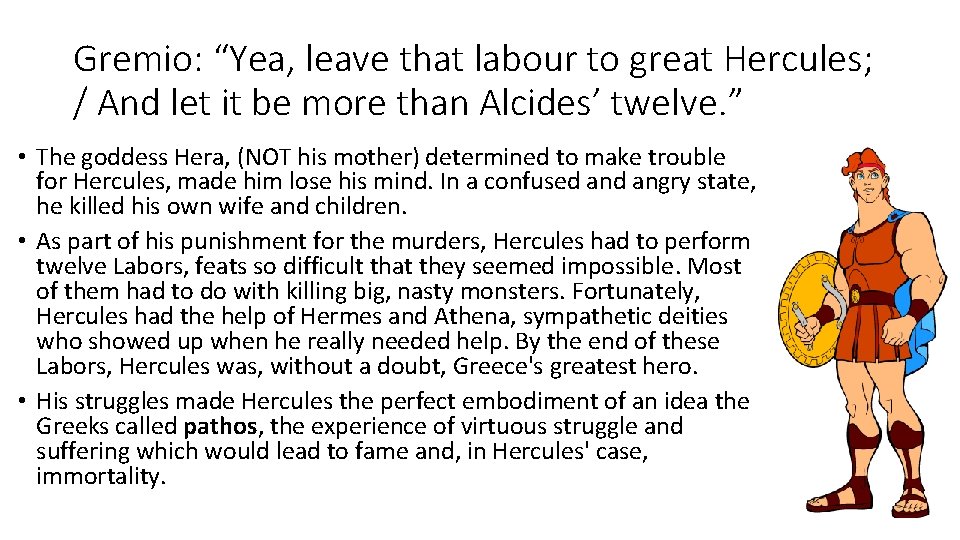
Gremio: “Yea, leave that labour to great Hercules; / And let it be more than Alcides’ twelve. ” • The goddess Hera, (NOT his mother) determined to make trouble for Hercules, made him lose his mind. In a confused angry state, he killed his own wife and children. • As part of his punishment for the murders, Hercules had to perform twelve Labors, feats so difficult that they seemed impossible. Most of them had to do with killing big, nasty monsters. Fortunately, Hercules had the help of Hermes and Athena, sympathetic deities who showed up when he really needed help. By the end of these Labors, Hercules was, without a doubt, Greece's greatest hero. • His struggles made Hercules the perfect embodiment of an idea the Greeks called pathos, the experience of virtuous struggle and suffering which would lead to fame and, in Hercules' case, immortality.
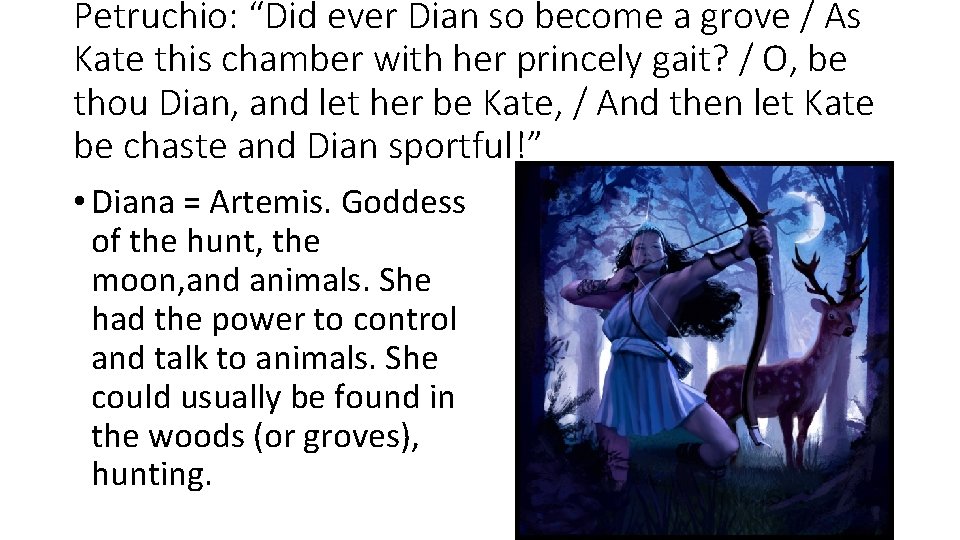
Petruchio: “Did ever Dian so become a grove / As Kate this chamber with her princely gait? / O, be thou Dian, and let her be Kate, / And then let Kate be chaste and Dian sportful!” • Diana = Artemis. Goddess of the hunt, the moon, and animals. She had the power to control and talk to animals. She could usually be found in the woods (or groves), hunting.
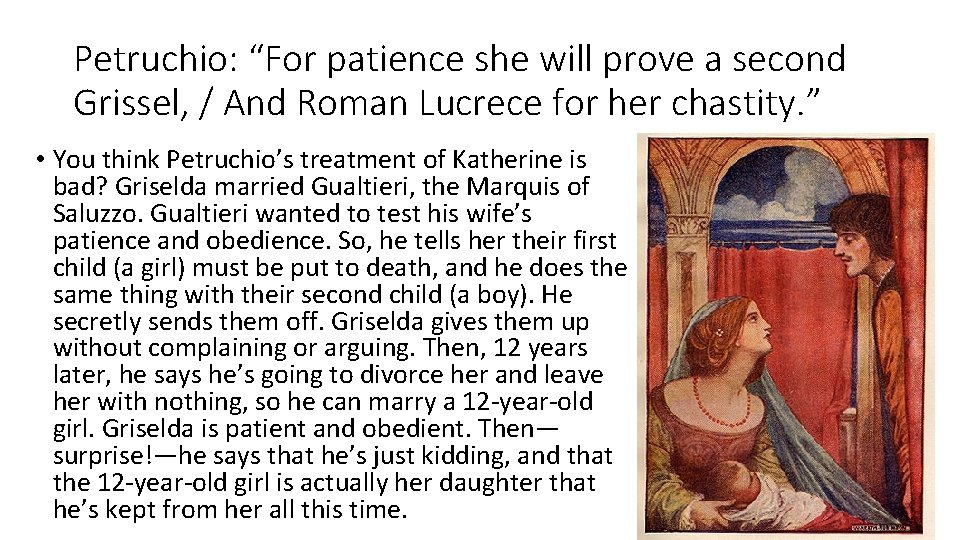
Petruchio: “For patience she will prove a second Grissel, / And Roman Lucrece for her chastity. ” • You think Petruchio’s treatment of Katherine is bad? Griselda married Gualtieri, the Marquis of Saluzzo. Gualtieri wanted to test his wife’s patience and obedience. So, he tells her their first child (a girl) must be put to death, and he does the same thing with their second child (a boy). He secretly sends them off. Griselda gives them up without complaining or arguing. Then, 12 years later, he says he’s going to divorce her and leave her with nothing, so he can marry a 12 -year-old girl. Griselda is patient and obedient. Then— surprise!—he says that he’s just kidding, and that the 12 -year-old girl is actually her daughter that he’s kept from her all this time.