
Allsky assimilation of microwave sounder radiances Alan Geer


- Slides: 37
All-sky assimilation of microwave sounder radiances Alan Geer, Niels Bormann, Fabrizio Baordo, Heather Lawrence, Cristina Lupu, Stephen English Slide 1 6 th WMO Workshop on the Impact of Various Observing Systems Slide 1
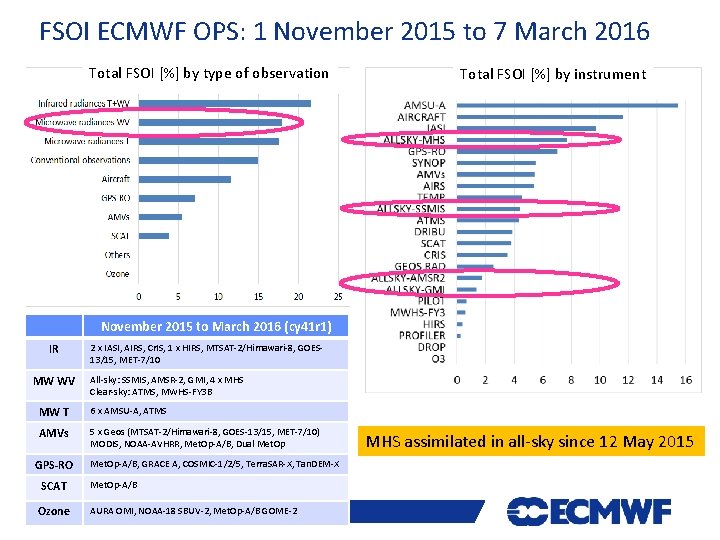
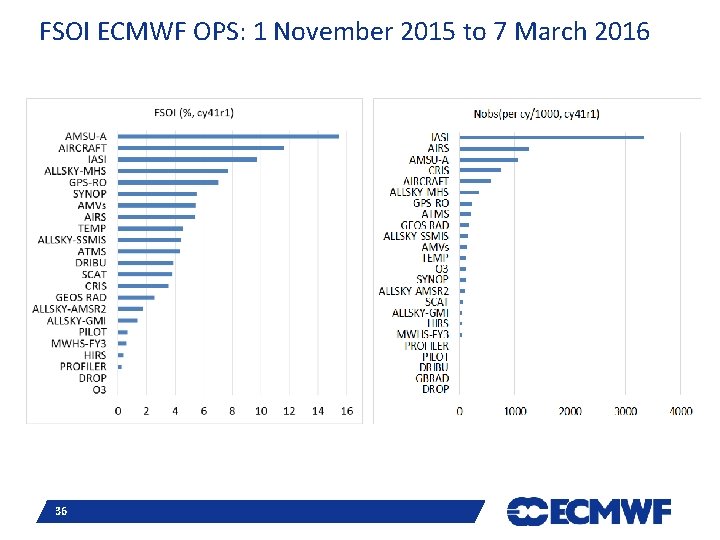
FSOI ECMWF OPS: 1 November 2015 to 7 March 2016 Total FSOI [%] by type of observation Total FSOI [%] by instrument November 2015 to March 2016 (cy 41 r 1) IR MW WV 2 x IASI, AIRS, Cr. IS, 1 x HIRS, MTSAT-2/Himawari-8, GOES 13/15, MET-7/10 All-sky: SSMIS, AMSR-2, GMI, 4 x MHS Clear-sky: ATMS, MWHS-FY 3 B MW T 6 x AMSU-A, ATMS AMVs 5 x Geos (MTSAT-2/Himawari-8, GOES-13/15, MET-7/10) MODIS, NOAA-AVHRR, Met. Op-A/B, Dual Met. Op GPS-RO SCAT 2 Ozone Met. Op-A/B, GRACE A, COSMIC-1/2/5, Terra. SAR-X, Tan. DEM-X Met. Op-A/B AURA OMI, NOAA-18 SBUV-2, Met. Op-A/B GOME-2 Slide 2 MHS assimilated in all-sky since 12 May 2015
Outline 1. 2. 3. 4. 5. All-sky approach Challenges and ingredients Forecast impact of MW humidity sounders: clear-sky vs all-sky Mechanisms Conclusions Slide 3 6 th WMO Workshop on the Impact of Various Observing Systems Slide 3
Outline 1. 2. 3. 4. 5. All-sky approach Challenges and ingredients Forecast impact of MW humidity sounders: clear-sky vs all-sky Mechanisms Conclusions Slide 4 6 th WMO Workshop on the Impact of Various Observing Systems Slide 4
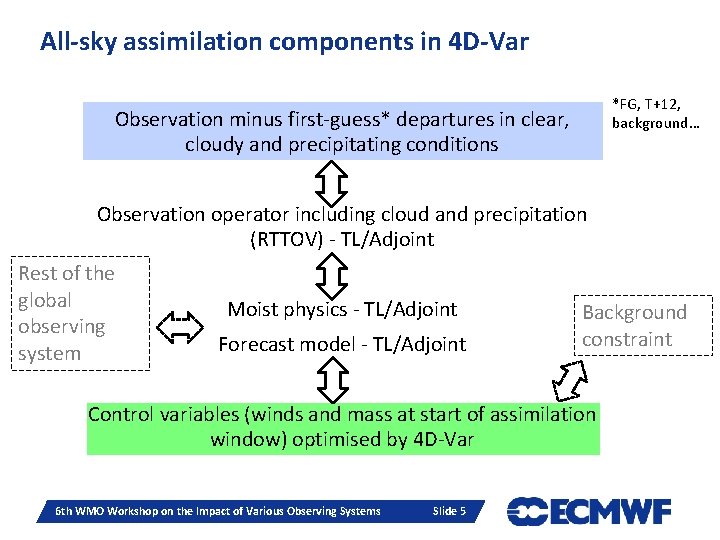
All-sky assimilation components in 4 D-Var *FG, T+12, background… Observation minus first-guess* departures in clear, cloudy and precipitating conditions Observation operator including cloud and precipitation (RTTOV) - TL/Adjoint Rest of the global observing system Moist physics - TL/Adjoint Forecast model - TL/Adjoint Background constraint Control variables (winds and mass at start of assimilation Slide 5 window) optimised by 4 D-Var 6 th WMO Workshop on the Impact of Various Observing Systems Slide 5
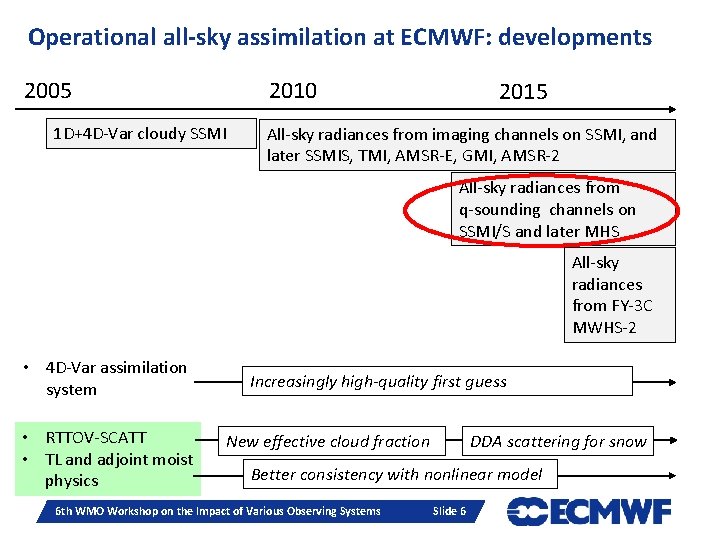
Operational all-sky assimilation at ECMWF: developments 2010 2005 1 D+4 D-Var cloudy SSMI 2015 All-sky radiances from imaging channels on SSMI, and later SSMIS, TMI, AMSR-E, GMI, AMSR-2 All-sky radiances from q-sounding channels on SSMI/S and later MHS All-sky radiances from FY-3 C MWHS-2 • 4 D-Var assimilation system • RTTOV-SCATT • TL and adjoint moist physics Increasingly high-quality first guess New effective cloud fraction. Slide 6 DDA scattering for snow Better consistency with nonlinear model 6 th WMO Workshop on the Impact of Various Observing Systems Slide 6
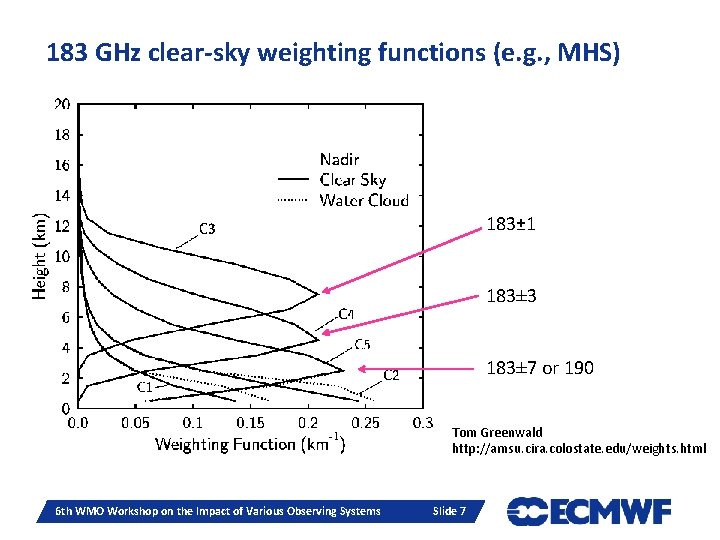
183 GHz clear-sky weighting functions (e. g. , MHS) 183± 1 183± 3 183± 7 or 190 Tom Slide 7 Greenwald http: //amsu. cira. colostate. edu/weights. html 6 th WMO Workshop on the Impact of Various Observing Systems Slide 7
Outline 1. 2. 3. 4. 5. All-sky approach Challenges and ingredients Forecast impact of MW humidity sounders: clear-sky vs all-sky Mechanisms Conclusions Slide 8 6 th WMO Workshop on the Impact of Various Observing Systems Slide 8
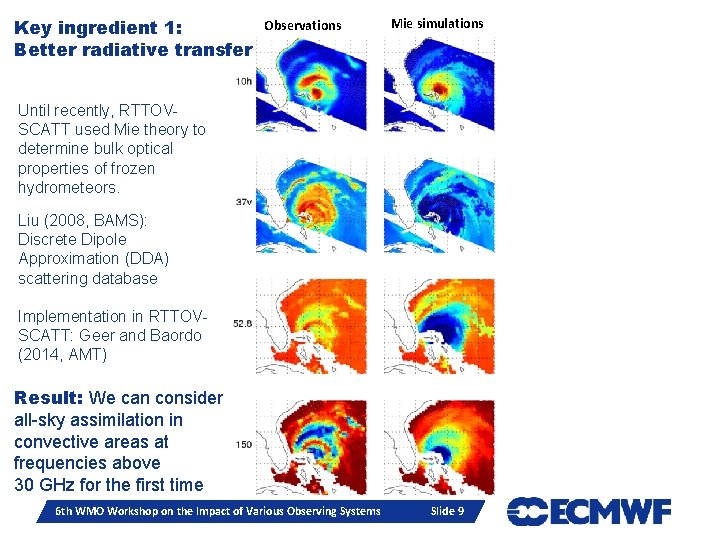
Key ingredient 1: Better radiative transfer Observations Mie simulations Until recently, RTTOVSCATT used Mie theory to determine bulk optical properties of frozen hydrometeors. Liu (2008, BAMS): Discrete Dipole Approximation (DDA) scattering database Implementation in RTTOVSCATT: Geer and Baordo (2014, AMT) Result: We can consider all-sky assimilation in convective areas at frequencies above 30 GHz for the first time 6 th WMO Workshop on the Impact of Various Observing Systems Slide 9 DDA simulations
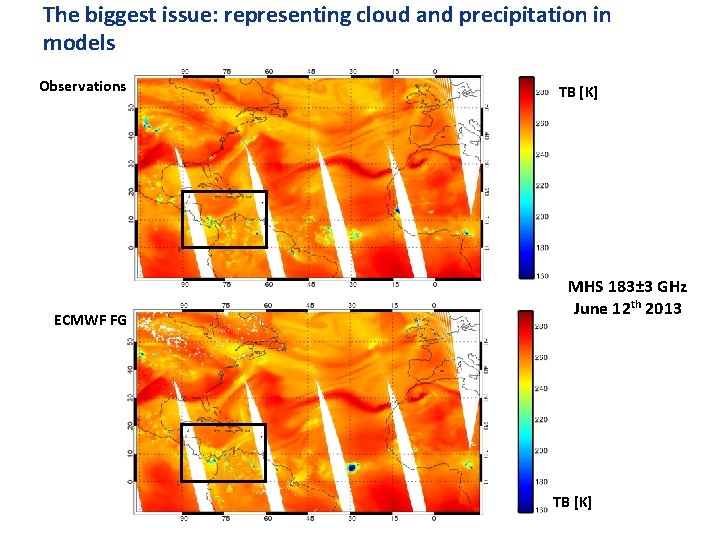
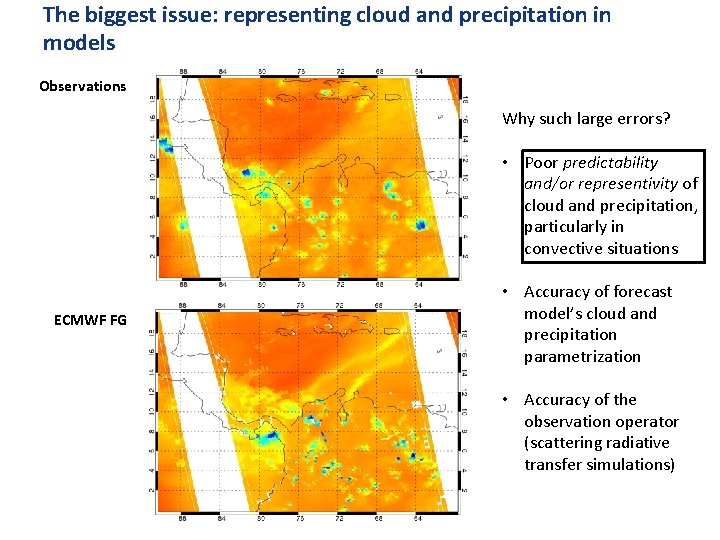
The biggest issue: representing cloud and precipitation in models Observations TB [K] MHS 183± 3 GHz June 12 th 2013 ECMWF FG Slide 10 TB [K] 6 th WMO Workshop on the Impact of Various Observing Slide 10
The biggest issue: representing cloud and precipitation in models Observations Why such large errors? • Poor predictability and/or representivity of cloud and precipitation, particularly in convective situations • Accuracy of forecast model’s cloud and precipitation parametrization ECMWF FG Slide 11 6 th WMO Workshop on the Impact of Various Observing Slide 11 • Accuracy of the observation operator (scattering radiative transfer simulations)
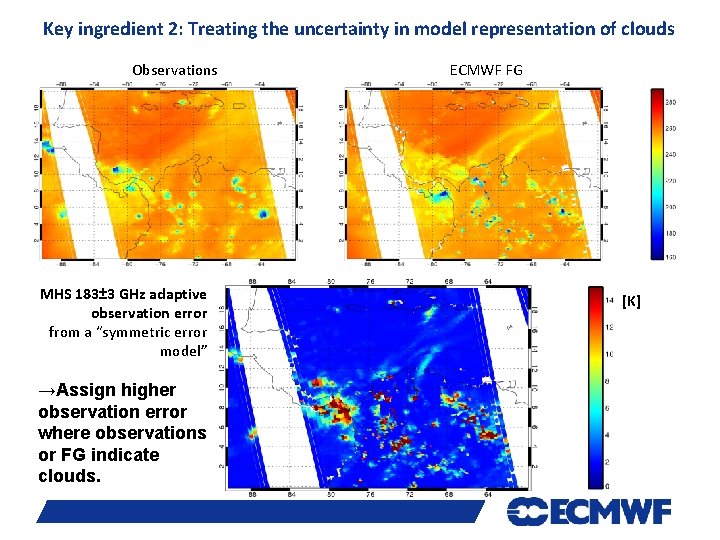
Key ingredient 2: Treating the uncertainty in model representation of clouds Observations ECMWF FG MHS 183± 3 GHz adaptive observation error from a “symmetric error model” →Assign higher observation error where observations or FG indicate clouds. . [K] Slide 12
Outline 1. 2. 3. 4. 5. All-sky approach Challenges and ingredients Forecast impact of MW humidity sounders: clear-sky vs all-sky Mechanisms Conclusions Slide 13 6 th WMO Workshop on the Impact of Various Observing Systems Slide 13
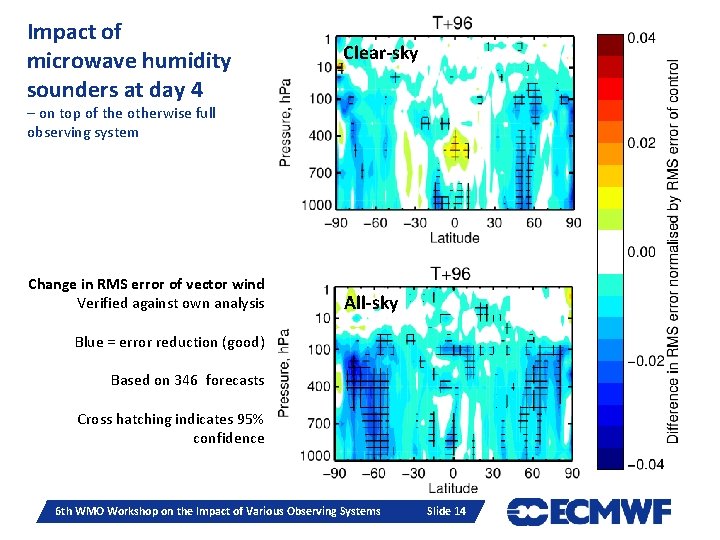
Impact of microwave humidity sounders at day 4 Clear-sky – on top of the otherwise full observing system Change in RMS error of vector wind Verified against own analysis All-sky Blue = error reduction (good) Based on 346 forecasts Cross hatching indicates 95% confidence 6 th WMO Workshop on the Impact of Various Observing Systems Slide 14
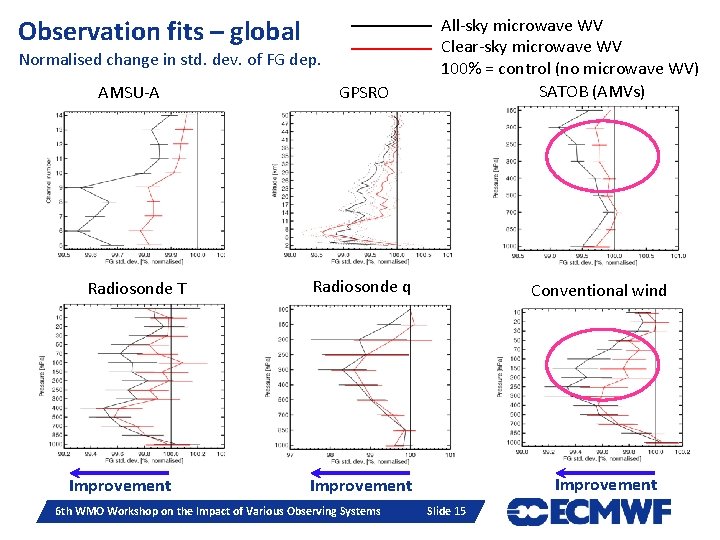
Observation fits – global Normalised change in std. dev. of FG dep. AMSU-A Radiosonde T GPSRO All-sky microwave WV Clear-sky microwave WV 100% = control (no microwave WV) SATOB (AMVs) Radiosonde q Conventional wind Slide 15 Improvement 6 th WMO Workshop on the Impact of Various Observing Systems Slide 15
Outline 1. 2. 3. 4. 5. All-sky approach Challenges and ingredients Forecast impact of MW humidity sounders: clear-sky vs all-sky Mechanisms Conclusions Slide 16 6 th WMO Workshop on the Impact of Various Observing Systems Slide 16
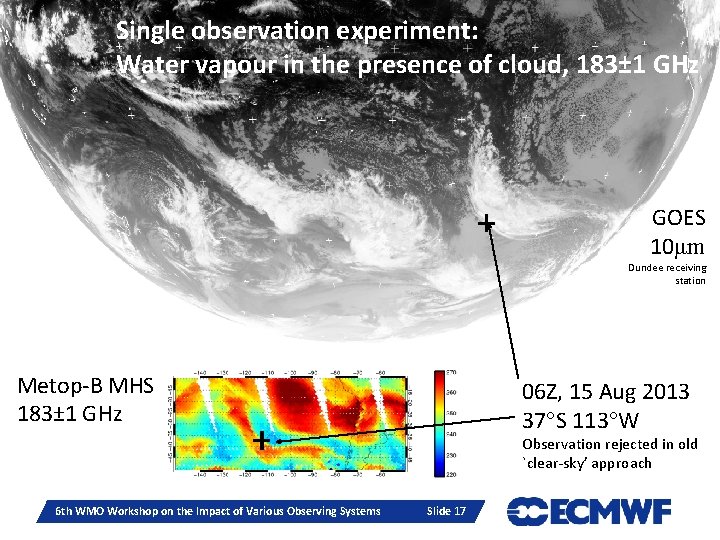
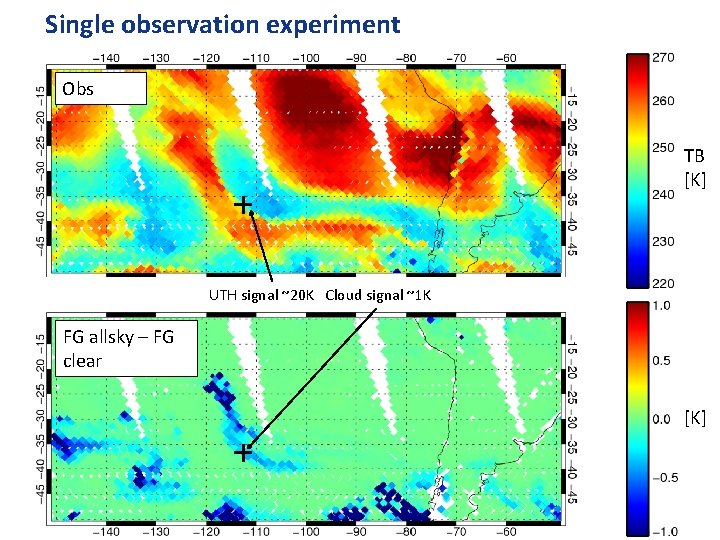
Single observation experiment: Water vapour in the presence of cloud, 183± 1 GHz GOES 10μm Dundee receiving station Metop-B MHS 183± 1 GHz 6 th WMO Workshop on the Impact of Various Observing Systems Slide 17 06 Z, 15 Aug 2013 37°S 113°W Observation rejected in old `clear-sky’ approach
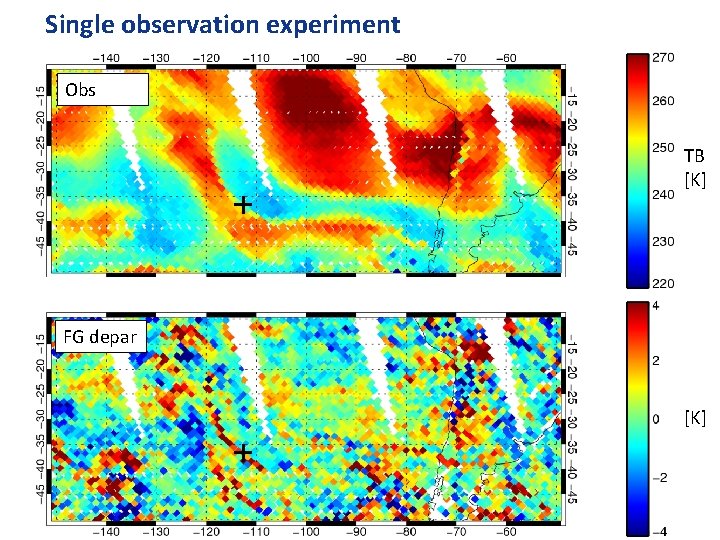
Single observation experiment Obs TB [K] FG depar Slide 18 6 th WMO Workshop on the Impact of Various Observing Systems Slide 18 [K]
Single observation experiment Obs TB [K] UTH signal ~20 K Cloud signal ~1 K FG allsky – FG clear Slide 19 6 th WMO Workshop on the Impact of Various Observing Systems Slide 19 [K]
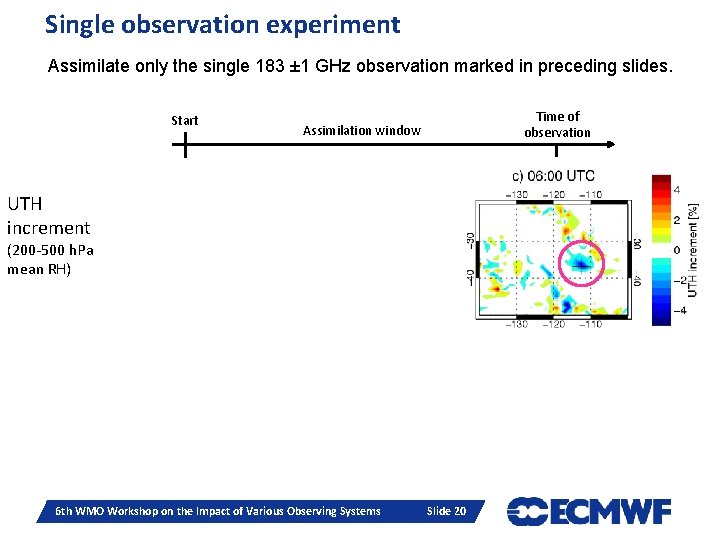
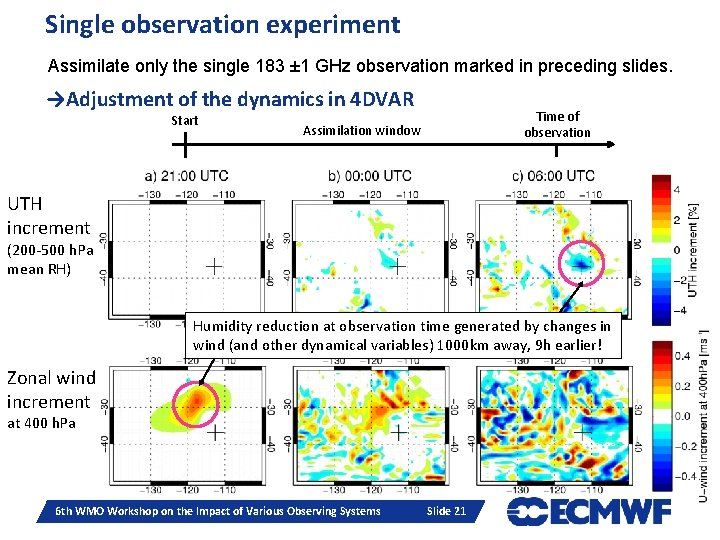
Single observation experiment Assimilate only the single 183 ± 1 GHz observation marked in preceding slides. Start Time of observation Assimilation window UTH increment (200 -500 h. Pa mean RH) Slide 20 6 th WMO Workshop on the Impact of Various Observing Systems Slide 20
Single observation experiment Assimilate only the single 183 ± 1 GHz observation marked in preceding slides. →Adjustment of the dynamics in 4 DVAR Start Time of observation Assimilation window UTH increment (200 -500 h. Pa mean RH) Humidity reduction at observation time generated by changes in wind (and other dynamical variables) 1000 km away, 9 h earlier! Zonal wind increment at 400 h. Pa 6 th WMO Workshop on the Impact of Various Observing Systems Slide 21
Microwave humidity observations on their own Slide 22 6 th WMO Workshop on the Impact of Various Observing Systems Slide 22
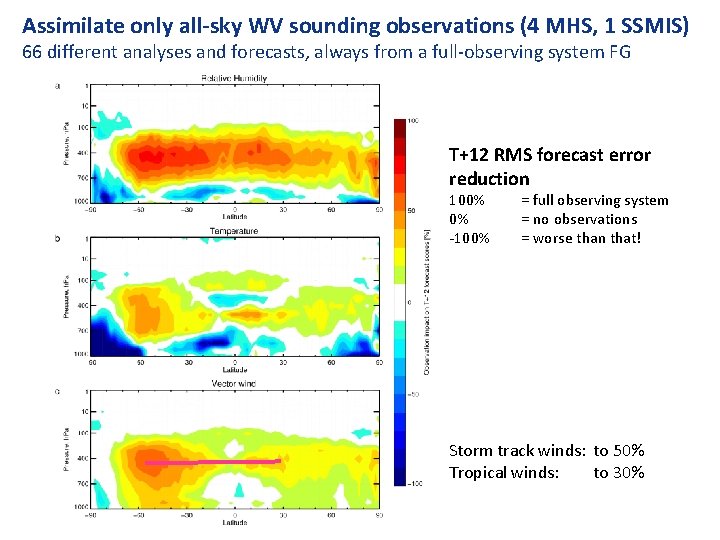
Assimilate only all-sky WV sounding observations (4 MHS, 1 SSMIS) 66 different analyses and forecasts, always from a full-observing system FG T+12 RMS forecast error reduction 100% 0% -100% Slide 23 = full observing system = no observations = worse than that! Storm track winds: to 50% Tropical winds: to 30% Slide 23
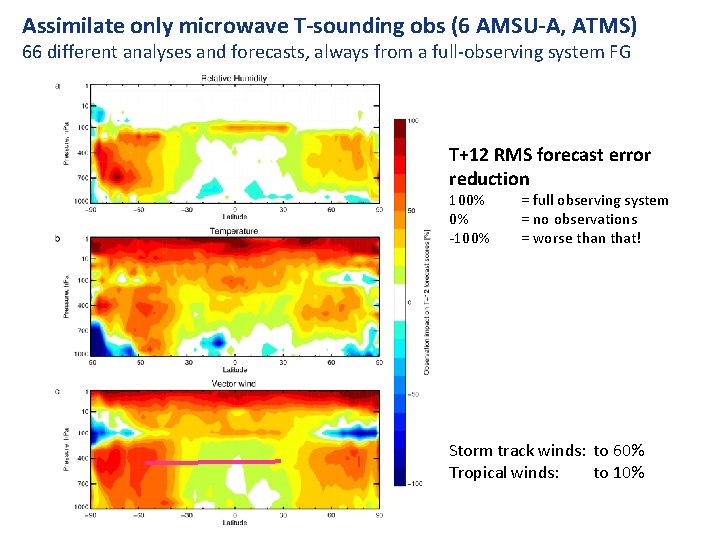
Assimilate only microwave T-sounding obs (6 AMSU-A, ATMS) 66 different analyses and forecasts, always from a full-observing system FG T+12 RMS forecast error reduction 100% 0% -100% Slide 24 = full observing system = no observations = worse than that! Storm track winds: to 60% Tropical winds: to 10% Slide 24
Outline 1. 2. 3. 4. 5. All-sky approach Challenges and ingredients Forecast impact of MW humidity sounders: clear-sky vs all-sky Mechanisms Conclusions Slide 25 6 th WMO Workshop on the Impact of Various Observing Systems Slide 25
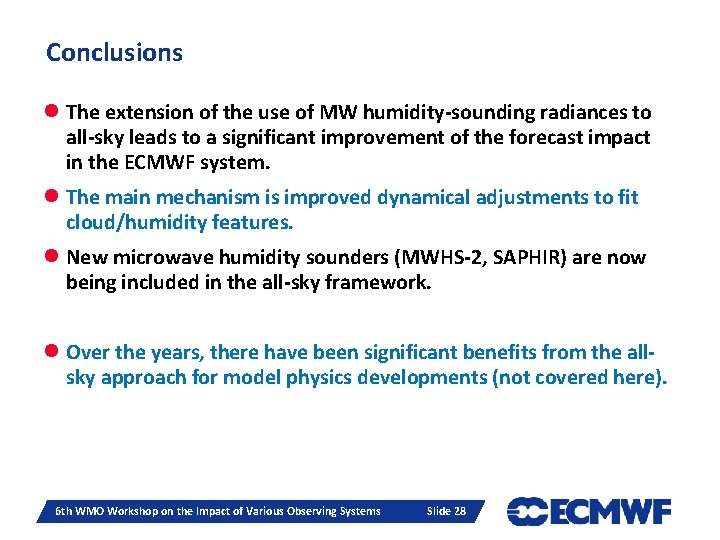
Conclusions l The extension of the use of MW humidity-sounding radiances to all-sky leads to a significant improvement of the forecast impact in the ECMWF system. l The main mechanism is improved dynamical adjustments to fit cloud/humidity features. l New microwave humidity sounders (MWHS-2, SAPHIR) are now being included in the all-sky framework. Slide 26 6 th WMO Workshop on the Impact of Various Observing Systems Slide 26
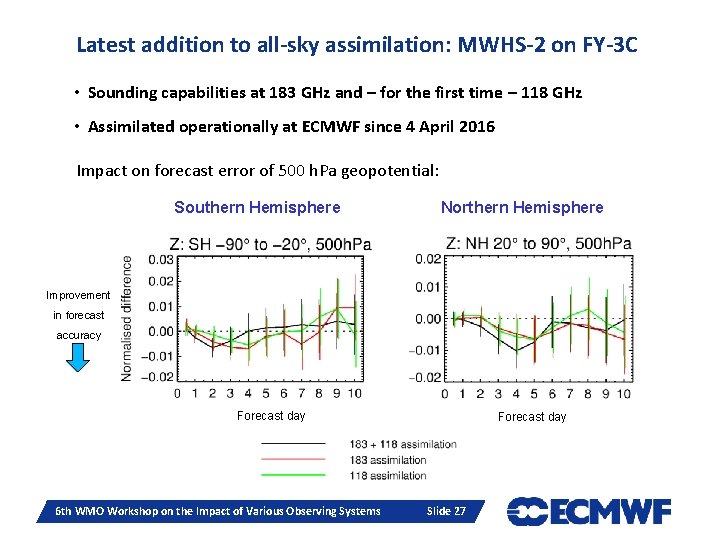
Latest addition to all-sky assimilation: MWHS-2 on FY-3 C • Sounding capabilities at 183 GHz and – for the first time – 118 GHz • Assimilated operationally at ECMWF since 4 April 2016 Impact on forecast error of 500 h. Pa geopotential: Southern Hemisphere Northern Hemisphere Improvement in forecast accuracy Forecast day Slide 27 6 th WMO Workshop on the Impact of Various Observing Systems Slide 27
Conclusions l The extension of the use of MW humidity-sounding radiances to all-sky leads to a significant improvement of the forecast impact in the ECMWF system. l The main mechanism is improved dynamical adjustments to fit cloud/humidity features. l New microwave humidity sounders (MWHS-2, SAPHIR) are now being included in the all-sky framework. l Over the years, there have been significant benefits from the allsky approach for model physics developments (not covered here). Slide 28 6 th WMO Workshop on the Impact of Various Observing Systems Slide 28
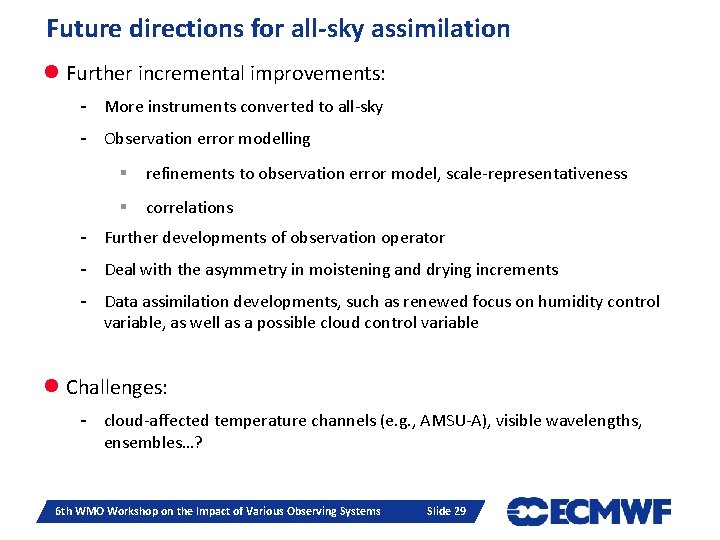
Future directions for all-sky assimilation l Further incremental improvements: - More instruments converted to all-sky - Observation error modelling § refinements to observation error model, scale-representativeness § correlations - Further developments of observation operator - Deal with the asymmetry in moistening and drying increments - Data assimilation developments, such as renewed focus on humidity control variable, as well as a possible cloud control variable l Challenges: - cloud-affected temperature channels (e. g. , AMSU-A), visible wavelengths, Slide 29 ensembles…? 6 th WMO Workshop on the Impact of Various Observing Systems Slide 29
Backup Slide 30 6 th WMO Workshop on the Impact of Various Observing Systems Slide 30
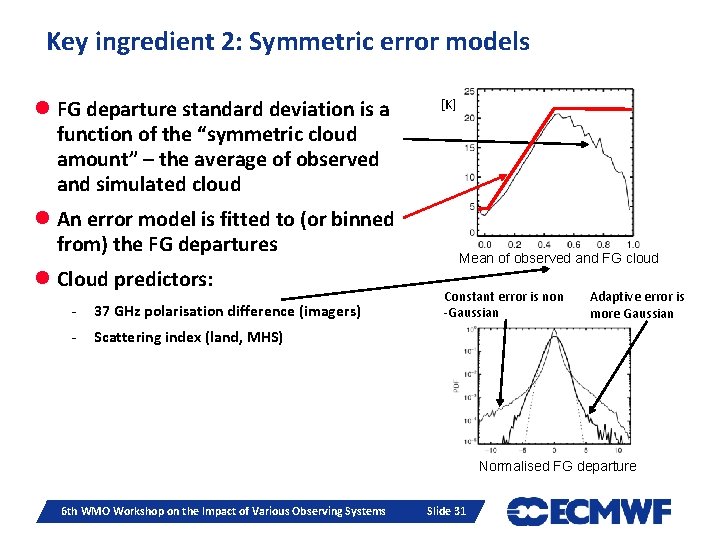
Key ingredient 2: Symmetric error models l FG departure standard deviation is a function of the “symmetric cloud amount” – the average of observed and simulated cloud l An error model is fitted to (or binned from) the FG departures l Cloud predictors: - 37 GHz polarisation difference (imagers) - Scattering index (land, MHS) [K] Mean of observed and FG cloud Constant error is non -Gaussian Adaptive error is more Gaussian Slide 31 Normalised FG departure 6 th WMO Workshop on the Impact of Various Observing Systems Slide 31
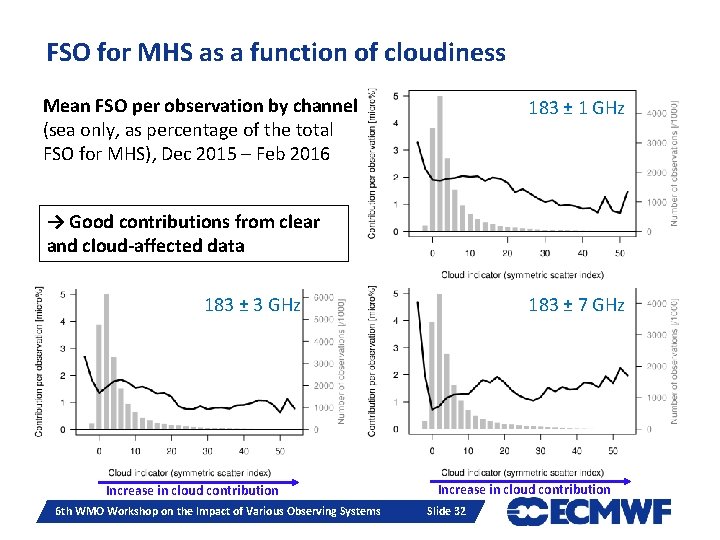
FSO for MHS as a function of cloudiness Mean FSO per observation by channel (sea only, as percentage of the total FSO for MHS), Dec 2015 – Feb 2016 183 ± 1 GHz → Good contributions from clear and cloud-affected data 183 ± 3 GHz 183 ± 7 GHz Slide 32 Increase in cloud contribution 6 th WMO Workshop on the Impact of Various Observing Systems Increase in cloud contribution Slide 32
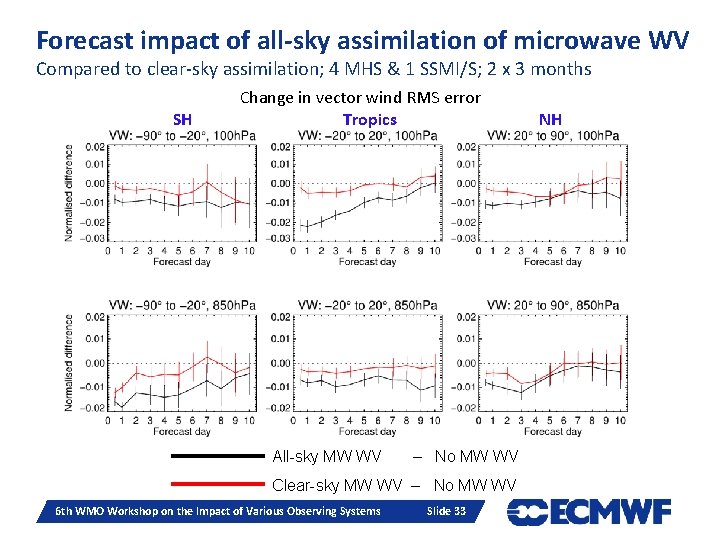
Forecast impact of all-sky assimilation of microwave WV Compared to clear-sky assimilation; 4 MHS & 1 SSMI/S; 2 x 3 months SH Change in vector wind RMS error Tropics Slide 33 All-sky MW WV – No MW WV Clear-sky MW WV – No MW WV 6 th WMO Workshop on the Impact of Various Observing Systems Slide 33 NH
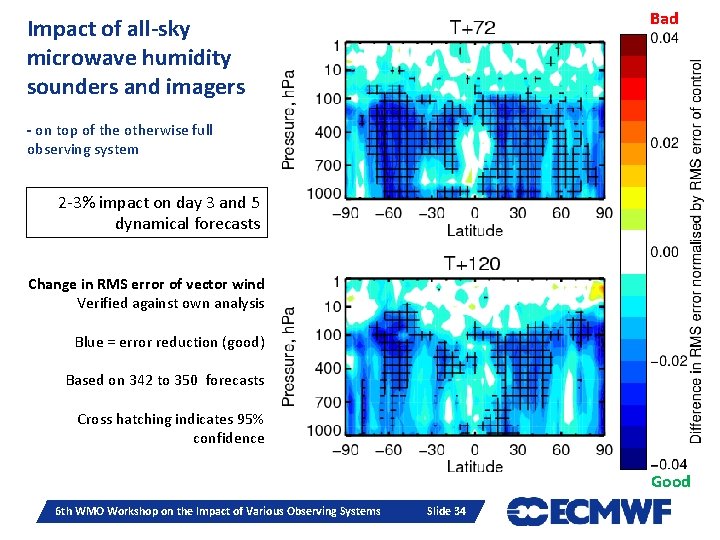
Bad Impact of all-sky microwave humidity sounders and imagers - on top of the otherwise full observing system 2 -3% impact on day 3 and 5 dynamical forecasts Change in RMS error of vector wind Verified against own analysis Blue = error reduction (good) Based on 342 to 350 forecasts Cross hatching indicates 95% confidence Slide 34 Good 6 th WMO Workshop on the Impact of Various Observing Systems Slide 34
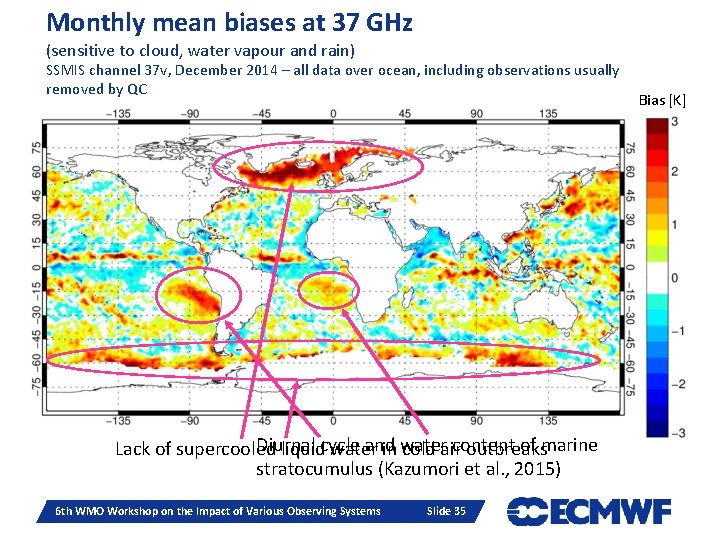
Monthly mean biases at 37 GHz (sensitive to cloud, water vapour and rain) SSMIS channel 37 v, December 2014 – all data over ocean, including observations usually removed by QC Slide 35 Diurnal and of marine Lack of supercooled liquidcycle water in water cold aircontent outbreaks stratocumulus (Kazumori et al. , 2015) 6 th WMO Workshop on the Impact of Various Observing Systems Slide 35 Bias [K]
FSOI ECMWF OPS: 1 November 2015 to 7 March 2016 Slide 36 36
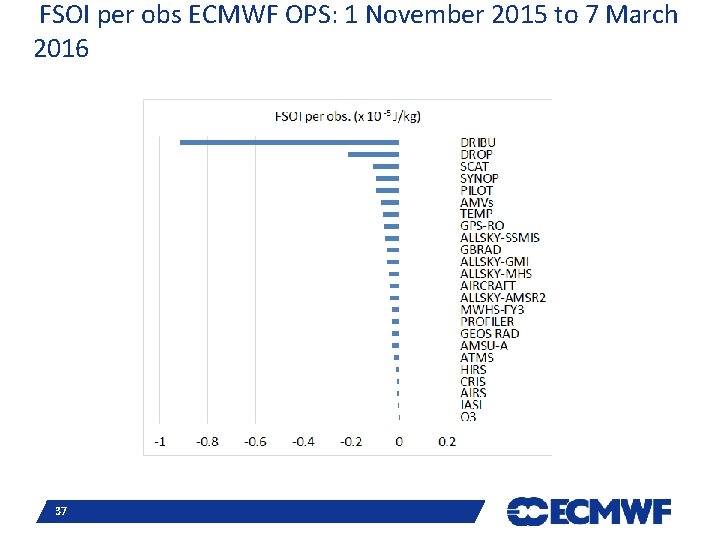
FSOI per obs ECMWF OPS: 1 November 2015 to 7 March 2016 Slide 37 37