
Alloy Designation System Wrought aluminium alloys were Aluminium
- Slides: 37
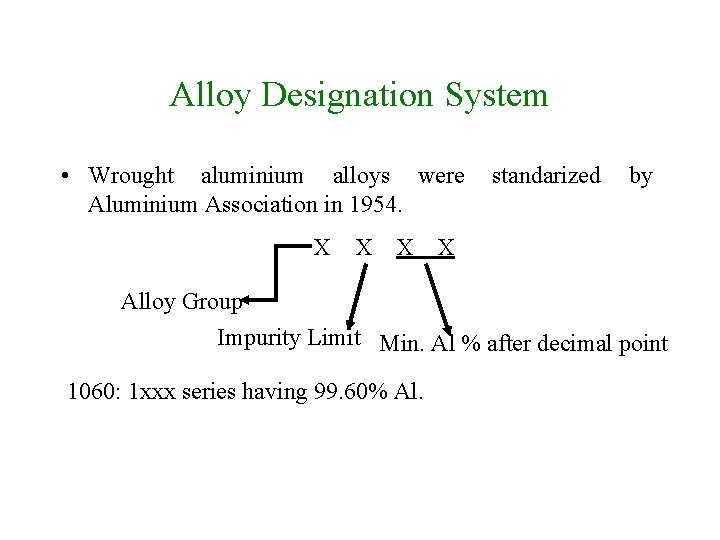
Alloy Designation System • Wrought aluminium alloys were Aluminium Association in 1954. X X X standarized by X Alloy Group Impurity Limit Min. Al % after decimal point 1060: 1 xxx series having 99. 60% Al.
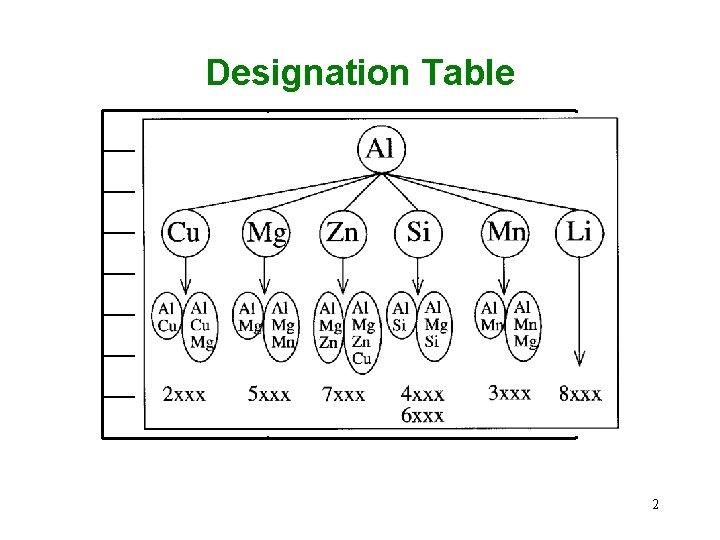
Designation Table 1 xxx Al, more than 99% pure 2 xxx Copper 3 xxx Manganese 4 xxx Silicon 5 xxx Magnesium 6 xxx Magnesium and Silicon 7 xxx Zinc 8 xxx Other elements 2
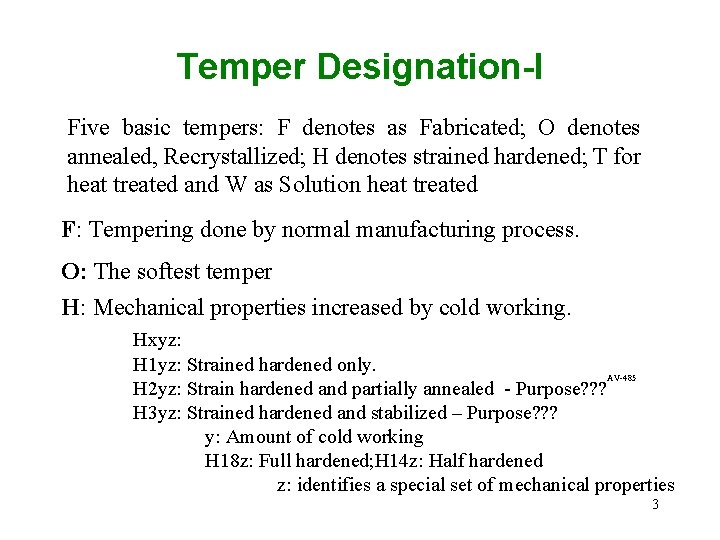
Temper Designation-I Five basic tempers: F denotes as Fabricated; O denotes annealed, Recrystallized; H denotes strained hardened; T for heat treated and W as Solution heat treated F: Tempering done by normal manufacturing process. O: The softest temper H: Mechanical properties increased by cold working. Hxyz: H 1 yz: Strained hardened only. AV-485 H 2 yz: Strain hardened and partially annealed - Purpose? ? ? H 3 yz: Strained hardened and stabilized – Purpose? ? ? y: Amount of cold working H 18 z: Full hardened; H 14 z: Half hardened z: identifies a special set of mechanical properties 3
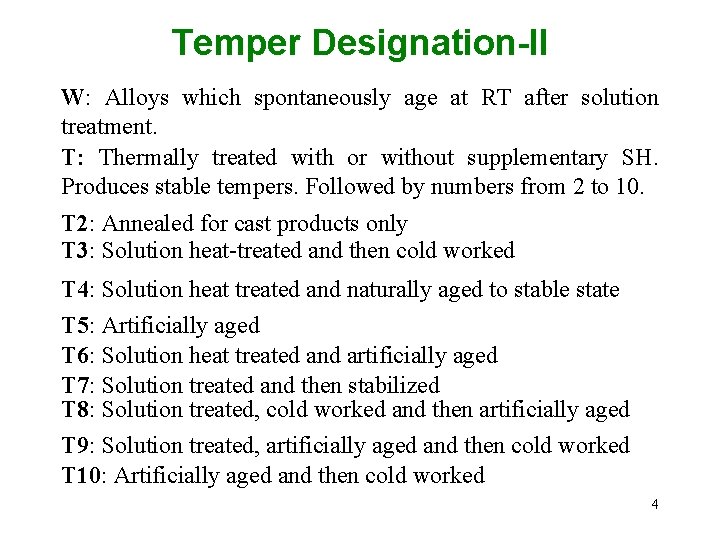
Temper Designation-II W: Alloys which spontaneously age at RT after solution treatment. T: Thermally treated with or without supplementary SH. Produces stable tempers. Followed by numbers from 2 to 10. T 2: Annealed for cast products only T 3: Solution heat-treated and then cold worked T 4: Solution heat treated and naturally aged to stable state T 5: Artificially aged T 6: Solution heat treated and artificially aged T 7: Solution treated and then stabilized T 8: Solution treated, cold worked and then artificially aged T 9: Solution treated, artificially aged and then cold worked T 10: Artificially aged and then cold worked 4
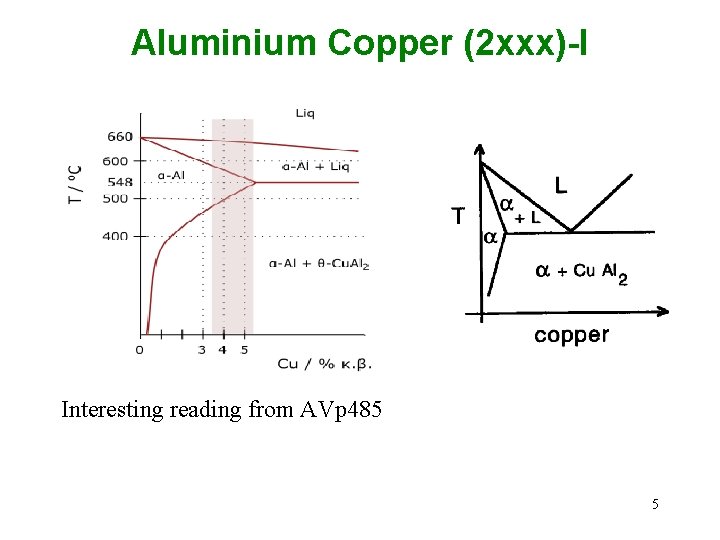
Aluminium Copper (2 xxx)-I Interesting reading from AVp 485 5
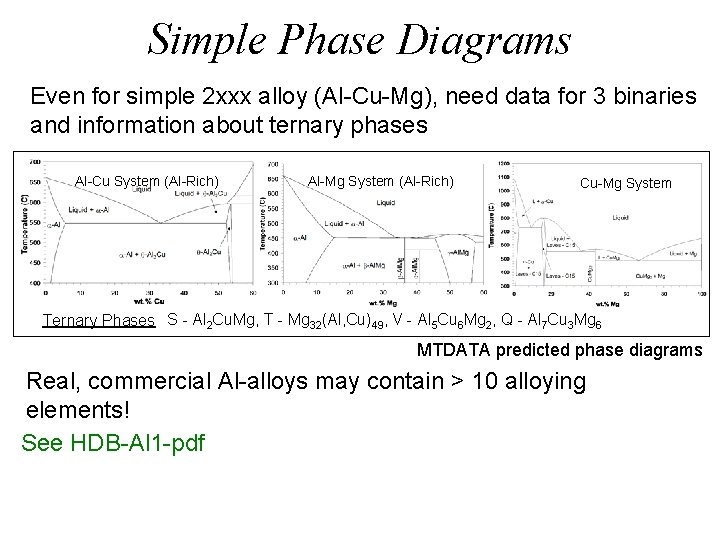
Simple Phase Diagrams Even for simple 2 xxx alloy (Al-Cu-Mg), need data for 3 binaries and information about ternary phases Al-Cu System (Al-Rich) Al-Mg System (Al-Rich) Cu-Mg System Ternary Phases S - Al 2 Cu. Mg, T - Mg 32(Al, Cu)49, V - Al 5 Cu 6 Mg 2, Q - Al 7 Cu 3 Mg 6 MTDATA predicted phase diagrams Real, commercial Al-alloys may contain > 10 alloying elements! See HDB-Al 1 -pdf
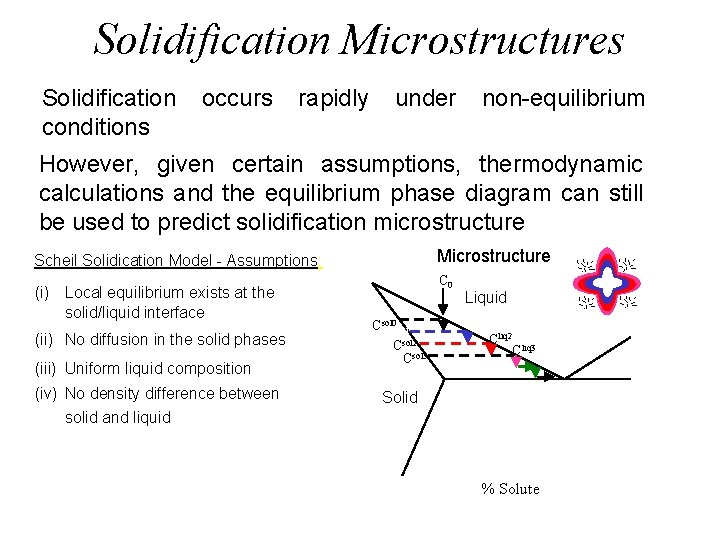
Solidification Microstructures Solidification conditions occurs rapidly under non-equilibrium However, given certain assumptions, thermodynamic calculations and the equilibrium phase diagram can still be used to predict solidification microstructure Microstructure Scheil Solidication Model - Assumptions: (i) Local equilibrium exists at the solid/liquid interface (ii) No diffusion in the solid phases (iii) Uniform liquid composition (iv) No density difference between solid and liquid C 0 Csol 0 sol 1 C Csol 2 Csol 3 T Liquid Cliq 1 Cliq 2 Cliq 3 Solid % Solute
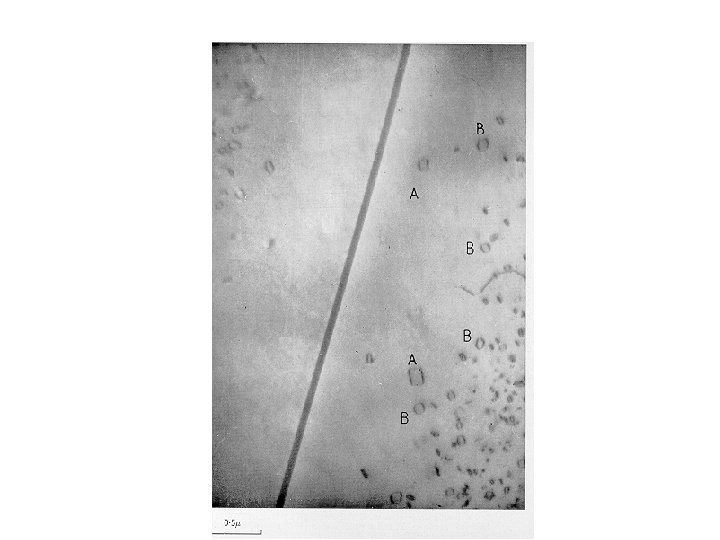
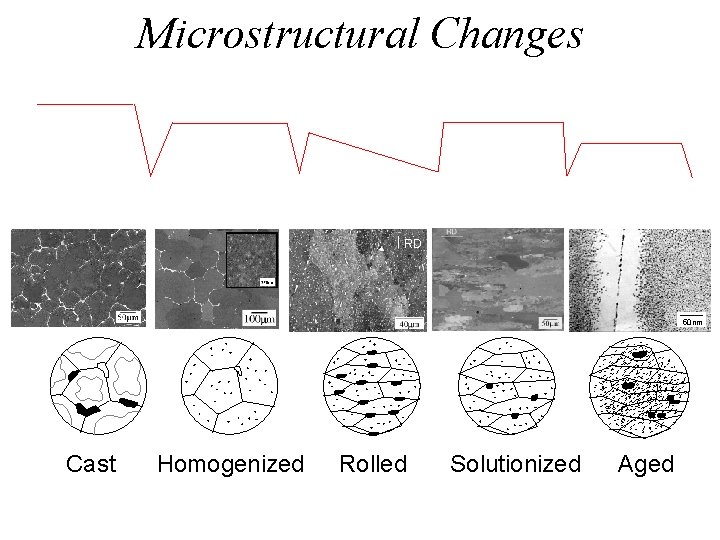
Temperature Microstructural Changes Time RD 50 nm Cast Homogenized Rolled Solutionized Aged
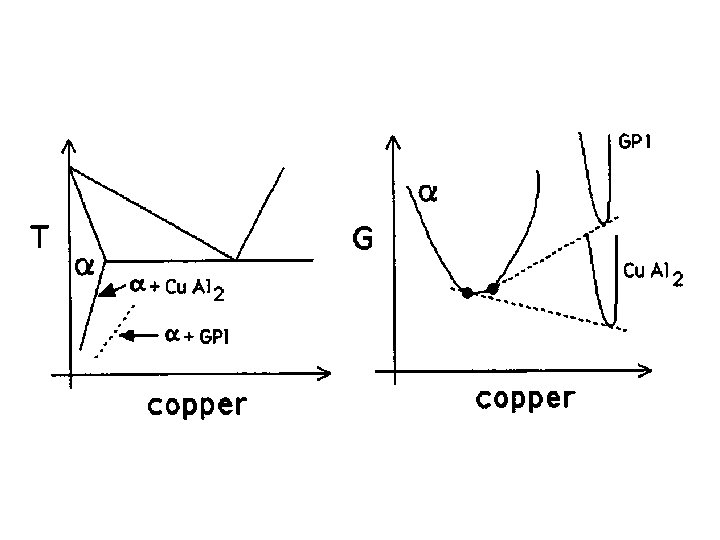
Aluminium Copper (2 xxx)-II Duralumin -2017 oldest of all heat-treatable aluminium alloys having 4% Cu. Widely used for aircraft construction. NA alloy – has to be refrigerated after solution treatment – Good formability in the solution treated condition – subsequent precipitation increases the strength and hardness. 2014 has higher Cu and Mn content and susceptible to artificial ageing. In artificially aged condition 2014 has higher YS, TS but lower elongation than 2017. 2024 with 4. 5%Cu and 1. 5% Mg highest strength of any NA 2 xxx series. Mainly used for aircraft structures, rivets, hardware, truck wheels and screw machine products. 13
Aluminium Copper (2 xxx)-III Adding of Mg reduces the formability and makes it more difficult to fabricate. Increase of silicon in cast alloy increases the fluidity and hence thin sectioned castings are made with ease. 14
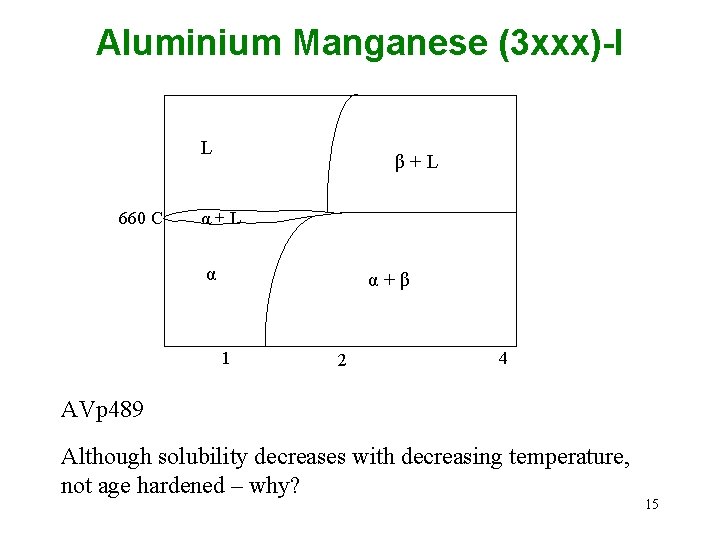
Aluminium Manganese (3 xxx)-I L 660 C β+L α α+β 1 2 4 AVp 489 Although solubility decreases with decreasing temperature, not age hardened – why? 15
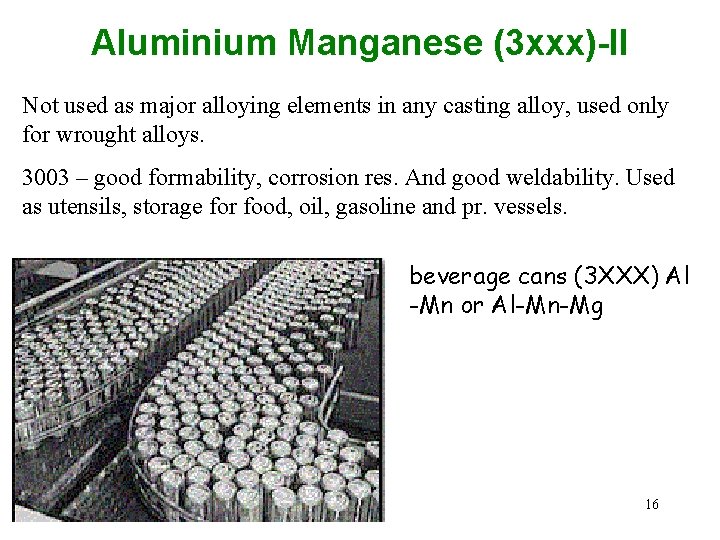
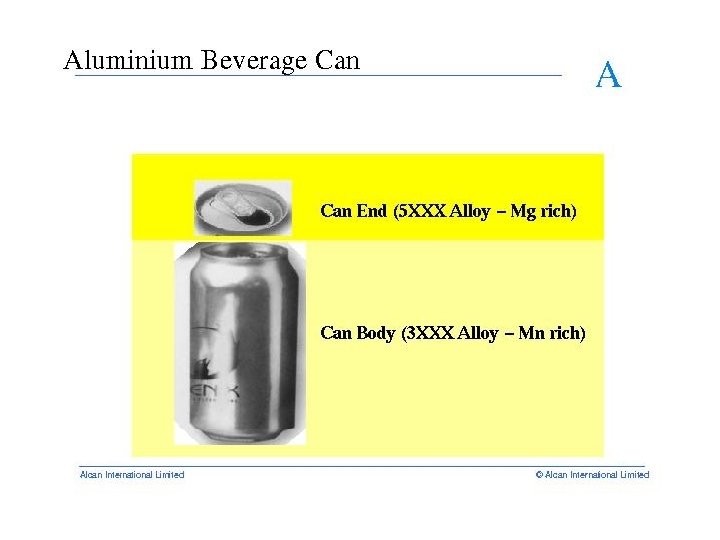
Aluminium Manganese (3 xxx)-II Not used as major alloying elements in any casting alloy, used only for wrought alloys. 3003 – good formability, corrosion res. And good weldability. Used as utensils, storage for food, oil, gasoline and pr. vessels. beverage cans (3 XXX) Al -Mn or Al-Mn-Mg 16
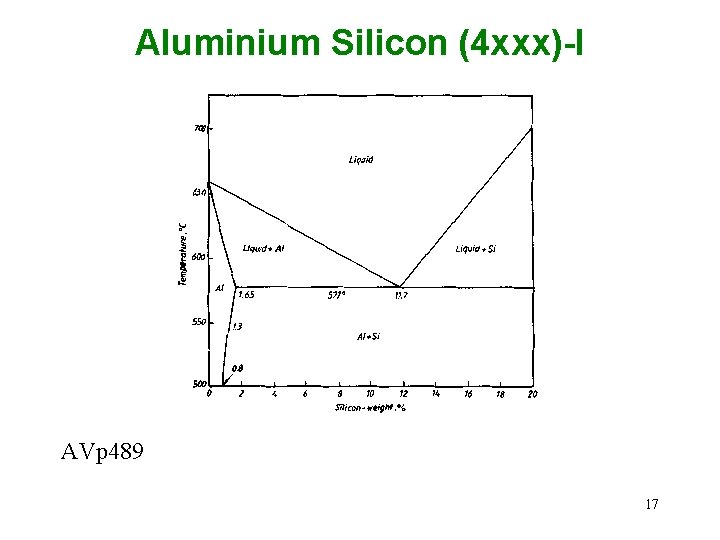
Aluminium Silicon (4 xxx)-I AVp 489 17
Aluminium Silicon (4 xxx)-II Have excellent castability and resistance to corrosion. Typical use for intricate casting and marine fittings. 4032 containing 12. 5% Si used for automotive pistons owing to its low coeff. of thermal expansion and good forgeability. 18
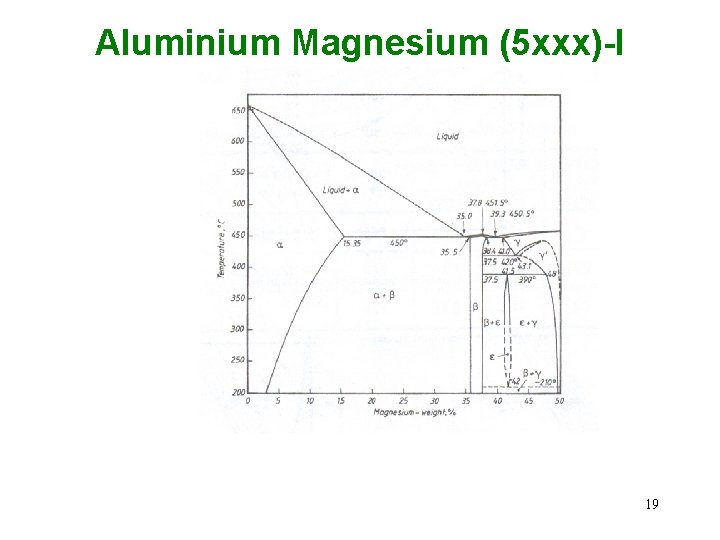
Aluminium Magnesium (5 xxx)-I 19
Aluminium Magnesium (5 xxx)-II Good weldability, Corrosion resistance and moderate strength. 5005 (0. 8%Mg): architectural extrusions; 5050 (1. 2% Mg): automotive gas and oil lines; 5052 (2. 5% Mg): aircraft fuel and gas lines 5083 (4. 5% Mg): marine and welded structural applications 20
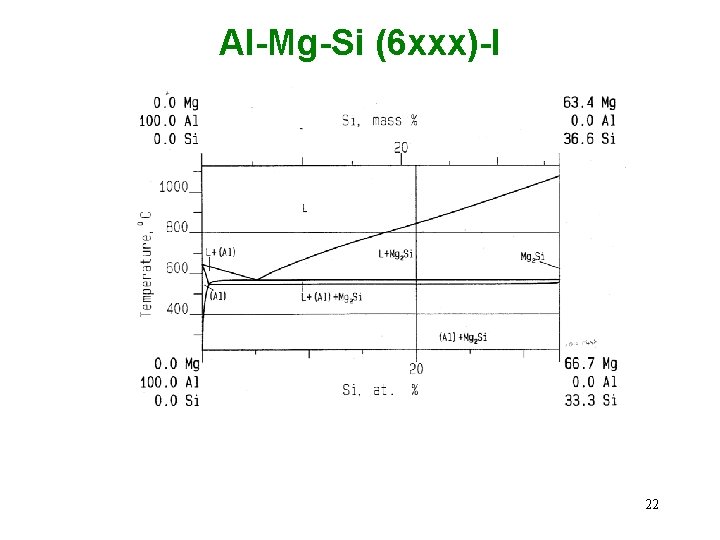
Al-Mg-Si (6 xxx)-I 22
Al-Mg-Si (6 xxx)-II More workable than other heat treatable alloys. Excellent corrosion resistance. Automobile body, furniture, vacuum cleaner turbine and architectural applications. 23
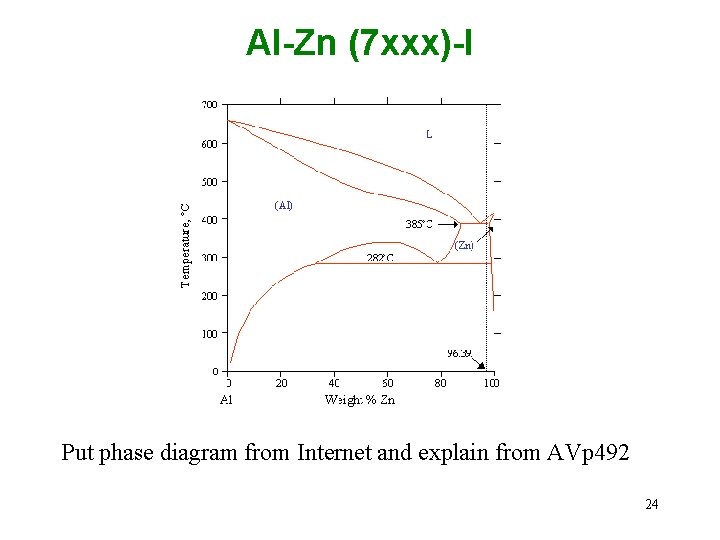
Al-Zn (7 xxx)-I Put phase diagram from Internet and explain from AVp 492 24
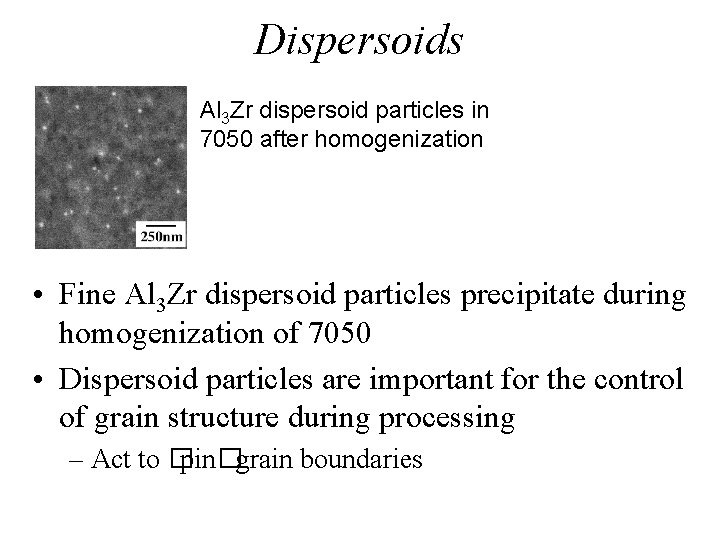
Dispersoids Al 3 Zr dispersoid particles in 7050 after homogenization • Fine Al 3 Zr dispersoid particles precipitate during homogenization of 7050 • Dispersoid particles are important for the control of grain structure during processing – Act to � pin�grain boundaries
Al-Zn (7 xxx)-II 7075 and 7079 produce highest tensile strength obtainable in aluminium alloys. Used where high strength and good corr. res is required. Aircraft structural parts. 26
Some Issues • • Automotive Applications Corrosion Resistance Precipitation Hardening Strain Hardening
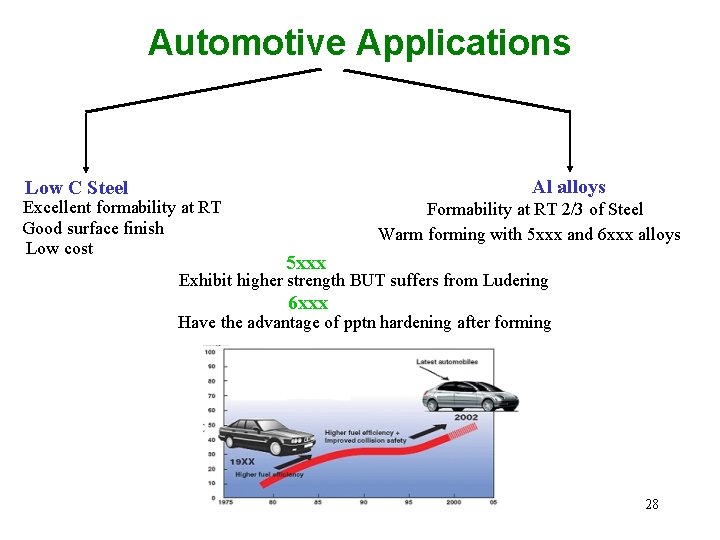
Automotive Applications Al alloys Low C Steel Excellent formability at RT Good surface finish Low cost Formability at RT 2/3 of Steel Warm forming with 5 xxx and 6 xxx alloys 5 xxx Exhibit higher strength BUT suffers from Ludering 6 xxx Have the advantage of pptn hardening after forming 28
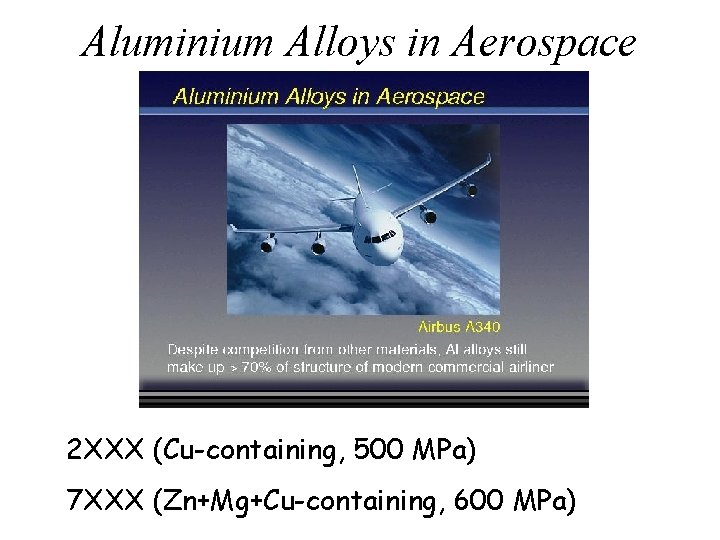
Aluminium Alloys in Aerospace 2 XXX (Cu-containing, 500 MPa) 7 XXX (Zn+Mg+Cu-containing, 600 MPa)
Design Requirements • Components must be – Lightweight – Damage tolerant – Durable (corrosion resistant) – Cost effective • Requires careful balance of material properties
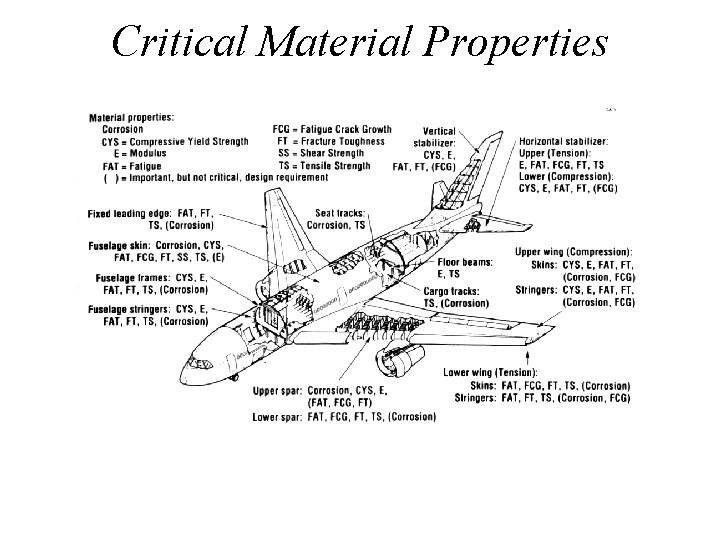
Critical Material Properties
Aluminium Alloys • Pure aluminium has – Low density (rrelative Al=2. 7, Fe=7. 9) – Readily available (Al is 3 rd most abundant element in Earth's crust) – Highly formable (FCC crystal structure) – Low strength and stiffness (EAl=70 GPa, EFe=211 GPa) – Low melting point (Tm=660 o. C) • Alloy with other elements to improve strength and stiffness - results in alloys with properties well matched to aerospace requirements
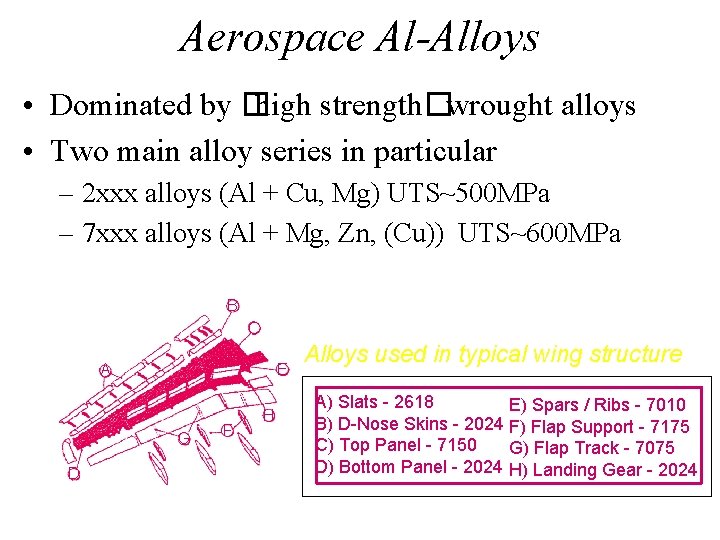
Aerospace Al-Alloys • Dominated by � high strength�wrought alloys • Two main alloy series in particular – 2 xxx alloys (Al + Cu, Mg) UTS~500 MPa – 7 xxx alloys (Al + Mg, Zn, (Cu)) UTS~600 MPa B C E A G D F H Alloys used in typical wing structure A) Slats - 2618 E) Spars / Ribs - 7010 B) D-Nose Skins - 2024 F) Flap Support - 7175 C) Top Panel - 7150 G) Flap Track - 7075 D) Bottom Panel - 2024 H) Landing Gear - 2024
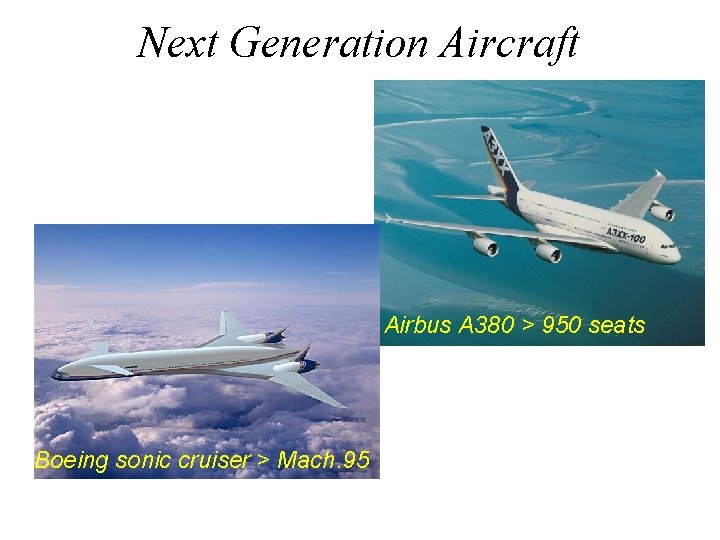
Next Generation Aircraft Bigger. . Airbus A 380 > 950 seats Boeing sonic cruiser > Mach. 95 . . . Faster
Goals • Next generation aircraft rely on advances in materials and assembly methods • Weight reduction is critical – Alloy optimization • Increase strength and stiffness and/or reduce density whilst maintaining other properties – Assembly optimization • Reduce weight associated with joints between components
Alloy Design • Traditionally, alloy and process development largely by trial and error based on metallurgical experience • Recently, emphasis has changed to designing alloys and processes to meet specific property goals – Improved understanding of relationships between processing, microstructure and properties – Development of models to predict alloy microstructure and performance
Questions 1. 2. 3. 4. 5. 6. 7. 8. 9. 10. Discuss how micro alloying influences the precipitation reactions in aluminium alloys? Polmear P 49. Principle of formation of PFZ and its role in controlling mechanical properties Dislocation precipitate interaction and its effect on strength and work hardening Notes on Non-Heat treatable Aluminium Alloys. Polmear 130 Notes on 2 XXX alloys – consider both cast and wrought Notes on 6 xxx alloys - consider both cast and wrought Alloy design and properties for Aircraft alloys Alloy design and properties for Automotive sheets and structural alloys Alloy design and properties for Shipping Alloy design and properties for Superplastic alloys