
Allotropes of carbon In the element carbon atoms
Allotropes of carbon In the element carbon, atoms bond in different ways, creating different kinds of giant structures. Two of these structures are diamond and graphite. They are called allotropes of carbon. Allotropes have the same chemical properties because they have the same number of electrons. However, they have different physical properties because the electrons are shared in different ways with other atoms.
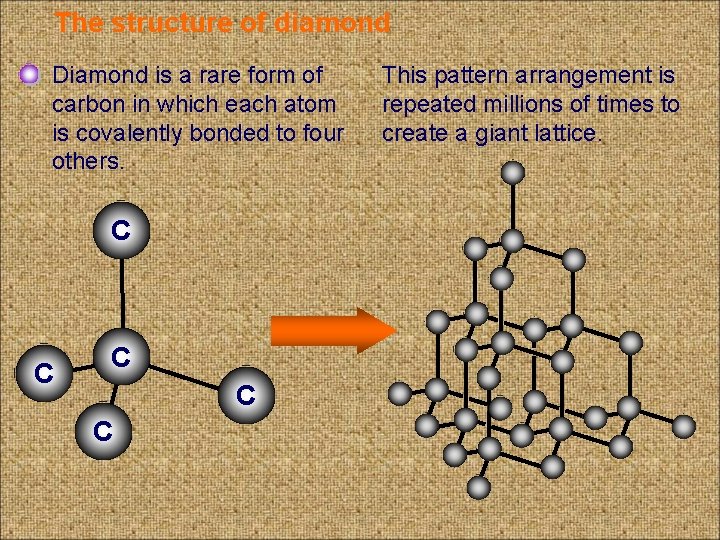
The structure of diamond Diamond is a rare form of carbon in which each atom is covalently bonded to four others. C C C This pattern arrangement is repeated millions of times to create a giant lattice.
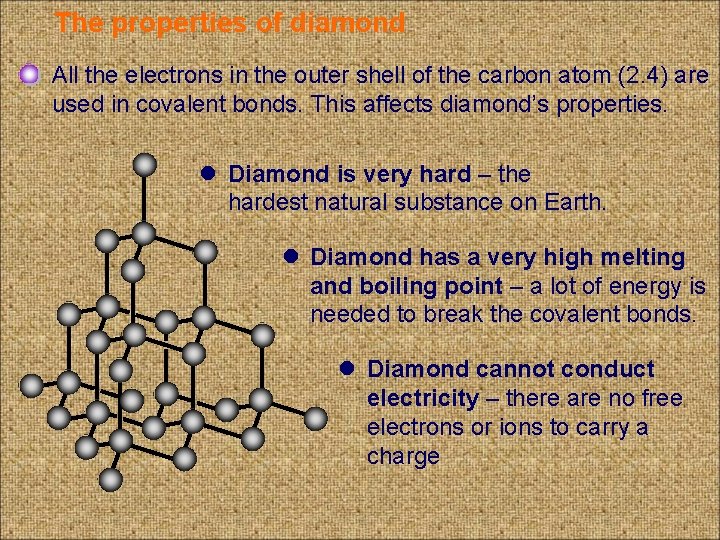
The properties of diamond All the electrons in the outer shell of the carbon atom (2. 4) are used in covalent bonds. This affects diamond’s properties. l Diamond is very hard – the hardest natural substance on Earth. l Diamond has a very high melting and boiling point – a lot of energy is needed to break the covalent bonds. l Diamond cannot conduct electricity – there are no free electrons or ions to carry a charge
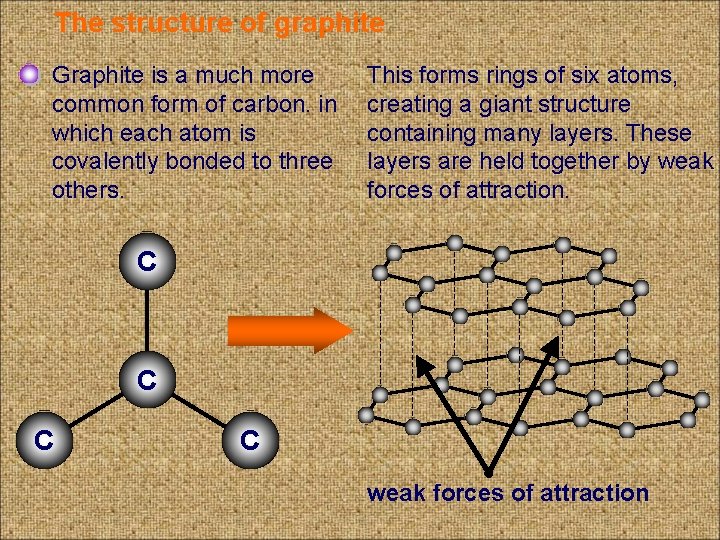
The structure of graphite Graphite is a much more common form of carbon. in which each atom is covalently bonded to three others. This forms rings of six atoms, creating a giant structure containing many layers. These layers are held together by weak forces of attraction. C C weak forces of attraction
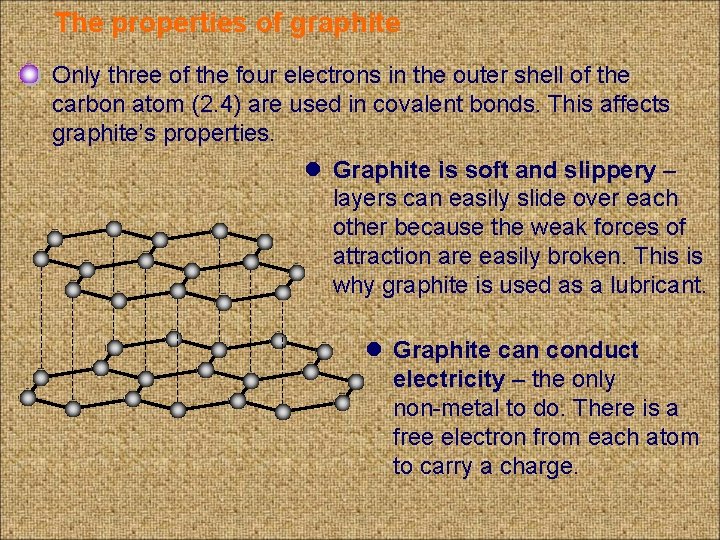
The properties of graphite Only three of the four electrons in the outer shell of the carbon atom (2. 4) are used in covalent bonds. This affects graphite’s properties. l Graphite is soft and slippery – layers can easily slide over each other because the weak forces of attraction are easily broken. This is why graphite is used as a lubricant. l Graphite can conduct electricity – the only non-metal to do. There is a free electron from each atom to carry a charge.
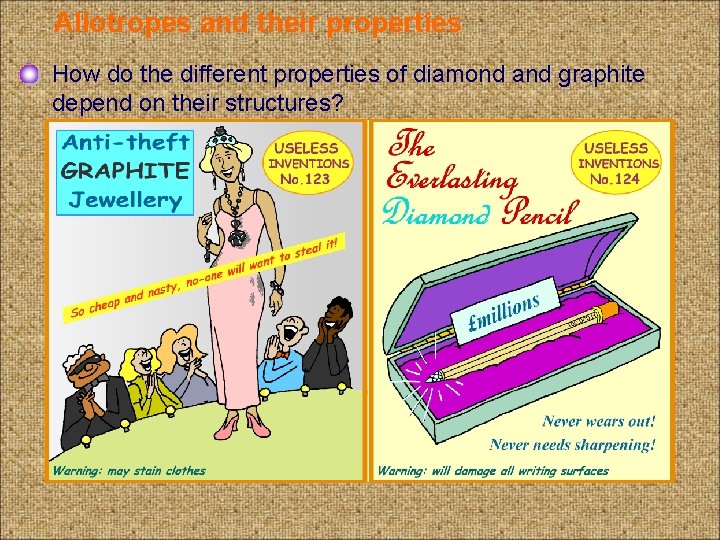
Allotropes and their properties How do the different properties of diamond and graphite depend on their structures?
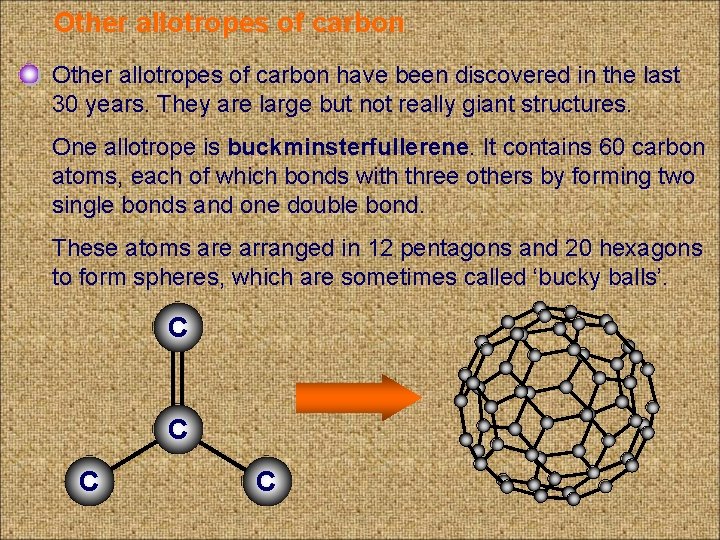
Other allotropes of carbon have been discovered in the last 30 years. They are large but not really giant structures. One allotrope is buckminsterfullerene. It contains 60 carbon atoms, each of which bonds with three others by forming two single bonds and one double bond. These atoms are arranged in 12 pentagons and 20 hexagons to form spheres, which are sometimes called ‘bucky balls’. C C
- Slides: 7