
ALLOSTERIC EFFECTS OF HAEMOGLOBIN 2 DR Aqsa Malik

ALLOSTERIC EFFECTS OF HAEMOGLOBIN 2 �DR Aqsa Malik � Assistant professor �Biochemistry
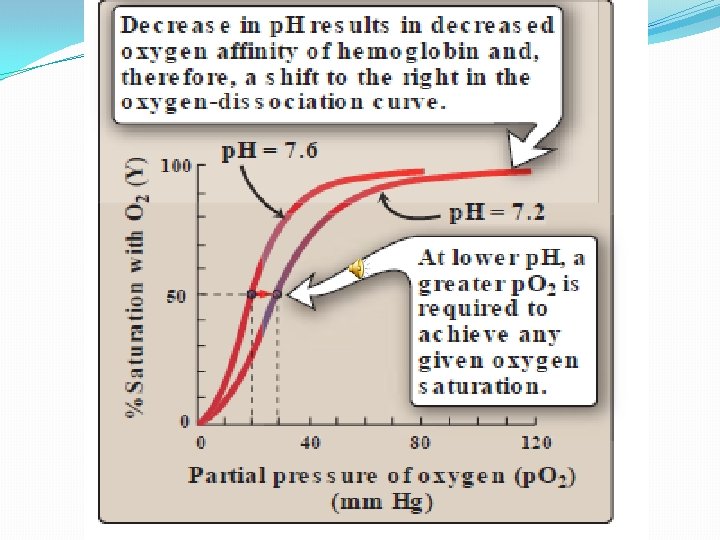
2. Bohr Effect: �When CO 2 is released into the blood from the tissues it acidifies the blood by increasing the concentration of hydrogen ions. �This lowering in p. H causes the oxygen affinity of the hemoglobin to decrease, which is known as the Bohr effect.
�The molecular basis behind the Bohr effect is that the T structure of hemoglobin binds hydrogen more readily than the R structure, so under a condition of low p. H (high hydrogen ion concentration) the T structure, which has a decreased oxygen affinity, dominates.

Mechanism of Bohr effect: �Bohr effect is because of the ionizable groups of histidine side chain. �When the conc of ions increase these groups are charged and are able to form ionic bonds. These bonds stabilize the T form and so the affinity for oxygen decreases. �Bohr effect causes the shift to the right in the oxygen dissociation curve.
Sources of Protons: a. Hydrogen ions and CO 2 are more in the metabolically active tissues. b. Organic acids produced during anaerobic metabolism ( role of carbonic anhydrase).
3. 2, 3 – Bisphoglycerate : � 2, 3 - bisphoglycerate is an allosteric effector that changes the oxygen affinity of hemoglobin by binding to the hemoglobin itself.
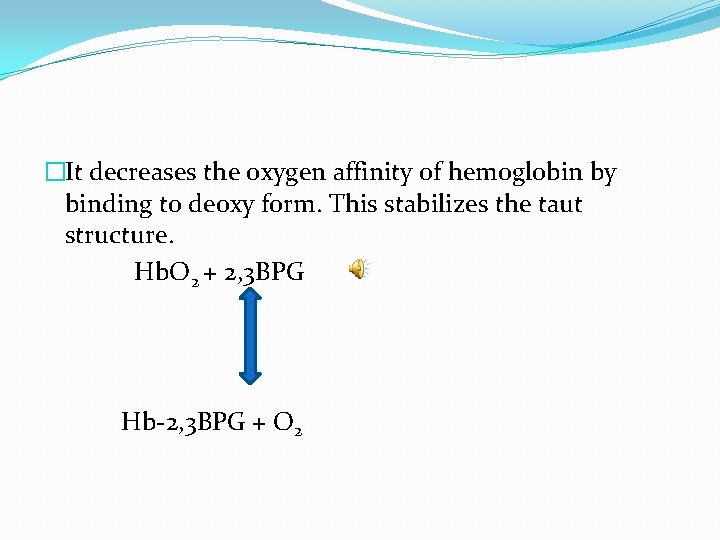
�It decreases the oxygen affinity of hemoglobin by binding to deoxy form. This stabilizes the taut structure. Hb. O 2 + 2, 3 BPG Hb-2, 3 BPG + O 2
� 2, 3 BPG binds to a pocket formed by two beta- globin chains in the center of the tetramer. �Pocket has got positively charged amino acids that forms ionic bonds with 2, 3 BPG. �When O 2 binds then 2, 3 BPG is expelled. � 2, 3 BPG causes the shift to the right in the oxygen dissociation curve.
� 2, 3 BPG levels are increased in chronic hypoxia (high altitudes, COPD) and chronic anemia. � 2, 3 BPG absent in fetal Hb. �Role in transfused blood (acid citrate dextrose). � 2, 3 BPG is essential for the normal transport function of Hb. Storing of blood in acid citrate medium decreases 2, 3 BPG and the affinity of Hb for oxygen increases.
�Fetal Hb has got a gamma globin chain, this has got less positive charge so does not bind 2, 3 BPG. �This allows the Hb. F to facilitate the transfer of oxygen from the maternal blood to the fetal blood.
4. Binding of CO 2 : �CO 2 has a similar effect on the hemoglobin, but instead of binding to the heme molecule like oxygen, CO 2 binds to the N-terminus of the alpha globin molecule.
�The CO 2 binds better to the globin in the T structure, so the release of oxygen in the tissues by the T structure of hemoglobin facilitates the uptake of CO 2. �CO 2 is mostly transported in the form of bicarbonate. �Some is transported by Hb. It is called carbamino hemoglobin or carbamate, because it is attached to the uncharged α -amino groups.
Ligand binding �Besides the oxygen ligand which binds to hemoglobin in a cooperative manner, hemoglobin ligands also include competitive inhibitors such as carbon monoxide (CO) and allosteric ligands such as carbon dioxide (CO 2).
Competitive �Hemoglobin's oxygen-binding capacity is decreased in the presence of carbon monoxide because both gases compete for the same binding sites on hemoglobin, carbon monoxide binding preferentially in place of oxygen. �The binding of oxygen is affected by molecules such as carbon monoxide (CO) (for example from tobacco smoking, car exhaust and incomplete combustion in furnaces). CO competes with oxygen at the heme binding site.
�Hemoglobin binding affinity for CO is 200 times greater than its affinity for oxygen, meaning that small amounts of CO dramatically reduce hemoglobin's ability to transport oxygen. �When hemoglobin combines with CO, it forms a very bright red compound called carboxyhemoglobin, which may cause the skin of CO poisoning victims to appear pink in death, instead of white or blue.
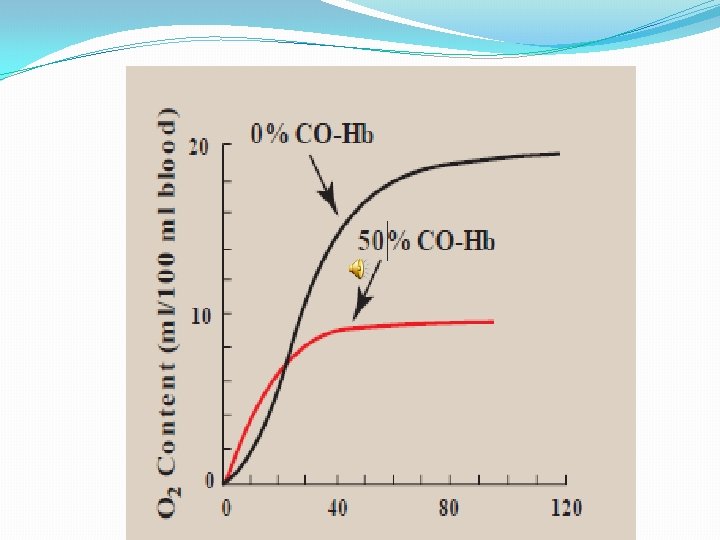
�When inspired air contains CO levels as low as 0. 02%, headache and nausea occur; if the CO concentration is increased to 0. 1%, unconsciousness will follow. In heavy smokers, up to 20% of the oxygen-active sites can be blocked by CO.
�In similar fashion, hemoglobin also has competitive binding affinity for cyanide(CN-), sulfur monoxide (SO), nitrogen dioxide(NO 2), and sulfide(S 2 -), including hydrogen sulfide (H 2 S). All of these bind to iron in heme without changing its oxidation state, but they nevertheless inhibit oxygen-binding, causing grave toxicity.
Allosteric �Carbon dioxide occupies a different binding site on the hemoglobin. Carbon dioxide is more readily dissolved in deoxygenated blood, facilitating its removal from the body after the oxygen has been released to tissues undergoing metabolism. This increased affinity for carbon dioxide by the venous blood is known as the Haldane effect.

- Slides: 22