
Allometric equations and Growth Functions Margarida Tom Susana
- Slides: 64
Allometric equations and Growth Functions Margarida Tomé, Susana Barreiro Instituto Superior de Agronomia Universidade de Lisboa
Outline Allometric relationships/equations Growth functions Theoretical growth functions Lundqvist-Korf type functions Richards type functions Hossfeld IV function • Mc. Dill-Amateis function Simultaneous modeling of several individuals (trees or stands) Formulating growth functions without age explicit
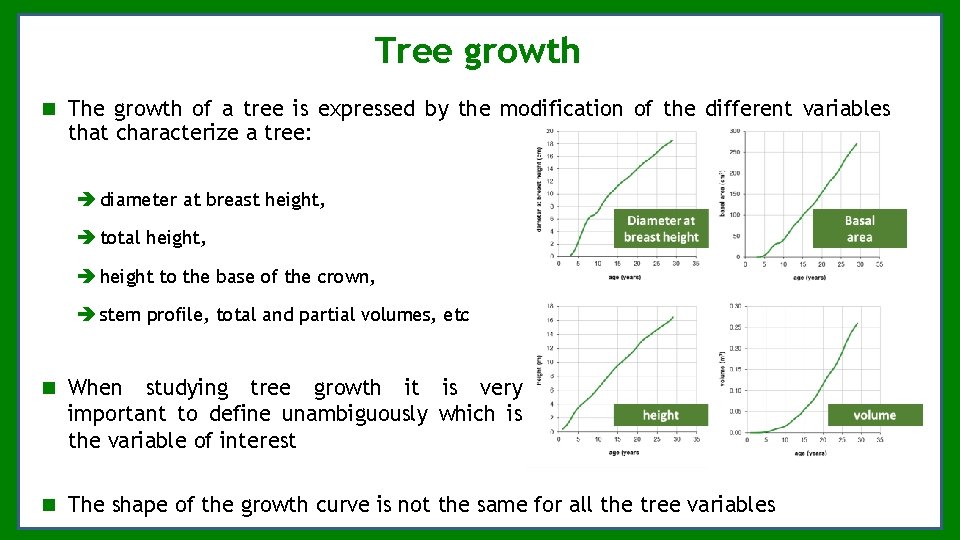
Tree growth The growth of a tree is expressed by the modification of the different variables that characterize a tree: diameter at breast height, total height, height to the base of the crown, stem profile, total and partial volumes, etc When studying tree growth it is very important to define unambiguously which is the variable of interest The shape of the growth curve is not the same for all the tree variables
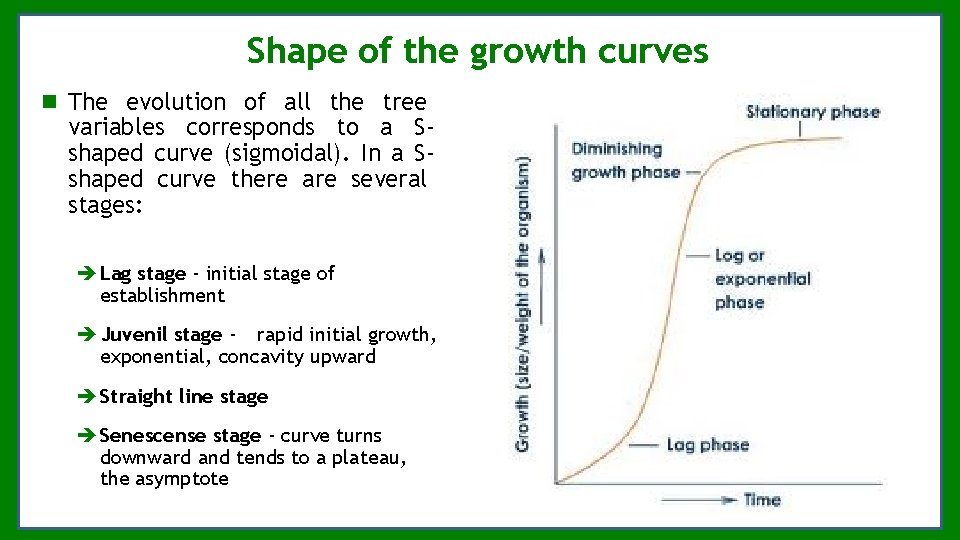
Shape of the growth curves The evolution of all the tree variables corresponds to a Sshaped curve (sigmoidal). In a Sshaped curve there are several stages: Lag stage - initial stage of establishment Juvenil stage - rapid initial growth, exponential, concavity upward Straight line stage Senescense stage - curve turns downward and tends to a plateau, the asymptote
Allometric relationships/equations
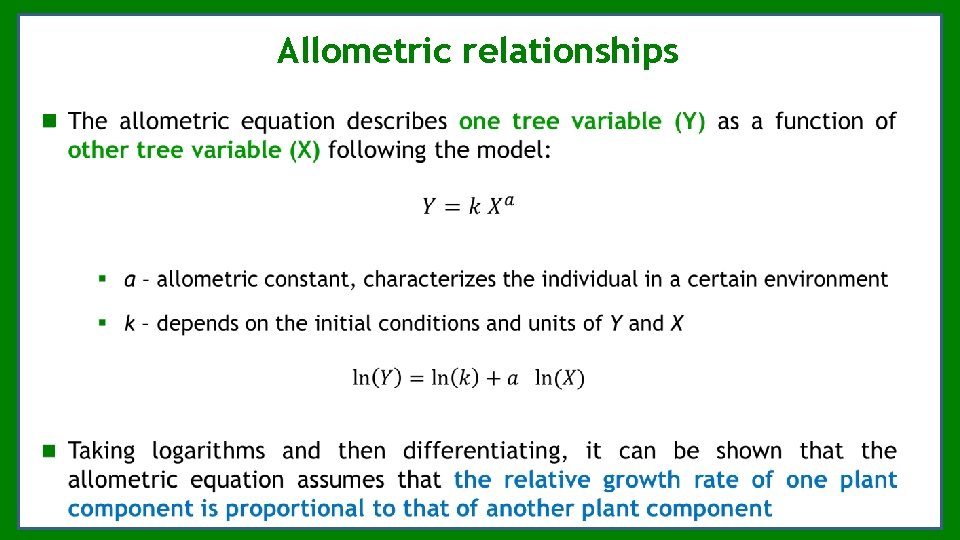
Allometric relationships
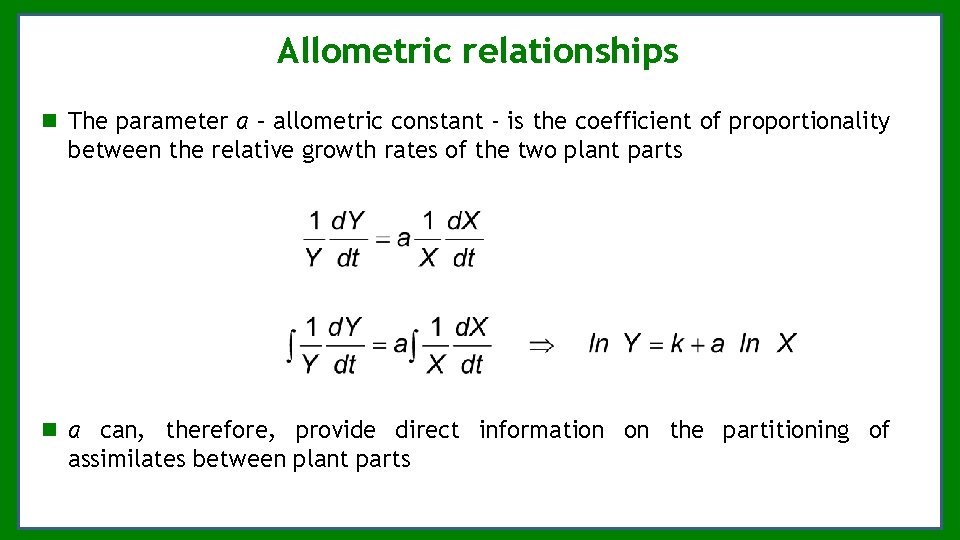
Allometric relationships The parameter a – allometric constant - is the coefficient of proportionality between the relative growth rates of the two plant parts a can, therefore, provide direct information on the partitioning of assimilates between plant parts
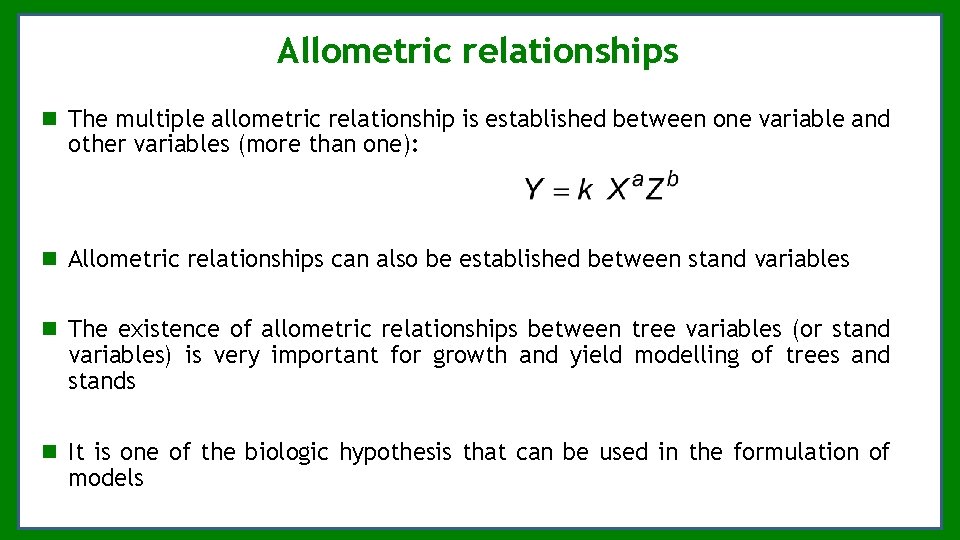
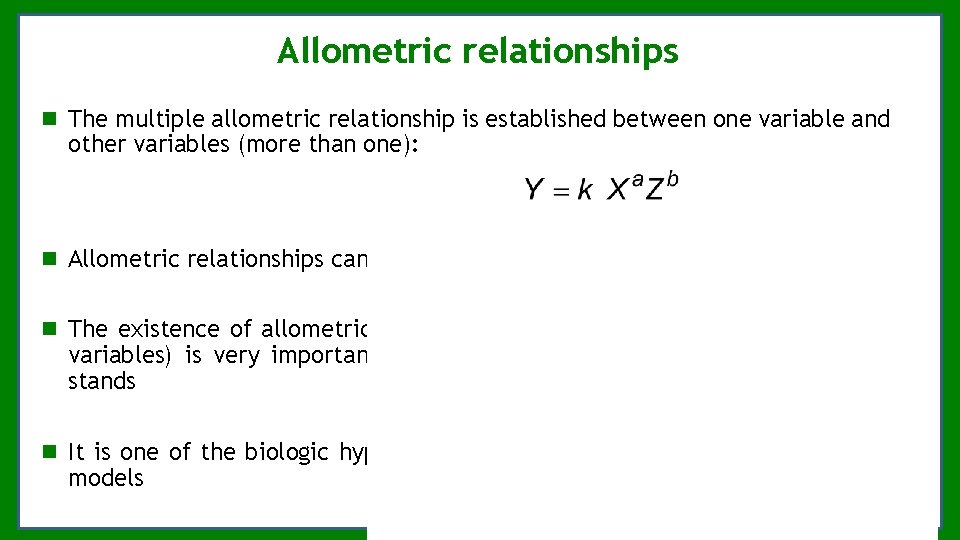
Allometric relationships The multiple allometric relationship is established between one variable and other variables (more than one): Allometric relationships can also be established between stand variables The existence of allometric relationships between tree variables (or stand variables) is very important for growth and yield modelling of trees and stands It is one of the biologic hypothesis that can be used in the formulation of models
Allometric relationships The multiple allometric relationship is established between one variable and other variables (more than one): Allometric relationships can also be established between stand variables The existence of allometric relationships between tree variables (or stand variables) is very important for growth and yield modelling of trees and stands It is one of the biologic hypothesis that can be used in the formulation of models
Allometric relationships Sustainable forest management has increased the need for reliable allometric equations to estimate tree and shrub biomass. Much effort has been placed on developing equations to estimate the weight, rather than the volume, of the commercial portion of tree stems Increasing interest in: quantifying branches and foliage predicting fuel loads and potential fire behavior quantifying carbon cycles and storage Weight estimates are more easily obtained than volume
Growth functions
Growth and Yield relationships Yield total amount available at a given time, yield can be regarded as the summation of the annual increments Growth the increase (increment) over a given period of time
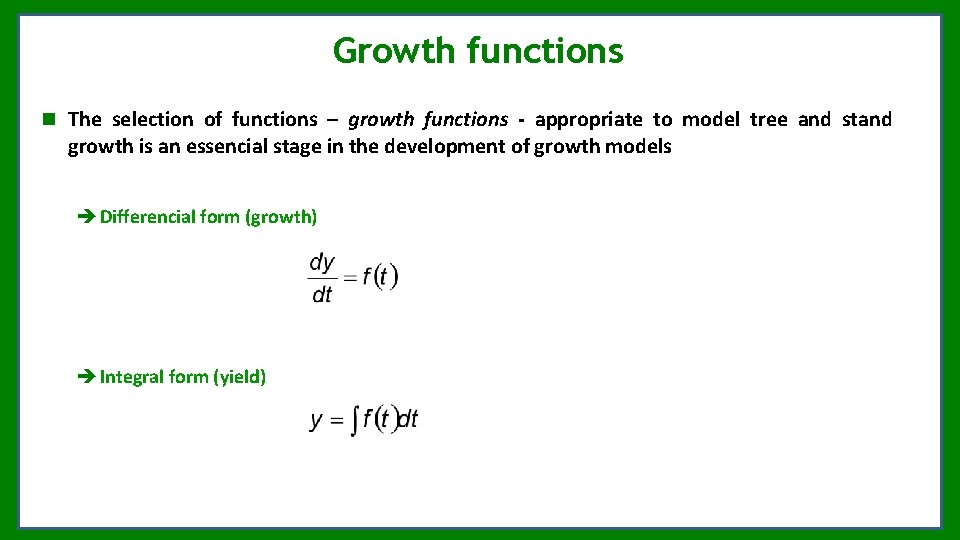
Growth functions The selection of functions – growth functions - appropriate to model tree and stand growth is an essencial stage in the development of growth models Differencial form (growth) Integral form (yield)
Growth functions must have a shape that is in accordance with the principles of biological growth: The curve is limited by yield 0 at the start (t=0 ou t=t 0) and by a maximum yield at an advanced age (existence of assymptote) The relative growth rate (variation of the x variable per unit of time and unit of x) presents a maximum at a very early stage, decreasing afterwards; in most cases, the maximum occurs very early so that we can use decreasing functions to model relative growth rate The slope of the curve increases in the initial stage and decreases after a certain point in time (existence of an inflection point)
Growth functions Two types of functions have been used to model growth: Empirical growth functions • Relationship between the dependent variable – the one we want to model – and the regressors according to some mathematical function – e. g. linear, parabolic, without trying to identify the causes or explaining the phenomenon Functional or theoretical growth functions • Conceived in terms of the mechanism of forest growth, usually having an underlying hypothesis associated with the principles of forest growth
Theoretical growth functions have commonly been developed in their growth form – either absolute or relative growth – and the respective yield form has been obtained by integration Generally this approach allows interpretation of the function parameters and helps to impose restrictions on the values that the parameters can take to be biologically consistent Theoretical growth functions are grouped according to their functional form in: Lundqvist-Korf type Richards type Hossfeld IV type Other growth functions
§Theoretical growth functions
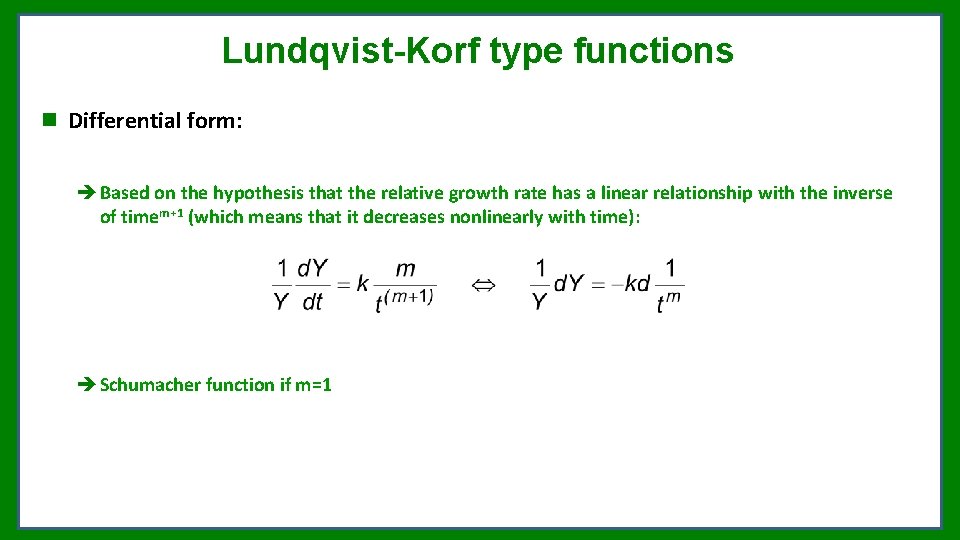
Lundqvist-Korf type functions Differential form: Based on the hypothesis that the relative growth rate has a linear relationship with the inverse of timem+1 (which means that it decreases nonlinearly with time): Schumacher function if m=1
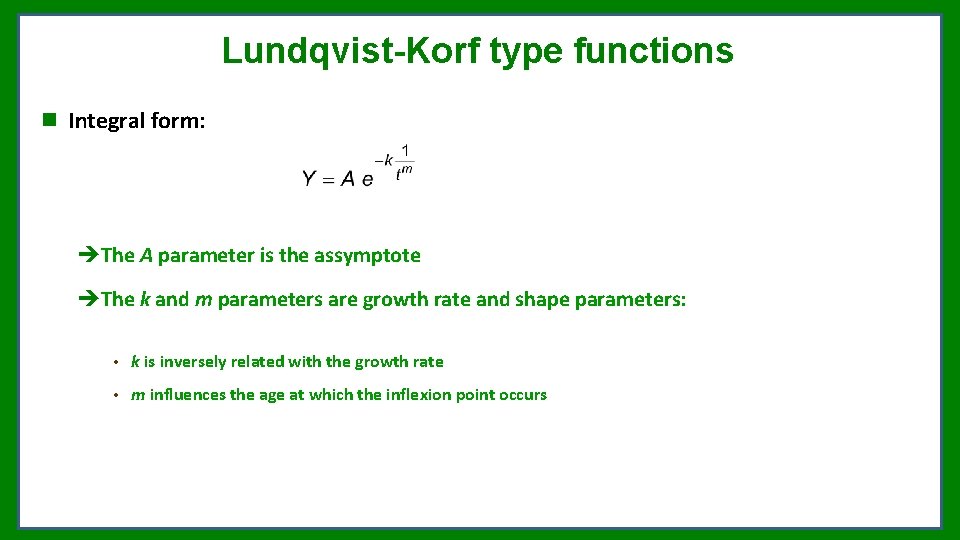
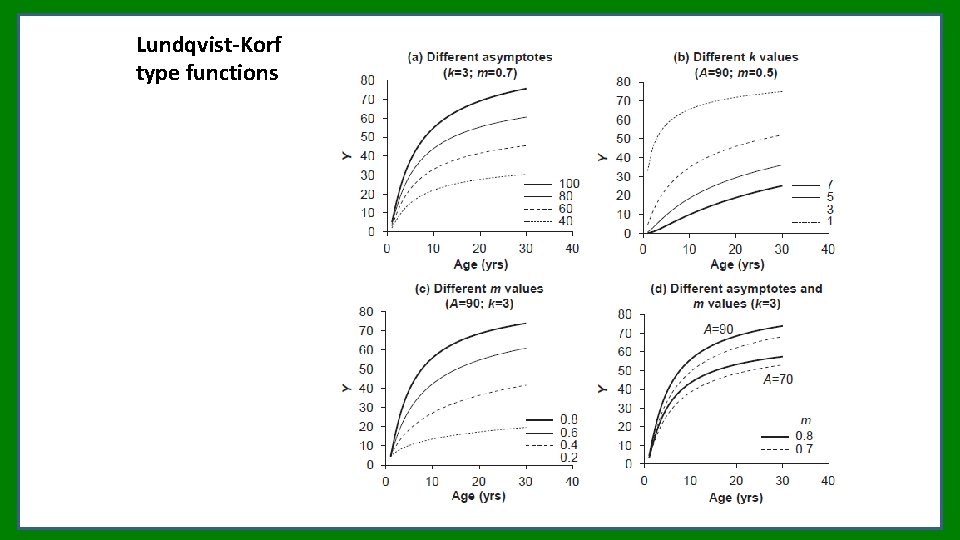
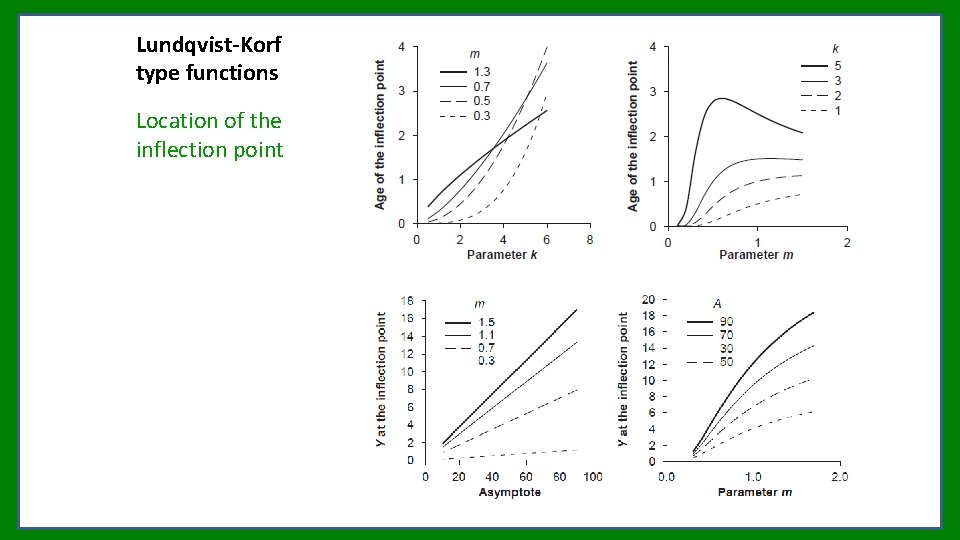
Lundqvist-Korf type functions Integral form: The A parameter is the assymptote The k and m parameters are growth rate and shape parameters: • k is inversely related with the growth rate • m influences the age at which the inflexion point occurs
Lundqvist-Korf type functions
Lundqvist-Korf type functions Location of the inflection point
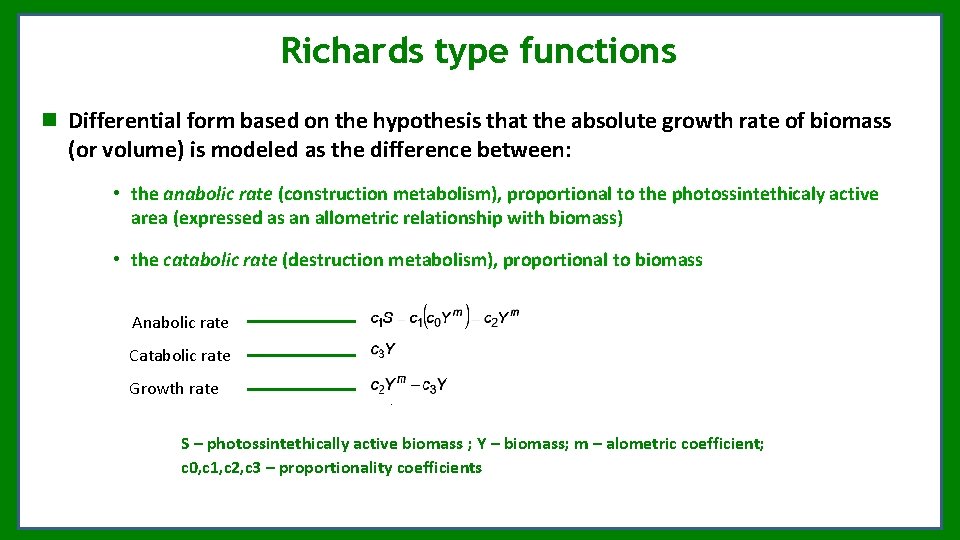
Richards type functions Differential form based on the hypothesis that the absolute growth rate of biomass (or volume) is modeled as the difference between: • the anabolic rate (construction metabolism), proportional to the photossintethicaly active area (expressed as an allometric relationship with biomass) • the catabolic rate (destruction metabolism), proportional to biomass Anabolic rate Catabolic rate Growth rate S – photossintethically active biomass ; Y – biomass; m – alometric coefficient; c 0, c 1, c 2, c 3 – proportionality coefficients
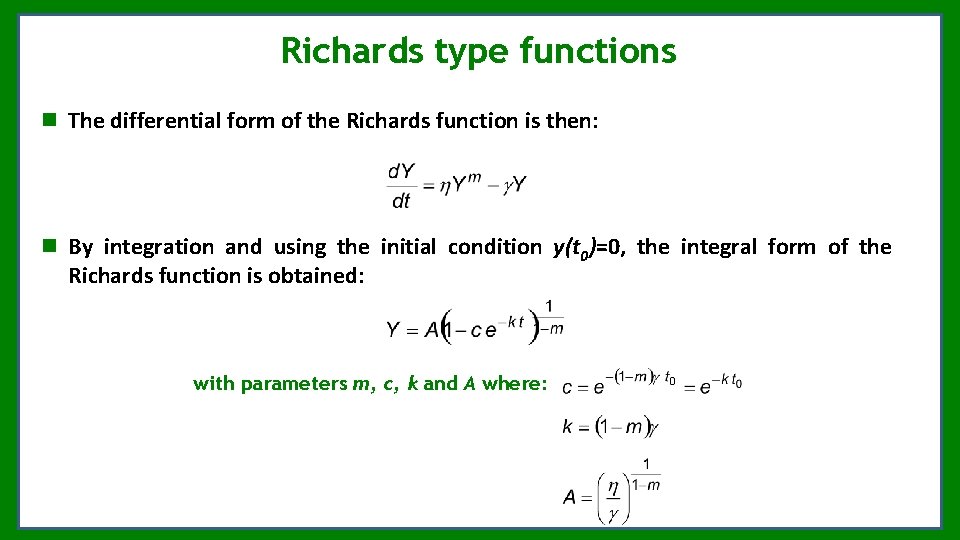
Richards type functions The differential form of the Richards function is then: By integration and using the initial condition y(t 0)=0, the integral form of the Richards function is obtained: with parameters m, c, k and A where:
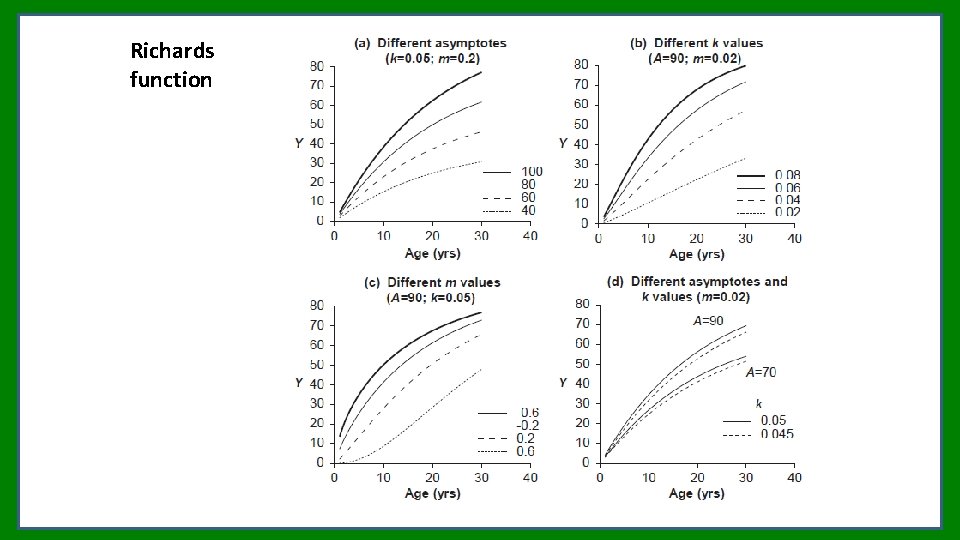
Richards function
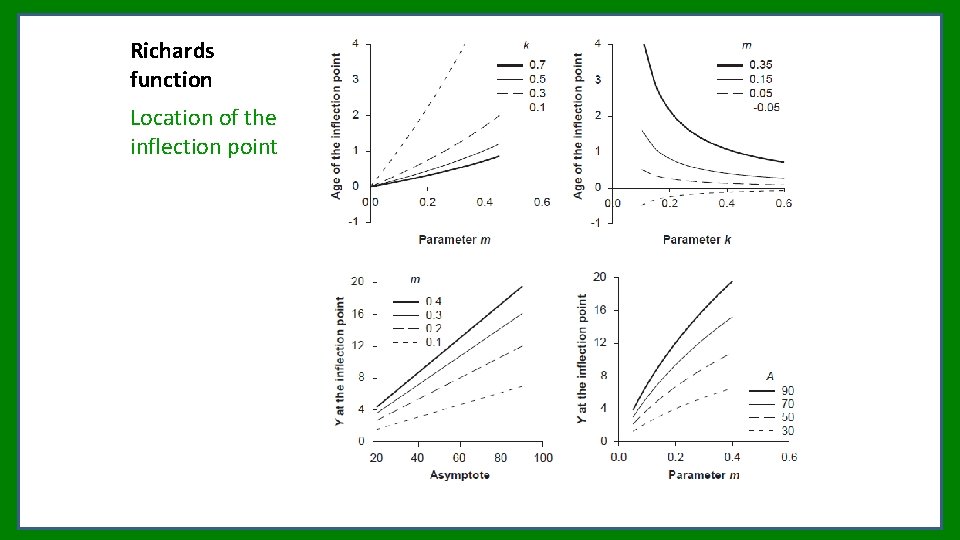
Richards function Location of the inflection point
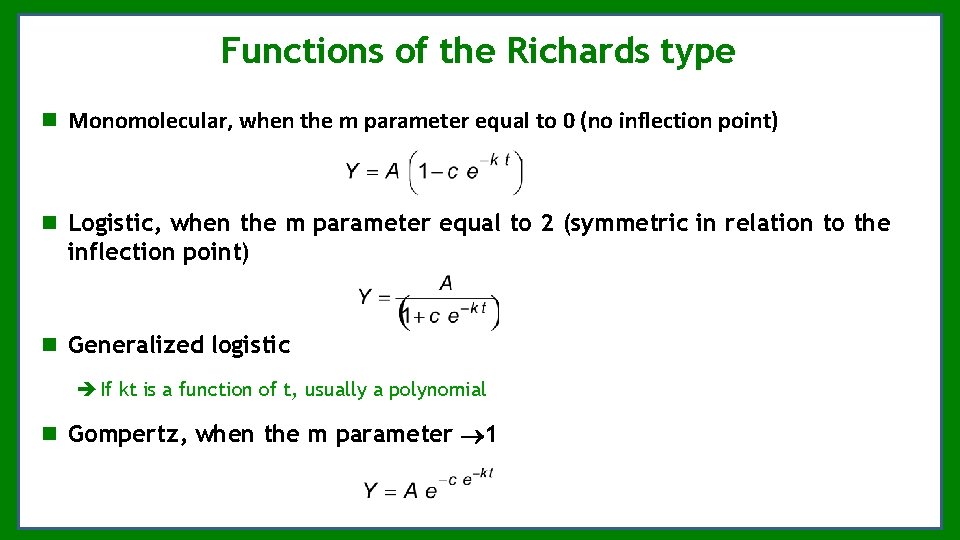
Functions of the Richards type Monomolecular, when the m parameter equal to 0 (no inflection point) Logistic, when the m parameter equal to 2 (symmetric in relation to the inflection point) Generalized logistic If kt is a function of t, usually a polynomial Gompertz, when the m parameter 1
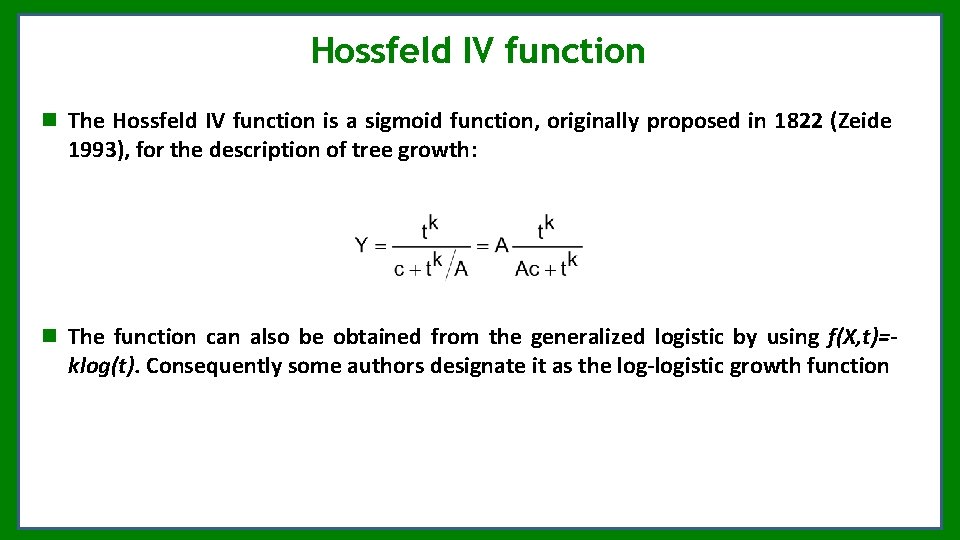
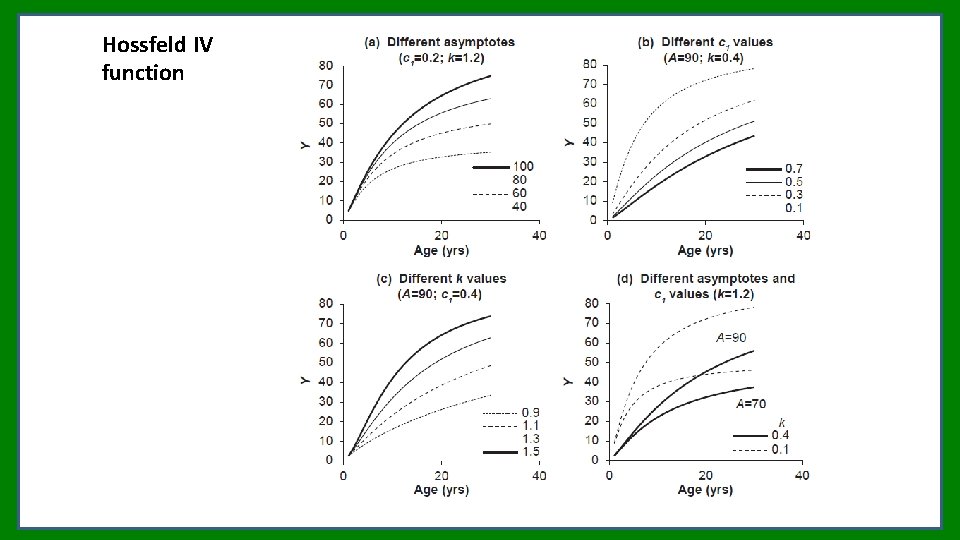
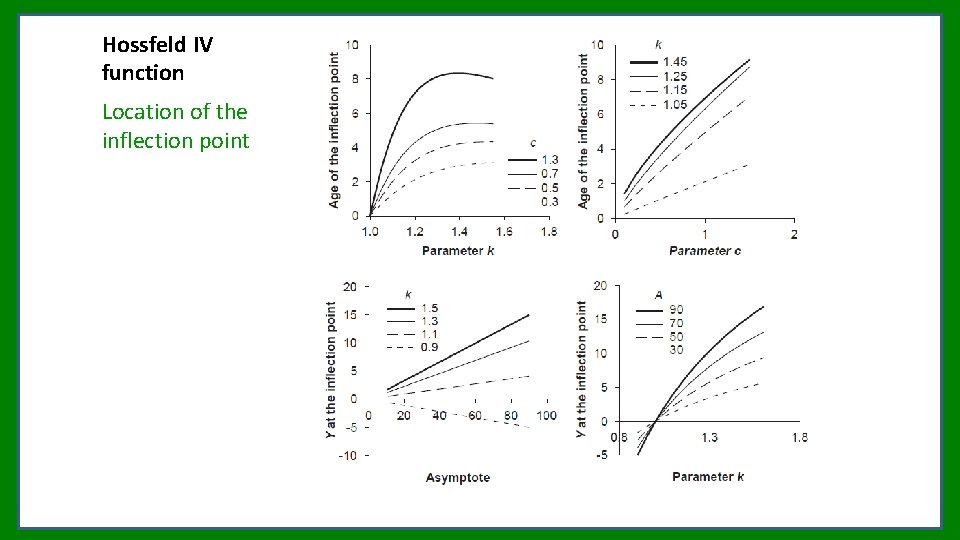
Hossfeld IV function The Hossfeld IV function is a sigmoid function, originally proposed in 1822 (Zeide 1993), for the description of tree growth: The function can also be obtained from the generalized logistic by using f(X, t)=- klog(t). Consequently some authors designate it as the log-logistic growth function
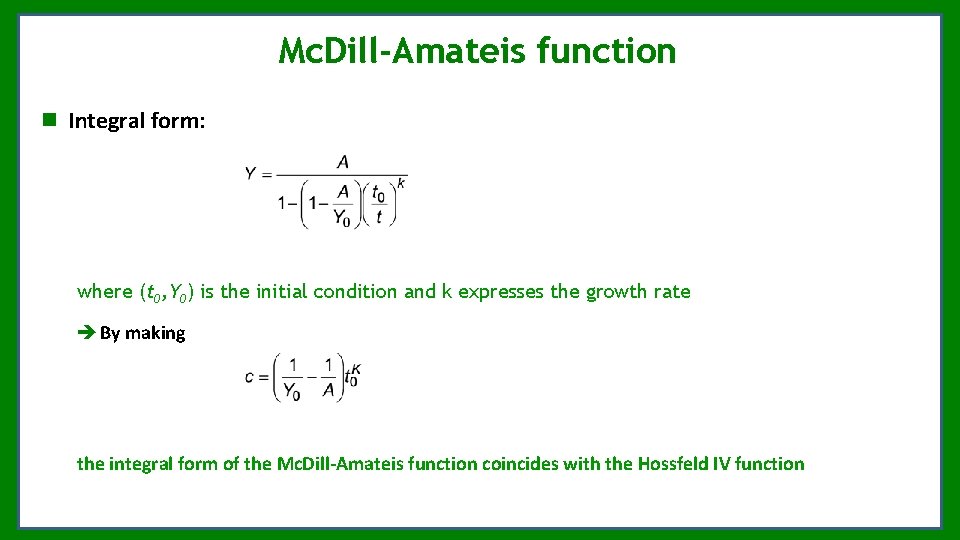
Mc. Dill-Amateis function Integral form: where (t 0, Y 0) is the initial condition and k expresses the growth rate By making the integral form of the Mc. Dill-Amateis function coincides with the Hossfeld IV function
Hossfeld IV function
Hossfeld IV function Location of the inflection point
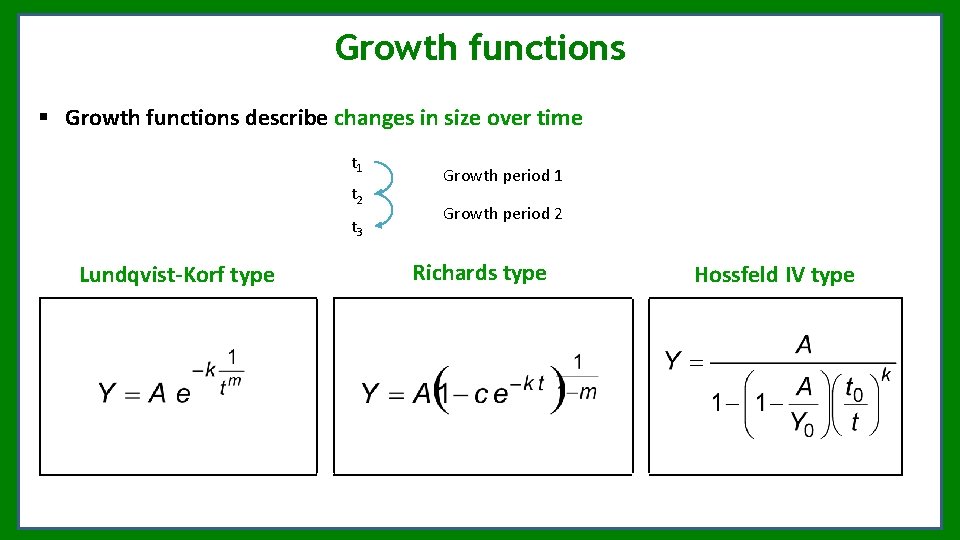
Growth functions § Growth functions describe changes in size over time t 1 t 2 t 3 Lundqvist-Korf type Growth period 1 Growth period 2 Richards type Hossfeld IV type
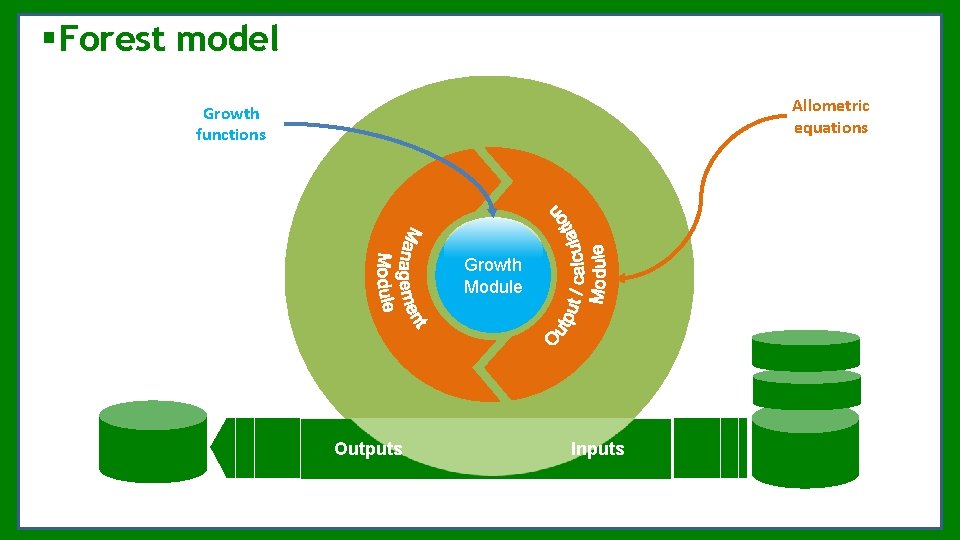
§Forest model Allometric equations Growth functions Growth Module Outputs Inputs
§Simultaneous modeling of several individuals (Families of growth functions)
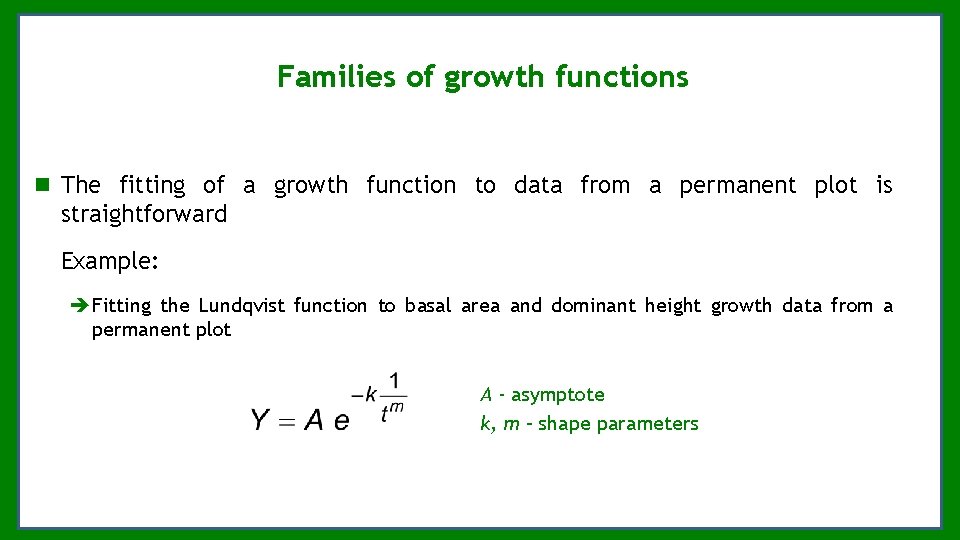
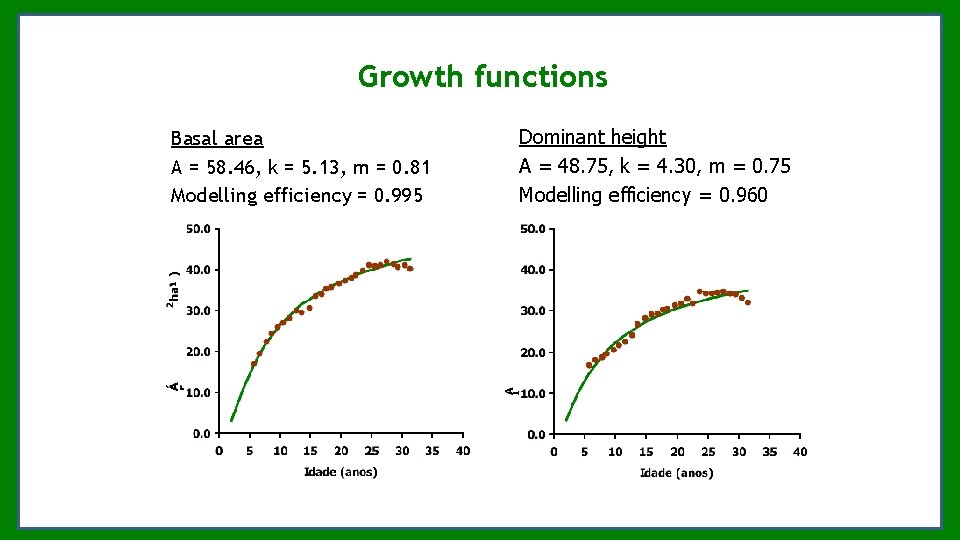
Families of growth functions The fitting of a growth function to data from a permanent plot is straightforward Example: Fitting the Lundqvist function to basal area and dominant height growth data from a permanent plot A - asymptote k, m – shape parameters
Growth functions Basal area A = 58. 46, k = 5. 13, m = 0. 81 Modelling efficiency = 0. 995 Dominant height A = 48. 75, k = 4. 30, m = 0. 75 Modelling efficiency = 0. 960
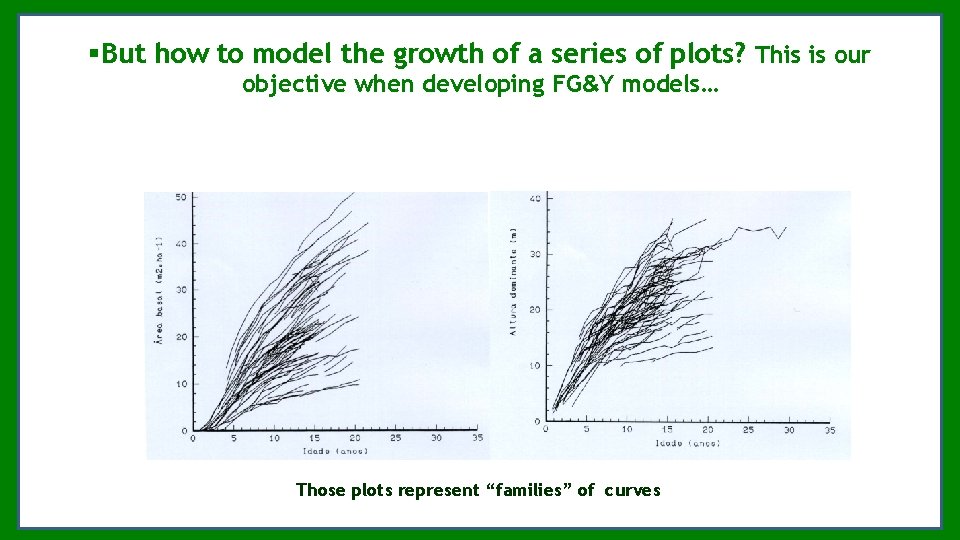
§But how to model the growth of a series of plots? This is our objective when developing FG&Y models… Those plots represent “families” of curves
But how to model the growth of several plots? There are several methods to simultaneously model the growth of several plots: The Guide-curve method (only for hdom) Expressing the parameters as a function of site and/or tree/stand variables (named “Parameter Prediction Method” when applied to hdom) Growth functions formulated as difference equations • Algebraic Difference Approach (ADA) • Generalized Algebraic Difference Approach (GADA) Mixed-effects models In this course we will just focus the first three methods (information on other methods available at the end of the slides)
But how to model the growth of several plots? There are several methods to simultaneously model the growth of several plots: The Guide-curve method (only for hdom) Expressing the parameters as a function of site and/or tree/stand variables (named “Parameter Prediction Method” when applied to hdom) Growth functions formulated as difference equations • Algebraic Difference Approach (ADA) • Generalized Algebraic Difference Approach (GADA) Mixed-effects models In this course we will just focus the first three methods (information on other methods available at the end of the slides)
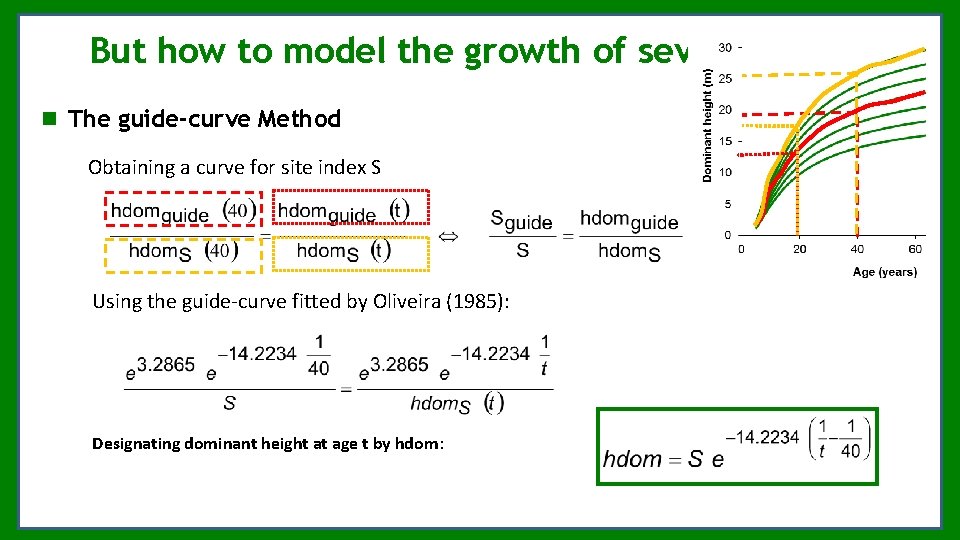
But how to model the growth of several plots? The Guide-curve Method The guide-curve method is the adaptation of the initial graphical methods to the regression analysis techniques The method is usually used with temporary plots data The application of the method implies the fitting of the selected growth curve to the whole data set – the guide-curve The curve for site index S is located at a distance from the guide-curve proportional to the distance between S and the site index of the guide-curve
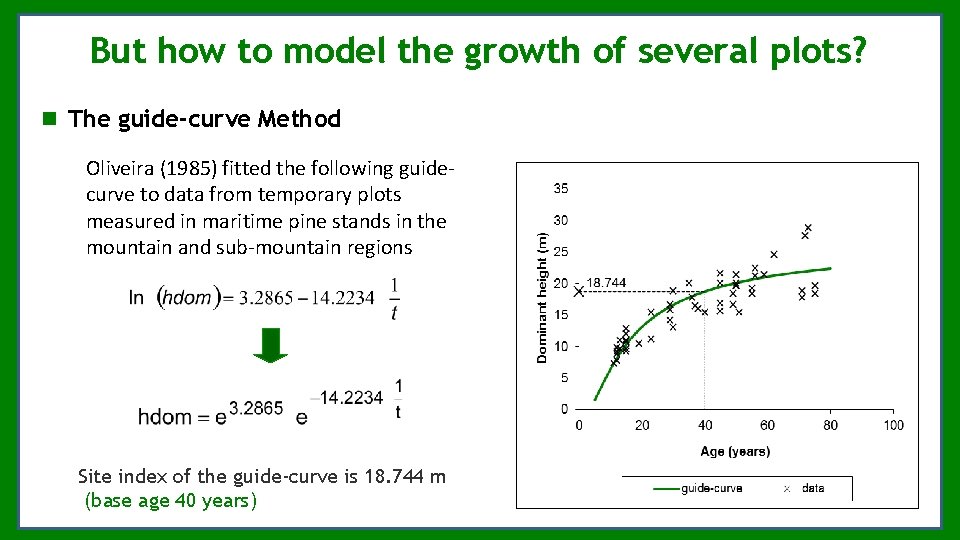
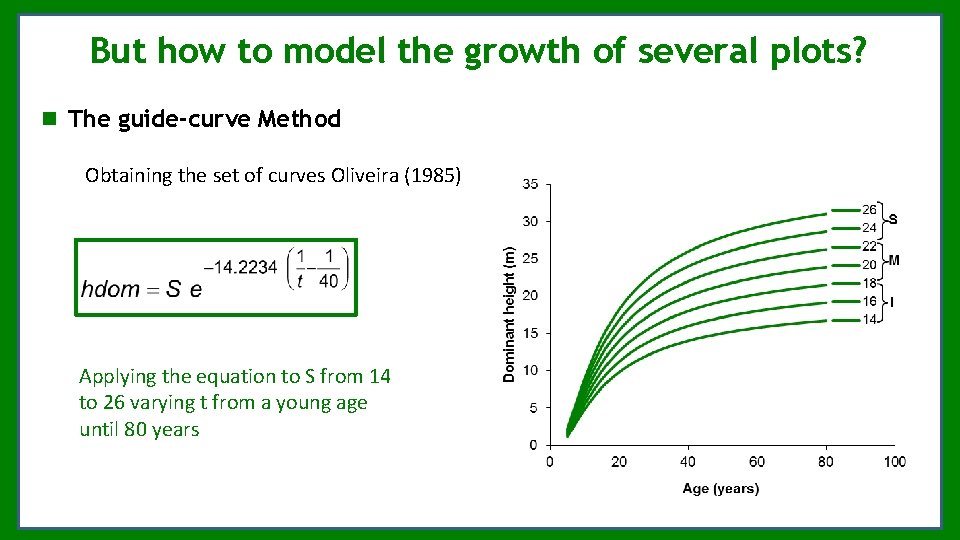
But how to model the growth of several plots? The guide-curve Method Oliveira (1985) fitted the following guidecurve to data from temporary plots measured in maritime pine stands in the mountain and sub-mountain regions Site index of the guide-curve is 18. 744 m (base age 40 years)
But how to model the growth of several plots? The guide-curve Method Obtaining a curve for site index S Using the guide-curve fitted by Oliveira (1985): Designating dominant height at age t by hdom:
But how to model the growth of several plots? The guide-curve Method Obtaining the set of curves Oliveira (1985) Applying the equation to S from 14 to 26 varying t from a young age until 80 years
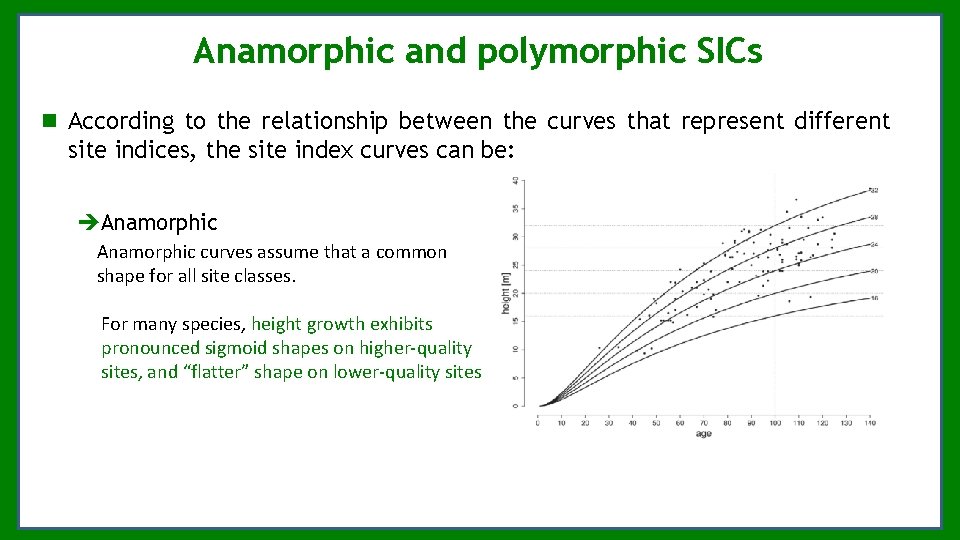
Anamorphic and polymorphic SICs According to the relationship between the curves that represent different site indices, the site index curves can be: Anamorphic curves assume that a common shape for all site classes. For many species, height growth exhibits pronounced sigmoid shapes on higher-quality sites, and “flatter” shape on lower-quality sites
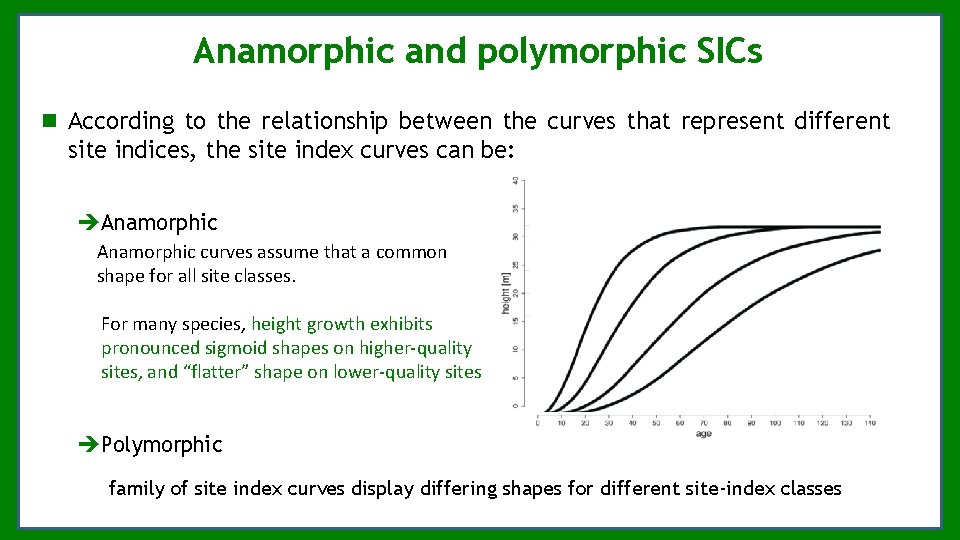
Anamorphic and polymorphic SICs According to the relationship between the curves that represent different site indices, the site index curves can be: Anamorphic curves assume that a common shape for all site classes. For many species, height growth exhibits pronounced sigmoid shapes on higher-quality sites, and “flatter” shape on lower-quality sites Polymorphic family of site index curves display differing shapes for different site-index classes
But how to model the growth of several plots? There are several methods to simultaneously model the growth of several plots: The Guide-curve method (only for hdom) Expressing the parameters as a function of site and/or tree/stand variables (named “Parameter Prediction Method” when applied to hdom) Growth functions formulated as difference equations • Algebraic Difference Approach (ADA) • Generalized Algebraic Difference Approach (GADA) Mixed-effects models In this course we will just focus the first three methods (information on other methods available at the end of the slides)
But how to model the growth of several plots? The parameter prediction method (hdom) This method can only be used when there is a set of long term growth series Therefore it has been essentially applied with stem analysis data (or to interval/permanente plots) It is equivalent to modelling a family of curves by expressing the parameters as a function of stand/site variables
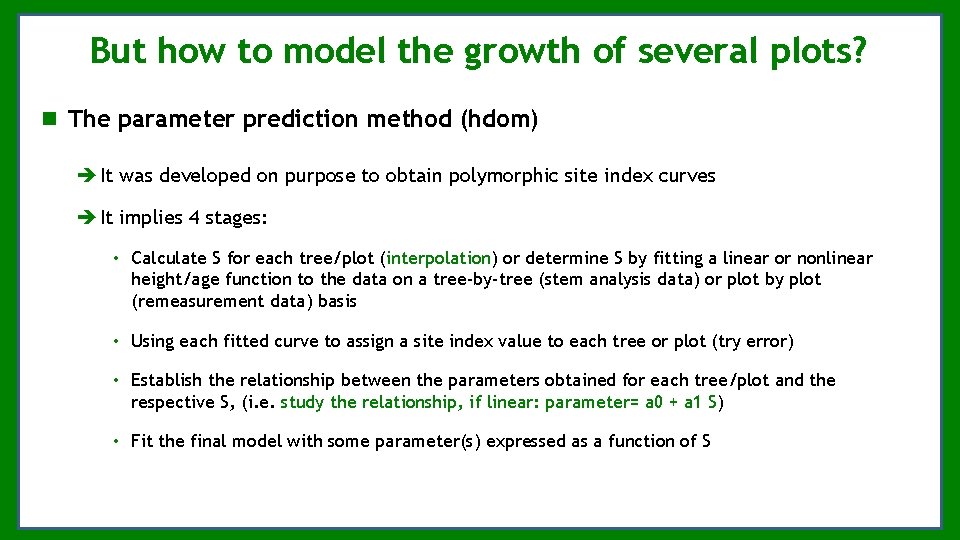
But how to model the growth of several plots? The parameter prediction method (hdom) It was developed on purpose to obtain polymorphic site index curves It implies 4 stages: • Calculate S for each tree/plot (interpolation) or determine S by fitting a linear or nonlinear height/age function to the data on a tree-by-tree (stem analysis data) or plot by plot (remeasurement data) basis • Using each fitted curve to assign a site index value to each tree or plot (try error) • Establish the relationship between the parameters obtained for each tree/plot and the respective S, (i. e. study the relationship, if linear: parameter= a 0 + a 1 S) • Fit the final model with some parameter(s) expressed as a function of S
But how to model the growth of several plots? The parameter prediction method (hdom) This method has some disadvantages: • The curves do not pass through the point corresponding to the base age (S), but it is possible to force the model to do so • The curves are dependent from the selected base age, they will need to be refitted it a new base age is selected
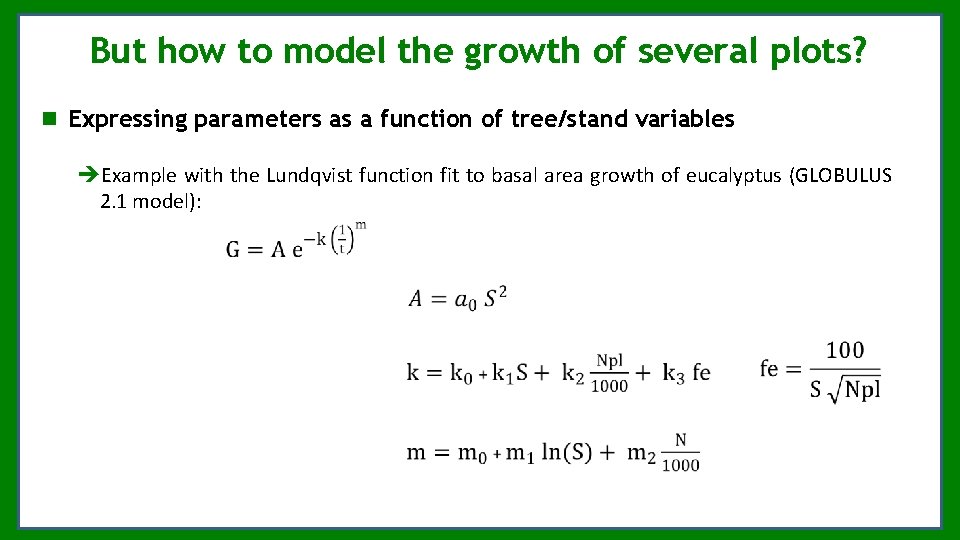
But how to model the growth of several plots? Expressing parameters as a function of tree/stand variables Example with the Lundqvist function fit to basal area growth of eucalyptus (GLOBULUS 2. 1 model):
But how to model the growth of several plots? There are several methods to simultaneously model the growth of several plots: The Guide-curve method (only for hdom) Expressing the parameters as a function of site and/or tree/stand variables (named “Parameter Prediction Method” when applied to hdom) Growth functions formulated as difference equations • Algebraic Difference Approach (ADA) • Generalized Algebraic Difference Approach (GADA) Mixed-effects models In this course we will just focus the first three methods (information on other methods available at the end of the slides)
But how to model the growth of several plots? Growth functions formulated as difference equations If the data set includes at least two remeasurements from each plot, it is possible to fit growth functions in the difference equation form The existence of long term growth series (interval, permanent and or stem analysis) is an advantage as in this way the data has more information about the curve shape There are several methods to fit difference equations (self-referencing curves) to growth data but they are out of the scope of this course
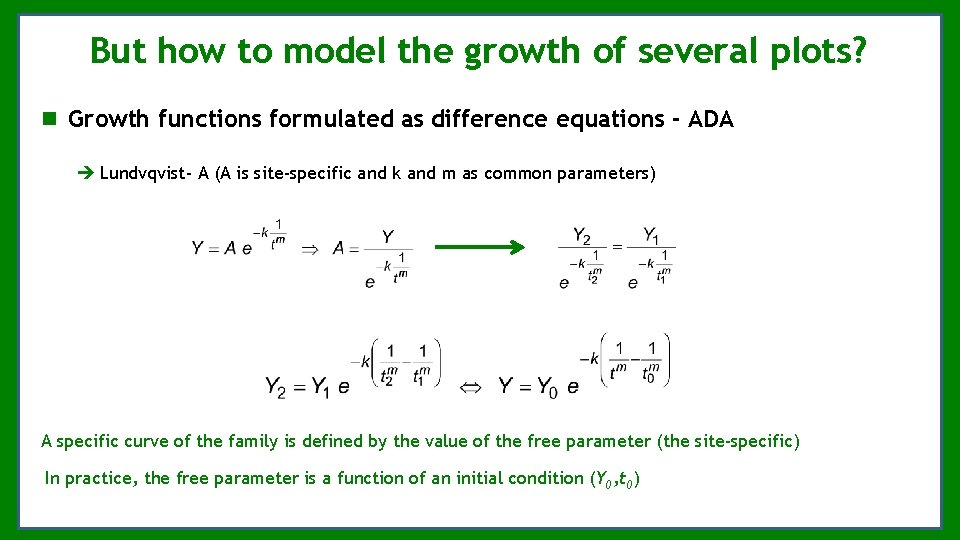
But how to model the growth of several plots? Growth functions formulated as difference equations - ADA Algebraic difference approach (ADA) When formulating a growth function as a difference equation, it is assumed that the curves belonging to the same “family” differ just by one parameter - the site-specific parameter A growth function with 3 parameters allows for 3 different formulations, usually denoted by the free/site-specific parameter For example for the Richards function: Richards-A (model with site specific asymptote) Richards-k (model with common asymptote) Richards-m (model with common asymptote)
But how to model the growth of several plots? Growth functions formulated as difference equations - ADA Lundvqvist- A (A is site-specific and k and m as common parameters) A specific curve of the family is defined by the value of the free parameter (the site-specific) In practice, the free parameter is a function of an initial condition (Y 0, t 0)
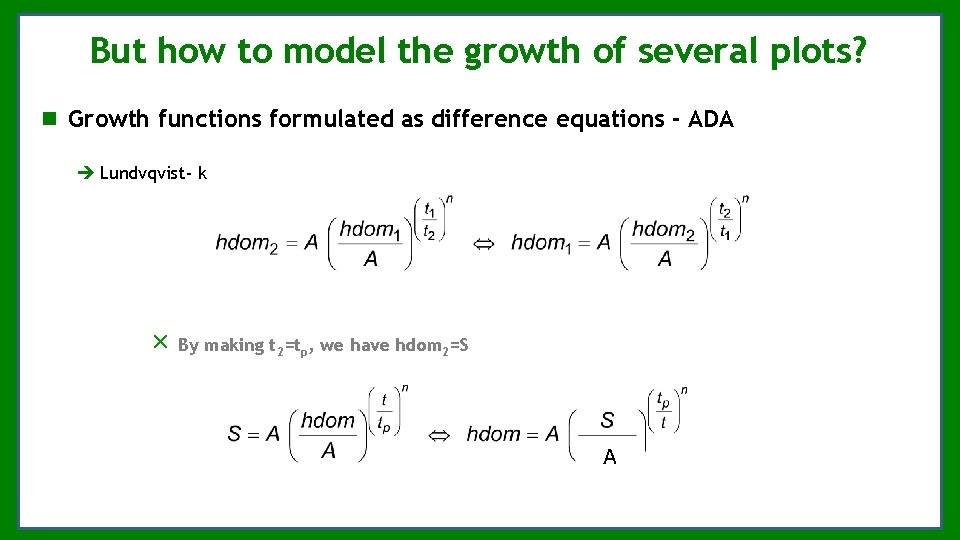
But how to model the growth of several plots? Growth functions formulated as difference equations - ADA Lundvqvist- k r By making t 2=tp, we have hdom 2=S A
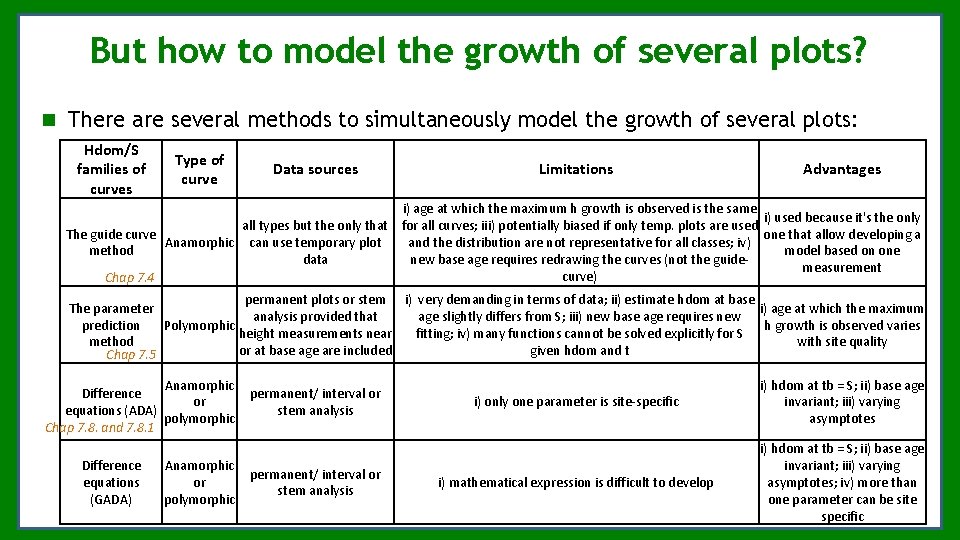
But how to model the growth of several plots? There are several methods to simultaneously model the growth of several plots: Hdom/S families of curves Type of curve Data sources Limitations Advantages i) age at which the maximum h growth is observed is the same i) used because it's the only all types but the only that for all curves; iii) potentially biased if only temp. plots are used The guide curve one that allow developing a Anamorphic can use temporary plot and the distribution are not representative for all classes; iv) method model based on one new base age requires redrawing the curves (not the guidedata measurement curve) Chap 7. 4 permanent plots or stem i) very demanding in terms of data; ii) estimate hdom at base The parameter i) age at which the maximum analysis provided that age slightly differs from S; iii) new base age requires new Polymorphic prediction h growth is observed varies height measurements near fitting; iv) many functions cannot be solved explicitly for S method with site quality or at base age are included given hdom and t Chap 7. 5 Anamorphic Difference or equations (ADA) polymorphic Chap 7. 8. and 7. 8. 1 Difference equations (GADA) Anamorphic or polymorphic permanent/ interval or stem analysis i) only one parameter is site-specific i) hdom at tb = S; ii) base age invariant; iii) varying asymptotes i) mathematical expression is difficult to develop i) hdom at tb = S; ii) base age invariant; iii) varying asymptotes; iv) more than one parameter can be site specific
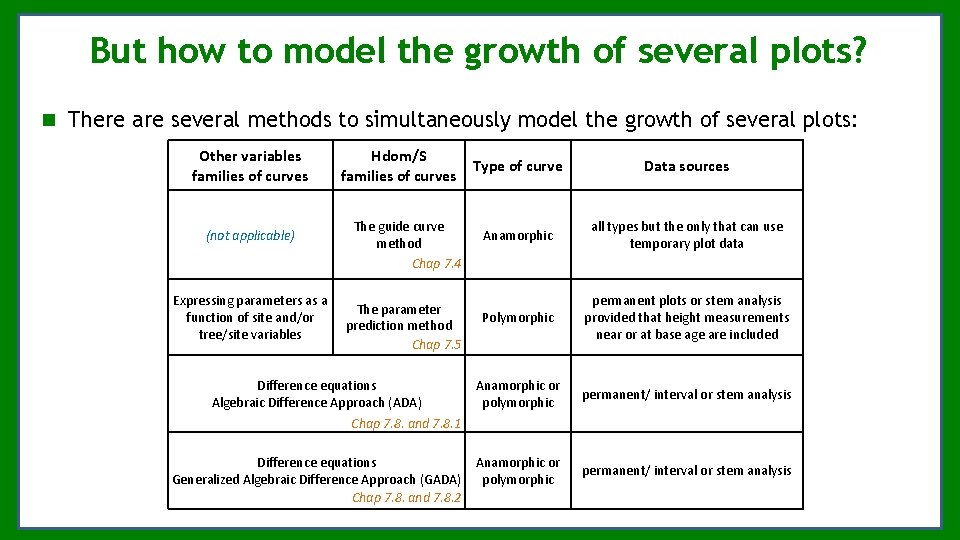
But how to model the growth of several plots? There are several methods to simultaneously model the growth of several plots: Other variables families of curves (not applicable) Expressing parameters as a function of site and/or tree/site variables Hdom/S families of curves The guide curve method Chap 7. 4 The parameter prediction method Chap 7. 5 Difference equations Algebraic Difference Approach (ADA) Type of curve Data sources Anamorphic all types but the only that can use temporary plot data Polymorphic permanent plots or stem analysis provided that height measurements near or at base age are included Anamorphic or polymorphic permanent/ interval or stem analysis Chap 7. 8. and 7. 8. 1 Difference equations Anamorphic or Generalized Algebraic Difference Approach (GADA) polymorphic Chap 7. 8. and 7. 8. 2 permanent/ interval or stem analysis
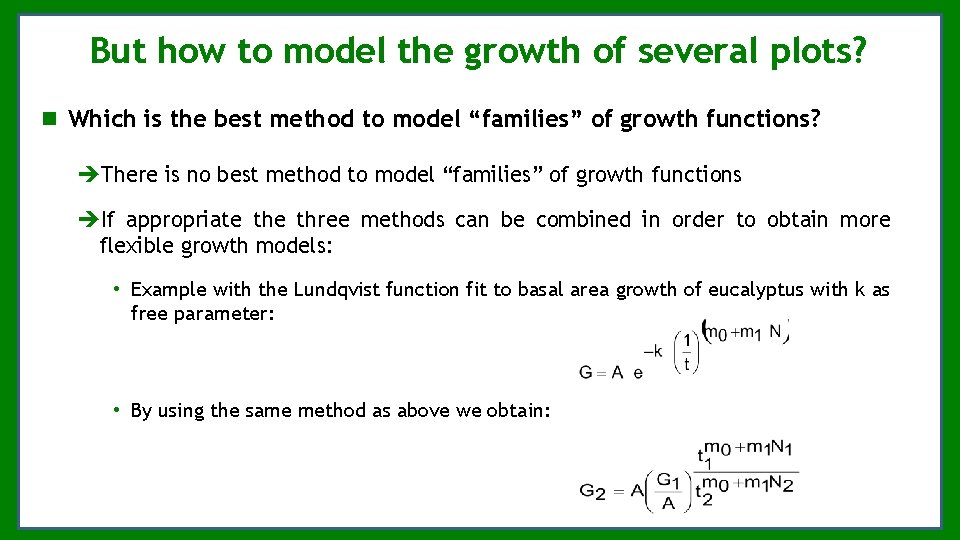
But how to model the growth of several plots? Which is the best method to model “families” of growth functions? There is no best method to model “families” of growth functions If appropriate three methods can be combined in order to obtain more flexible growth models: • Example with the Lundqvist function fit to basal area growth of eucalyptus with k as free parameter: • By using the same method as above we obtain:
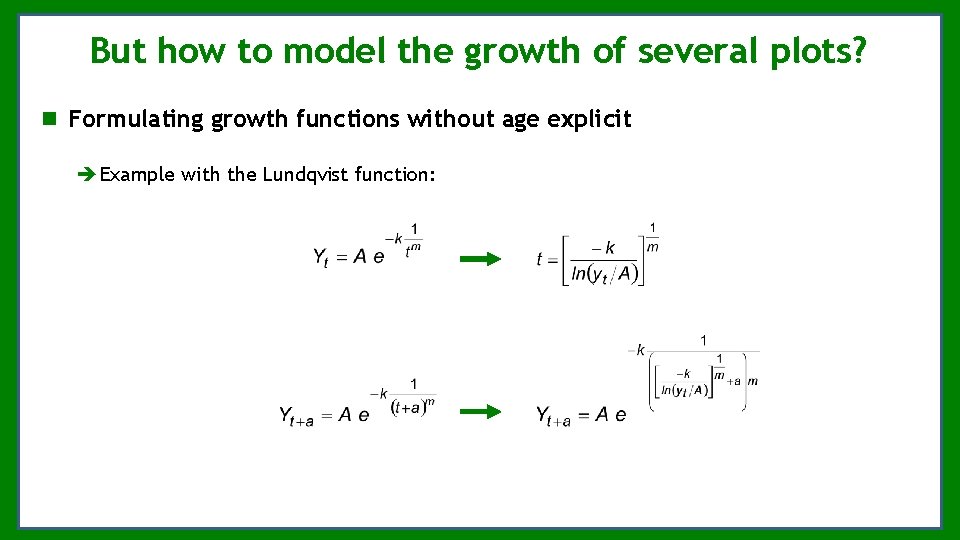
But how to model the growth of several plots? Formulating growth functions without age explicit In many applications age is not known, e. g. in trees that do not exhibit easy to measure growth rings or in uneven aged stands For these cases it is useful to derive formulations of growth functions in which age is not explicit The derivation of these formulations is obtained by expressing t as a function of the variable and the parameters and substituting it in the growth function written for t+a (Tomé et al. 2006)
But how to model the growth of several plots? Formulating growth functions without age explicit Example with the Lundqvist function:
But how to model the growth of several plots? There are several methods to simultaneously model the growth of several plots: The Guide-curve method (only for hdom) Expressing the parameters as a function of site and/or tree/stand variables (named “Parameter Prediction Method” when applied to hdom) Growth functions formulated as difference equations • Algebraic Difference Approach (ADA) • Generalized Algebraic Difference Approach (GADA) Mixed-effects models In this course we will just focus the first three methods (information on other methods available at the end of the slides)
Using growth functions formulated as difference equations - GADA Generalized algebraic difference approach (GADA) One of the problems with ADA is the fact that it originates formulations that differ just by one parameter With GADA it is possible to obtain formulations that have more than one site-specific parameter In GADA parameters are assumed to be function of an unobservable set of variables (denoted by X) that express site differences The equations are then solved by X, which, for a particular site, is substituted in the original equation (X 0)
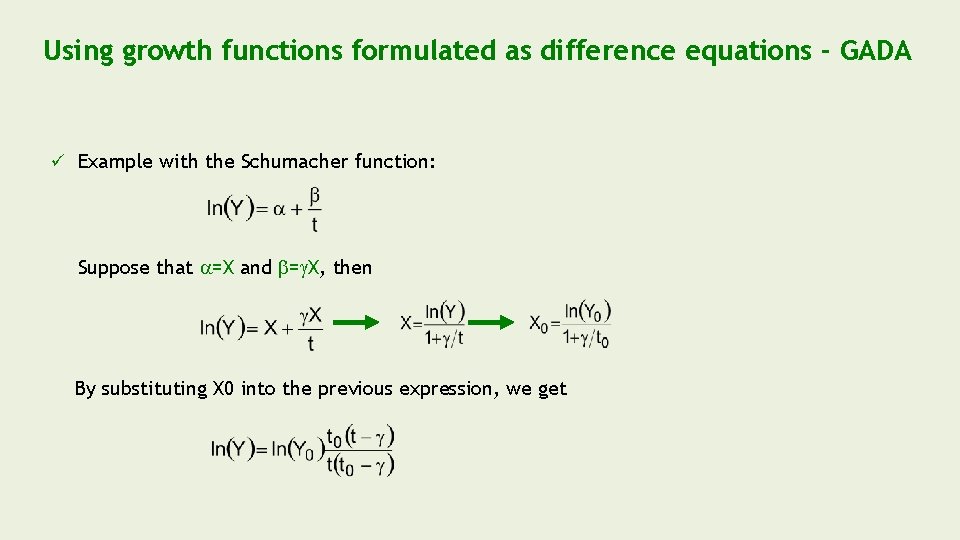
Using growth functions formulated as difference equations - GADA ü Example with the Schumacher function: Suppose that =X and = X, then By substituting X 0 into the previous expression, we get
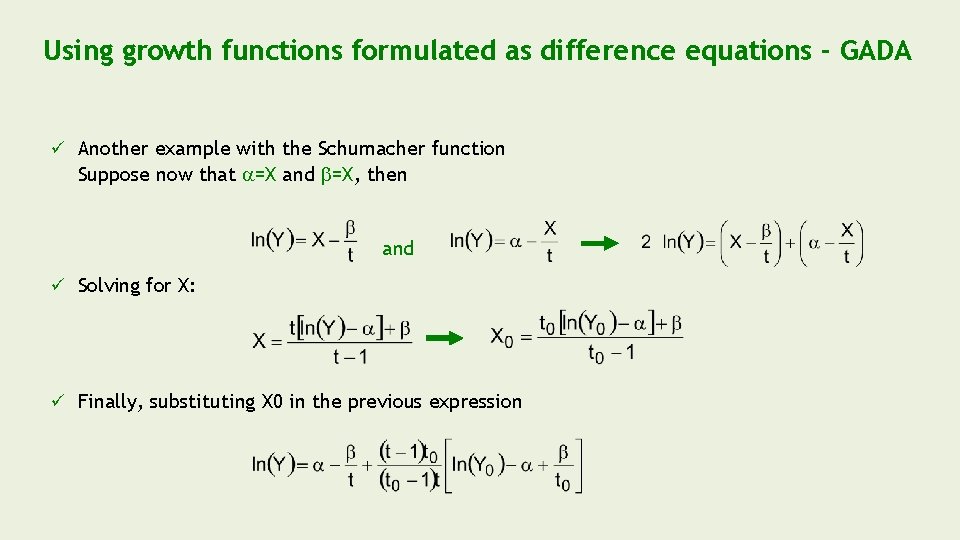
Using growth functions formulated as difference equations - GADA ü Another example with the Schumacher function Suppose now that =X and =X, then and ü Solving for X: ü Finally, substituting X 0 in the previous expression
Using mixed-models Mixed-models (linear and non-linear) “split” the model error according to different sources of variation, such as: Region Stand Plots … When using a model fitted with mixed-models theory it is possible to calibrate the parameters with random components by measuring a small sample of individuals This means that it is possible to use specific parameters for a particular tree/stand