
Allocation of Resources Healthcare in America In 2005





- Slides: 24
Allocation of Resources
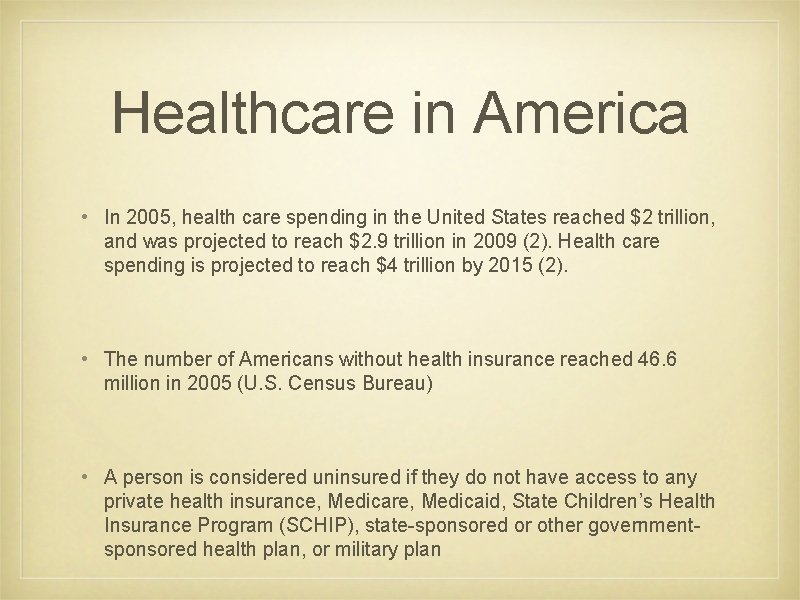
Healthcare in America • In 2005, health care spending in the United States reached $2 trillion, and was projected to reach $2. 9 trillion in 2009 (2). Health care spending is projected to reach $4 trillion by 2015 (2). • The number of Americans without health insurance reached 46. 6 million in 2005 (U. S. Census Bureau) • A person is considered uninsured if they do not have access to any private health insurance, Medicare, Medicaid, State Children’s Health Insurance Program (SCHIP), state-sponsored or other governmentsponsored health plan, or military plan
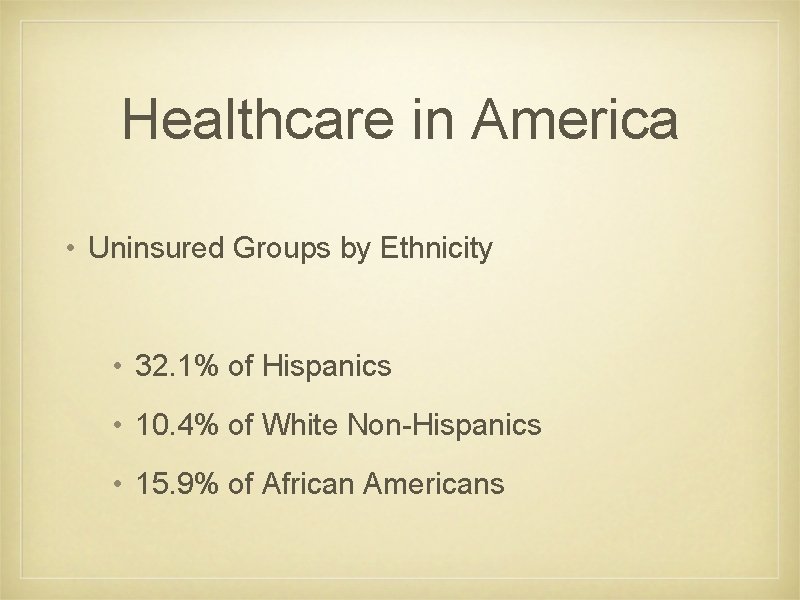
Healthcare in America • Uninsured Groups by Ethnicity • 32. 1% of Hispanics • 10. 4% of White Non-Hispanics • 15. 9% of African Americans
Medicare • Medicare is a health insurance program administered by the United States government, covering people who are age 65 and over, or who meet other special criteria • People under 65 years old can also be eligible if they are disabled or have end stage renal disease. • In 2005, Medicare provided health care coverage for 42. 6 million Americans. Enrollment is expected to reach 77 million by 2031, when the baby boom generation is fully enrolled. • According to the 2004 "Green Book" of the House Ways and Means Committee, Medicare expenditures from the American government were $256. 8 billion in fiscal year 2002.
Medicaid is the United States health program for individuals and families with low incomes and resources. It is jointly funded by the states and federal government, and is managed by the states. Among the groups of people served by Medicaid are eligible low-income parents, children, seniors, and people with disabilities. Illegal immigrants do not have access to Medicaid, but are eligible to receive care for emergencies including labor and delivery. Medicaid is the largest source of funding for medical and health-related services for people with limited income.
Medi-Cal • Medi-Cal is California's Medicaid program • It provides health insurance and longterm care coverage to 6. 5 million lowincome children, their parents, elderly, and disabled people in the state. • Most people are automatically eligible for Medi-Cal if they receive cash assistance under one of the following programs:
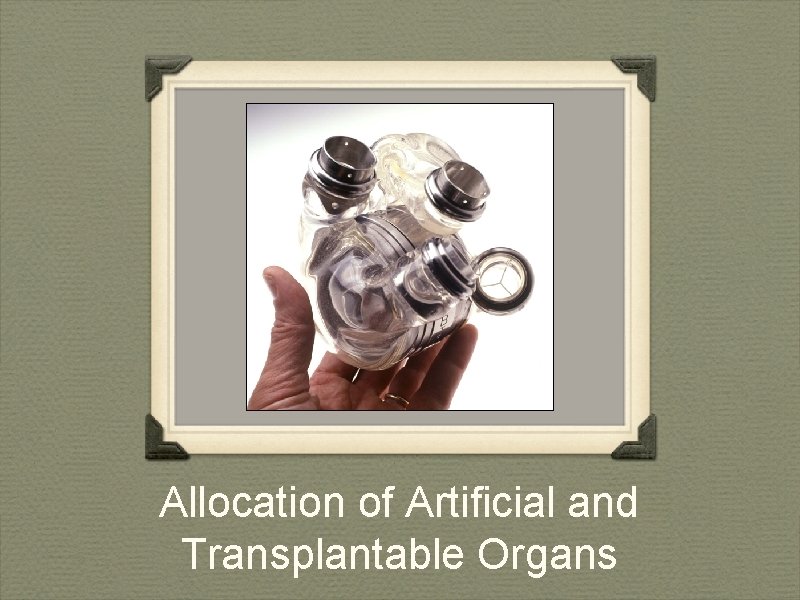
Allocation of Artificial and Transplantable Organs
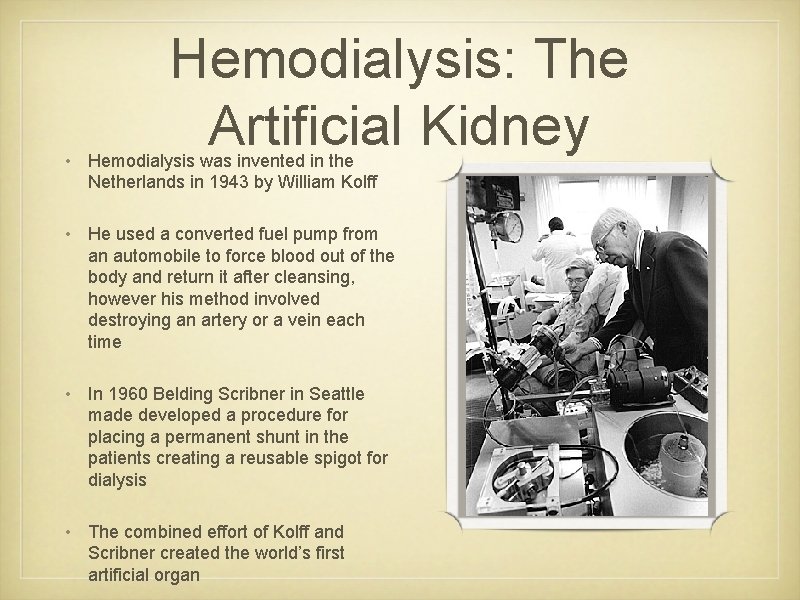
Hemodialysis: The Artificial Kidney • Hemodialysis was invented in the Netherlands in 1943 by William Kolff • He used a converted fuel pump from an automobile to force blood out of the body and return it after cleansing, however his method involved destroying an artery or a vein each time • In 1960 Belding Scribner in Seattle made developed a procedure for placing a permanent shunt in the patients creating a reusable spigot for dialysis • The combined effort of Kolff and Scribner created the world’s first artificial organ
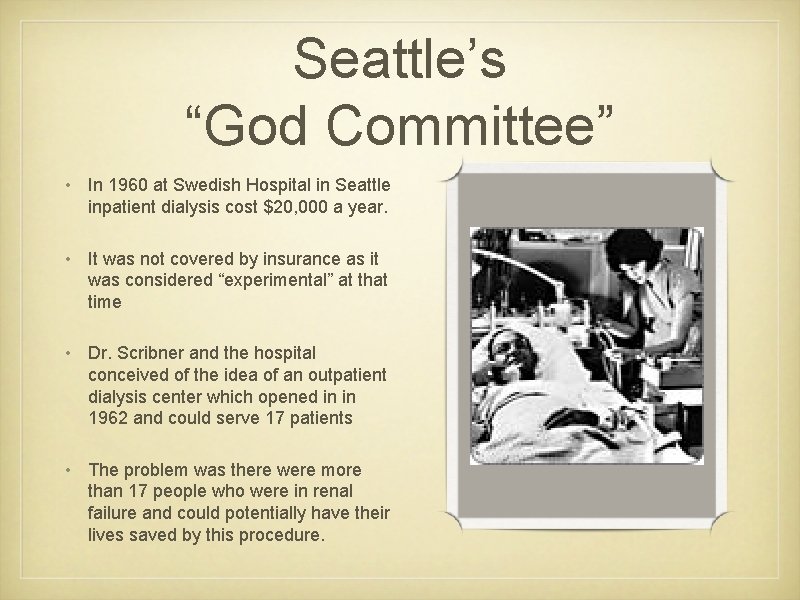
Seattle’s “God Committee” • In 1960 at Swedish Hospital in Seattle inpatient dialysis cost $20, 000 a year. • It was not covered by insurance as it was considered “experimental” at that time • Dr. Scribner and the hospital conceived of the idea of an outpatient dialysis center which opened in in 1962 and could serve 17 patients • The problem was there were more than 17 people who were in renal failure and could potentially have their lives saved by this procedure.
Seattle’s “God Committee” • Swedish Hospital and King County Medical Society decided the best way to resolve the issue of who should receive dialysis and who should not was to set up a committee of lay people who would decide • The committee initially had seven members: a minister, a lawyer, a housewife, a labor leader, a state government official, a banker and a surgeon. There were also two physicians that served as advisors but had no vote • At first candidates were limited to legal residents of the state of Washington under the age of 45 who could pay for the procedure. This caused an overwhelming number of applications to be turned into the insurance companies so additional criteria had to be developed • Additional considerations included whether or not the person had children, was employed, was educated, had a history of achievements, had the “will to live”, how supportive the patient’s family was. . . but all without ever meeting the patients
Issues in Organ Allocation
Organ Donation Waiting Lists • In the 1970 s there was no real organized system for the distribution of transplantable organs • By 1987 the National Transplantion Act (1984) and the federal Task Force on Organ Transplantation (1986) had created the United Network for Organ Sharing (UNOS) • UNOS established a standardized system for deciding which patient will get the next available organ
Problems with UNOS • UNOS only deals with patients who are in the system • A patient’s primary physician is responsible for listing them in the system • To increase the odds of getting an organ some patients see multiple physicians so that they can get multiple listings • Currently, New York is the only state which forbids multiple listings
Problems with UNOS • In the early 1990 s it was revealed that candidates for neonatal heart transplants were being identified prenatally and placed on the UNOS list as fetuses • Fetuses diagnosed with Hypoplastic Left Heart Syndrome (HLHS) in utero are safe while they are in the womb whereas babies with HLHS are not and in more immediate need of heart transplants • In 1992 UNOS changed its policy to put fetuses on a separate list from babies and decided to allocate a heart to a fetus only when no
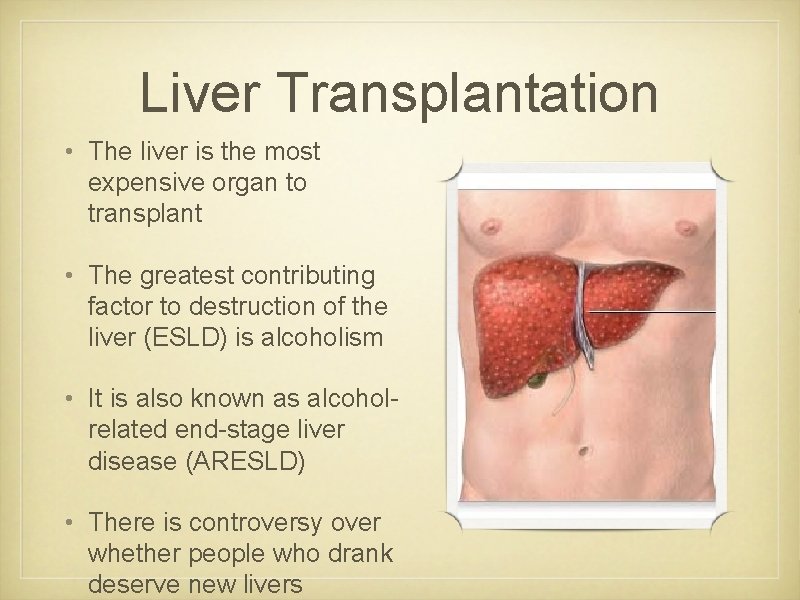
Liver Transplantation • The liver is the most expensive organ to transplant • The greatest contributing factor to destruction of the liver (ESLD) is alcoholism • It is also known as alcoholrelated end-stage liver disease (ARESLD) • There is controversy over whether people who drank deserve new livers
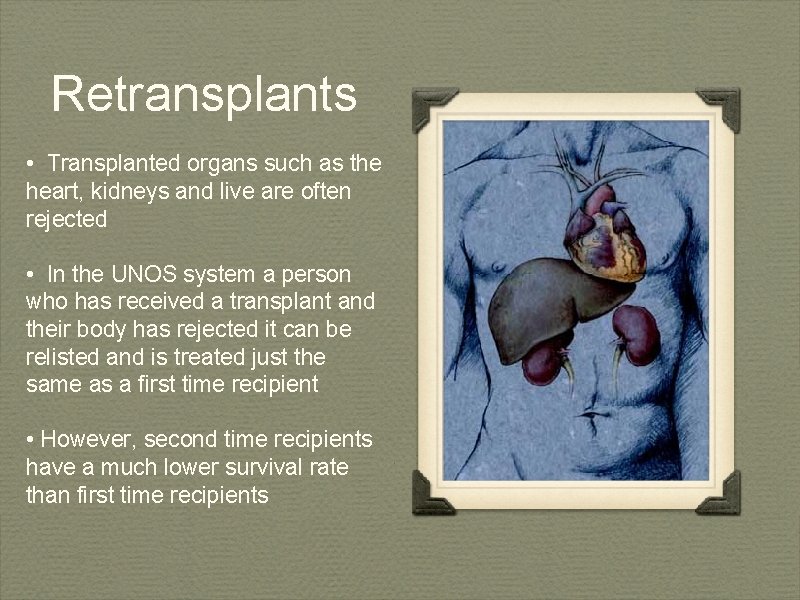
Retransplants • Transplanted organs such as the heart, kidneys and live are often rejected • In the UNOS system a person who has received a transplant and their body has rejected it can be relisted and is treated just the same as a first time recipient • However, second time recipients have a much lower survival rate than first time recipients
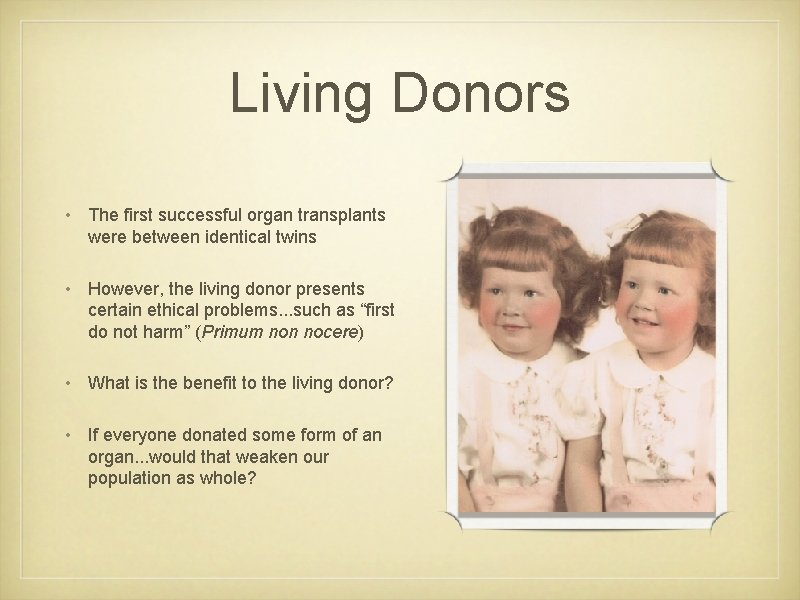
Living Donors • The first successful organ transplants were between identical twins • However, the living donor presents certain ethical problems. . . such as “first do not harm” (Primum non nocere) • What is the benefit to the living donor? • If everyone donated some form of an organ. . . would that weaken our population as whole?
Ethical Questions
Is it ethical to use “Social Worth” to determine who should receive treatment?
Do you think the U. S. would benefit from procuring organs from prisoners?
Do We Need to Limit the access Illegal Immigrants have to healthcare?
Should Lifestyle choices influence access to transplantable organs?
Is it ethical to keep a person alive with tertiary care at the cost of primary care to hundreds?
Should we have age cut-offs in healthcare?