
Allocation of Frames Thrashing Virtual Memory 04022010 CSCI
- Slides: 23
Allocation of Frames & Thrashing (Virtual Memory) 04/02/2010 CSCI 315 Operating Systems Design 1
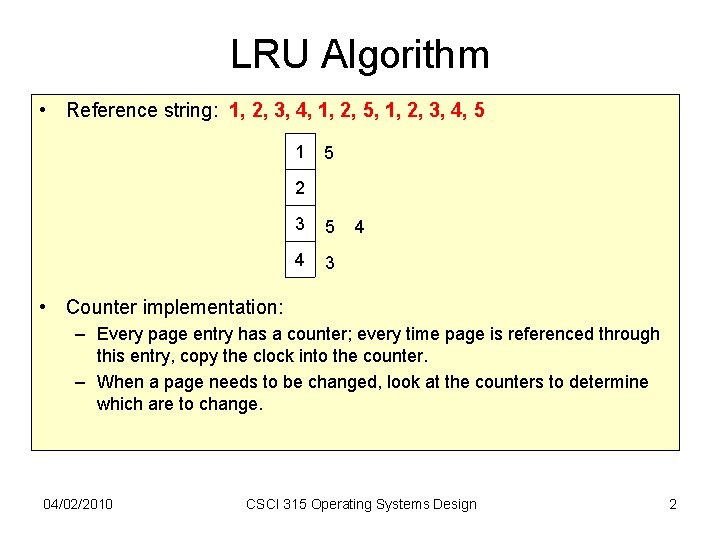
LRU Algorithm • Reference string: 1, 2, 3, 4, 1, 2, 5, 1, 2, 3, 4, 5 1 5 2 3 5 4 3 4 • Counter implementation: – Every page entry has a counter; every time page is referenced through this entry, copy the clock into the counter. – When a page needs to be changed, look at the counters to determine which are to change. 04/02/2010 CSCI 315 Operating Systems Design 2
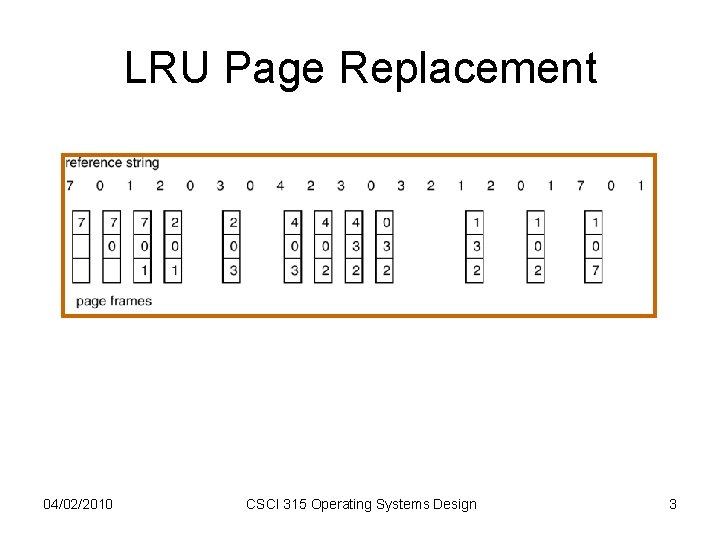
LRU Page Replacement 04/02/2010 CSCI 315 Operating Systems Design 3
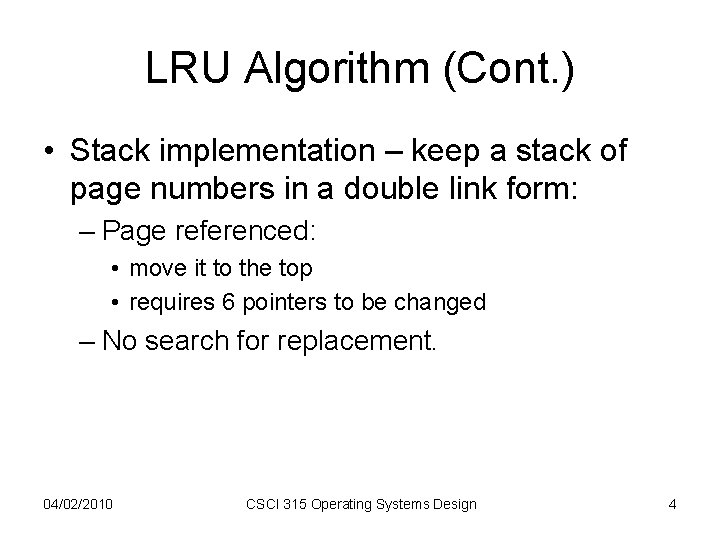
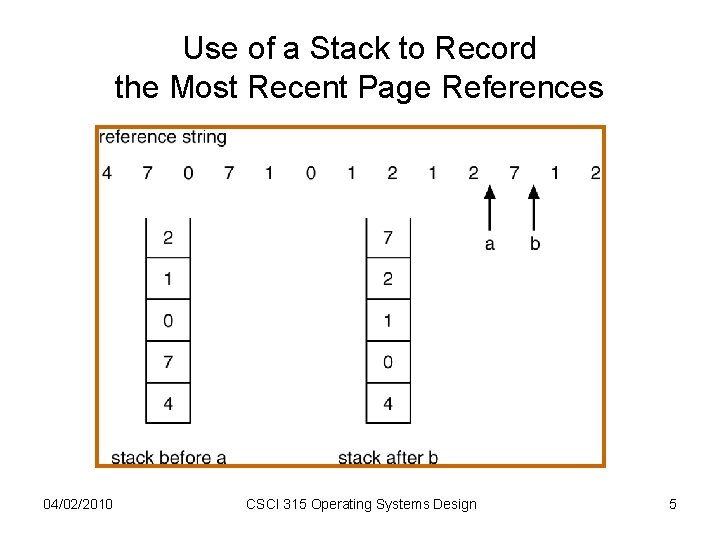
LRU Algorithm (Cont. ) • Stack implementation – keep a stack of page numbers in a double link form: – Page referenced: • move it to the top • requires 6 pointers to be changed – No search for replacement. 04/02/2010 CSCI 315 Operating Systems Design 4
Use of a Stack to Record the Most Recent Page References 04/02/2010 CSCI 315 Operating Systems Design 5
LRU and Belady’s Anomaly • LRU does not suffer from Belady’s Anomaly (OPT doesn’t either). • It has been shown that algorithms in a class called stack algorithms can never exhibit Belady’s Anomaly. • A stack algorithm is one for which the set of pages in memory for n frames is a subset of the pages that Could be in memory for n+1 frames. 04/02/2010 CSCI 315 Operating Systems Design 6
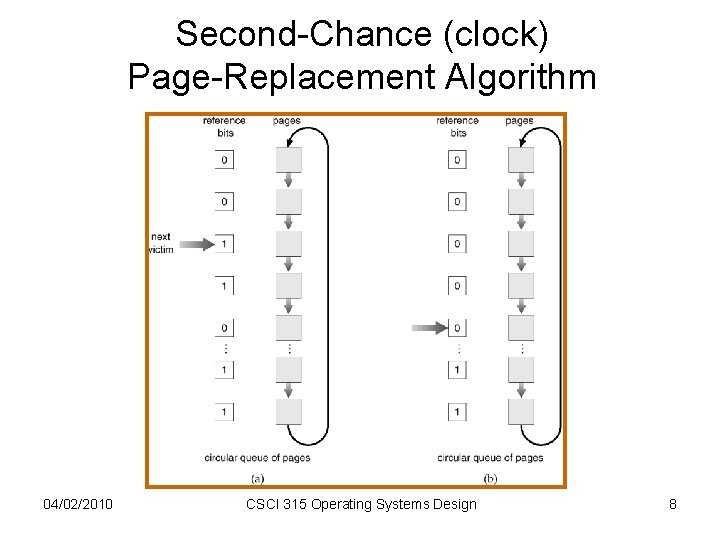
LRU Approximation Algorithms • Reference bit – With each page associate a bit, initially = 0 – When page is referenced bit set to 1. – Replace the one which is 0 (if one exists). We do not know the order, however. • Second chance – Need reference bit. – Clock replacement. – If page to be replaced (in clock order) has reference bit = 1. then: • set reference bit 0. • leave page in memory. • replace next page (in clock order), subject to same rules. 04/02/2010 CSCI 315 Operating Systems Design 7
Second-Chance (clock) Page-Replacement Algorithm 04/02/2010 CSCI 315 Operating Systems Design 8
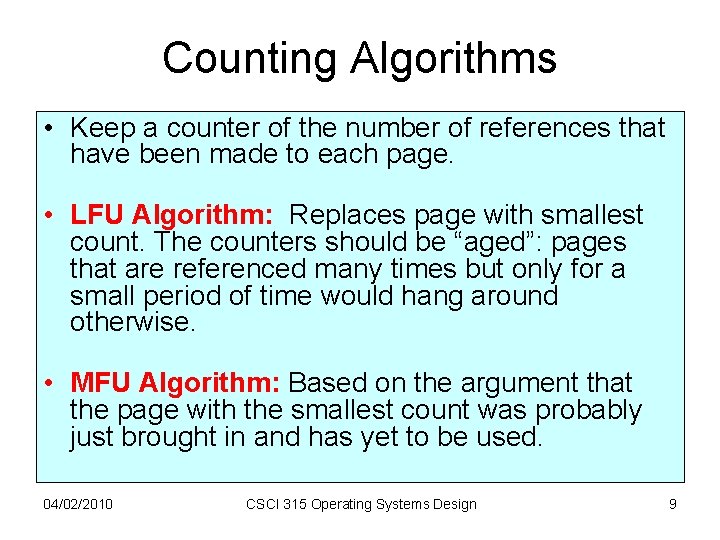
Counting Algorithms • Keep a counter of the number of references that have been made to each page. • LFU Algorithm: Replaces page with smallest count. The counters should be “aged”: pages that are referenced many times but only for a small period of time would hang around otherwise. • MFU Algorithm: Based on the argument that the page with the smallest count was probably just brought in and has yet to be used. 04/02/2010 CSCI 315 Operating Systems Design 9
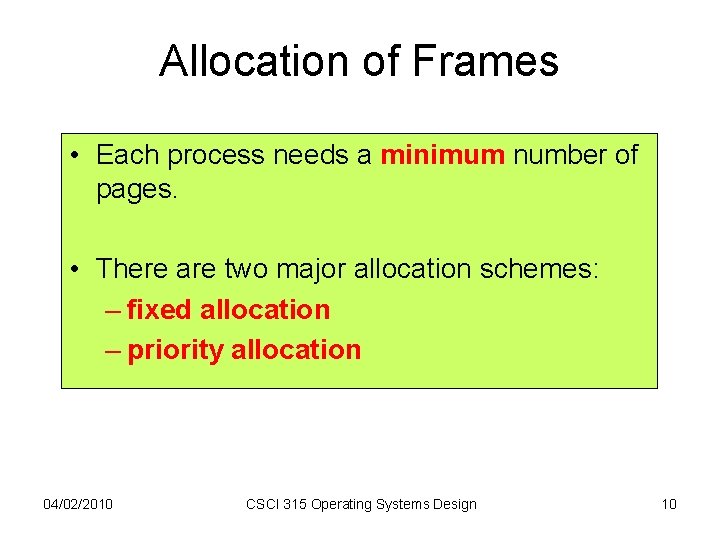
Allocation of Frames • Each process needs a minimum number of pages. • There are two major allocation schemes: – fixed allocation – priority allocation 04/02/2010 CSCI 315 Operating Systems Design 10
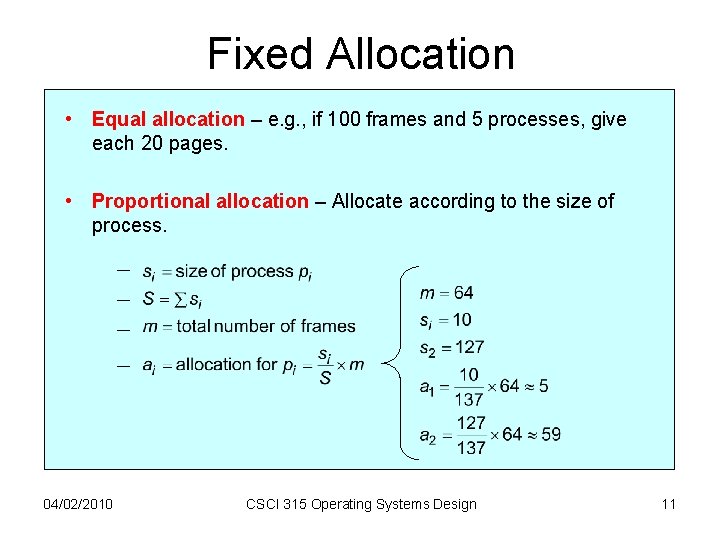
Fixed Allocation • Equal allocation – e. g. , if 100 frames and 5 processes, give each 20 pages. • Proportional allocation – Allocate according to the size of process. 04/02/2010 CSCI 315 Operating Systems Design 11
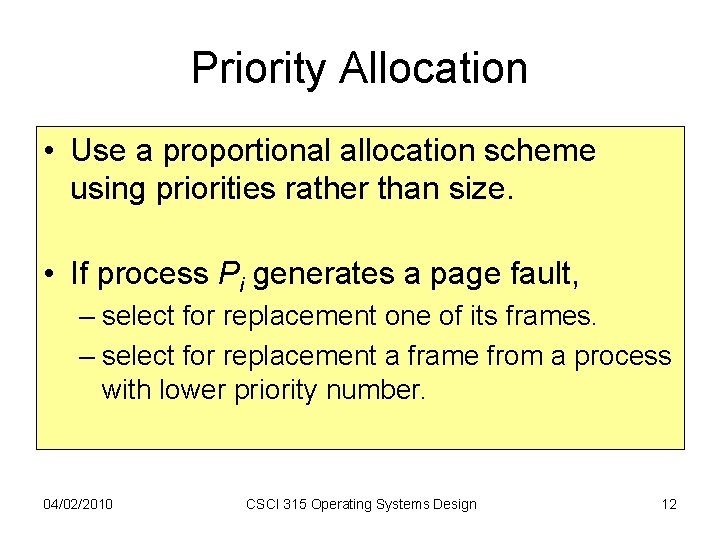
Priority Allocation • Use a proportional allocation scheme using priorities rather than size. • If process Pi generates a page fault, – select for replacement one of its frames. – select for replacement a frame from a process with lower priority number. 04/02/2010 CSCI 315 Operating Systems Design 12
Global vs. Local Allocation • Global replacement – process selects a replacement frame from the set of all frames; one process can take a frame from another. • Local replacement – each process selects from only its own set of allocated frames. 04/02/2010 CSCI 315 Operating Systems Design 13
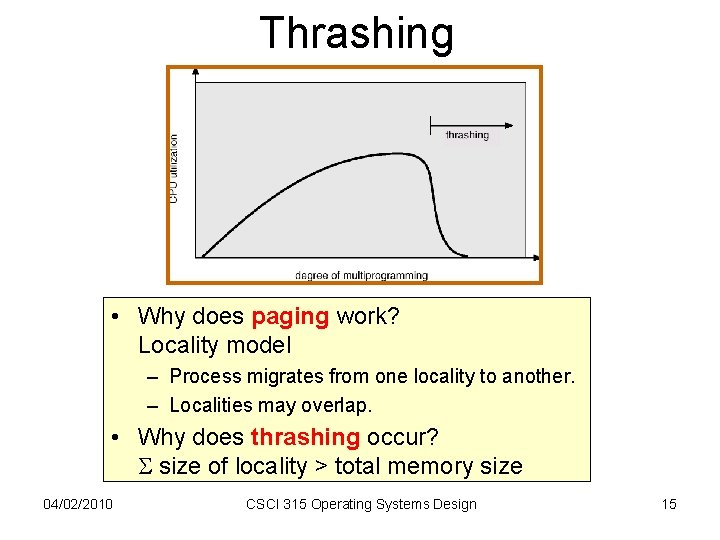
Thrashing • If a process does not have “enough” pages, the page-fault rate is very high. This leads to: – Low CPU utilization. – Operating system thinks that it needs to increase the degree of multiprogramming. – Another process added to the system. • Thrashing a process is busy swapping pages in and out. 04/02/2010 CSCI 315 Operating Systems Design 14
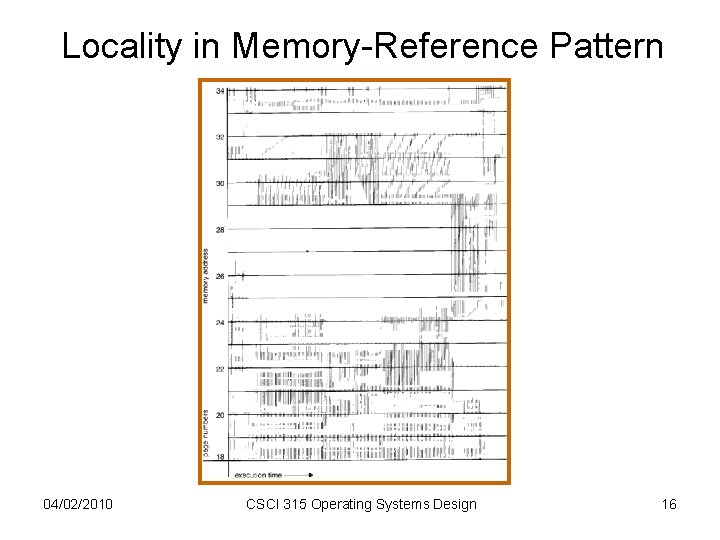
Thrashing • Why does paging work? Locality model – Process migrates from one locality to another. – Localities may overlap. • Why does thrashing occur? size of locality > total memory size 04/02/2010 CSCI 315 Operating Systems Design 15
Locality in Memory-Reference Pattern 04/02/2010 CSCI 315 Operating Systems Design 16
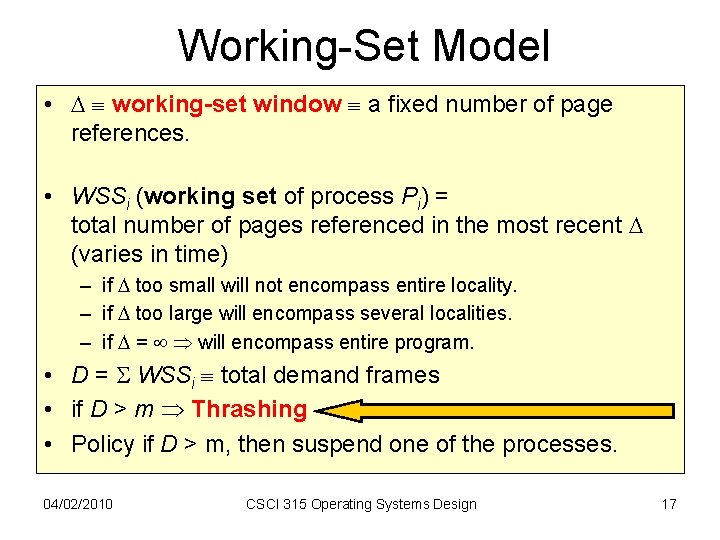
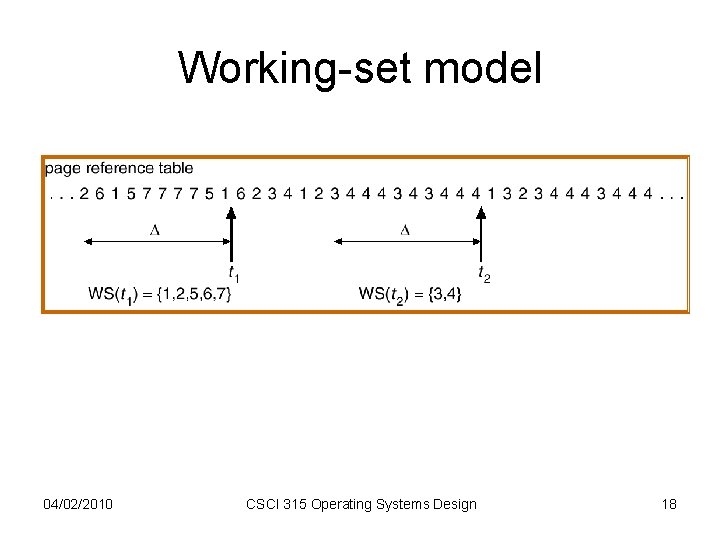
Working-Set Model • working-set window a fixed number of page references. • WSSi (working set of process Pi) = total number of pages referenced in the most recent (varies in time) – if too small will not encompass entire locality. – if too large will encompass several localities. – if = will encompass entire program. • D = WSSi total demand frames • if D > m Thrashing • Policy if D > m, then suspend one of the processes. 04/02/2010 CSCI 315 Operating Systems Design 17
Working-set model 04/02/2010 CSCI 315 Operating Systems Design 18
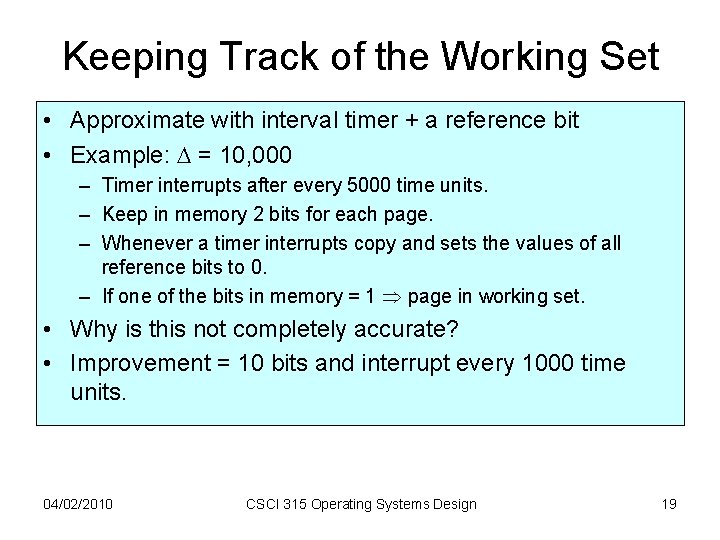
Keeping Track of the Working Set • Approximate with interval timer + a reference bit • Example: = 10, 000 – Timer interrupts after every 5000 time units. – Keep in memory 2 bits for each page. – Whenever a timer interrupts copy and sets the values of all reference bits to 0. – If one of the bits in memory = 1 page in working set. • Why is this not completely accurate? • Improvement = 10 bits and interrupt every 1000 time units. 04/02/2010 CSCI 315 Operating Systems Design 19
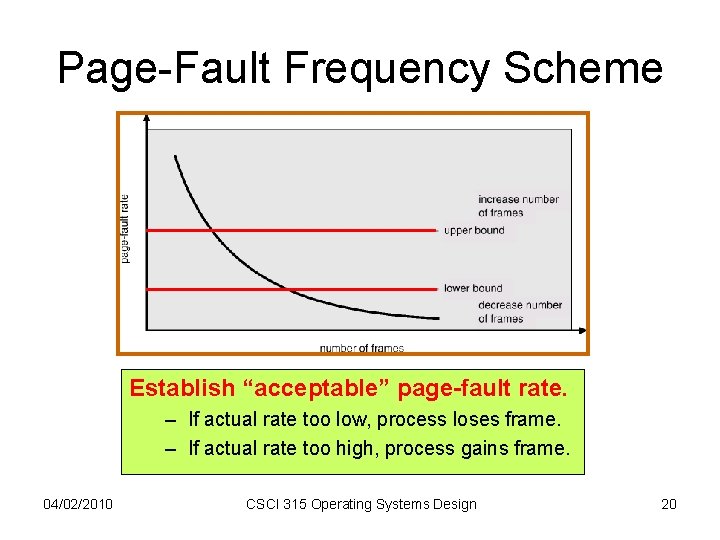
Page-Fault Frequency Scheme Establish “acceptable” page-fault rate. – If actual rate too low, process loses frame. – If actual rate too high, process gains frame. 04/02/2010 CSCI 315 Operating Systems Design 20
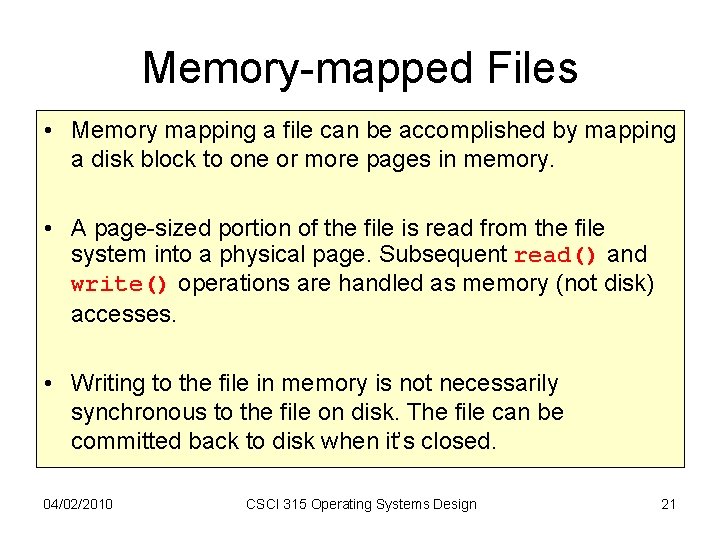
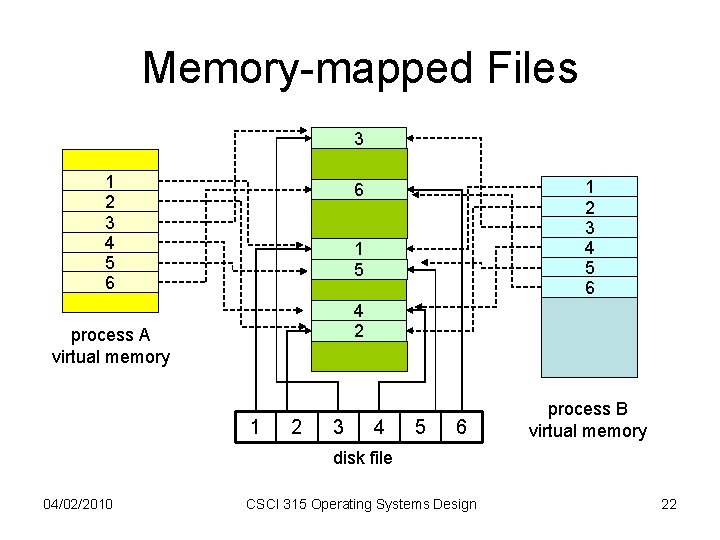
Memory-mapped Files • Memory mapping a file can be accomplished by mapping a disk block to one or more pages in memory. • A page-sized portion of the file is read from the file system into a physical page. Subsequent read() and write() operations are handled as memory (not disk) accesses. • Writing to the file in memory is not necessarily synchronous to the file on disk. The file can be committed back to disk when it’s closed. 04/02/2010 CSCI 315 Operating Systems Design 21
Memory-mapped Files 3 1 2 3 4 5 6 6 1 5 4 2 process A virtual memory 1 2 3 4 5 6 process B virtual memory disk file 04/02/2010 CSCI 315 Operating Systems Design 22
Prepaging • Prepaging: In order to avoid the initial number of page faults, the system can bring into memory all the pages that will be needed all at once. • This can also be applied when a swapped-out process is restarted. The smart thing to do is to remember the working set of the process. • One question that arises is whether all the pages brought in will actually be used… • Is the cost of prepaging less than the cost of servicing each individual page fault? 04/02/2010 CSCI 315 Operating Systems Design 23