
Alliances Objectives and Challenges 1 Objectives of Alliances
Alliances: Objectives and Challenges 1
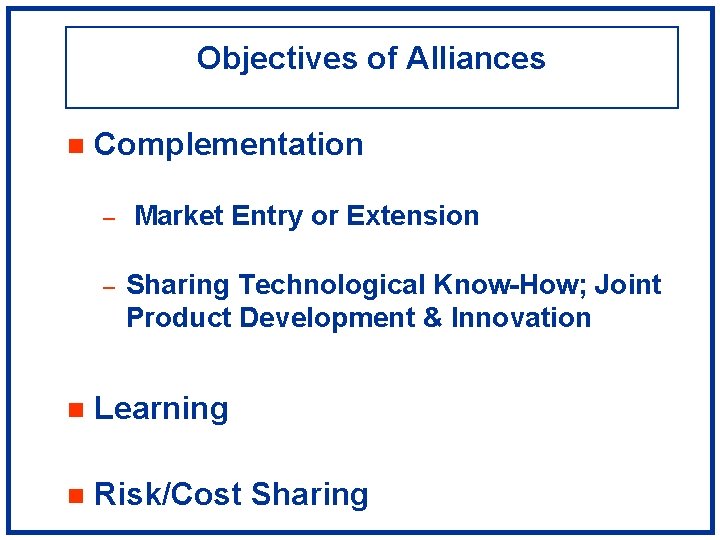
Objectives of Alliances n Complementation – – Market Entry or Extension Sharing Technological Know-How; Joint Product Development & Innovation n Learning n Risk/Cost Sharing
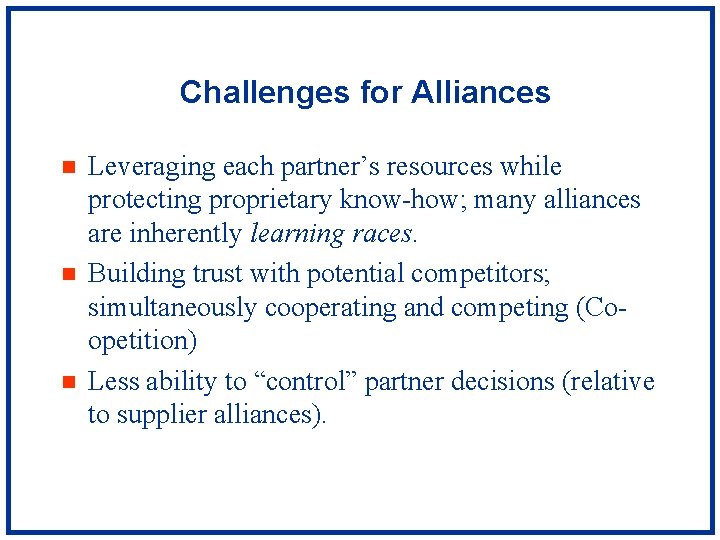
Challenges for Alliances n n n Leveraging each partner’s resources while protecting proprietary know-how; many alliances are inherently learning races. Building trust with potential competitors; simultaneously cooperating and competing (Coopetition) Less ability to “control” partner decisions (relative to supplier alliances).
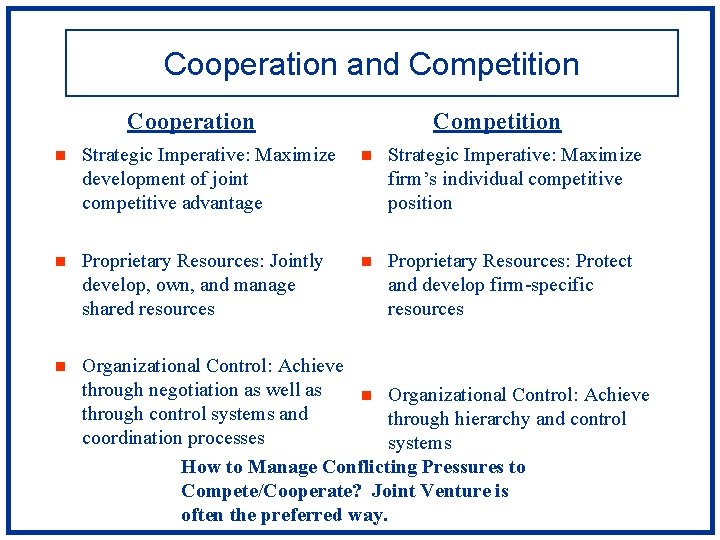
Cooperation and Competition Cooperation Competition n Strategic Imperative: Maximize development of joint competitive advantage n Strategic Imperative: Maximize firm’s individual competitive position n Proprietary Resources: Jointly develop, own, and manage shared resources n Proprietary Resources: Protect and develop firm-specific resources n Organizational Control: Achieve through negotiation as well as n Organizational Control: Achieve through control systems and through hierarchy and control coordination processes systems How to Manage Conflicting Pressures to Compete/Cooperate? Joint Venture is often the preferred way.
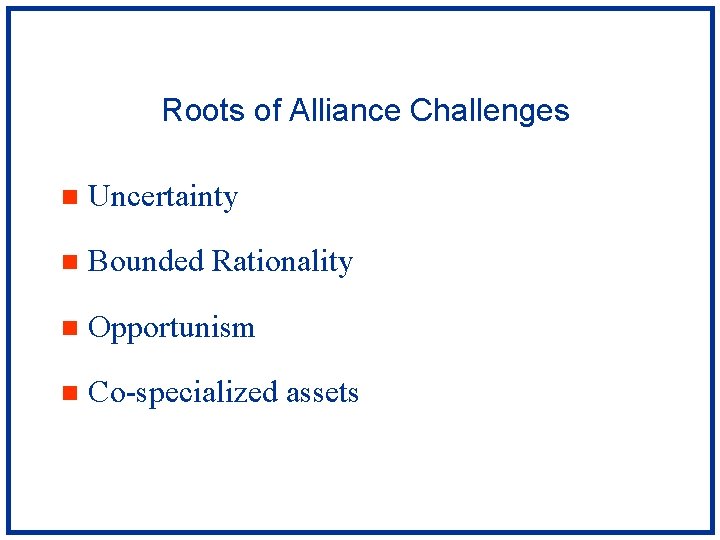
Roots of Alliance Challenges n Uncertainty n Bounded Rationality n Opportunism n Co-specialized assets
n What are the keys to successful alliances? 6
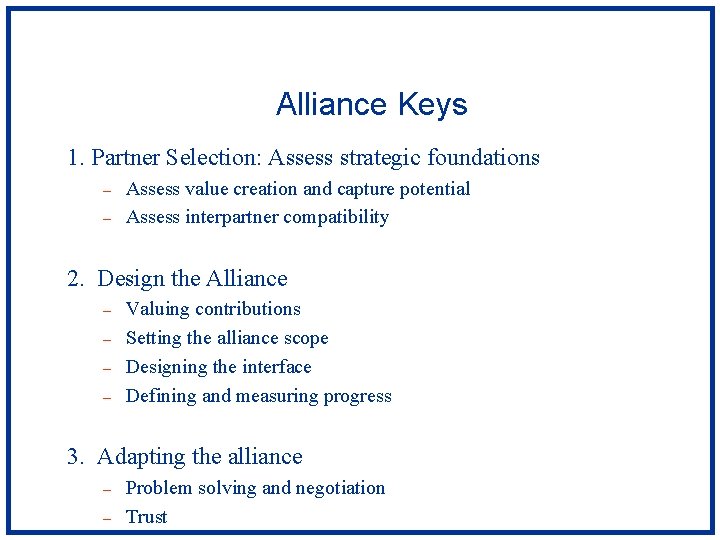
Alliance Keys 1. Partner Selection: Assess strategic foundations – – Assess value creation and capture potential Assess interpartner compatibility 2. Design the Alliance – – Valuing contributions Setting the alliance scope Designing the interface Defining and measuring progress 3. Adapting the alliance – – Problem solving and negotiation Trust
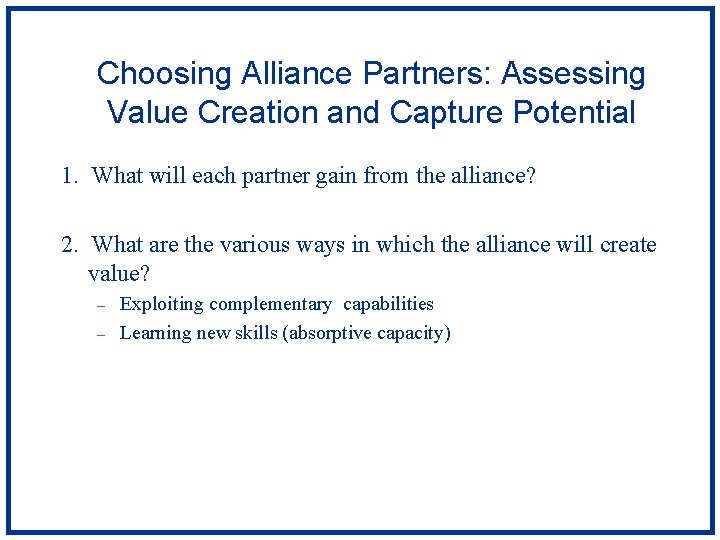
Choosing Alliance Partners: Assessing Value Creation and Capture Potential 1. What will each partner gain from the alliance? 2. What are the various ways in which the alliance will create value? – – Exploiting complementary capabilities Learning new skills (absorptive capacity)
Assessing Partner Compatibility: Stakes, Ambitions, Compatibility 1. Do you understand the strategic stakes of your partners? 2. Are partners really in different competitive spaces or market rivals? 3. What are the strategic ambitions of your partner?
Designing Alliances: Valuing Contributions 1. How clearly can you connect alliance results to partners’ contributions? 2. How do you handle shifts in the relative value of partners’ contributions over time? – – – Can you fully plan the alliance at its inception? Does the alliance require a series of commitments over time? Do you think of the alliance as an evolving, flexible partnership?
Trust: A Typology and its Applications. . . n Trust as the “magic ingredient” n Meaning of trust if often not clear n Costs and problems of trust as governance are ignored
Overview of Trust n Define trust n Trust types n Application of trust types -- When are various trust types efficient or inefficient? n Dark side of trust
Defining Trust “the reliance by one person, group, or firm upon a voluntary accepted duty on the part of another person, group, or firm to recognize and protect the rights and interests of all others engaged in a joint endeavor or economic exchange. ” (Hosmer, 1995) n Definition is broad –agency and risk
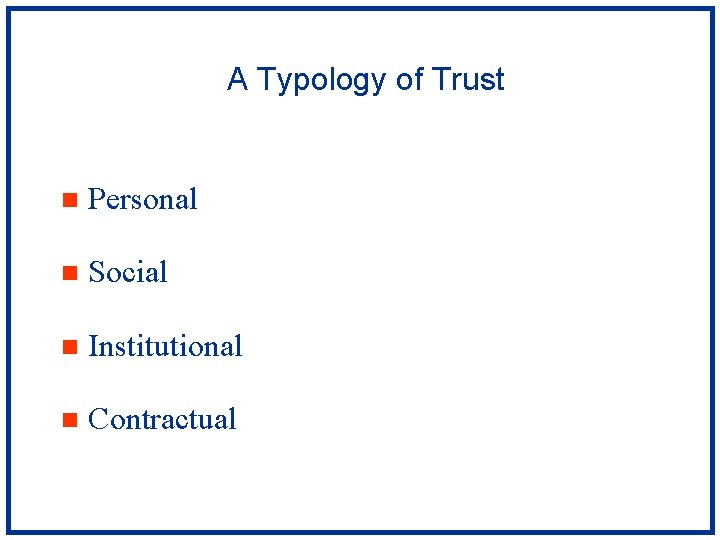
A Typology of Trust n Personal n Social n Institutional n Contractual
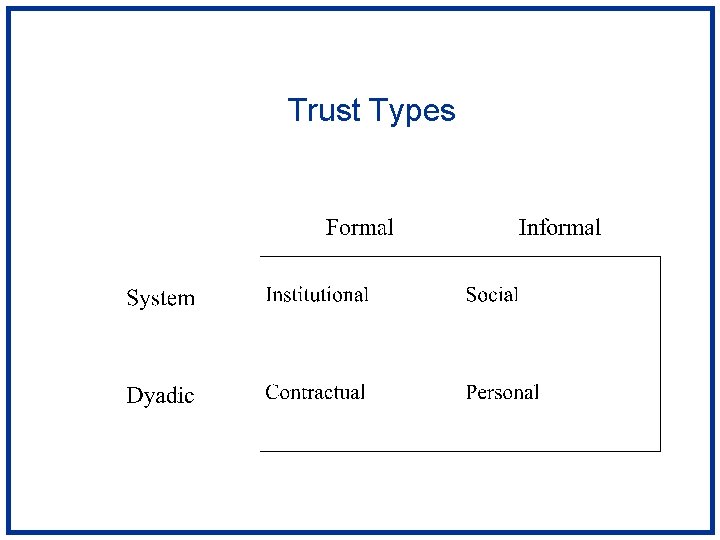
Trust Types
Personal Trust n Dyadic n Goodwill – Identification n Direct personal interaction
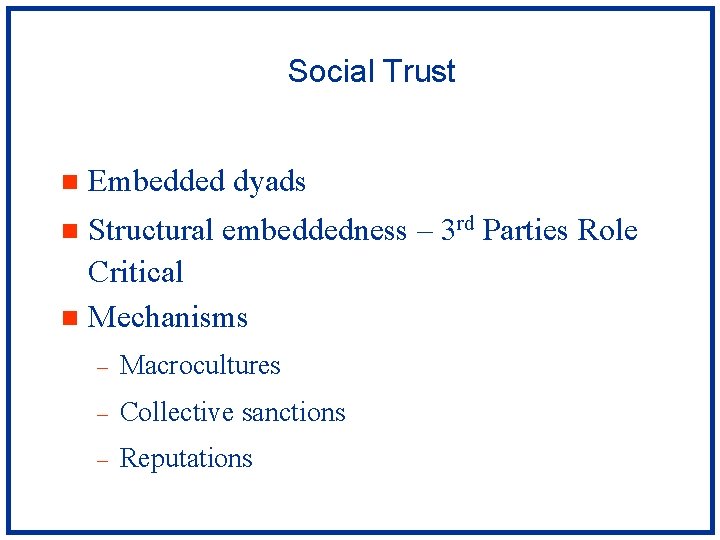
Social Trust n Embedded dyads Structural embeddedness – 3 rd Parties Role Critical n Mechanisms n – Macrocultures – Collective sanctions – Reputations
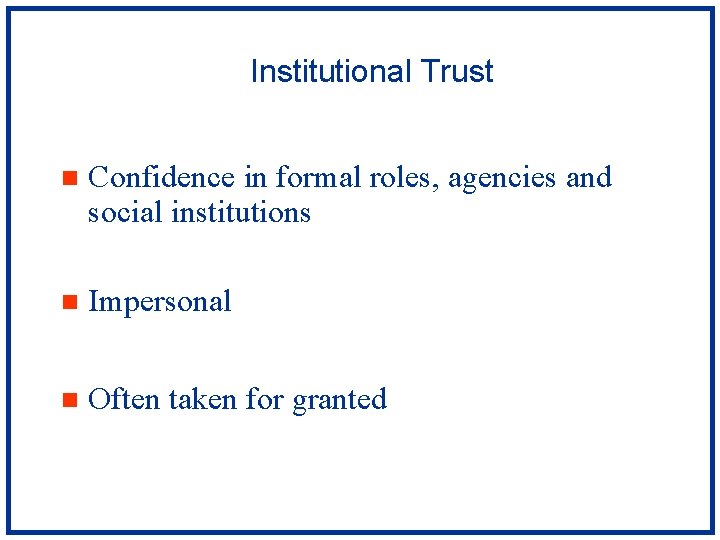
Institutional Trust n Confidence in formal roles, agencies and social institutions n Impersonal n Often taken for granted
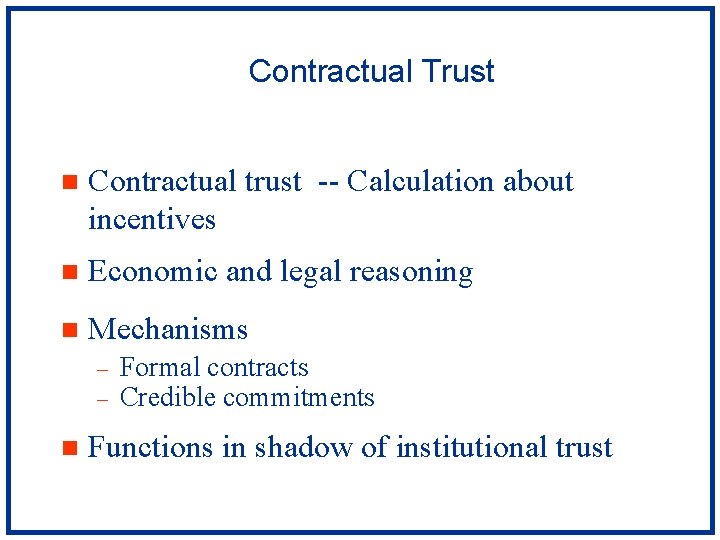
Contractual Trust n Contractual trust -- Calculation about incentives n Economic and legal reasoning n Mechanisms – – n Formal contracts Credible commitments Functions in shadow of institutional trust
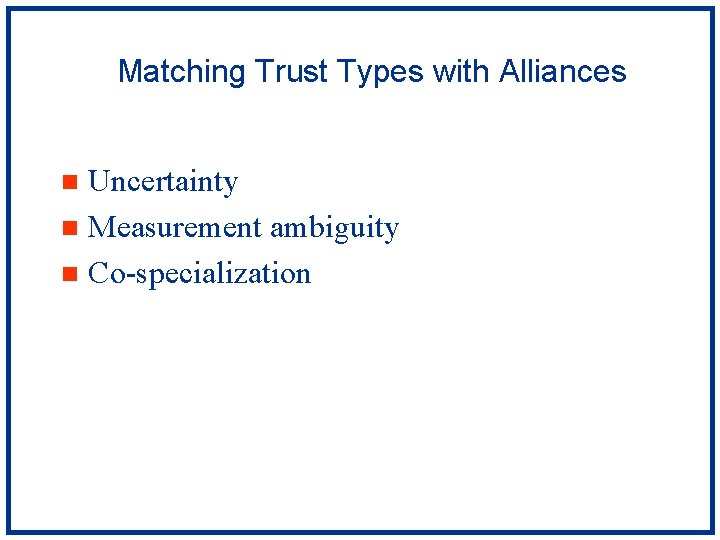
Matching Trust Types with Alliances Uncertainty n Measurement ambiguity n Co-specialization n
Dark Side of Trust n Paradox of trust n Cost of trust
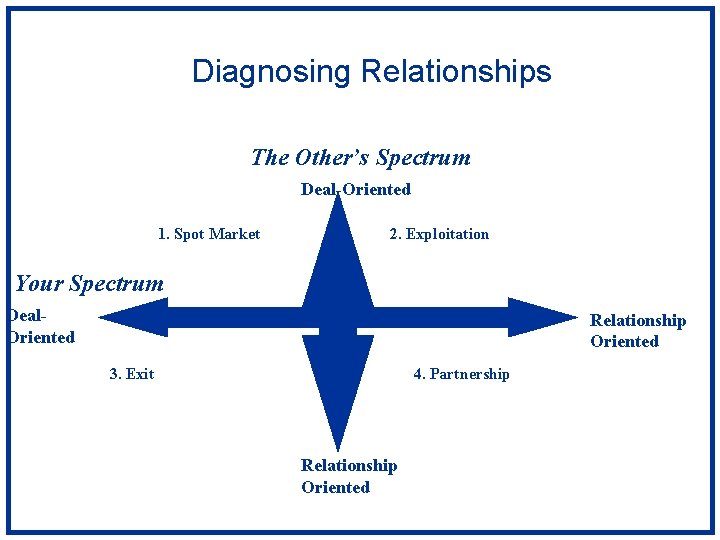
Diagnosing Relationships The Other’s Spectrum Deal-Oriented 1. Spot Market 2. Exploitation Your Spectrum Deal. Oriented Relationship Oriented 3. Exit 4. Partnership Relationship Oriented
- Slides: 22