
Allergic Reaction in a Female High School Softball

Allergic Reaction in a Female High School Softball Player Casie Mc. Ginness Chelsie Michael Wenatchee High School
Background Our subject is a 16 year-old female softball player. She was taken to the emergency room on June 17, 2009 for a possible drug allergic reaction/interaction. She had been taking Lamictal for four weeks for what now appears to be an incorrect diagnosis of a “possible mild bipolar disorder” and Cefadroxil for two weeks for minor illness causing lymph node swelling.
Background (con’t) She returned to her pediatrician the following day with peeling of the lips and increasing macular rash involving the trunk. The pediatrician recommended OTC Benadryl 50 mg. t. i. d. She was advised to return to the E. R. if she had breathing difficulties.
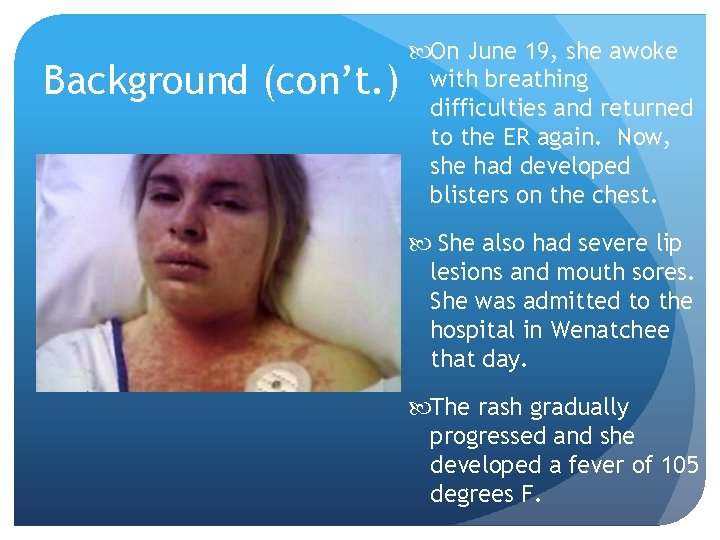
Background (con’t. ) On June 19, she awoke with breathing difficulties and returned to the ER again. Now, she had developed blisters on the chest. She also had severe lip lesions and mouth sores. She was admitted to the hospital in Wenatchee that day. The rash gradually progressed and she developed a fever of 105 degrees F.
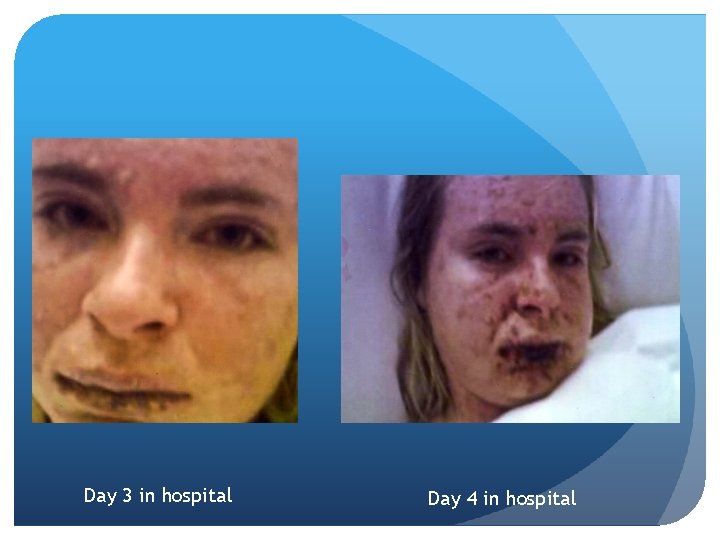
Day 3 in hospital Day 4 in hospital
Differential Diagnoses Stevens-Johnson syndrome, Transdermal Epidermal Necrolysis, viral exanthems, toxic shock/toxic strep syndrome, exfoliative erythroderma, staphylococcal scalded skin syndrome, Kawasaki disease.
Diagnosis Diagnostics included a chest x-ray that was negative. Urinalysis was also negative. CBC was normal. Based upon the patient’s history of new medications and physical signs/symptoms, the diagnosis of Stevens-Johnson Syndrome (SJS), a life-threatening skin disease that causes rash, skin peeling, and sores on the mucous membranes, was made.
Treatment She was started on morphine, Benadryl, Cipro Zithromax, and Ativan intravenously. Despite this, she continued to have fevers of 104 -105 degrees F. The rash gradually increased in size (>35% skin involvement) which put the subject in the advanced category of Toxic Epidermal Necrolysis (TEN). The lesions were positive for staphylococcus aureus.

Treatment (con’t. ) After consultation with specialists at Harborview Medical in Seattle, Washington, she was transported to the center’s burn unit on June 24, 2009, after six days in the hospital in Wenatchee. Upon arrival in Seattle, she was immediately taken to the operating room where 1, 000 sq/cm. of skin was debrided.
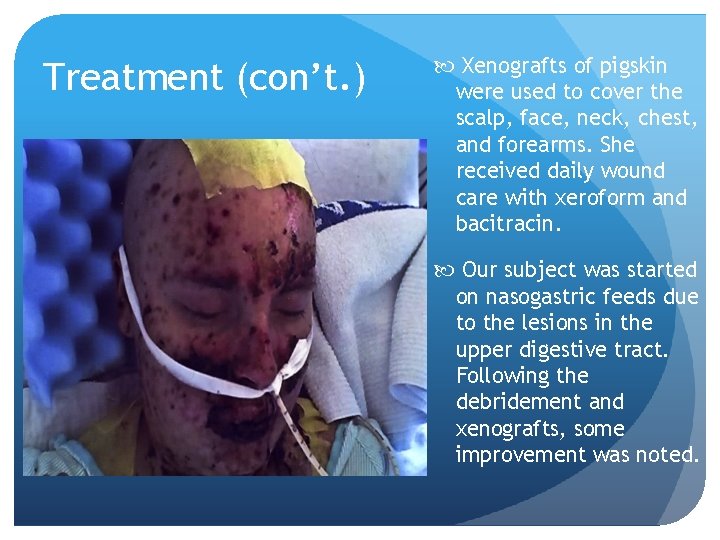
Treatment (con’t. ) Xenografts of pigskin were used to cover the scalp, face, neck, chest, and forearms. She received daily wound care with xeroform and bacitracin. Our subject was started on nasogastric feeds due to the lesions in the upper digestive tract. Following the debridement and xenografts, some improvement was noted.
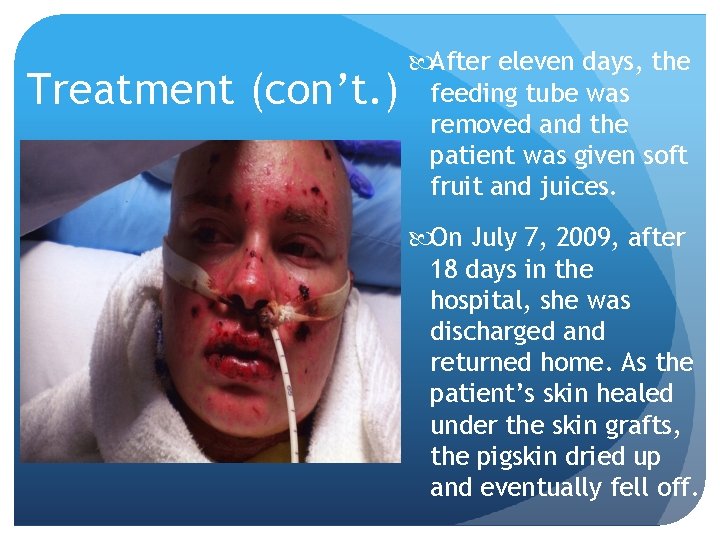
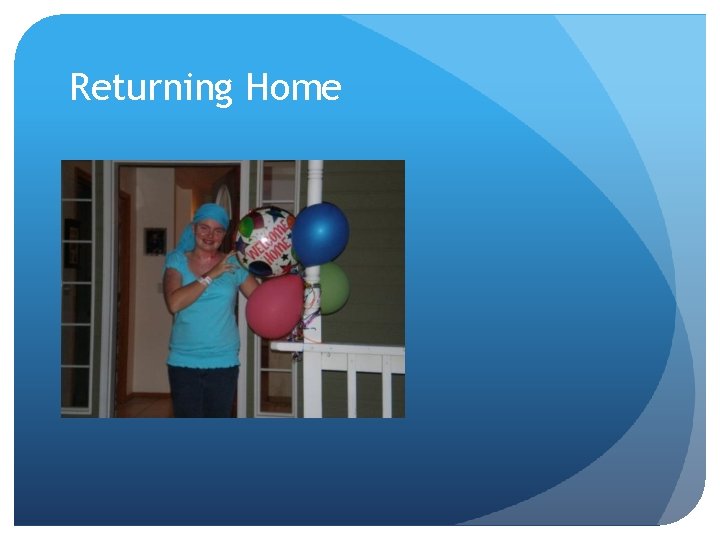
Treatment (con’t. ) After eleven days, the feeding tube was removed and the patient was given soft fruit and juices. On July 7, 2009, after 18 days in the hospital, she was discharged and returned home. As the patient’s skin healed under the skin grafts, the pigskin dried up and eventually fell off.
Returning Home
Uniqueness Stevens-Johnson syndrome is a rare condition, with a reported incidence of about 2. 6 -6. 1 per million people/year. There are still unanswered questions with this case including: Why was this reaction so severe to these medications? Was this a drug interaction or a single drug reaction? Why was the patient’s upper body more dramatically affected than her lower body?
Uniqueness (con’t) Stevens-Johnson syndrome is an immunecomplex–mediated hypersensitivity disorder that may be caused by medications, viral infections, and malignancies. Pathologically, cell death results causing separation of the epidermis from the dermis.
Conclusions Our subject has recovered remarkably well with only minimal scarring. However, the SJS/TEN did trigger rheumatoid arthritis primarily in her knees and ankles that causes considerable pain and dysfunction. Following her time in the hospital, she lost her fingernails. They have now grown back. Her vision has also deteriorated and she now requires fluorometholone (steroid) eye drops.
Conclusions It has also been estimated that she has a 95% chance of miscarrying due to the reproductive system damage caused by the SJS/TEN. She is now required to have good skin cover and high SPF sunscreen for the rest of her life. She was advised to stay out of hot tubs, due to the hot temperature and chlorine, as well as swimming pools due to chlorine.
Despite what was going on, our patient kept a positive outlook and found the humor in all situations…
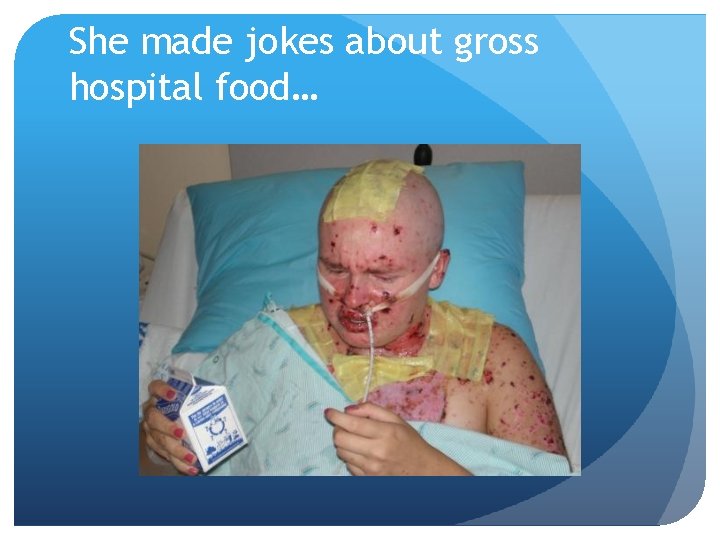
She made jokes about gross hospital food…
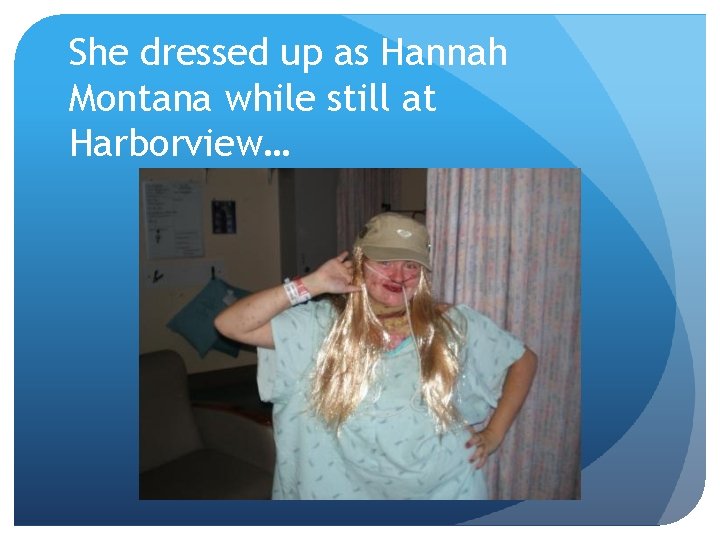
She dressed up as Hannah Montana while still at Harborview…
She threw washcloths at friends who didn’t seem to make them cold enough for her… And finally, she continuously pressed her “magic” morphine button when it just didn’t come fast enough for her, even when she was told she had to wait another half an hour…

Now today, our patient is doing great and is looking forward to attending college next year and pursuing a career as a music therapist!

Thank You!
- Slides: 22