
Allegory Symbolism Review A Symbol is an ordinary
Allegory
Symbolism Review • A Symbol is an ordinary object, event, person, or animal to which we have attached extraordinary meaning and significance.
Why Create Symbols in literature? • Symbols allow writers to: • suggest layers of meanings and possibilities that a simple literal statement could not convey as well • convey a complex idea without having to explain each detail • A symbol is like a pebble cast into a pond: It sends out ever widening ripples.
Allegory • An allegory is… • A specific type of symbolism where the characters, settings and actions stand for something beyond themselves. • Types of Allegories: • characters and setting represent abstract ideas of moral qualities • characters and situations stand for historical figures and events
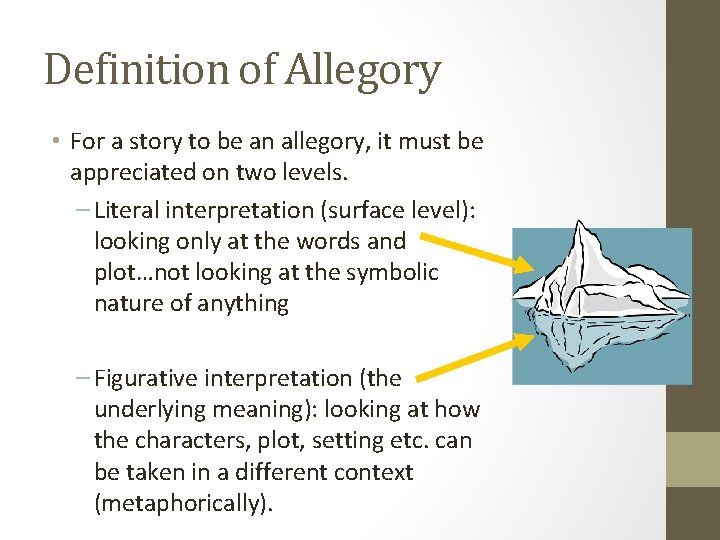
Definition of Allegory • For a story to be an allegory, it must be appreciated on two levels. – Literal interpretation (surface level): looking only at the words and plot…not looking at the symbolic nature of anything – Figurative interpretation (the underlying meaning): looking at how the characters, plot, setting etc. can be taken in a different context (metaphorically).
Allegory • The meaning is hidden beneath the surface may become apparent only after close analysis.
Allegory • Allegories such as John Bunyan’s Pilgrim’s Progress, Jonathan Swift’s Gulliver’s Travels, and George Orwell’s Animal Farm can be read literally and enjoyed by children. • Gulliver’s Travels and Animal Farm both serve as political allegories, while Pilgrim’s Progress, like the Divine Comedy, is a religious allegory depicting the Christian’s journey through life’s temptations.
The Allegory of the Journey • The allegory of the journey was a particularly important in the medieval period, which was steeped in Christian values. • The allegorical journey also appears in many modern literary works, for example, Mark Twain’s Adventures of Huckleberry Finn.
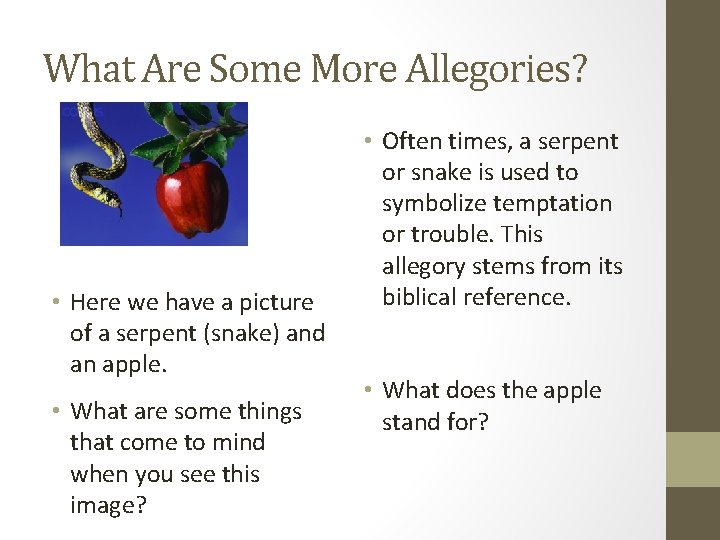
What Are Some More Allegories? • Here we have a picture of a serpent (snake) and an apple. • What are some things that come to mind when you see this image? • Often times, a serpent or snake is used to symbolize temptation or trouble. This allegory stems from its biblical reference. • What does the apple stand for?

Symbolism vs. Allegory • A symbol is a word, place, character, or object that means something beyond what it is on a literal level. • An allegory involves using many interconnected symbols or allegorical figures in such as way that in nearly every element of the narrative has a meaning beyond the literal level, i. e. , everything in the narrative is a symbol that relates to other symbols within the story.
Symbolism vs. Allegory Symbol: • can be an event, place, character or object that has significance or importance. Allegory: • connects many symbols within the story to one another; producing a deeper meaning.
Independent Practice • Think of a movie or book that utilizes a symbol (you cannot use an example from this Power. Point!) 1. 2. 3. 4. Name the movie/book Identify the symbol Identify the literal meaning of the symbol Identify the figurative (symbolic) meaning of the symbol 5. Explain why the symbol was used
- Slides: 12