
Allegory An Allegory is a story in which
- Slides: 5
Allegory An Allegory is a story in which characters, settings and actions stand for something beyond themselves. In some types of Allegories, the characters and setting represent abstract ideas of moral qualities. In other types, characters and situations stand for historical figures and events.
Examples of Allegories An Allegory can be read on one level for its literal or straightforward meaning Example: The Wizard of Oz was literally about Dorothy’s journey as she tried to find her way home An allegory can be read for its symbolic, or allegorical meaning Example: The Wizard of Oz was symbolically a satirical representation of the Gilded Age of America Allegories are often intended to teach a moral lesson or make a comment about goodness and depravity.
Some famous allegorical stories/movies/television programs are: Animal Farm The Lion, The Witch, and The Wardrobe The Wizard of Oz Avatar The Pandora woods is a lot like the Amazon rainforest (the movie stops in its tracks for a heavy ecological speech or two), and the attempt to get the Na'vi to 'cooperate' carries overtones of the U. S. involvement in Iraq and Afghanistan. " The Matrix Of Mice and Men
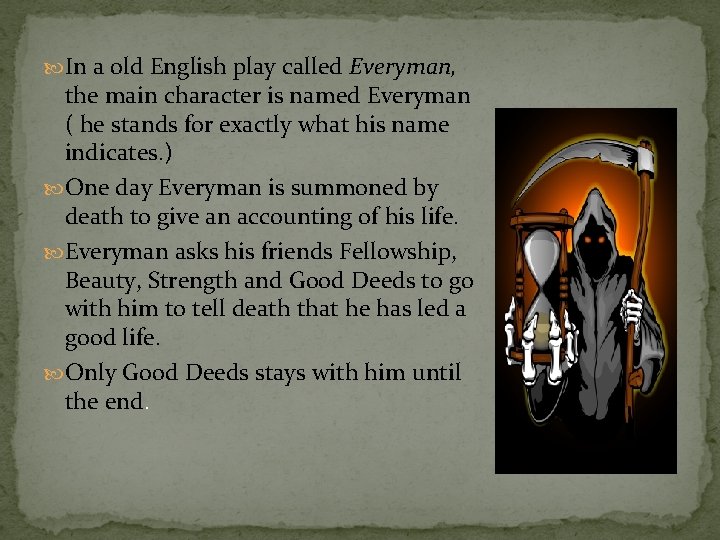
In a old English play called Everyman, the main character is named Everyman ( he stands for exactly what his name indicates. ) One day Everyman is summoned by death to give an accounting of his life. Everyman asks his friends Fellowship, Beauty, Strength and Good Deeds to go with him to tell death that he has led a good life. Only Good Deeds stays with him until the end.
Symbolism vs. Allegory A symbol can be a word, place, character or object that means something beyond what it is on a literal level. An allegory involves using many interconnected symbols or allegorical figures in such a way that nearly every element of the narrative has a meaning beyond the literal level, i. e. , everything in the narrative is a symbol that relates to other symbols within the story.