
Allanblackia Integrated Domestication Strategy West and Central Africa
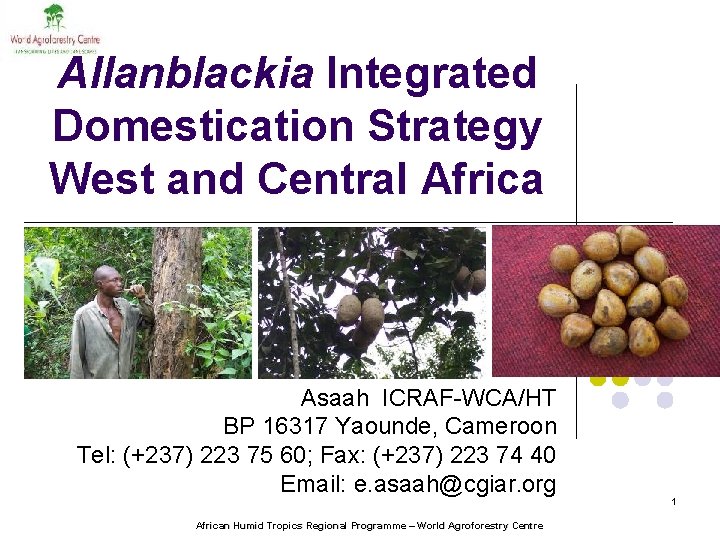
Allanblackia Integrated Domestication Strategy West and Central Africa Asaah ICRAF-WCA/HT BP 16317 Yaounde, Cameroon Tel: (+237) 223 75 60; Fax: (+237) 223 74 40 Email: e. asaah@cgiar. org African Humid Tropics Regional Programme – World Agroforestry Centre 1
Topics for discussion Background l Main Components of Domestication l Allanblackia Domestigram l Partnerships l Management and Coordination l Lessons Learnt l Development of a national strategy l 2 African Humid Tropics Regional Programme – World Agroforestry Centre
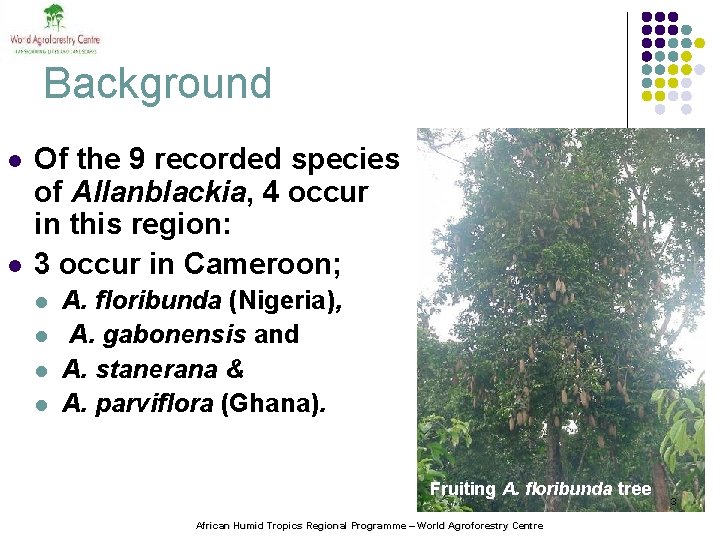
Background l l Of the 9 recorded species of Allanblackia, 4 occur in this region: 3 occur in Cameroon; l l A. floribunda (Nigeria), A. gabonensis and A. stanerana & A. parviflora (Ghana). Fruiting A. floribunda tree African Humid Tropics Regional Programme – World Agroforestry Centre 3
Main Components of Domestication l Some specificity of agroforestry trees for domestication - Allanblackia l l l l l Species with threatened habitats and populations Limited knowledge on propagation Limited knowledge on management Incomplete knowledge on nutritional qualities No formal varieties Traditional use based on wild harvest Timid promotional campaigns Limited product development Limited market information systems 4 African Humid Tropics Regional Programme – World Agroforestry Centre
l l l l Review and collation of available literature on Allanblackia species. Determination of natural distribution and zones of abundance of each species. Development of germplasm collection and conservation strategies. Assessment of genetic diversity through molecular, biophysical & chemical characterisation studies. Development of suitable clonal propagation methods. Determine integration/diversification requirement of the species. Training and technical backstopping of stakeholders in the Allanblackia domestication initiative. 5 African Humid Tropics Regional Programme – World Agroforestry Centre
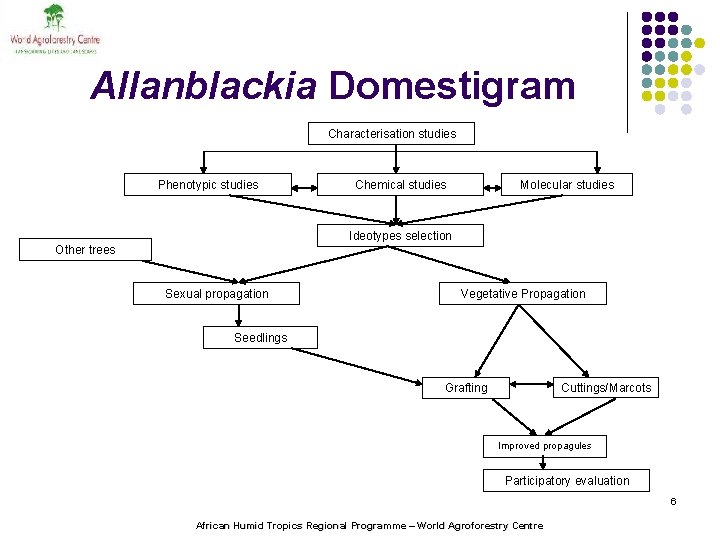
Allanblackia Domestigram Characterisation studies Phenotypic studies Chemical studies Molecular studies Ideotypes selection Other trees Sexual propagation Vegetative Propagation Seedlings Grafting Cuttings/Marcots Improved propagules Participatory evaluation CS of propagator African Humid Tropics Regional Programme – World Agroforestry Centre 6
Partnerships ICRAF-WCA l l l l Farmer Groups CBOs NGOs NARS Universities Private sectors In Ghana, Nigeria and Cameroon 7 African Humid Tropics Regional Programme – World Agroforestry Centre
Key elements in partnerships l Partners should be strategic l l Partnership appraisal l l On technical, policy and NRM domains. to assess how partners fit into the strategy and what mutual and complementary benefits could arise from such partnerships. Definition of specific roles and potential contributions of partners l e. g. Allanblackia domestication initiative 8 African Humid Tropics Regional Programme – World Agroforestry Centre
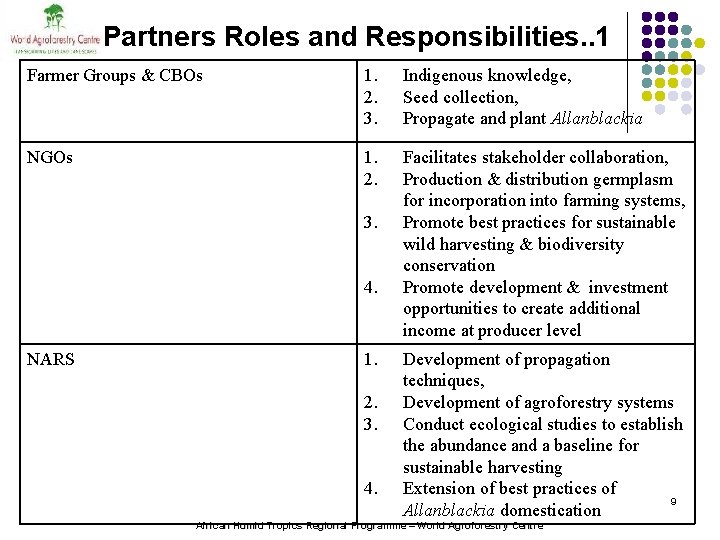
Partners Roles and Responsibilities. . 1 Farmer Groups & CBOs 1. 2. 3. Indigenous knowledge, Seed collection, Propagate and plant Allanblackia NGOs 1. 2. Facilitates stakeholder collaboration, Production & distribution germplasm for incorporation into farming systems, Promote best practices for sustainable wild harvesting & biodiversity conservation Promote development & investment opportunities to create additional income at producer level 3. 4. NARS 1. 2. 3. 4. Development of propagation techniques, Development of agroforestry systems Conduct ecological studies to establish the abundance and a baseline for sustainable harvesting Extension of best practices of 9 Allanblackia domestication African Humid Tropics Regional Programme – World Agroforestry Centre
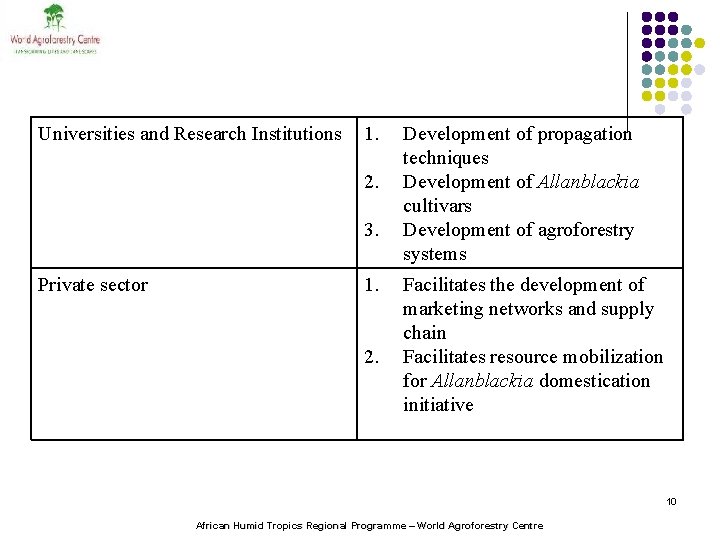
Universities and Research Institutions 1. 2. 3. Private sector 1. 2. Development of propagation techniques Development of Allanblackia cultivars Development of agroforestry systems Facilitates the development of marketing networks and supply chain Facilitates resource mobilization for Allanblackia domestication initiative 10 African Humid Tropics Regional Programme – World Agroforestry Centre
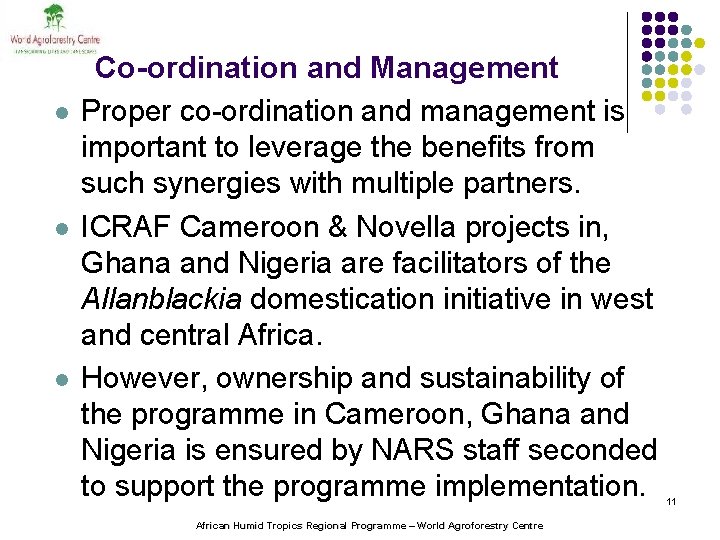
l l l Co-ordination and Management Proper co-ordination and management is important to leverage the benefits from such synergies with multiple partners. ICRAF Cameroon & Novella projects in, Ghana and Nigeria are facilitators of the Allanblackia domestication initiative in west and central Africa. However, ownership and sustainability of the programme in Cameroon, Ghana and Nigeria is ensured by NARS staff seconded to support the programme implementation. 11 African Humid Tropics Regional Programme – World Agroforestry Centre
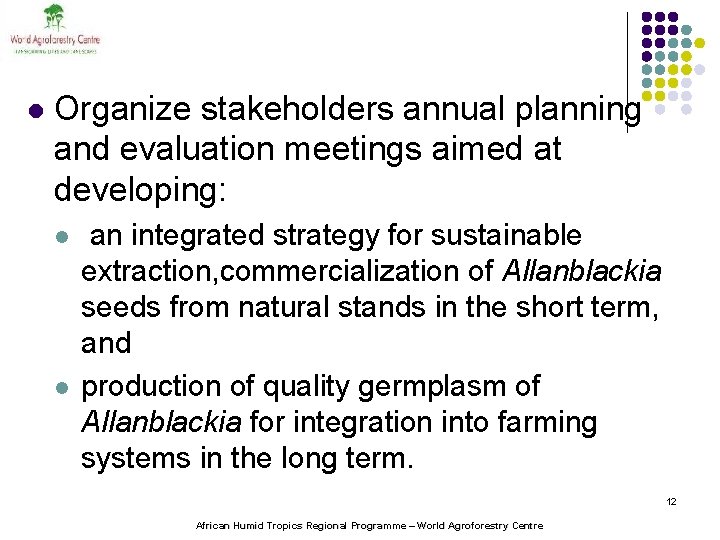
l Organize stakeholders annual planning and evaluation meetings aimed at developing: l l an integrated strategy for sustainable extraction, commercialization of Allanblackia seeds from natural stands in the short term, and production of quality germplasm of Allanblackia for integration into farming systems in the long term. 12 African Humid Tropics Regional Programme – World Agroforestry Centre
l Outcomes of planning meetings include: l l Specific roles and contributions of partners in the implementation of the Allanblackia domestication initiative established; Key stakeholders evaluate past activities and orientate future work as required. Partners and stakeholders present and consolidate yearly work plans and budgets. Elements for writing of yearly progress reports derived, gaps for further research identified and directions for further orientation of the domestication initiative and resource mobilisation strategies defined. 13 African Humid Tropics Regional Programme – World Agroforestry Centre
Organise technical backstopping l l Crucial for partners in the different countries playing a prominent role in empowering communities and farmer groups on Allanblackia domestication. Partners have to develop pilots in villages which will constitute future Allanblackia knowledge (Resource) centers in communities for dissemination of best practices of Allanblackia domestication 14 African Humid Tropics Regional Programme – World Agroforestry Centre
l l Allanblackia knowledge centers are being developed in Cameroon with partners who participated in germplasm collection, production, & biophysical characterization, Nigeria with partners who participated in a national tree domestication training course with emphasis on Allanblackia in July 2006. Tanzania following an Allanblackia domestication training course organized in July 2006 and Later in Ghana after similar plan training course. 15 African Humid Tropics Regional Programme – World Agroforestry Centre
Highlights of Training in Tanzania 16 African Humid Tropics Regional Programme – World Agroforestry Centre
Structure of Knowledge Center l 10 non mist propagators, germination beds, l quality seeds/seedlings of AB and a number of priority species, l stock plants plots established of AB and other priority species, l at least 10 selected female trees cut down for mass multiplication through vegetative propagation, l plants of AB and other priority species produced by sexual or vegetative propagation techniques, l demonstration plots of AB integrated with other priority species and l training materials on (nursery techniques, propagation methods, guidelines for tree integration and management etc. . ). African Humid Tropics Regional Programme – World Agroforestry Centre 17
Integration models for Allanblackia l l Allanblackia is not isolated but integrated in the domestication process of working trees (fruits, medicinal, culinary, fodder, fuel wood, timber…) on working landscapes (agricultural and degraded forest landscapes). Preliminary work done in Cameroon on Allanblackia integration under partial shade in secondary forest and under direct sunlight indicates that Allanblackia seedlings will required partial shade just like other local fruit trees. 18 African Humid Tropics Regional Programme – World Agroforestry Centre
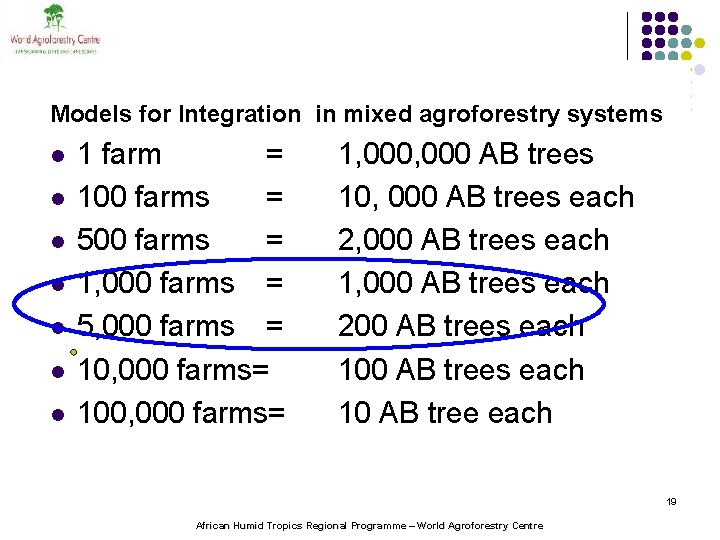
Models for Integration in mixed agroforestry systems l l l l 1 farm = 100 farms = 500 farms = 1, 000 farms = 5, 000 farms = 10, 000 farms= 100, 000 farms= 1, 000 AB trees 10, 000 AB trees each 2, 000 AB trees each 1, 000 AB trees each 200 AB trees each 10 AB tree each 19 African Humid Tropics Regional Programme – World Agroforestry Centre
Lesson learnt and gaps 1. An integrated domestication strategy to guide the Allanblackia domestication initiative has been developed and is in place. Various components of the strategy e. g. development of suitable propagation methods, characterization studies and integration models are being implemented at varying levels in Cameroon, Ghana, Nigeria and Tanzania. 20 African Humid Tropics Regional Programme – World Agroforestry Centre
2. Biophysical characterization methods have been developed, and descriptors for the predication of nut traits from fruit traits (fruit size=high number of nuts) identified. These results will gradually be applied in the selection of mother trees for germplsam and fruit collection in the different countries. 21 African Humid Tropics Regional Programme – World Agroforestry Centre
3. Solid and strategic partnerships developed, however, there should be a clear definition of roles and responsibilities among and between partners in the Allanblackia domestication initiative. 4. The need to facilitate the creation of Allanblackia knowledge centers in communities that will play the key role of dissemination of knowledge on best practices of Allanblackia domestication. 5. Develop a sustainable funding mechanism for Allanblackia domestication initiative. 22 African Humid Tropics Regional Programme – World Agroforestry Centre
Development of a national strategy specific to Cameroon l l Since domestication is a farmer driven and market led process, it is important that mechanisms to put in place to establish a supply chain for Allanblackia seeds in Cameroon. In the absence of an alternative wide scale local use for the seeds, the non-existence of the supply chain is a disincentive for Allanblackia cultivation in Cameroon and all awareness efforts on the species might not make a difference in the eyes of farmers. 23 African Humid Tropics Regional Programme – World Agroforestry Centre
- Slides: 23