
All You Need to Know about Poetry What
All You Need to Know about Poetry (What more could you ask for? )
Verse Any single line of poetry Any composition in lines of more or less regular rhythm—in contrast to prose,
Paraphrase Put into your own words what the poet is trying to say (usually done line-by-line)
Theme, Subject, Tone, Speaker Tone: The poet’s attitude Theme: The overall message toward the subject Speaker: The imaginary of the poem voice assumed by the writer of the poem. Subject: Who or what the poem Can be a person, animal, thing, or abstraction. is about
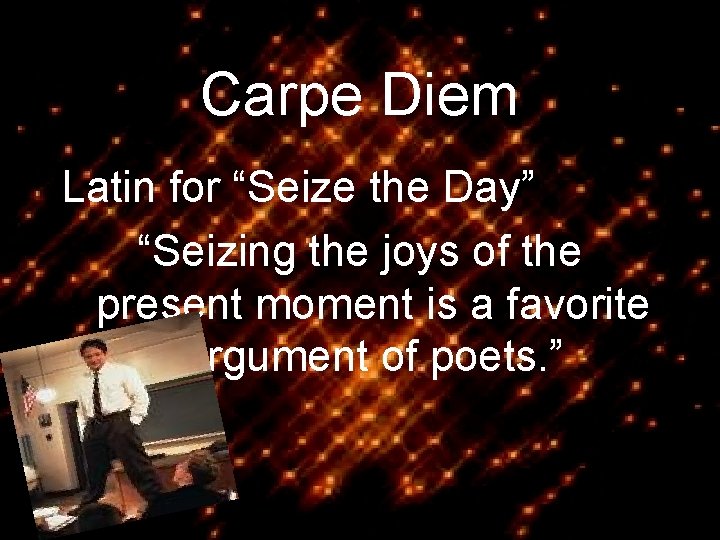
Carpe Diem Latin for “Seize the Day” “Seizing the joys of the present moment is a favorite argument of poets. ”

Lyric Poetry • A short poem expressing the thoughts and feelings of a singular speaker. • Often written in the first person. • Traditionally has a songlike immediacy and emotion
Narrative Poetry • Poem that tells a story • Common forms: ballads and epics (Remember good old Odysseus? )
Dramatic Poetry • Presents the voice of an imaginary character speaking directly, without any additional narration by the author. • Ex. : “My Last Duchess” and pretty much anything by Shakespeare.
Dramatic Monologue • Poem written as a speech made by a character at some decisive moment. • Speaker usually addresses a silent listener. • Again, “My Last Duchess” could be used as an example.
Didactic Poetry • Poem apparently written to state a message or teach a body of knowledge. • Poem that aims for education over art. • Ex. Many famous works
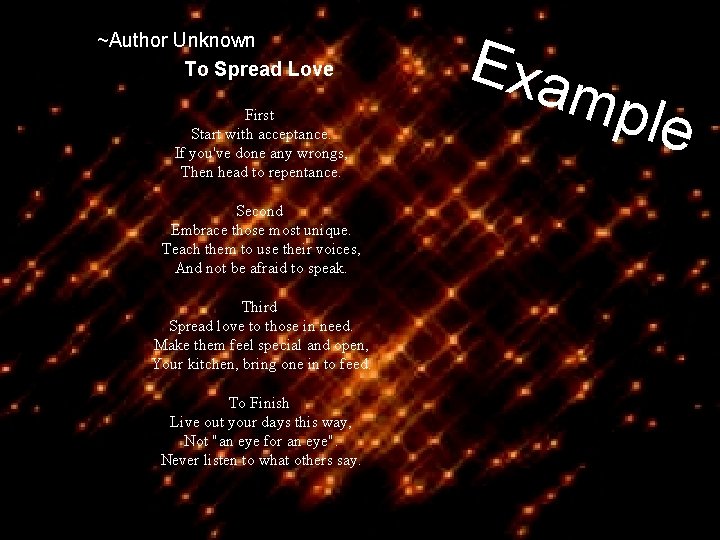
~Author Unknown To Spread Love First Start with acceptance. If you've done any wrongs, Then head to repentance. Second Embrace those most unique. Teach them to use their voices, And not be afraid to speak. Third Spread love to those in need. Make them feel special and open, Your kitchen, bring one in to feed. To Finish Live out your days this way, Not "an eye for an eye". Never listen to what others say. Exa mpl e

Satiric Poetry • Blends criticism with humor to convey a message. • Characteristically uses irony to make its points. • Usually, it’s the tone of detached amusement, withering
Persona • A fictitious character • This is not the poet, but the poet’s creation!
Figures of Speech • Simile: Comparing two unlike things using like or as • Metaphor: Comparing to unlike things without using like or as • Personification: a thing, an animal, or an abstract term is made human.
• Apostrophe: a way of addressing someone or something invisible or not ordinarily spoken to • Hyperbole: Exaggeration used to emphasize a point. • Metonymy: name of a thing is substituted for that of another closely associated
So De und vic es • Alliteration: the repetition of the same consonant sound at the beginning of successive words “Round and round the rugged rocks the ragged rascal man”
Sou n Dev d ices Assonance: the repetition of a vowel sound within words. Exact Rhyme: sounds following the vowel sound have to be the same
Types of Rhyme Exact Rhyme: Sounds following the vowel sound have to be the same Red/Bread Wealthily/Stealthily Walk/Talk Slant Rhyme (Near Rhyme, Off Rhyme, Imperfect Rhyme, Almost Rhyme): if final consonant sounds are the same but the vowel sounds are different Sun moon, rain, green, gone, thin
Consonance: A kind of slant rhyme that occurs when the rhymed words or phrases have the same beginning and ending consonant sounds but a different vowel Chitter/chatter Spoiled/spilled Reader/rider End Rhyme: rhyme that occurs at the end of lines Internal Rhyme: When words rhyme within lines Once upon a midnight dreary, while I pondered weak and weary.
Eye Rhyme: spellings that look alike but pronunciations differ Rough/Dough Idea/Flea Venus/Menus Not really a rhyme at all!
- Slides: 20