
All you always wanted to know about PSS

All you always wanted to know about PSS… Morteza Mansouri On behalf of Protection and Safety Systems Group www. europeanspallationsource. se
Content • What is a PSS function? • What is the PSS scope at ESS? • Standards & Legal Framework • Example of a Basic Safety System’s Architecture • Example of Granting Safe Access • The Desired Workflow to Implement a Safety Requirement • Summary 2
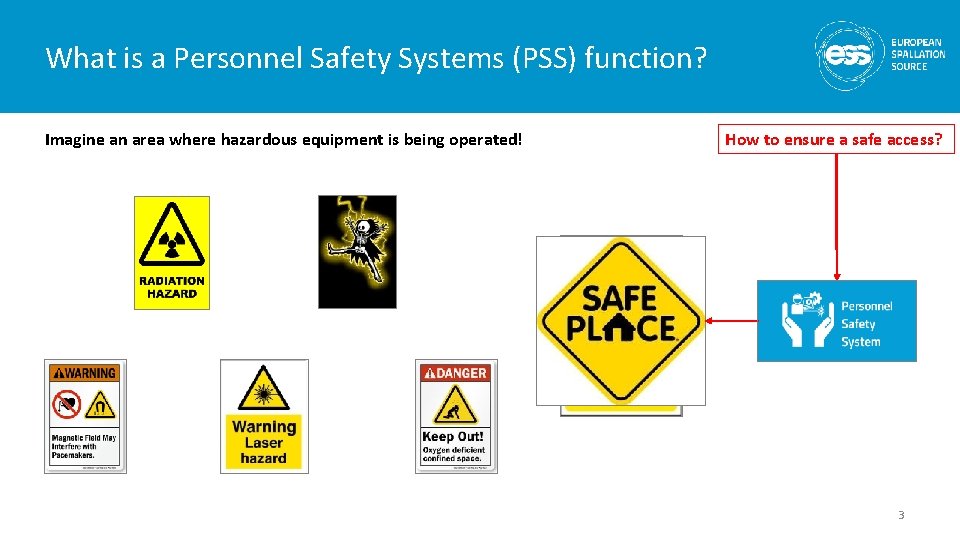
What is a Personnel Safety Systems (PSS) function? Imagine an area where hazardous equipment is being operated! How to ensure a safe access? 3
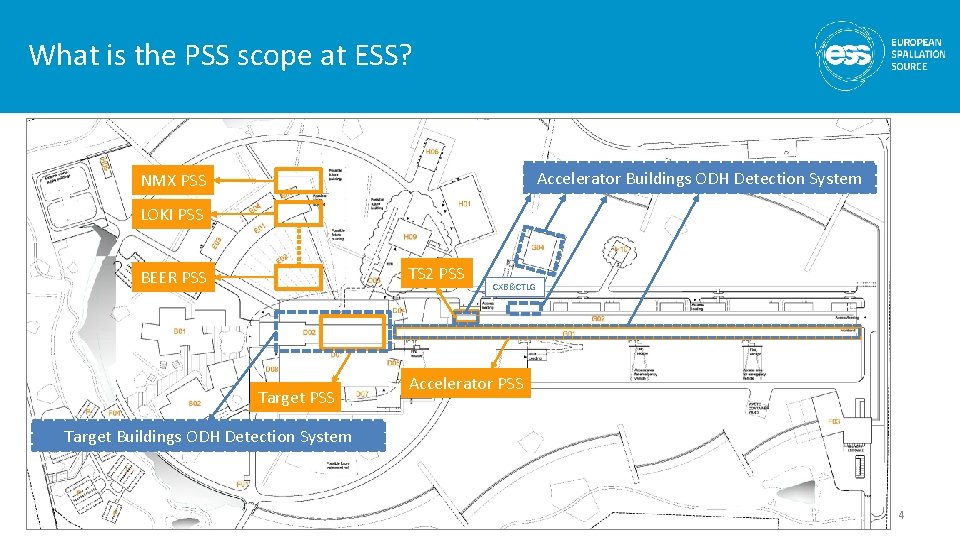
What is the PSS scope at ESS? Accelerator Buildings ODH Detection System NMX PSS LOKI PSS TS 2 PSS BEER PSS Target PSS CXB&CTLG Accelerator PSS Target Buildings ODH Detection System 4
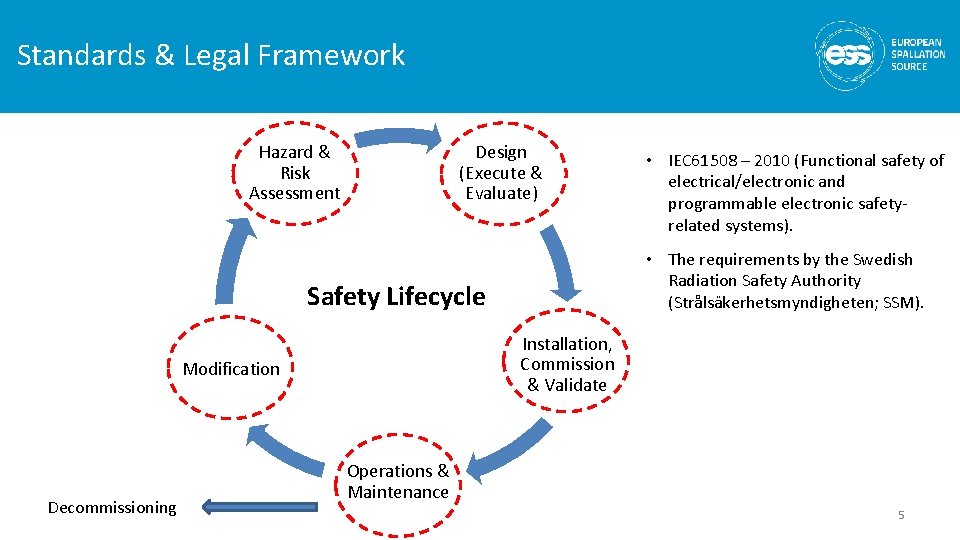
Standards & Legal Framework Hazard & Risk Assessment Design (Execute & Evaluate) • The requirements by the Swedish Radiation Safety Authority (Strålsäkerhetsmyndigheten; SSM). Safety Lifecycle Installation, Commission & Validate Modification Decommissioning • IEC 61508 – 2010 (Functional safety of electrical/electronic and programmable electronic safetyrelated systems). Operations & Maintenance 5
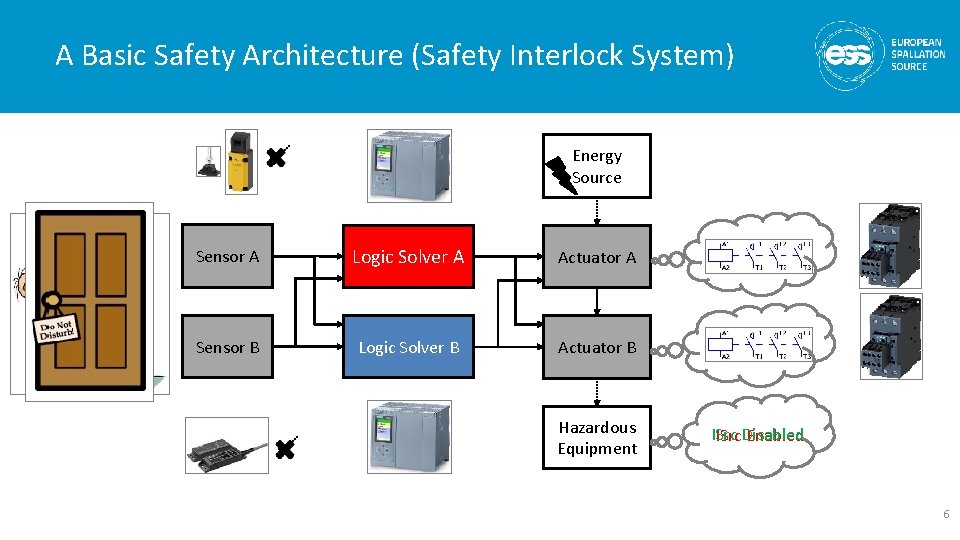
A Basic Safety Architecture (Safety Interlock System) Energy Source Sensor A Logic Solver A Actuator A Sensor B Logic Solver B Actuator B Hazardous Equipment ISrc. Disabled Enabled 6
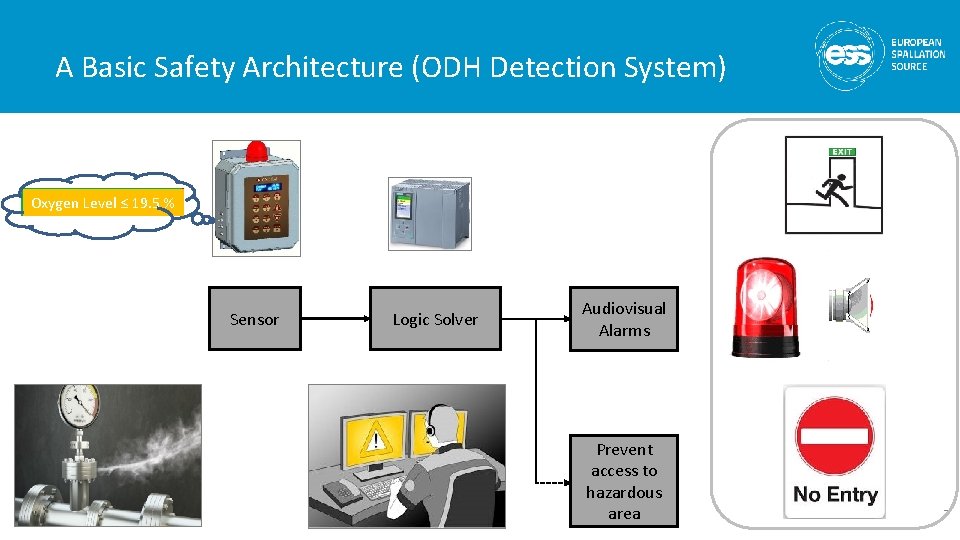
A Basic Safety Architecture (ODH Detection System) Oxygen Level >≤ 19. 5 18 %% 19. 5 % Sensor Logic Solver Audiovisual Alarms Prevent access to hazardous area 7
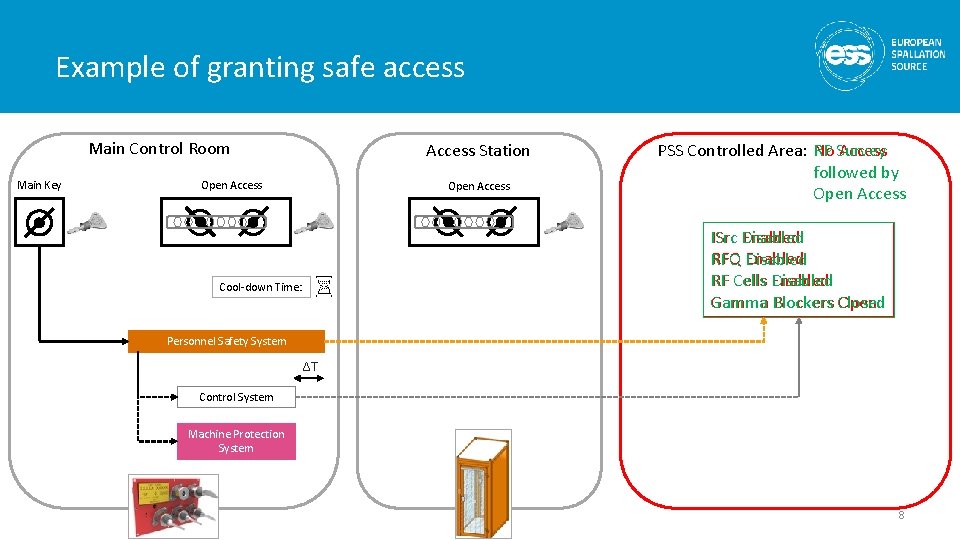
Example of granting safe access Main Control Room Main Key Access Station Open Access RP Survey Access PSS Controlled Area: No followed by Open Access Enabled ISrc Disabled Enabled RFQ Disabled Enabled RF Cells Disabled Gamma Blockers Closed Open Cool-down Time: Personnel Safety System ΔT Control System Machine Protection System 8
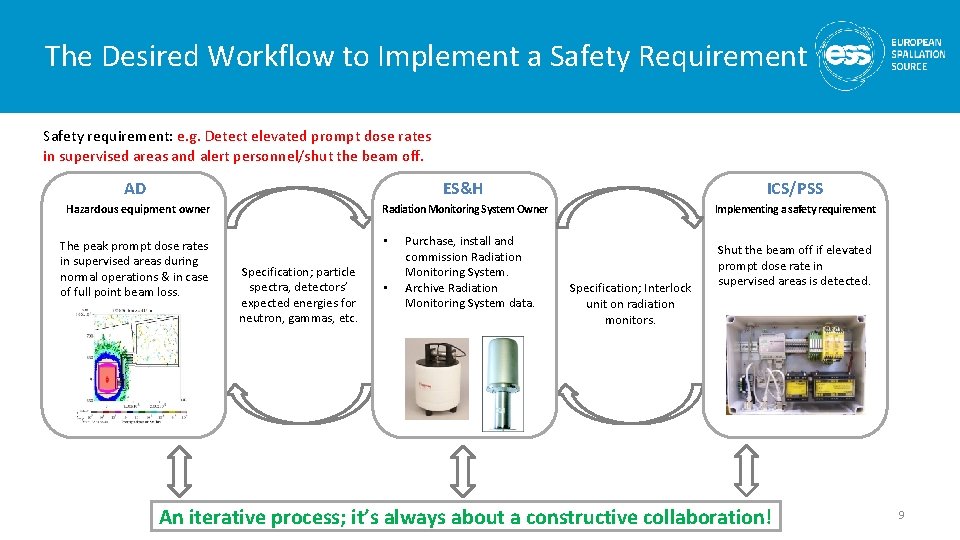
The Desired Workflow to Implement a Safety Requirement Safety requirement: e. g. Detect elevated prompt dose rates in supervised areas and alert personnel/shut the beam off. AD ES&H ICS/PSS Hazardous equipment owner Radiation Monitoring System Owner Implementing a safety requirement The peak prompt dose rates in supervised areas during normal operations & in case of full point beam loss. • Specification; particle spectra, detectors’ expected energies for neutron, gammas, etc. • Purchase, install and commission Radiation Monitoring System. Archive Radiation Monitoring System data. Specification; Interlock unit on radiation monitors. Shut the beam off if elevated prompt dose rate in supervised areas is detected. An iterative process; it’s always about a constructive collaboration! 9
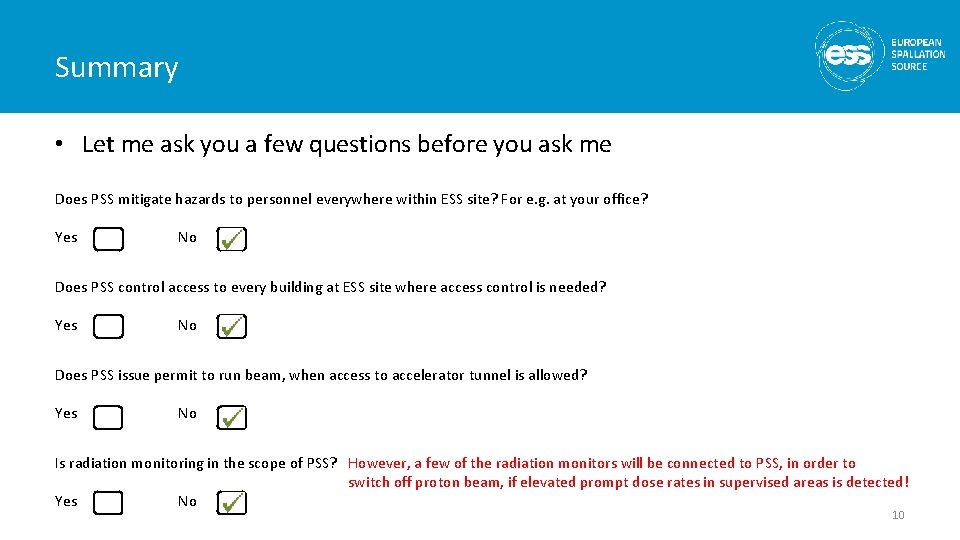
Summary • Let me ask you a few questions before you ask me Does PSS mitigate hazards to personnel everywhere within ESS site? For e. g. at your office? Yes No Does PSS control access to every building at ESS site where access control is needed? Yes No Does PSS issue permit to run beam, when access to accelerator tunnel is allowed? Yes No Is radiation monitoring in the scope of PSS? However, a few of the radiation monitors will be connected to PSS, in order to switch off proton beam, if elevated prompt dose rates in supervised areas is detected! Yes No 10

Thank you for your attention!
Typical Requirements to PSS • Control access to the accelerator housing, ensuring that personnel are excluded from the area where the potential for presence of beam exists, or prevent beam operation if access to PSS controlled area is allowed. • Switch off beam and all hazardous equipment if anybody tries to enter the PSS controlled areas during beam operation. • Detect elevated prompt dose rates outside PSS controlled areas and alert personnel/shut the beam off. • Provide means within PSS controlled areas for preventing or quickly interrupting the irradiation. • Control significant exposed electrical hazards within PSS controlled areas through the use of interlock devices. • Operate annunciator signs and audio warning systems. 12
How to protect yourself using PSS? • If you are in PSS controlled areas, you should know what PSS is telling you and what actions you should take to protect yourself from potential harm. – Before access to PSS controlled areas, always read the message on the signage/annuciator at the access station/door, you’ll find some useful information about access mode! – Always follow the instructions made by public address system. For e. g. during formalized search, leave the PSS controlled area through PSS access station. – If the normal white lighting in the PSS controlled areas goes out and the blue lights turn on, leave the area asap through the nearest escape route. On your way out press the Beam-off button. – If the normal white lighting in the PSS controlled areas goes out and the red lights turn on, considering the training you have received in case of ODH, you need to leave the area. • And three principles of radiation protection to keep in mind: – Shielding (Placing adequate shielding between you and the radiation source will minimize the amount of radiation you receive. ) – Distance (Maximizing the distance from a radiation source will minimize the amount of radiation you receive. – Time (Minimizing the time you spend near a radiation source will minimize the amount of radiation you receive. 13
Some Key PSS Terms…. • • PSS controlled area Equipment Under Control (EUC) – Component(s) which its function can impose a risk (radiation , electrical, etc. ), or it is used to ensure that the accelerator beam is either inhibited or cannot be steered into areas where people are present. • Key exchange system – Trapped Key Interlock Switches will be used to ensure that a predetermined sequence of events takes place or that hazards have been removed before personnel become exposed to them. This system ensures that the access process to PSS controlled areas is followed and cannot be circumvented or short cut. • Emergency Shut-off (beam-off button) – Manual means provided within the PSS controlled areas for preventing or quickly interrupting the irradiation. • Formalized search – PSS controlled areas shall be searched before the beam is introduced to ensure that no people remain inside. • • Access station V&V – Verification is a quality control process that is used to evaluate whether a product, service, or system complies with regulations, specifications, or conditions imposed at the start of a development phase. – Validation is a quality assurance process of establishing evidence that provides a high degree of assurance that a product, service, or system accomplishes its intended requirements. 14
- Slides: 14