
All Parts of The Endoplasmic Reticulum ER By

All Parts of The Endoplasmic Reticulum (ER) By: Sapphire Bowen-Kauth Barksdale 19 September 2016 AP Biology ½ Period
What is ER in cells?
What is ER in cells? ➢ Endoplasmic means “within the cytoplasm” and reticulum means “little net” ➢ Extensive network of membranes that make up approximately half of the membrane in a cell ➢ Consists of tubules and sacs, called cisternae, which is a reservoir for liquid ➢Membrane of the ER encloses a continuous compartment called ER lumen (cisternal space)
What is ER in cells? ➢ Two Types of ER: Smooth ER (SER) and Rough ER (RER) ➢ SER and RER look separate but are subcompartments of the same organelle ➢ Smooth ER: surface lacks ribosomes, associated with smooth slippery fats, and found evenly distributed through cytoplasm ➢ Rough ER: ribosomes attached to its external surface and also to cytoplasmic side of nuclear envelope’s outer membrane, which is continuous to rough ER.

What is ER in cells? Distinguishing between Rough ER and smooth ER from physical characteristics: through an electron micrograph you can view transport vesicles that spring off from a region of the rough ER called transitional ER and travel to the Golgi

Functions of Smooth ER
Functions of Smooth ER: Metabolic Processes Main themes to think about when studying SER: ➢ Synthesis of lipids ➢ Metabolism of Carbohydrates ➢ Detoxification of Drugs and Poisons
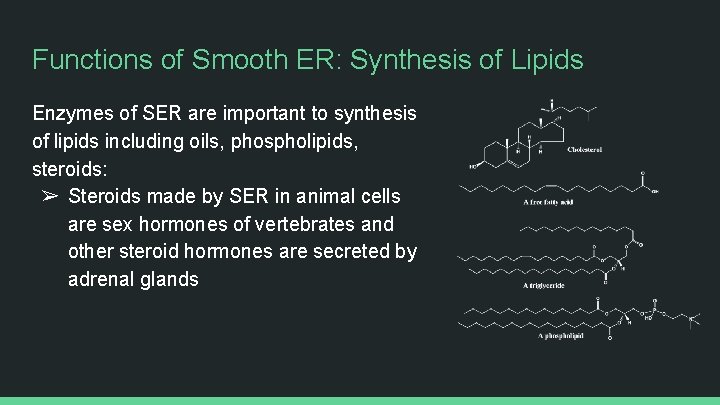
Functions of Smooth ER: Synthesis of Lipids Enzymes of SER are important to synthesis of lipids including oils, phospholipids, steroids: ➢ Steroids made by SER in animal cells are sex hormones of vertebrates and other steroid hormones are secreted by adrenal glands
Detoxification of Drugs and Poisons Detoxification- adding hydroxyl groups to drugs, making them more soluble and easier to flush from the body ➢ Phenobarbital and other barbiturates are drugs metabolized by SER in liver cells- induce the increase of smooth ER, increasing the rate of detoxification= higher doses are needed to produce effect (in this case sedation) ➢ Can increase the tolerance to other drugs besides phenobarbital
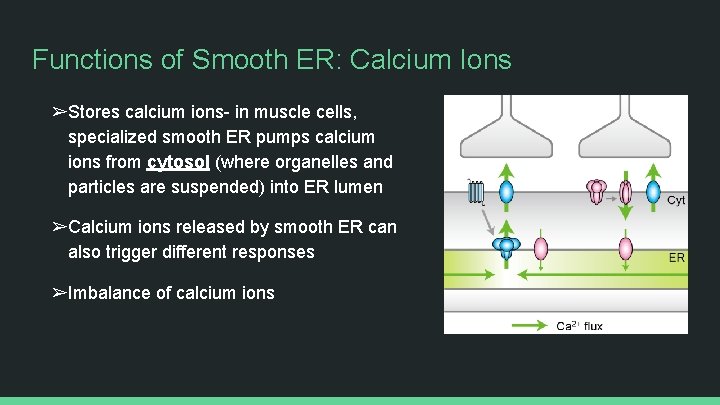
Functions of Smooth ER: Calcium Ions ➢Stores calcium ions- in muscle cells, specialized smooth ER pumps calcium ions from cytosol (where organelles and particles are suspended) into ER lumen ➢Calcium ions released by smooth ER can also trigger different responses ➢Imbalance of calcium ions

Functions of Rough ER

Functions of Rough ER Main themes to think about when studying RER: ➢ Synthesize ➢ Modify ➢ Transport

Functions of Rough ER: Protein Synthesis Free ribosomes vs. bound ribosomes ➢ Free ribosomes are suspended in the cytosol ➢ Bound ribosomes are attached to the outside of the ER or nuclear envelope

Functions of Rough ER: Secretory Proteins ➢ Ribosomes attached to RER secrete specialized proteins ➢ Pancreas cells secrete protein insulin in bloodstream ➢ Protein threads itself into ER lumen (glycoproteins) ➢ Folds into original confirmation (reconstruct primary proteins to make them into tertiary structures)
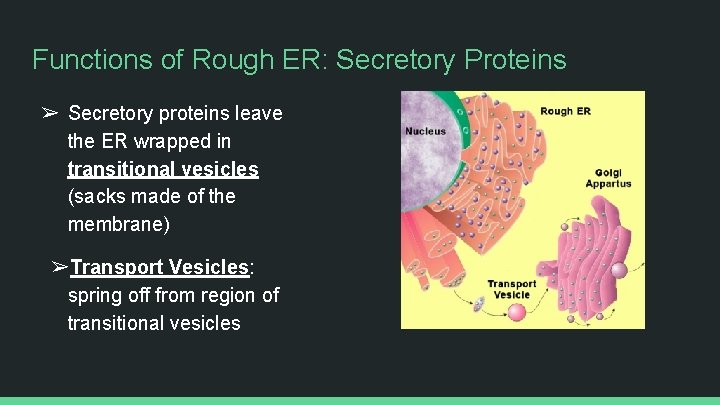
Functions of Rough ER: Secretory Proteins ➢ Secretory proteins leave the ER wrapped in transitional vesicles (sacks made of the membrane) ➢Transport Vesicles: spring off from region of transitional vesicles

Functions of Rough ER: Translation ➢ Ribosomes carrying RNA from the nucleus attach here and read RNA molecules to translate into protein
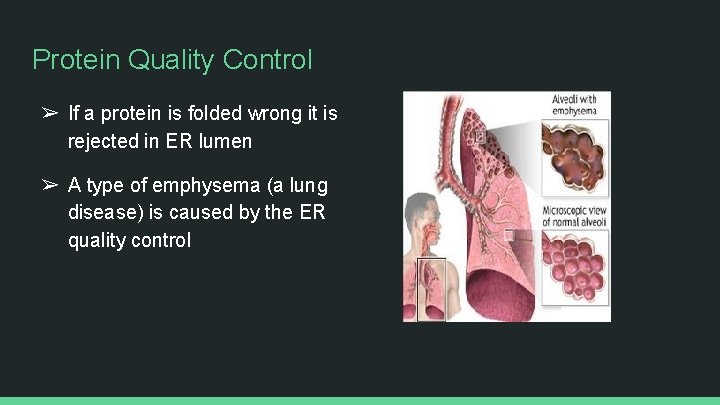
Protein Quality Control ➢ If a protein is folded wrong it is rejected in ER lumen ➢ A type of emphysema (a lung disease) is caused by the ER quality control

Interactions with other Organelles
Interactions with other Organelles Proteins are produced for: ➢ Plasma membrane ➢ Golgi apparatus ➢ Secretory vesicles ➢ Plant vacuoles ➢ Lysosomes ➢ Endosomes ➢ ER itself
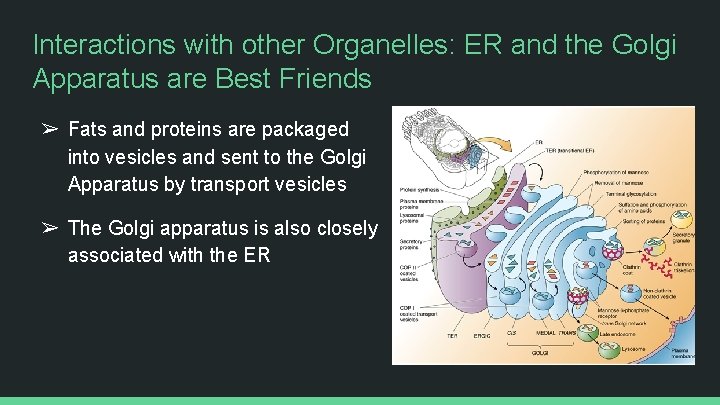
Interactions with other Organelles: ER and the Golgi Apparatus are Best Friends ➢ Fats and proteins are packaged into vesicles and sent to the Golgi Apparatus by transport vesicles ➢ The Golgi apparatus is also closely associated with the ER

Relation of ER Structure to its Functions
Relation of ER Structure to its Functions ➢ER composites approximately half of the membrane in a cell!
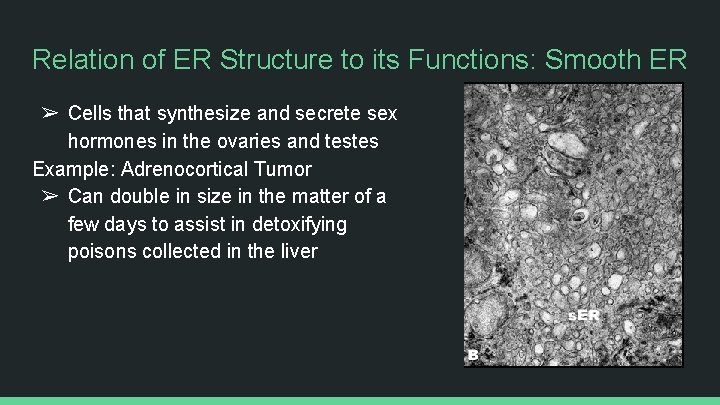
Relation of ER Structure to its Functions: Smooth ER ➢ Cells that synthesize and secrete sex hormones in the ovaries and testes Example: Adrenocortical Tumor ➢ Can double in size in the matter of a few days to assist in detoxifying poisons collected in the liver
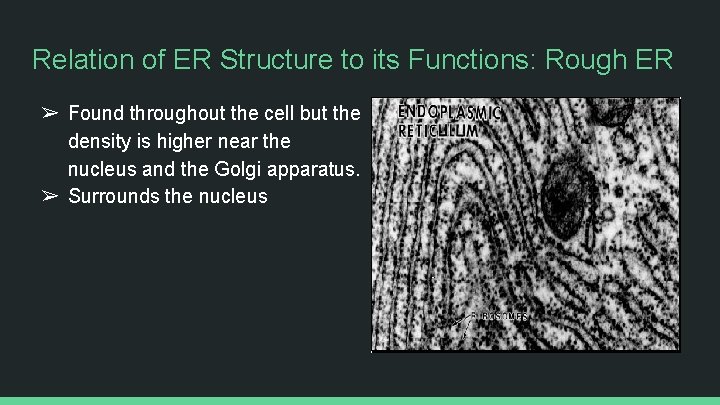
Relation of ER Structure to its Functions: Rough ER ➢ Found throughout the cell but the density is higher near the nucleus and the Golgi apparatus. ➢ Surrounds the nucleus

What Goes into ER and what is produced?
What Goes into ER and what is produced? ➢ Polypeptides that are meant to be membrane proteins grow from ribosomes and are put into the ER membrane ➢ Makes own membrane phospholipids ➢ Enzymes in ER membrane assemble phospholipids into cytosol ➢ ER membrane expands and is transferred in the form of transport vesicles to other regions of the endomembrane system

Any Questions?
Works Cited Campbell, N. A. , & Reece, J. B. (2005). Preparing for the Biology AP Exam with Biology, Seventh Edition (7 th ed. ). San Fransico, Ca. : Pearson/Benjamin Cummings. Endoplasmic Reticulum (Rough and Smooth). (n. d. ). Retrieved from http: //bscb. org/learning-resources/softcell-e-learning/endoplasmic-reticulum-ro ugh-and-smooth/ Inside A Cell. (n. d. ). Retrieved September 14, 2016, from http: //learn. genetics. utah. edu/content/cells/insideacell/ Review of Protein Secretion. (n. d. ). Retrieved from https: //courses. washington. edu/conj/cell/secretion. htm Visualization of the Movement of Calcium Ions in Neurons. (2015, December 24). Retrieved September 19, 2016, from http: //www. u-tokyo. ac. jp/en/utokyoresearch/research-news/visualization-of-the-movement-of-calcium-ions-in-neurons. html
- Slides: 28