
All pairs shortest path problem Motivation Solve an
All pairs shortest path problem
Motivation • Solve an all-pairs shortest-paths problem by running a single-source shortest-paths algorithm |V| times, once for each vertex as the source. – Dijkstra's algorithm – linear-array implementation of the min-priority queue – The binary min-heap implementation of the minpriority queue – implement the min-priority queue with a Fibonacci heap • A better method to find shortest path?
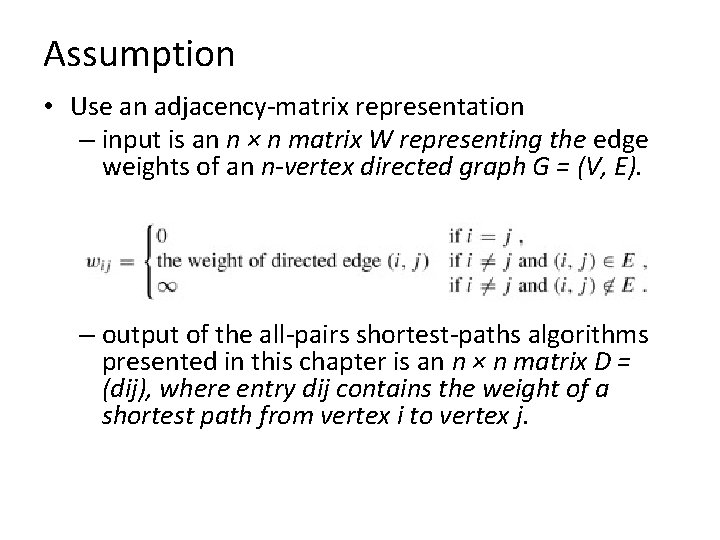
Assumption • Use an adjacency-matrix representation – input is an n × n matrix W representing the edge weights of an n-vertex directed graph G = (V, E). – output of the all-pairs shortest-paths algorithms presented in this chapter is an n × n matrix D = (dij), where entry dij contains the weight of a shortest path from vertex i to vertex j.
• Dynamic-programming algorithm based on matrix multiplication • The Floyd-Warshall algorithm

Shortest paths and matrix multiplication • Dynamic-programming algorithm 1. Characterize the structure of an optimal solution. 2. Recursively define the value of an optimal solution. 3. Compute the value of an optimal solution in a bottom-up fashion. 4. Constructing an optimal solution from computed information
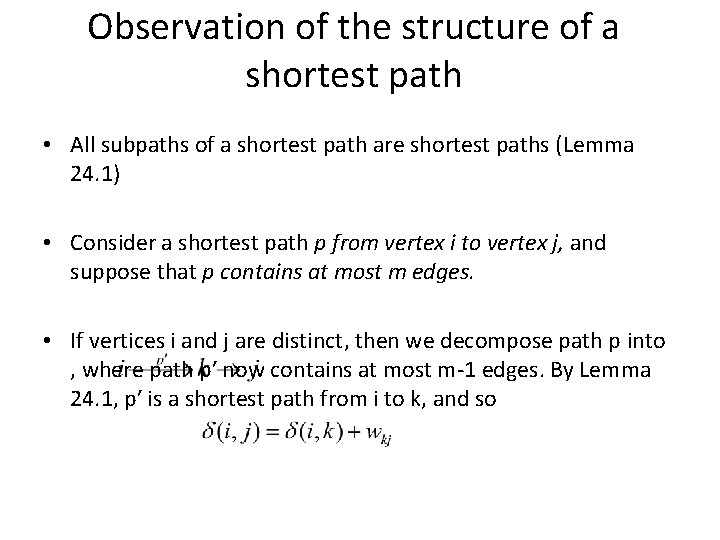
Observation of the structure of a shortest path • All subpaths of a shortest path are shortest paths (Lemma 24. 1) • Consider a shortest path p from vertex i to vertex j, and suppose that p contains at most m edges. • If vertices i and j are distinct, then we decompose path p into , where path p′ now contains at most m-1 edges. By Lemma 24. 1, p′ is a shortest path from i to k, and so
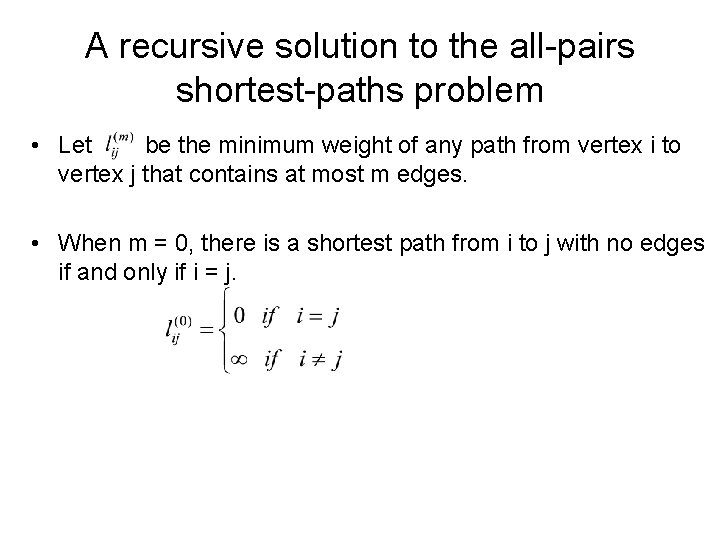
A recursive solution to the all-pairs shortest-paths problem • Let be the minimum weight of any path from vertex i to vertex j that contains at most m edges. • When m = 0, there is a shortest path from i to j with no edges if and only if i = j.
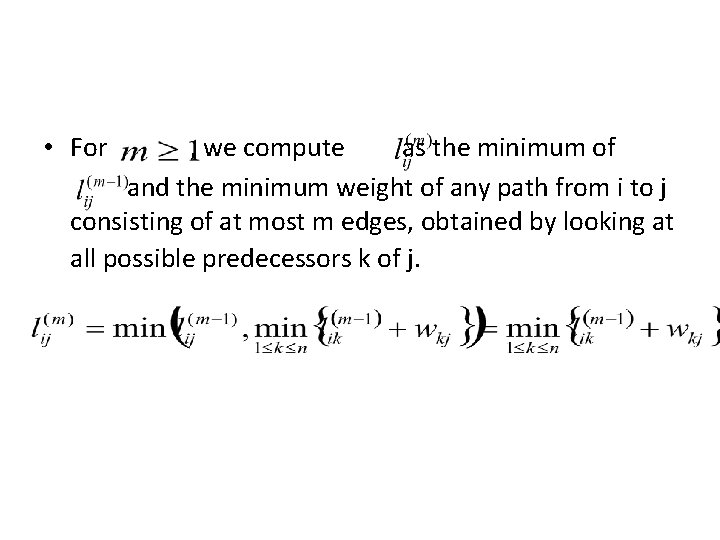
• For , we compute as the minimum of and the minimum weight of any path from i to j consisting of at most m edges, obtained by looking at all possible predecessors k of j.
![Computing the shortest-path weights bottom up • EXTEND-SHORTEST-PATHS(L, W) 1 n ← rows[L] 2](http://slidetodoc.com/presentation_image_h2/7b9f98dfd47aebca2d6a5a8a5dc8ced8/image-9.jpg "Computing the shortest-path weights bottom up • EXTEND-SHORTEST-PATHS(L, W) 1 n ← rows[L] 2")
Computing the shortest-path weights bottom up • EXTEND-SHORTEST-PATHS(L, W) 1 n ← rows[L] 2 let be an n × n matrix 3 for i ← 1 to n 4 do for j ← 2 to n 5 do 6 for k ← 1 to n 7 do 8 return
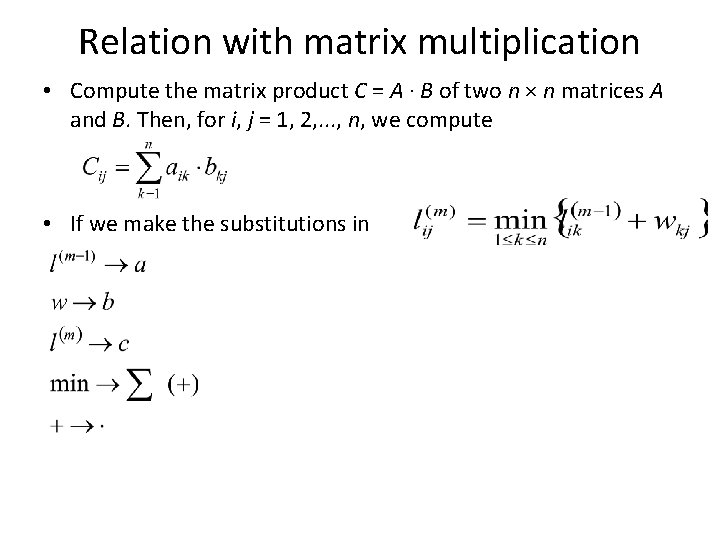
Relation with matrix multiplication • Compute the matrix product C = A · B of two n × n matrices A and B. Then, for i, j = 1, 2, . . . , n, we compute • If we make the substitutions in
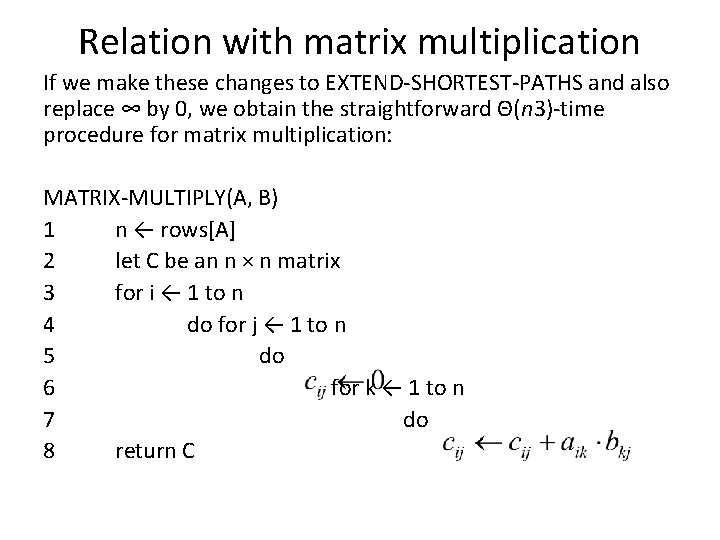
Relation with matrix multiplication If we make these changes to EXTEND-SHORTEST-PATHS and also replace ∞ by 0, we obtain the straightforward Θ(n 3)-time procedure for matrix multiplication: MATRIX-MULTIPLY(A, B) 1 n ← rows[A] 2 let C be an n × n matrix 3 for i ← 1 to n 4 do for j ← 1 to n 5 do 6 for k ← 1 to n 7 do 8 return C
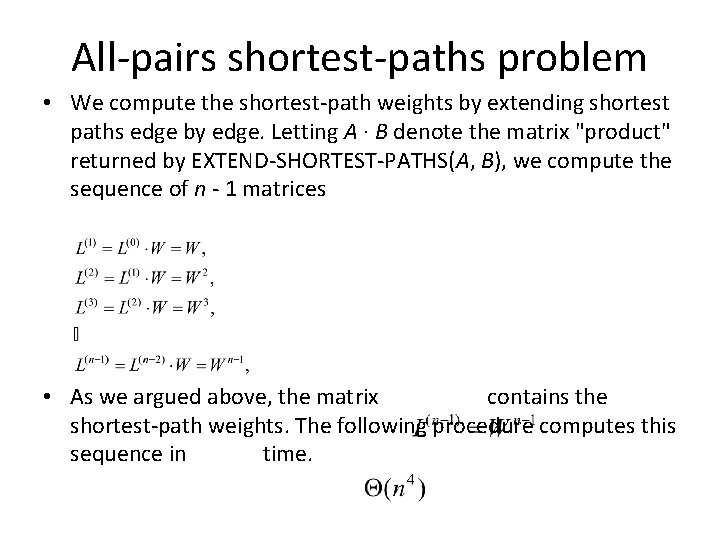
All-pairs shortest-paths problem • We compute the shortest-path weights by extending shortest paths edge by edge. Letting A · B denote the matrix "product" returned by EXTEND-SHORTEST-PATHS(A, B), we compute the sequence of n - 1 matrices • As we argued above, the matrix contains the shortest-path weights. The following procedure computes this sequence in time.

• As we argued above, the matrix contains the shortest-path weights. The following procedure computes this sequence in time. SLOW-ALL-PAIRS-SHORTEST-PATHS(W) 1 n ← rows[W] 2 L(1) ← W 3 for m ← 2 to n - 1 4 do ← EXTEND-SHORTEST-PATHS( 5 return , W)
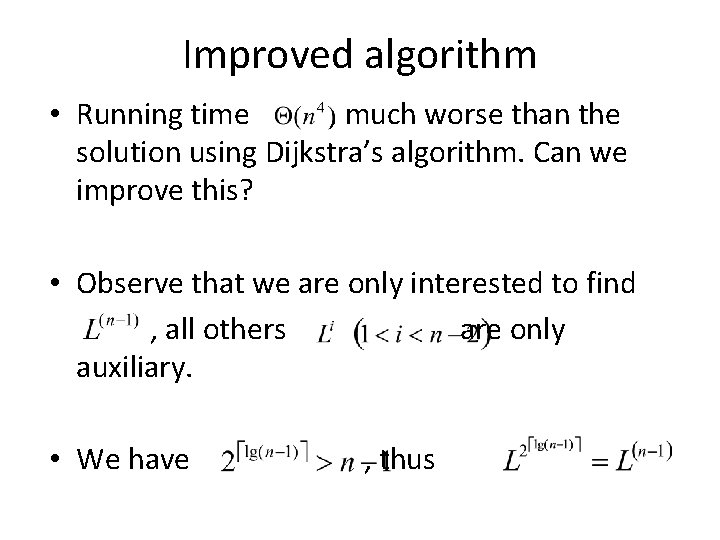
Improved algorithm • Running time , much worse than the solution using Dijkstra’s algorithm. Can we improve this? • Observe that we are only interested to find , all others are only auxiliary. • We have , thus
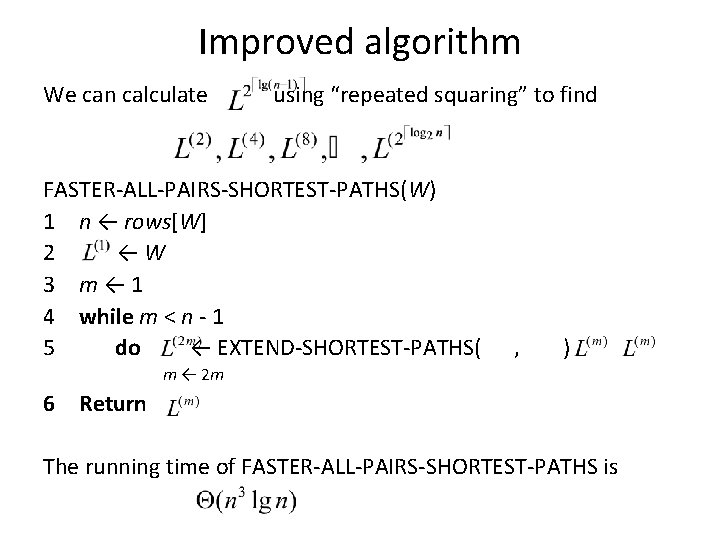
Improved algorithm We can calculate using “repeated squaring” to find FASTER-ALL-PAIRS-SHORTEST-PATHS(W) 1 n ← rows[W] 2 ←W 3 m← 1 4 while m < n - 1 5 do ← EXTEND-SHORTEST-PATHS( , ) m ← 2 m 6 Return The running time of FASTER-ALL-PAIRS-SHORTEST-PATHS is
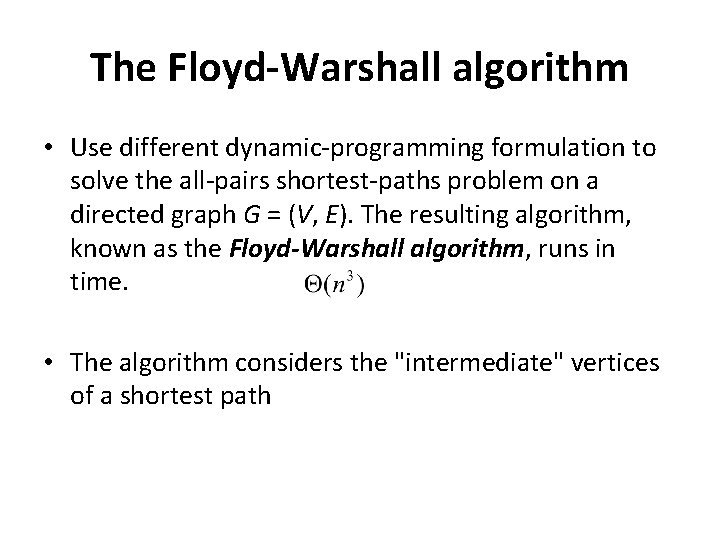
The Floyd-Warshall algorithm • Use different dynamic-programming formulation to solve the all-pairs shortest-paths problem on a directed graph G = (V, E). The resulting algorithm, known as the Floyd-Warshall algorithm, runs in time. • The algorithm considers the "intermediate" vertices of a shortest path
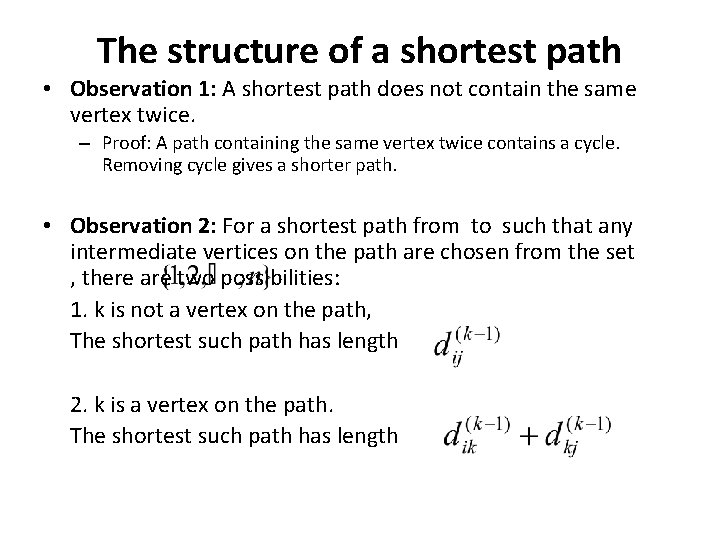
The structure of a shortest path • Observation 1: A shortest path does not contain the same vertex twice. – Proof: A path containing the same vertex twice contains a cycle. Removing cycle gives a shorter path. • Observation 2: For a shortest path from to such that any intermediate vertices on the path are chosen from the set , there are two possibilities: 1. k is not a vertex on the path, The shortest such path has length 2. k is a vertex on the path. The shortest such path has length
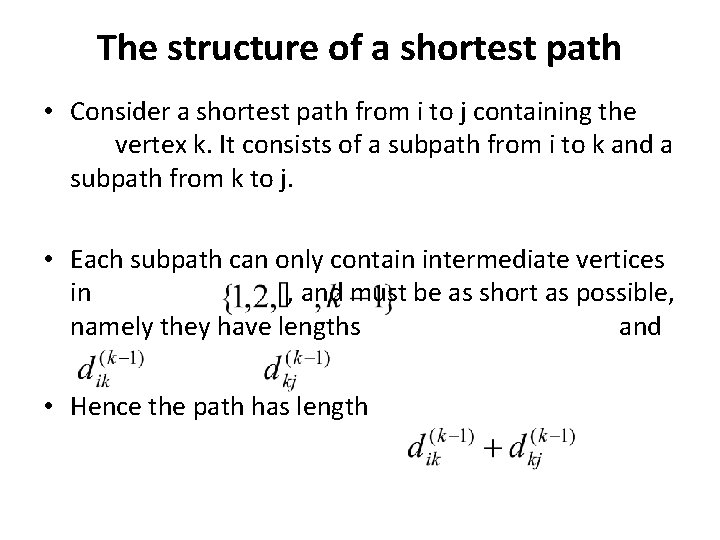
The structure of a shortest path • Consider a shortest path from i to j containing the vertex k. It consists of a subpath from i to k and a subpath from k to j. • Each subpath can only contain intermediate vertices in , and must be as short as possible, namely they have lengths and • Hence the path has length
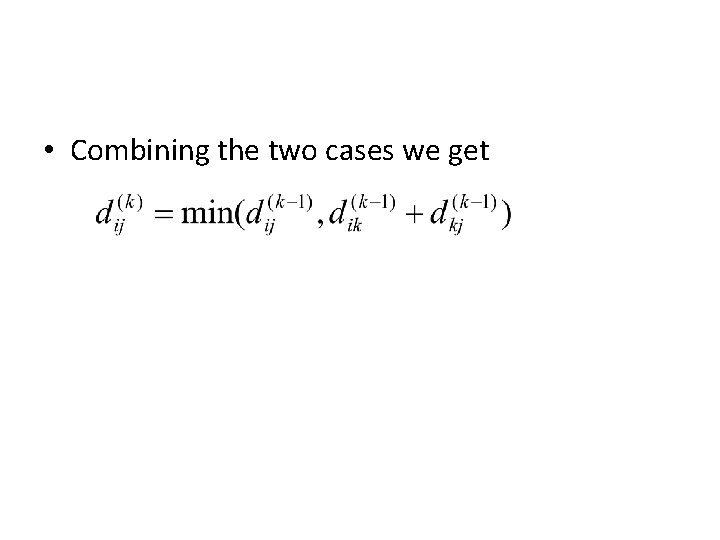
• Combining the two cases we get
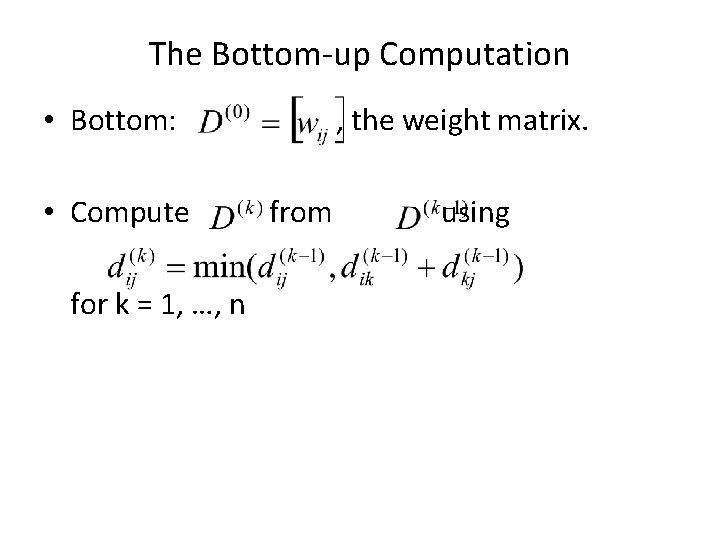
The Bottom-up Computation • Bottom: • Compute for k = 1, …, n , the weight matrix. from using
![Floyd-Warshall Algorithm FLOYD-WARSHALL(W) 1 n ← rows[W] 2 ←W 3 for k ← 1](http://slidetodoc.com/presentation_image_h2/7b9f98dfd47aebca2d6a5a8a5dc8ced8/image-21.jpg "Floyd-Warshall Algorithm FLOYD-WARSHALL(W) 1 n ← rows[W] 2 ←W 3 for k ← 1")
Floyd-Warshall Algorithm FLOYD-WARSHALL(W) 1 n ← rows[W] 2 ←W 3 for k ← 1 to n 4 do for i ← 1 to n 5 do for j ← 1 to n 6 do 7 return D(n)
- Slides: 21