
All learning begins with the learner John Dewey
All learning begins with the learner. John Dewey Information Literacy/Technology Education Integration Plan Toolkit SC Department of Education 2003
What we ask students to do… ¨ Write a report on “frogs. ” ¨ Who was Franklin Roosevelt? – Born? Died? – Presidential Years – One important fact ¨ Write a brief report on the Vietnam War. – When began? Ended? – Who was President? – What countries were involved? Information Literacy/Technology Education Integration Plan Toolkit SC Department of Education 2003
What we ask students to do… ¨ Write a report on the Amazon Rain Forest. – Size? – Inhabitants? (animals, humans) – Write a description – One important fact ¨ Read a book and write a report on your book: – Who were the main characters – Describe what happened – Could you recommend this book to a friend? Information Literacy/Technology Education Integration Plan Toolkit SC Department of Education 2003
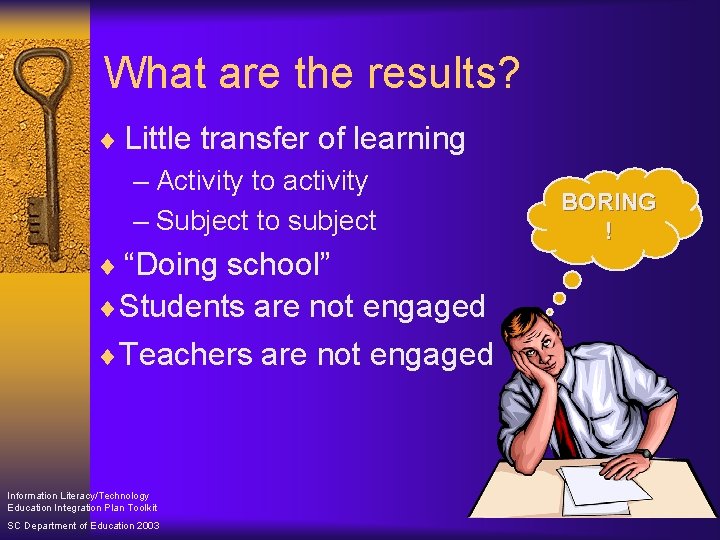
What are the results? ¨ Little transfer of learning – Activity to activity – Subject to subject ¨ “Doing school” ¨Students are not engaged ¨Teachers are not engaged Information Literacy/Technology Education Integration Plan Toolkit SC Department of Education 2003 BORING !
What can we do to change the way we “do school”? ¨ Involve teachers Information Literacy – engages ¨ Involve students and teachers; matches the standards, curriculum, the ¨ Cooperative learning technology, and makes learning ¨ Interdisciplinary units/lessons g/sum 00/winning. html) relevant! (http: //www. fno. or ¨ Move up Bloom’s Taxonomy Information Literacy/Technology Education Integration Plan Toolkit SC Department of Education 2003
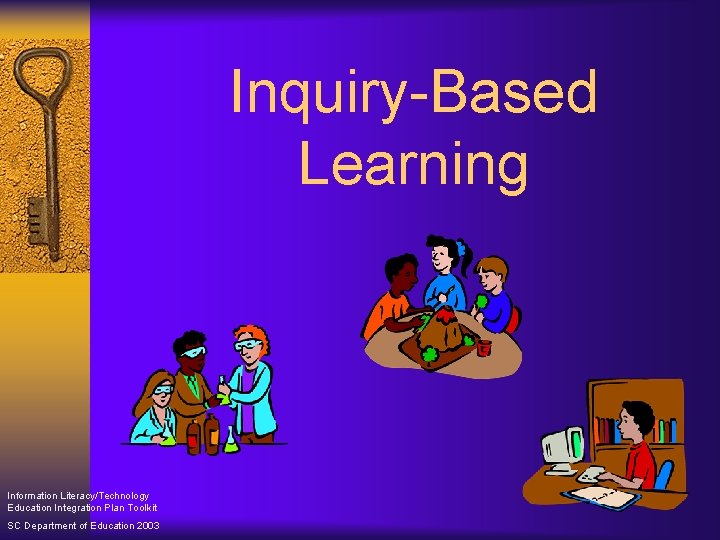
Inquiry-Based Learning Information Literacy/Technology Education Integration Plan Toolkit SC Department of Education 2003
Five Hallmarks of Inquiry-based Learning Information Literacy/Technology Education Integration Plan Toolkit SC Department of Education 2003
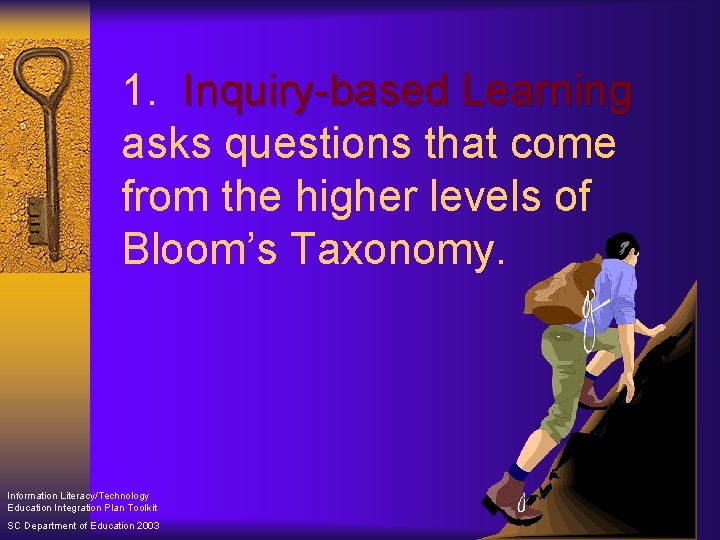
1. Inquiry-based Learning asks questions that come from the higher levels of Bloom’s Taxonomy. Information Literacy/Technology Education Integration Plan Toolkit SC Department of Education 2003

2. Inquiry-based Learning involves questions that are interesting and motivating to students. Information Literacy/Technology Education Integration Plan Toolkit SC Department of Education 2003
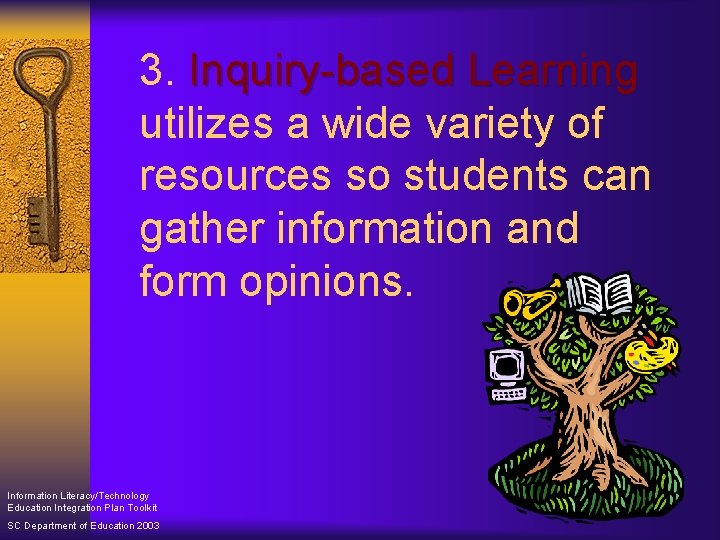
3. Inquiry-based Learning utilizes a wide variety of resources so students can gather information and form opinions. Information Literacy/Technology Education Integration Plan Toolkit SC Department of Education 2003
4. Teachers play a new role as guide or facilitator. Information Literacy/Technology Education Integration Plan Toolkit SC Department of Education 2003
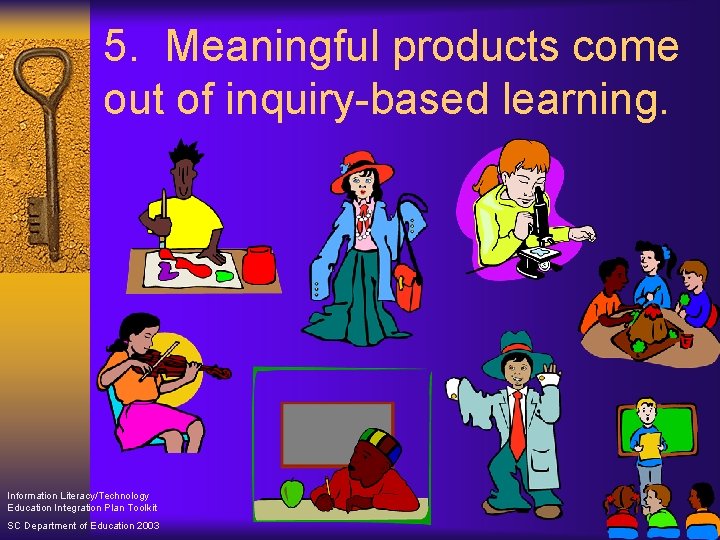
5. Meaningful products come out of inquiry-based learning. Information Literacy/Technology Education Integration Plan Toolkit SC Department of Education 2003
What does it mean to students? ¨ “When you do stuff that is real. ” ¨ “It is like projects and things that take a long time. ” ¨ “When kids work in groups or with partners and make big things. ” ¨ “It’s fun!” ¨ “I think about things. ” Information Literacy/Technology Education Integration Plan Toolkit SC Department of Education 2003
Inquiry-based learning implies involvement that leads to understanding "Tell me and I forget, show me and I remember, involve me and I understand. " Information Literacy/Technology Education Integration Plan Toolkit SC Department of Education 2003
What are the benefits of inquirybased learning? Students often have difficulty understanding how various activities within a particular subject relate to each other. Much more confusion results when the learner tries to interrelate the various subjects taught at school. Information Literacy/Technology Education Integration Plan Toolkit SC Department of Education 2003

USE a spiral path of inquiry Asking questions Reflecting on new-found knowledge Investigating Solutions Discussing discoveries and experiences Information Literacy/Technology Education Integration Plan Toolkit SC Department of Education 2003 Creating new knowledge http: //inquiry. uiuc. edu/ (The Inquiry Page)
Asking questions, investigating solutions, creating reflecting on our new-found knowledge ¨ What needs to be done? ¨ What can I use to find what I need? ¨ Where can I find what I !need? 6 g i B ¨ What information The can I use? ¨ How can I put my information together? ¨ How will I know if I did my job well? Information Literacy/Technology Education Integration Plan Toolkit SC Department of Education 2003
How Does Inquiry-based Learning Sound? ¨ Close the door! ¨ Students with students Information Literacy/Technology Education Integration Plan Toolkit SC Department of Education 2003 ¨ Teacher as guide
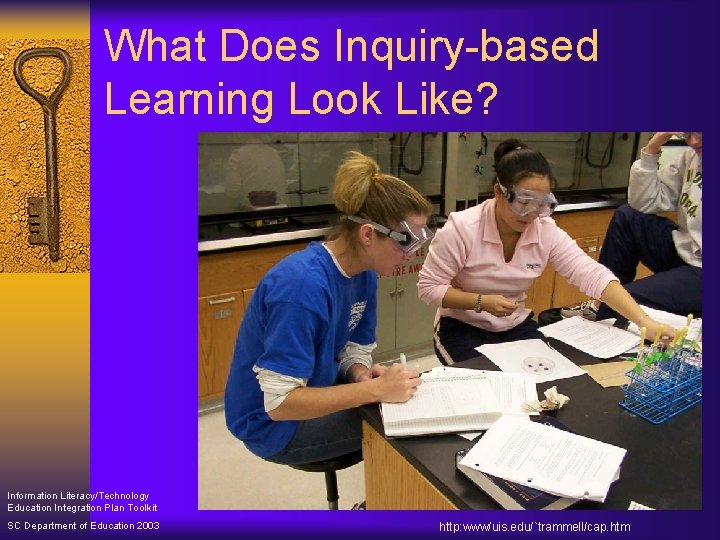
What Does Inquiry-based Learning Look Like? Information Literacy/Technology Education Integration Plan Toolkit SC Department of Education 2003 http: www/uis. edu/`trammell/cap. htm
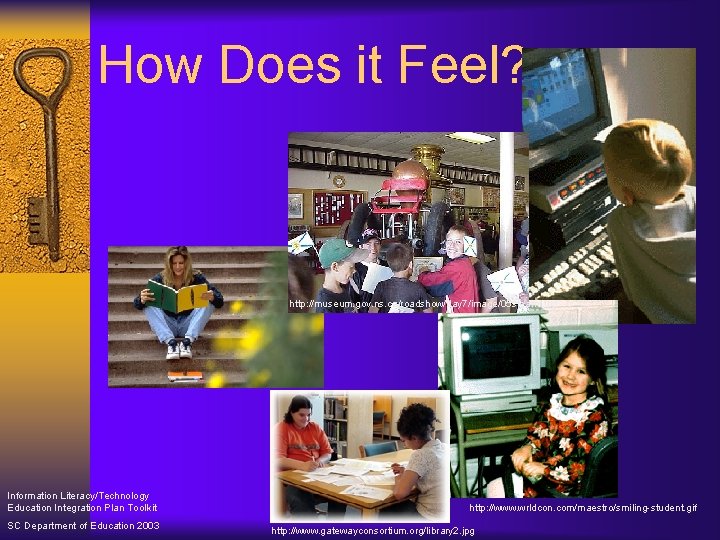
How Does it Feel? http: //museum. gov. ns. ca/roadshow/day 7/image/05 steamr. jpg Information Literacy/Technology Education Integration Plan Toolkit SC Department of Education 2003 http: //www. wrldcon. com/maestro/smiling-student. gif http: //www. gatewayconsortium. org/library 2. jpg
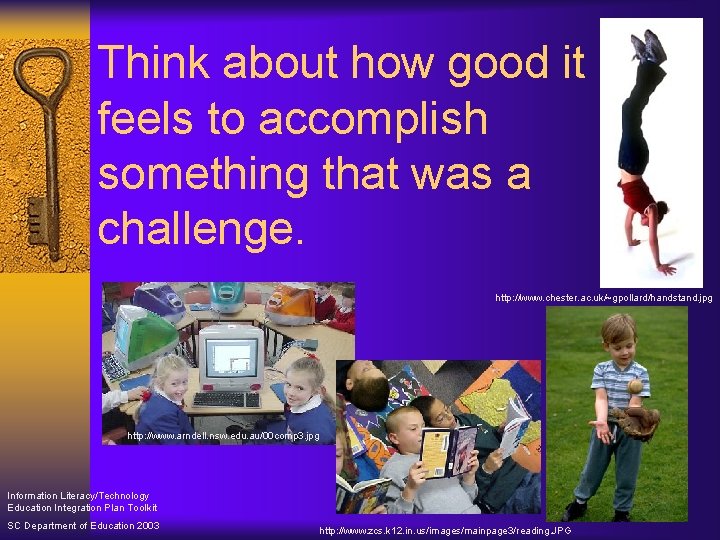
Think about how good it feels to accomplish something that was a challenge. http: //www. chester. ac. uk/~gpollard/handstand. jpg http: //www. arndell. nsw. edu. au/00 comp 3. jpg Information Literacy/Technology Education Integration Plan Toolkit SC Department of Education 2003 http: //www. zcs. k 12. in. us/images/mainpage 3/reading. JPG
Elements of Inquiry-based Learning ¨Cooperative Learning ¨Teamwork ¨Excitement ¨Presenting ¨Movement Information Literacy/Technology Education Integration Plan Toolkit SC Department of Education 2003
Problem-based learning Placing students in the active role of problem-solvers confronted with an illstructured problem which mirrors realworld problems. Information Literacy/Technology Education Integration Plan Toolkit SC Department of Education 2003
Active Learning - Students ¨ Ends the listen-to-learn paradigm of the classroom ¨ Gives students real and authentic challenges to overcome. http: //www. ncsa. uiuc. edu/Cyberia/DVE/Fusion. DVE/html/inquiry_based_education. html Information Literacy/Technology Education Integration Plan Toolkit SC Department of Education 2003
Active Learning - Teachers ¨ Ends teachers’ paradigm of talking to teach ¨ Puts teachers in the role of a colleague and mentor ¨ Engaged teachers in the same knowledge quest as their students. http: //www. ncsa. uiuc. edu/Cyberia/DVE/Fusion. DVE/html/inquiry_based_education. html Information Literacy/Technology Education Integration Plan Toolkit SC Department of Education 2003
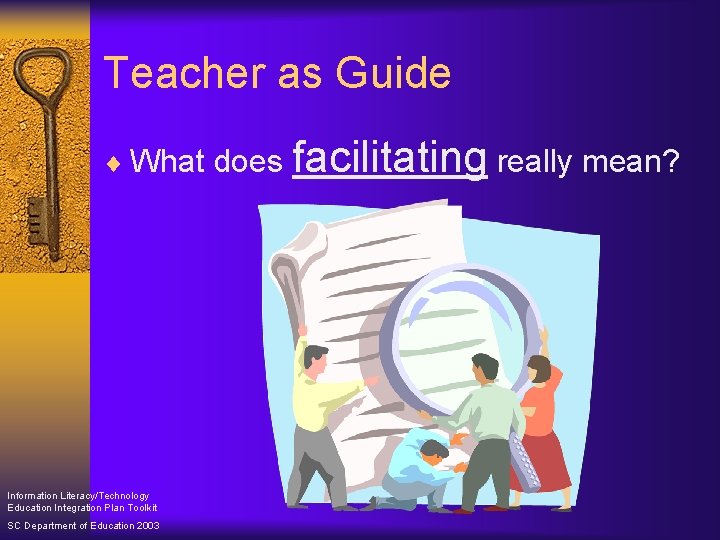
Teacher as Guide ¨ What does Information Literacy/Technology Education Integration Plan Toolkit SC Department of Education 2003 facilitating really mean?
Five Kind of Questions 1. Inference Questions 2. Interpretation Questions 3. Transfer Questions 4. Questions about Hypotheses 5. Reflective Questions The Art of Questioning by Denise Wolf Research project for the Rockefeller Foundation. Information Literacy/Technology Education Integration Plan Toolkit SC Department of Education 2003
Inference Questions… ¨ Ask students to go beyond the immediately available information. ¨ Ask students to look for clues, examine them and decide if they have a role in the question. Information Literacy/Technology Education Integration Plan Toolkit SC Department of Education 2003
Examples … ¨“What conclusions can you draw by looking at this photograph? ” ¨“How did the author feel about the character in the story? ” Information Literacy/Technology Education Integration Plan Toolkit SC Department of Education 2003
Interpretation Questions… ¨Ask students to predict what consequences may occur as a result of a given scenario. ¨Ask students to combine past knowledge of situations and new factual information. Information Literacy/Technology Education Integration Plan Toolkit SC Department of Education 2003
Examples… ¨ “You found that Sports Illustrated actually had more tobacco ads than any other magazine we looked at. What does that say about Sports Illustrated? ” ¨ “We read and loved two books by AVI. What patterns did you see that you think might be present in the third book? ” Information Literacy/Technology Education Integration Plan Toolkit SC Department of Education 2003
Transfer Questions… ¨ Ask students to take their knowledge and apply it to new situations. ¨ Ask students to expand their thinking. Information Literacy/Technology Education Integration Plan Toolkit SC Department of Education 2003
Examples… ¨ “We found many patterns in math today. Now let’s look at our Language Arts lesson on adverbs. Let’s see what patterns you find there? ” ¨ “We learned how to make Inspiration webs from paragraphs in our textbook. Now let’s try going the other way and making a web and then writing a paragraph from it. ” Information Literacy/Technology Education Integration Plan Toolkit SC Department of Education 2003
Questions about Hypotheses ¨Ask students to predict outcomes and carry out tests to discover new knowledge. ¨Use in all disciplines, not just science. Information Literacy/Technology Education Integration Plan Toolkit SC Department of Education 2003
Example… ¨ “How can we find out if Energizer batteries really last the longest? ” Information Literacy/Technology Education Integration Plan Toolkit SC Department of Education 2003
Reflective Questions… ¨ Ask students to look again at the beliefs they have and the evidence that supports them. ¨ Lead students back into investigation. Information Literacy/Technology Education Integration Plan Toolkit SC Department of Education 2003
Examples… ¨“How do I really know that there are no aliens out there? ” ¨“How do I know that the show on TV was telling the truth? ” Information Literacy/Technology Education Integration Plan Toolkit SC Department of Education 2003
Where do You Begin? ¨ Examine the lessons ¨ Listen to the questions you ask. ¨ Start with small projects – don’t get overwhelmed ¨ Remember, children who are not used to thinking may not know how to approach problems. ¨ Be the guide. Don’t supply the answers Information Literacy/Technology Education Integration Plan Toolkit SC Department of Education 2003
Implementing ¨ Collaborating - working together ¨ Conversing - developing ideas and making connections ¨ Continuing - knowing that learning is a process ¨ Choosing - sense of control over the learning process by making choices on what to pursue, choose, leave out ¨ Charting - depicts ideas for visualizations ¨ Composing - formulating thoughts as a tool for thinking Information Literacy/Technology Education Integration Plan Toolkit SC Department of Education 2003
Caution… ¨ Avoid activities that don’t promote deep processing ¨ Avoid too much structure, too little guidance, too few strategies ¨ Distinction between project centered approach and inquiry-based approach lies in underlying motivation and objective Information Literacy/Technology Education Integration Plan Toolkit SC Department of Education 2003
Inquiry is an important part of • multiple-intelligence work -- and • cooperative and collaborative learning is inherently inquiry-based. • a key tool for learning in constructivism • Standards can be met • incorporated early in planning • guiding students toward questions that will help them learn the required material Information Literacy/Technology Education Integration Plan Toolkit SC Department of Education 2003
Lesson Plans ¨ Inquiry-based lesson plans are usually referred to as "facilitation plans, " to help teachers remember their role as facilitator of learning, rather than fount of all wisdom. The notion also helps teachers structure lessons more loosely to allow student questions to drive the learning process without derailing it. Information Literacy/Technology Education Integration Plan Toolkit SC Department of Education 2003
What is your perception of learning? What do you emphasize? What do you reward? What do you expect? Information Literacy/Technology Education Integration Plan Toolkit SC Department of Education 2003
Focus Questions How is inquiry teaching/learning defined? How do we overcome barriers to make inquiry teaching inclusive to all learners? How does information technology contribute to inquiry teaching and learning? Information Literacy/Technology Education Integration Plan Toolkit SC Department of Education 2003
Focus Questions What meaningful learning experiences do you recall as a result of student media center experiences? How do you know that a learning experience resulted in new learning? Information Literacy/Technology Education Integration Plan Toolkit SC Department of Education 2003
What do we want to see happen? ¨ Increased student achievement ¨ School to work connection ¨ Lifelong learning skills and a desire to learn ¨ Productive citizens Information Literacy/Technology Education Integration Plan Toolkit SC Department of Education 2003
- Slides: 46