
All IP Network Architecture 2001 12 5 4
- Slides: 18
All IP Network Architecture 2001년 12월 5일 통신공학연구실 석사 4차 유성균 5 ksky@netian. com
Contents q q q All IP 3 G Movements 3 GPP Network Architecture 3 GPP 2 Network Architecture MWIF Network Architecture 인하대학교 정보통신대학원 통신공학연구실 2
All IP q Enable fully IP based service delivery. q q Not only data, but also speech service would be provisioned over IP bearer. Advantage q q q q Ability to offer seamless services, through the use of IP, regardless of means of access (e. g. common features used by subscribers whether accessing via conventional land telephony, cable, wireless, HPERLAN 2, etc. ). Synergy with generic IP developments and reduced cost of service. Efficient solution for simultaneous multi-media services including voice, data, and advanced real time services. Higher level of control of services. Integrated, and cost reduced operations and maintenance through IP. Take advantage of Internet applications by supporting terminals which are IP clients. Cost reduction through packet transport. 인하대학교 정보통신대학원 통신공학연구실 3
3 G Movements q q Wireless industry is evolving its core networks toward IP technology. Global wireless industry has created two new partnership projects: q 3 rd Generation Partnership Project (3 GPP) q q 3 rd Generation Partnership Project 2 (3 GPP 2) q q 3 G standards for IS-41 based cellular systems (cdma 2000). Mobile Wireless Internet Forum (MWIF) has specified an access independent All IP architecture. q q 3 G standards for GSM based cellular systems (UMTS). “drive acceptance and adoption of a single mobile wireless and Internet architecture”. Internet Engineering Taskforce (IETF) q Several protocols that will be essential for All IP networks. 인하대학교 정보통신대학원 통신공학연구실 4
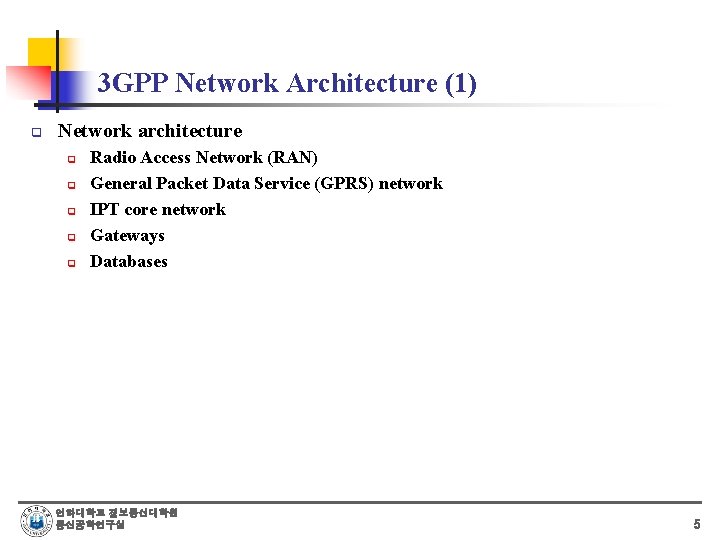
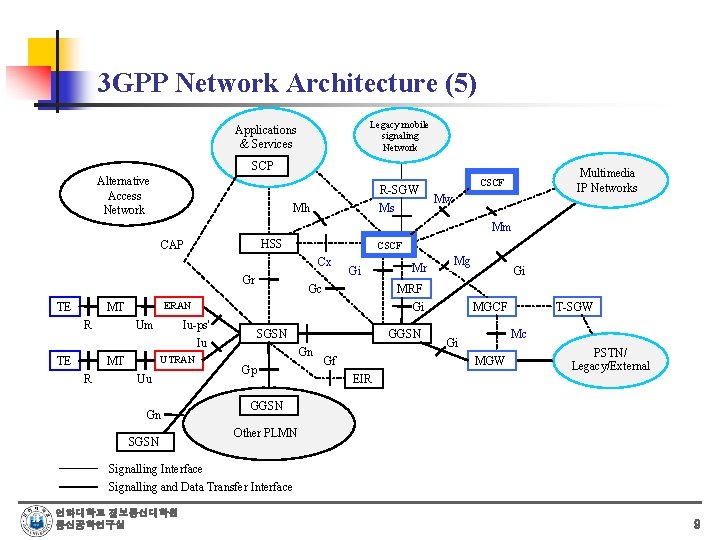
3 GPP Network Architecture (1) q Network architecture q q q Radio Access Network (RAN) General Packet Data Service (GPRS) network IPT core network Gateways Databases 인하대학교 정보통신대학원 통신공학연구실 5
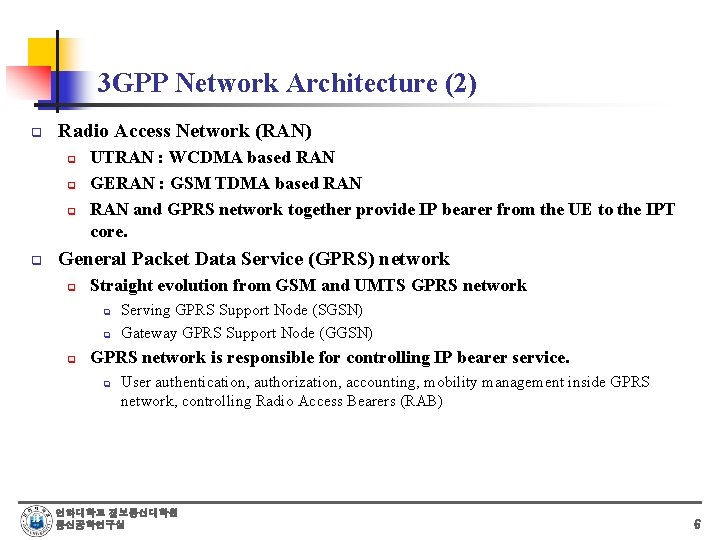
3 GPP Network Architecture (2) q Radio Access Network (RAN) q q UTRAN : WCDMA based RAN GERAN : GSM TDMA based RAN and GPRS network together provide IP bearer from the UE to the IPT core. General Packet Data Service (GPRS) network q Straight evolution from GSM and UMTS GPRS network q q q Serving GPRS Support Node (SGSN) Gateway GPRS Support Node (GGSN) GPRS network is responsible for controlling IP bearer service. q User authentication, authorization, accounting, mobility management inside GPRS network, controlling Radio Access Bearers (RAB) 인하대학교 정보통신대학원 통신공학연구실 6
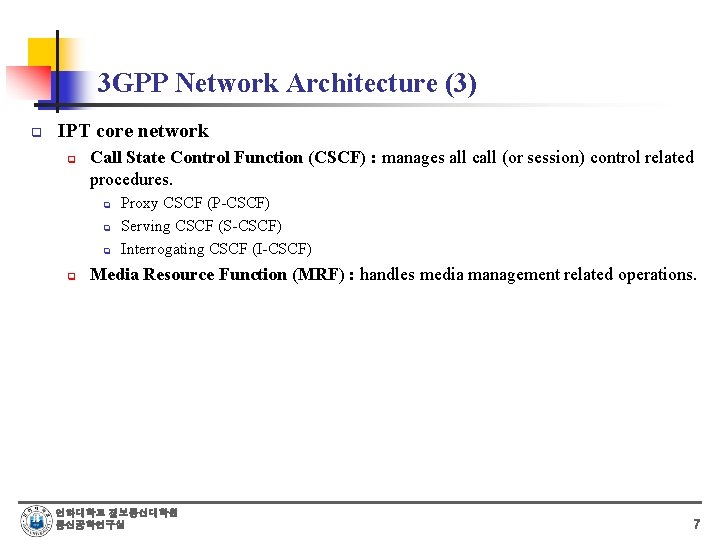
3 GPP Network Architecture (3) q IPT core network q Call State Control Function (CSCF) : manages all call (or session) control related procedures. q q Proxy CSCF (P-CSCF) Serving CSCF (S-CSCF) Interrogating CSCF (I-CSCF) Media Resource Function (MRF) : handles media management related operations. 인하대학교 정보통신대학원 통신공학연구실 7
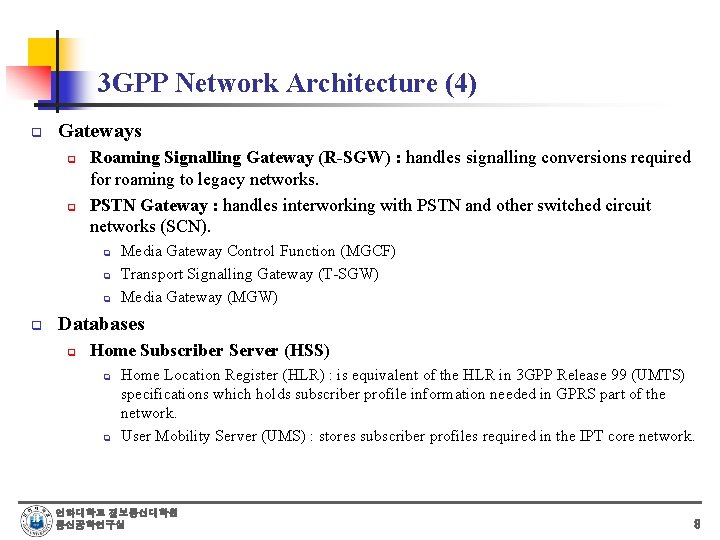
3 GPP Network Architecture (4) q Gateways q q Roaming Signalling Gateway (R-SGW) : handles signalling conversions required for roaming to legacy networks. PSTN Gateway : handles interworking with PSTN and other switched circuit networks (SCN). q q Media Gateway Control Function (MGCF) Transport Signalling Gateway (T-SGW) Media Gateway (MGW) Databases q Home Subscriber Server (HSS) q q Home Location Register (HLR) : is equivalent of the HLR in 3 GPP Release 99 (UMTS) specifications which holds subscriber profile information needed in GPRS part of the network. User Mobility Server (UMS) : stores subscriber profiles required in the IPT core network. 인하대학교 정보통신대학원 통신공학연구실 8
3 GPP Network Architecture (5) Legacy mobile signaling Network Applications & Services SCP Alternative Access Network R-SGW Ms Mh Multimedia IP Networks CSCF Mw Mm HSS CAP CSCF Cx Gr TE TE Um Uu Gn SGSN Mr Mg SGSN Gn Gp Gi MRF MGCF Gi Iu-ps' Iu UTRAN MT R Gc ERAN MT R Gi Gf Mc Gi MGW EIR T-SGW PSTN/ Legacy/External GGSN Other PLMN Signalling Interface Signalling and Data Transfer Interface 인하대학교 정보통신대학원 통신공학연구실 9
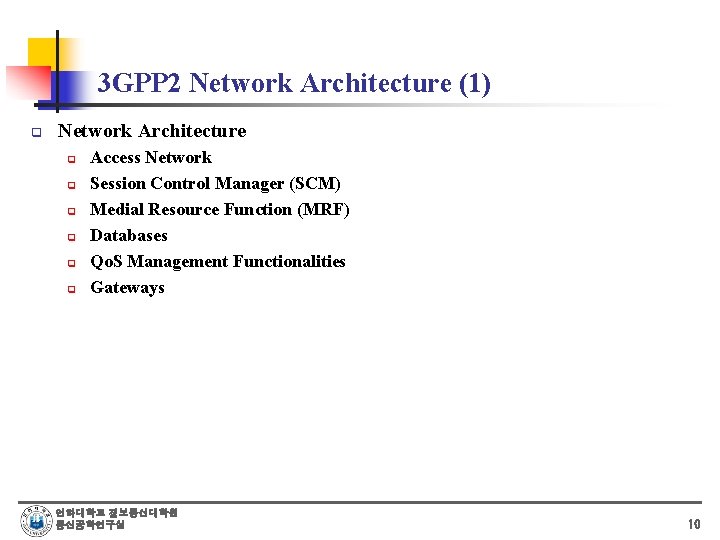
3 GPP 2 Network Architecture (1) q Network Architecture q q q Access Network Session Control Manager (SCM) Medial Resource Function (MRF) Databases Qo. S Management Functionalities Gateways 인하대학교 정보통신대학원 통신공학연구실 10
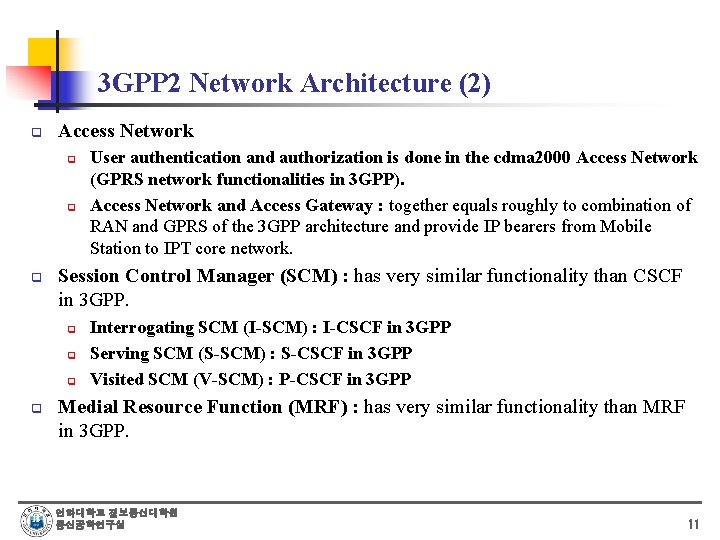
3 GPP 2 Network Architecture (2) q Access Network q q q Session Control Manager (SCM) : has very similar functionality than CSCF in 3 GPP. q q User authentication and authorization is done in the cdma 2000 Access Network (GPRS network functionalities in 3 GPP). Access Network and Access Gateway : together equals roughly to combination of RAN and GPRS of the 3 GPP architecture and provide IP bearers from Mobile Station to IPT core network. Interrogating SCM (I-SCM) : I-CSCF in 3 GPP Serving SCM (S-SCM) : S-CSCF in 3 GPP Visited SCM (V-SCM) : P-CSCF in 3 GPP Medial Resource Function (MRF) : has very similar functionality than MRF in 3 GPP. 인하대학교 정보통신대학원 통신공학연구실 11
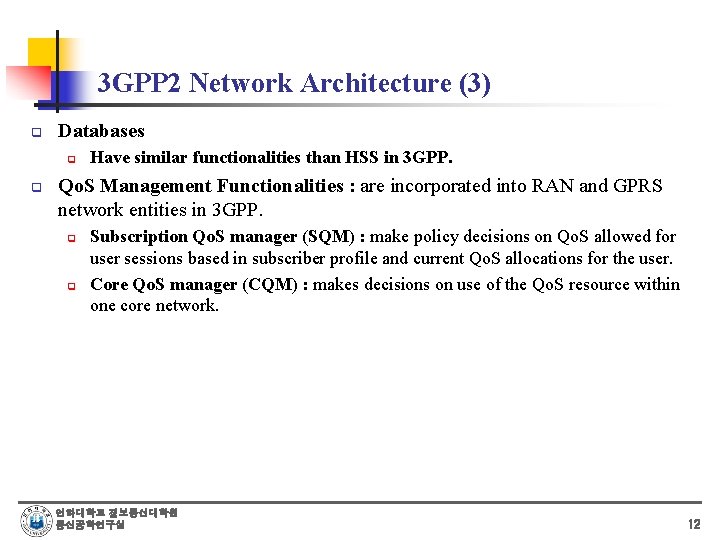
3 GPP 2 Network Architecture (3) q Databases q q Have similar functionalities than HSS in 3 GPP. Qo. S Management Functionalities : are incorporated into RAN and GPRS network entities in 3 GPP. q q Subscription Qo. S manager (SQM) : make policy decisions on Qo. S allowed for user sessions based in subscriber profile and current Qo. S allocations for the user. Core Qo. S manager (CQM) : makes decisions on use of the Qo. S resource within one core network. 인하대학교 정보통신대학원 통신공학연구실 12
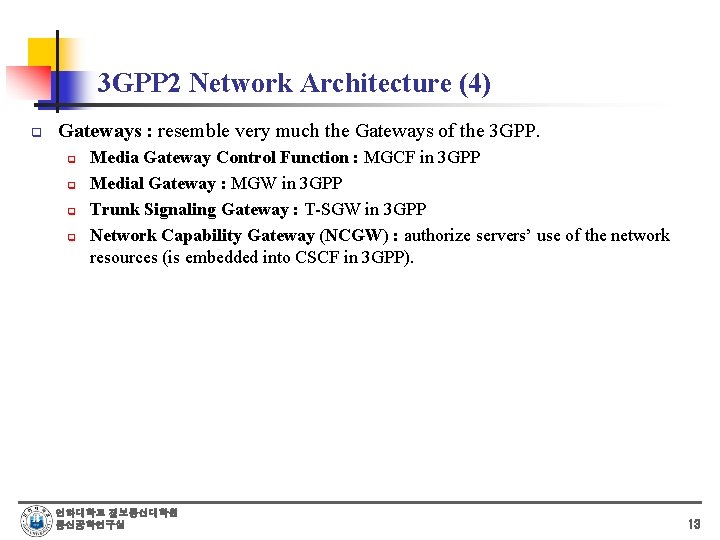
3 GPP 2 Network Architecture (4) q Gateways : resemble very much the Gateways of the 3 GPP. q q Media Gateway Control Function : MGCF in 3 GPP Medial Gateway : MGW in 3 GPP Trunk Signaling Gateway : T-SGW in 3 GPP Network Capability Gateway (NCGW) : authorize servers’ use of the network resources (is embedded into CSCF in 3 GPP). 인하대학교 정보통신대학원 통신공학연구실 13
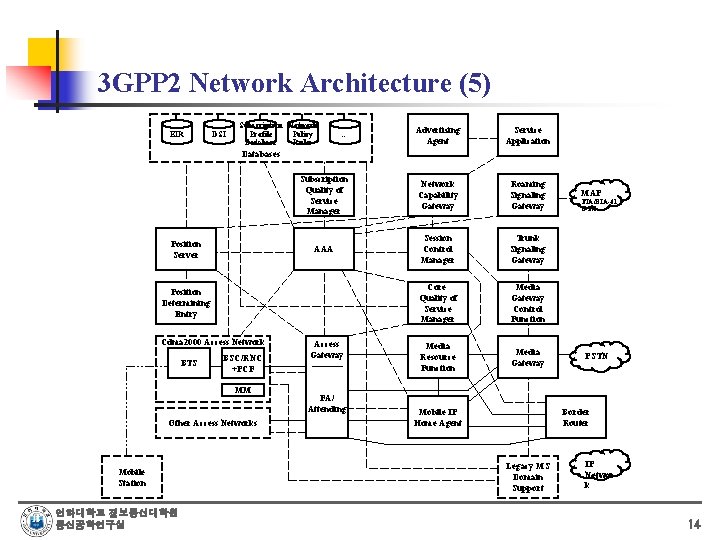
3 GPP 2 Network Architecture (5) EIR DSI Subscription Network Profile Policy Database Rules … Advertising Agent Service Application Subscription Quality of Service Manager Network Capability Gateway Roaming Signaling Gateway AAA Session Control Manager Trunk Signaling Gateway Core Quality of Service Manager Media Gateway Control Function Media Resource Function Media Gateway Databases Position Server Position Determining Entry Cdma 2000 Access Network BTS BSC/RNC +PCF MM Other Access Networks Mobile Station 인하대학교 정보통신대학원 통신공학연구실 Access Gateway FA/ Attending Mobile IP Home Agent MAP TIA/EIA-41 GSM PSTN Border Router Legacy MS Domain Support IP Networ k 14
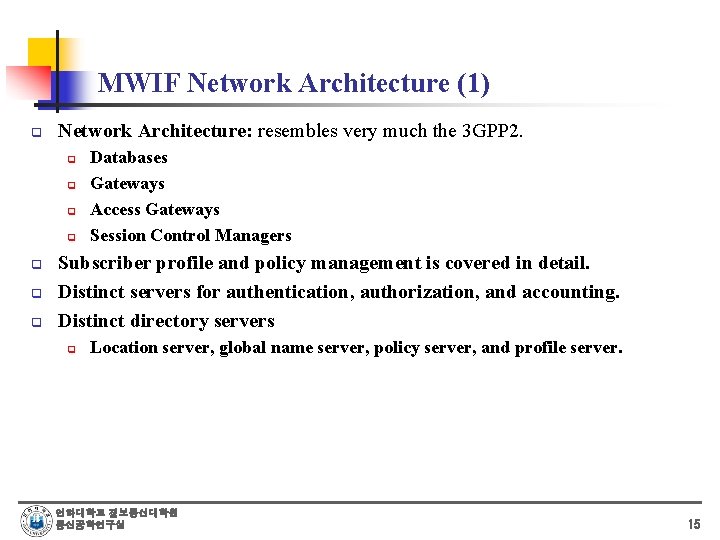
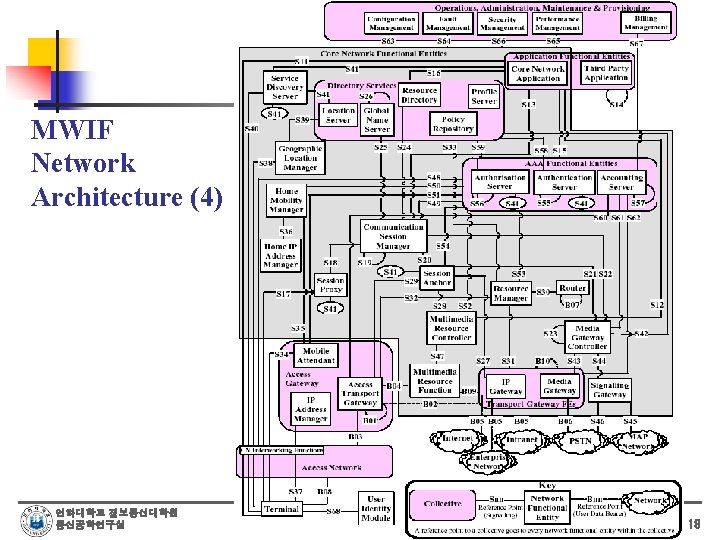
MWIF Network Architecture (1) q Network Architecture: resembles very much the 3 GPP 2. q q q q Databases Gateways Access Gateways Session Control Managers Subscriber profile and policy management is covered in detail. Distinct servers for authentication, authorization, and accounting. Distinct directory servers q Location server, global name server, policy server, and profile server. 인하대학교 정보통신대학원 통신공학연구실 15
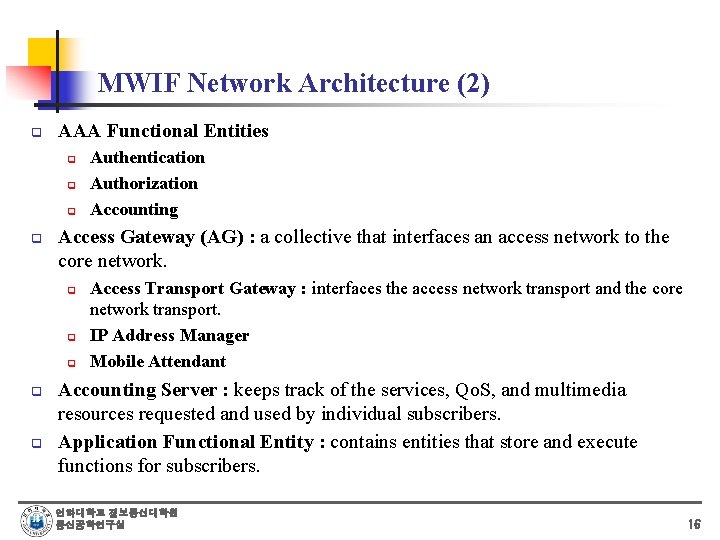
MWIF Network Architecture (2) q AAA Functional Entities q q Access Gateway (AG) : a collective that interfaces an access network to the core network. q q q Authentication Authorization Accounting Access Transport Gateway : interfaces the access network transport and the core network transport. IP Address Manager Mobile Attendant Accounting Server : keeps track of the services, Qo. S, and multimedia resources requested and used by individual subscribers. Application Functional Entity : contains entities that store and execute functions for subscribers. 인하대학교 정보통신대학원 통신공학연구실 16
MWIF Network Architecture (3) q q q q Authentication Server : verifies the identity of a requesting entity. Authorization Server : verifies that the one or more services, the Qo. S, or the multimedia resources requested by a subscriber are allowed based on the services subscribed and policies of the service provider. Billing Management : is responsible for collection, storage, and processing of all necessary data for billing network services and applications. Communication Session Manager (CSM) : provides the controls for all sessions for a given subscriber. Home IP Address Manager : supports dynamic allocation of IP addresses to terminals. Media Gateway (MG) : interconnects the core network to the PSTN or to circuit terminations. Policy Repository : provides the policy rules for subscriber policy usage, expected Qo. S, valid times and routes. 인하대학교 정보통신대학원 통신공학연구실 17