
All forecast information reflects planning assumptions as of
- Slides: 29
All forecast information reflects planning assumptions as of December 2005. Appendix H Entergy System Strategic Supply Resource Plan Description (For the planning period 2006 – 2015) The statements contained in this Appendix are made subject to the Reservation of Rights set forth in the RFP and subject to the terms and acknowledgements set forth in the Proposal Submission Agreement. 2006 LONG-TERM RFP - April 17, 2006
All forecast information reflects planning assumptions as of December 2005. Overview This document describes the Entergy System’s (utility) Strategic Supply Resource Plan (SSRP). As described in this document, the SSRP is based on principles and planning objectives adopted by the Operating Committee and provides a long-term resource strategy that will transform the Entergy System’s generation portfolio. Contents 1. Planning Framework 2. Strategic Overview 3. Current Portfolio 4. Load Forecast 5. Retirement Strategy 6. Overview of Plan for 2006 – 2015 The statements contained in this Appendix are made subject to the Reservation of Rights set forth in the RFP and subject to the terms and acknowledgements set forth in the Proposal Submission Agreement. 2006 LONG-TERM RFP - April 17, 2006 2
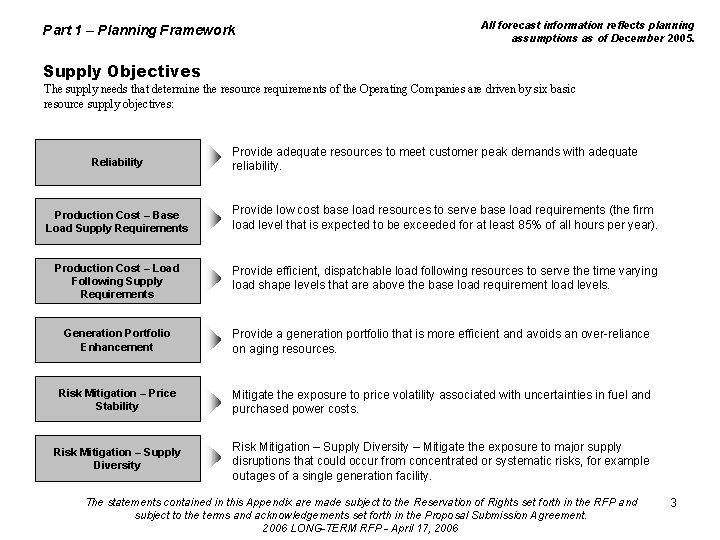
Part 1 – Planning Framework All forecast information reflects planning assumptions as of December 2005. Supply Objectives The supply needs that determine the resource requirements of the Operating Companies are driven by six basic resource supply objectives: Reliability Provide adequate resources to meet customer peak demands with adequate reliability. Production Cost – Base Load Supply Requirements Provide low cost base load resources to serve base load requirements (the firm load level that is expected to be exceeded for at least 85% of all hours per year). Production Cost – Load Following Supply Requirements Provide efficient, dispatchable load following resources to serve the time varying load shape levels that are above the base load requirement load levels. Generation Portfolio Enhancement Provide a generation portfolio that is more efficient and avoids an over-reliance on aging resources. Risk Mitigation – Price Stability Mitigate the exposure to price volatility associated with uncertainties in fuel and purchased power costs. Risk Mitigation – Supply Diversity – Mitigate the exposure to major supply disruptions that could occur from concentrated or systematic risks, for example outages of a single generation facility. The statements contained in this Appendix are made subject to the Reservation of Rights set forth in the RFP and subject to the terms and acknowledgements set forth in the Proposal Submission Agreement. 2006 LONG-TERM RFP - April 17, 2006 3
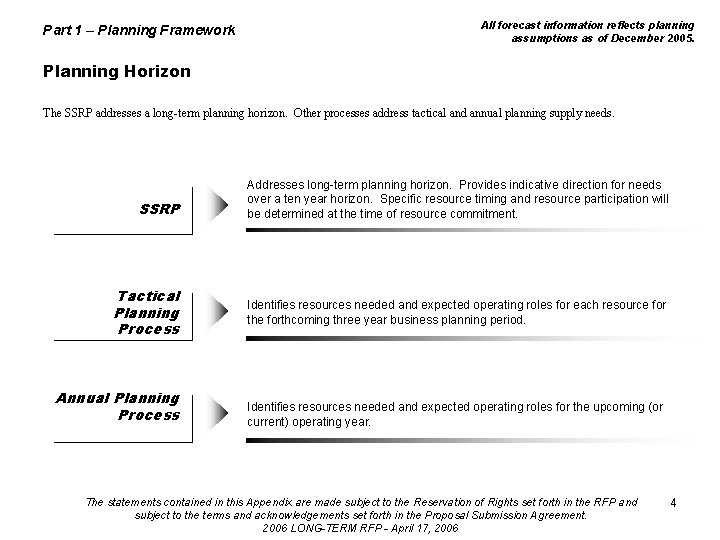
Part 1 – Planning Framework All forecast information reflects planning assumptions as of December 2005. Planning Horizon The SSRP addresses a long-term planning horizon. Other processes address tactical and annual planning supply needs. SSRP Tactical Planning Process Annual Planning Process Addresses long-term planning horizon. Provides indicative direction for needs over a ten year horizon. Specific resource timing and resource participation will be determined at the time of resource commitment. Identifies resources needed and expected operating roles for each resource for the forthcoming three year business planning period. Identifies resources needed and expected operating roles for the upcoming (or current) operating year. The statements contained in this Appendix are made subject to the Reservation of Rights set forth in the RFP and subject to the terms and acknowledgements set forth in the Proposal Submission Agreement. 2006 LONG-TERM RFP - April 17, 2006 4
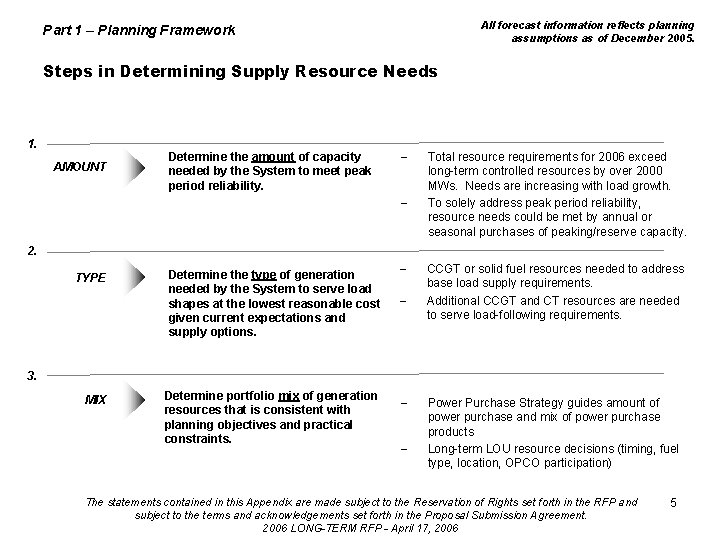
All forecast information reflects planning assumptions as of December 2005. Part 1 – Planning Framework Steps in Determining Supply Resource Needs 1. AMOUNT Determine the amount of capacity needed by the System to meet peak period reliability. – – Total resource requirements for 2006 exceed long-term controlled resources by over 2000 MWs. Needs are increasing with load growth. To solely address peak period reliability, resource needs could be met by annual or seasonal purchases of peaking/reserve capacity. 2. TYPE Determine the type of generation needed by the System to serve load shapes at the lowest reasonable cost given current expectations and supply options. – – CCGT or solid fuel resources needed to address base load supply requirements. Additional CCGT and CT resources are needed to serve load-following requirements. 3. MIX Determine portfolio mix of generation resources that is consistent with planning objectives and practical constraints. – – Power Purchase Strategy guides amount of power purchase and mix of power purchase products Long-term LOU resource decisions (timing, fuel type, location, OPCO participation) The statements contained in this Appendix are made subject to the Reservation of Rights set forth in the RFP and subject to the terms and acknowledgements set forth in the Proposal Submission Agreement. 2006 LONG-TERM RFP - April 17, 2006 5
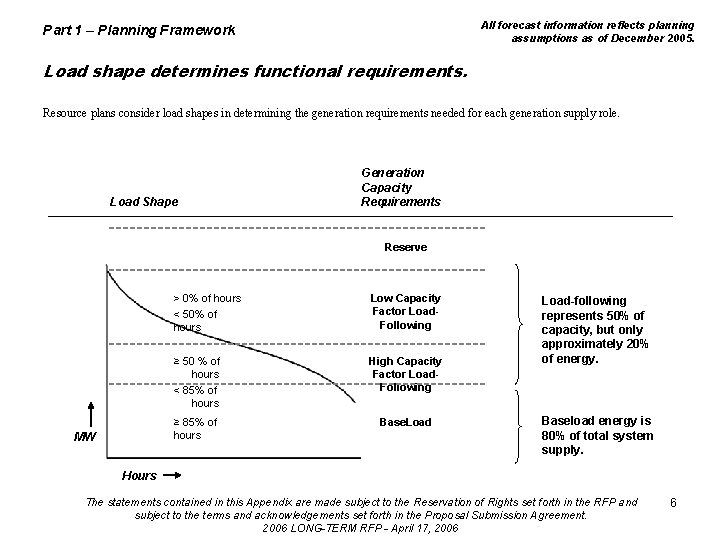
All forecast information reflects planning assumptions as of December 2005. Part 1 – Planning Framework Load shape determines functional requirements. Resource plans consider load shapes in determining the generation requirements needed for each generation supply role. Load Shape Generation Capacity Requirements Reserve MW > 0% of hours < 50% of hours Low Capacity Factor Load. Following ≥ 50 % of hours < 85% of hours High Capacity Factor Load. Following ≥ 85% of hours Base. Load-following represents 50% of capacity, but only approximately 20% of energy. Baseload energy is 80% of total system supply. Hours The statements contained in this Appendix are made subject to the Reservation of Rights set forth in the RFP and subject to the terms and acknowledgements set forth in the Proposal Submission Agreement. 2006 LONG-TERM RFP - April 17, 2006 6
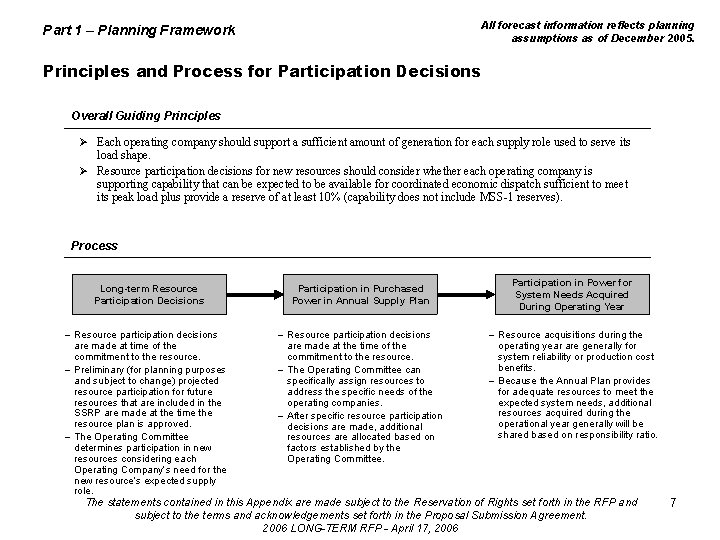
All forecast information reflects planning assumptions as of December 2005. Part 1 – Planning Framework Principles and Process for Participation Decisions Overall Guiding Principles Ø Each operating company should support a sufficient amount of generation for each supply role used to serve its load shape. Ø Resource participation decisions for new resources should consider whether each operating company is supporting capability that can be expected to be available for coordinated economic dispatch sufficient to meet its peak load plus provide a reserve of at least 10% (capability does not include MSS-1 reserves). Process Long-term Resource Participation Decisions Participation in Purchased Power in Annual Supply Plan Participation in Power for System Needs Acquired During Operating Year – Resource participation decisions – Resource acquisitions during the are made at time of the are made at the time of the operating year are generally for commitment to the resource. system reliability or production cost benefits. – Preliminary (for planning purposes – The Operating Committee can and subject to change) projected specifically assign resources to – Because the Annual Plan provides resource participation for future address the specific needs of the for adequate resources to meet the resources that are included in the operating companies. expected system needs, additional SSRP are made at the time the resources acquired during the – After specific resource participation resource plan is approved. operational year generally will be decisions are made, additional shared based on responsibility ratio. – The Operating Committee resources are allocated based on determines participation in new factors established by the resources considering each Operating Committee. Operating Company’s need for the new resource’s expected supply role. The statements contained in this Appendix are made subject to the Reservation of Rights set forth in the RFP and subject to the terms and acknowledgements set forth in the Proposal Submission Agreement. 2006 LONG-TERM RFP - April 17, 2006 7
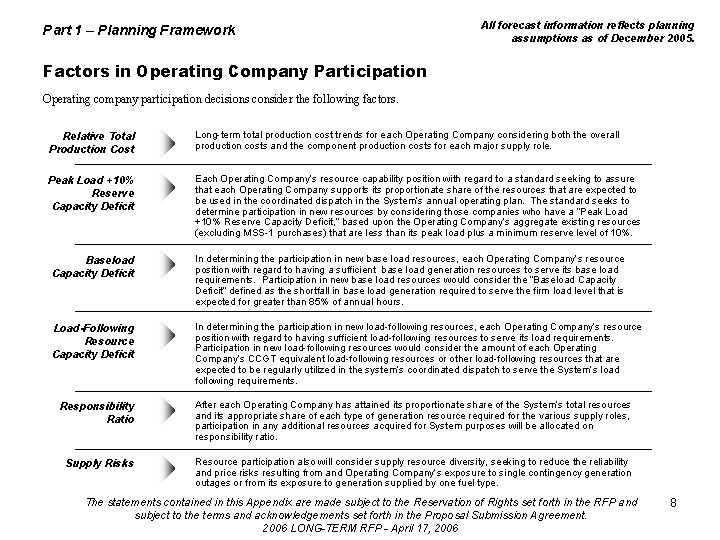
Part 1 – Planning Framework All forecast information reflects planning assumptions as of December 2005. Factors in Operating Company Participation Operating company participation decisions consider the following factors. Relative Total Production Cost Long-term total production cost trends for each Operating Company considering both the overall production costs and the component production costs for each major supply role. Peak Load +10% Reserve Capacity Deficit Each Operating Company’s resource capability position with regard to a standard seeking to assure that each Operating Company supports its proportionate share of the resources that are expected to be used in the coordinated dispatch in the System’s annual operating plan. The standard seeks to determine participation in new resources by considering those companies who have a “Peak Load +10% Reserve Capacity Deficit, ” based upon the Operating Company’s aggregate existing resources (excluding MSS-1 purchases) that are less than its peak load plus a minimum reserve level of 10%. Baseload Capacity Deficit In determining the participation in new base load resources, each Operating Company’s resource position with regard to having a sufficient base load generation resources to serve its base load requirements. Participation in new base load resources would consider the “Baseload Capacity Deficit” defined as the shortfall in base load generation required to serve the firm load level that is expected for greater than 85% of annual hours. Load-Following Resource Capacity Deficit In determining the participation in new load-following resources, each Operating Company’s resource position with regard to having sufficient load-following resources to serve its load requirements. Participation in new load-following resources would consider the amount of each Operating Company’s CCGT equivalent load-following resources or other load-following resources that are expected to be regularly utilized in the system’s coordinated dispatch to serve the System’s load following requirements. Responsibility Ratio After each Operating Company has attained its proportionate share of the System’s total resources and its appropriate share of each type of generation resource required for the various supply roles, participation in any additional resources acquired for System purposes will be allocated on responsibility ratio. Supply Risks Resource participation also will consider supply resource diversity, seeking to reduce the reliability and price risks resulting from and Operating Company’s exposure to single contingency generation outages or from its exposure to generation supplied by one fuel type. The statements contained in this Appendix are made subject to the Reservation of Rights set forth in the RFP and subject to the terms and acknowledgements set forth in the Proposal Submission Agreement. 2006 LONG-TERM RFP - April 17, 2006 8
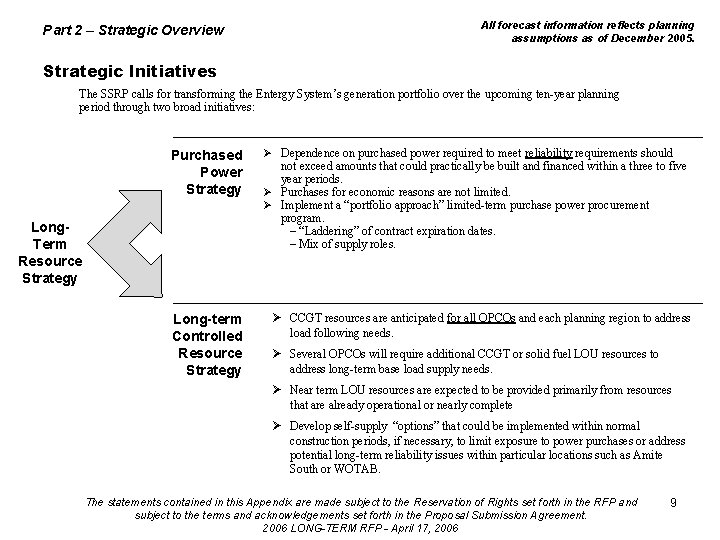
Part 2 – Strategic Overview All forecast information reflects planning assumptions as of December 2005. Strategic Initiatives The SSRP calls for transforming the Entergy System’s generation portfolio over the upcoming ten-year planning period through two broad initiatives: Purchased Power Strategy Long. Term Resource Strategy Long-term Controlled Resource Strategy Ø Dependence on purchased power required to meet reliability requirements should not exceed amounts that could practically be built and financed within a three to five year periods. Ø Purchases for economic reasons are not limited. Ø Implement a “portfolio approach” limited-term purchase power procurement program. – “Laddering” of contract expiration dates. – Mix of supply roles. Ø CCGT resources are anticipated for all OPCOs and each planning region to address load following needs. Ø Several OPCOs will require additional CCGT or solid fuel LOU resources to address long-term base load supply needs. Ø Near term LOU resources are expected to be provided primarily from resources that are already operational or nearly complete Ø Develop self-supply “options” that could be implemented within normal construction periods, if necessary, to limit exposure to power purchases or address potential long-term reliability issues within particular locations such as Amite South or WOTAB. The statements contained in this Appendix are made subject to the Reservation of Rights set forth in the RFP and subject to the terms and acknowledgements set forth in the Proposal Submission Agreement. 2006 LONG-TERM RFP - April 17, 2006 9
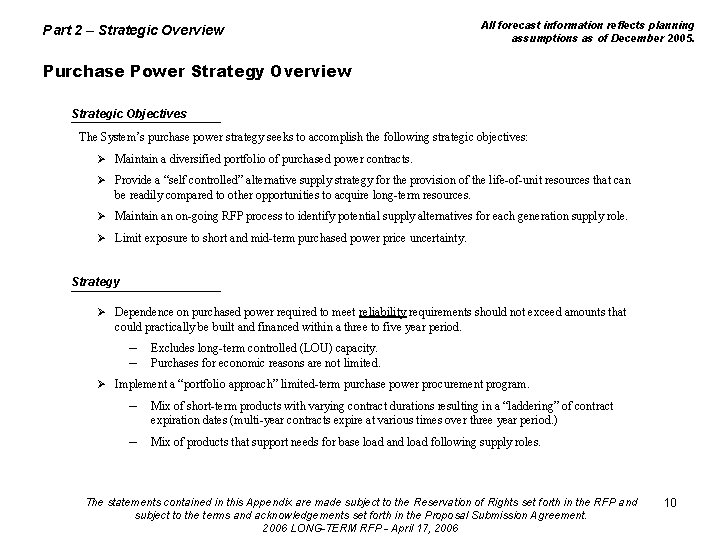
Part 2 – Strategic Overview All forecast information reflects planning assumptions as of December 2005. Purchase Power Strategy Overview Strategic Objectives The System’s purchase power strategy seeks to accomplish the following strategic objectives: Ø Maintain a diversified portfolio of purchased power contracts. Ø Provide a “self controlled” alternative supply strategy for the provision of the life-of-unit resources that can be readily compared to other opportunities to acquire long-term resources. Ø Maintain an on-going RFP process to identify potential supply alternatives for each generation supply role. Ø Limit exposure to short and mid-term purchased power price uncertainty. Strategy Ø Dependence on purchased power required to meet reliability requirements should not exceed amounts that could practically be built and financed within a three to five year period. ─ ─ Excludes long-term controlled (LOU) capacity. Purchases for economic reasons are not limited. Ø Implement a “portfolio approach” limited-term purchase power procurement program. ─ Mix of short-term products with varying contract durations resulting in a “laddering” of contract expiration dates (multi-year contracts expire at various times over three year period. ) ─ Mix of products that support needs for base load and load following supply roles. The statements contained in this Appendix are made subject to the Reservation of Rights set forth in the RFP and subject to the terms and acknowledgements set forth in the Proposal Submission Agreement. 2006 LONG-TERM RFP - April 17, 2006 10
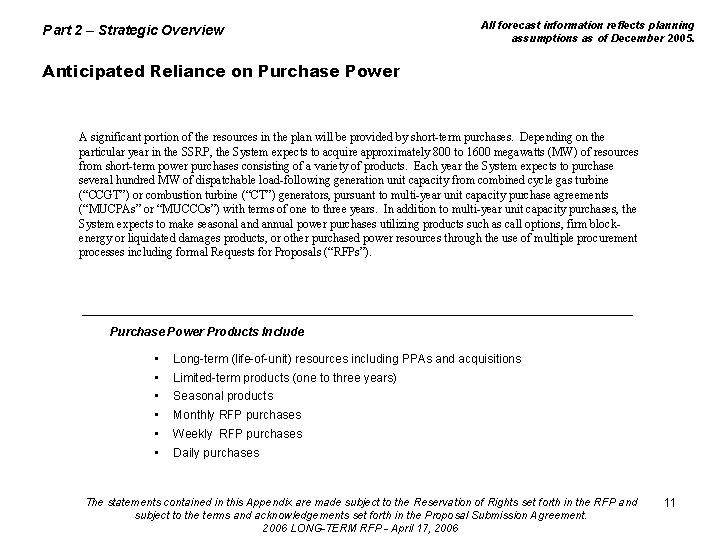
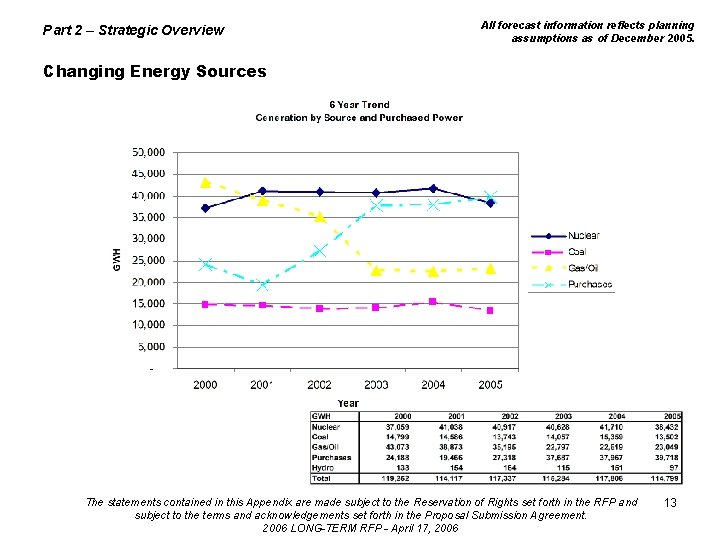
Part 2 – Strategic Overview All forecast information reflects planning assumptions as of December 2005. Anticipated Reliance on Purchase Power A significant portion of the resources in the plan will be provided by short-term purchases. Depending on the particular year in the SSRP, the System expects to acquire approximately 800 to 1600 megawatts (MW) of resources from short-term power purchases consisting of a variety of products. Each year the System expects to purchase several hundred MW of dispatchable load-following generation unit capacity from combined cycle gas turbine (“CCGT”) or combustion turbine (“CT”) generators, pursuant to multi-year unit capacity purchase agreements (“MUCPAs” or “MUCCOs”) with terms of one to three years. In addition to multi-year unit capacity purchases, the System expects to make seasonal and annual power purchases utilizing products such as call options, firm blockenergy or liquidated damages products, or other purchased power resources through the use of multiple procurement processes including formal Requests for Proposals (“RFPs”). Purchase Power Products Include • • • Long-term (life-of-unit) resources including PPAs and acquisitions Limited-term products (one to three years) Seasonal products Monthly RFP purchases Weekly RFP purchases Daily purchases The statements contained in this Appendix are made subject to the Reservation of Rights set forth in the RFP and subject to the terms and acknowledgements set forth in the Proposal Submission Agreement. 2006 LONG-TERM RFP - April 17, 2006 11
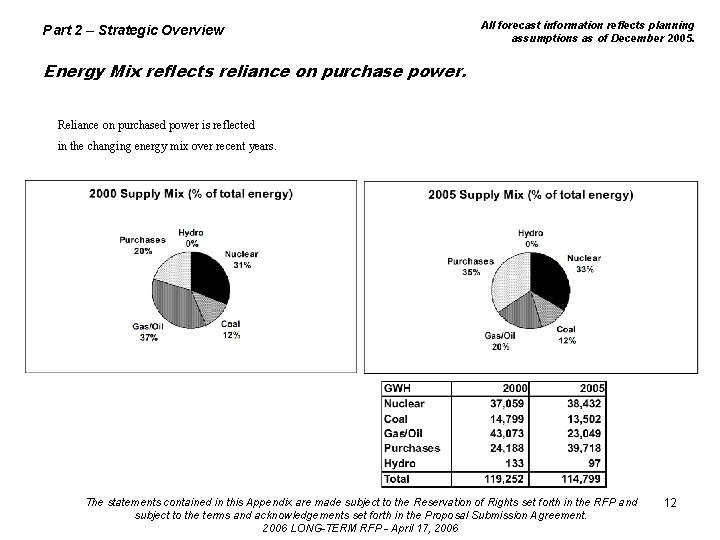
Part 2 – Strategic Overview All forecast information reflects planning assumptions as of December 2005. Energy Mix reflects reliance on purchase power. Reliance on purchased power is reflected in the changing energy mix over recent years. The statements contained in this Appendix are made subject to the Reservation of Rights set forth in the RFP and subject to the terms and acknowledgements set forth in the Proposal Submission Agreement. 2006 LONG-TERM RFP - April 17, 2006 12
Part 2 – Strategic Overview All forecast information reflects planning assumptions as of December 2005. Changing Energy Sources The statements contained in this Appendix are made subject to the Reservation of Rights set forth in the RFP and subject to the terms and acknowledgements set forth in the Proposal Submission Agreement. 2006 LONG-TERM RFP - April 17, 2006 13
Part 2 – Strategic Overview All forecast information reflects planning assumptions as of December 2005. Self-supply Options In order to mitigate the exposure of the Operating Companies to purchase power supply risks and cost volatility, the System plans to identify and evaluate real executable resource proposals that would allow for the possibility to construct , if needed and economically justified, new capacity through self-build options – Such self-supply options would be executable within a three to five year window. – These self-build options include participation in new CCGT/cogeneration capacity, unit repowering and/or upgrades at existing generation sites. Self-supply options will be compared against market alternatives that provide comparable functionality. The statements contained in this Appendix are made subject to the Reservation of Rights set forth in the RFP and subject to the terms and acknowledgements set forth in the Proposal Submission Agreement. 2006 LONG-TERM RFP - April 17, 2006 14
Part 2 – Strategic Overview All forecast information reflects planning assumptions as of December 2005. Portfolio Mix for Long-term Resource Additions The life-of-unit (LOU) resources, whether PPA or acquisition, that will be added over the ten-year planning horizon are expected to consist primarily of CCGT and solid fuel resources. – CCGT resources are anticipated for all OPCOs and each planning region to address load-following needs. – Several OPCOs will require additional CCGT or solid fuel LOU resources to address long-term base load supply needs. – Near term LOU resources are expected to be provided primarily from resources that are already operational or nearly complete – The System will develop self-supply projects to provide “options” that could be implemented within normal construction periods, if necessary, to limit exposure to power purchases or address potential long-term reliability issues within particular locations such as Amite South or WOTAB. The statements contained in this Appendix are made subject to the Reservation of Rights set forth in the RFP and subject to the terms and acknowledgements set forth in the Proposal Submission Agreement. 2006 LONG-TERM RFP - April 17, 2006 15
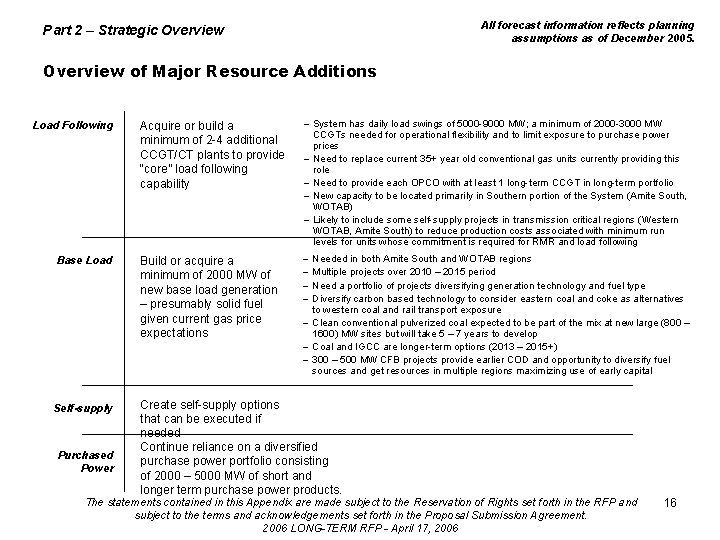
All forecast information reflects planning assumptions as of December 2005. Part 2 – Strategic Overview of Major Resource Additions Acquire or build a minimum of 2 -4 additional CCGT/CT plants to provide “core” load following capability – System has daily load swings of 5000 -9000 MW; a minimum of 2000 -3000 MW CCGTs needed for operational flexibility and to limit exposure to purchase power prices – Need to replace current 35+ year old conventional gas units currently providing this role – Need to provide each OPCO with at least 1 long-term CCGT in long-term portfolio – New capacity to be located primarily in Southern portion of the System (Amite South, WOTAB) – Likely to include some self-supply projects in transmission critical regions (Western WOTAB, Amite South) to reduce production costs associated with minimum run levels for units whose commitment is required for RMR and load following Base Load Build or acquire a minimum of 2000 MW of new base load generation – presumably solid fuel given current gas price expectations – – Self-supply Create self-supply options that can be executed if needed Continue reliance on a diversified purchase power portfolio consisting of 2000 – 5000 MW of short and longer term purchase power products. Load Following Purchased Power Needed in both Amite South and WOTAB regions Multiple projects over 2010 – 2015 period Need a portfolio of projects diversifying generation technology and fuel type Diversify carbon based technology to consider eastern coal and coke as alternatives to western coal and rail transport exposure – Clean conventional pulverized coal expected to be part of the mix at new large (800 – 1600) MW sites but will take 5 – 7 years to develop – Coal and IGCC are longer-term options (2013 – 2015+) – 300 – 500 MW CFB projects provide earlier COD and opportunity to diversify fuel sources and get resources in multiple regions maximizing use of early capital The statements contained in this Appendix are made subject to the Reservation of Rights set forth in the RFP and subject to the terms and acknowledgements set forth in the Proposal Submission Agreement. 2006 LONG-TERM RFP - April 17, 2006 16
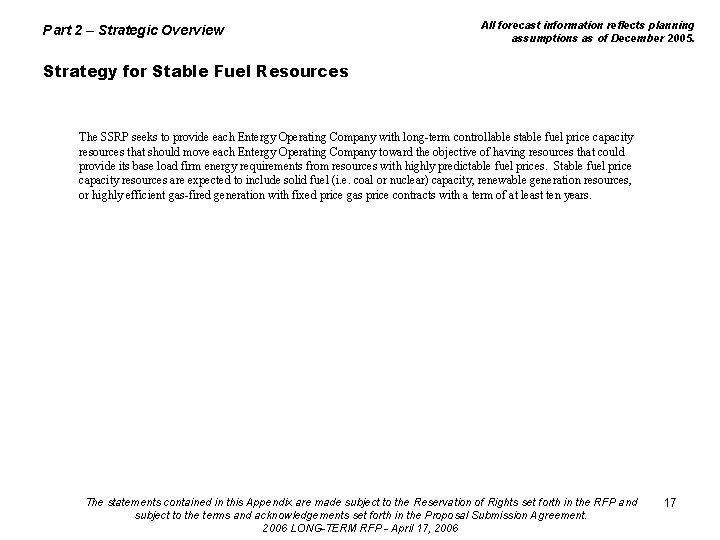
Part 2 – Strategic Overview All forecast information reflects planning assumptions as of December 2005. Strategy for Stable Fuel Resources The SSRP seeks to provide each Entergy Operating Company with long-term controllable stable fuel price capacity resources that should move each Entergy Operating Company toward the objective of having resources that could provide its base load firm energy requirements from resources with highly predictable fuel prices. Stable fuel price capacity resources are expected to include solid fuel (i. e. coal or nuclear) capacity, renewable generation resources, or highly efficient gas-fired generation with fixed price gas price contracts with a term of at least ten years. The statements contained in this Appendix are made subject to the Reservation of Rights set forth in the RFP and subject to the terms and acknowledgements set forth in the Proposal Submission Agreement. 2006 LONG-TERM RFP - April 17, 2006 17
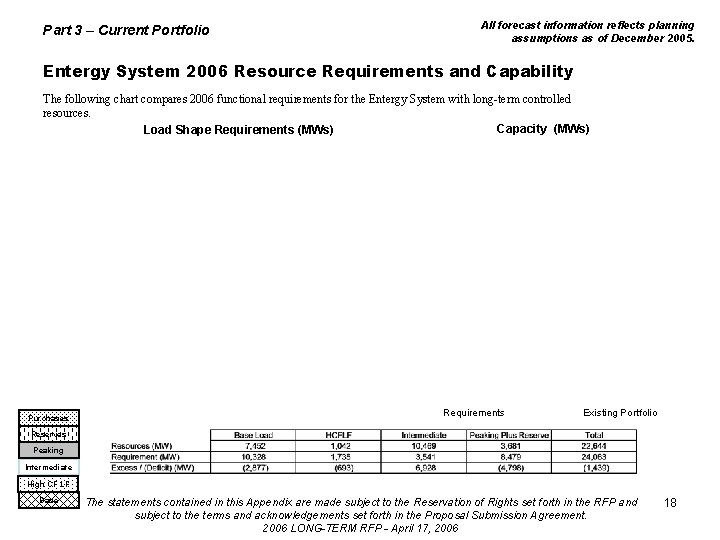
Part 3 – Current Portfolio All forecast information reflects planning assumptions as of December 2005. Entergy System 2006 Resource Requirements and Capability The following chart compares 2006 functional requirements for the Entergy System with long-term controlled resources. Capacity (MWs) Load Shape Requirements (MWs) Purchases Requirements Existing Portfolio Reserves Peaking Intermediate High CF LF Base The statements contained in this Appendix are made subject to the Reservation of Rights set forth in the RFP and subject to the terms and acknowledgements set forth in the Proposal Submission Agreement. 2006 LONG-TERM RFP - April 17, 2006 18
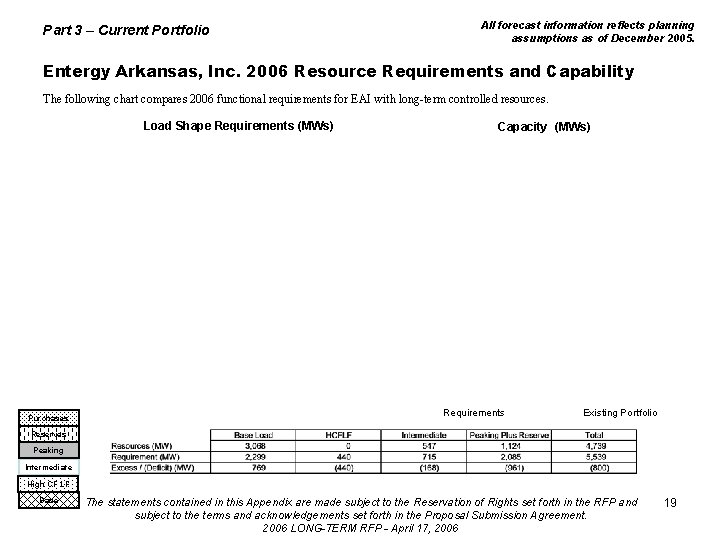
Part 3 – Current Portfolio All forecast information reflects planning assumptions as of December 2005. Entergy Arkansas, Inc. 2006 Resource Requirements and Capability The following chart compares 2006 functional requirements for EAI with long-term controlled resources. Load Shape Requirements (MWs) Purchases Capacity (MWs) Requirements Existing Portfolio Reserves Peaking Intermediate High CF LF Base The statements contained in this Appendix are made subject to the Reservation of Rights set forth in the RFP and subject to the terms and acknowledgements set forth in the Proposal Submission Agreement. 2006 LONG-TERM RFP - April 17, 2006 19
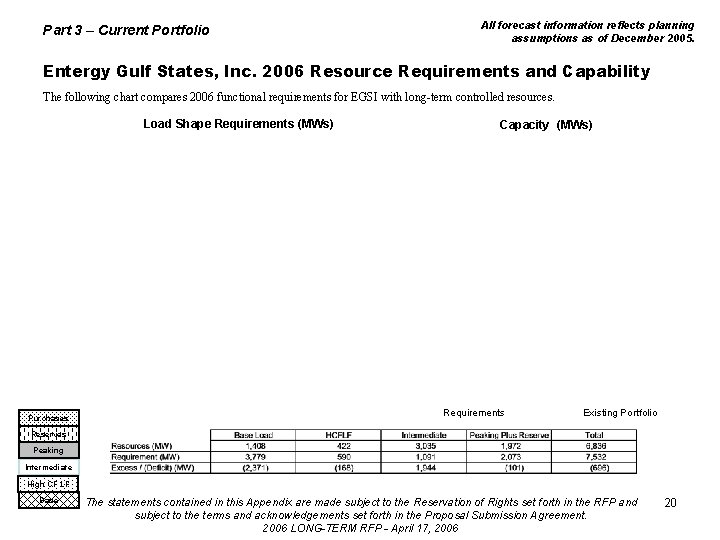
Part 3 – Current Portfolio All forecast information reflects planning assumptions as of December 2005. Entergy Gulf States, Inc. 2006 Resource Requirements and Capability The following chart compares 2006 functional requirements for EGSI with long-term controlled resources. Load Shape Requirements (MWs) Purchases Capacity (MWs) Requirements Existing Portfolio Reserves Peaking Intermediate High CF LF Base The statements contained in this Appendix are made subject to the Reservation of Rights set forth in the RFP and subject to the terms and acknowledgements set forth in the Proposal Submission Agreement. 2006 LONG-TERM RFP - April 17, 2006 20
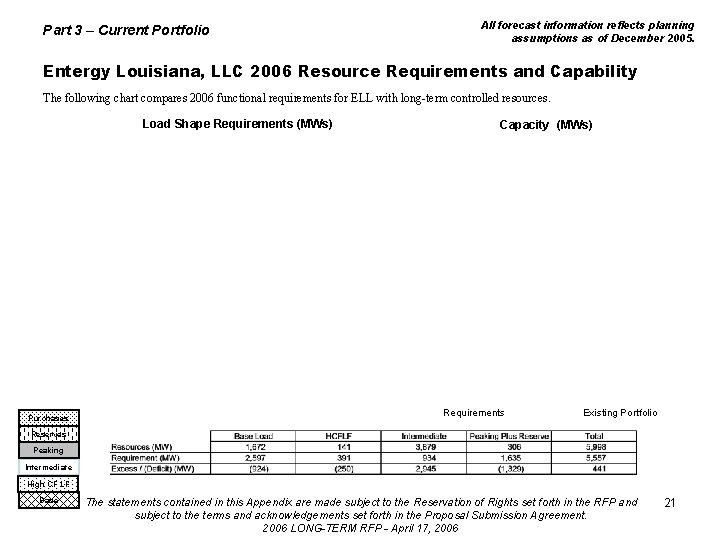
Part 3 – Current Portfolio All forecast information reflects planning assumptions as of December 2005. Entergy Louisiana, LLC 2006 Resource Requirements and Capability The following chart compares 2006 functional requirements for ELL with long-term controlled resources. Load Shape Requirements (MWs) Purchases Capacity (MWs) Requirements Existing Portfolio Reserves Peaking Intermediate High CF LF Base The statements contained in this Appendix are made subject to the Reservation of Rights set forth in the RFP and subject to the terms and acknowledgements set forth in the Proposal Submission Agreement. 2006 LONG-TERM RFP - April 17, 2006 21
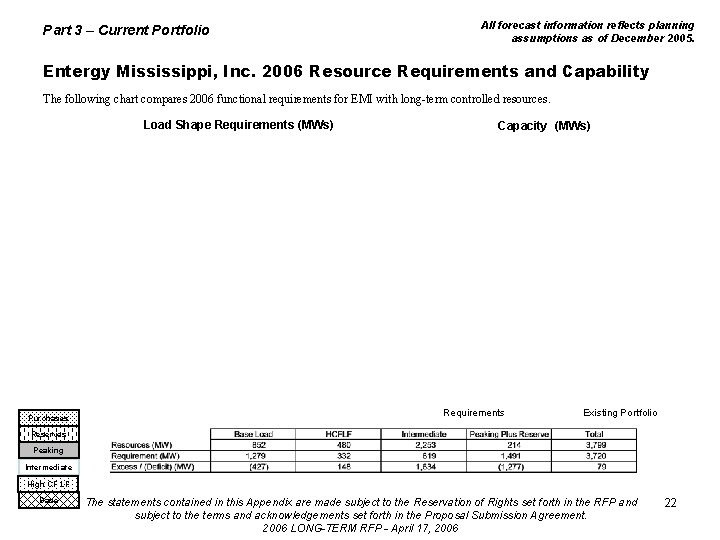
Part 3 – Current Portfolio All forecast information reflects planning assumptions as of December 2005. Entergy Mississippi, Inc. 2006 Resource Requirements and Capability The following chart compares 2006 functional requirements for EMI with long-term controlled resources. Load Shape Requirements (MWs) Purchases Capacity (MWs) Requirements Existing Portfolio Reserves Peaking Intermediate High CF LF Base The statements contained in this Appendix are made subject to the Reservation of Rights set forth in the RFP and subject to the terms and acknowledgements set forth in the Proposal Submission Agreement. 2006 LONG-TERM RFP - April 17, 2006 22
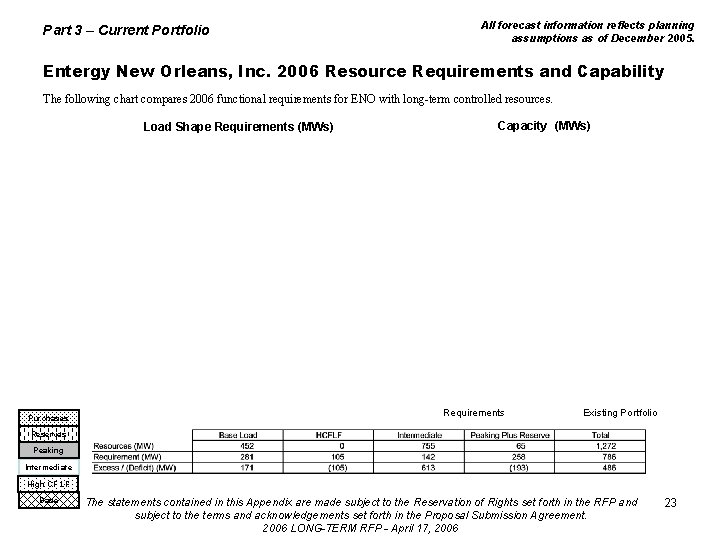
Part 3 – Current Portfolio All forecast information reflects planning assumptions as of December 2005. Entergy New Orleans, Inc. 2006 Resource Requirements and Capability The following chart compares 2006 functional requirements for ENO with long-term controlled resources. Load Shape Requirements (MWs) Purchases Capacity (MWs) Requirements Existing Portfolio Reserves Peaking Intermediate High CF LF Base The statements contained in this Appendix are made subject to the Reservation of Rights set forth in the RFP and subject to the terms and acknowledgements set forth in the Proposal Submission Agreement. 2006 LONG-TERM RFP - April 17, 2006 23
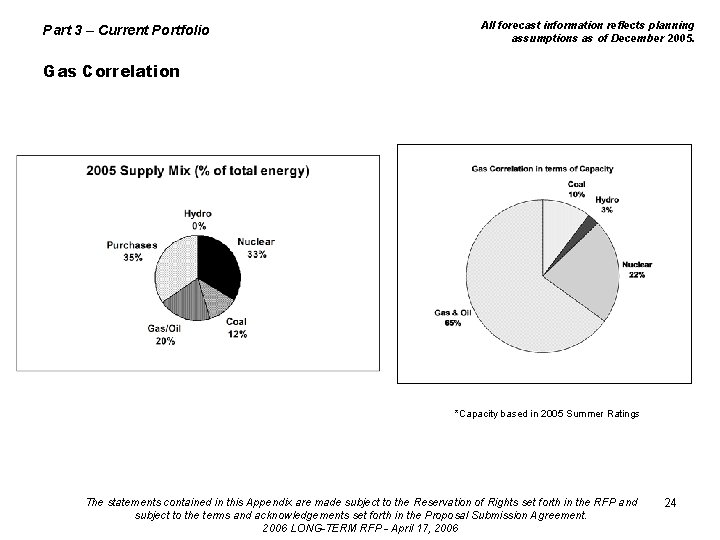
Part 3 – Current Portfolio All forecast information reflects planning assumptions as of December 2005. Gas Correlation *Capacity based in 2005 Summer Ratings The statements contained in this Appendix are made subject to the Reservation of Rights set forth in the RFP and subject to the terms and acknowledgements set forth in the Proposal Submission Agreement. 2006 LONG-TERM RFP - April 17, 2006 24
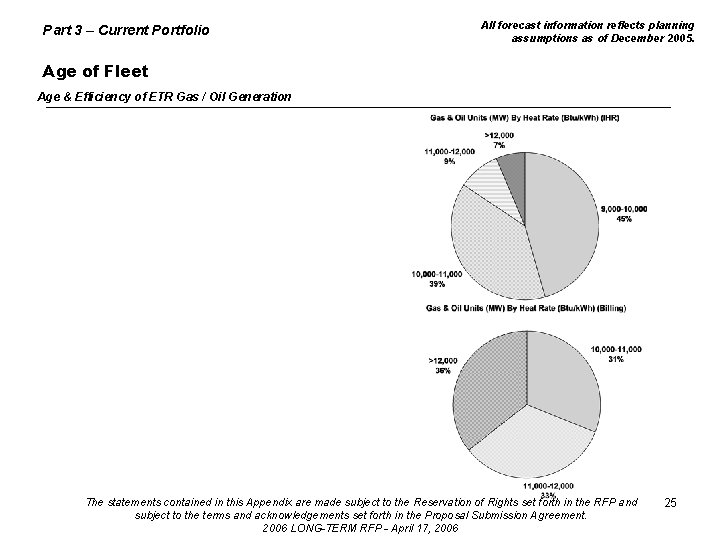
Part 3 – Current Portfolio All forecast information reflects planning assumptions as of December 2005. Age of Fleet Age & Efficiency of ETR Gas / Oil Generation The statements contained in this Appendix are made subject to the Reservation of Rights set forth in the RFP and subject to the terms and acknowledgements set forth in the Proposal Submission Agreement. 2006 LONG-TERM RFP - April 17, 2006 25
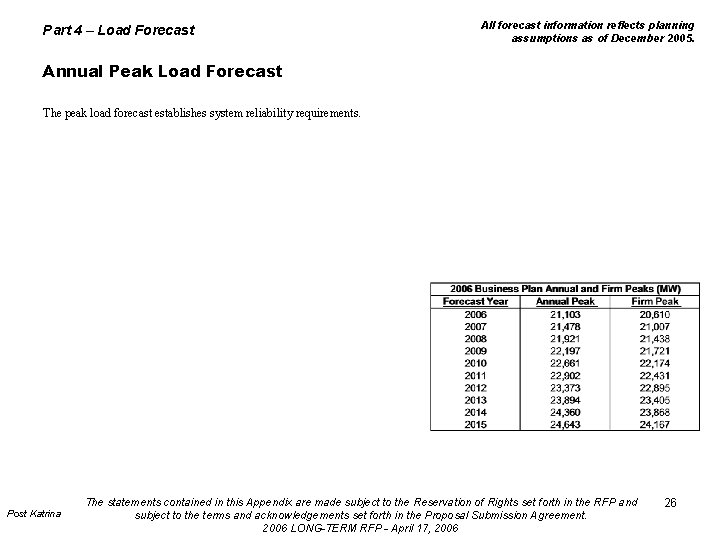
Part 4 – Load Forecast All forecast information reflects planning assumptions as of December 2005. Annual Peak Load Forecast The peak load forecast establishes system reliability requirements. Post Katrina The statements contained in this Appendix are made subject to the Reservation of Rights set forth in the RFP and subject to the terms and acknowledgements set forth in the Proposal Submission Agreement. 2006 LONG-TERM RFP - April 17, 2006 26
Part 5 – Retirement Strategy All forecast information reflects planning assumptions as of December 2005. Retirement Strategy The operating companies have evaluated and continue to evaluate potential unit retirements on an on-going basis. The decision whether to retire an existing unit is an economic one that requires comparison of the forward cost of the existing unit with the forward cost of alternatives. Many of the System’s older gas and oil-fired units run at low capacity factors. At the same time these units require relatively low forward spending to keep available. Consequently, these units serve the peaking / reserve role in an economic manner. They provide economic sources of capacity. The statements contained in this Appendix are made subject to the Reservation of Rights set forth in the RFP and subject to the terms and acknowledgements set forth in the Proposal Submission Agreement. 2006 LONG-TERM RFP - April 17, 2006 27
Part 6 – Overview of Plan 2006 - 2015 All forecast information reflects planning assumptions as of December 2005. Overview of Plan Ø Plan identifies preliminary expectations regarding timing and location (planning region) for new long-term resources, and expected participation in each resource (to be finalized by the Operating Committee at the time commitment to resource is made). Ø Amounts and timing reflect the Entergy System needs. Ø Preliminary resource participation based upon consideration of Operating Company supply requirements to meet load shape and expected business risks and conditions. The statements contained in this Appendix are made subject to the Reservation of Rights set forth in the RFP and subject to the terms and acknowledgements set forth in the Proposal Submission Agreement. 2006 LONG-TERM RFP - April 17, 2006 28
Part 6 – Overview of Plan 2006 - 2015 All forecast information reflects planning assumptions as of December 2005. Summary of Plan Resources The statements contained in this Appendix are made subject to the Reservation of Rights set forth in the RFP and subject to the terms and acknowledgements set forth in the Proposal Submission Agreement. 2006 LONG-TERM RFP - April 17, 2006 29