
ALL Describe properties of the states of matter
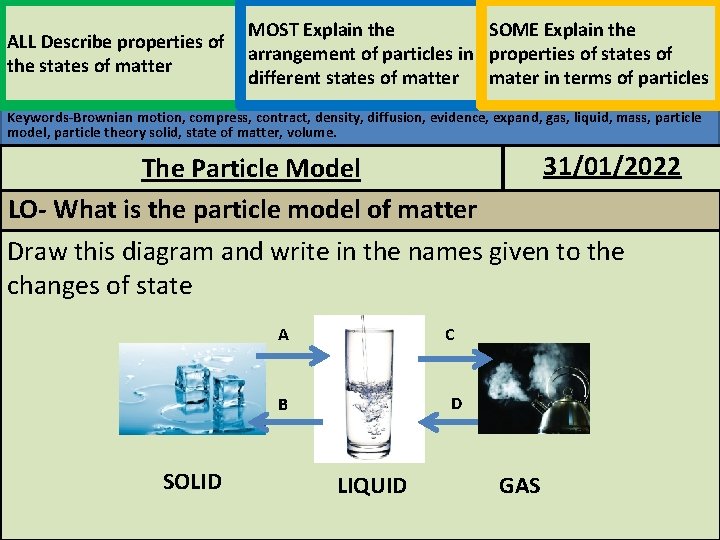
ALL Describe properties of the states of matter MOST Explain the SOME Explain the arrangement of particles in properties of states of different states of matter mater in terms of particles Keywords-Brownian motion, compress, contract, density, diffusion, evidence, expand, gas, liquid, mass, particle model, particle theory solid, state of matter, volume. 31/01/2022 The Particle Model LO- What is the particle model of matter Draw this diagram and write in the names given to the changes of state A C D B SOLID LIQUID GAS
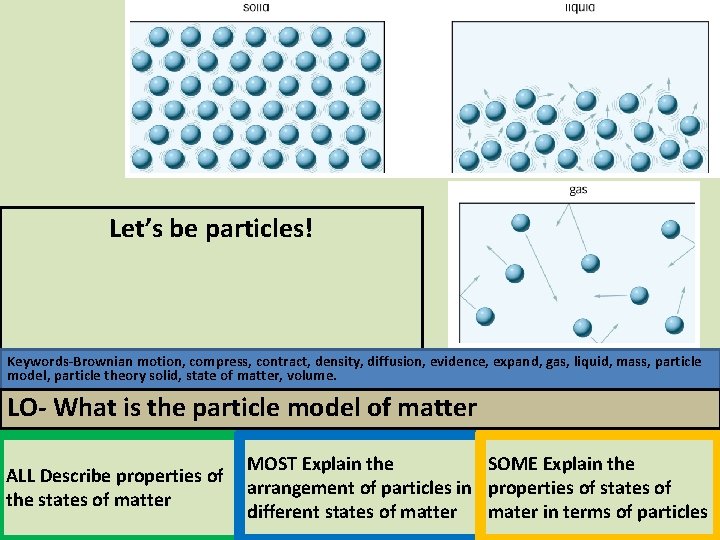
Let’s be particles! Keywords-Brownian motion, compress, contract, density, diffusion, evidence, expand, gas, liquid, mass, particle model, particle theory solid, state of matter, volume. LO- What is the particle model of matter ALL Describe properties of the states of matter MOST Explain the SOME Explain the arrangement of particles in properties of states of different states of matter mater in terms of particles
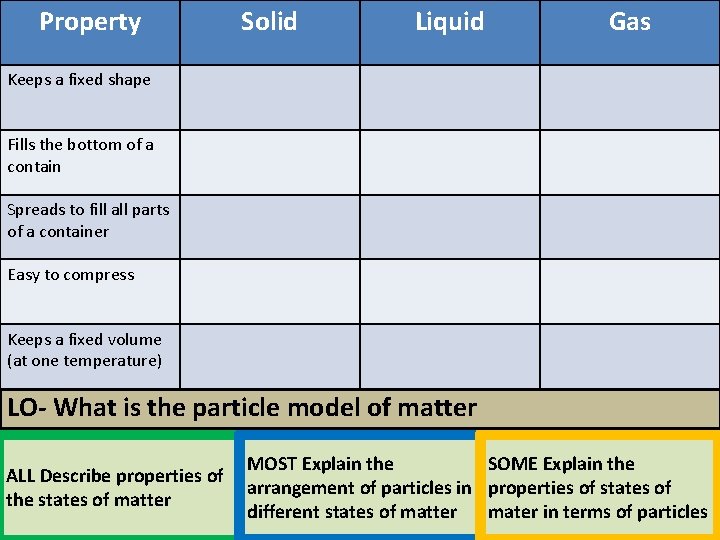
Property Solid Liquid Gas Keeps a fixed shape Fills the bottom of a contain Spreads to fill all parts of a container Easy to compress Keeps a fixed volume (at one temperature) LO- What is the particle model of matter ALL Describe properties of the states of matter MOST Explain the SOME Explain the arrangement of particles in properties of states of different states of matter mater in terms of particles
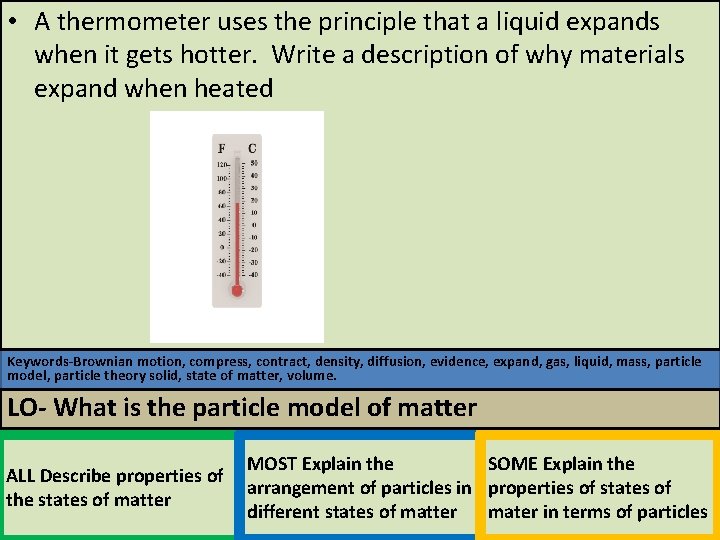
• A thermometer uses the principle that a liquid expands when it gets hotter. Write a description of why materials expand when heated Keywords-Brownian motion, compress, contract, density, diffusion, evidence, expand, gas, liquid, mass, particle model, particle theory solid, state of matter, volume. LO- What is the particle model of matter ALL Describe properties of the states of matter MOST Explain the SOME Explain the arrangement of particles in properties of states of different states of matter mater in terms of particles
A. Fill a bowl with crushed ice. B. Put a little coloured dye in the flask, and then fill it to the very top with cold water. Stand it in the bowl of crushed ice. C. After 15 minutes, carefully push the rubber bung into the top of the flask. You should see the coloured water in the glass tube. Mark the level of the water in the tube. D. Put the flask into a water bath and leave it for 15 minutes. E. After 15 minutes, mark the new level of the water in the glass tube. F. Divide the distance between your two marks into five equal divisions. Each division will represent 10 degrees. G. Leave your flask on the bench for 15 minutes (or until the next lesson). Mark the new level of the water. Keywords-Brownian motion, compress, contract, density, diffusion, evidence, expand, gas, liquid, mass, particle model, particle theory solid, state of matter, volume. LO- What is the particle model of matter ALL Describe properties of the states of matter MOST Explain the SOME Explain the arrangement of particles in properties of states of different states of matter mater in terms of particles
(ALL) Draw a picture of the arrangement of particles in each of the states of matter the write a description of the properties of that state of matter using the tick table to help (MOST) For each state of matter write a couple of sentences to describe the arrangement of particles in that state (SOME) For each state of matter explain the properties (in the ALL) using the term particles e. g. a gas is easy to compress because the particles are…. Keywords-Brownian motion, compress, contract, density, diffusion, evidence, expand, gas, liquid, mass, particle model, particle theory solid, state of matter, volume. LO- What is the particle model of matter ALL Describe properties of the states of matter MOST Explain the SOME Explain the arrangement of particles in properties of states of different states of matter mater in terms of particles
- Slides: 6