
All ALS vs Tiered EMS System Design An
- Slides: 18
All ALS vs. Tiered EMS System Design An Operational Perspective
Topics Covered • History • Delivery Models • Staffing Models • EMS System Design – Clinical vs. Economic • Operational Impacts • Cost Impacts • Controversies • Conclusions
Introduction • Dave Shrader – The Polaris Group • Jonathan Washko, BS-EMSA, NREMT-P, EMD – AVP NS-LIJ Center for EMS – Washko & Associates, LLC
Presentation Background • Controversies in EMS Design – All ALS vs. Tiered, a Scientific Review – Well put together presentation with scary clinical results for the industry – Clearly demonstrates the need to develop and maintain ALS skills – Need to further clarify cause and effect of results • Training deficits • Experience deficits • Task time elements • First responder elements – “If you have seen one EMS system you’ve seen one EMS system” as no two are alike
Presentation Background • Each EMS System has to make most of resources available to it – Money – People – Public Expectations (In and Out) – Clinical Resources • We agree that we should challenge and investigate the value and appropriateness of ALS as a whole, and the cost/benefit of each procedure – So busy trying to prove that we could, we never stopped to ask the questions if we should? – So busy trying to do things right that we forgot to ask if we were doing the right things?
History & Evolution of All ALS in the U. S. • Citizen Expectations • Clinical Beginnings • Reimbursement • Professional Advancement / Incremental Pay • Operational / Economic Efficiencies (Stout / Overton) • Clinical Specializations (CCEMTP, EMTI, EMT-B) • Clinical Research • Public Safety vs. Healthcare Identity Crisis • Advance Practice / Healthcare Integration of EMS
Delivery Model Types • BLS Transport Only • BLS Transport with ALS Fly Car • BLS Transport with ALS Fire First Response • ALS Transport with BLS Fire First Response • ALS Transport with ILS Fire First Response • ALS Transport with ALS Fire First Response • ALS & BLS Transport with BLS Fire First Response (Tiered)
Staffing Models • EMT-B + EMT-B • EMT-B + EMT-I • EMT-B + EMT-P • EMT-I + EMT-P • EMT-P + EMT-P • EMT-B + MICN (RN) • EMT-B + EMT-P + MICN (RN) • EMT-B + CCEMTP + MICN (RN) • EMT-B + MICN + PA • EMT-B + MICN + Respiratory Therapist / Perfusionist • EMT-P + RN + Board Certified MD (Cardiologist, Internist, Emergency) • Others
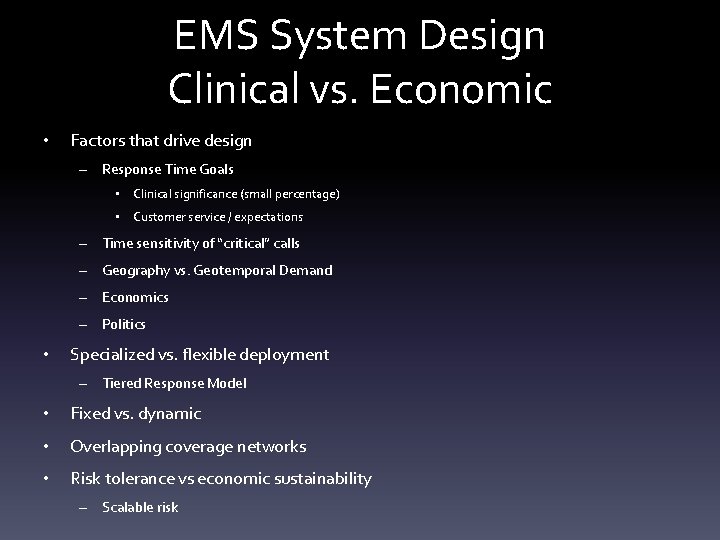
EMS System Design Clinical vs. Economic • Factors that drive design – Response Time Goals • Clinical significance (small percentage) • Customer service / expectations – Time sensitivity of “critical” calls – Geography vs. Geotemporal Demand – Economics – Politics • Specialized vs. flexible deployment – Tiered Response Model • Fixed vs. dynamic • Overlapping coverage networks • Risk tolerance vs economic sustainability – Scalable risk
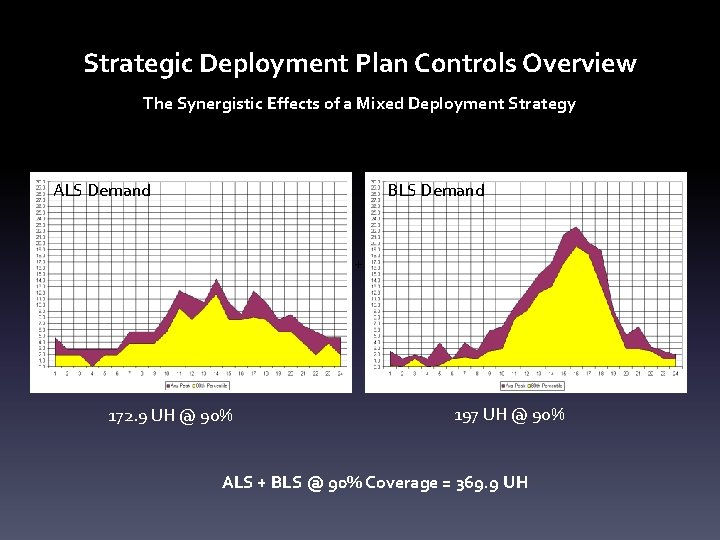
Strategic Deployment Plan Controls Overview The Synergistic Effects of a Mixed Deployment Strategy BLS Demand ALS Demand + 172. 9 UH @ 90% 197 UH @ 90% ALS + BLS @ 90% Coverage = 369. 9 UH
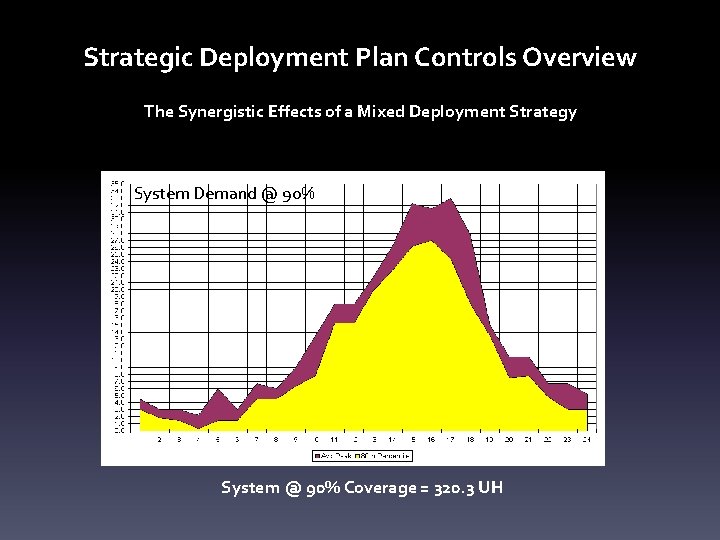
Strategic Deployment Plan Controls Overview The Synergistic Effects of a Mixed Deployment Strategy System Demand @ 90% System @ 90% Coverage = 320. 3 UH
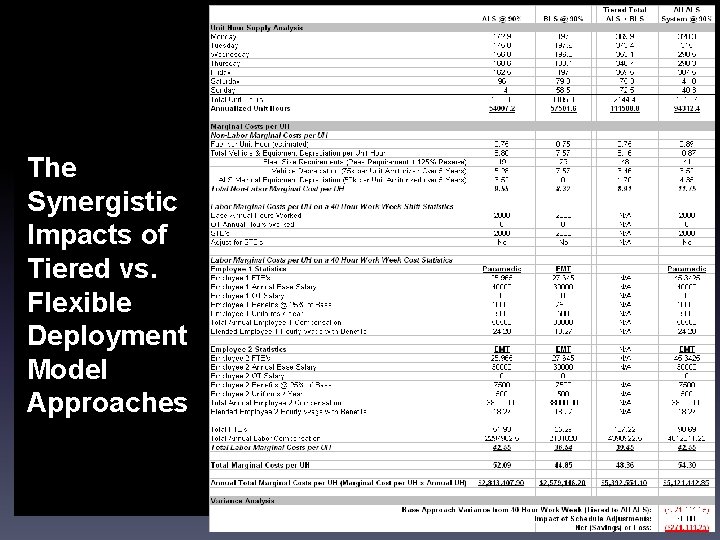
The Synergistic Impacts of Tiered vs. Flexible Deployment Model Approaches
Operational Impacts • Triage and sorting reliability (un) • Cost of service per patient • Productivity vs. unit hours costs • Operational flexibility (standardization) – Equipment, Fleet, Dispatch Methods • Compounding complexities of production – Payroll costs and OT – Specialized skills (Square Peg – Round Hole) • Mismatch of services
Cost Impacts • Economies of scale • Utility economics • Loss of revenues (BLS vs ALS reimbursement) • More for the same $$$ • Do same for less $$$ • Overton, J. ALS and BLS A Cost Effectiveness Study. Presentation – NAEMSP, January 2000
Controversies • System overload situations • Clinical concerns • Employee well-being concerns • Experience in U. S. of Elitist attitudes of Paramedics in tiered systems that can impede quality patient care – Cause / Effect? ? ? • Mismatching of services
Conclusions • All variables must be assessed in determining system design – Clinical, economic, operational, political, employee • One size does not fit all • Further clinical, operational and financial research is needed before we throw the baby out with the bath water • Is ALS needed at all or do we need ILS or do our Paramedics need to do less skills • Single tier is financially preferable model that achieves same/better performance at lower cost – Use $$$ to improve clinical sophistication
Conclusions Continued… • Underlying cause of poor ALS performance is insufficient training and experience – To solve problem we should address at root of problem • Clinical experiences (simulation, regionalization, collaboration) • Clinical credentialing • Operational / process improvement
Contact Us • Dave Shrader – dshrader@thepolarisgroup. org • Jonathan Washko – jwashko@washkoassoc. com – jwashko@nshs. edu