
All About Rain Slide Title How many weather
All About Rain
Slide Title How many weather key terms can you make from these letters in one minute (you can use each letter more than once). You can include types of cloud. C D O R M S A H N B E L T Did you find any of these? clouds, anemometer, thermometer, precipitation, cirrus, cumulus, cloud droplet, condensation nuclei, barometer, air pressure, tornado, storm P I U
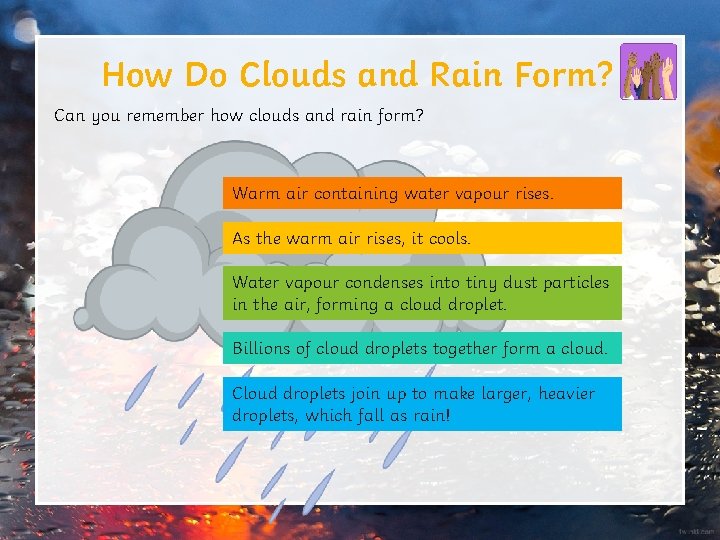
How Do Clouds and Rain Form? Can you remember how clouds and rain form? Warm air containing water vapour rises. As the warm air rises, it cools. Water vapour condenses into tiny dust particles in the air, forming a cloud droplet. Billions of cloud droplets together form a cloud. Cloud droplets join up to make larger, heavier droplets, which fall as rain!
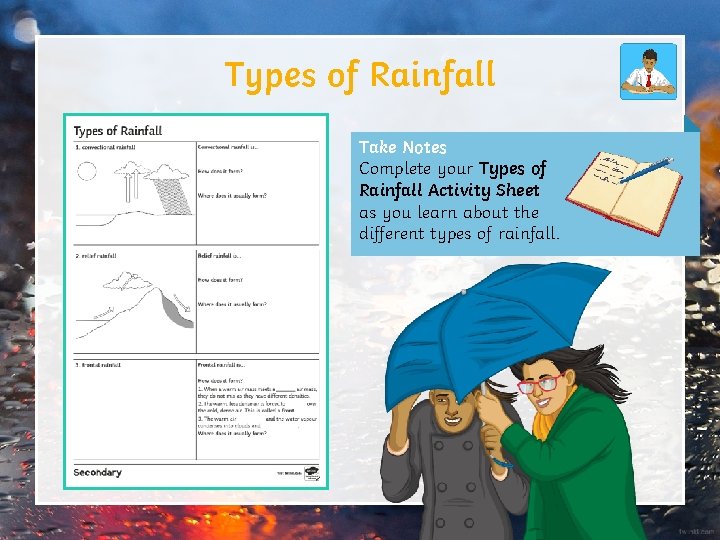
Types of Rainfall Take Notes Complete your Types of Rainfall Activity Sheet as you learn about the different types of rainfall.
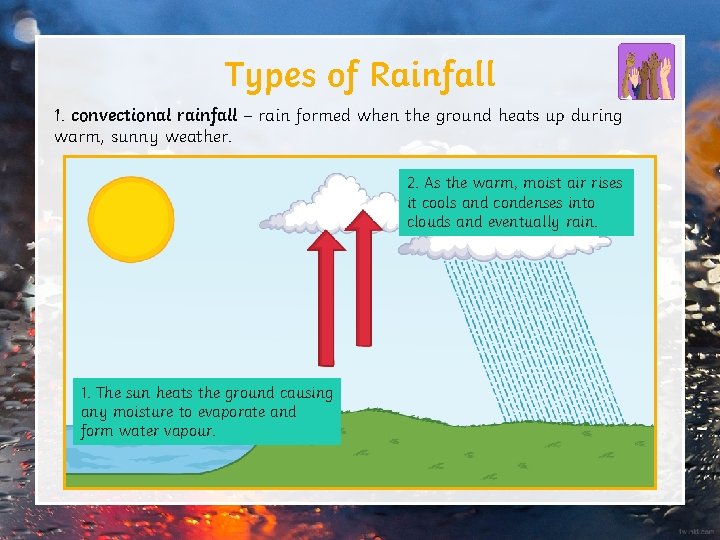
Types of Rainfall 1. convectional rainfall – rain formed when the ground heats up during warm, sunny weather. 2. As the warm, moist air rises it cools and condenses into clouds and eventually rain. 1. The sun heats the ground causing any moisture to evaporate and form water vapour.
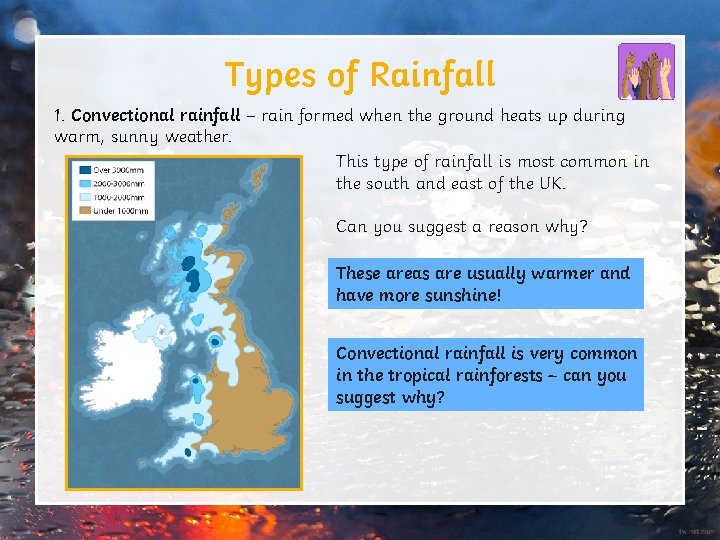
Types of Rainfall 1. Convectional rainfall – rain formed when the ground heats up during warm, sunny weather. This type of rainfall is most common in the south and east of the UK. Can you suggest a reason why? These areas are usually warmer and have more sunshine! Convectional rainfall is very common in the tropical rainforests – can you suggest why?
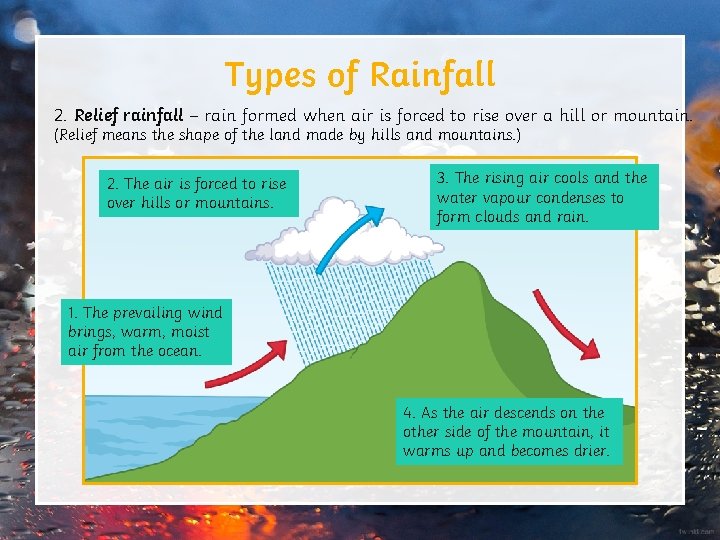
Types of Rainfall 2. Relief rainfall – rain formed when air is forced to rise over a hill or mountain. (Relief means the shape of the land made by hills and mountains. ) 2. The air is forced to rise over hills or mountains. 3. The rising air cools and the water vapour condenses to form clouds and rain. 1. The prevailing wind brings, warm, moist air from the ocean. 4. As the air descends on the other side of the mountain, it warms up and becomes drier.
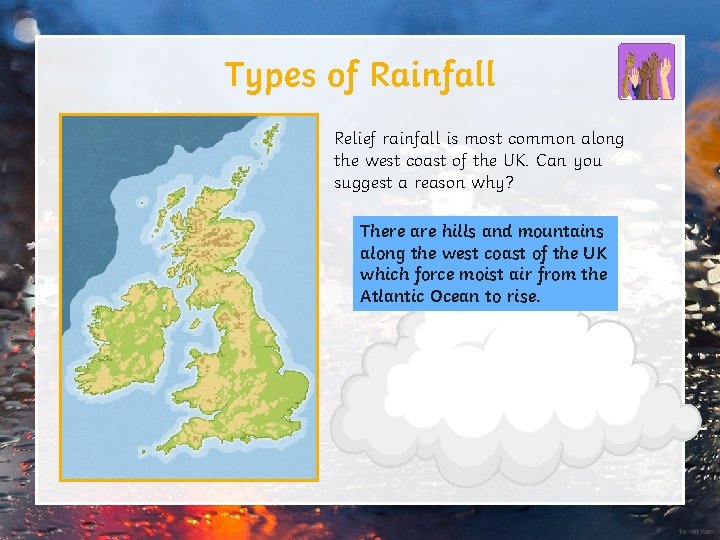
Types of Rainfall Relief rainfall is most common along the west coast of the UK. Can you suggest a reason why? There are hills and mountains along the west coast of the UK which force moist air from the Atlantic Ocean to rise. Relief map of the UK
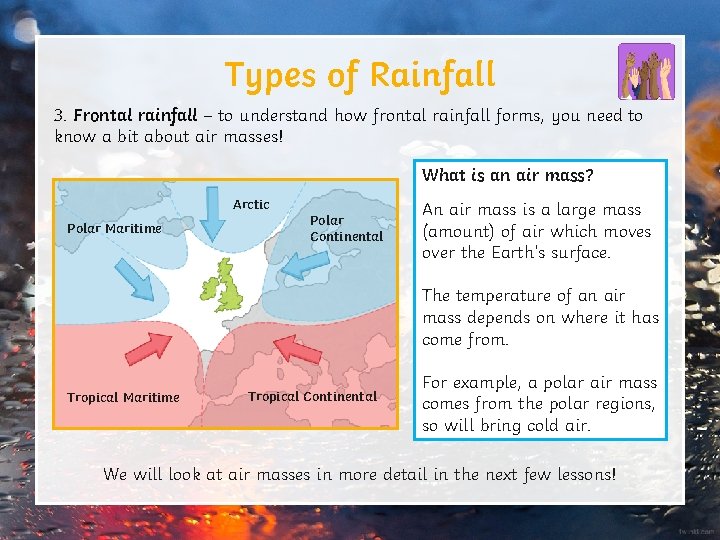
Types of Rainfall 3. Frontal rainfall – to understand how frontal rainfall forms, you need to know a bit about air masses! What is an air mass? Arctic Polar Maritime Polar Continental An air mass is a large mass (amount) of air which moves over the Earth’s surface. The temperature of an air mass depends on where it has come from. Tropical Maritime Tropical Continental For example, a polar air mass comes from the polar regions, so will bring cold air. We will look at air masses in more detail in the next few lessons!
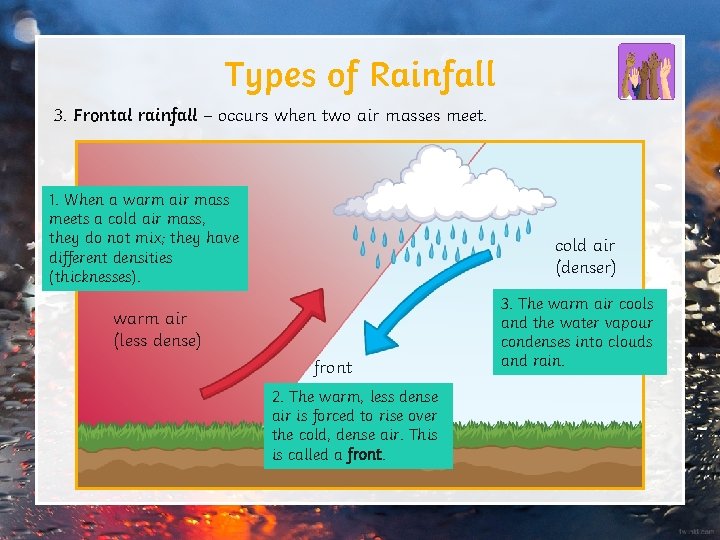
Types of Rainfall 3. Frontal rainfall – occurs when two air masses meet. 1. When a warm air mass meets a cold air mass, they do not mix; they have different densities (thicknesses). cold air (denser) warm air (less dense) front 2. The warm, less dense air is forced to rise over the cold, dense air. This is called a front. 3. The warm air cools and the water vapour condenses into clouds and rain.
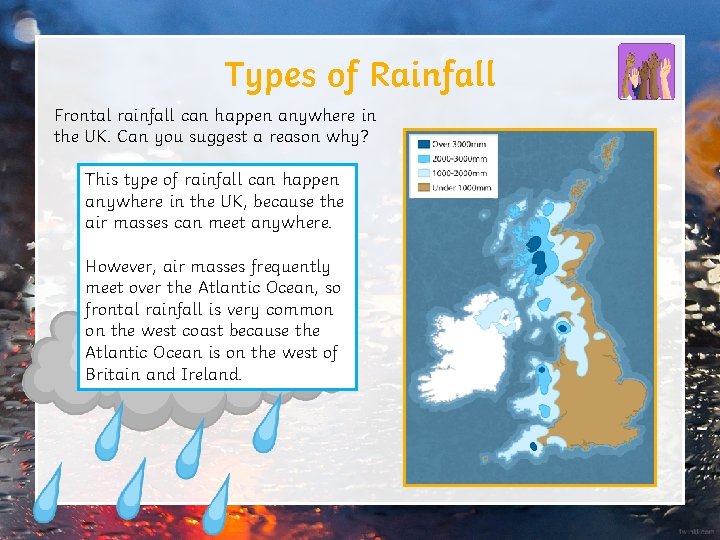
Types of Rainfall Frontal rainfall can happen anywhere in the UK. Can you suggest a reason why? This type of rainfall can happen anywhere in the UK, because the air masses can meet anywhere. However, air masses frequently meet over the Atlantic Ocean, so frontal rainfall is very common on the west coast because the Atlantic Ocean is on the west of Britain and Ireland.
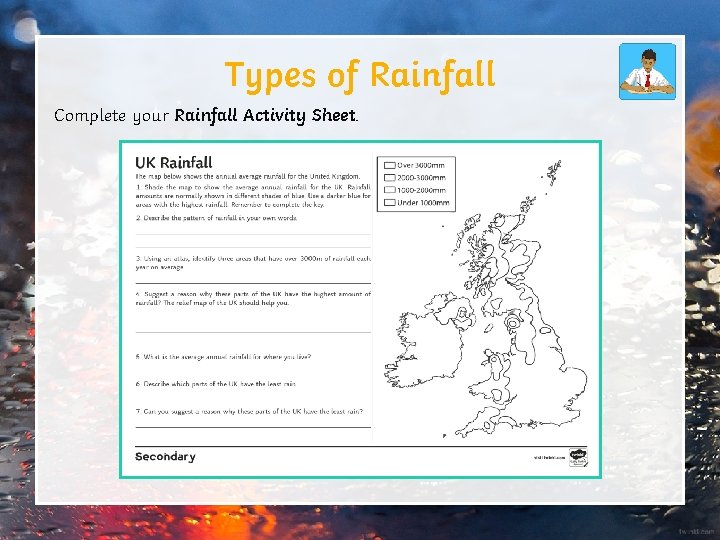
Types of Rainfall Complete your Rainfall Activity Sheet.
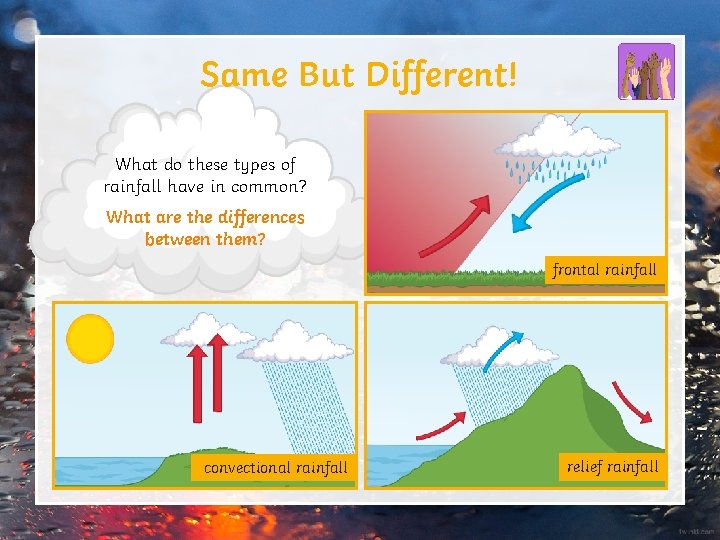
Same But Different! What do these types of rainfall have in common? What are the differences between them? frontal rainfall convectional rainfall relief rainfall
- Slides: 14