
All About Monoids Edward Kmett Overview Monoids definition
All About Monoids Edward Kmett
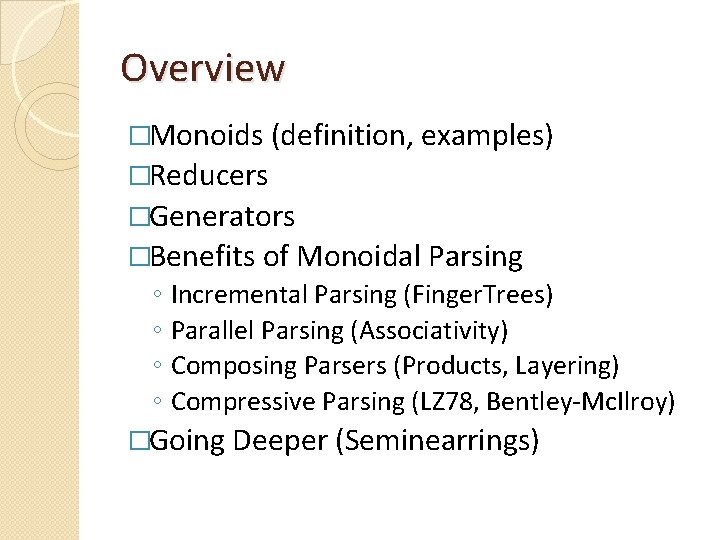
Overview �Monoids (definition, examples) �Reducers �Generators �Benefits of Monoidal Parsing ◦ ◦ Incremental Parsing (Finger. Trees) Parallel Parsing (Associativity) Composing Parsers (Products, Layering) Compressive Parsing (LZ 78, Bentley-Mc. Ilroy) �Going Deeper (Seminearrings)
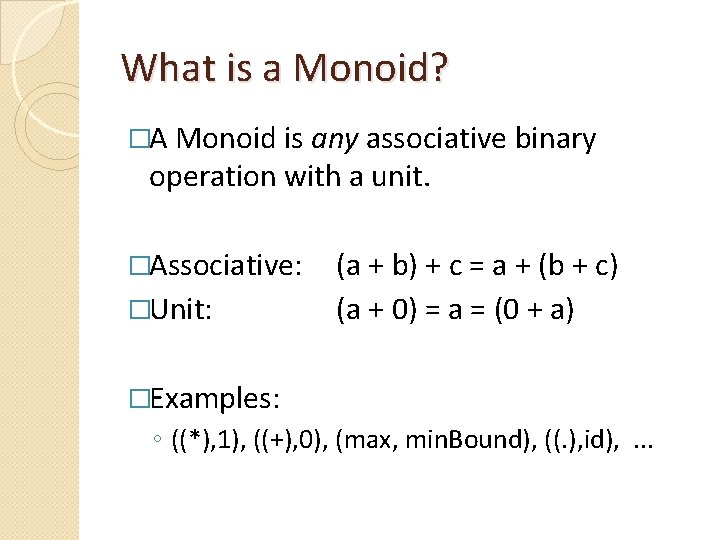
What is a Monoid? �A Monoid is any associative binary operation with a unit. �Associative: �Unit: (a + b) + c = a + (b + c) (a + 0) = a = (0 + a) �Examples: ◦ ((*), 1), ((+), 0), (max, min. Bound), ((. ), id), . . .
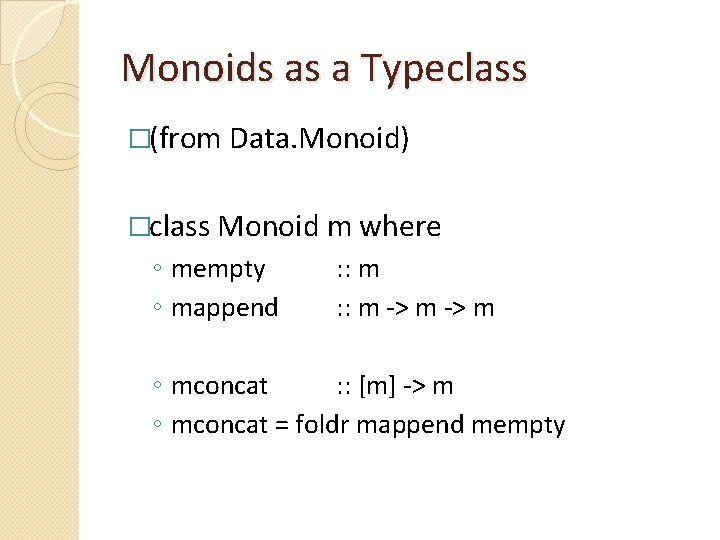
Monoids as a Typeclass �(from Data. Monoid) �class Monoid m where ◦ mempty ◦ mappend : : m -> m ◦ mconcat : : [m] -> m ◦ mconcat = foldr mappend mempty

Built-in monoid examples newtype Sum a = Sum a instance Num a => Monoid (Sum a) where mempty = Sum 0 Sum a `mappend` Sum b = Sum (a + b) newtype Endo a = Endo (a -> a) instance Monoid (Endo a) where mempty = id Endo f `mappend` Endo g = Endo (f. g)
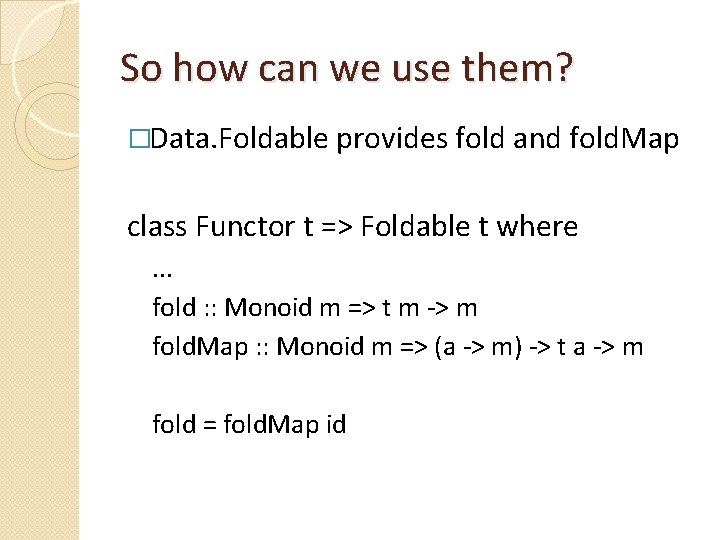
So how can we use them? �Data. Foldable provides fold and fold. Map class Functor t => Foldable t where. . . fold : : Monoid m => t m -> m fold. Map : : Monoid m => (a -> m) -> t a -> m fold = fold. Map id
![Monoids allow succinct definitions instance Monoid [a] where mempty = [] mappend = (++)](http://slidetodoc.com/presentation_image/23e681e8a7adc53e01ea64948fe83d0c/image-7.jpg "Monoids allow succinct definitions instance Monoid [a] where mempty = [] mappend = (++)")
Monoids allow succinct definitions instance Monoid [a] where mempty = [] mappend = (++) concat : : [[a]] -> [a] concat = fold concat. Map : : (a -> [b]) -> [a] -> [b] concat. Map = fold. Map
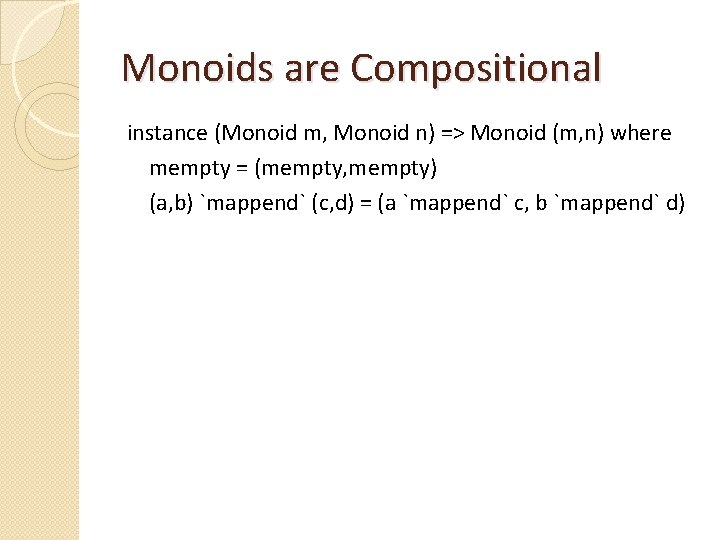
Monoids are Compositional instance (Monoid m, Monoid n) => Monoid (m, n) where mempty = (mempty, mempty) (a, b) `mappend` (c, d) = (a `mappend` c, b `mappend` d)
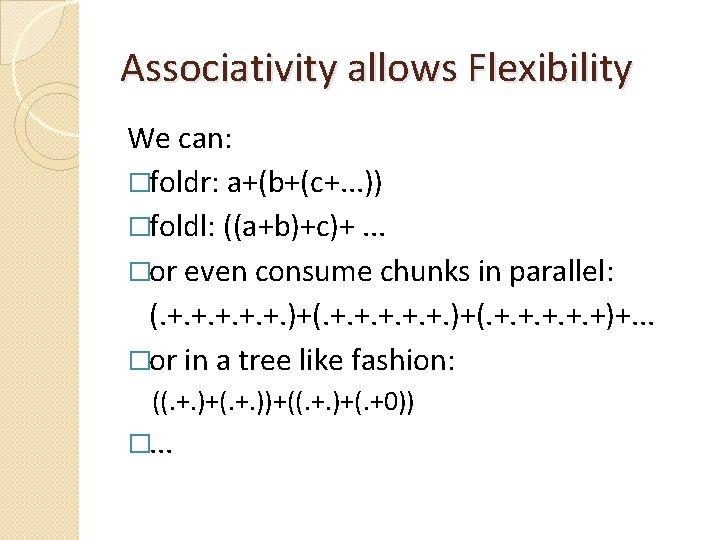
Associativity allows Flexibility We can: �foldr: a+(b+(c+. . . )) �foldl: ((a+b)+c)+. . . �or even consume chunks in parallel: (. +. +. +. )+(. +. +. +)+. . . �or in a tree like fashion: ((. +. )+(. +. ))+((. +. )+(. +0)) �. . .
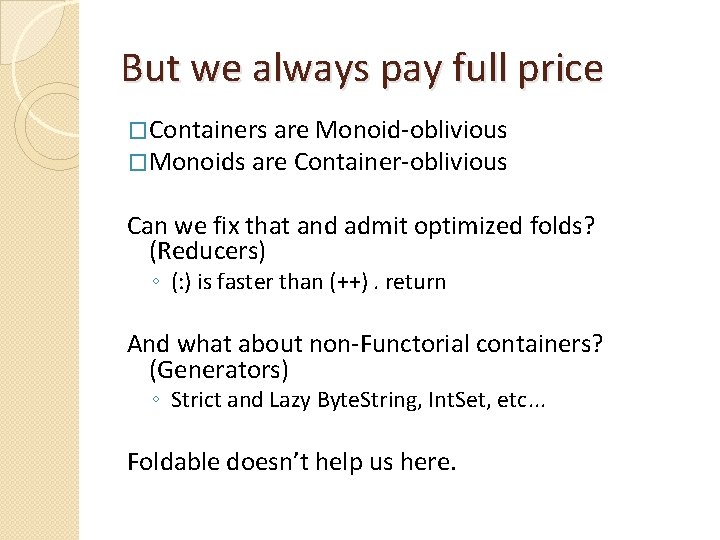
But we always pay full price �Containers are Monoid-oblivious �Monoids are Container-oblivious Can we fix that and admit optimized folds? (Reducers) ◦ (: ) is faster than (++). return And what about non-Functorial containers? (Generators) ◦ Strict and Lazy Byte. String, Int. Set, etc. . . Foldable doesn’t help us here.
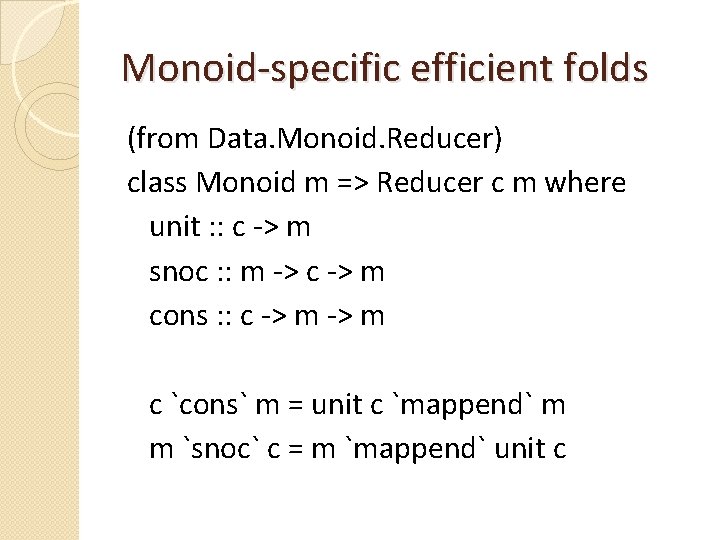
Monoid-specific efficient folds (from Data. Monoid. Reducer) class Monoid m => Reducer c m where unit : : c -> m snoc : : m -> c -> m cons : : c -> m c `cons` m = unit c `mappend` m m `snoc` c = m `mappend` unit c
![Reducers enable faster folds �reduce. List : : (c `Reducer` m) => [c] ->](http://slidetodoc.com/presentation_image/23e681e8a7adc53e01ea64948fe83d0c/image-12.jpg "Reducers enable faster folds �reduce. List : : (c `Reducer` m) => [c] ->")
Reducers enable faster folds �reduce. List : : (c `Reducer` m) => [c] -> m �reduce. List = foldr cons mempty �reduce. Text : : (Char `Reducer` m) => Text -> m �reduce. Text = Text. foldl’ snoc mempty �(We’ll come back and generalize the containers later)
![Simple Reducers �instance Reducer a [a] where ◦ unit a = [a] ◦ cons](http://slidetodoc.com/presentation_image/23e681e8a7adc53e01ea64948fe83d0c/image-13.jpg "Simple Reducers �instance Reducer a [a] where ◦ unit a = [a] ◦ cons")
Simple Reducers �instance Reducer a [a] where ◦ unit a = [a] ◦ cons = (: ) instance Num a => Reducer a (Sum a) where unit = Sum instance Reducer (a -> a) (Endo a) where unit = Endo
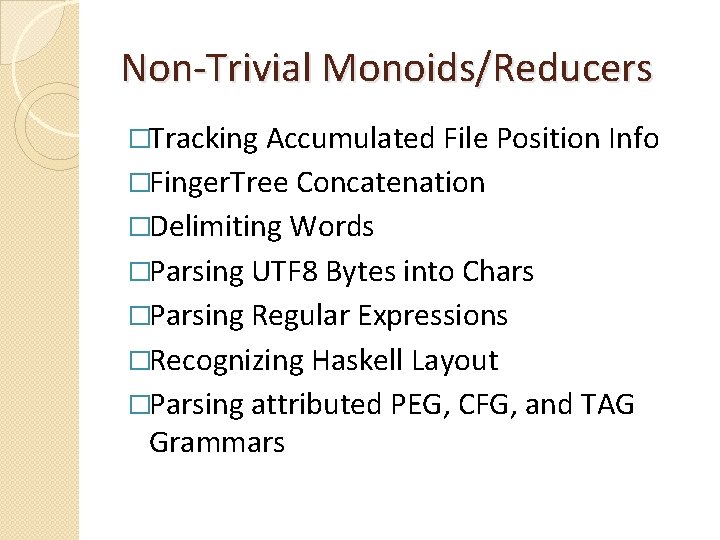
Non-Trivial Monoids/Reducers �Tracking Accumulated File Position Info �Finger. Tree Concatenation �Delimiting Words �Parsing UTF 8 Bytes into Chars �Parsing Regular Expressions �Recognizing Haskell Layout �Parsing attributed PEG, CFG, and TAG Grammars
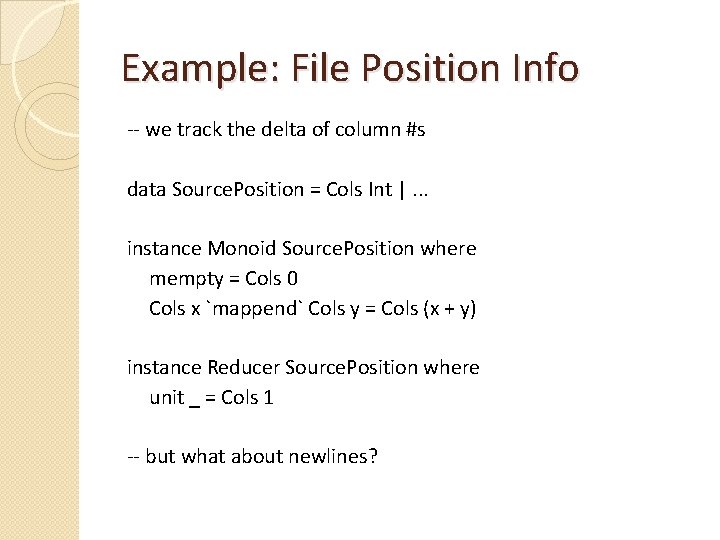
Example: File Position Info -- we track the delta of column #s data Source. Position = Cols Int |. . . instance Monoid Source. Position where mempty = Cols 0 Cols x `mappend` Cols y = Cols (x + y) instance Reducer Source. Position where unit _ = Cols 1 -- but what about newlines?
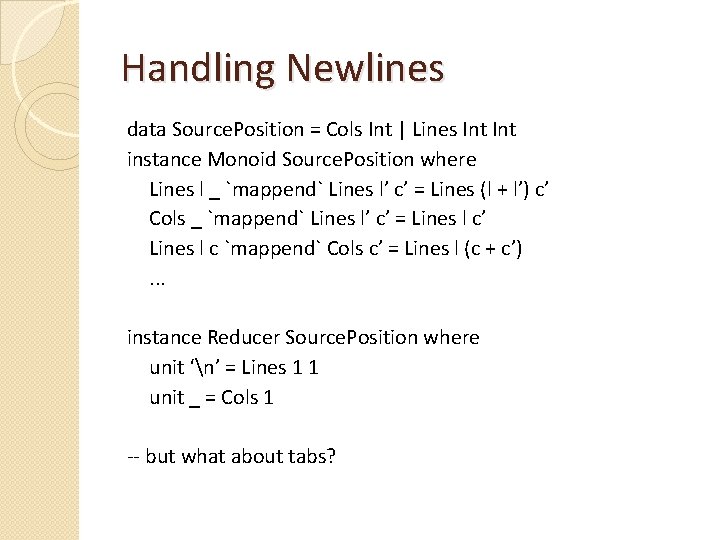
Handling Newlines data Source. Position = Cols Int | Lines Int instance Monoid Source. Position where Lines l _ `mappend` Lines l’ c’ = Lines (l + l’) c’ Cols _ `mappend` Lines l’ c’ = Lines l c’ Lines l c `mappend` Cols c’ = Lines l (c + c’). . . instance Reducer Source. Position where unit ‘n’ = Lines 1 1 unit _ = Cols 1 -- but what about tabs?
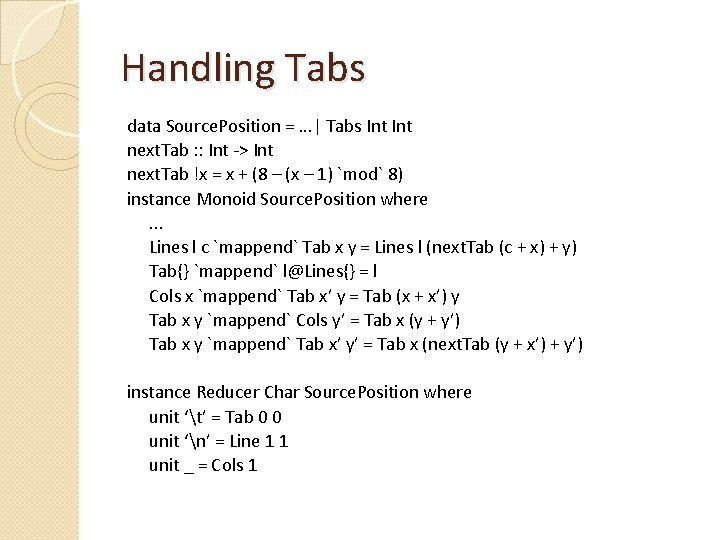
Handling Tabs data Source. Position =. . . | Tabs Int next. Tab : : Int -> Int next. Tab !x = x + (8 – (x – 1) `mod` 8) instance Monoid Source. Position where. . . Lines l c `mappend` Tab x y = Lines l (next. Tab (c + x) + y) Tab{} `mappend` l@Lines{} = l Cols x `mappend` Tab x’ y = Tab (x + x’) y Tab x y `mappend` Cols y’ = Tab x (y + y’) Tab x y `mappend` Tab x’ y’ = Tab x (next. Tab (y + x’) + y’) instance Reducer Char Source. Position where unit ‘t’ = Tab 0 0 unit ‘n’ = Line 1 1 unit _ = Cols 1
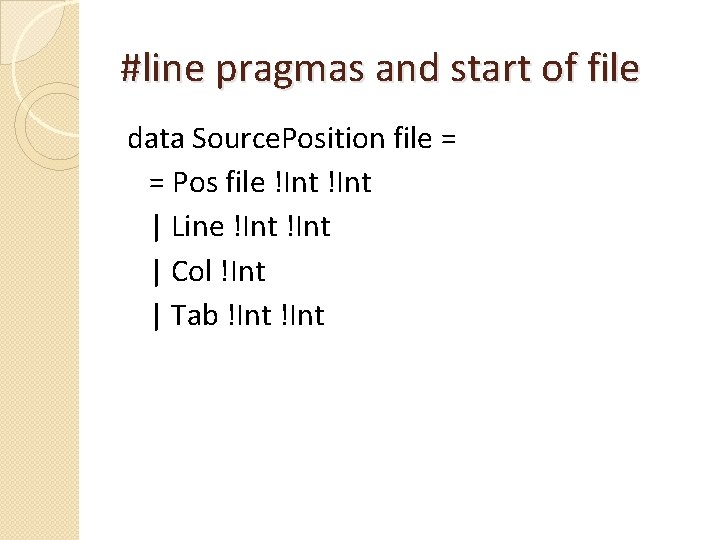
#line pragmas and start of file data Source. Position file = = Pos file !Int | Line !Int | Col !Int | Tab !Int
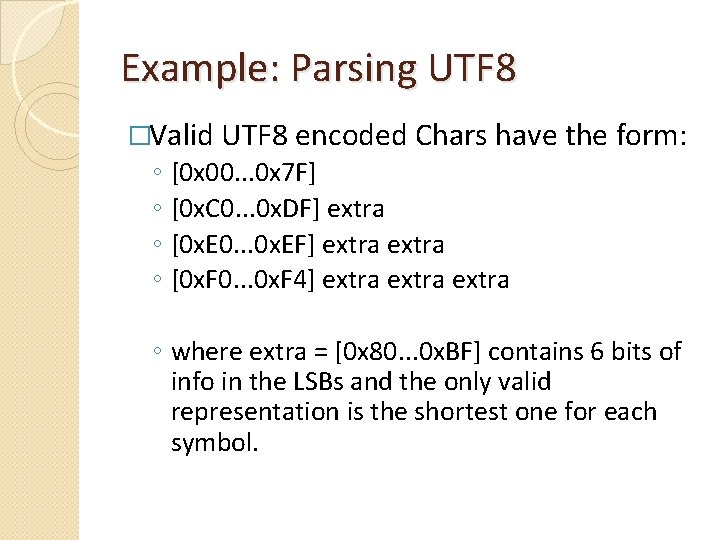
Example: Parsing UTF 8 �Valid UTF 8 encoded Chars have the form: ◦ ◦ [0 x 00. . . 0 x 7 F] [0 x. C 0. . . 0 x. DF] extra [0 x. E 0. . . 0 x. EF] extra [0 x. F 0. . . 0 x. F 4] extra ◦ where extra = [0 x 80. . . 0 x. BF] contains 6 bits of info in the LSBs and the only valid representation is the shortest one for each symbol.
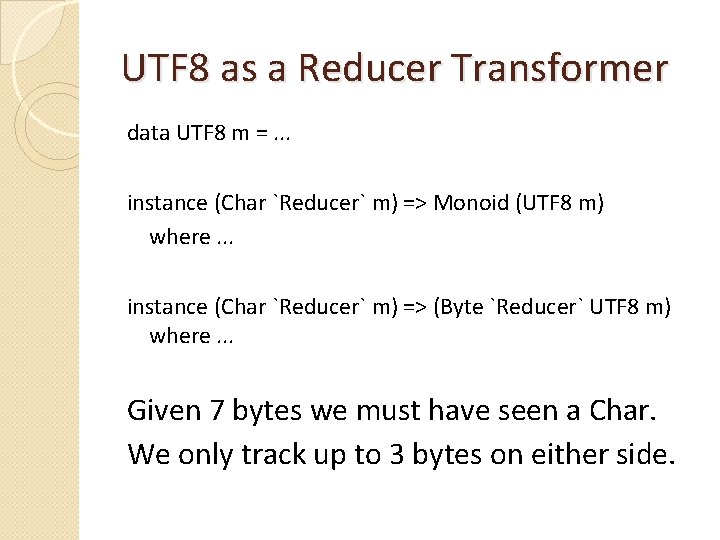
UTF 8 as a Reducer Transformer data UTF 8 m =. . . instance (Char `Reducer` m) => Monoid (UTF 8 m) where. . . instance (Char `Reducer` m) => (Byte `Reducer` UTF 8 m) where. . . Given 7 bytes we must have seen a Char. We only track up to 3 bytes on either side.
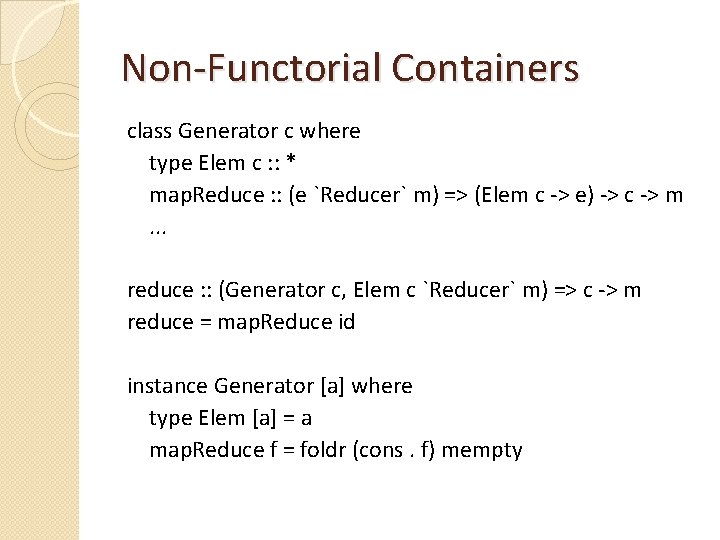
Non-Functorial Containers class Generator c where type Elem c : : * map. Reduce : : (e `Reducer` m) => (Elem c -> e) -> c -> m. . . reduce : : (Generator c, Elem c `Reducer` m) => c -> m reduce = map. Reduce id instance Generator [a] where type Elem [a] = a map. Reduce f = foldr (cons. f) mempty
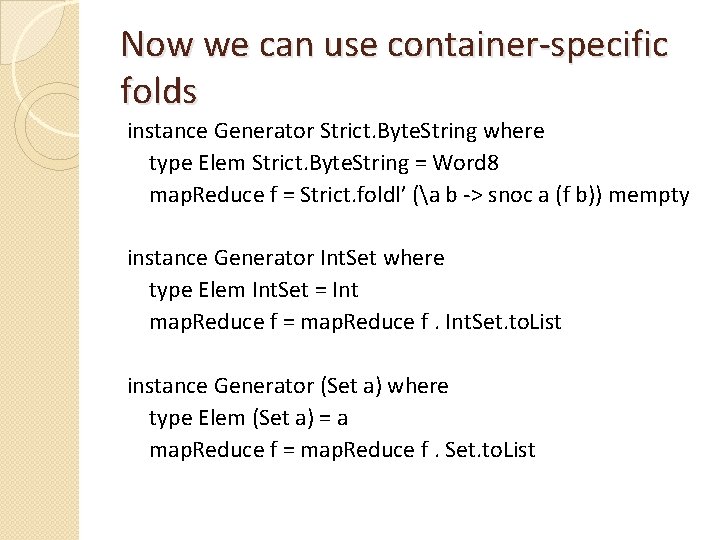
Now we can use container-specific folds instance Generator Strict. Byte. String where type Elem Strict. Byte. String = Word 8 map. Reduce f = Strict. foldl’ (a b -> snoc a (f b)) mempty instance Generator Int. Set where type Elem Int. Set = Int map. Reduce f = map. Reduce f. Int. Set. to. List instance Generator (Set a) where type Elem (Set a) = a map. Reduce f = map. Reduce f. Set. to. List
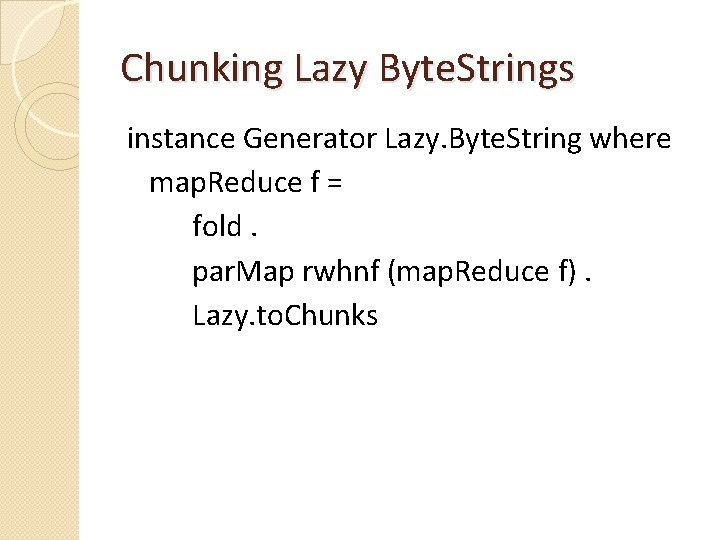
Chunking Lazy Byte. Strings instance Generator Lazy. Byte. String where map. Reduce f = fold. par. Map rwhnf (map. Reduce f). Lazy. to. Chunks
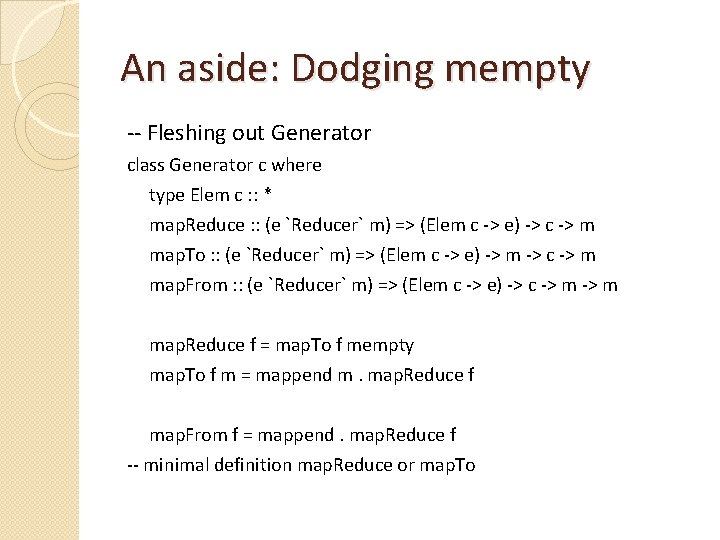
An aside: Dodging mempty -- Fleshing out Generator class Generator c where type Elem c : : * map. Reduce : : (e `Reducer` m) => (Elem c -> e) -> c -> m map. To : : (e `Reducer` m) => (Elem c -> e) -> m -> c -> m map. From : : (e `Reducer` m) => (Elem c -> e) -> c -> m map. Reduce f = map. To f mempty map. To f m = mappend m. map. Reduce f map. From f = mappend. map. Reduce f -- minimal definition map. Reduce or map. To
![Dodging mempty instance Generator [c] where type Elem [c] = c map. From f](http://slidetodoc.com/presentation_image/23e681e8a7adc53e01ea64948fe83d0c/image-25.jpg "Dodging mempty instance Generator [c] where type Elem [c] = c map. From f")
Dodging mempty instance Generator [c] where type Elem [c] = c map. From f = foldr (cons. f) map. Reduce f = foldr (cons. f) mempty instance Generator Strict. Byte. String where type Elem Strict. Byte. String = Word 8 map. To f = Strict. foldl’ (a b -> snoc a (f b)) This avoids some spurious ‘mappend mempty’ cases when reducing generators of generators.
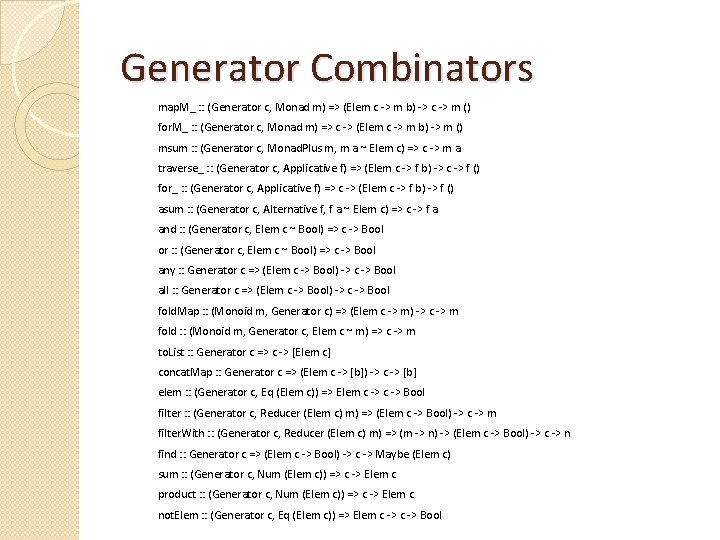
Generator Combinators map. M_ : : (Generator c, Monad m) => (Elem c -> m b) -> c -> m () for. M_ : : (Generator c, Monad m) => c -> (Elem c -> m b) -> m () msum : : (Generator c, Monad. Plus m, m a ~ Elem c) => c -> m a traverse_ : : (Generator c, Applicative f) => (Elem c -> f b) -> c -> f () for_ : : (Generator c, Applicative f) => c -> (Elem c -> f b) -> f () asum : : (Generator c, Alternative f, f a ~ Elem c) => c -> f a and : : (Generator c, Elem c ~ Bool) => c -> Bool or : : (Generator c, Elem c ~ Bool) => c -> Bool any : : Generator c => (Elem c -> Bool) -> c -> Bool all : : Generator c => (Elem c -> Bool) -> c -> Bool fold. Map : : (Monoid m, Generator c) => (Elem c -> m) -> c -> m fold : : (Monoid m, Generator c, Elem c ~ m) => c -> m to. List : : Generator c => c -> [Elem c] concat. Map : : Generator c => (Elem c -> [b]) -> c -> [b] elem : : (Generator c, Eq (Elem c)) => Elem c -> Bool filter : : (Generator c, Reducer (Elem c) m) => (Elem c -> Bool) -> c -> m filter. With : : (Generator c, Reducer (Elem c) m) => (m -> n) -> (Elem c -> Bool) -> c -> n find : : Generator c => (Elem c -> Bool) -> c -> Maybe (Elem c) sum : : (Generator c, Num (Elem c)) => c -> Elem c product : : (Generator c, Num (Elem c)) => c -> Elem c not. Elem : : (Generator c, Eq (Elem c)) => Elem c -> Bool
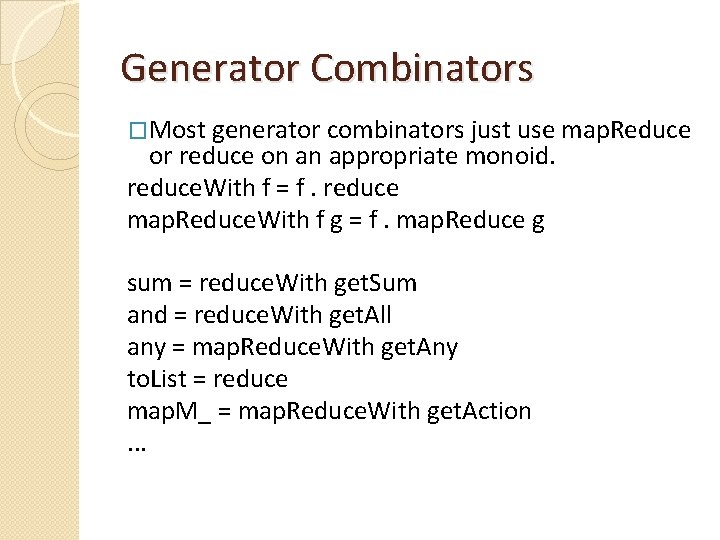
Generator Combinators �Most generator combinators just use map. Reduce or reduce on an appropriate monoid. reduce. With f = f. reduce map. Reduce. With f g = f. map. Reduce g sum = reduce. With get. Sum and = reduce. With get. All any = map. Reduce. With get. Any to. List = reduce map. M_ = map. Reduce. With get. Action. . .
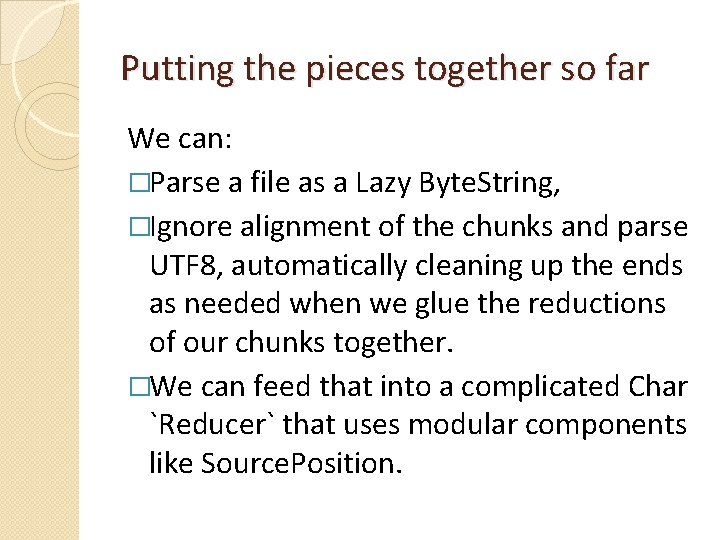
Putting the pieces together so far We can: �Parse a file as a Lazy Byte. String, �Ignore alignment of the chunks and parse UTF 8, automatically cleaning up the ends as needed when we glue the reductions of our chunks together. �We can feed that into a complicated Char `Reducer` that uses modular components like Source. Position.
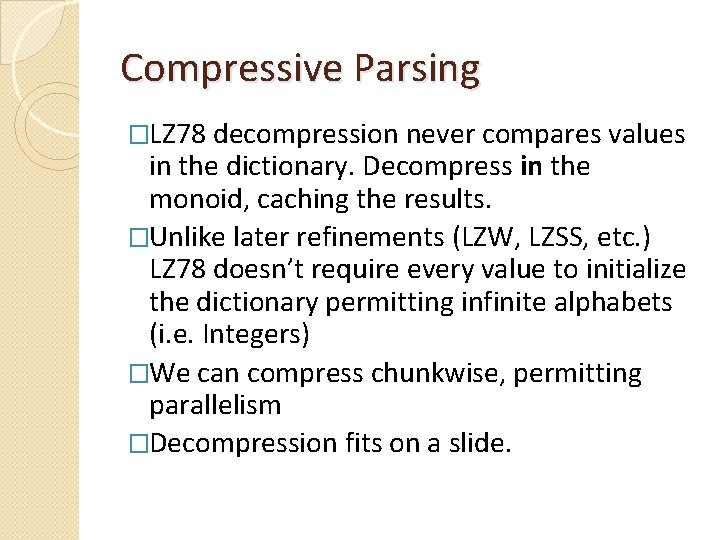
Compressive Parsing �LZ 78 decompression never compares values in the dictionary. Decompress in the monoid, caching the results. �Unlike later refinements (LZW, LZSS, etc. ) LZ 78 doesn’t require every value to initialize the dictionary permitting infinite alphabets (i. e. Integers) �We can compress chunkwise, permitting parallelism �Decompression fits on a slide.
![Compressive Parsing newtype LZ 78 a = LZ 78 [Token a] data Token a](http://slidetodoc.com/presentation_image/23e681e8a7adc53e01ea64948fe83d0c/image-30.jpg "Compressive Parsing newtype LZ 78 a = LZ 78 [Token a] data Token a")
Compressive Parsing newtype LZ 78 a = LZ 78 [Token a] data Token a = Token a !Int instance Generator (LZ 78 a) where type Elem (LZ 78 a) = a map. To f m (LZ 78 xs) = map. To’ f m (Seq. singleton mempty) xs map. To' : : (e `Reducer` m) => (a -> e) -> m -> Seq m -> [Token a] -> m map. To' _ m _ [] = m map. To' f m s (Token c w: ws) = m `mappend` map. To' f v (s |> v) ws where v = Seq. index s w `snoc` f c
Other Compressive Parsers �The dictionary size in the previous example can be bounded, so we can provide reuse of common monoids up to a given size or within a given window. �Other extensions to LZW (i. e. LZAP) can be adapted to LZ 78, and work even better over monoids than normal! �Bentley-Mc. Ilroy (the basis of bmdiff and open-vcdiff) can be used to reuse all common submonoids over a given size.
I Want More Structure! A Monoid is to an Applicative as a Right Seminearring is to an Alternative. If you throw away the argument of an Applicative, you get a Monoid, if you throw away the argument of an Alternative you get a Right. Semi. Near. Ring. In fact any Applicative wrapped around any Monoid forms a Monoid, and any Alternative wrapped around a Monoid forms a Right. Semi. Nearring.
- Slides: 32