
All About Eve Context Every good satirist directs

All About Eve Context
“Every good satirist… directs the probe of this satire at what he believes to be a truth: a fact of manners or mores or morality which society either evades, disguises or denies. Thus probing, hopes to penetrate the sham and expose said truth or fact. The goal of every satirist would be to have
UTILISING CONTEXT IN YOUR ESSAY Context is crucially important to out essay writing. It obviously forms the first line of our essay – it sets the political, social and cultural platform on which the text is based – but it also serves to give us the rationale for every word written, every line spoken and every action carried out! In your essays CONTEXTUAL IMFORMATION must be included in the opening line, the contention, begin every topic sentence (or use the title of the text) and the conclusion. (Lots and lots of eg’s to follow!!) This presentation is going to cover: 1. Mankewicz (his bio and messages) 2. The origins of his product 3. The nature of this film 4. How we analyse film as a text
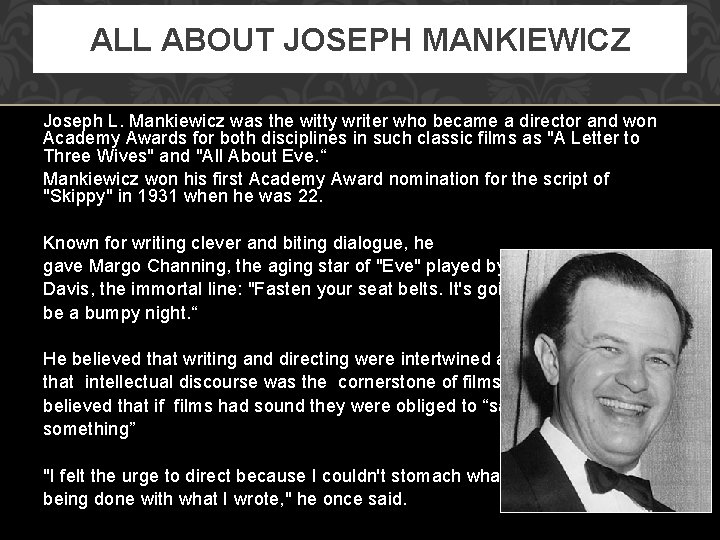
ALL ABOUT JOSEPH MANKIEWICZ Joseph L. Mankiewicz was the witty writer who became a director and won Academy Awards for both disciplines in such classic films as "A Letter to Three Wives" and "All About Eve. “ Mankiewicz won his first Academy Award nomination for the script of "Skippy" in 1931 when he was 22. Known for writing clever and biting dialogue, he gave Margo Channing, the aging star of "Eve" played by Bette Davis, the immortal line: "Fasten your seat belts. It's going to be a bumpy night. “ He believed that writing and directing were intertwined and that intellectual discourse was the cornerstone of films. He believed that if films had sound they were obliged to “sat something” "I felt the urge to direct because I couldn't stomach what was being done with what I wrote, " he once said.
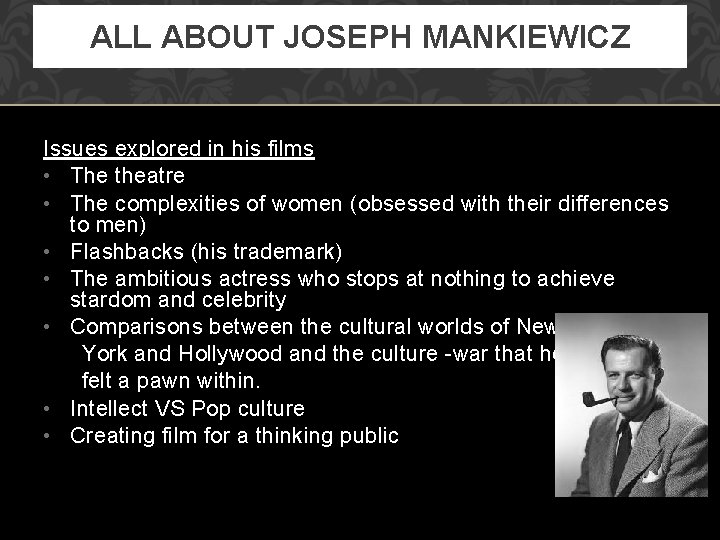
ALL ABOUT JOSEPH MANKIEWICZ Issues explored in his films • The theatre • The complexities of women (obsessed with their differences to men) • Flashbacks (his trademark) • The ambitious actress who stops at nothing to achieve stardom and celebrity • Comparisons between the cultural worlds of New York and Hollywood and the culture -war that he felt a pawn within. • Intellect VS Pop culture • Creating film for a thinking public
THE CULTURE WAR AND JOSEPH MANKIEWICZ Championed high culture of East Coast theatre and the fine arts but flourished in the West Coast world of movies and low brow entertainment. Throughout his career he maintained this dichotomy. (2 modes of thoughts) He maintained that he liked writing for theatre but rarely did. I see. Hollywood strong connections to him Mankiewicz Lloyd, kept luring back butand New York. Bill wasand hiseven oasis. Addison: Lloyd – his frustrations(the most famous screenwriter in Hollywood). Was it him that made the plays incredible or was it the stars. Remember his statement to Margo about her being just the “body” that carried out the work. Is he right? ? Who is the real star? ? Bill – the Director lured to Hollywood and prepared to be silent, conciliatory/a pawn in the game Addison – the outsider/ the critic. The voice of authority in the culture vs pop
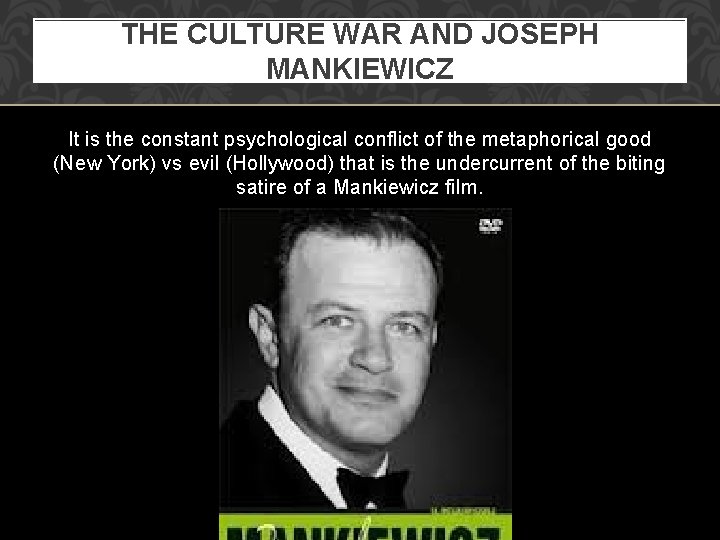
THE CULTURE WAR AND JOSEPH MANKIEWICZ It is the constant psychological conflict of the metaphorical good (New York) vs evil (Hollywood) that is the undercurrent of the biting satire of a Mankiewicz film.
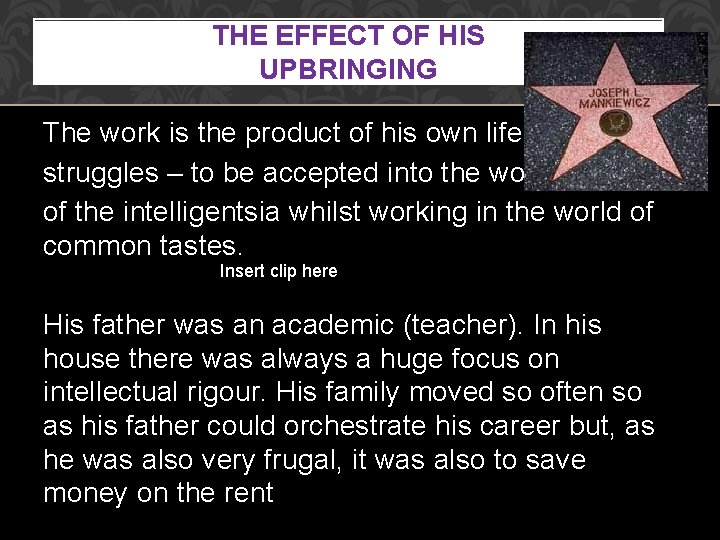
THE EFFECT OF HIS UPBRINGING The work is the product of his own life’s struggles – to be accepted into the world of the intelligentsia whilst working in the world of common tastes. Insert clip here His father was an academic (teacher). In his house there was always a huge focus on intellectual rigour. His family moved so often so as his father could orchestrate his career but, as he was also very frugal, it was also to save money on the rent
THE EFFECT OF HIS UPBRINGING He had no friends as a child and turned inwards a result, which began a lifelong pursuit understanding of what motivates human behaviour. In a rare interview in the height of his career he said: “As a child I became skilful at taking on the colour of the environment without absorbing it, at participating without being part of anything. I acquired an awareness of people the way an animal knows the woods in which he lives. I made no friends. I have no contact
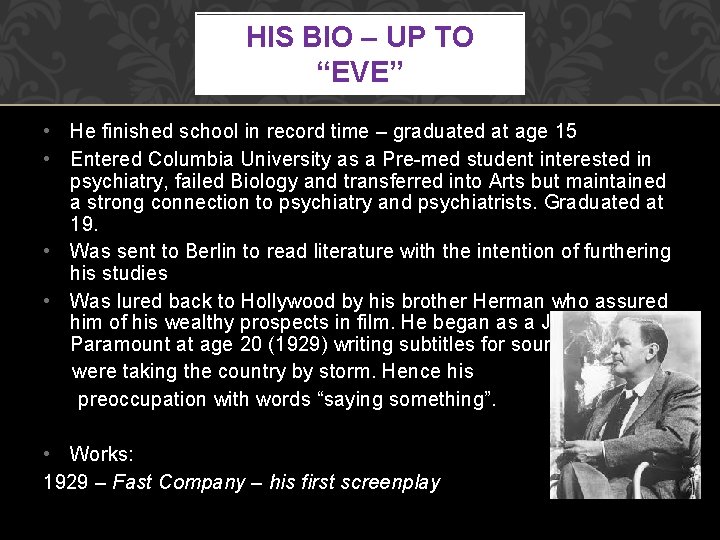
HIS BIO – UP TO “EVE” • He finished school in record time – graduated at age 15 • Entered Columbia University as a Pre-med student interested in psychiatry, failed Biology and transferred into Arts but maintained a strong connection to psychiatry and psychiatrists. Graduated at 19. • Was sent to Berlin to read literature with the intention of furthering his studies • Was lured back to Hollywood by his brother Herman who assured him of his wealthy prospects in film. He began as a Junior writer at Paramount at age 20 (1929) writing subtitles for sound films which were taking the country by storm. Hence his preoccupation with words “saying something”. • Works: 1929 – Fast Company – his first screenplay
HIS BIO – UP TO “EVE” 1931 – Skippy – His first academy award nomination (22 yrs) 1932 – Million Dollar Legs 1933 - Our Daily Bread 1934 – 1943 went to rival film company Metro Golwyn-Mayer – wrote Manhatten Melodrama but also wanted to direct however the CEO wanted him to produce he claims these were the “black years”. Here he produced 20 films but he kept writing. He edited F. Scott Fitzgerald work. 1943 – Moved to 20 th Century Fox studios where he got to write and direct. He has said that this was his “most fruitful period”. It was in this time that he won back to back Oscars for screenwriting and directing A Letter to Three Women(1949) and All About Eve (1950). 1946 – Wrote and directed Important influence on our film – Dragonwyck – Its focus was the primary action which revolves around character motivation, not plot events. 1947 – Was made the President of the Screen Directors Guild – a highly political role amidst the controversial HUAC trials and senator Joseph Mc. Carthy. He though wasn’t political and stayed focused on his art!
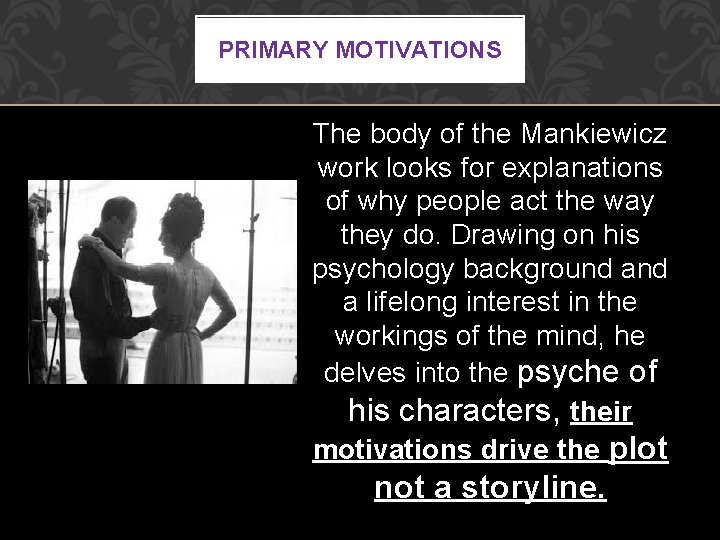
PRIMARY MOTIVATIONS The body of the Mankiewicz work looks for explanations of why people act the way they do. Drawing on his psychology background a lifelong interest in the workings of the mind, he delves into the psyche of his characters, their motivations drive the plot not a storyline.
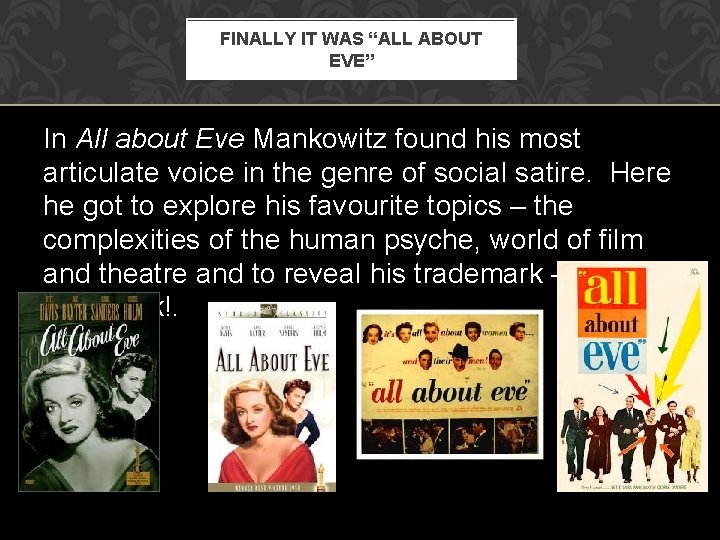
FINALLY IT WAS “ALL ABOUT EVE” In All about Eve Mankowitz found his most articulate voice in the genre of social satire. Here he got to explore his favourite topics – the complexities of the human psyche, world of film and theatre and to reveal his trademark – the flashback!.
POST EVE Ironically “Eve” was made 2 years before he left Hollywood for the Eastcoast convincing himself that theatre was a more viable environment for his talents. After completing his contract with Fox he moved his family from the “intellectual fog belt” of LA to New York City to educate his children while his wife went back to her STAGE CAREER! As was always the case though, before he could write for theatre he returned to film and wrote a personal version of Shakespeare’s Julius Caesar, The Barefoot Contessa, The Quiet American, Guys and Dolls among many others.

STRUCTURE Circular Narrative – begins and ends at the same point and the narrative goes back in time to explain how they got to that point. Interesting as we as viewers know where the characters end up and are left wondering and watching how they got there. Building of suspense in a way.
STYLE Multi-voiced narration: Addison, Karen and Margo Three different characters all filling in their observations about Eve. Almost like a documentary that offers a biography of Eve. Why these three? All have an individual investment in Eve’s career rise. They all were manipulated by or used her to help themselves in Addison’s case
STYLE There different perspectives given about Eve as they all see a different side to her at various parts of her climb to the top. Each character has a distinctive voice and provide good contrast to different parts of theatre world. However, none are completely objective, they have all been limited by perspective, circumstance and bias.
STYLE & STRUCTURE Link between narration and circular narrative… Effective to message of the film as the use of flashback and narration gives characters ability to use hindsight as they retrospectively explore the narrative and Eve’s rise from obscurity to stardom.
THEMES Insiders vs Outsiders § Group Identity § Individual Identity Celebrity vs Stardom § The Rise of Celebrity (and how temporary this can be) Human Relationships Loyalty and Betrayal The Power of Ambition Theatre

THE ORIGINS OF HIS PRODUCT ALL ABOUT EVE
3 DIFFERENT ORIGINS OF HIS PRODUCT • His fixation with the nature of women • The Madonna – Whore complex (connections with Lady Macbeth and Eve (biblical figure) • The significance of award and rewards and the nature of theatre and “its folk”
A LIFELONG FASCINATION WITH HUMAN NATURE – ESPECIALLY WOMEN • Mankiewicz was a student of the psyche as we now know. At the base of every Mankiewicz film is an examination of human behaviour. Because of this films examine what motivates characters and he uses his wit and humour to comment on social manners and mores. • Through the dialogue the psychological depth of a character is exposed to the viewer – especially the female character. • Captivated by the multifaceted behaviour of women Mankiewicz found writing for and about them very satisfying. He was intrigued by their differences to men and their diverse nature
LIFELONG FASCINATION WITH HUMAN NATURE – ESPECIALLY WOMEN He said: “ Women are fantastic creatures put together by the wind. Men are simple. Simple component parts. They’re raised to conquer something, to be rich, to win something. Women , by the time they are six years old, know that physically they are not match for that fellow, that person over there with the different physical build. So that at age six they must find other ways to get what they want. And each one is different, and each one has a separate scheme, and they begin to develop their little tricks, their little wiles and its fascinating. ”
LIFELONG FASCINATION WITH HUMAN NATURE – ESPECIALLY WOMEN • Mankeiwicz valued the complexity of the female nature and understood the limitations society placed on women. • He created his greatest work during the conservative years of the postwar baby boom when motherhood and the home were revered and happy endings were mandatory! • His work stands the test of time because his female protagonists were given a literate, articulate voice to express their feelings and predicaments – which are not that different to what women experience today!
LIFELONG FASCINATION WITH HUMAN NATURE – ESPECIALLY WOMEN • The strong women characters in Mankiewicz films expressed their displeasure at deriving power from the hands of men just as female protagonists do now. • Many wanted to work when it was more socially accepted to be in the home. Some wanted to explore the world without the shackles of a male companion. • And a few wanted it all! – a career and a marriage and a family income some 50 years before this was a lifestyle taken for granted! • Most importantly she had a voice, she could articulate her dreams and express her dissatisfaction using Mankiewicz witty, satirical “comedic” voice.
OUTSMARTING THE “RULES” OF HIS TIME • He was very clever and knew the only way he could make a film which questioned social consensus of the time was to accommodate the “Promotion Code Administration” which decreed that marriage and motherhood ( all of which limited a woman’s power by keeping them in the home!) was the most important role for women. • So he exercised his skill in creating “high comedy” whereby the female characters used humorous, witty dialogue to express themselves. • It must be noted that although they were given the power of a voice he generally succumbed to the conservatism of Hollywood studio systems and his women inevitably returned to patriarchal conventions and the conservative status quo – via the “happy ending”
THE MANKIEWICZ WOMAN • Even with the accommodations he had to make to get his films produced it must be noted that he created some of Hollywood’s most memorable women. • These individuals represent the complex nature of a women’s struggle to find her own identity in a conservative patriarchal culture. • While he doesn’t resolve the conflict his film serves to address the and voiced unusually astute opinions about the outcomes of women stepping outside their societal role. • The only “stereotypic” character he has in the film is Marilyn Monroe who plays the “dumb blonde” – but he cast her to help her resurrect her faltering film career.
THE MANKIEWICZ WOMAN • To sum up the strong Mankiewicz women works within the patriarchy, vocalising her displeasure with the system – pushing the envelope to attain what other women have traditionally not gained. • They have sharp tongues and strong desires • They are usually in a position (or work themselves into a position) of wealth and prestige which enables them to question the gender restrictions of their patriarchy. • The formula he used for “All About Eve” – and all his films – was a strong female protagonist (Eve) who questions societies prescriptions for women, all the while knowing that she must indeed live within the same conservative society.
EXTENDED MODES OF CONTEXTUAL THOUGHT But for Adam there was not found a helper comparable to him. And the LORD God caused a deep sleep to fall on Adam, and he slept; and He took one of his ribs, and closed up the flesh in its place. Then the rib which the LORD God had taken from man He made into a woman, and He brought her to the man. And Adam said: "This is now bone of my bones and flesh of my flesh; she shall be called Woman, because she was taken out of Man. Therefore a man shall leave his father and mother and be joined to his wife, and they shall become one flesh. " - Genesis 2 Eve is the first woman created by God (Yahweh, the god of Israel). Her husband was Adam, from whose rib God created her to be his companion. She succumbs to the serpent's temptation via the suggestion that to eat the forbidden fruit from the tree of the knowledge of good and evil would improve on the way God had made her, and that she would not die, and she, believing the lie of the serpent rather than the earlier instruction from God, shares the fruit with Adam. As a result, the first humans are expelled from the Garden of Eden and are cursed.
• Mankiewicz admits to being obsessed with the genesis of “Eve” : • “When I was 8 years old I saw my first film…. Two little actresses…(were) two little American girl spies hiding from the Germans and a bee was about to sting one of them on her bare bottom – and betray their whereabouts to the Huns. The suspense nearly destroyed me. But – most importantly – when the film was over I got up and insisted on looking behind me. I was convinced the two little girls would be there. I have never, since that day, been certain that actresses on the screen were altogether unreal – or that off-screen they were altogether real”
EXTENDED MODES OF CONTEXTUAL THOUGHT • Eve in Hebrew is Ḥawwāh, meaning "living one" or "source of life", and is related to ḥāyâ, "to live".

THE MADONNA-WHORE COMPLEX Women have been the subject of the “Madonna-Whore Complex” trap. They are either one or the other. Society never has them as both. Shakespeare’s Lady Macbeth and Eve (as in “Adam and Eve” have always been put into the whore category and punished greatly because of their gender. But in the end, is this really right for them? Are they truly evil or are they just the scapegoats when the male half of mankind falls from grace?
THE MADONNA-WHORE COMPLEX • Women have not always been painted in a pretty picture. They are either saints or devils. Women are sometimes cast as worse than Satan himself. What caused all of this? The answer can be traced back to Eve in the Bible. • She is blamed for the fall of man when she took and ate from the Tree of Good and Evil. Ever since then, women have been the temptress of good men to the Fallen.
THE MADONNA-WHORE COMPLEX • In Macbeth, there are four main women that pull the strings throughout the whole dark circus: the witches and Lady Macbeth herself. • The witches give Macbeth and his best friend, Banquo, their prophecies that start Macbeth’s downfall. Without looking further into the play, the audience could blame the witches for his corruption. They are like the gasoline to his destruction. However, this is only half of the problem. What is a good explosion of the tainted with a good fire? If the witches are the gasoline in Macbeth, then what is the lighter? Shakespeare answers that question with Macbeth’s wife, Lady Macbeth.
THE MADONNA-WHORE COMPLEX • In the beginning, Lady Macbeth is the stronger of the two. She is the one who plans everything and has a strong control of her husband. She knows what she wants and knows how to get it. Many men before the twentieth century would have frowned upon her just for that. However, it does not stop there with Lady Macbeth’s own twisted character. Shakespeare makes her worse than the witches in the play. The witches were not the ones that said Macbeth would murder anybody to become king or keep his power. They never gave any details about how or when this would occur and they certainly did not mention any murder. That was all Lady Macbeth’s idea all along. The witches just planted the idea and she pushed for the course of murder to take place. In fact, the audience could compare her to the serpent in the Bible. Both of which tempted the innocent to stray into the darkness of desire. In the Sistine Chapel in the Eve panel the serpent is painted as a women.
WOMEN DARING TO DEFY SOCIAL MORES • Lady Macbeth is an ambitious woman. All she wants to do is rule over Scotland. There is a problem with that however. Women in Shakespeare’s time were treated like second-class citizens. The men had more rights than they did. Lady Macbeth pushes her husband into killing Duncan for the throne. Macbeth does not want to do this at first because of his loyalty to the old king. To make a long story short, Lady Macbeth questions her husband’s manhood and he falls into her dark trap.
BUT WHY ARE WOMEN PAINTED HISTORICALLY AS MORE EVIL THAN MEN? • Before the twentieth century, many countries frowned upon women being in power. Shakespeare knew this rather well. He cleverly makes Lady Macbeth the puppet master in the whole play. Women usually manipulate men into doing their dirty work. Rooks points out a wellknown fact about women and schemes, “Wright's blatant contrasting of the sexual behaviours of Lady Macbeth and the three schoolgirl witches exposes a fascination with this alleged female "power" to either withhold sex or bestow it willingly as a means of manipulation. ”
BUT WHY ARE WOMEN PAINTED HISTORICALLY AS MORE EVIL THAN MEN? • Women will use their bodies to get what they want. While Lady Macbeth and Eve did not necessarily use sex to accomplish their goals, they used other methods to persuade their husbands. Eve used her blind innocence to get Adam to eat the fruit after her. Lady Macbeth on the other hand, questioned her husband’s manhood to get him along with her murderous ambitions.
TOUCHES OF FILM NOIR • One key thing to notice in Macbeth is that Lady Macbeth gets downplayed until close to the end. • Macbeth is the one that steals all of the attention with his bloodlust. This is quite common in stories involving a femme fatale. The man starts out innocent, then the sexy woman comes along and seduces him into doing wrong, the man acts out the deed, and the lady of darkness is pushed into the background
THE SIGNIFICANCE OF AWARD AND REWARDS AND THE NATURE OF THEATRE AND “ITS FOLK” • Mankiewicz was also VERY preoccupied by the notions of the “theatre (and its actors and actresses – the world and community involved with “entertaining the masses”. It was a lifelong dedication _ “a calling really “ in his words- as a theatre buff. An obsessive interest in the “inhabitants of theatre – those who cause it to exist - its creative commune”.
THE SIGNIFICANCE OF AWARD AND REWARDS AND THE NATURE OF THEATRE AND “ITS FOLK” • His preoccupation comes from his theory as to the origin of the actor and his thirst for “awards”. He stated of our cavemen forebears who would have had little to do between “that frightening time between meal and mankind's bedtime” … “…for suddenly one of them jumped to his feet smeared some birdshit over his face, shoved a big feather up his ass and began to prance up and down waving his arms and making noises like a roc or some prehistoric chicken. And at that precise moment, my friend – Curtain time, Make up, Costume, and the Actor simultaneously came into being”. The others stared at him for an instant; then intuitively roared with pleasure. The first belly laugh. They yelled for more – and got it, I’m sure. The first encore. That poor bastard with the feather up his ass must have pranced and danced and cackled himself into total exhaustion. When we mustn't forget the audience was also born!”
THE SIGNIFICANCE OF AWARD AND REWARDS AND THE NATURE OF THEATRE AND “ITS FOLK” • “If the actor was successful at his art –night after night of “entertaining the masses” he could ensure him acceptance within the tribe; within society”…. I’ve postulated that he was probably ill- equipped in a very physical world. He was a lousy hunter, a pitiful warrior, given to daydreaming, pushed around or ignored, relegated to the remnants of food and least appetising of the women, probably expendable in case of hostilities. But ever since the first night living was different for him. He now moved among his fellows with assurance, ate well, slept securely inside the cave – probably knocking off any number of tasty broads, in whose eye he had suddenly acquired that strange special sexuality which women so often ascribe to men engaged in other than traditionally masculine pursuits. Why? When he himself was every bit as insufficient as before? ”
THE SIGNIFICANCE OF AWARD AND REWARDS AND THE NATURE OF THEATRE AND “ITS FOLK” • “Simple. Because each evening he had administered to the very basic need of the human entity – the Mass Audience- to be beguiled and distracted when forced back upon its own inner resources which were-n and are – nil. And that Mass Audience – are in turn gratefully reward him…. Imagine all that just for shoving a feather up your ass and making like a chicken. How infinitely more gratifying it must be today – how much more prideful, even ennobling – when that identity proxy can be Oedipus or Hamlet or Medea, St Joan, Eliza Doolittle, Camille. For that matter, even Margo Channing. Or even Eve.
THE SIGNIFICANCE OF AWARD AND REWARDS AND THE NATURE OF THEATRE AND “ITS FOLK” • Mankiewicz was ultimately obsessed with this idea of “the award” – of what it took to be one of “those” who entertained “the Mass Audience”. • “The Award was a totem which obtained immortality to the ‘masses”. He was obsessed with the conniving, soliciting and maeuvering that went on for the acquisition of them. • “The Award Syndrome” as he called it became an excellent frame for his film. • The hunger for applause is epitomised in the final scene of “Eve” where his satirical point is proven in the form of the young actress in the multitudinous mirrors – the part he LOVED the most – remember the first quotation!
THE SIGNIFICANCE OF AWARD AND REWARDS AND THE NATURE OF THEATRE AND “ITS FOLK” • The fact he found most amusing – as seen in the last scene of “Eve” is in his comment: • “It would seem that the idiocies of theatre-folk , within their world share one common characteristic…they are continuing, self perpetuating idiocies”. • He means that in the end even Eve herself is confronted with the fact that “ever since the beginning, as ambitious and insatiable for celebrity as she is, she has been “serving a bottomless pit. A void. Her ego? The Eves – male or female – have none. Just an inner emptiness they can never fill – but must continually feed, merely to exist. Such exactly was the human condition of our heroine when we first came upon her in our film. ”

ALL ABOUT EVE The Final contextual Layer
American “success mania” …. slicing deeply into the American psyche • Mankiewicz's scripts were talky, dry, and always deeply thoughtful portraits of America. • ALL ABOUT EVE appears to gather all of Joe Mankiewicz's beliefs about the American drive to succeed and focuses them closely on a miniature world he loved, theatre.
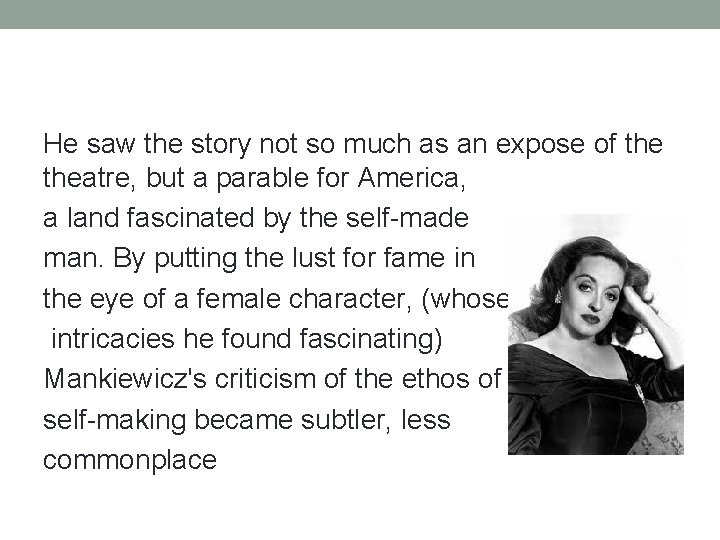
He saw the story not so much as an expose of theatre, but a parable for America, a land fascinated by the self-made man. By putting the lust for fame in the eye of a female character, (whose intricacies he found fascinating) Mankiewicz's criticism of the ethos of self-making became subtler, less commonplace
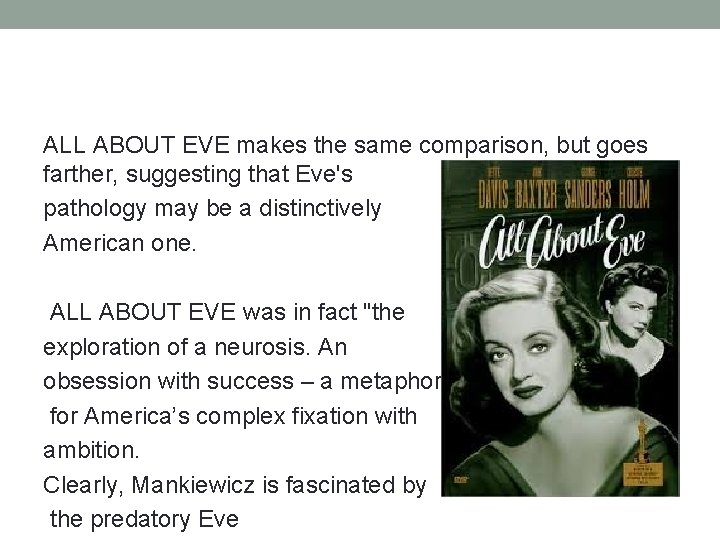
ALL ABOUT EVE makes the same comparison, but goes farther, suggesting that Eve's pathology may be a distinctively American one. ALL ABOUT EVE was in fact "the exploration of a neurosis. An obsession with success – a metaphor for America’s complex fixation with ambition. Clearly, Mankiewicz is fascinated by the predatory Eve
Definition of 'American Dream' The belief that anyone, regardless of where they were born or what class they were born into, can attain their own version of success in a society where upward mobility is possible for everyone. The American dream is achieved through sacrifice, risk-taking and hard work, not by chance. Both native-born Americans and American immigrants pursue and can achieve the American dream. In contrast to other political and economic systems, such as communist dictatorships, America’s free-enterprise system makes possible the circumstances that allow individuals to go beyond meeting their basic needs to achieve self-actualization and personal fulfilment.
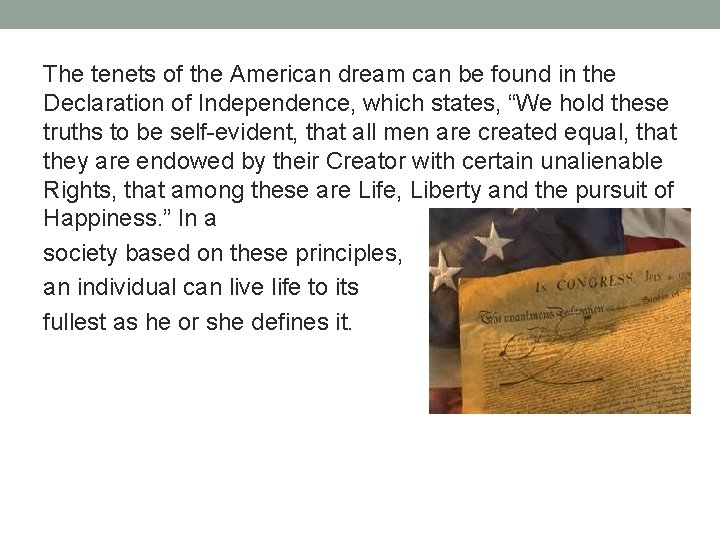
The tenets of the American dream can be found in the Declaration of Independence, which states, “We hold these truths to be self-evident, that all men are created equal, that they are endowed by their Creator with certain unalienable Rights, that among these are Life, Liberty and the pursuit of Happiness. ” In a society based on these principles, an individual can live life to its fullest as he or she defines it.
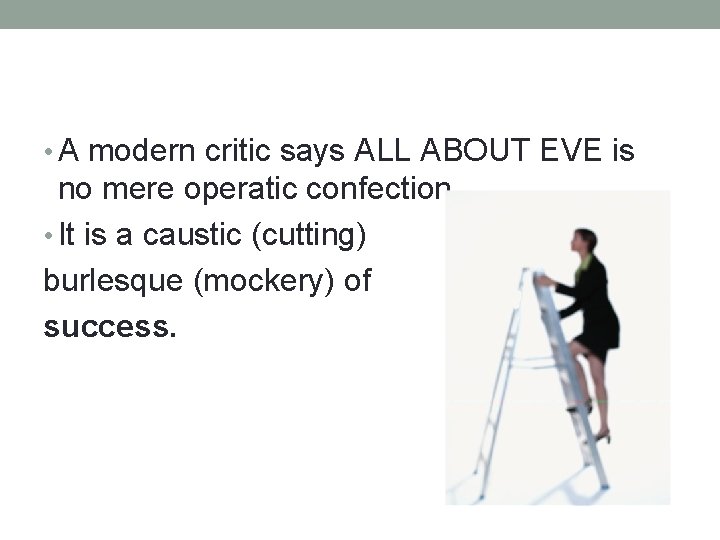
• A modern critic says ALL ABOUT EVE is no mere operatic confection. • It is a caustic (cutting) burlesque (mockery) of success.
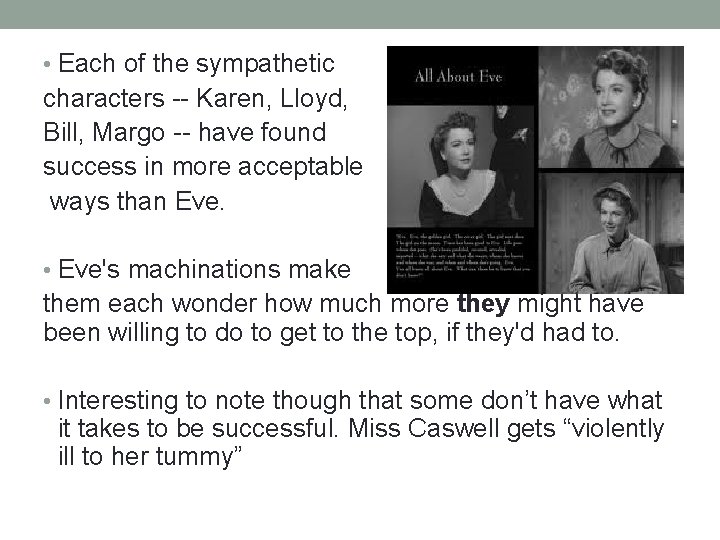
• Each of the sympathetic characters -- Karen, Lloyd, Bill, Margo -- have found success in more acceptable ways than Eve. • Eve's machinations make them each wonder how much more they might have been willing to do to get to the top, if they'd had to. • Interesting to note though that some don’t have what it takes to be successful. Miss Caswell gets “violently ill to her tummy”
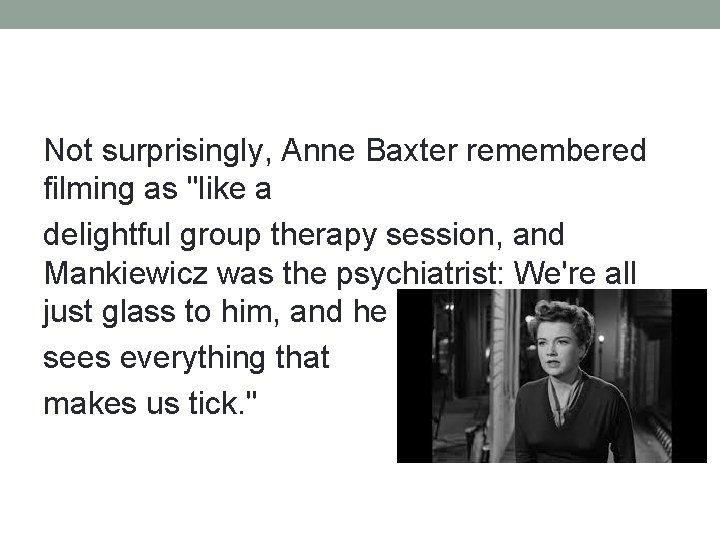
Not surprisingly, Anne Baxter remembered filming as "like a delightful group therapy session, and Mankiewicz was the psychiatrist: We're all just glass to him, and he sees everything that makes us tick. "
Does Mankiewicz really want us to feel that his film is a demonstration of the power of women and their strategies to be successful or should we see it as a satrical documentary of success in post war America ? It is interesting to note that : • Mankiewicz is ultimately in control of everything from the start to the end of the film and that while Eve is condemned by her” friends” and the aurdience for her evilness and betrayal , Addison, who claims he is the same person is not. • Addison begins the narrative and ends it and succeeds at controlling the conniving Eve, foiling her plans to destroy and conquer “the universe. ” • He claims “do you now know how completely you belong to me” , depriving her of the power to act. • Why did Mankiewitz need a man to save the day? Can traditional America rest easy now?
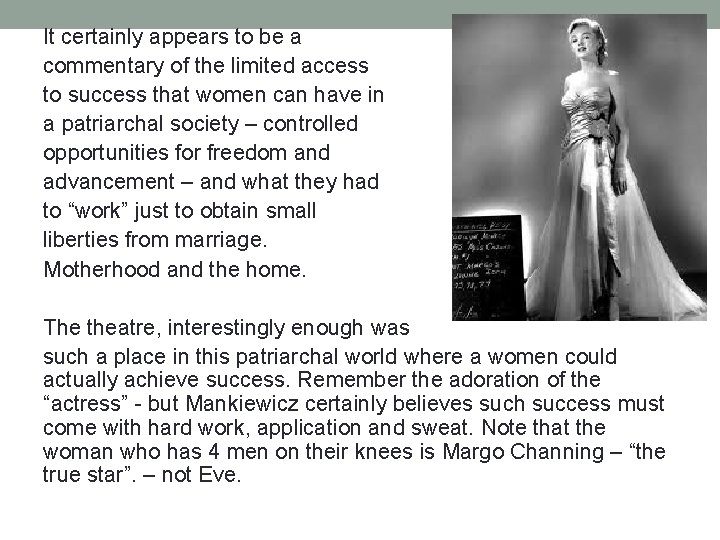
It certainly appears to be a commentary of the limited access to success that women can have in a patriarchal society – controlled opportunities for freedom and advancement – and what they had to “work” just to obtain small liberties from marriage. Motherhood and the home. The theatre, interestingly enough was such a place in this patriarchal world where a women could actually achieve success. Remember the adoration of the “actress” - but Mankiewicz certainly believes such success must come with hard work, application and sweat. Note that the woman who has 4 men on their knees is Margo Channing – “the true star”. – not Eve.
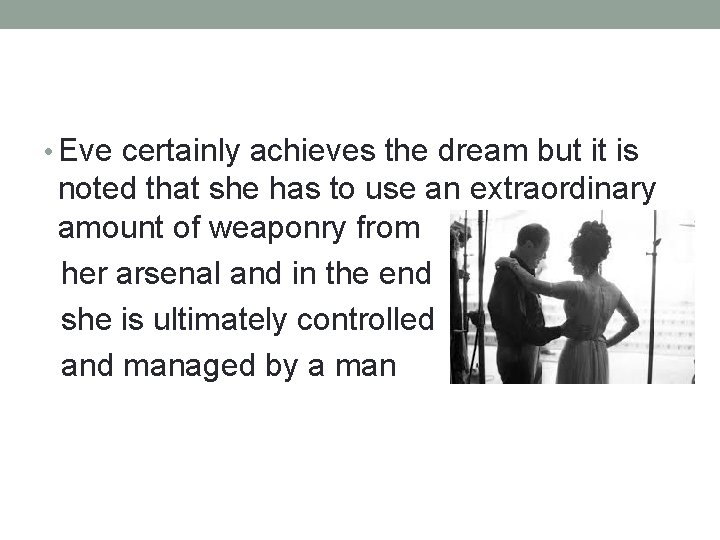
• Eve certainly achieves the dream but it is noted that she has to use an extraordinary amount of weaponry from her arsenal and in the end she is ultimately controlled and managed by a man
- Slides: 58