
All about ATM ATM Terminology Explained Carey Williamson

All about ATM: ATM Terminology Explained Carey Williamson Department of Computer Science University of Calgary 1

Introduction ATM networking is filled with a lingo of its very own, many of which are acronyms, and many of which are quite fundamental to an understanding of what is going on in an ATM network n Examples: VCI, VPI, PVC, SVC, AAL, CBR, VBR, ABR, PCR, SCR, QOS, CDV n 2
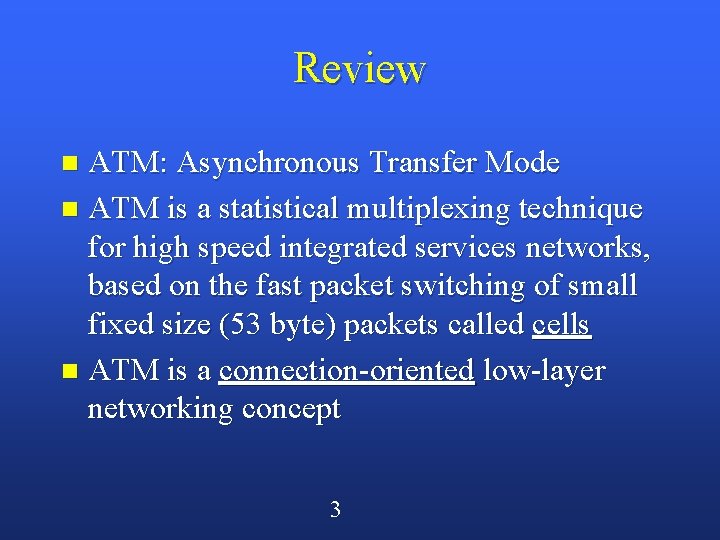
Review ATM: Asynchronous Transfer Mode n ATM is a statistical multiplexing technique for high speed integrated services networks, based on the fast packet switching of small fixed size (53 byte) packets called cells n ATM is a connection-oriented low-layer networking concept n 3
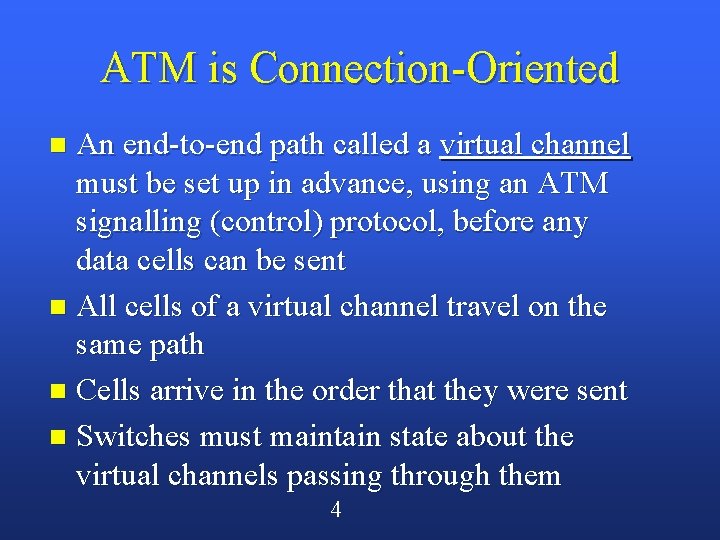
ATM is Connection-Oriented An end-to-end path called a virtual channel must be set up in advance, using an ATM signalling (control) protocol, before any data cells can be sent n All cells of a virtual channel travel on the same path n Cells arrive in the order that they were sent n Switches must maintain state about the virtual channels passing through them n 4
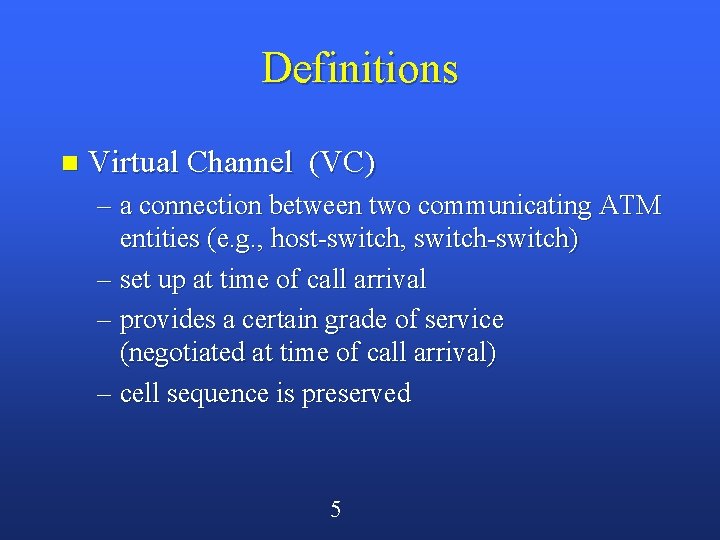
Definitions n Virtual Channel (VC) – a connection between two communicating ATM entities (e. g. , host-switch, switch-switch) – set up at time of call arrival – provides a certain grade of service (negotiated at time of call arrival) – cell sequence is preserved 5
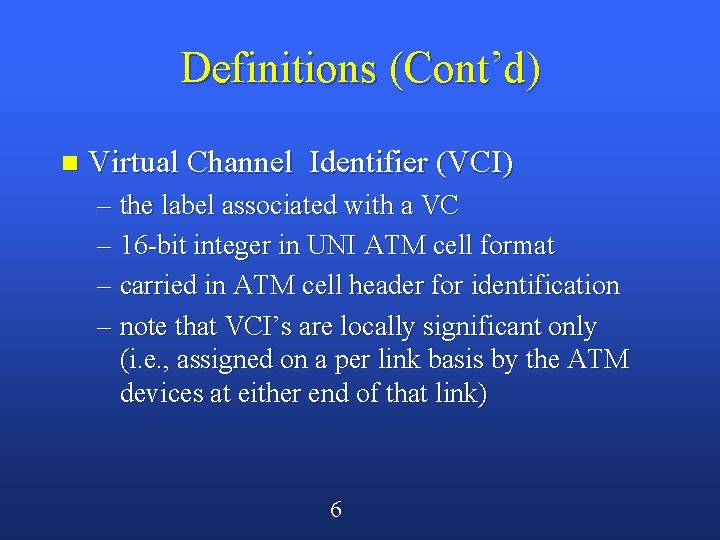
Definitions (Cont’d) n Virtual Channel Identifier (VCI) – the label associated with a VC – 16 -bit integer in UNI ATM cell format – carried in ATM cell header for identification – note that VCI’s are locally significant only (i. e. , assigned on a per link basis by the ATM devices at either end of that link) 6
Definitions (Cont’d) n Virtual Path (VP) – a group of virtual channels (VC’s) all travelling between the same two points in ATM network – used by the network to simplify provisioning, resource management, providing different grades of service, etc. – “bundles up” traffic heading to same destination 7
Definitions (Cont’d) n Virtual Path Identifier (VPI) – the label associated with a VP – 8 -bit integer in UNI ATM cell format – carried in ATM cell header for identification – part of two level addressing scheme in ATM – note that VPI’s are locally significant only (i. e. , assigned on a per link basis by the ATM devices at either end of that link) 8
Definitions (Cont’d) VP switch: an ATM switch that deals only with the VPI’s in cell headers (e. g. , a core switch in middle of a large ATM network) n VC switch: an ATM switch that deals only with the VCI’s in cell headers (e. g. , access switch at the edge of an ATM network) n VP/VC switch: an ATM switch that deals with both VPI’s and VCI’s in cell switching n 9
Definitions (Cont’d) n Permanent Virtual Channel (PVC) – a virtual channel connection (virtual channel) that is set up on a long term basis (e. g. , hours, days, months, years) by a human operator – involves statically configuring the “routing table” in ATM equipment – done as part of network provisioning in current ATM network testbeds – supported by all ATM switch vendors 10
Definitions (Cont’d) n Switched Virtual Channel (SVC) – a virtual channel connection (virtual channel) that is set up by the ATM signalling protocol between two communicating ATM entities – set up on an as needed basis, and torn down when complete – short term basis (e. g. , seconds, minutes) – involves dynamically configuring the “routing table” in ATM equipment – supported by very few ATM switch vendors 11
Definitions (Cont’d) n ATM Adaptation Layer (AAL) – a protocol for converting between higher layer protocol data units (PDU’s), such as TCP packets, IP packets, or JPEG images, and ATM cells for actual transmission – defines procedures for segmentation and reassembly (SAR) – segmentation: packets to cells (done by sender) – reassembly: cells to packets (done by receiver) 12
Definitions (Cont’d) n Traffic Descriptors – a numerical specification of the statistical characteristics of an ATM traffic flow – used by ATM switches at time of call setup – specifies Peak Cell Rate (PCR), Sustained Cell Rate (SCR), Maximum Burst Size (MBS), etc. – different calls can specify different values for their traffic descriptor » e. g. , voice: PCR = SCR = 1000 cells/sec » e. g. , data: PCR = 10, 000 cells/sec, SCR = 1000 13
Definitions (Cont’d) n Quality of Service (QOS) – a specification of the desired (or acceptable) grade of service required for a traffic flow – some traffic is delay-sensitive (e. g. , voice) – some traffic is loss-sensitive (e. g. , data) – some traffic is both (e. g. , compressed video) – some traffic is neither (e. g. , LAN emulation) – QOS requested at time of call setup – ATM network tries to provide requested QOS 14
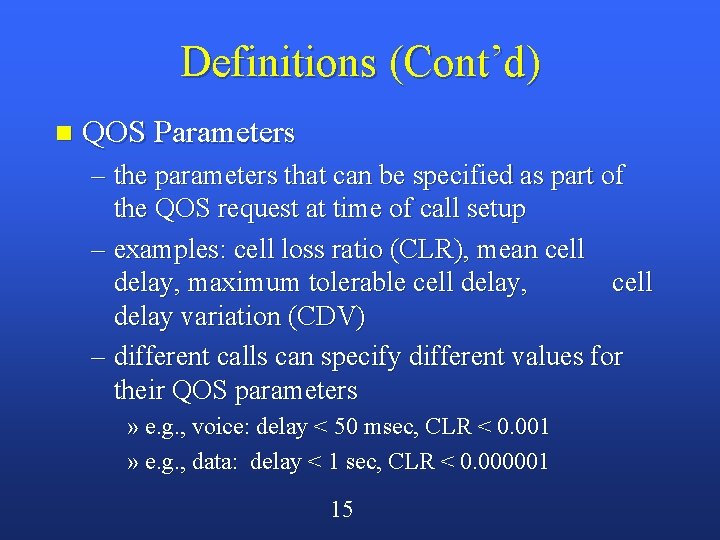
Definitions (Cont’d) n QOS Parameters – the parameters that can be specified as part of the QOS request at time of call setup – examples: cell loss ratio (CLR), mean cell delay, maximum tolerable cell delay, cell delay variation (CDV) – different calls can specify different values for their QOS parameters » e. g. , voice: delay < 50 msec, CLR < 0. 001 » e. g. , data: delay < 1 sec, CLR < 0. 000001 15
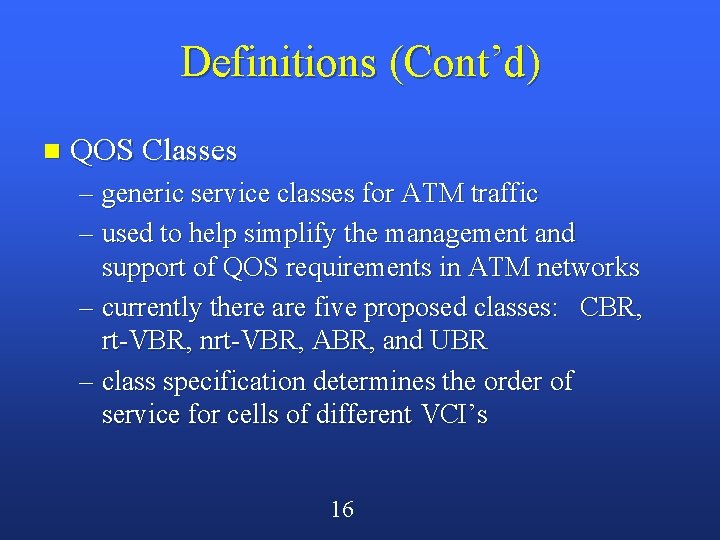
Definitions (Cont’d) n QOS Classes – generic service classes for ATM traffic – used to help simplify the management and support of QOS requirements in ATM networks – currently there are five proposed classes: CBR, rt-VBR, nrt-VBR, ABR, and UBR – class specification determines the order of service for cells of different VCI’s 16
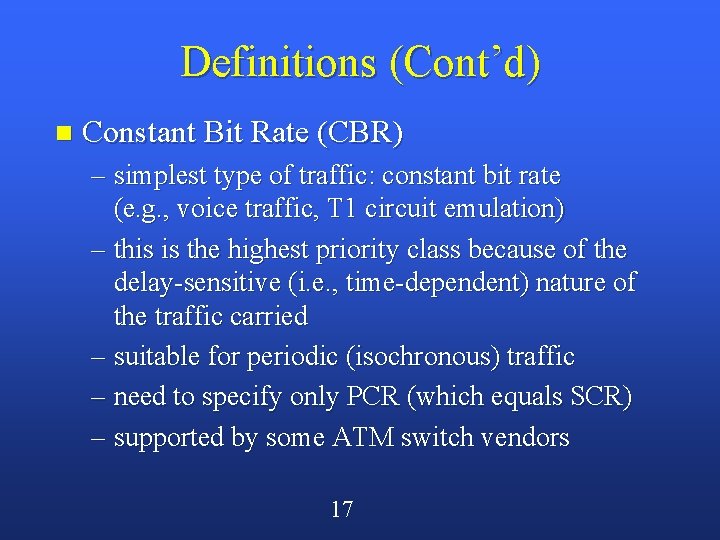
Definitions (Cont’d) n Constant Bit Rate (CBR) – simplest type of traffic: constant bit rate (e. g. , voice traffic, T 1 circuit emulation) – this is the highest priority class because of the delay-sensitive (i. e. , time-dependent) nature of the traffic carried – suitable for periodic (isochronous) traffic – need to specify only PCR (which equals SCR) – supported by some ATM switch vendors 17
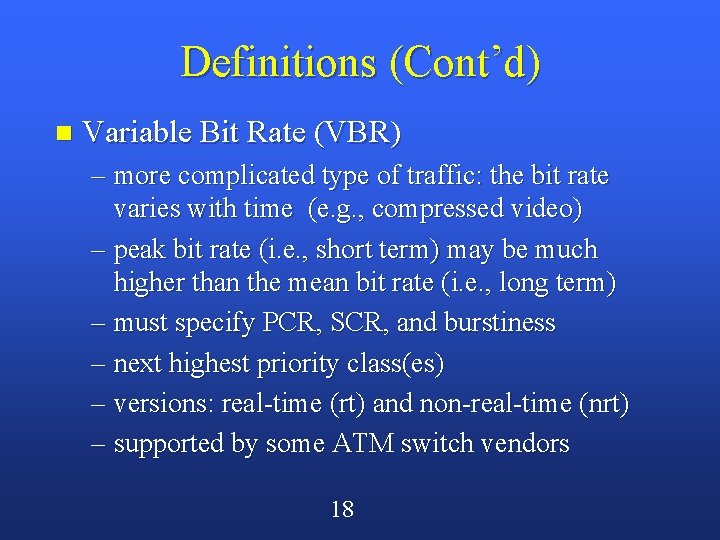
Definitions (Cont’d) n Variable Bit Rate (VBR) – more complicated type of traffic: the bit rate varies with time (e. g. , compressed video) – peak bit rate (i. e. , short term) may be much higher than the mean bit rate (i. e. , long term) – must specify PCR, SCR, and burstiness – next highest priority class(es) – versions: real-time (rt) and non-real-time (nrt) – supported by some ATM switch vendors 18
Definitions (Cont’d) n Available Bit Rate (ABR) – unpredictable type of traffic: traffic is willing to use as much or as little bandwidth as is available (e. g. , Internet traffic, LAN emulation) – usually variable bit rate, delay-insensitive – referred to as “elastic traffic” (e. g. , ftp) – next lowest priority class – supported by few ATM switch vendors – still under discussion by ATM Forum 19
Definitions (Cont’d) n Unspecified Bit Rate (UBR) – the “bottom feeder” in the ATM food chain – Minimum Cell Rate (MCR) is zero; guaranteed nothing, but may get more than this if there happens to be extra bandwidth available – lowest priority class – much discussion at ATM Forum – may become Guaranteed Frame Rate (GFR)? 20
Definitions (Cont’d) n Call Admission Control (CAC) – a control function in ATM switches that makes the decision on whether or not to accept a newly incoming call – considers traffic descriptor (TD) and quality of service (QOS) parameters, as well as impact on the QOS of existing calls in the network – can be statistical or deterministic – still an active research topic 21
Definitions (Cont’d) n Usage Parameter Control (UPC) – a control function performed in switches to “police” ATM traffic flows – monitors traffic on a VCI basis, to make sure that it conforms to the declared traffic descriptor (TD) – in case of violation, can tag cells with a violation tag (CLP = 1), discard cells, or abort the connection 22
Definitions (Cont’d) n Cell Loss Priority (CLP) – a single bit in ATM cell headers for denoting the cell loss priority (e. g. , violation cells) – in the event of congestion, drop tagged cells before dropping any untagged cells – not to be confused with “delay priority” (i. e. , the service classes) 23
Summary ATM has much confusing terminology, and an endless (growing) list of TLA’s (three letter acronyms) n Get used to it! n Soon you will be speaking it too!!! n 24
- Slides: 24