
All about ancient India gods One of the


All about ancient India gods One of the ancient India gods are Brahma. He was the one who created eleven Prajapatis. He also was self-born{ without a mother}. One of the other god's name is Shiva and people considered her as to be very deity in Shaivism. The worship of Shiva is a pan-Hindu tradition, practiced widely across all of India. Third Eye: Shiva is often depicted with a third eye with which he burned Desire (Kama) to ashes Another one of their god's name is Gāyatrī is typically portrayed as seated on a red lotus, signifying wealth.
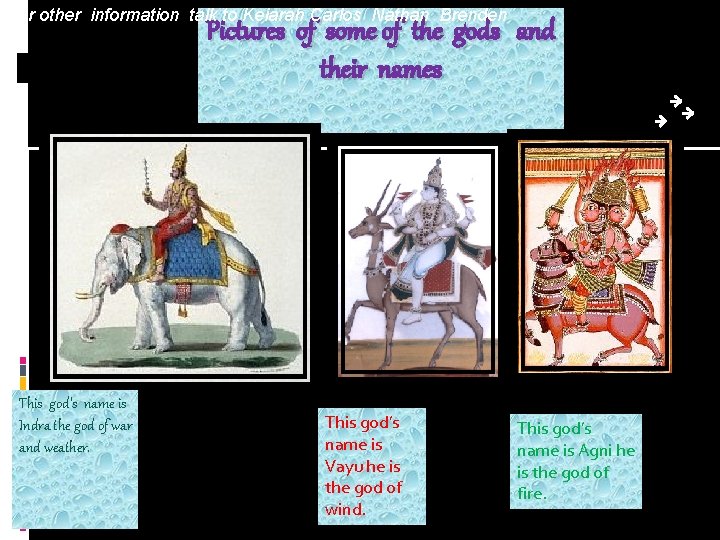
For other information talk to Keiarah Carlos Nathan Brenden Pictures of some of the gods and their names This god's name is Indra the god of war and weather. This god’s name is Vayu he is the god of wind. This god’s name is Agni he is the god of fire.
Ancient India Daily life A child of ancient India is named 11 days after birth. Hindus believe that an unmarried person has no social status. Also a Hindu marriage is considered a lifelong partnership. The marriage is supposed to be a sacred and unalterable. They have rituals that last a week and has been like that for 2, 000 years. The ancient India believes in karma. Ancient India believed that when the girls and boys get there fist ears pierce the family will come over and the whole family will have a big celebration. Also

All About India’s Geography The Indus Valley civilization, one of the oldest in the world, dates back at least 5, 000 years. Aryan tribes from the northwest invaded about 1500 B. C. ; their merger with the earlier Dravidian inhabitants created the classical Indian culture. Arab incursions starting in the 8 th century and Turkish in the 12 th were followed by those of European traders, beginning in the late 15 th century. By the 19 th century, Britain had assumed political control of virtually all Indian lands. Indian armed forces in the British army played a vital role in both World Wars. Nonviolent resistance to British colonialism led by Mohandas GANDHI and Jawaharlal NEHRU brought independence in 1947. The subcontinent was divided into the secular state of India and the smaller Muslim state of Pakistan. A third war between the two countries in 1971 resulted in East Pakistan becoming the separate nation of Bangladesh. Despite impressive gains in economic investment and output, India faces pressing problems such as the ongoing dispute with Pakistan over Kashmir, massive overpopulation, environmental degradation, extensive poverty, and ethnic and religious strife.
- Slides: 6