
Alkanes Acyclic Cn H 2 n2 Cyclic one
- Slides: 37
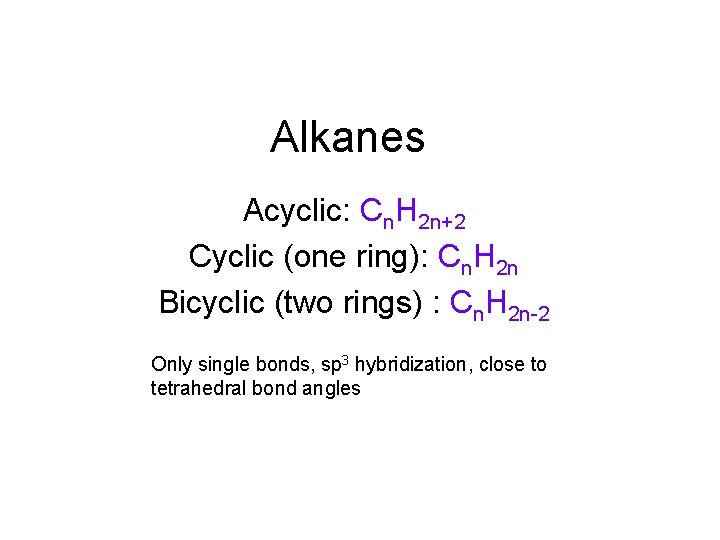
Alkanes Acyclic: Cn. H 2 n+2 Cyclic (one ring): Cn. H 2 n Bicyclic (two rings) : Cn. H 2 n-2 Only single bonds, sp 3 hybridization, close to tetrahedral bond angles
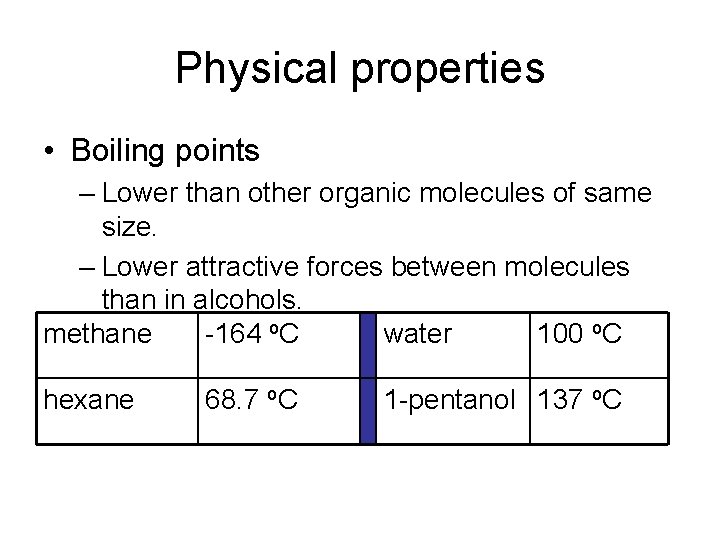
Physical properties • Boiling points – Lower than other organic molecules of same size. – Lower attractive forces between molecules than in alcohols. methane -164 o. C water 100 o. C hexane 68. 7 o. C 1 -pentanol 137 o. C
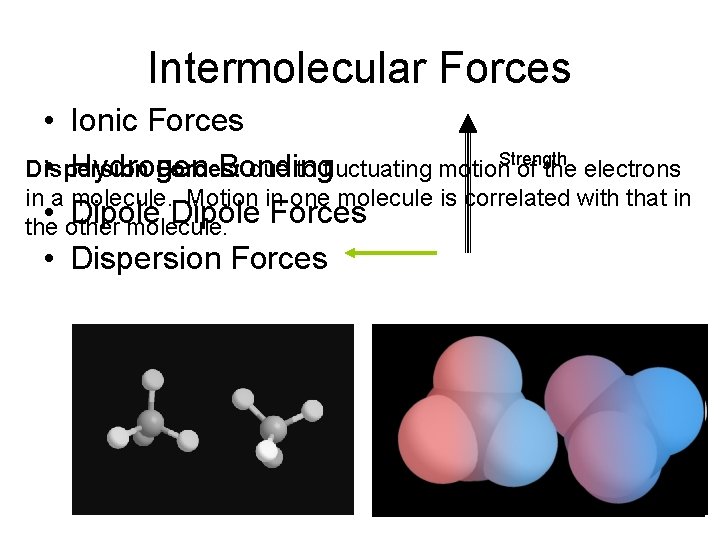
Intermolecular Forces • Ionic Forces • Hydrogen Bonding Dispersion Forces: due to fluctuating motion. Strength of the electrons in a molecule. Motion in one molecule is correlated with that in • other Dipole Forces the molecule. • Dispersion Forces
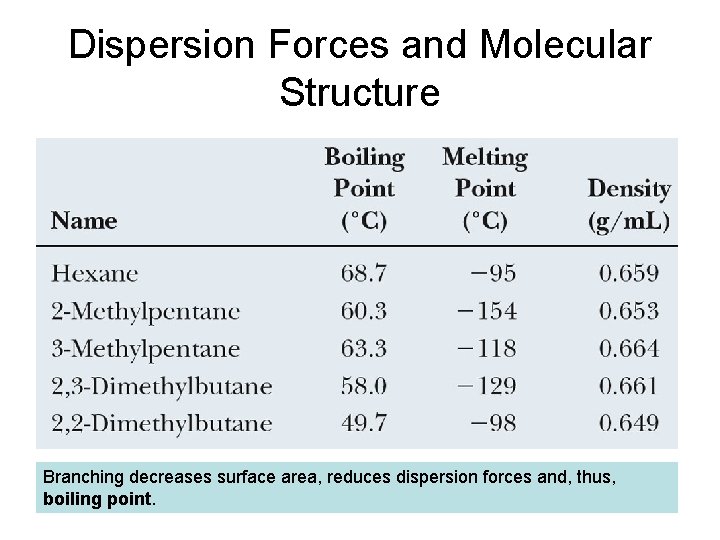
Dispersion Forces and Molecular Structure Branching decreases surface area, reduces dispersion forces and, thus, boiling point.
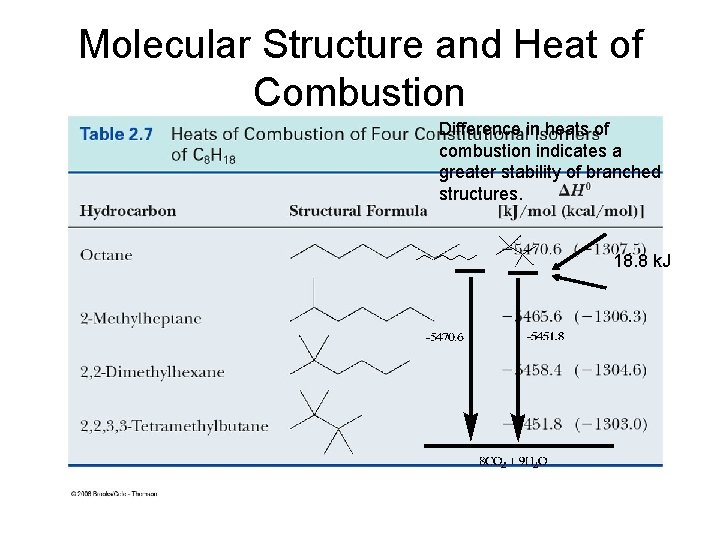
Molecular Structure and Heat of Combustion Difference in heats of combustion indicates a greater stability of branched structures. 18. 8 k. J
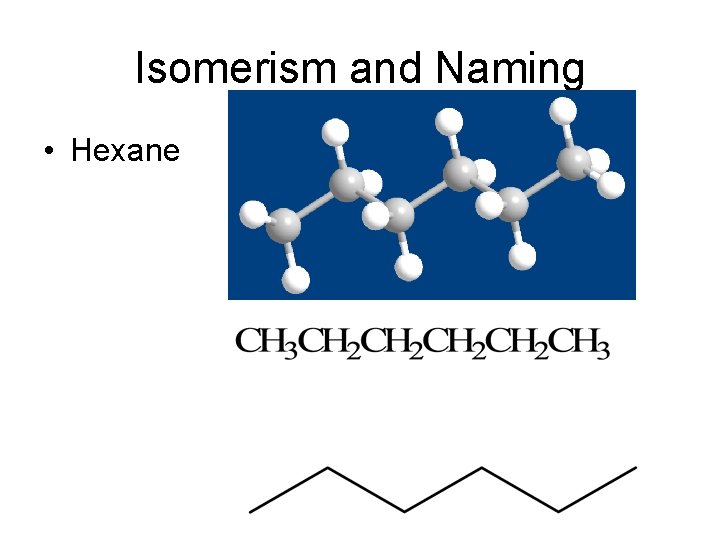
Isomerism and Naming • Hexane
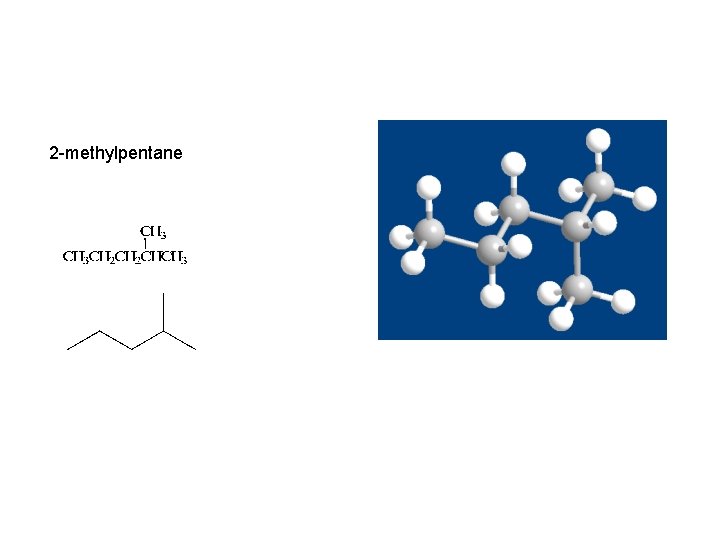
2 -methylpentane
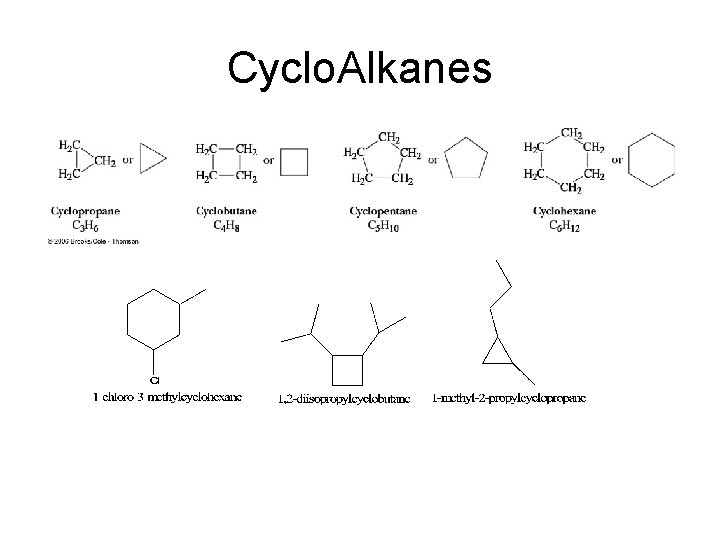
Cyclo. Alkanes
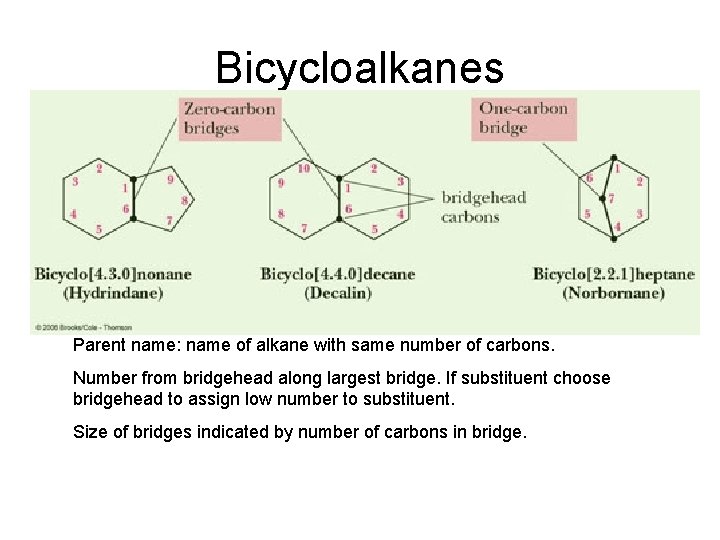
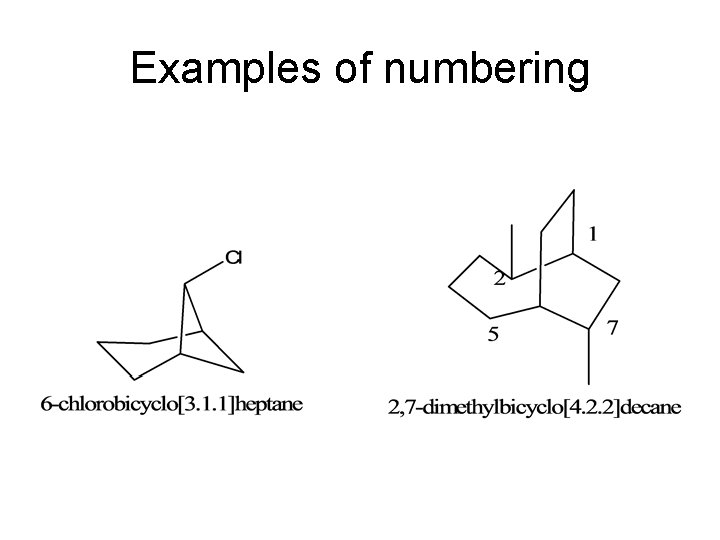
Bicycloalkanes Parent name: name of alkane with same number of carbons. Number from bridgehead along largest bridge. If substituent choose bridgehead to assign low number to substituent. Size of bridges indicated by number of carbons in bridge.
Examples of numbering
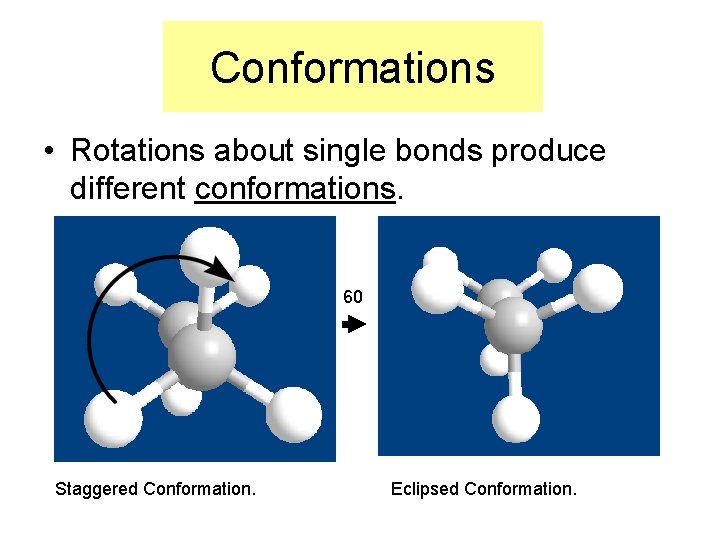
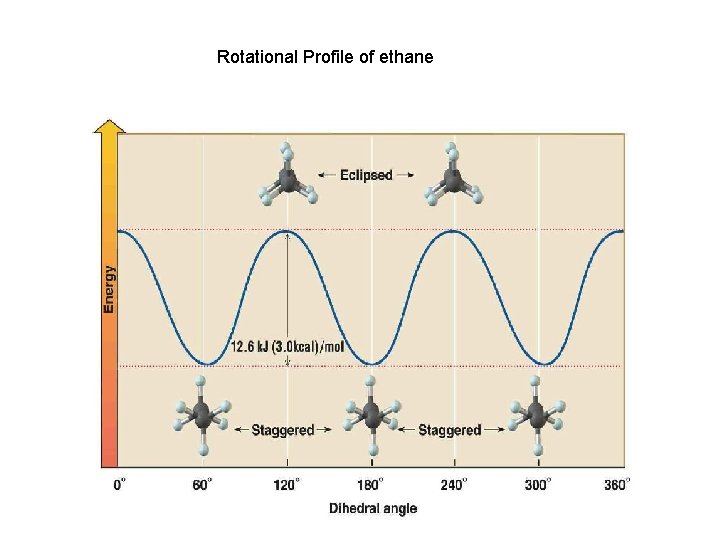
Conformations • Rotations about single bonds produce different conformations. 60 Staggered Conformation. Eclipsed Conformation.
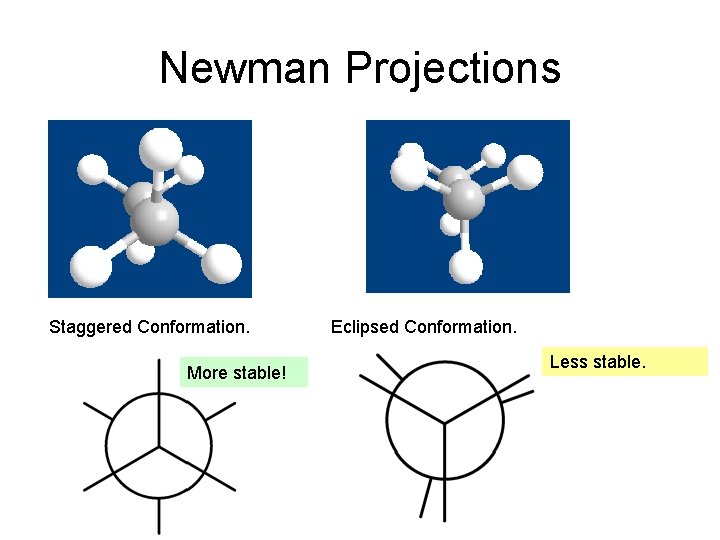
Newman Projections Staggered Conformation. More stable! Eclipsed Conformation. Less stable.
Rotational Profile of ethane
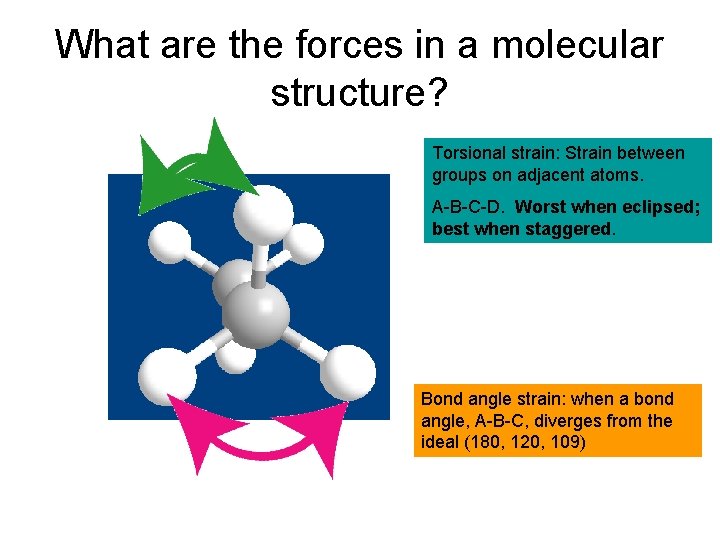
What are the forces in a molecular structure? Torsional strain: Strain between groups on adjacent atoms. A-B-C-D. Worst when eclipsed; best when staggered. Bond angle strain: when a bond angle, A-B-C, diverges from the ideal (180, 120, 109)
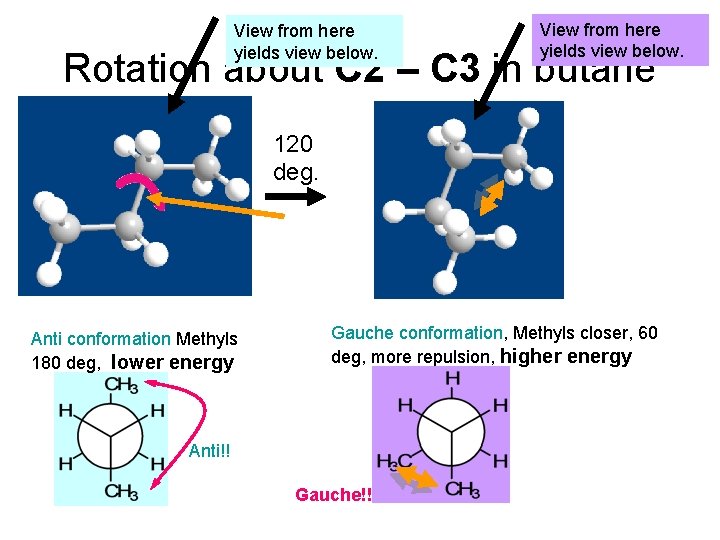
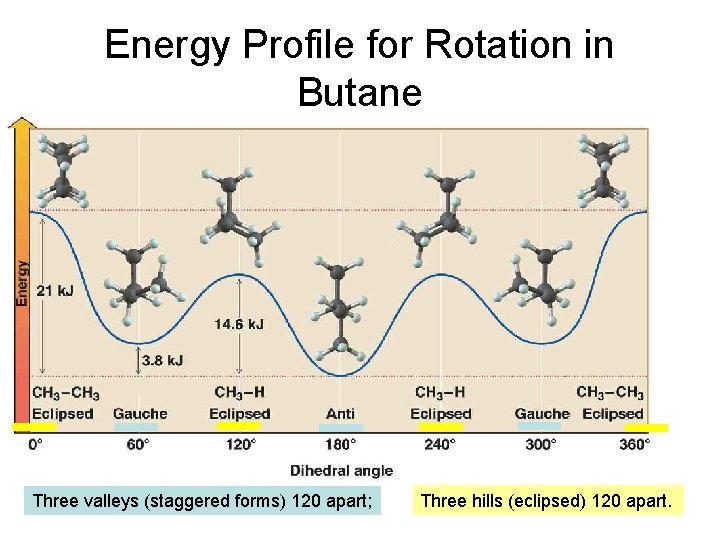
View from here yields view below. Rotation about C 2 – C 3 in butane 120 deg. Anti conformation Methyls 180 deg, lower energy Gauche conformation, Methyls closer, 60 deg, more repulsion, higher energy Anti!! Gauche!!
Energy Profile for Rotation in Butane Three valleys (staggered forms) 120 apart; Three hills (eclipsed) 120 apart.
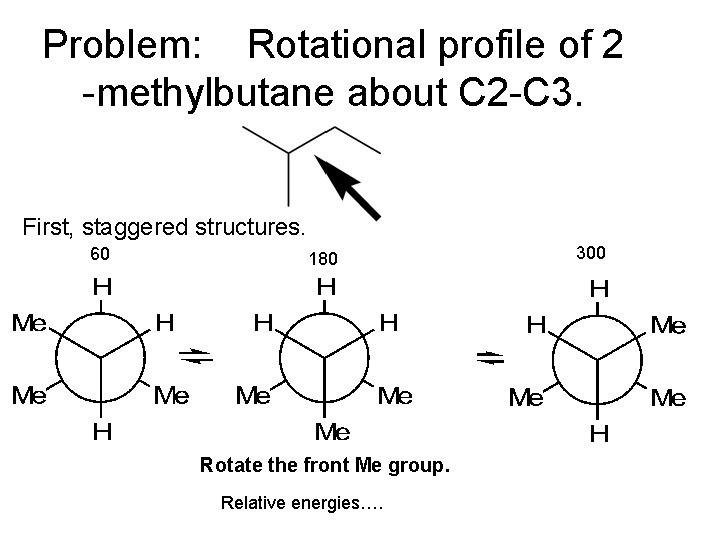
Problem: Rotational profile of 2 -methylbutane about C 2 -C 3. First, staggered structures. 60 180 Rotate the front Me group. Relative energies…. 300
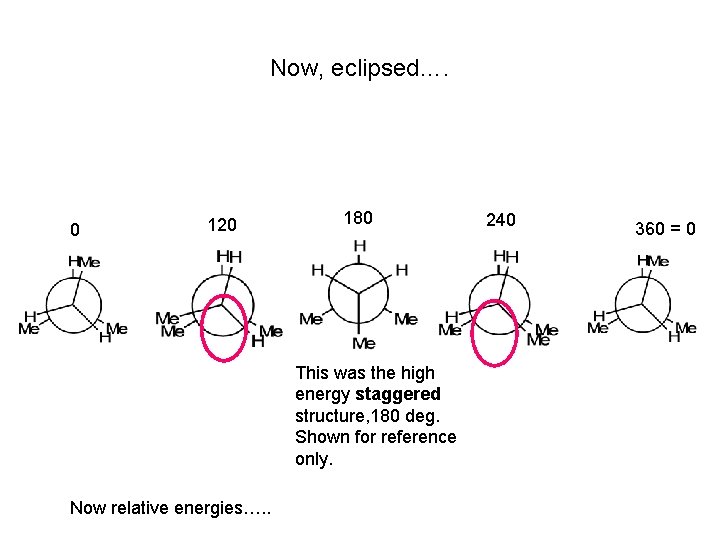
Now, eclipsed…. 0 120 180 This was the high energy staggered structure, 180 deg. Shown for reference only. Now relative energies…. . 240 360 = 0
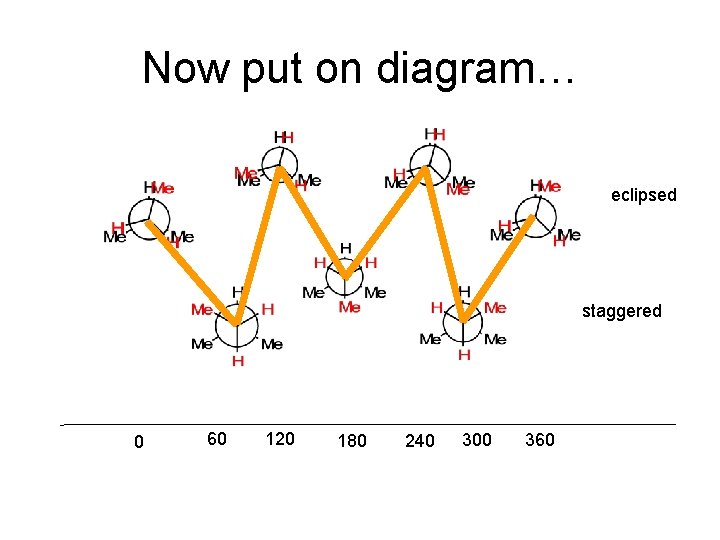
Now put on diagram… eclipsed staggered 0 60 120 180 240 300 360
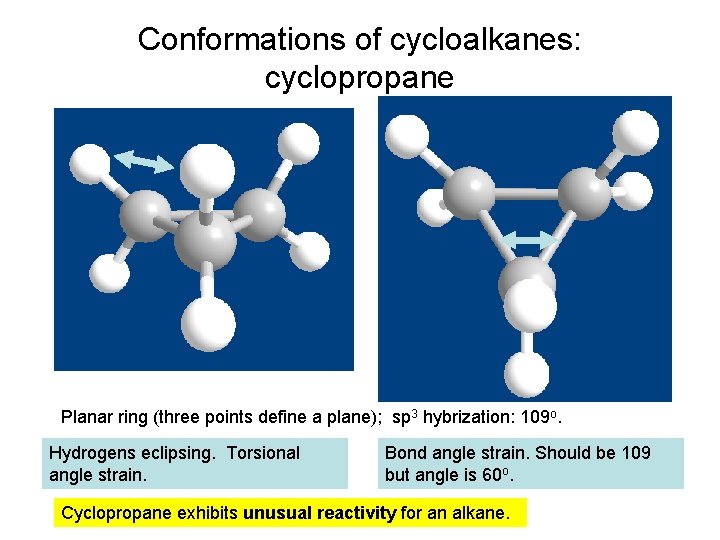
Conformations of cycloalkanes: cyclopropane Planar ring (three points define a plane); sp 3 hybrization: 109 o. Hydrogens eclipsing. Torsional angle strain. Bond angle strain. Should be 109 but angle is 60 o. Cyclopropane exhibits unusual reactivity for an alkane.
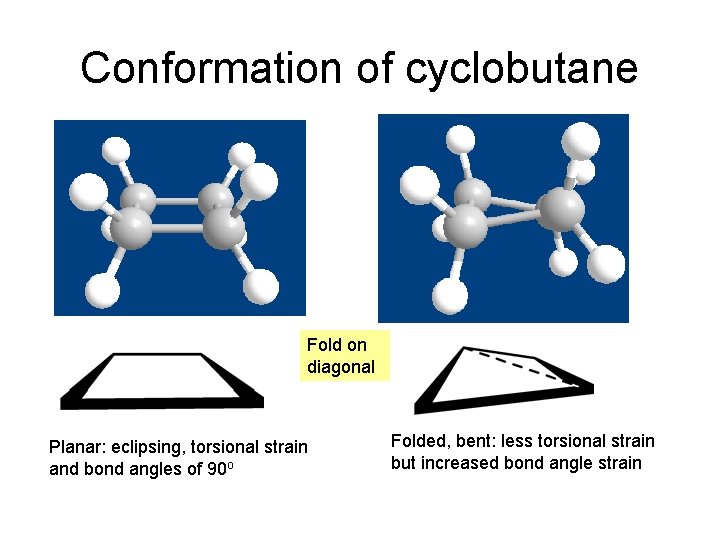
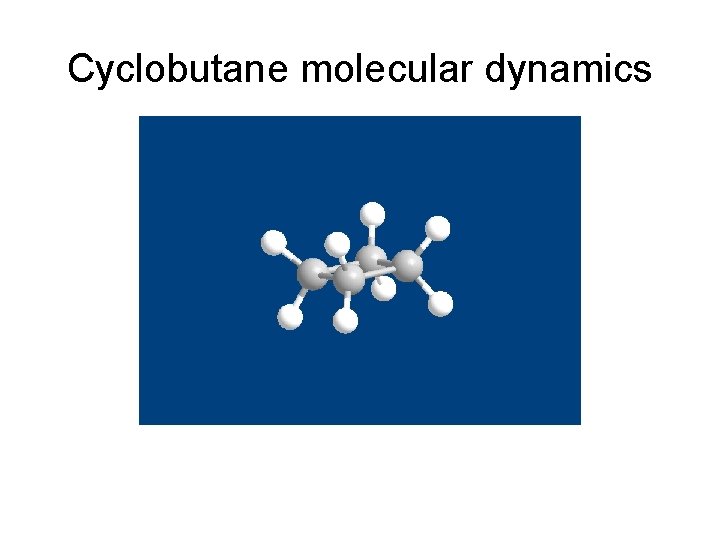
Conformation of cyclobutane Fold on diagonal Planar: eclipsing, torsional strain and bond angles of 90 o Folded, bent: less torsional strain but increased bond angle strain
Cyclobutane molecular dynamics
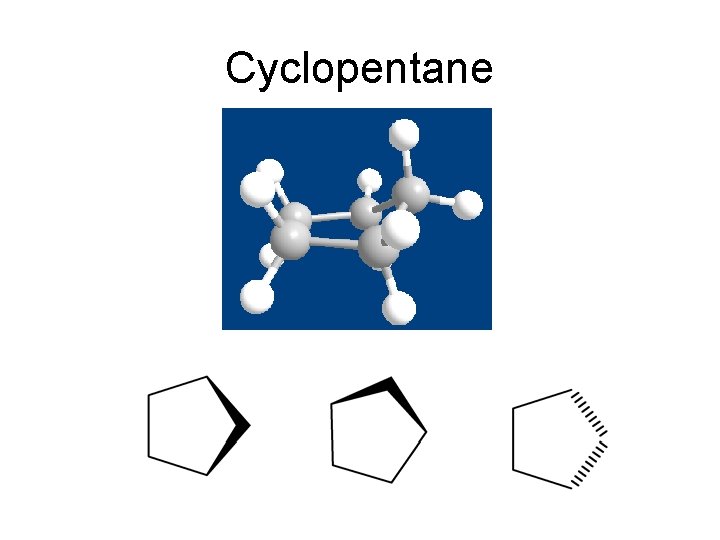
Cyclopentane
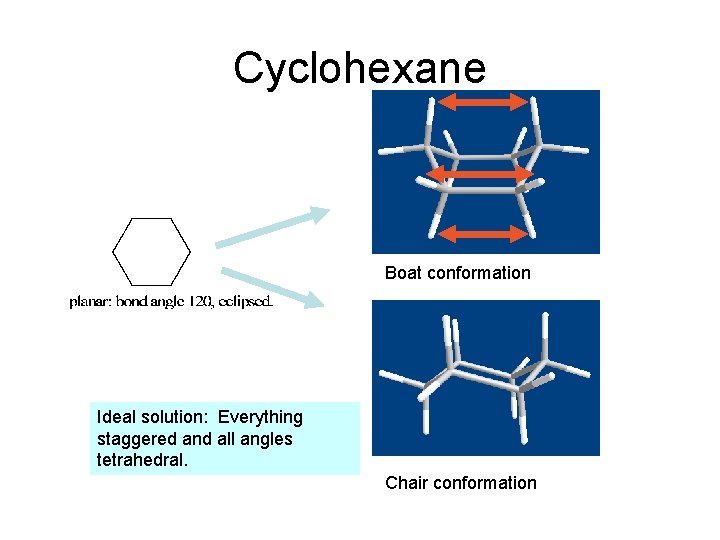
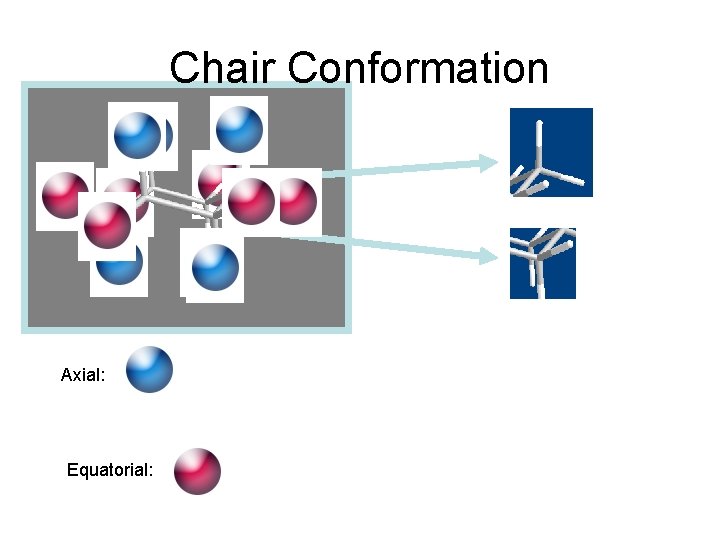
Cyclohexane Boat conformation Ideal solution: Everything staggered and all angles tetrahedral. Chair conformation
Chair Conformation Axial: Equatorial:
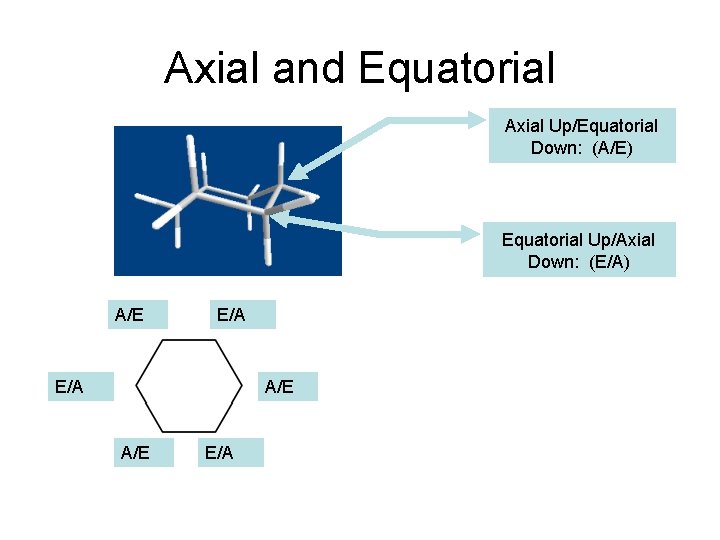
Axial and Equatorial Axial Up/Equatorial Down: (A/E) Equatorial Up/Axial Down: (E/A) A/E E/A
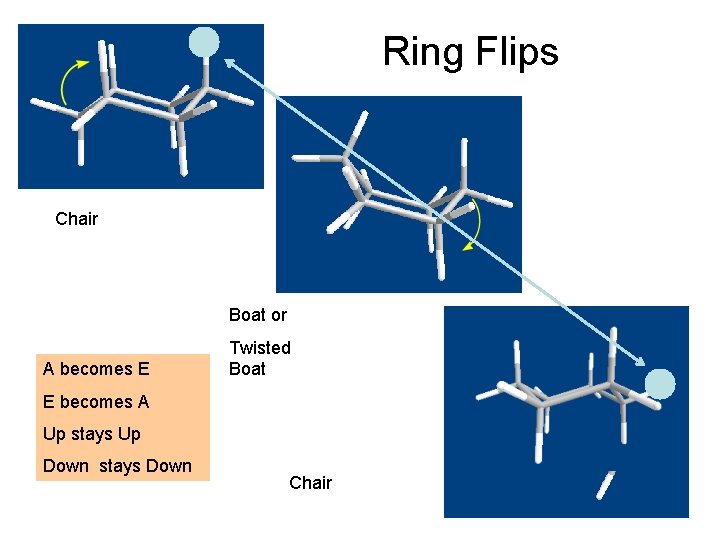
Ring Flips Chair Boat or A becomes E Twisted Boat E becomes A Up stays Up Down stays Down Chair
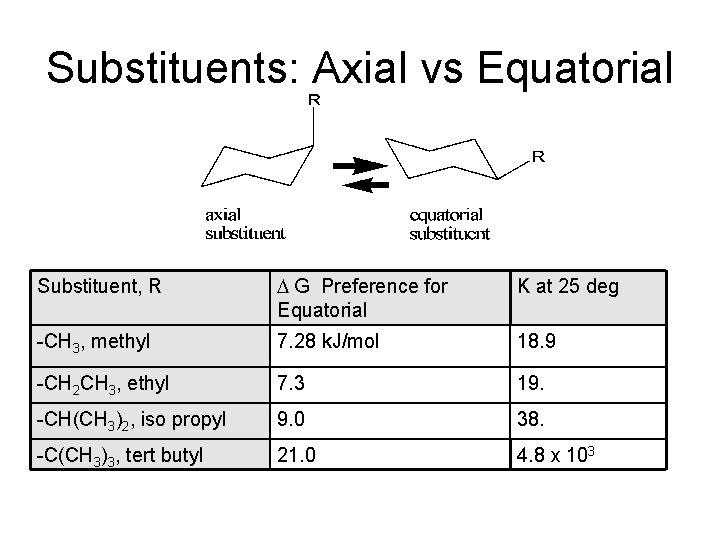
Substituents: Axial vs Equatorial Substituent, R D G Preference for Equatorial K at 25 deg -CH 3, methyl 7. 28 k. J/mol 18. 9 -CH 2 CH 3, ethyl 7. 3 19. -CH(CH 3)2, iso propyl 9. 0 38. -C(CH 3)3, tert butyl 21. 0 4. 8 x 10³
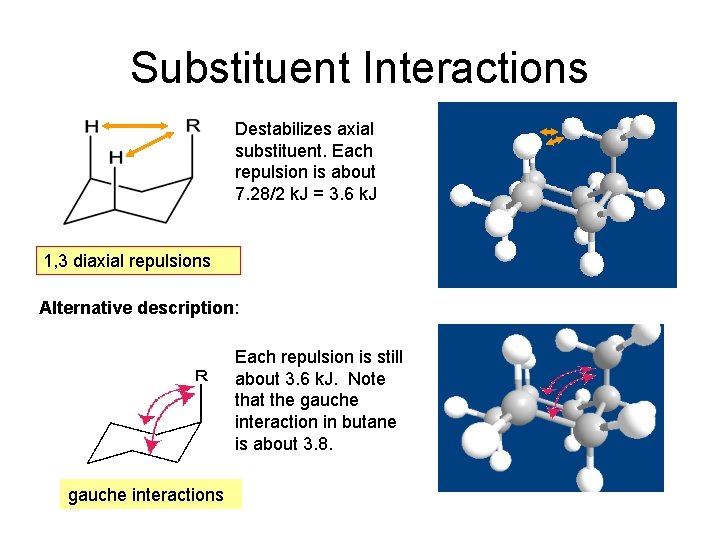
Substituent Interactions Destabilizes axial substituent. Each repulsion is about 7. 28/2 k. J = 3. 6 k. J 1, 3 diaxial repulsions Alternative description: Each repulsion is still about 3. 6 k. J. Note that the gauche interaction in butane is about 3. 8. gauche interactions
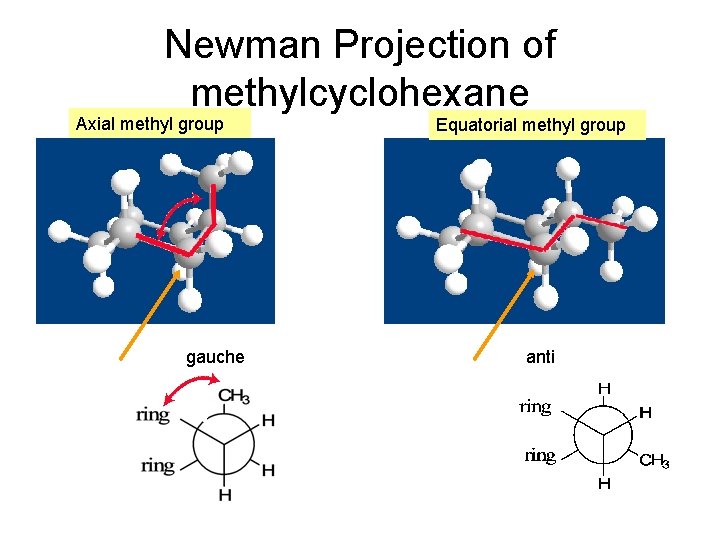
Newman Projection of methylcyclohexane Axial methyl group gauche Equatorial methyl group anti
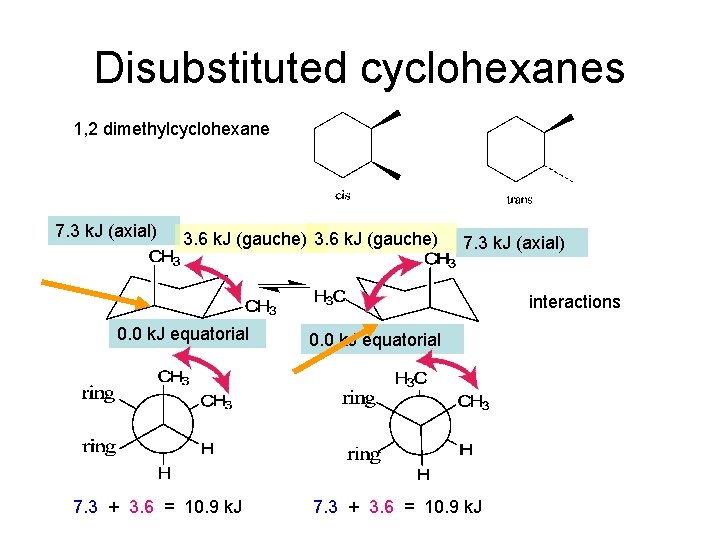
Disubstituted cyclohexanes 1, 2 dimethylcyclohexane 7. 3 k. J (axial) 3. 6 k. J (gauche) 7. 3 k. J (axial) interactions 0. 0 k. J equatorial 7. 3 + 3. 6 = 10. 9 k. J
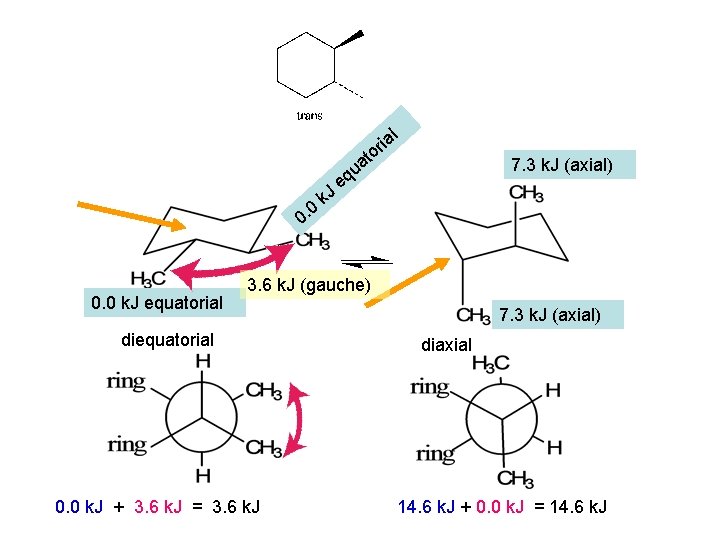
l ria to a u 0 0. 0 k. J equatorial k. J 7. 3 k. J (axial) eq 3. 6 k. J (gauche) diequatorial 0. 0 k. J + 3. 6 k. J = 3. 6 k. J 7. 3 k. J (axial) diaxial 14. 6 k. J + 0. 0 k. J = 14. 6 k. J
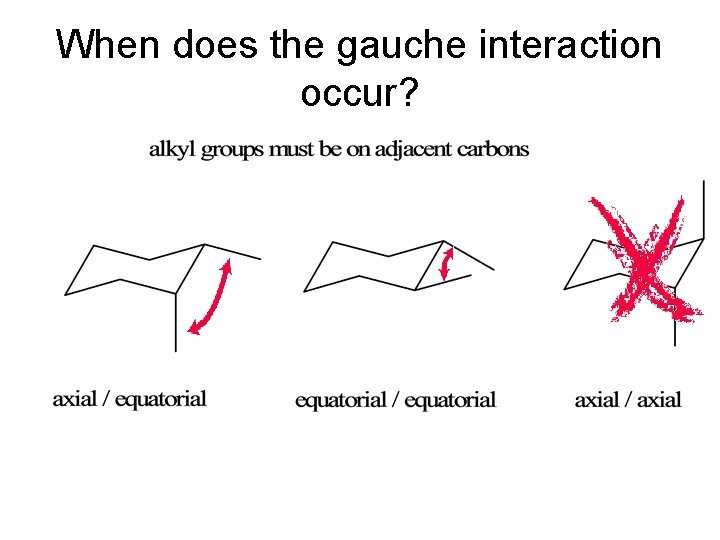
When does the gauche interaction occur?
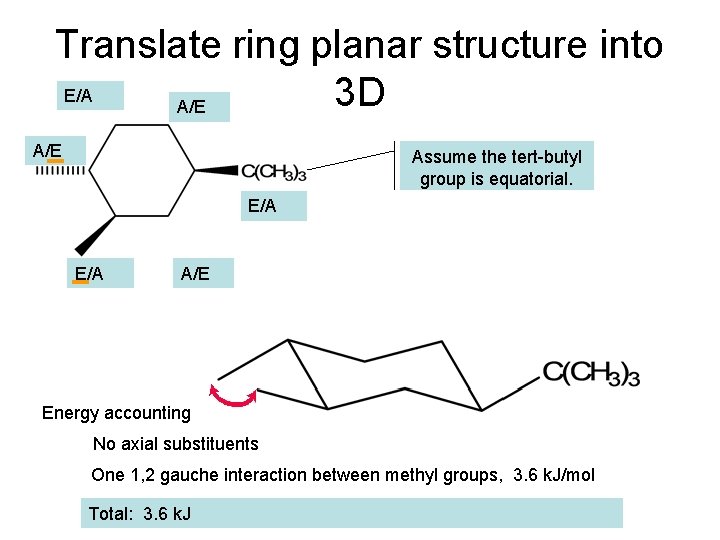
Translate ring planar structure into E/A 3 D A/E Assume the tert-butyl group is equatorial. E/A A/E Energy accounting No axial substituents One 1, 2 gauche interaction between methyl groups, 3. 6 k. J/mol Total: 3. 6 k. J
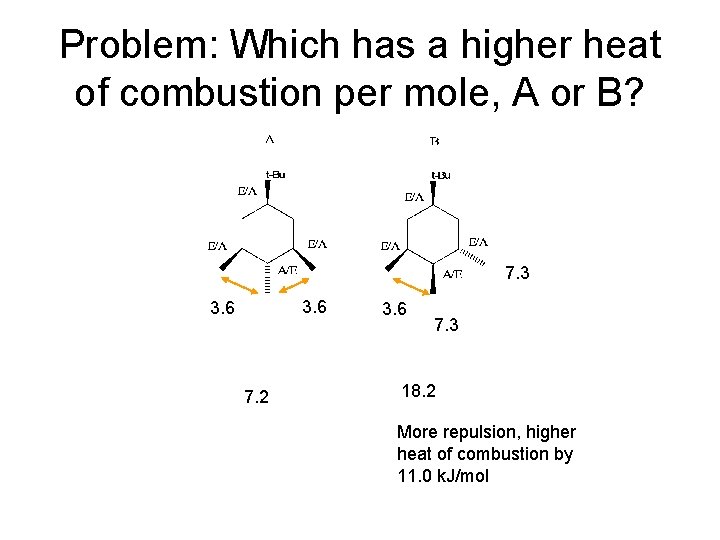
Problem: Which has a higher heat of combustion per mole, A or B? 7. 3 3. 6 7. 2 3. 6 7. 3 18. 2 More repulsion, higher heat of combustion by 11. 0 k. J/mol
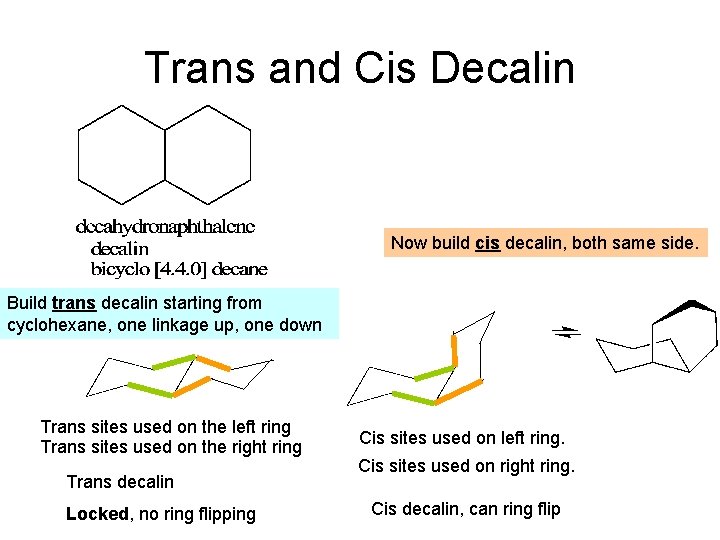
Trans and Cis Decalin Now build cis decalin, both same side. Build trans decalin starting from cyclohexane, one linkage up, one down Trans sites used on the left ring Trans sites used on the right ring Trans decalin Locked, no ring flipping Cis sites used on left ring. Cis sites used on right ring. Cis decalin, can ring flip
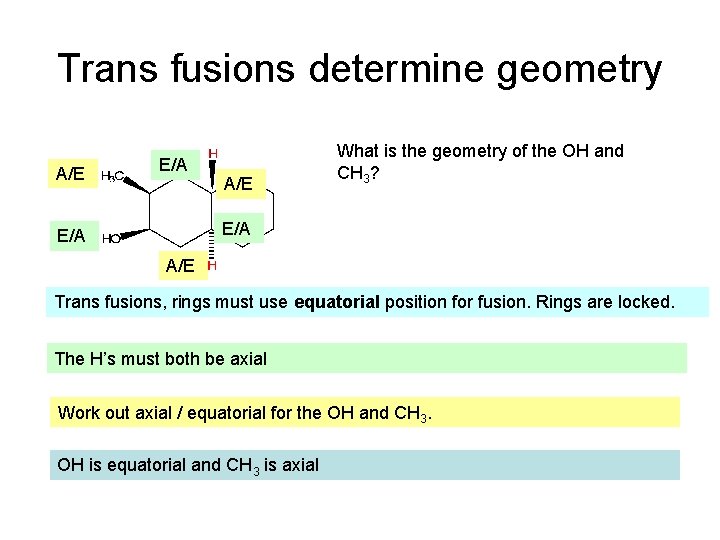
Trans fusions determine geometry A/E E/A A/E What is the geometry of the OH and CH 3? E/A A/E Trans fusions, rings must use equatorial position for fusion. Rings are locked. The H’s must both be axial Work out axial / equatorial for the OH and CH 3. OH is equatorial and CH 3 is axial