
Alimentary glands The Liver Shape two surfaces n
- Slides: 22
Alimentary glands 消化腺
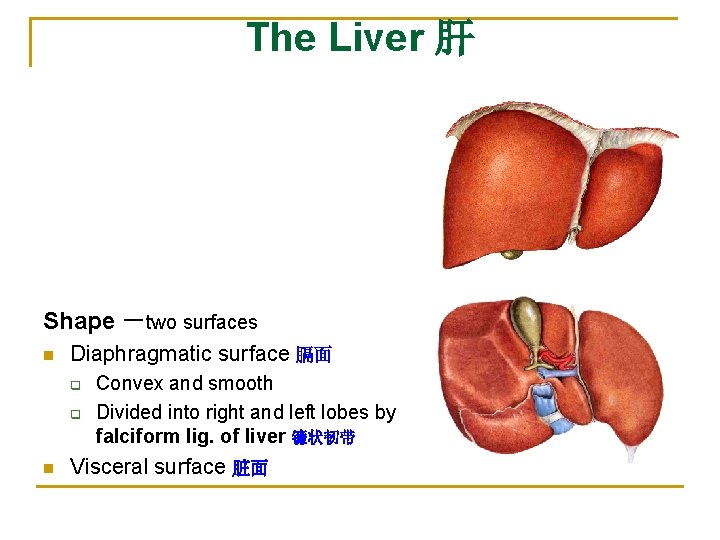
The Liver 肝 Shape -two surfaces n Diaphragmatic surface 膈面 q q n Convex and smooth Divided into right and left lobes by falciform lig. of liver 镰状韧带 Visceral surface 脏面
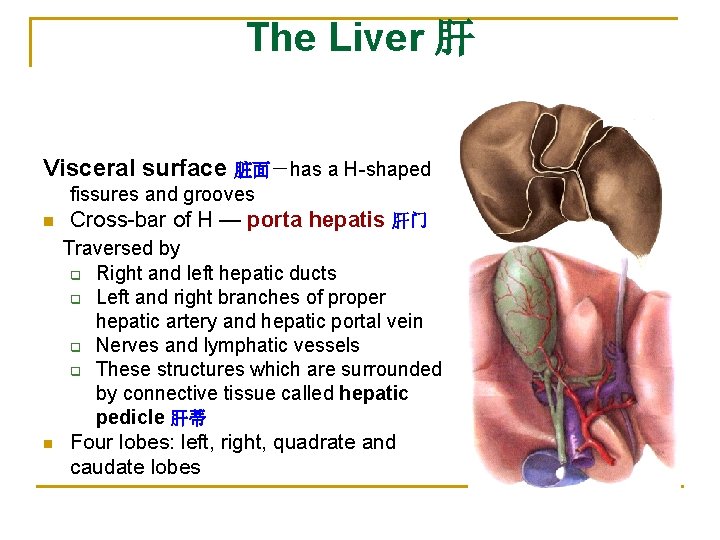
The Liver 肝 Visceral surface 脏面-has a H-shaped fissures and grooves n Cross-bar of H — porta hepatis 肝门 Traversed by q Right and left hepatic ducts q Left and right branches of proper hepatic artery and hepatic portal vein q Nerves and lymphatic vessels q These structures which are surrounded by connective tissue called hepatic pedicle 肝蒂 n Four lobes: left, right, quadrate and caudate lobes
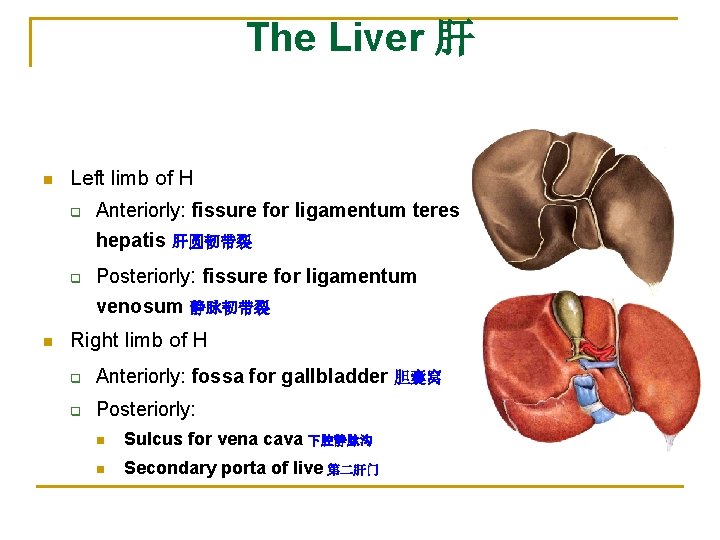
The Liver 肝 n Left limb of H q q Anteriorly: fissure for ligamentum teres hepatis 肝圆韧带裂 Posteriorly: fissure for ligamentum venosum n 静脉韧带裂 Right limb of H q Anteriorly: fossa for gallbladder q Posteriorly: n Sulcus for vena cava 下腔静脉沟 n Secondary porta of live 第二肝门 胆囊窝
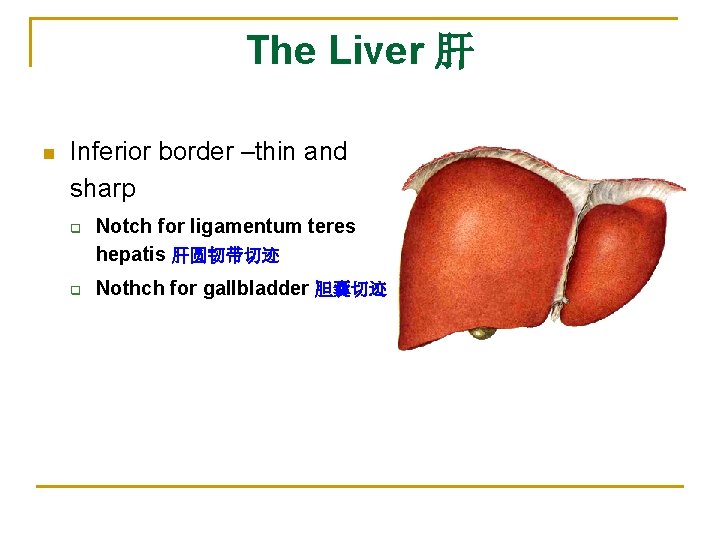
The Liver 肝 n Inferior border –thin and sharp q q Notch for ligamentum teres hepatis 肝圆韧带切迹 Nothch for gallbladder 胆囊切迹
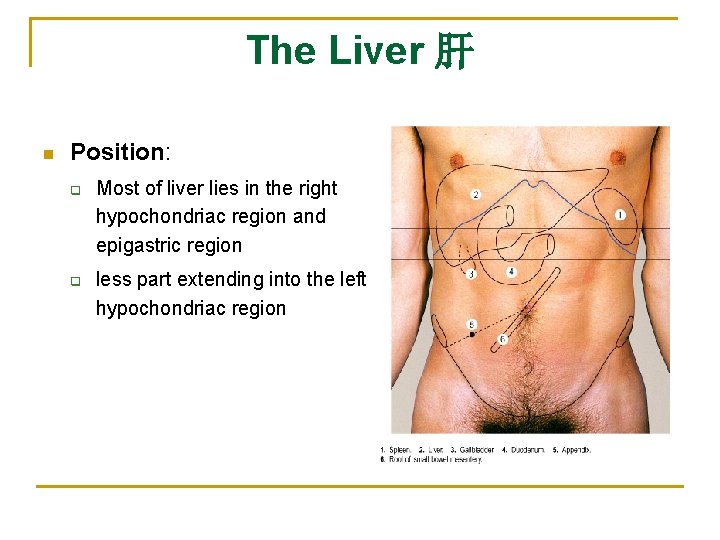
The Liver 肝 n Position: q q Most of liver lies in the right hypochondriac region and epigastric region less part extending into the left hypochondriac region
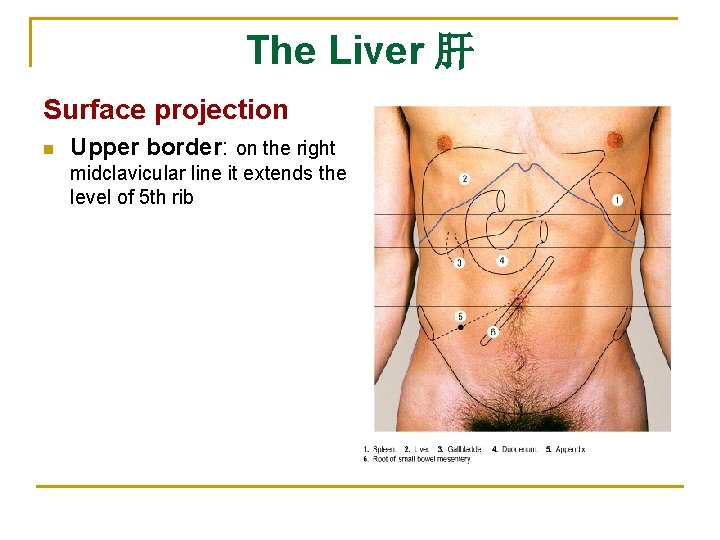
The Liver 肝 Surface projection n Upper border: on the right midclavicular line it extends the level of 5 th rib
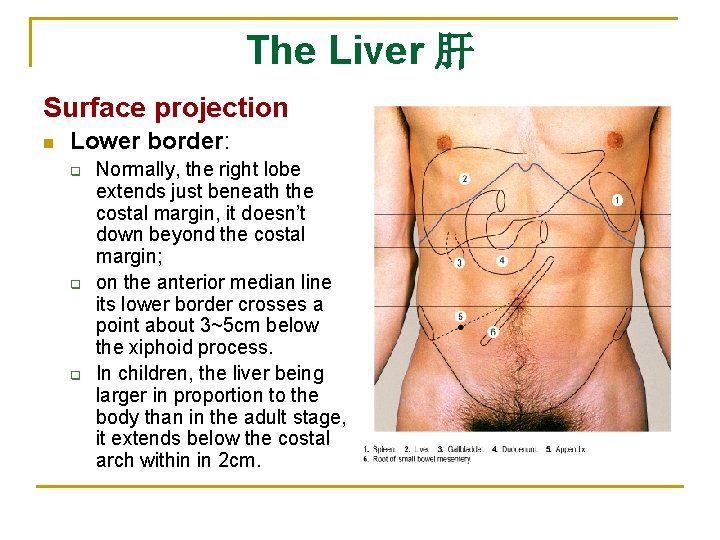
The Liver 肝 Surface projection n Lower border: q q q Normally, the right lobe extends just beneath the costal margin, it doesn’t down beyond the costal margin; on the anterior median line its lower border crosses a point about 3~5 cm below the xiphoid process. In children, the liver being larger in proportion to the body than in the adult stage, it extends below the costal arch within in 2 cm.
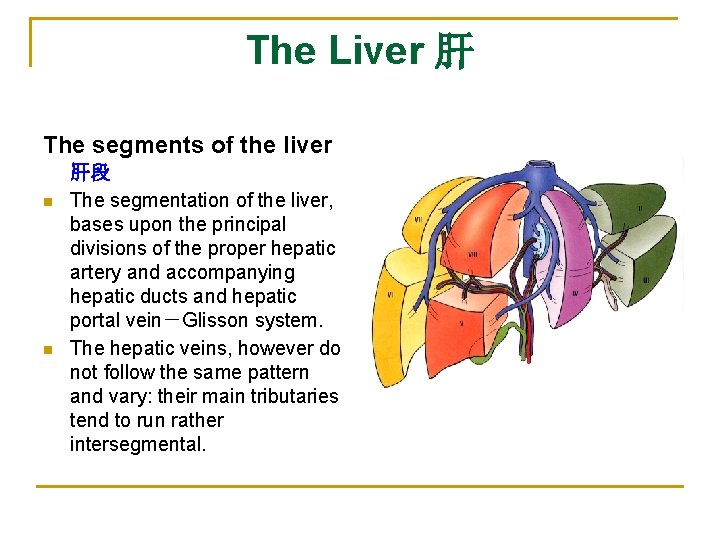
The Liver 肝 The segments of the liver n n 肝段 The segmentation of the liver, bases upon the principal divisions of the proper hepatic artery and accompanying hepatic ducts and hepatic portal vein-Glisson system. The hepatic veins, however do not follow the same pattern and vary: their main tributaries tend to run rather intersegmental.
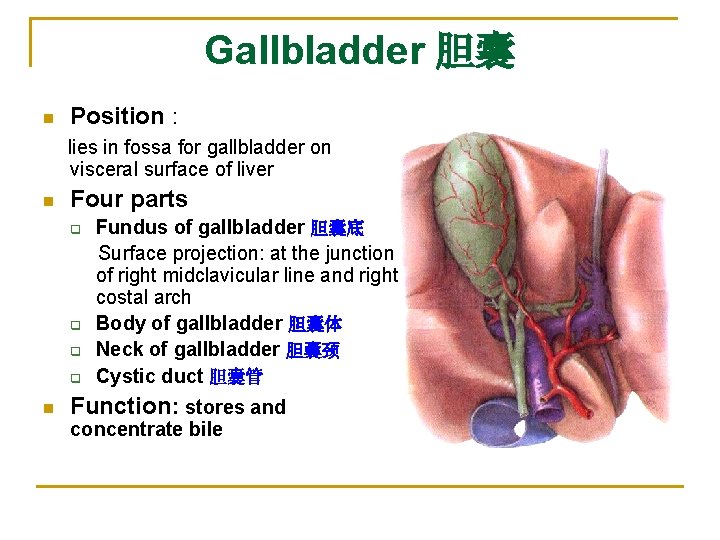
Gallbladder 胆囊 n Position : lies in fossa for gallbladder on visceral surface of liver n Four parts q q n Fundus of gallbladder 胆囊底 Surface projection: at the junction of right midclavicular line and right costal arch Body of gallbladder 胆囊体 Neck of gallbladder 胆囊颈 Cystic duct 胆囊管 Function: stores and concentrate bile
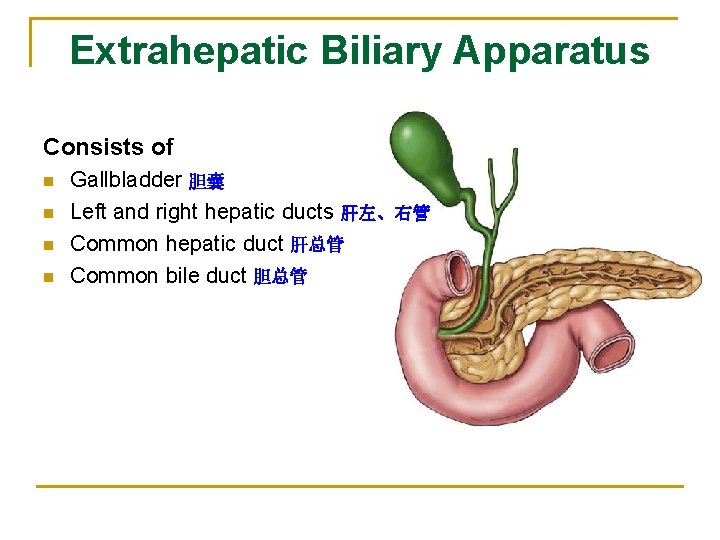
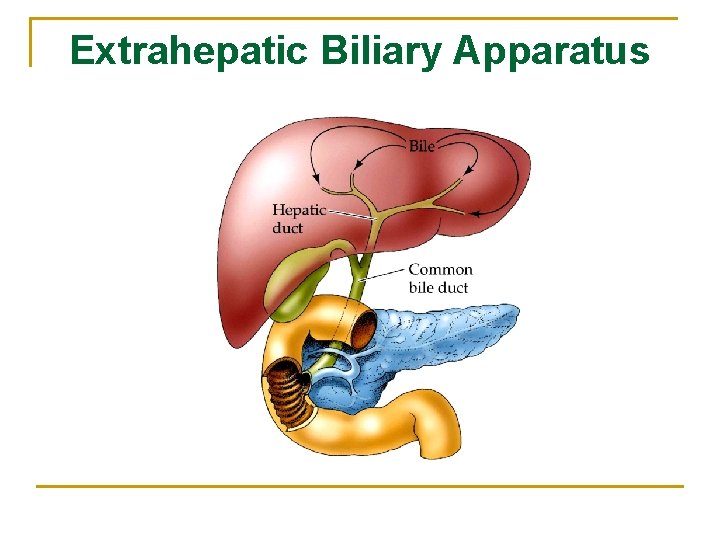
Extrahepatic Biliary Apparatus Consists of n n Gallbladder 胆囊 Left and right hepatic ducts 肝左、右管 Common hepatic duct 肝总管 Common bile duct 胆总管
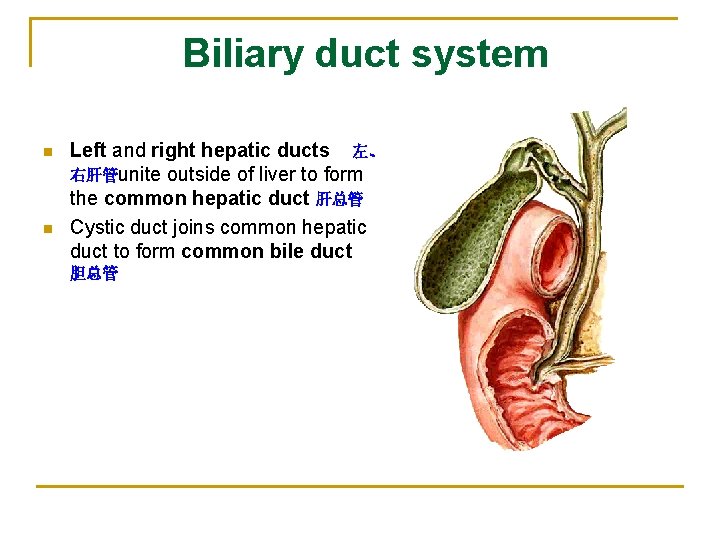
Biliary duct system n n Left and right hepatic ducts 左、 右肝管unite outside of liver to form the common hepatic duct 肝总管 Cystic duct joins common hepatic duct to form common bile duct 胆总管
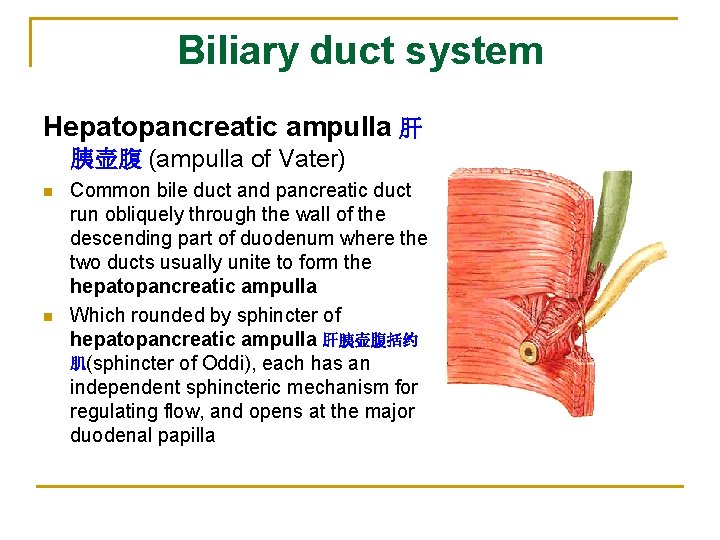
Biliary duct system Hepatopancreatic ampulla 肝 胰壶腹 (ampulla of Vater) n n Common bile duct and pancreatic duct run obliquely through the wall of the descending part of duodenum where the two ducts usually unite to form the hepatopancreatic ampulla Which rounded by sphincter of hepatopancreatic ampulla 肝胰壶腹括约 肌(sphincter of Oddi), each has an independent sphincteric mechanism for regulating flow, and opens at the major duodenal papilla
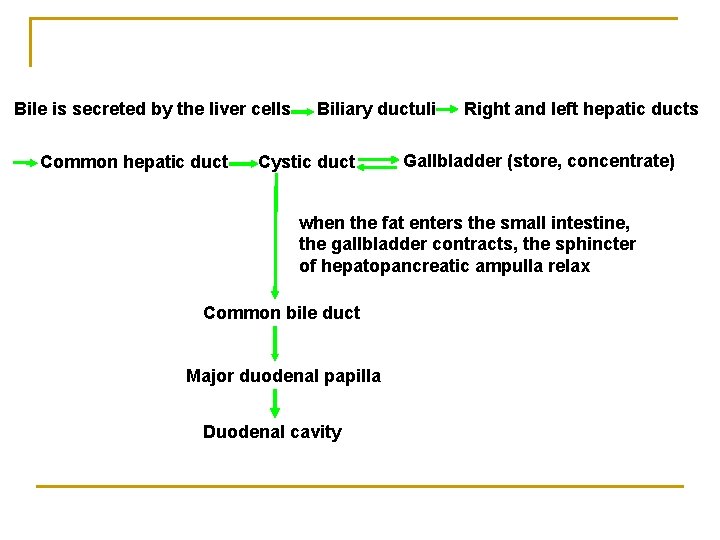
Bile is secreted by the liver cells Common hepatic duct Biliary ductuli Cystic duct Right and left hepatic ducts Gallbladder (store, concentrate) when the fat enters the small intestine, the gallbladder contracts, the sphincter of hepatopancreatic ampulla relax Common bile duct Major duodenal papilla Duodenal cavity
Extrahepatic Biliary Apparatus
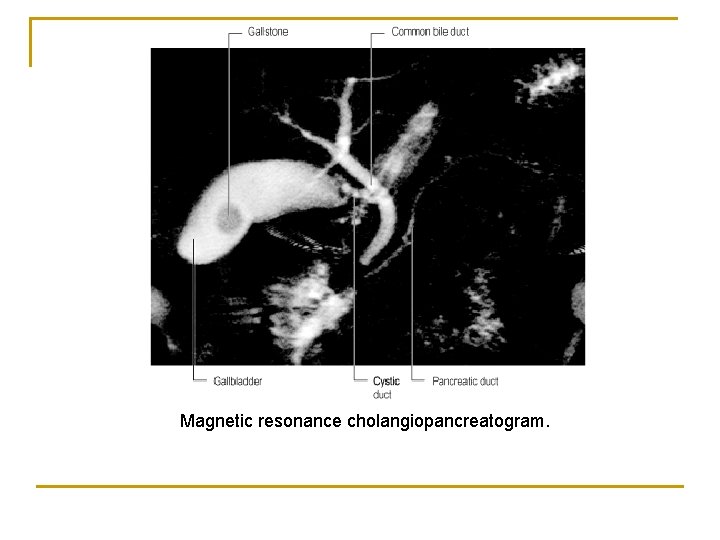
Magnetic resonance cholangiopancreatogram.
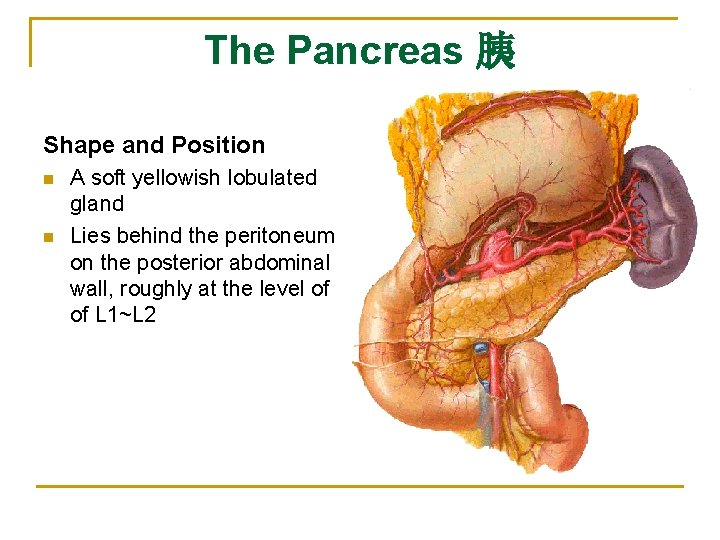
The Pancreas 胰 Shape and Position n n A soft yellowish lobulated gland Lies behind the peritoneum on the posterior abdominal wall, roughly at the level of of L 1~L 2
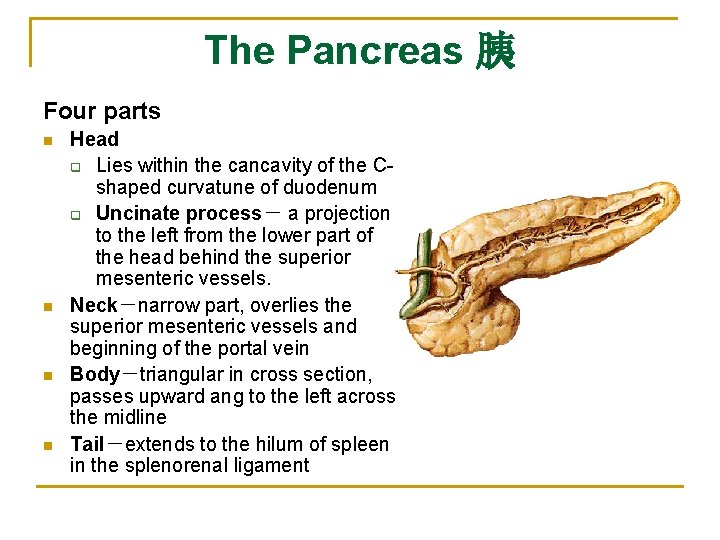
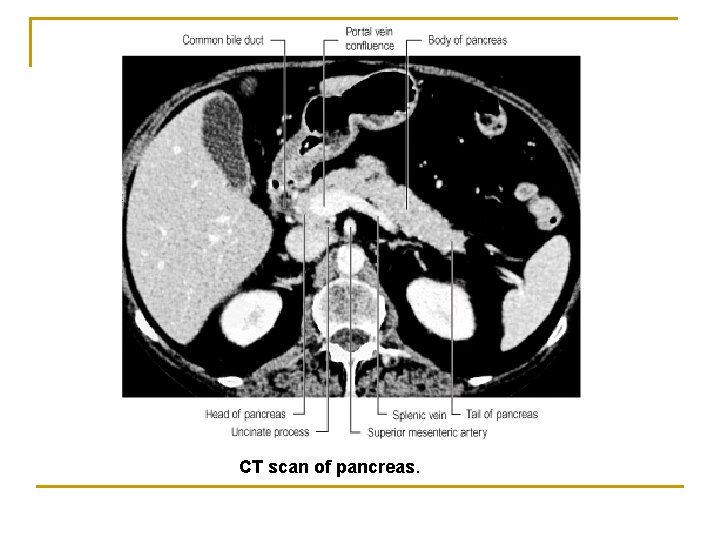
The Pancreas 胰 Four parts n n Head q Lies within the cancavity of the Cshaped curvatune of duodenum q Uncinate process- a projection to the left from the lower part of the head behind the superior mesenteric vessels. Neck-narrow part, overlies the superior mesenteric vessels and beginning of the portal vein Body-triangular in cross section, passes upward ang to the left across the midline Tail-extends to the hilum of spleen in the splenorenal ligament
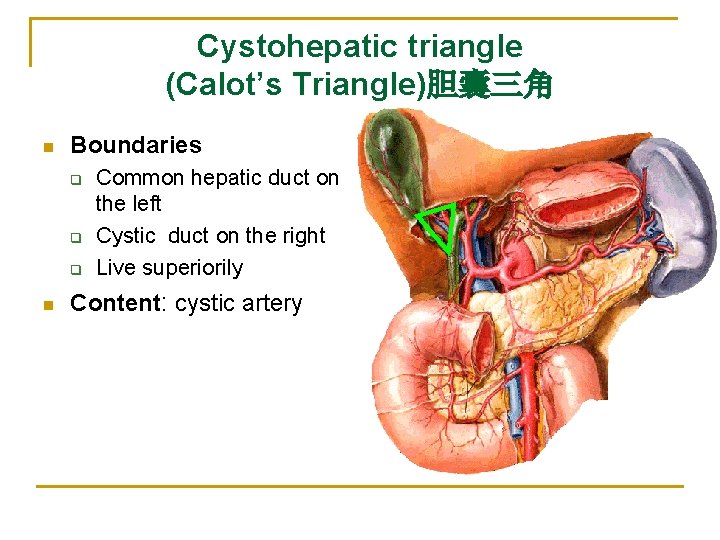
Cystohepatic triangle (Calot’s Triangle)胆囊三角 n Boundaries q q q n Common hepatic duct on the left Cystic duct on the right Live superiorily Content: cystic artery
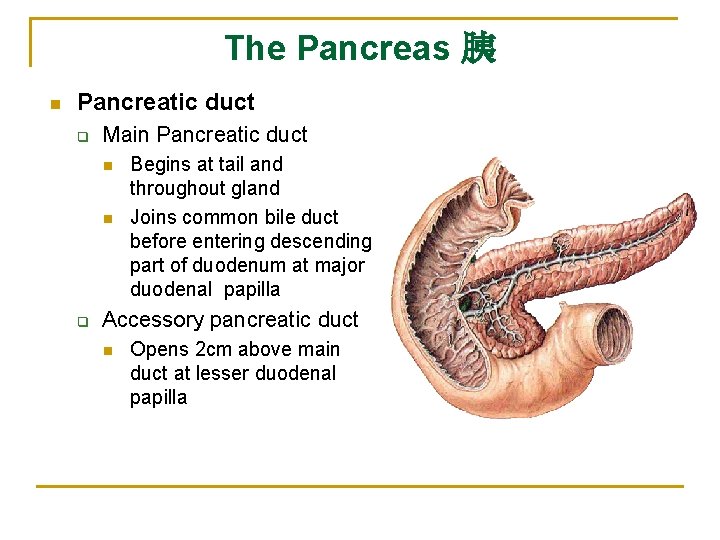
The Pancreas 胰 n Pancreatic duct q Main Pancreatic duct n n q Begins at tail and throughout gland Joins common bile duct before entering descending part of duodenum at major duodenal papilla Accessory pancreatic duct n Opens 2 cm above main duct at lesser duodenal papilla
CT scan of pancreas.
The Pancreas 胰 Function The pancreas is both an exocrine and an endocrine gland. The exocrine portion of the gland produces a secretion that contains enzymes that are capable of hydrolyzing proteins, fats, and carbohydrates. The endocrine portion of the gland, the pancreatic islet, produces the hormones insulin and glucagons that play a key role in carbohydrate metabolism.