
Alignment with the Grand Challenges Industrial Strategy Grand


- Slides: 7
Alignment with the Grand Challenges
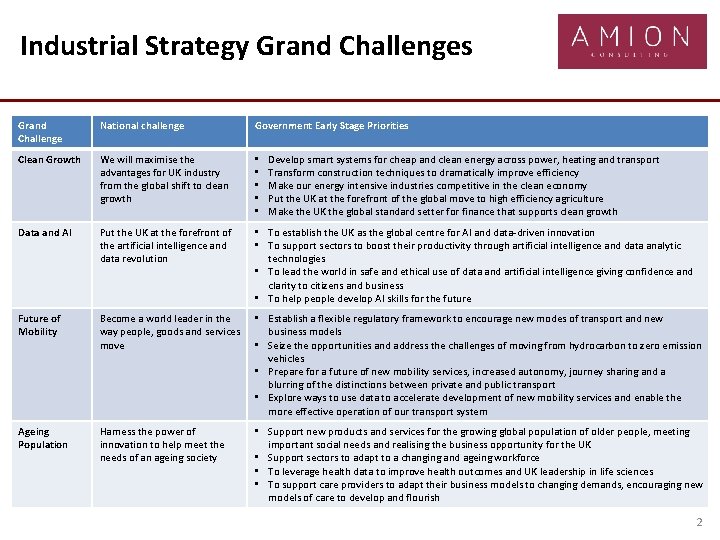
Industrial Strategy Grand Challenges Grand Challenge National challenge Government Early Stage Priorities Clean Growth We will maximise the advantages for UK industry from the global shift to clean growth • • • Data and AI Put the UK at the forefront of the artificial intelligence and data revolution • To establish the UK as the global centre for AI and data-driven innovation • To support sectors to boost their productivity through artificial intelligence and data analytic technologies • To lead the world in safe and ethical use of data and artificial intelligence giving confidence and clarity to citizens and business • To help people develop AI skills for the future Future of Mobility Become a world leader in the way people, goods and services move • Establish a flexible regulatory framework to encourage new modes of transport and new business models • Seize the opportunities and address the challenges of moving from hydrocarbon to zero emission vehicles • Prepare for a future of new mobility services, increased autonomy, journey sharing and a blurring of the distinctions between private and public transport • Explore ways to use data to accelerate development of new mobility services and enable the more effective operation of our transport system Ageing Population Harness the power of innovation to help meet the needs of an ageing society • Support new products and services for the growing global population of older people, meeting important social needs and realising the business opportunity for the UK • Support sectors to adapt to a changing and ageing workforce • To leverage health data to improve health outcomes and UK leadership in life sciences • To support care providers to adapt their business models to changing demands, encouraging new models of care to develop and flourish Develop smart systems for cheap and clean energy across power, heating and transport Transform construction techniques to dramatically improve efficiency Make our energy intensive industries competitive in the clean economy Put the UK at the forefront of the global move to high efficiency agriculture Make the UK the global standard setter for finance that supports clean growth 2
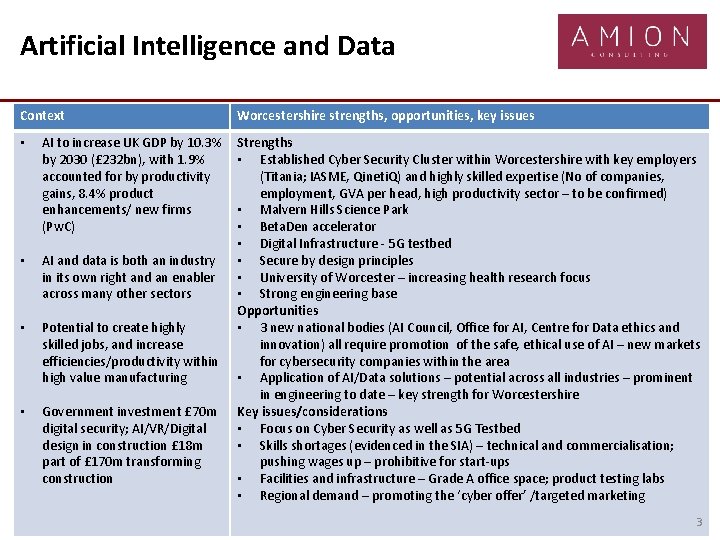
Artificial Intelligence and Data Context • AI to increase UK GDP by 10. 3% by 2030 (£ 232 bn), with 1. 9% accounted for by productivity gains, 8. 4% product enhancements/ new firms (Pw. C) • AI and data is both an industry in its own right and an enabler across many other sectors • Potential to create highly skilled jobs, and increase efficiencies/productivity within high value manufacturing • Government investment £ 70 m digital security; AI/VR/Digital design in construction £ 18 m part of £ 170 m transforming construction Worcestershire strengths, opportunities, key issues Strengths • Established Cyber Security Cluster within Worcestershire with key employers (Titania; IASME, Qineti. Q) and highly skilled expertise (No of companies, employment, GVA per head, high productivity sector – to be confirmed) • Malvern Hills Science Park • Beta. Den accelerator • Digital Infrastructure - 5 G testbed • Secure by design principles • University of Worcester – increasing health research focus • Strong engineering base Opportunities • 3 new national bodies (AI Council, Office for AI, Centre for Data ethics and innovation) all require promotion of the safe, ethical use of AI – new markets for cybersecurity companies within the area • Application of AI/Data solutions – potential across all industries – prominent in engineering to date – key strength for Worcestershire Key issues/considerations • Focus on Cyber Security as well as 5 G Testbed • Skills shortages (evidenced in the SIA) – technical and commercialisation; pushing wages up – prohibitive for start-ups • Facilities and infrastructure – Grade A office space; product testing labs • Regional demand – promoting the ‘cyber offer’ /targeted marketing 3
Future of Mobility • Innovation in engineering is driving changes in the future of mobility in addition to environmental concerns and new standards • Different working practices and new modes of provision provide opportunities to reduce congestion and improve productivity • Impacts on health and wellbeing • Government funding £ 400 m for new EV charging infrastructure Worcestershire strengths, opportunities, key issues Strengths • Advanced manufacturing and engineering is a priority sector – with strong competitive advantage in transport, machinery). Sector currently employs over 30, 000 employees in approx. 2, 500 companies. £ 1. 6 bn GVA (top 50 companies) • Part of West Midlands Automotive Cluster; • Global engineering specialists (Mazak, European Technology Centre, GKN HQ) • Investment in engineering skills infrastructure – North Worcestershire Engineering Centre of Excellence; Ho. W College • Digital infrastructure – 5 G • Cyber security expertise New markets/Opportunities • Aerospace and Automotives - Worcestershire strengths and established supply chains • Transition to zero emission vehicles/electric vehicles – key priority in Worcestershire’s Energy Strategy • New business models – ride sharing, mobility as a service, app-based services – potential market opportunities for rural areas? Key Issues/Considerations • Limited competitive advantages with CAV but supply chain opportunities • Competition for skills and attracting/retaining workers – wage levels; housing; Qo. L • EV infrastructure required - WCC 12 charging points; 3, 000 charging events vs 25, 700 in Northumberland in 2017 (WM currently has lowest level of charging points per head) 4
Clean Growth Context • Low carbon and environmental technologies also an industry in its own right and a key requisite driving change among a range of other production, manufacturing and service industries (e. g. transport) • Environmental impacts also likely to improve health, wellbeing and quality of life • Government funding £ 220 m Clean Air fund; Transforming Construction £ 170 m; SME Energy Efficiency Fund Worcestershire strengths, opportunities, key issues Strengths • Worcestershire Energy Strategy (2030) driving the shift to low carbon economy and clean growth: reduce carbon emissions by 50%; double the local carbon sector; triple energy production • 400 + low carbon/environmental companies, employing close to 7, 500 people in 2011/12 (Turnover £ 1 bn). • Low carbon and renewable energy only generates £ 334 m, employing 1, 700. • Offenham Geo-thermal Resource • Key employers – e. g. Bosch Thermotechnology • University of Worcester- recognition for commitment to sustainability • Agri-tech West, Pershore College Opportunities • Industries to be transformed include construction, manufacturing (e. g. automotive) – both predominant in the area • Geothermal heat below Worcestershire – potentially significant energy source • Housing/commitment to high quality energy efficient homes – key priority for the area • Agri-tech R&D, potential collaboration Pershore, Harper Adams, Hartpury University (The Marches; Gfirst) Key issues/considerations • Some areas of potential competitive advantage linked to Energy Strategy – threat to traditional energy related activities • Significant investment required to progress Geothermal Heat proposition • Establishment of industrial clusters likely to focus on Grangemouth, Merseyside, South 5 Wales, Southampton, Teeside, Humberside
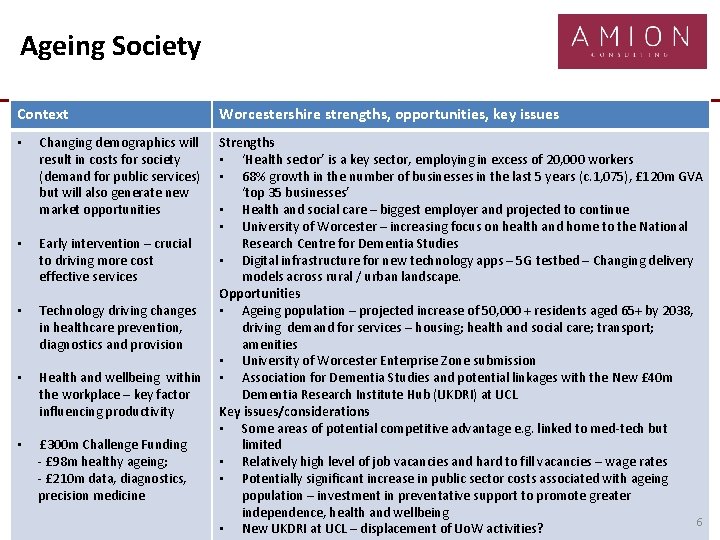
Ageing Society Context • Changing demographics will result in costs for society (demand for public services) but will also generate new market opportunities • Early intervention – crucial to driving more cost effective services • Technology driving changes in healthcare prevention, diagnostics and provision • Health and wellbeing within the workplace – key factor influencing productivity • £ 300 m Challenge Funding - £ 98 m healthy ageing; - £ 210 m data, diagnostics, precision medicine Worcestershire strengths, opportunities, key issues Strengths • ‘Health sector’ is a key sector, employing in excess of 20, 000 workers • 68% growth in the number of businesses in the last 5 years (c. 1, 075), £ 120 m GVA ‘top 35 businesses’ • Health and social care – biggest employer and projected to continue • University of Worcester – increasing focus on health and home to the National Research Centre for Dementia Studies • Digital infrastructure for new technology apps – 5 G testbed – Changing delivery models across rural / urban landscape. Opportunities • Ageing population – projected increase of 50, 000 + residents aged 65+ by 2038, driving demand for services – housing; health and social care; transport; amenities • University of Worcester Enterprise Zone submission • Association for Dementia Studies and potential linkages with the New £ 40 m Dementia Research Institute Hub (UKDRI) at UCL Key issues/considerations • Some areas of potential competitive advantage e. g. linked to med-tech but limited • Relatively high level of job vacancies and hard to fill vacancies – wage rates • Potentially significant increase in public sector costs associated with ageing population – investment in preventative support to promote greater independence, health and wellbeing 6 • New UKDRI at UCL – displacement of Uo. W activities?
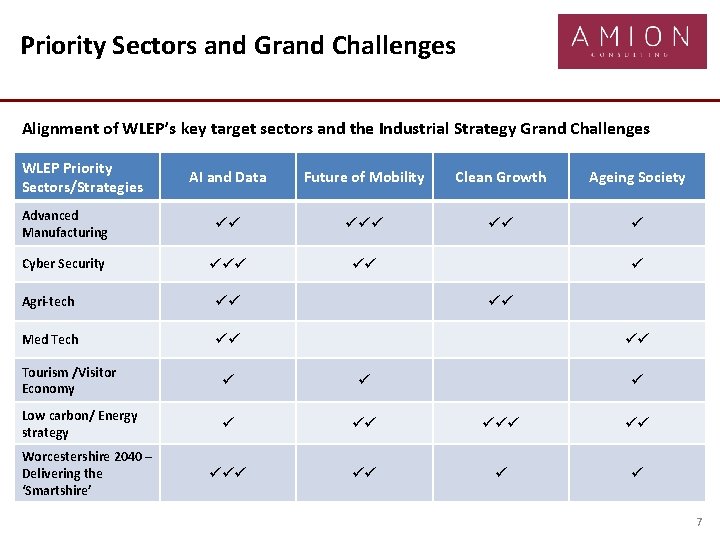
Priority Sectors and Grand Challenges Alignment of WLEP’s key target sectors and the Industrial Strategy Grand Challenges WLEP Priority Sectors/Strategies AI and Data Future of Mobility Clean Growth Ageing Society Advanced Manufacturing Cyber Security Agri-tech Med Tech Tourism /Visitor Economy Low carbon/ Energy strategy Worcestershire 2040 – Delivering the ‘Smartshire’ 7