
Alignment Issues in the IT Strategic Planning Process

- Slides: 22
Alignment Issues in the IT Strategic Planning Process Copyright James Penrod & Ann Harbor 2003. This work is the Southeast EDUCAUSE intellectual property of the authors. Permission is granted for this June 20, 2003 material to be shared for noncommercial, educational purposes, James I. Penrod provided that this copyright statement appears on the Ann F. Harbor reproduced materials and notice is given that the copying is by The University of Memphis permission of the authors. To disseminate otherwise or to republish requires written permission from the authors.
The Rise and Fall of Strategic Planning, The Free Press, 1993 "Indeed, the whole nature of strategy making -dynamic, irregular, discontinuous, calling for groping, interactive processes with an emphasis on learning and synthesis -- compels managers to favor intuition. This is probably why all those analytical techniques of planning felt so wrong. . Ultimately, the term "strategic planning" has proved to be an oxymoron. " --Henry Mintzberg
Pitfalls to Strategic Planning Not determining critical success factors from mission statement Lack of support & communication from top management Making management decisions that conflict with the plan Failure to use the plan to measure success Assignment of planning to a “planner” or committee http: //www. entarga. com/stratplan/pitfalls. htm
Pitfalls to Strategic Planning Failure to involve staff & constituents in all phases of plan development. Lack of a collaborative climate open to change Planning not seen as part of routine management Becoming too engrossed in current problems Lack of flexibility and creativity in the planning process http: //www. entarga. com/stratplan/pitfalls. htm
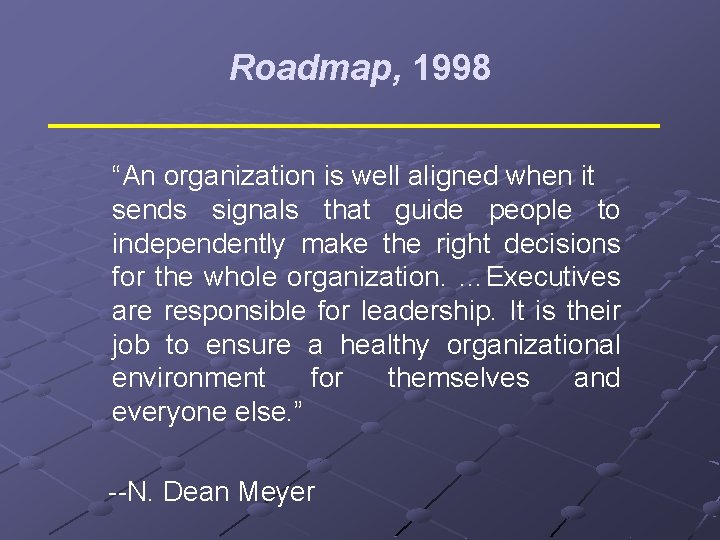
Roadmap, 1998 “An organization is well aligned when it sends signals that guide people to independently make the right decisions for the whole organization. …Executives are responsible for leadership. It is their job to ensure a healthy organizational environment for themselves and everyone else. ” --N. Dean Meyer
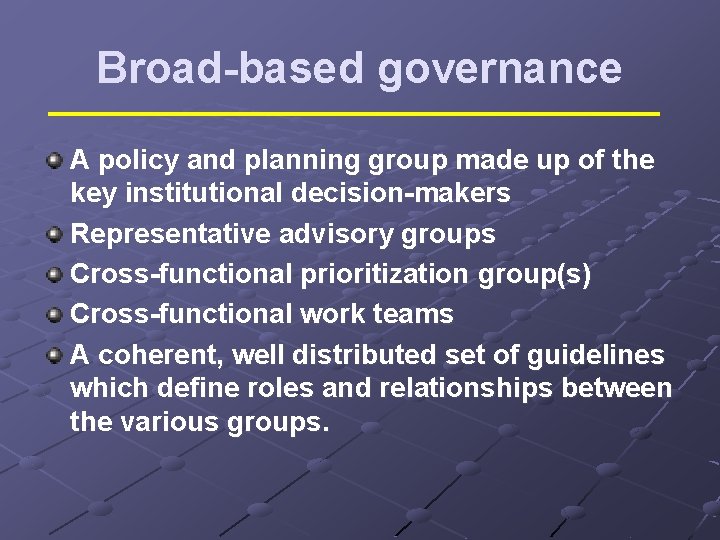
Broad-based governance A policy and planning group made up of the key institutional decision-makers Representative advisory groups Cross-functional prioritization group(s) Cross-functional work teams A coherent, well distributed set of guidelines which define roles and relationships between the various groups.
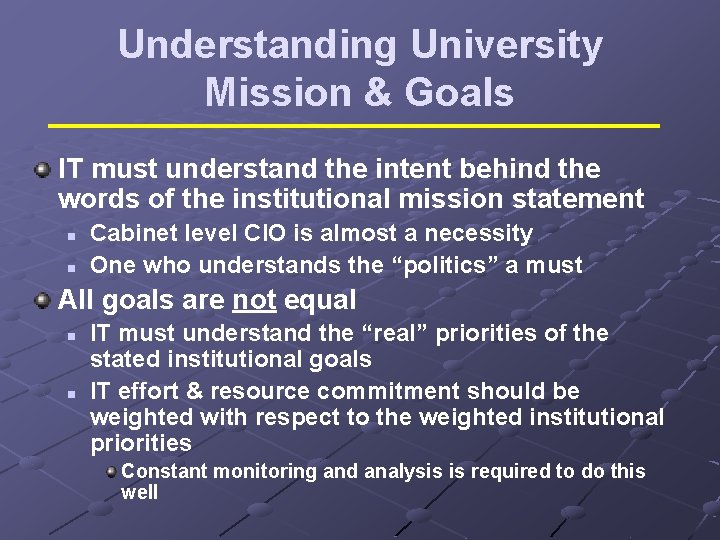
Understanding University Mission & Goals IT must understand the intent behind the words of the institutional mission statement n n Cabinet level CIO is almost a necessity One who understands the “politics” a must All goals are not equal n n IT must understand the “real” priorities of the stated institutional goals IT effort & resource commitment should be weighted with respect to the weighted institutional priorities Constant monitoring and analysis is required to do this well
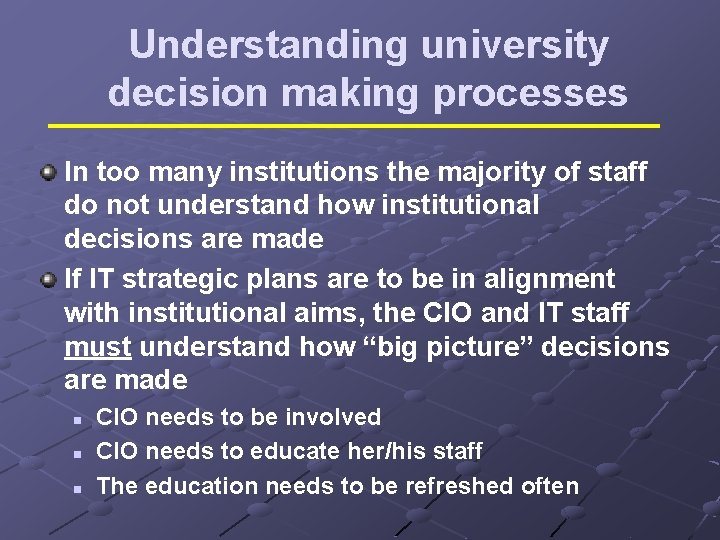
Understanding university decision making processes In too many institutions the majority of staff do not understand how institutional decisions are made If IT strategic plans are to be in alignment with institutional aims, the CIO and IT staff must understand how “big picture” decisions are made n n n CIO needs to be involved CIO needs to educate her/his staff The education needs to be refreshed often
Ten Steps to a Learning Organization, 1998 “Individuals store their learning primarily in their memories, augmented by libraries, notes, and other aids to memory. Organizations store it primarily in their cultures, with a secondary back-up in documentation that is useful only if the culture is committed to making use of it. …Demand that people do things a certain way and you’ll get relatively meager results. Create a culture in which it is taken for granted that they're done that way, and you’ll get nearly universal results. ” --Kline & Saunders
Understanding university culture Culture occurs in the interaction between people in any situation in which they congregate with some degree of predictability Both individuals and cultures operate on the basis of homeostasis, thus have a tendency to avoid change In most organizations many cultures exist side by side that are essentially incompatible with each other Significant learning requires change, thus produces stress --Kline & Saunders
Understanding university culture To change a culture, leaders must create conditions that give permission for people to confront ambiguity and stay with it until they have turned apparently meaningless patterns into useful ones A learning culture requires: n The input of new information or skills into the matrix of ideas n Synthesization of the new data with what was previously there n Some sort of output
Ten Steps to a Learning Organization, 1998 “Many are now aware that the Information Age is behind us and the Age of Relationships has come into being as perhaps the final stage in a series of steps that evolved the old autocratic organizations of half a century ago into modern, finely tuned agencies of human service and change. …No business or other agency that does not respect and honor [humans] can really, in the long run, remain successful. Those who do embrace the human dimension, soon discover that most of their profitability is in what is variously called human capital, learning capital, or intellectual capital. It is here, in the brains of people who work for [an enterprise], and the way they collectively use those brains to build systems which work to the advantage of all, that we can find the true and essential focal point of our business. ” --Kline & Saunders
Communication Processes Work to create communication processes that bring people together to consider in a friendly, noncompetitive atmosphere different perceptions, templates, habits of thought, and possible solutions, from which the most useful may be chosen n n Positive expectation that dilemmas can be resolved. Willingness to delay closure long enough to arrive at significant Gestalts The establishment of contexts within which meaning for new possibilities may be found Support for the learning process itself
Communication Processes Provide settings, opportunities, mechanisms, and tools that promote true dialogue n n n Make “mistakes are necessary for learning” a truism Provide an open confidential door to the top Provide situations for unregulated, direct communication between organizational levels and units Create and utilize self-directed teams Provide access to groupware to stimulate and capture dialogue between individuals and among groups Provide a variety of “standard” communication paths available to all
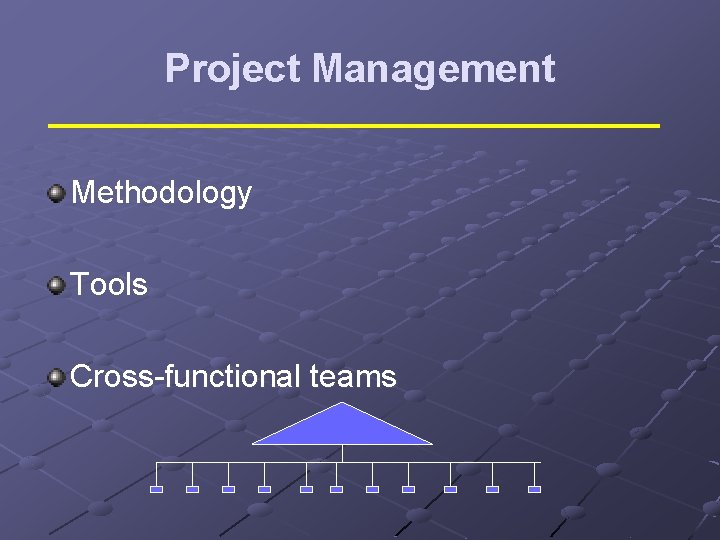
Project Management Methodology Tools Cross-functional teams
Needed IT Strategic Planning Linkages System University Budget Institutional entities IT unit level Teams Individual n n n Professional development Performance evaluation Assigned specified objectives Assessment/Metrics Reporting
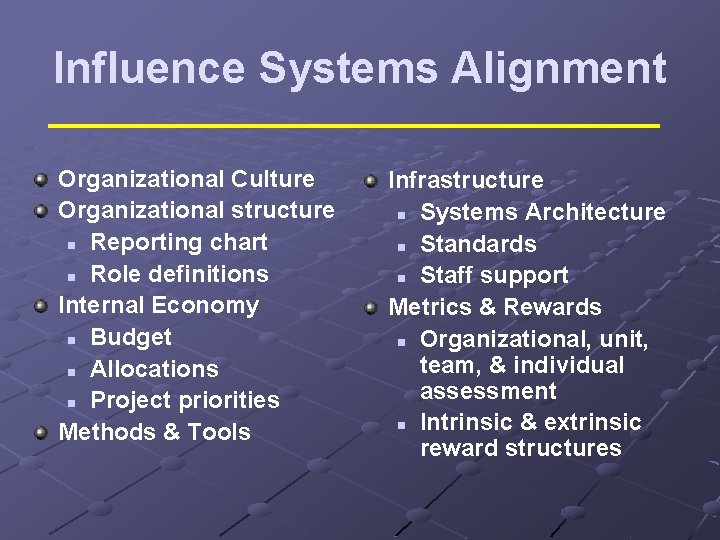
Influence Systems Alignment Organizational Culture Organizational structure n Reporting chart n Role definitions Internal Economy n Budget n Allocations n Project priorities Methods & Tools Infrastructure n Systems Architecture n Standards n Staff support Metrics & Rewards n Organizational, unit, team, & individual assessment n Intrinsic & extrinsic reward structures
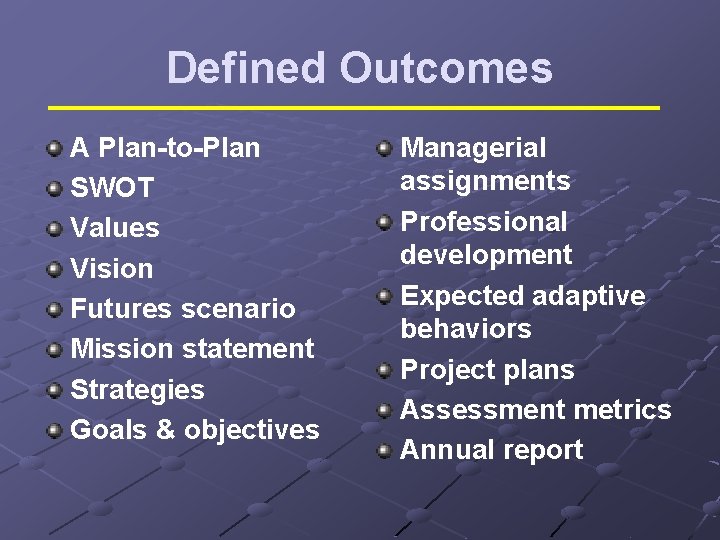
Defined Outcomes A Plan-to-Plan SWOT Values Vision Futures scenario Mission statement Strategies Goals & objectives Managerial assignments Professional development Expected adaptive behaviors Project plans Assessment metrics Annual report
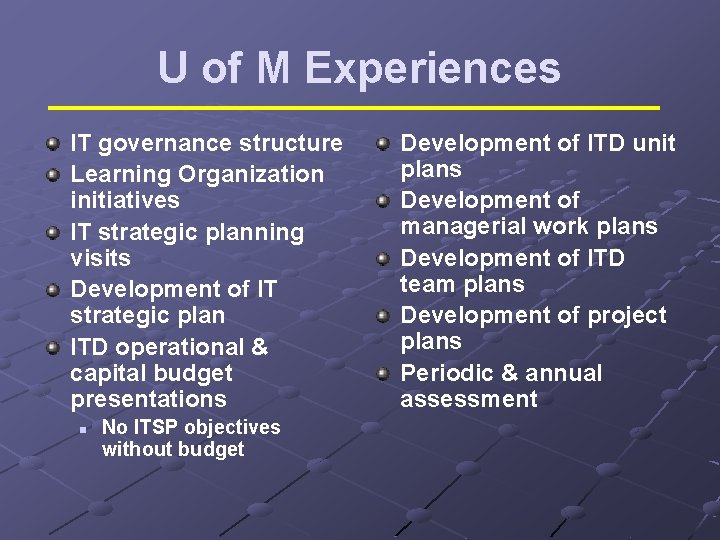
U of M Experiences IT governance structure Learning Organization initiatives IT strategic planning visits Development of IT strategic plan ITD operational & capital budget presentations n No ITSP objectives without budget Development of ITD unit plans Development of managerial work plans Development of ITD team plans Development of project plans Periodic & annual assessment
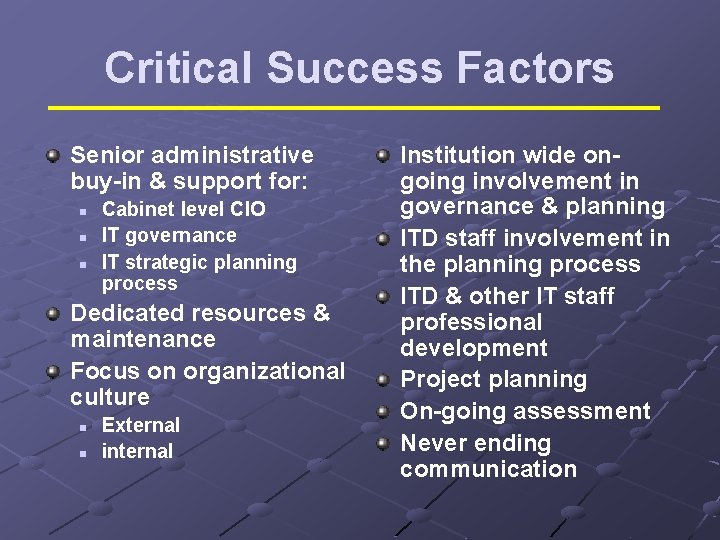
Critical Success Factors Senior administrative buy-in & support for: n n n Cabinet level CIO IT governance IT strategic planning process Dedicated resources & maintenance Focus on organizational culture n n External internal Institution wide ongoing involvement in governance & planning ITD staff involvement in the planning process ITD & other IT staff professional development Project planning On-going assessment Never ending communication
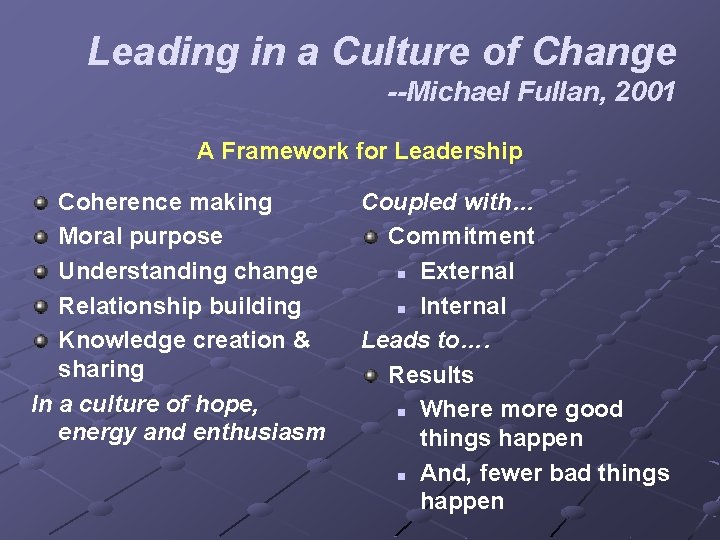
Leading in a Culture of Change --Michael Fullan, 2001 A Framework for Leadership Coherence making Moral purpose Understanding change Relationship building Knowledge creation & sharing In a culture of hope, energy and enthusiasm Coupled with… Commitment n External n Internal Leads to…. Results n Where more good things happen n And, fewer bad things happen
Questions?