
Alignment and calibration of the ZEUS Leading Proton
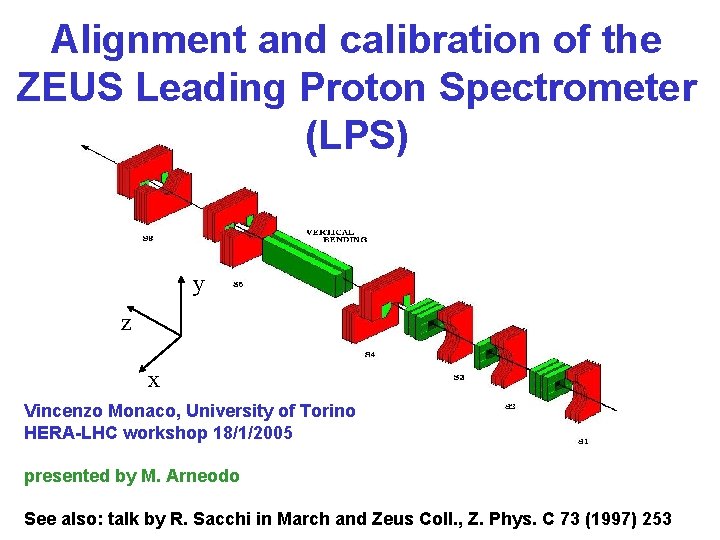
Alignment and calibration of the ZEUS Leading Proton Spectrometer (LPS) y z x Vincenzo Monaco, University of Torino HERA-LHC workshop 18/1/2005 presented by M. Arneodo See also: talk by R. Sacchi in March and Zeus Coll. , Z. Phys. C 73 (1997) 253
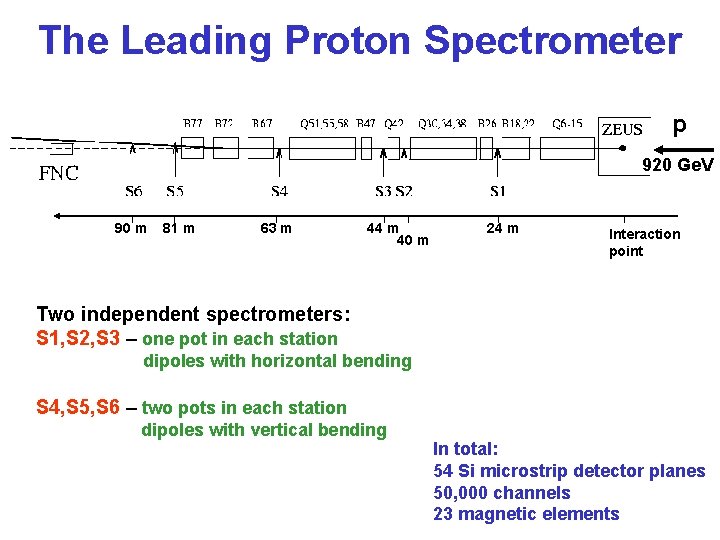
The Leading Proton Spectrometer p 920 Ge. V 90 m 81 m 63 m 44 m 40 m 24 m Interaction point Two independent spectrometers: S 1, S 2, S 3 – one pot in each station dipoles with horizontal bending S 4, S 5, S 6 – two pots in each station dipoles with vertical bending In total: 54 Si microstrip detector planes 50, 000 channels 23 magnetic elements
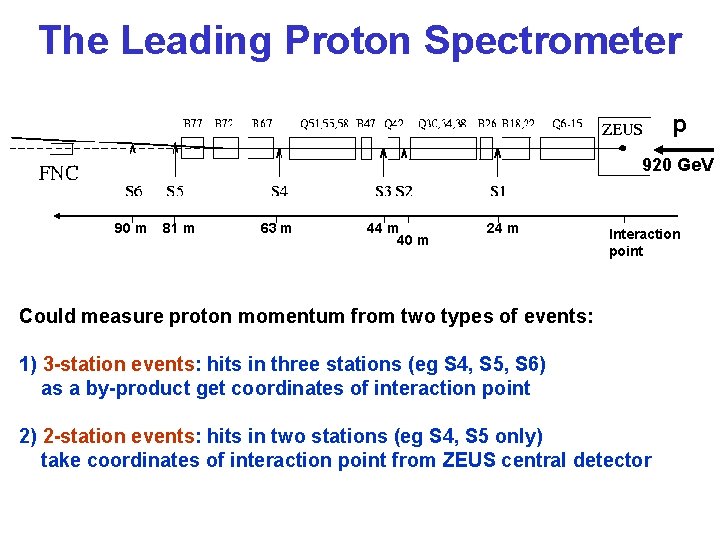
The Leading Proton Spectrometer p 920 Ge. V 90 m 81 m 63 m 44 m 40 m 24 m Interaction point Could measure proton momentum from two types of events: 1) 3 -station events: hits in three stations (eg S 4, S 5, S 6) as a by-product get coordinates of interaction point 2) 2 -station events: hits in two stations (eg S 4, S 5 only) take coordinates of interaction point from ZEUS central detector
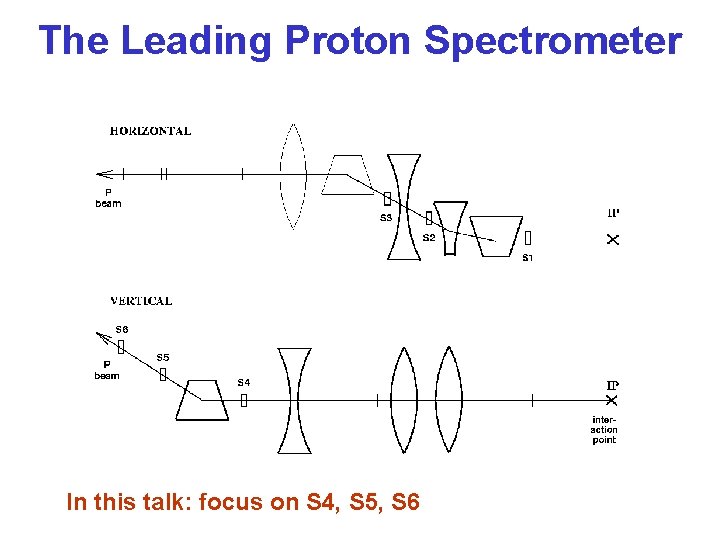
The Leading Proton Spectrometer In this talk: focus on S 4, S 5, S 6
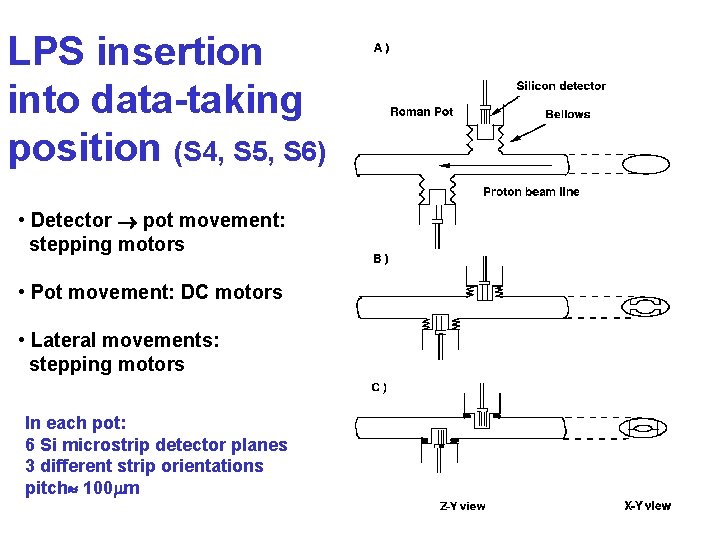
LPS insertion into data-taking position (S 4, S 5, S 6) • Detector pot movement: stepping motors • Pot movement: DC motors • Lateral movements: stepping motors In each pot: 6 Si microstrip detector planes 3 different strip orientations pitch 100 mm
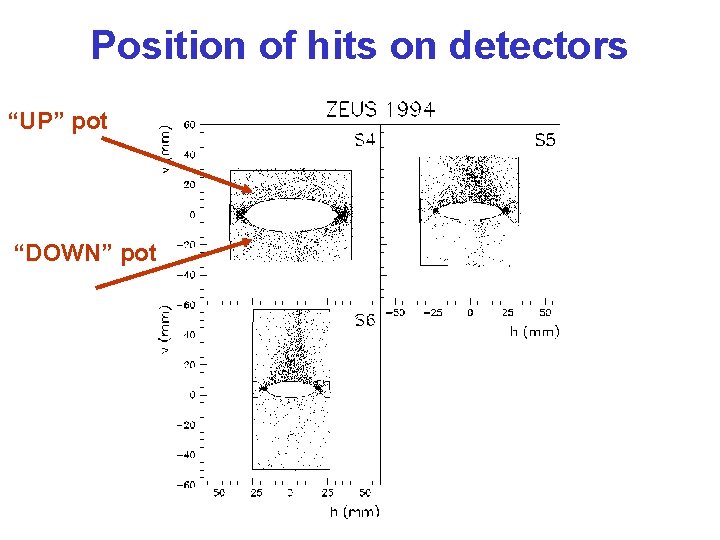
Position of hits on detectors “UP” pot “DOWN” pot
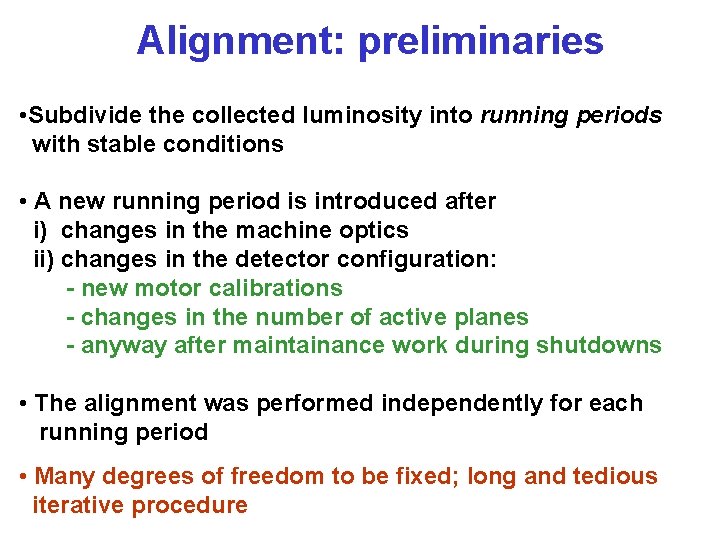
Alignment: preliminaries • Subdivide the collected luminosity into running periods with stable conditions • A new running period is introduced after i) changes in the machine optics ii) changes in the detector configuration: - new motor calibrations - changes in the number of active planes - anyway after maintainance work during shutdowns • The alignment was performed independently for each running period • Many degrees of freedom to be fixed; long and tedious iterative procedure
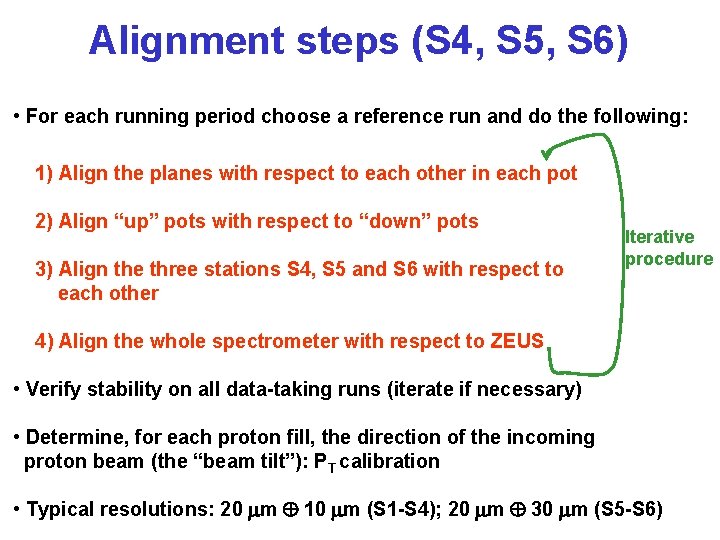
Alignment steps (S 4, S 5, S 6) • For each running period choose a reference run and do the following: 1) Align the planes with respect to each other in each pot 2) Align “up” pots with respect to “down” pots 3) Align the three stations S 4, S 5 and S 6 with respect to each other Iterative procedure 4) Align the whole spectrometer with respect to ZEUS • Verify stability on all data-taking runs (iterate if necessary) • Determine, for each proton fill, the direction of the incoming proton beam (the “beam tilt”): PT calibration • Typical resolutions: 20 mm 10 mm (S 1 -S 4); 20 mm 30 mm (S 5 -S 6)

Physics channels • Key to any alignment: use tracks whose trajectory is known a priori • Since protons move in magnetic fields (which cannot be turned off !), need tracks of known momentum • Exploit the fact that diffractive cross section peaks at x. L=p’/p=1 • Select processes using central detector and then look at proton in LPS • Peak narrow ! For ep e 0 p, expected x. L width = 10 -4 e e p+ pp p e, p+ , p- measured in central detector
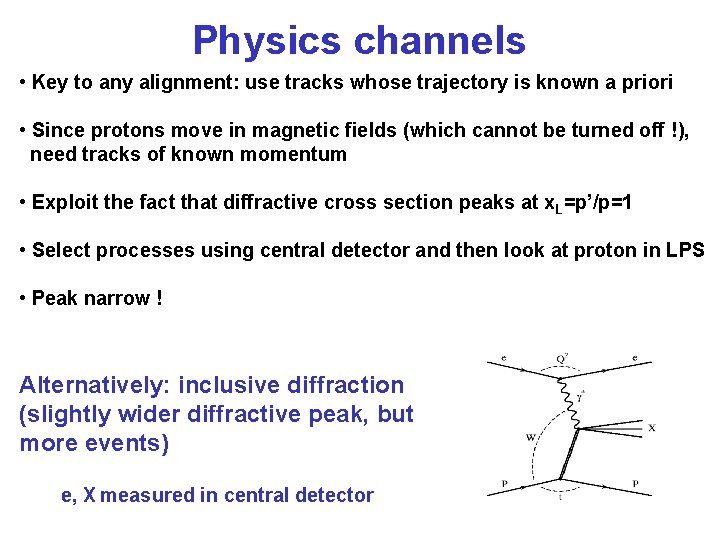
Physics channels • Key to any alignment: use tracks whose trajectory is known a priori • Since protons move in magnetic fields (which cannot be turned off !), need tracks of known momentum • Exploit the fact that diffractive cross section peaks at x. L=p’/p=1 • Select processes using central detector and then look at proton in LPS • Peak narrow ! Alternatively: inclusive diffraction (slightly wider diffractive peak, but more events) e, X measured in central detector
1) Align planes within each pot • Track impact point in pot determined using planes with two different orientations • Compare with the other planes • Residuals in the other planes are minimized by translating the planes in the x/y plane and rotating them around the z-axis • The procedure is iterated on all planes The procedure is cross-checked by looking at the residuals of the hits in each plane with respect to the track fitted through the entire spectrometer.
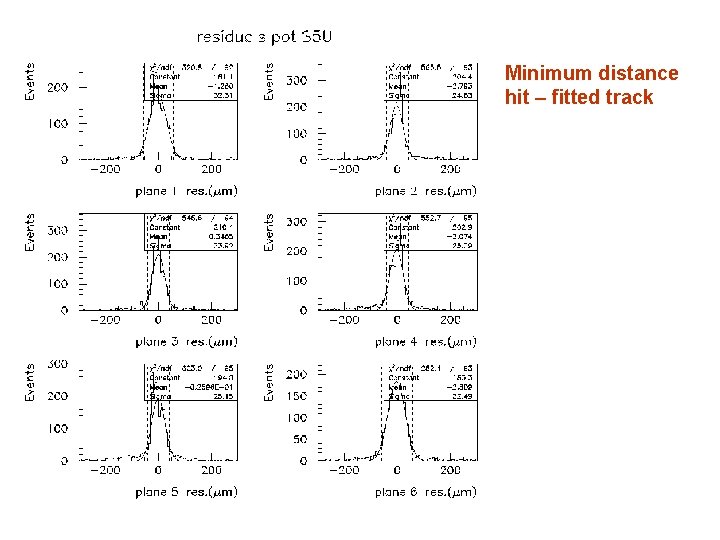
Minimum distance hit – fitted track
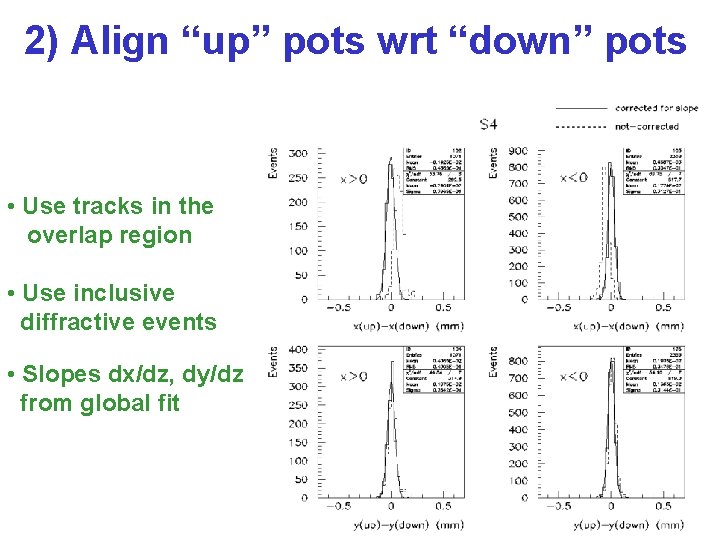
2) Align “up” pots wrt “down” pots • Use tracks in the overlap region • Use inclusive diffractive events • Slopes dx/dz, dy/dz from global fit
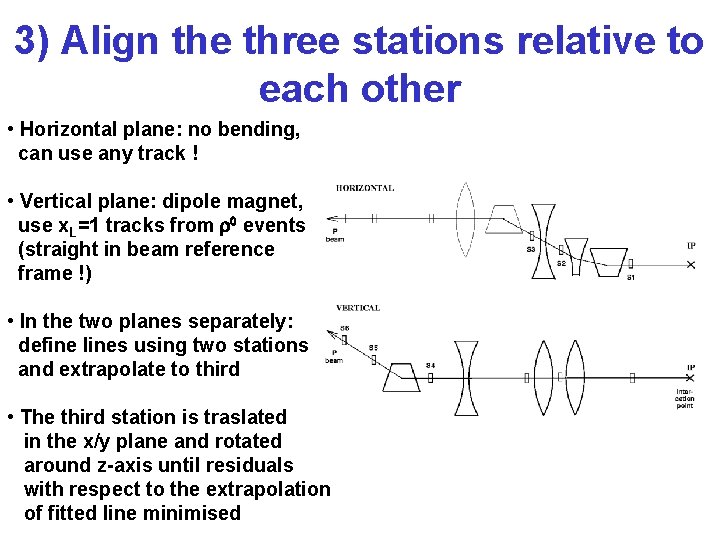
3) Align the three stations relative to each other • Horizontal plane: no bending, can use any track ! • Vertical plane: dipole magnet, use x. L=1 tracks from 0 events (straight in beam reference frame !) • In the two planes separately: define lines using two stations and extrapolate to third • The third station is traslated in the x/y plane and rotated around z-axis until residuals with respect to the extrapolation of fitted line minimised
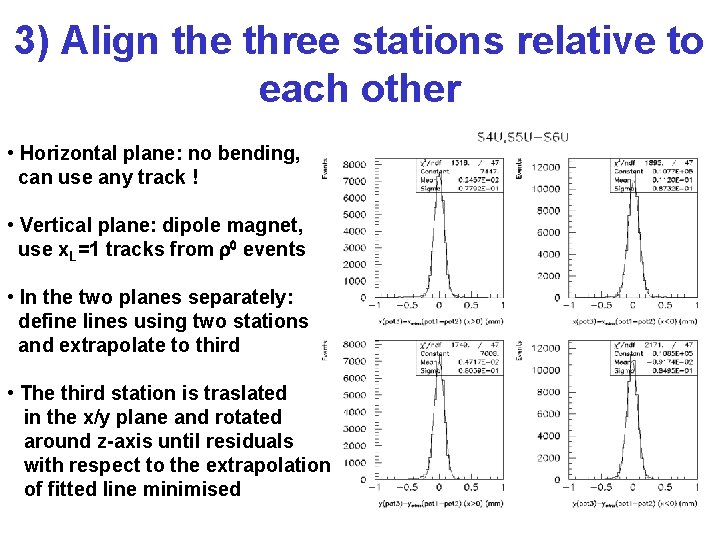
3) Align the three stations relative to each other • Horizontal plane: no bending, can use any track ! • Vertical plane: dipole magnet, use x. L=1 tracks from 0 events • In the two planes separately: define lines using two stations and extrapolate to third • The third station is traslated in the x/y plane and rotated around z-axis until residuals with respect to the extrapolation of fitted line minimised
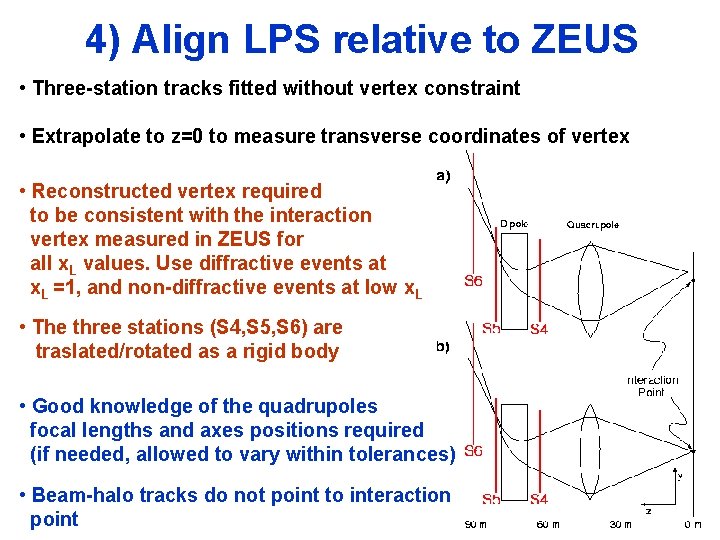
4) Align LPS relative to ZEUS • Three-station tracks fitted without vertex constraint • Extrapolate to z=0 to measure transverse coordinates of vertex • Reconstructed vertex required to be consistent with the interaction vertex measured in ZEUS for all x. L values. Use diffractive events at x. L =1, and non-diffractive events at low x. L • The three stations (S 4, S 5, S 6) are traslated/rotated as a rigid body • Good knowledge of the quadrupoles focal lengths and axes positions required (if needed, allowed to vary within tolerances) • Beam-halo tracks do not point to interaction point
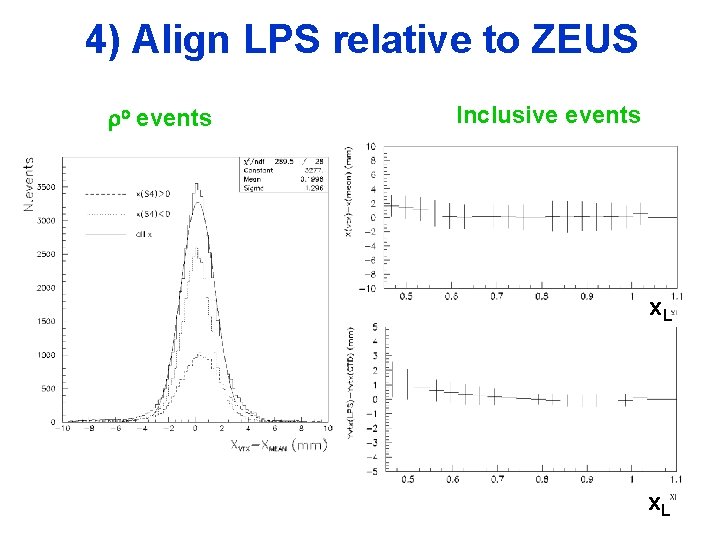
4) Align LPS relative to ZEUS o events Inclusive events x. L
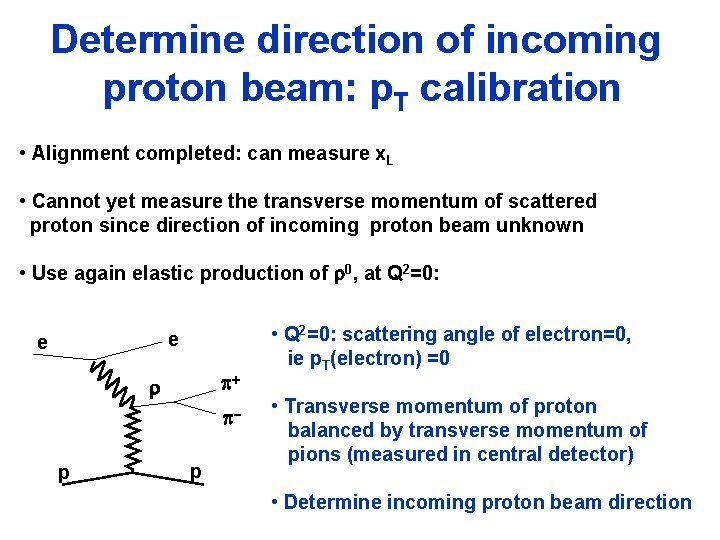
Determine direction of incoming proton beam: p. T calibration • Alignment completed: can measure x. L • Cannot yet measure the transverse momentum of scattered proton since direction of incoming proton beam unknown • Use again elastic production of 0, at Q 2=0: e e p+ pp p • Q 2=0: scattering angle of electron=0, ie p. T(electron) =0 • Transverse momentum of proton balanced by transverse momentum of pions (measured in central detector) • Determine incoming proton beam direction
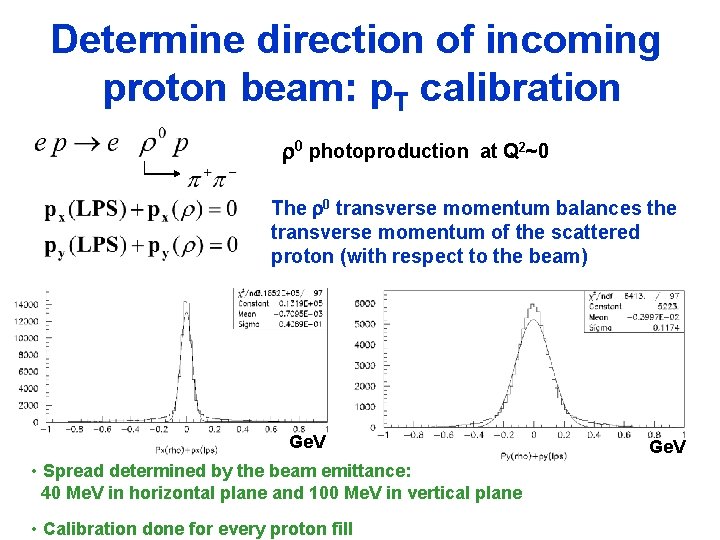
Determine direction of incoming proton beam: p. T calibration 0 photoproduction at Q 2~0 The 0 transverse momentum balances the transverse momentum of the scattered proton (with respect to the beam) Ge. V • Spread determined by the beam emittance: 40 Me. V in horizontal plane and 100 Me. V in vertical plane • Calibration done for every proton fill Ge. V
Systematic checks • Check residuals vs run number • Position and width of the x. L=1 peak -- stability vs run number • 2 independent of x. L and p. T • Check • … position of the beam pipe apertures
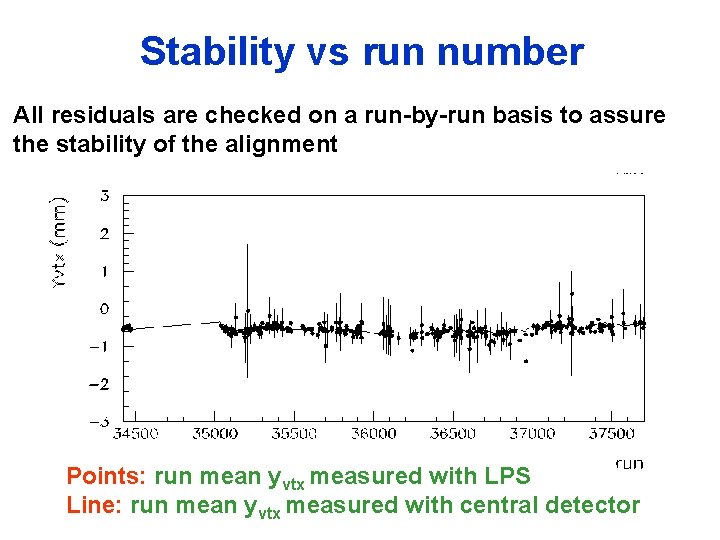
Stability vs run number All residuals are checked on a run-by-run basis to assure the stability of the alignment Points: run mean yvtx measured with LPS Line: run mean yvtx measured with central detector
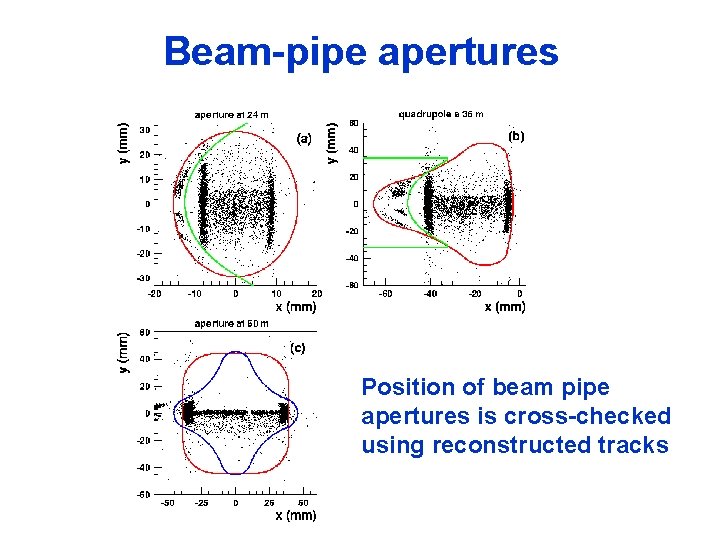
Beam-pipe apertures Position of beam pipe apertures is cross-checked using reconstructed tracks
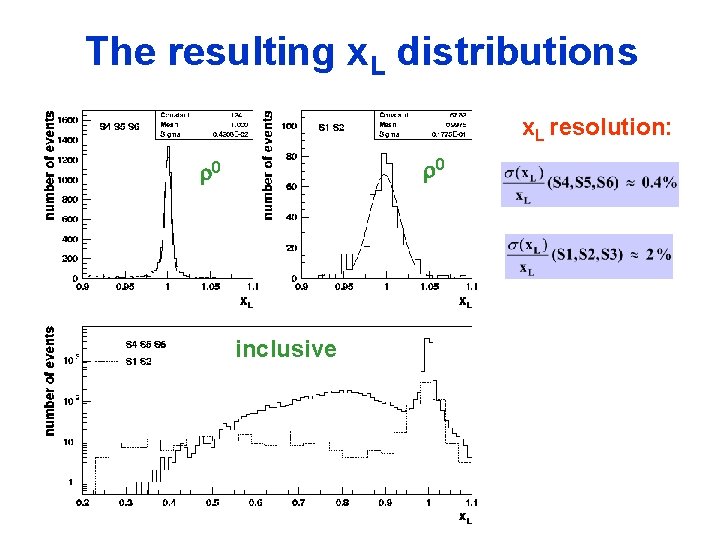
The resulting x. L distributions x. L resolution: 0 0 inclusive
Conclusions • Alignment of LPS was the most difficult, time-consuming and tedious part of the analysis. Not a job for a student. • Critical to have a reaction which produced plenty of nearly monochromatic protons with a priori known trajectory in the LPS • Survey results useless • HERA Beam Position Monitors also useless for alignment – but very good to monitor relative changes of beam orbit • It pays to have data-taking conditions as stable as possible: detectors always in the same position, stable beam tilt etc
- Slides: 24