
Aligning Deep Neural Networks and Visual Cortex This
- Slides: 1
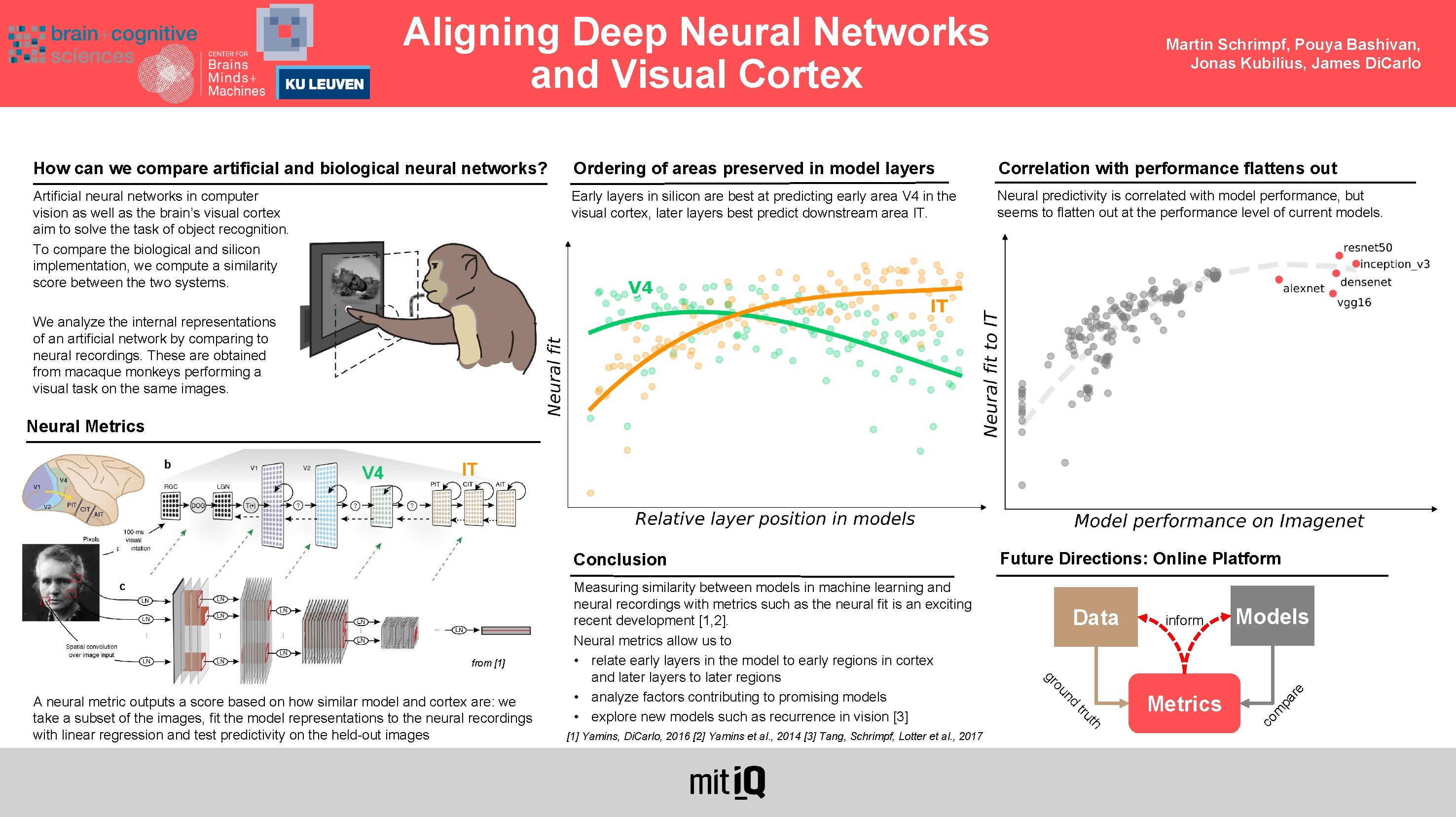
Aligning Deep Neural Networks and Visual Cortex This is a caption for the example and it may be this long or longer Martin Schrimpf, Pouya Bashivan, Jonas Kubilius, James Di. Carlo How can we compare artificial and biological neural networks? Ordering of areas preserved in model layers Correlation with performance flattens out Artificial neural networks in computer vision as well as the brain’s visual cortex aim to solve the task of object recognition. To compare the biological and silicon implementation, we compute a similarity score between the two systems. Early layers in silicon are best at predicting early area V 4 in the visual cortex, later layers best predict downstream area IT. Neural predictivity is correlated with model performance, but seems to flatten out at the performance level of current models. Conclusion Future Directions: Online Platform We analyze the internal representations of an artificial network by comparing to neural recordings. These are obtained from macaque monkeys performing a visual task on the same images. Neural Metrics IT Models th tru Metrics re nd ou [1] Yamins, Di. Carlo, 2016 [2] Yamins et al. , 2014 [3] Tang, Schrimpf, Lotter et al. , 2017 inform gr A neural metric outputs a score based on how similar model and cortex are: we take a subset of the images, fit the model representations to the neural recordings with linear regression and test predictivity on the held-out images Data m pa from [1] Measuring similarity between models in machine learning and neural recordings with metrics such as the neural fit is an exciting recent development [1, 2]. Neural metrics allow us to • relate early layers in the model to early regions in cortex and later layers to later regions • analyze factors contributing to promising models • explore new models such as recurrence in vision [3] co V 4