
Alienation in the Process of Teaching and Learning












- Slides: 28
Alienation in the Process of Teaching and Learning English in Indonesia Suryanto English Education Department Universitas Muhammadiyah Yogyakarta Presented International TESOL Conference, University of Mataram, Lombok, Indonesia 11 -23 August 2016
Alienation • Loneliness • Separation
Aim of this study • To study on the existence of alienation • To investigate the ways of teachers to cope with such a condition in the English teaching and learning process
Literature Reviews Students’ alienation is commonly described in terms of five specific dimensions: • powerlessness, • meaninglessness, • normlessness, • isolation, • and self-estrangement (Brown, Higgins, & Paulsen, 2003; Hoy, 1971; Keating, 1987; Roberts, 1987; Seeman, 1959)
Powerlessness • Powerlessness refers to the students’ inability to control their own power toward the matters they encounter at school. • An example of student powerlessness is when the student complains about the process of teaching and learning, and find that their complaints are unheard or not responded to. (Brown, et al. , 2003).
Meaninglessness • students’ inability to make sense of the meaning of class activities for their advantage(Brown, et al. , 2003). • Students experience meaninglessness when they see no reason for taking a class in school. • Here, students may sense that the world is not understandable to them (Roberts, 1987). • To eliminate meaninglessness, students should be educated on the importance of every skill and piece of knowledge that they acquire in school (Keating, 1987)
Normlessness • Normlessness refers to the circumstance whereby rules and regulations used to control behavior and conduct do not effectively take place (O'Donnell, Schwab-Stone, & Ruchkin, 2006). • An example of this dimension is students who cheat in examinations in order to obtain rewards from parents or others, by finding ways outside of norms practiced by the educational institutions (Brown, et al. , 2003). • In other words, a normlessness condition in school may refer to the state where students achieve their own objectives using any means, such as breaking the rules or passing over their own personal responsibility (Roberts, 1987).
Isolation • The isolation dimension may refer to the condition where students do not internalize the school goals as part of their own study objectives (Hoy, 1971). • Such a refusal detaches the student from others, decreasing their common responsiveness and losing their interest in important class activities (O'Donnell, et al. , 2006). • This problem may be solved by increasing social integration in the classroom through group projects, class discussion and other group activities (Keating, 1987)
self-estrangement • . A student’s self-estrangement refers principally to their failure to discover self-rewarding activities (Seeman, 1959). • In this case, students may lose their basic fulfillment toward study in school (Keating, 1987). • Students suffer from loneliness and frequently want to drop out of school (Brown, et al. , 2003). • Loneliness may be due to shyness on the student’s part (Myers, 2010). • Thus, shyness may cause loneliness, and loneliness is an aspect of self-estrangement that may be felt by students.
Alienation in the process of English language teaching and learning comprises a parting relationship that embodies: • emotional detachment between the students and teachers • resulting in students’ tension and frustration (Johnson, 1973; Murray & Zvoch, 2011).
Characteristics of alienated students in literatures • Firstly, the alienated students are quiet and passive. • Secondly, alienated students are defensive and sensitive toward other people’s feelings. • Thirdly, alienated students usually do not admit that they are alienated. • Fourthly, the more students confront their alienation, the better they cope with problems. • Fifthly, the alienated students do not like to stay long in the classroom. • Lastly, the alienated students feel that they prefer to be involved in art and sporting activities (Joo and Han, 2000)
Methodology • This study employs a mixed methods approach • combining interviews from the qualitative side and survey research on the quantitative side • Ten teachers and twenty students participated in interviews to gather the qualitative data, • 250 students took part in the questionnaire surveys to obtain the quantitative data.
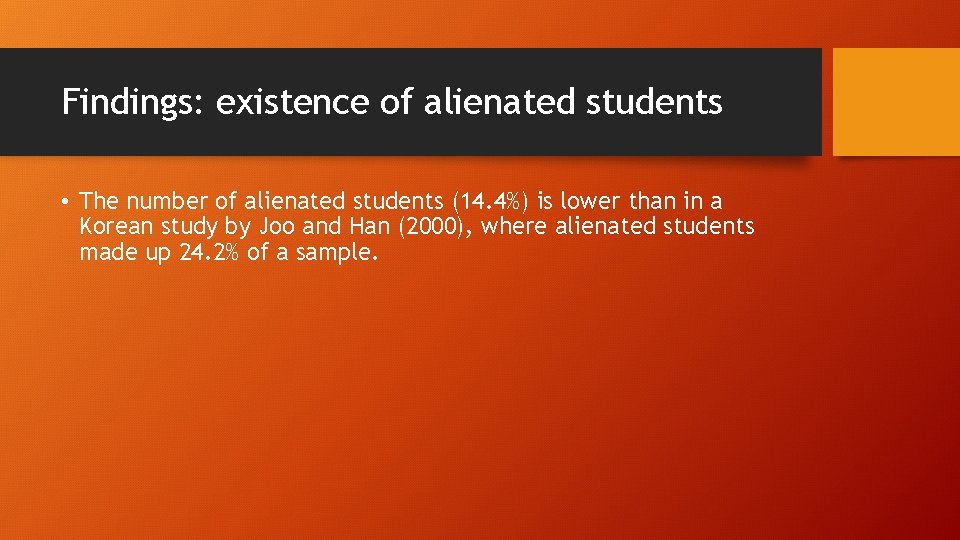
Findings: existence of alienated students • The number of alienated students (14. 4%) is lower than in a Korean study by Joo and Han (2000), where alienated students made up 24. 2% of a sample.
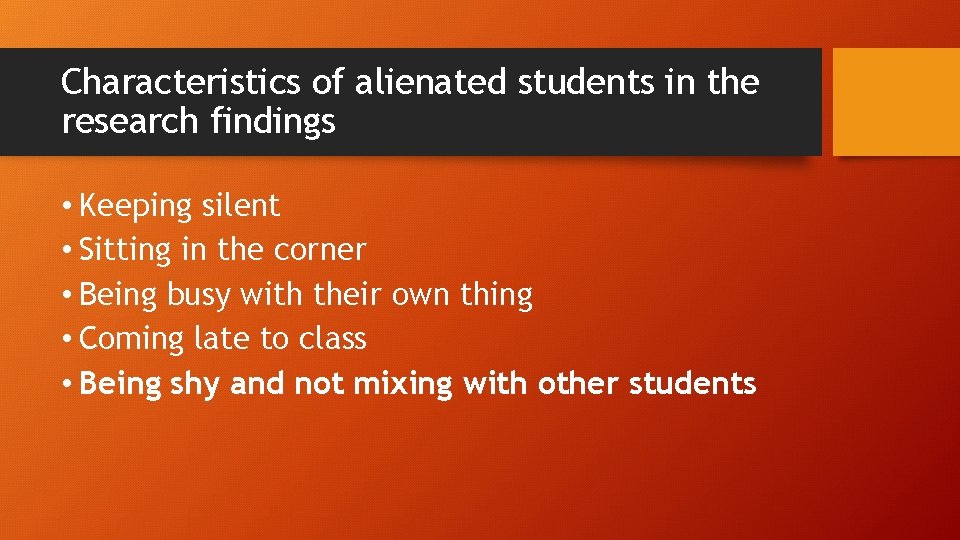
Characteristics of alienated students in the research findings • Keeping silent • Sitting in the corner • Being busy with their own thing • Coming late to class • Being shy and not mixing with other students
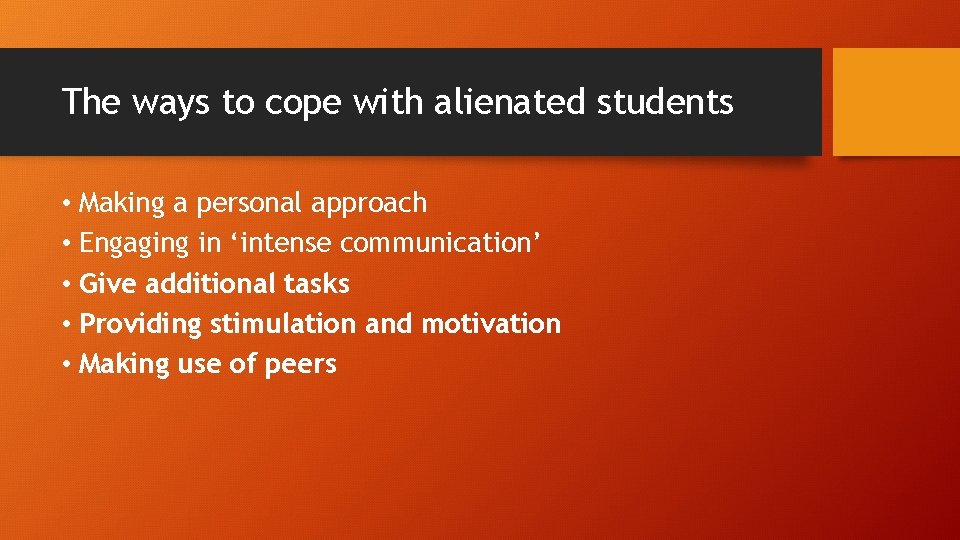
The ways to cope with alienated students • Making a personal approach • Engaging in ‘intense communication’ • Give additional tasks • Providing stimulation and motivation • Making use of peers
References • APA. (2010). Publication Manual of the American Psychological Association, 6 th Edition. Washington, DC: American Psychological Association. • Bowlby, J. (1969). Attachment and loss: Vol. 1. Attachment. New York: Basic Books. • Bowlby, J. (1973). Attachment and loss: Vol. 2. Separation: Anxiety and anger. New York: Basic Books. • Bowlby, J. (1980). Attachment and loss: Vol. 3 Loss: Sadness and depression. New York: Basic Books. • Bradford, A. (2007). Motivational Orientations in Under-researched FLL Contexts: Findings from Indonesia. RELC Journal, 38(3), 302 -323. doi: 10. 1177/0033688207085849 • Brown, M. R. , Higgins, K. , & Paulsen, K. (2003). Adolescent alienation: What is it and what can educators do about it? Intervention in School and Clinic, 39(1), 3 -9. • Bryk, A. S. , & Schneider, B. (2003). Trust in schools: A core resource for school reform. Educational leadership, 60(6), 40 -44. • Cohen, J. (1992). A power primer. (power analysis) (Quantitative Methods in Psychology). Psychological bulletin, 112(1), 155. • Cole, M. (1998). Cognitive Development and Formal Schooling: The Evidence from Cross-Cultural Research. In D. Faulkner, K. Littleton & M. woodhead (Eds. ), Learning Relationship in the Classroom (pp. 31 -53). London: Routledge. • Colquitt, J. , Scott, B. A. , & Le. Pine, J. A. (2007). Trust, Trustworthiness, and Trust Propensity. Journal of applied psychology, 92(4), 909 -927. • Communication. (2012). In Oxford Dictionary Online Retrieved from http: //oxforddictionaries. com/definition/english/communication? q=communication
• Connell, J. P. , & Wellborn, J. G. (1991). Competence, autonomy, and relatedness: A motivational analysis of self-system processes. In M. R. G. L. A. Sroufe (Ed. ), Self processes and development (pp. 43 -77). Hillsdale, NJ, England: Lawrence Erlbaum Associates, Inc. • Conran, P. (1989). School Superintendents' Complete Handbook. New Jersey: Prentice Hall. • Cornelius-White, J. (2007). Learner-Centered Teacher-Student Relationships Are Effective: A Meta-Analysis. Review of Educational Research, 77(1), 113 -143. doi: 10. 1037/0022 -0663. 85. 4. 5711994 -15490 -00110. 1037/0022 -0663. 85. 4. 571 • Creswell, J. W. (2012). Educational Research: Planning, Conducting, and Evaluating Quantitative and Qualitative Research. Boston: Pearson Education, Inc. • Dardjowidjojo, S. (2000). English teaching in Indonesia. EA Journal, 18(1), 22 -30. • Dardjowidjojo, S. ( 2003). Rampai Bahasa, Pendidikan, dan Budaya. Jakarta: Yayasan Obor • Ellis, P. D. (2010). The Essential Guide to Effect Sizes: Statistical Power, Meta-Analysis, and the Interpretation of Research Results. Cambridge: Cambridge University Press. • Emmert, P. , & Donaghy, W. C. (1981). Human Communication: Element and Context. Massachusetts: Addison-Wesley Publishing Company, Inc. • Evans, G. W. , & Johnson, D. (2000). Stress and Open-Office Noise. Journal of applied psychology, 85(5), 779 -783. • Exley, B. (2005). Learner Characteristics of ‘Asian’ EFL Students: Exceptions to the ‘Norm’. Proceedings Pleasure Passion Provocation. Joint National Conference AATE & ALEA 2005, 1 -16. • Fang, F. (2010). A Discussion on Developing Students' Communicative Competence in College English Teaching in China. Journal of Language Teaching and Research, 1(2), 111 -116.
• Hamre, B. K. , & Pianta, R. C. (2005). Can Instructional and Emotional Support in the First-Grade Classroom Make a Difference for Children at Risk of School Failure? Child Development, 76(5), 949 -967. doi: 10. 1111/j. 1467 -8624. 2005. 00889. x • Hardin, R. (1996). Trustworthiness. Ethics, 107(1), 26 -42. • Hardin, R. (2006). Trust. Cambridge: Polity Press. • Harmer, J. (1995). Taming the big ‘I’: teacher performance and student satisfaction. ELT Journal, 49(4), 337 -345. doi: 10. 1093/elt/49. 4. 337 • Harvey-Jordan, S. , & Long, S. (2001). The process and the pitfall of semi-structured interviews. Community practitioner, 74(6), 219 -221. • Hassini, E. (2006). Student–instructor communication: The role of email. Computers & Education, 47(1), 29 -40. doi: 10. 1016/j. compedu. 2004. 08. 014 • Helman, L. (2009). Literacy Development with English Learners: Concluding Thoughts. In L. Helman (Ed. ), Literacy Development with English Learners: Research-Based Instruction in Grade K-6 (pp. 252 -260). New York: The Guilford Press. • Henjum, A. (1982). Introversion: A misunderstood 'individual difference' among students. Educational and psychological measurement, 103, 39 -43. • Hofstede, G. , Hofstede, G. J. , & Minkov, M. (2010). Cultures and Organisations: Software of the Mind. New York: Mc. Graw Hill. • Horst, M. , White, J. , & Bell, P. (2010). First and second language knowledge in the language classroom. International Journal of Bilingualism, 14(3), 331 -349. doi: 10. 1177/1367006910367848 • Hoy, W. K. (1971). An Investigation of the Relationships between Characteristics of Secondary Schools and Student Alienation. Washington: U. S. Department of Health, Education, and Welfare.
• Huang, Y. (2011). Identity Negotiation in Relation to Context of Communication. Theory and Practice in Language Studies, 1(3), 219 -225. • Johnson, F. (1973). Alienations: Concept, Term, and Meanings. In F. Johnson (Ed. ), Alienations: Concept, Term, and Meanings (pp. 26 -53). New York: Seminar Press. • Johnson, R. B. , Onwuegbuzie, A. J. , & Turner, L. A. ( 2007 ). Toward a Definition of Mixed Methods Research. Journal of Mixed Methods Research, 1( 2), 112 -133. • Joo, E. , & Han, B. (2000). An Investigation of the Characteristics of "Classroom Alienated" Middle School Students in Korea. Asia Pacific Education Review, 1(1), 123 -128. • patrick, A. (2007). Teaching English across cultures : what do English language teachers need to know how to teach English. EA Journal, 23(2), 20 -36. • Klofstad, C. A. (2005). Interviews. In K. -L. Editor-in-Chief: Kimberly (Ed. ), Encyclopedia of Social Measurement (pp. 359 -363). New York: Elsevier. • Kokkinos, C. M. , Charalambous, K. , & Davazoglou, A. (2009). Interpersonal Teacher Behaviour in Primary School Classrooms: A Cross-Cultural Validation of a Greek Translation of the Questionnaire on Teacher Interaction. Learning environments research, 12(2), 101. • Koomen, H. M. Y. , Verschueren, K. , van Schooten, E. , Jak, S. , & Pianta, R. C. (2012). Validating the Student-Teacher Relationship Scale: Testing factor structure and measurement invariance across child gender and age in a Dutch sample. Journal of school psychology, 50(2), 215 -234. doi: http: //dx. doi. org/10. 1016/j. jsp. 2011. 09. 001 • Krashen, S. D. (1981). Second Language Acquisition and Second Language Learning. New York: Pergamon Press Inc.
• Laksmi, A. (2010, Setember 23). Jangan bangga jadi guru "Killer" (Don't be proud to be a killer teacher), Education, Kompas. Retrieved from http: //edukasi. kompas. com/read/2010/09/23/17080441/Jangan. Bangga. Jadi. Guru. Killer • Lasswell, H. D. (1948). The structure and function of communication in society. In L. Bryson (Ed. ), The communication of Ideas (pp. 37– 51). New York: Harper & Row. • Lawson, M. J. , & Askell-Williams, H. (2012). Framing the Features of Good-Quality Knowledge for Teachers and Students. In J. R. Kirby & M. J. Lawson (Eds. ), Enhancing the Quality of learning (pp. 137 -159). Cambrigde: Cambridge University Press. • Lawson, M. J. , & Kirby, J. R. (2012). Introduction. In J. R. Kirby & M. J. Lawson (Eds. ), Enhancing the Quality of Learning: Dispositions, Instruction, and Learning Process (pp. 1 -11). Cambrigde: Cambridge University Press. • Lee, N. , & Lings, I. (2008). Doing Business Research: A Guide to Theory and Practice. London: Sage Publications. • Lee, S. , Fraser, B. J. , & Fisher, D. L. (2003). Teacher -Student Interactions in Korean High School Science Classrooms. International Journal of Science and Mathematical Education, 1(1), 67 -85. • Lengkanawati, N. S. (2004). How learners from different cultural backgrounds learn a foreign language. Asian EFL Journal, 6(1). • Levine, G. S. (2003). Student and Instructor Beliefs and Attitudes about Target Language Use, First Language Use, and Anxiety: Report of a Questionnaire Study. The Modern Language Journal, 87(3), 343 -364.
• Levy, J. , Créton, H. , & Wubbels, T. (1993). Perceptions of Interpersonal Teacher Behavior. In T. Wubbels & J. Levy (Eds. ), Do You Know What You Look Like? Interpersonal Relationship in Education (pp. 26 -40). Washington: The Falmer Press. • Lie, A. (2004). Pengajaran bahasa asing: Antara sekolah dan kursus. Retrieved from http: //www. kompas. com/kompas-cetak/0407/08/Pend. IN/1129942. htm • Lincoln, Y. S. , & Guba, E. G. (1985). Naturalistic Inquiry. London: Sage Publications Ltd. • Littejohn, S. W. , & Foss, K. A. (2008). Theories of Human Communication, Nith Edition. Belmont, CA: Thomson Wadsworth. • Lorenz, K. Z. (1950). The comparative method in studying innate behavior patterns Physiological mechanisms in animal behavior. (Society's Symposium IV. ) (pp. 221 -268). Oxford, England: Academic Press. • Lynch, T. (1996). Communication in the Language Classroom. Oxford: Oxford University Press. • Mac. Intyre, P. D. , & Charos, C. (1996). Personality, Attitudes, and Affect as Predictors of Second Language Communication. Journal of Language and Social Psychology, 15(1), 3 -26. doi: 10. 1177/0261927 x 960151001 • Maddi, S. R. , Hoover, M. , & Kobasa, S. C. (1982). Alienation and Exploratory Behavior. Journal of Personality and Social Psychology, 42(5), 884 -890. • Mahmud, M. (2010). Language and Gender in English Language Teaching. TEFLIN Journal, 21(2), 172 -185. • Manke, M. P. (1997). Classroom Power Relations: Understanding Student-Teacher Interaction. New Jersey: Lawrence Erlbaum Associates, Publishers. • Marcellino, M. (2008). English Language Teaching in Indonesia: A Continous Challenge in Education and Cultural Diversity. TEFLIN Journal, 19(1), 57 -69. • Marks, H. M. (2000). Student engagement in instructional activity: Patterns in the elementary, middle, and high school years. American Educational Research Journal, 37, 153 -184
• Marsh, C. (2008). Becoming a Teacher: Knowledge, Skill, and Issues. Frenchs Forests, New South Wales: Pearson Education Australia. • Murray, C. , & Zvoch, K. (2011). The Inventory of Teacher-Student Relationships: Factor Structure, Reliability, and Validity among African American Youth in Low-Income Urban Schools. The Journal of early adolescence, 31(4), 493 -525. • Myers, D. G. (2010). Social Psychology. New York: The Mc. Graw-Hill Companies, Inc. • Pianta, R. C. (2001). Student-Teacher Relationship Scale: Professional Manual. Lutz FL: Psychological Assessment Resources. • Pianta, R. C. , Hamre, B. , & Stuhlman, M. (2003). Relationships Between Teachers and Children Handbook of Psychology: John Wiley & Sons, Inc. • Pianta, R. C. , & Nimetz, S. L. (1991). Relationships between children and teachers: Associations with classroom and home behavior. Journal of Applied Developmental Psychology, 12(3), 379 -393. • Pianta, R. C. , Nimetz, S. L. , & Bennett, E. (1997). Mother-child relationships, teacher-child relationships, and school outcomes in preschool and kindergarten. Early Childhood Research Quarterly, 12(3), 263 -280. • Pianta, R. C. , & Stuhlman, M. W. (2004). Teacher-child relationships and children's success in the first years of school. School Psychology Review, 33(3), 444 -458. • Rapley, T. , & Jenkings, K. N. (2010). Document Analysis. In P. Editors-in-Chief: Penelope, B. Eva, E. B. Barry Mc. Gaw. A 2 - Editors-in. Chief: Penelope Peterson & M. Barry (Eds. ), International Encyclopedia of Education (Third Edition) (pp. 380 -385). Oxford: Elsevier. • Rayce, S. L. B. , Holstein, B. E. , & Kreiner, S. (2009). Aspects of alienation and symptom load among adolescents. European Journal of Public Health, 19(1), 79 -84. • Roorda, D. L. , Koomen, H. M. Y. , Spilt, J. L. , & Oort, F. J. (2011). The Influence of Affective Teacher–Student Relationships on Students’ School Engagement and Achievement: A Meta-Analytic Approach. Review of Educational Research, 81(4), 493 -529. doi: 10. 3102/0034654311421793
• Rowe, A. (2011). The personal dimension in teaching: why students value feedback. The International Journal of Educational Management, 25(4), 343 -360. doi: 10. 1177/1028315307299699 • Saldana, J. (2009). The Coding Manual for Qualitative Researchers. London: Sage Publications Ltd. • Sampson, H. (2004). Navigating the waves: the usefulness of a pilot in qualitative research. Qualitative Research, 4(3), 383 -402. doi: 10. 1177/1468794104047236 • Sandelowski, M. (1995). Sample size in qualitative research. Research in Nursing & Health, 18(2), 179 -183. doi: 10. 1002/nur. 4770180211 • Sawir, E. (2005). Language difficulties of international students in Australia: The effects of prior learning experience. International Educational Journal, 6(5), 567 -580. • Scovel, T. (1978). The effect of affect on foreign language learning: A review of the anxiety research. Language Learning, 28, 129 -142. • Seeman, M. (1959). On The Meaning of Alienation. American sociological review, 24(6), 783 -791. • Shannon, C. (1948). A Mathematical Theory of Communication. The Bell System Technical Journal, 27(3), 379 -423. • Shannon, C. , & Weaver, W. (1949). The Mathematical Theory of Communication. Champaign: University of Illinois Press. • Shaver, P. R. , & Mikulincer, M. (2010). New directions in attachment theory and research. Journal of social and personal relationships, 27(2), 163172. • Shicmidt, R. , Boraie, D. , & Kassabgy, O. n. (1996). Foreign Language Motivation: Internal Structure and External Connection. In R. Oxford (Ed. ), Language Learning Motivation: Pathways to the New Century. Honolulu: University of Hawai"i, Second Language Teaching & Curriculum Center.
• Silverman, D. (2011). Interprenting Qualitative Data. London: Sage Publications. • Sins, P. H. M. , Savelsbergh, E. R. , van Joolingen, W. R. , & van Hout-Wolters, B. H. A. M. (2011). Effects of face-to-face versus chat communication on performance in a collaborative inquiry modeling task. Computers & Education, 56(2), 379 -387. doi: 10. 1016/j. compedu. 2010. 08. 022 • Sloper, D. W. (1984). Competence and Confidence: Reducing the Gap for Adult Learners. RELC Journal, 15(2), 61 -69. doi: 10. 1177/003368828401500205 • Soerjaningsih, W. , Fraser, B. J. , & Aldridge, J. M. (2001). Teacher-Student Interpersonal Behaviour and Student Outcomes Among University Students in Indonesia. Paper presented at the Australian Association for Research in Education, Fremantle. http: //www. aare. edu. au/01 pap/soe 01034. htm • Solimeno, A. , Mebane, M. E. , Tomai, M. , & Francescato, D. (2008). The influence of students and teachers characteristics on the efficacy of faceto-face and computer supported collaborative learning. Computers & Education, 51(1), 109 -128. doi: 10. 1016/j. compedu. 2007. 04. 003 • Spivak, A. L. , & Howes, C. (2011). Social and Relational Factors in Early Education and Prosocial Actions of Children of Diverse Ethnocultural Communities. Merrill - Palmer Quarterly, 57(1), 1 -24. doi: 10. 1037/0012 -1649. 28. 5. 961 • Staples, J. M. (2010). Encouraging Agitation: Teaching Teacher Candidates To Confront Words That Wound. Teacher Education Quarterly, 37(1), 53 -72. • Stapleton, C. D. (1997). Basic concepts in Exploratory Factor Analysis (EFA) as a tool to evaluate score validity: A right-brained approach. Paper presented at the Annual Meeting of The Southeast Educational Research Association, Austin, Texas. http: //eric. ed. gov/PDFS/ED 407419. pdf • Strauss, A. , & Corbin, J. (1990). Basics of Qualitative Research: Grounded Theory-Procedures and Techniques. Newbury Park: Sage Publications.
• Streiner, D. (2003). Starting at the Beginning: An Introduction to Coefficient Alpha and Internal Consistency. Journal of personality assessment, 80(1), 99 -103. • Suarman, Aziz, Z. , & Yasin, R. M. (2012). Relationship between Lectures and Students in University of Riau Indonesia. International Journal on Social Science, Economics & Art, 2(4), 17 -20. • Supriadi, & Hoogenboom. (2004). Teachers in Indonesia: Their Education, Training, and Struggle since Colonial Era until the reformation era. Jakarta: Ministry of Education, Indonesian Republic. • Suryani, A. (2011). Leader-Follower Conflict: The Perception of Some Indonesian Leaders on their Conflict Management. Doctor of Philosophy, Flinders University, South Australia. • Suryanto, Gendroyono, & Sudarsi, S. (2012). Some Cultural Issues In The Innovative Process Of Teaching And Learning English In Indonesia. Paper presented at the The International Conference on Sustainable Innovation: Sustainable Innovation in Enhancing Global Competitiveness in Asian Countries, Universitas Muhammadiyah Yogyakarta, Indonesia. • Tabachnick, B. G. , & Fidell, L. S. (2007). Using Multivariate Statistics. Boston: Pearson Education, Inc. • Tabri, D. , Chacra, K. M. S. A. , & Pring, T. (2011). Speech perception in noise by monolingual, bilingual and trilingual listeners. International Journal of Language & Communication Disorders, 46(4), 411 -422. doi: 10. 3109/13682822. 2010. 519372 • Tanner, C. K. (2008). Explaining Relationships among Student Outcomes and the School's Physical Environment. Journal of advanced academics, 19(3), 444 -471.
• Tanova, C. , & Nadiri, H. (2010). The role of cultural context in direct communication. Baltic Journal of Management, 5(2), 185 -196. • Tashakkori, A. , & W. Creswell, J. (2007). Editorial: The New Era of Mixed Methods. Journal of Mixed Methods Research 2007 1(3), 3 -7. • Teclehaimanot, B. , & Hickman, T. (2011). Student-Teacher Interaction on Facebook: What Students Find appropriate. Tech. Trends, 55(3), 19 -30. • Teddlie, C. , & Tashakkhori, A. (2006). A general typology of research design featuring mixed methods. Research in the Schools, 13(1), 12 -28. • Teddlie, C. , & Tashakkori, A. (2009). Foundations of Mixed Methods Research. California: Sage Publications, Inc. • Telli, S. , Brok, P. , & Cakiroglu, J. (2007). Students' perceptions of science teachers' interpersonal behaviour in secondary schools: Development of a Turkish version of the Questionnaire on Teacher Interaction. Learning Environments Research, 10(2), 115 -129. • Tharp, R. G. , Estrada, P. , Dalton, S. S. , & Yamauchi, L. A. (2000). Teaching transformed: Achieving excellence, fairness, inclusion, and harmony. Westview: Boulder, CO. • Thijs, J. , Westhof, S. , & Koomen, H. (2012). Ethnic incongruence and the student–teacher relationship: The perspective of ethnic majority teachers. Journal of school psychology, 50(2), 257 -273. doi: 10. 1016/j. jsp. 2011. 09. 004 • Torrance, J. (1981). Alienation and estrangement as elements of social structure. In R. F. Geyer & D. schweitzer (Eds. ), Alienation: problems of meaning, theory and method (pp. 68 -95). London: Routledge & Kegan Paul Ltd. • Triandis, H. C. (2001). Individualism-Collectivism and Personality. Journal of Personality, 69(6), 907 -924. doi: 10. 1111/1467 -6494. 696169 • Triandis, H. C. , Brislin, R. , & Hui, C. H. (1988). Cross-cultural training across the individualism-collectivism divide. International Journal of Intercultural Relations, 12(3), 269 -289. doi: http: //dx. doi. org/10. 1016/0147 -1767(88)90019 -3 • Tschannen-Moran, M. , & Hoy, W. (1998). Trust in schools: a conceptual and empirical analysis. Journal of Educational Administration, 36(4), 334 -352. • Tsikriktsis, N. (2005). A review of techniques for treating missing
Thank you