
Ali Hearn LCSW Technical Assistance Director Midwest PBIS
Ali Hearn, LCSW Technical Assistance Director Midwest PBIS Network
“…Like Peas and Carrots” RP and PBIS: Alignment for Enhancing Student Supports Thank you to International Institute of Restorative Practices, Illinois Balanced and Restorative Practices Project, The National PBIS TA Center, Jeffrey Sprague and Tary Tobin at University of Oregon, Dr. Naomi Brahim and Jefferson Co. Public Schools, Mrs. Jill Johnson and Garden Hill Elementary
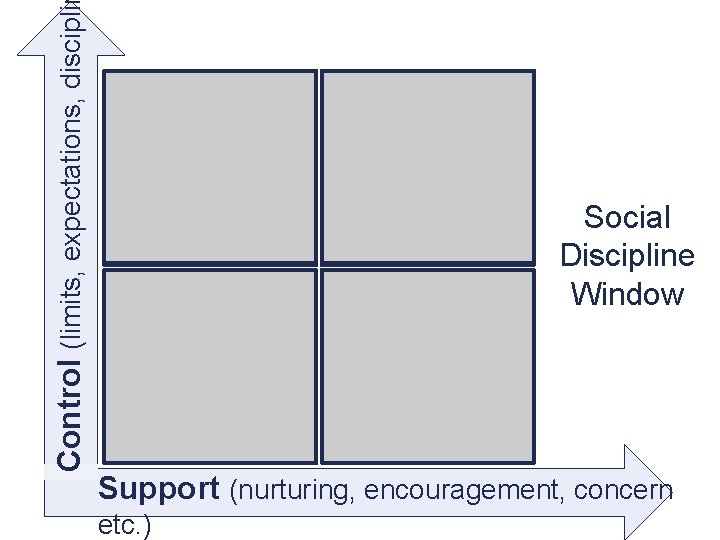
Control (limits, expectations, discipli TO WITH Punitive Restorative Authoritarian Confronting Win/Lose Problem-Solving Respectful Responsive NOT FOR Neglectful Permissive Indifferent Lazy Given Up Protective Rescuing Excusing Social Discipline Window Support (nurturing, encouragement, concern etc. )
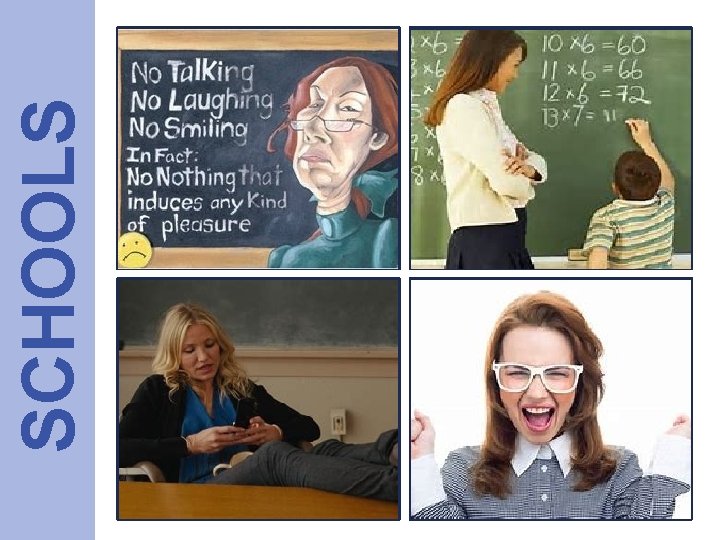
SCHOOLS TO WITH Punitive Restorative Authoritarian Confronting Win/Lose Problem Solving Respectful Responsive NOT FOR Neglectful Permissive Indifferent Lazy Given Up Protective Rescuing Excusing
ACTIVITY Fly on the wall • FOR: Permissive Practitioner Style • NOT: Neglectful Practitioner Style • TO: Punitive Practitioner Style • WITH: Restorative Practitioner Style
The Social Discipline Window § We are not all Restorative all of the time § People can move boxes § It’s all about being self-aware and self -reflective § It’s the cornerstone of everything we
How “WITH” are we? § Family engagement § Student voice § Organizational change
Think of a person who has had the greatest impact on you, a person you have respected the most in your life. When this person challenged you, when you did something wrong or weren’t living up to your potential, how did this feel?
When this person challenged you, when you did something wrong or weren’t living up to your potential, how did this person treat you? How did you FIRST feel?
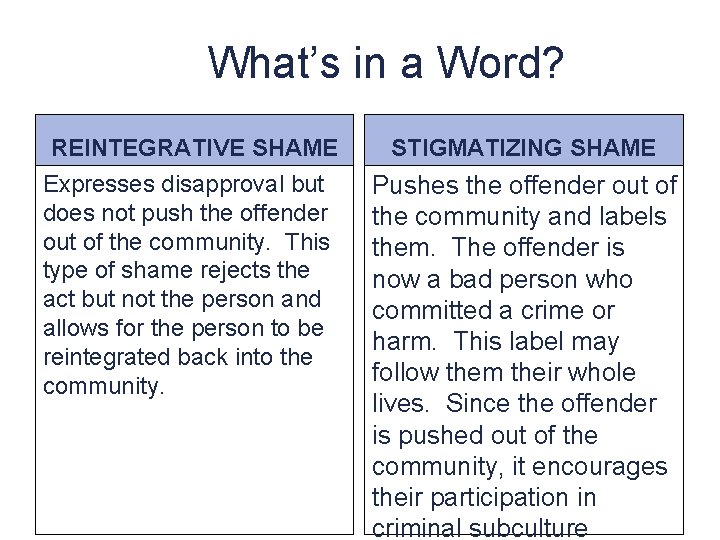
What’s in a Word? REINTEGRATIVE SHAME Expresses disapproval but does not push the offender out of the community. This type of shame rejects the act but not the person and allows for the person to be reintegrated back into the community. STIGMATIZING SHAME Pushes the offender out of the community and labels them. The offender is now a bad person who committed a crime or harm. This label may follow them their whole lives. Since the offender is pushed out of the community, it encourages their participation in criminal subculture
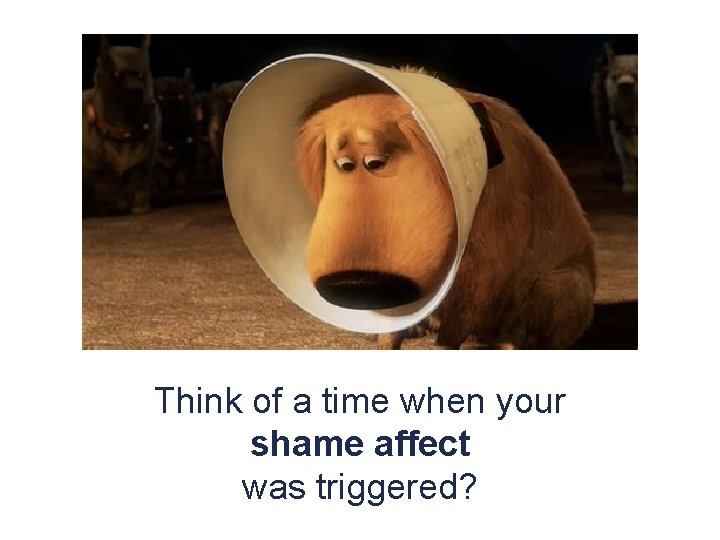
Think of a time when your shame affect was triggered?
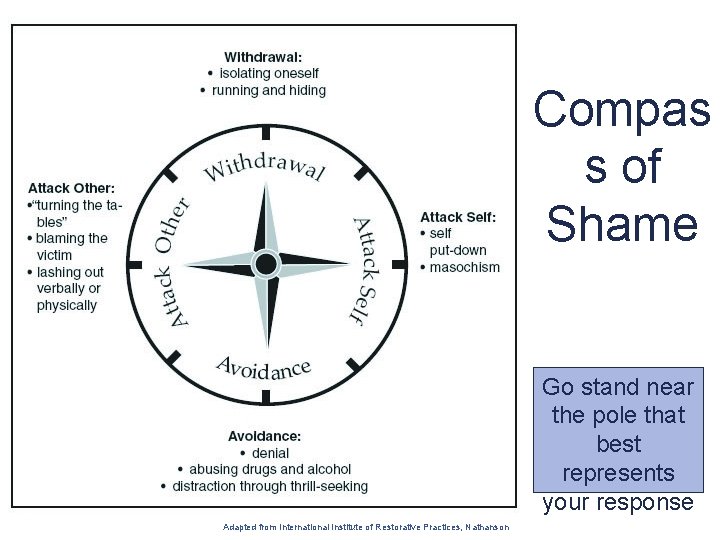
Compas s of Shame Go stand near the pole that best represents your response Adapted from International Institute of Restorative Practices, Nathanson
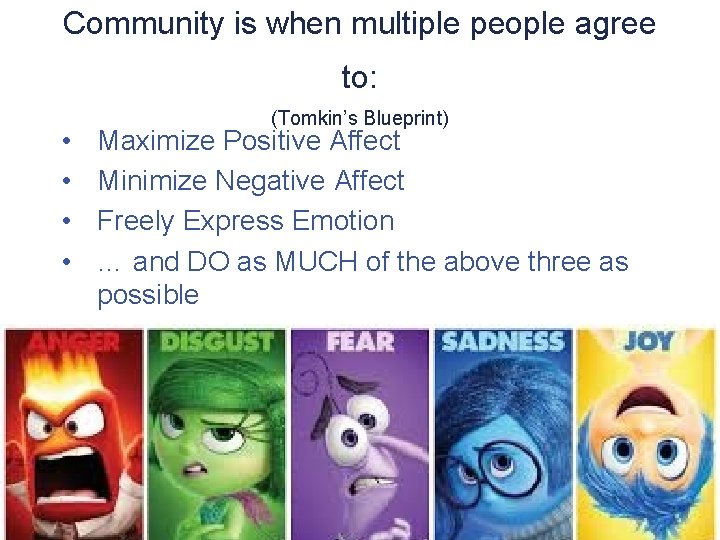
Community is when multiple people agree to: • • (Tomkin’s Blueprint) Maximize Positive Affect Minimize Negative Affect Freely Express Emotion … and DO as MUCH of the above three as possible
Restorative Practices § Provide rituals and processes to do Tomkin’s Blueprint § Maximize positive affect § Minimize negative affect § Freely express emotion § Get youth off of the compass of shame (and prevent where possible) § Help us operate out of the “with” box
As you move from informal to formal § More people § More planning § More time § More structure
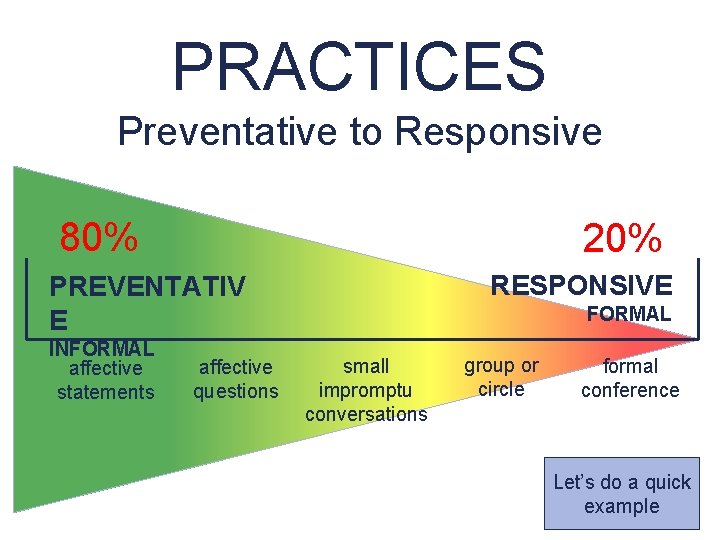
PRACTICES Preventative to Responsive 80% 20% RESPONSIVE PREVENTATIV E INFORMAL affective statements affective questions FORMAL small impromptu conversations group or circle formal conference Let’s do a quick example
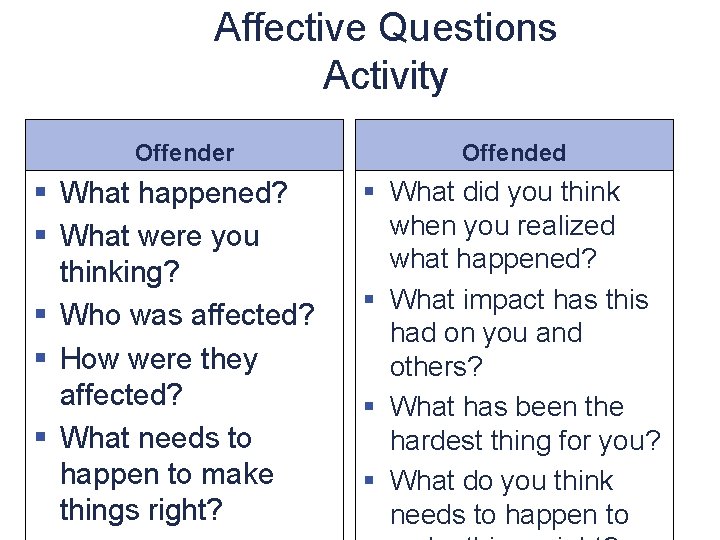
Affective Questions Activity Offender § What happened? § What were you thinking? § Who was affected? § How were they affected? § What needs to happen to make things right? Offended § What did you think when you realized what happened? § What impact has this had on you and others? § What has been the hardest thing for you? § What do you think needs to happen to
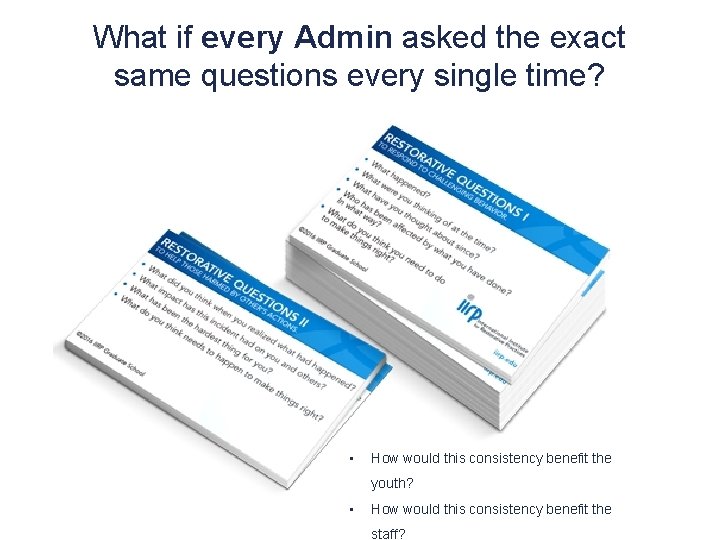
What if every Admin asked the exact same questions every single time? • How would this consistency benefit the youth? • How would this consistency benefit the staff?
We need to be able to answer these questions § What problems are we trying to address? § What impact are we hoping to make? Outcomes? § Which specific practices will we use? § Who will use them? § When will we use them? § How will we know if we are doing them “right”? § How will we know if it’s working?
Which practices are you going to use? Where will they fit into your triangle?
Affective Language § Students and staff use “I” statements (specific positive/corrective feedback) and link back to school-wide expectations § Behavior specific praise § All teachers using consistent Restorative Questions in their classrooms and connected to school-wide expectations § All administrators use consistent Restorative chats in the office and connect to schoolwide expectations
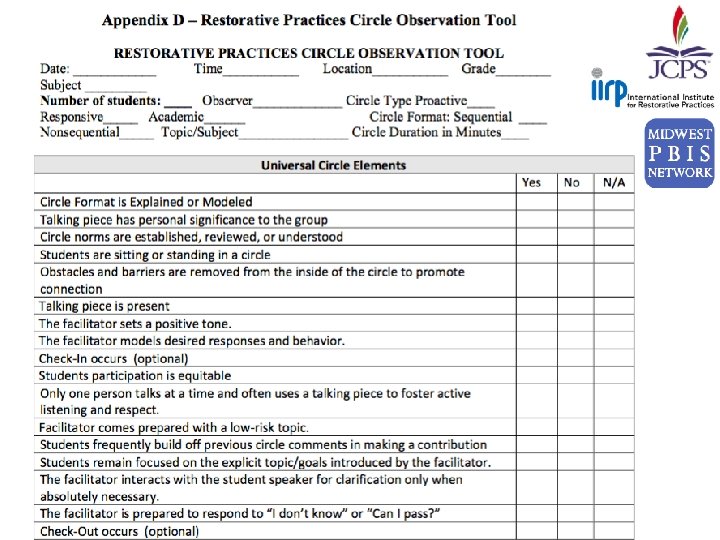
Circles § Morning community check-ins as a class connected to classroom practices/routines and procedures § To teach academics § To teach social skills § Behavioral Lesson Plans § Social Academic Instructional Groups § Response to classroom incidents connected to school-wide expectations § School-wide response to crisis
Conferences § Processing incidents between two parties that would require admin involvementconnected to school-wide expectations § Develop plan to prevent future occurrences § Re-integration after disciplinary action § Reintegration after hospitalization § Unique teams of home, school, community - connected to Tier III Wraparound
How do you ensure staff will know WHY they are doing the practices and HOW to do them?
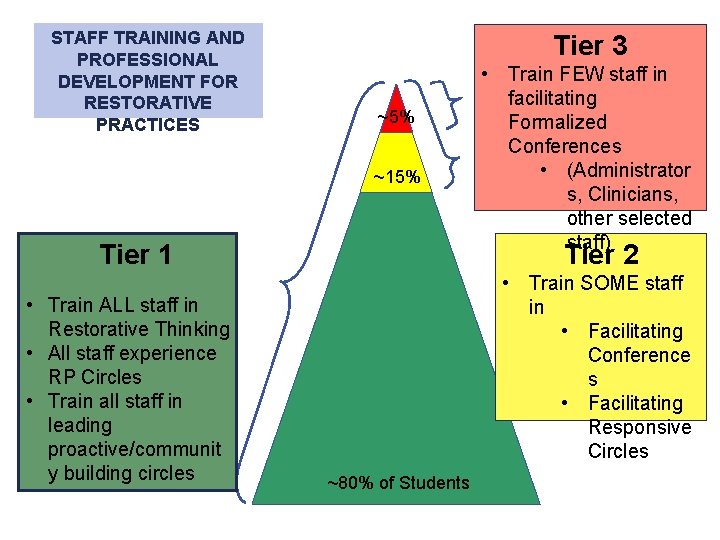
STAFF TRAINING AND PROFESSIONAL DEVELOPMENT FOR RESTORATIVE PRACTICES Tier 3 ~5% ~15% Tier 2 Tier 1 • Train ALL staff in Restorative Thinking • All staff experience RP Circles • Train all staff in leading proactive/communit y building circles • Train FEW staff in facilitating Formalized Conferences • (Administrator s, Clinicians, other selected staff) • Train SOME staff in • Facilitating Conference s • Facilitating Responsive Circles ~80% of Students
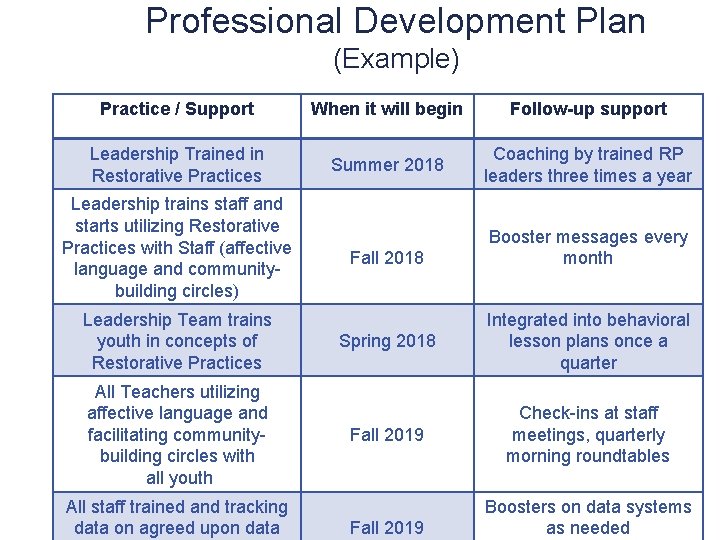
Professional Development Plan (Example) Practice / Support When it will begin Follow-up support Leadership Trained in Restorative Practices Summer 2018 Coaching by trained RP leaders three times a year Leadership trains staff and starts utilizing Restorative Practices with Staff (affective language and communitybuilding circles) Leadership Team trains youth in concepts of Restorative Practices All Teachers utilizing affective language and facilitating communitybuilding circles with all youth All staff trained and tracking data on agreed upon data Fall 2018 Booster messages every month Spring 2018 Integrated into behavioral lesson plans once a quarter Fall 2019 Check-ins at staff meetings, quarterly morning roundtables Fall 2019 Boosters on data systems as needed
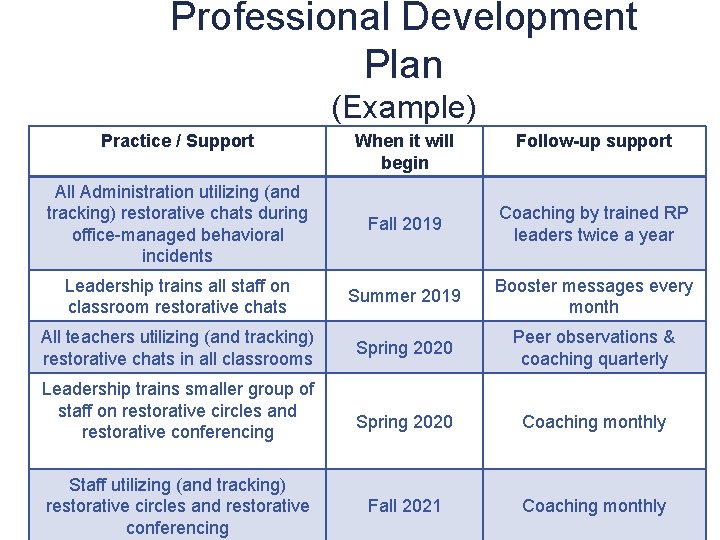
Professional Development Plan (Example) Practice / Support When it will begin Follow-up support All Administration utilizing (and tracking) restorative chats during office-managed behavioral incidents Fall 2019 Coaching by trained RP leaders twice a year Leadership trains all staff on classroom restorative chats Summer 2019 Booster messages every month All teachers utilizing (and tracking) restorative chats in all classrooms Spring 2020 Peer observations & coaching quarterly Spring 2020 Coaching monthly Fall 2021 Coaching monthly Leadership trains smaller group of staff on restorative circles and restorative conferencing Staff utilizing (and tracking) restorative circles and restorative conferencing
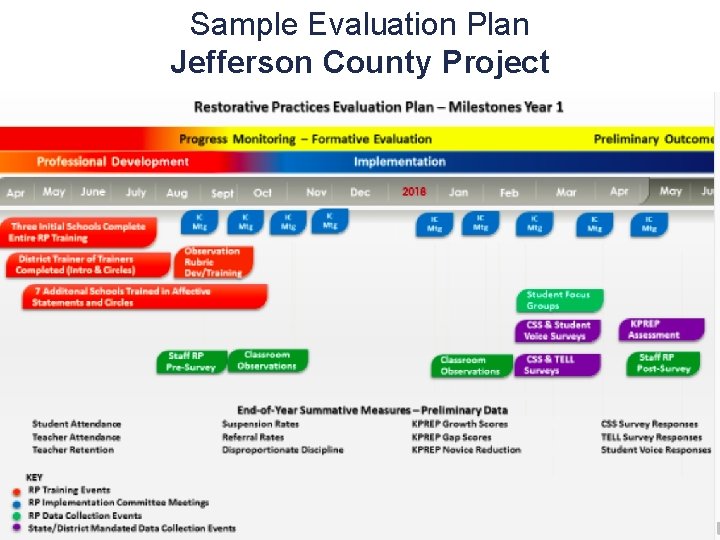
Sample Evaluation Plan Jefferson County Project PBIS
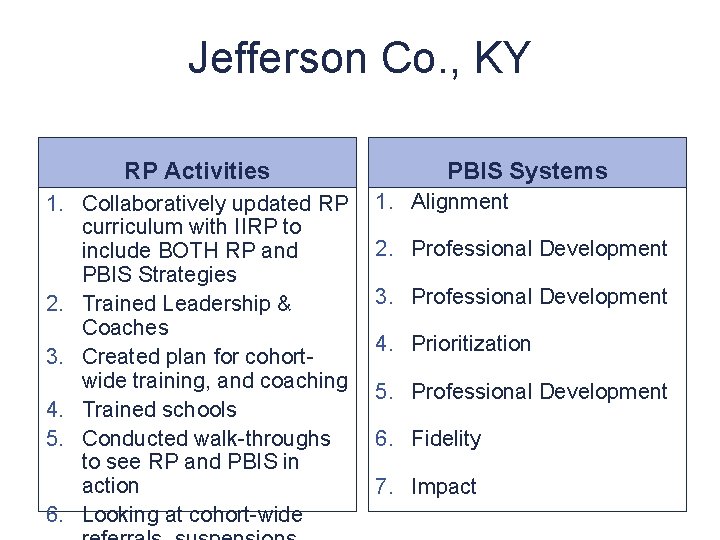
Jefferson Co. , KY RP Activities 1. Collaboratively updated RP curriculum with IIRP to include BOTH RP and PBIS Strategies 2. Trained Leadership & Coaches 3. Created plan for cohortwide training, and coaching 4. Trained schools 5. Conducted walk-throughs to see RP and PBIS in action 6. Looking at cohort-wide PBIS Systems 1. Alignment 2. Professional Development 3. Professional Development 4. Prioritization 5. Professional Development 6. Fidelity 7. Impact
How will we know if we are implementing the practices with fidelity? How will we know if youth are responding/they are working?
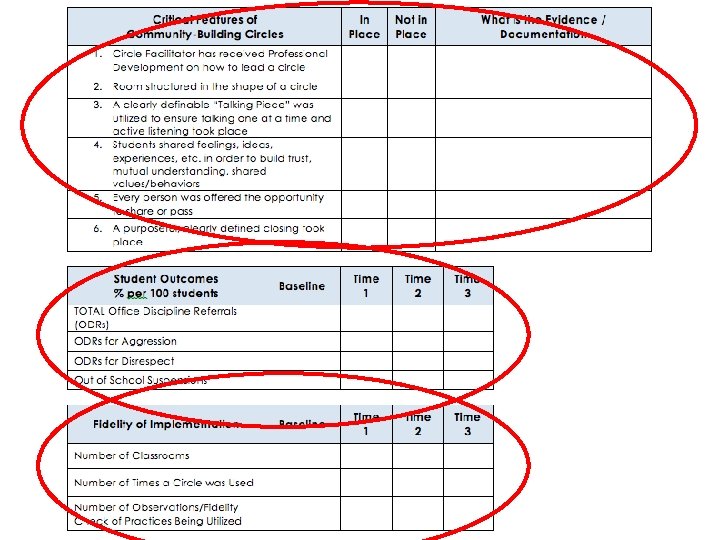
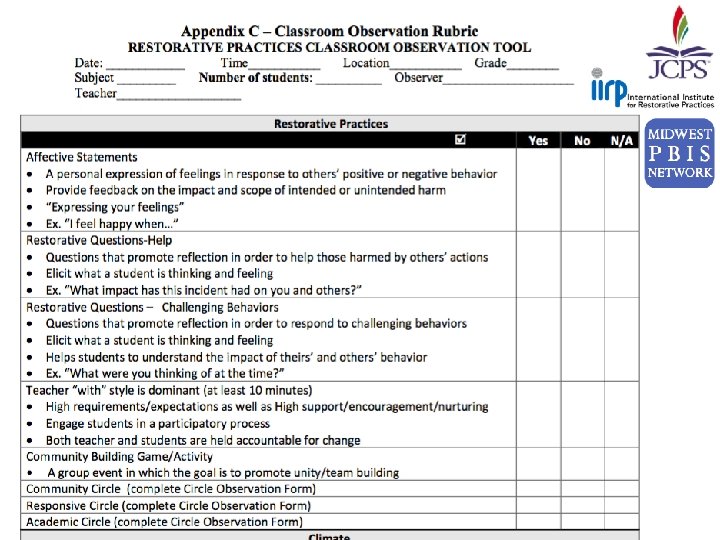
PBIS
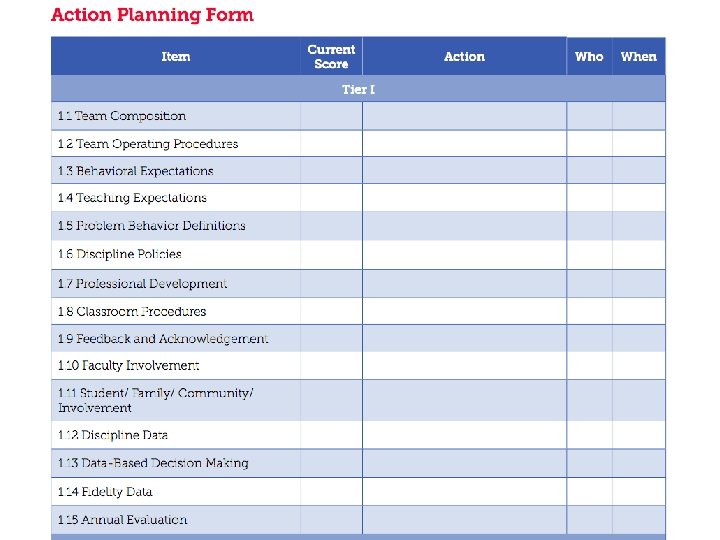
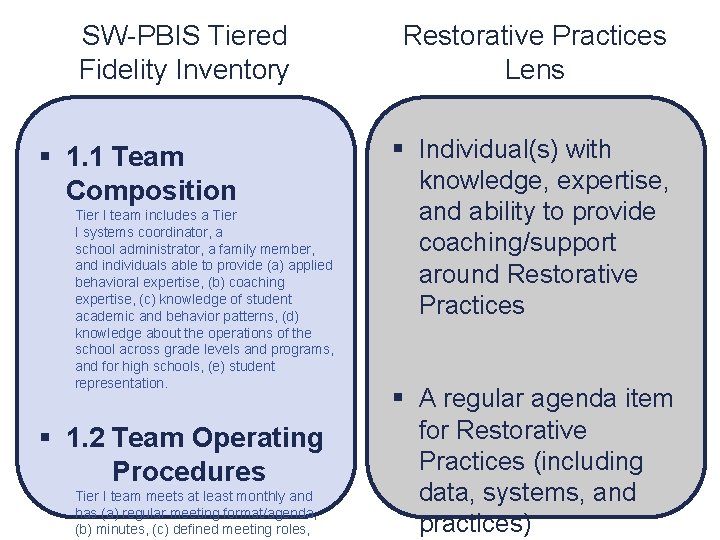
SW-PBIS Tiered Fidelity Inventory § 1. 1 Team Composition Tier I team includes a Tier I systems coordinator, a school administrator, a family member, and individuals able to provide (a) applied behavioral expertise, (b) coaching expertise, (c) knowledge of student academic and behavior patterns, (d) knowledge about the operations of the school across grade levels and programs, and for high schools, (e) student representation. § 1. 2 Team Operating Procedures Tier I team meets at least monthly and has (a) regular meeting format/agenda, (b) minutes, (c) defined meeting roles, Restorative Practices Lens § Individual(s) with knowledge, expertise, and ability to provide coaching/support around Restorative Practices § A regular agenda item for Restorative Practices (including data, systems, and practices)
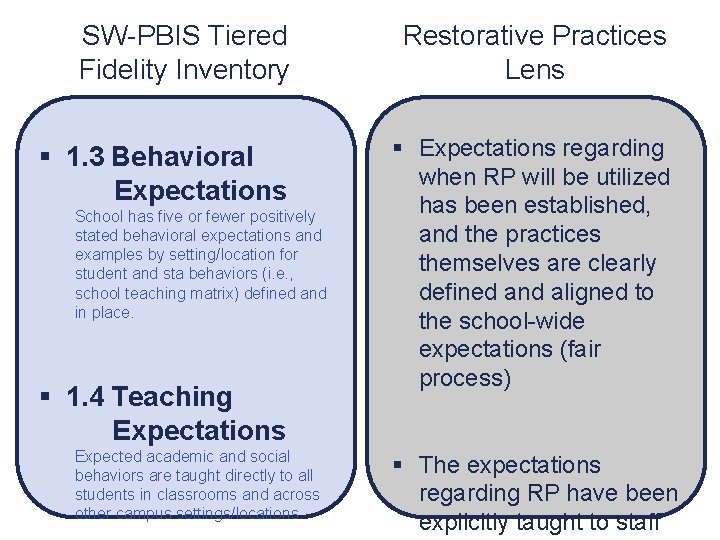
SW-PBIS Tiered Fidelity Inventory Restorative Practices Lens § 1. 3 Behavioral Expectations § Expectations regarding when RP will be utilized has been established, and the practices themselves are clearly defined and aligned to the school-wide expectations (fair process) School has five or fewer positively stated behavioral expectations and examples by setting/location for student and sta behaviors (i. e. , school teaching matrix) defined and in place. § 1. 4 Teaching Expectations Expected academic and social behaviors are taught directly to all students in classrooms and across other campus settings/locations. § The expectations regarding RP have been explicitly taught to staff
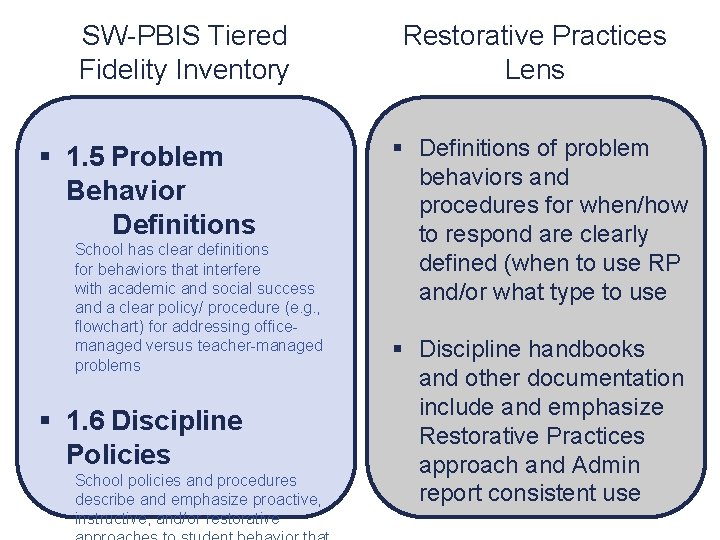
SW-PBIS Tiered Fidelity Inventory § 1. 5 Problem Behavior Definitions School has clear definitions for behaviors that interfere with academic and social success and a clear policy/ procedure (e. g. , flowchart) for addressing officemanaged versus teacher-managed problems § 1. 6 Discipline Policies School policies and procedures describe and emphasize proactive, instructive, and/or restorative Restorative Practices Lens § Definitions of problem behaviors and procedures for when/how to respond are clearly defined (when to use RP and/or what type to use § Discipline handbooks and other documentation include and emphasize Restorative Practices approach and Admin report consistent use
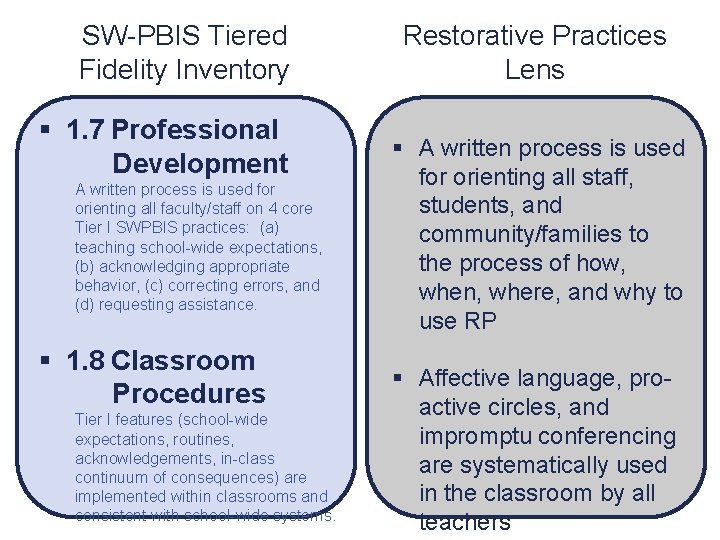
SW-PBIS Tiered Fidelity Inventory § 1. 7 Professional Development A written process is used for orienting all faculty/staff on 4 core Tier I SWPBIS practices: (a) teaching school-wide expectations, (b) acknowledging appropriate behavior, (c) correcting errors, and (d) requesting assistance. § 1. 8 Classroom Procedures Tier I features (school-wide expectations, routines, acknowledgements, in-class continuum of consequences) are implemented within classrooms and consistent with school-wide systems. Restorative Practices Lens § A written process is used for orienting all staff, students, and community/families to the process of how, when, where, and why to use RP § Affective language, proactive circles, and impromptu conferencing are systematically used in the classroom by all teachers
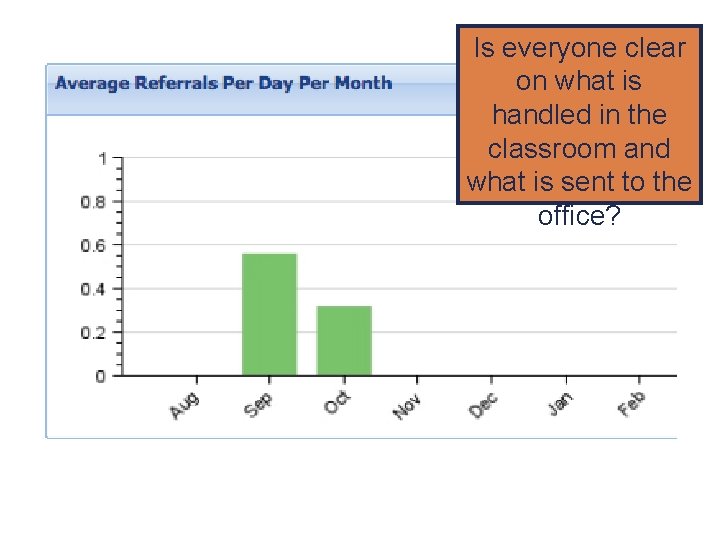
Is everyone clear on what is handled in the classroom and what is sent to the office? PBIS
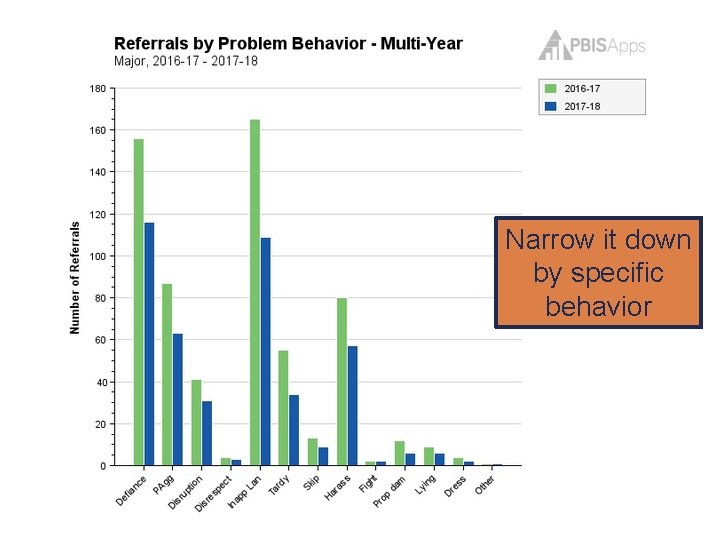
PBIS Narrow it down by specific behavior
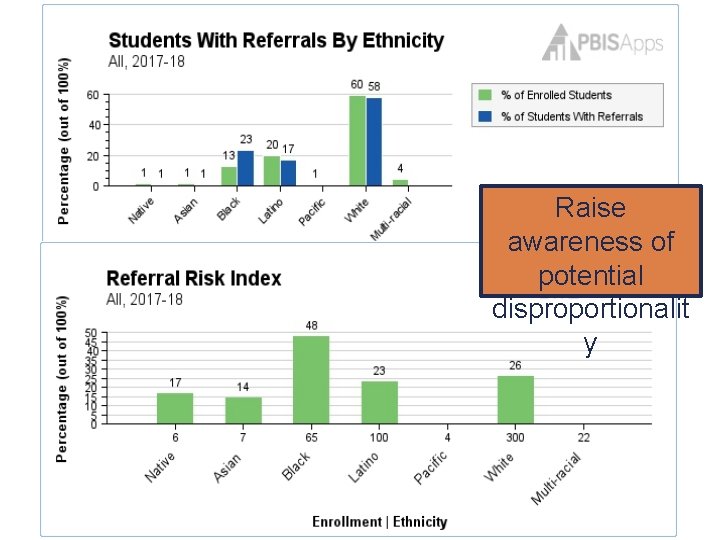
PBIS Raise awareness of potential disproportionalit y
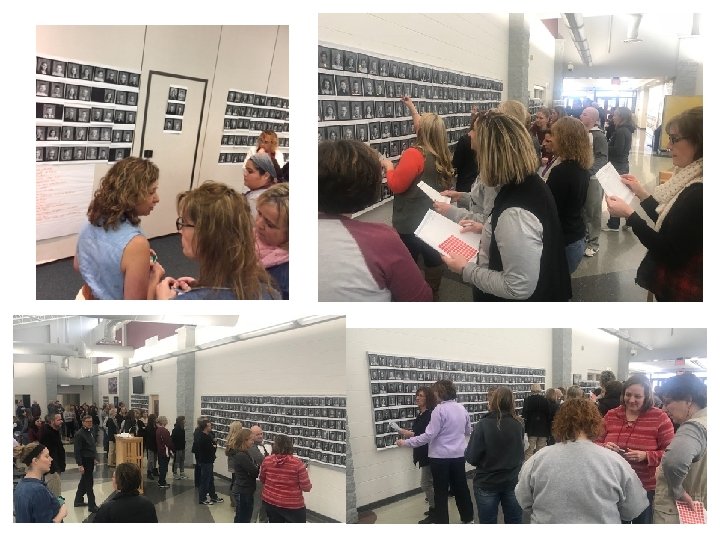
PBIS
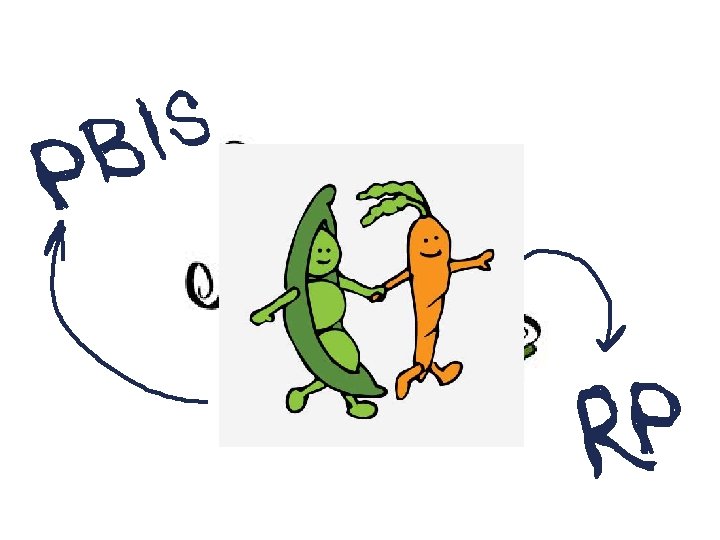
If you’re going to go… go together… (like peas and carrots)
Resources § www. PBIS. org § ISF monograph (aligning with community partners)https: //www. pbis. org/school-mentalhealth/interconnected-systems § Technical Guide for Alignment of initiatives, programs and practices in school districts http: //www. pbis. org/blueprintguidestools/technical-guide § Illinois Balanced and Restorative Justice: www. ibarj. org § International Insitite of Restorative Practices (IIRP): http: //www. iirp. edu § National Association of Community and Restorative Justice: http: //nacrj. org
Resources § Costello, Bob, Joshua Wachtel, and Ted Wachtel. The Restorative Practices Handbook: For Teachers, Disciplinarians and Administrators. Bethlehem, PA: International Institute for Restorative Practices, 2009. Print. § Costello, Bob, Joshua Wachtel, and Ted Wachtel. The Restorative Circles in Schools: Building Community and Enhancing Learning. Bethlehem, PA: International Institute for Restorative Practices, 2010. Print. § Wachtel, Ted, Terry O’Connell, and Ben Wachtel. Restorative Justice Conferencing: Real Justice & The Conferencing Handbook. Bethlehem, PA: International Institute for Restorative Practices, 2010. Print.
- Slides: 47