
Algorithms in the Real World Data Compression Lectures























- Slides: 55
Algorithms in the Real World Data Compression: Lectures 1 and 2 296. 3 1
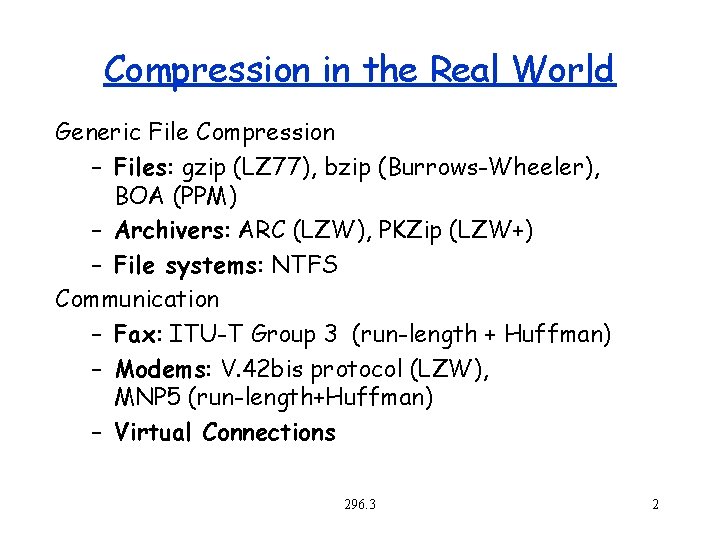
Compression in the Real World Generic File Compression – Files: gzip (LZ 77), bzip (Burrows-Wheeler), BOA (PPM) – Archivers: ARC (LZW), PKZip (LZW+) – File systems: NTFS Communication – Fax: ITU-T Group 3 (run-length + Huffman) – Modems: V. 42 bis protocol (LZW), MNP 5 (run-length+Huffman) – Virtual Connections 296. 3 2
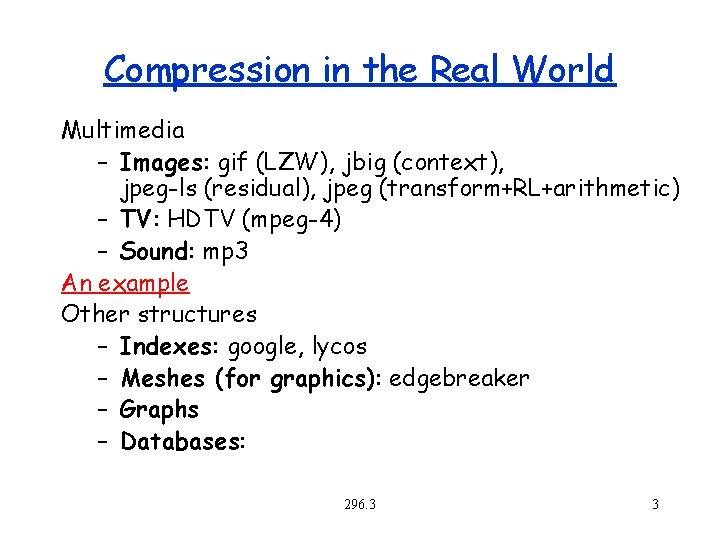
Compression in the Real World Multimedia – Images: gif (LZW), jbig (context), jpeg-ls (residual), jpeg (transform+RL+arithmetic) – TV: HDTV (mpeg-4) – Sound: mp 3 An example Other structures – Indexes: google, lycos – Meshes (for graphics): edgebreaker – Graphs – Databases: 296. 3 3
Compression Outline Introduction: – Lossless vs. lossy – Model and coder – Benchmarks Information Theory: Entropy, etc. Probability Coding: Huffman + Arithmetic Coding Applications of Probability Coding: PPM + others Lempel-Ziv Algorithms: LZ 77, gzip, compress, . . . Other Lossless Algorithms: Burrows-Wheeler Lossy algorithms for images: JPEG, MPEG, . . . Compressing graphs and meshes: BBK 296. 3 4
Encoding/Decoding Will use “message” in generic sense to mean the data to be compressed Input Message Compressed Encoder Decoder Message Output Message The encoder and decoder need to understand common compressed format. 296. 3 5
Lossless vs. Lossy Lossless: Input message = Output message Lossy: Input message Output message Lossy does not necessarily mean loss of quality. In fact the output could be “better” than the input. – Drop random noise in images (dust on lens) – Drop background in music – Fix spelling errors in text. Put into better form. Writing is the art of lossy text compression. 296. 3 6
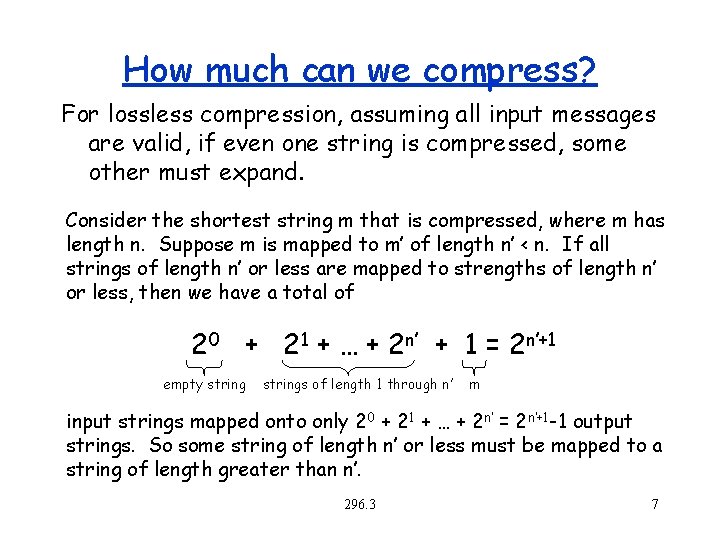
How much can we compress? For lossless compression, assuming all input messages are valid, if even one string is compressed, some other must expand. Consider the shortest string m that is compressed, where m has length n. Suppose m is mapped to m’ of length n’ < n. If all strings of length n’ or less are mapped to strengths of length n’ or less, then we have a total of 20 + 21 + … + 2 n’ + 1 = 2 n’+1 empty strings of length 1 through n’ m input strings mapped onto only 20 + 21 + … + 2 n’ = 2 n’+1 -1 output strings. So some string of length n’ or less must be mapped to a string of length greater than n’. 296. 3 7
Model vs. Coder To compress we need a bias on the probability of messages. The model determines this bias Encoder Messages Input Message Model Probs. Coder Compressed Message Example models: – Simple: Character counts, repeated strings – Complex: Models of a human face 296. 3 8
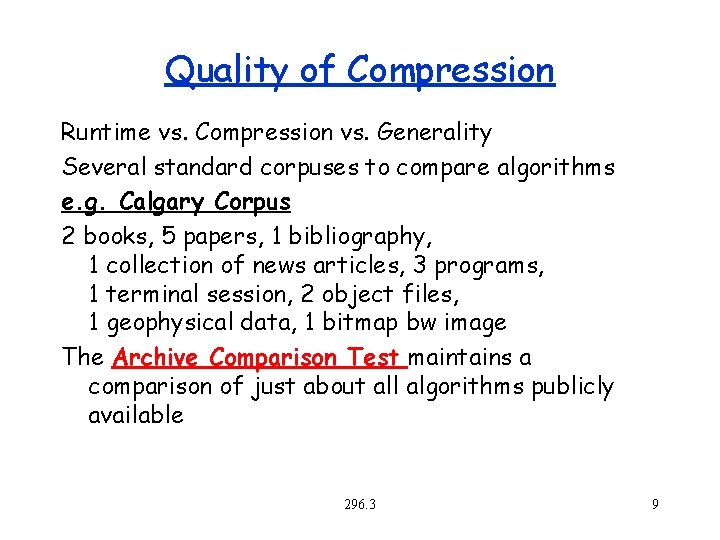
Quality of Compression Runtime vs. Compression vs. Generality Several standard corpuses to compare algorithms e. g. Calgary Corpus 2 books, 5 papers, 1 bibliography, 1 collection of news articles, 3 programs, 1 terminal session, 2 object files, 1 geophysical data, 1 bitmap bw image The Archive Comparison Test maintains a comparison of just about all algorithms publicly available 296. 3 9
Comparison of Algorithms 296. 3 10
Compression Outline Introduction: Lossy vs. Lossless, Benchmarks, … Information Theory: – Entropy – Conditional Entropy – Entropy of the English Language Probability Coding: Huffman + Arithmetic Coding Applications of Probability Coding: PPM + others Lempel-Ziv Algorithms: LZ 77, gzip, compress, . . . Other Lossless Algorithms: Burrows-Wheeler Lossy algorithms for images: JPEG, MPEG, . . . Compressing graphs and meshes: BBK 296. 3 11
Information Theory An interface between modeling and coding Entropy – A measure of information content Conditional Entropy – Information content based on a context Entropy of the English Language – How much information does each character in “typical” English text contain? 296. 3 12
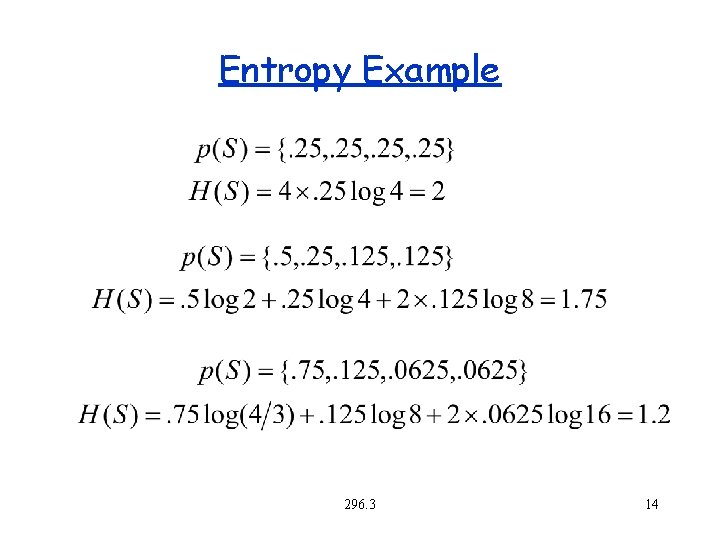
Entropy (Shannon 1948) For a set of messages S with probability p(s), s S, the self information of s is: Measured in bits if the log is base 2. The lower the probability, the higher the information Entropy is the weighted average of self information. 296. 3 13
Entropy Example 296. 3 14
Conditional Entropy The conditional probability p(s|c) is the probability of s in a context c. The conditional self information is The conditional information can be either more or less than the unconditional information. The conditional entropy is the weighted average of the conditional self information 296. 3 15
Example of a Markov Chain . 1 p(b|w) p(w|w). 9 w b p(w|b). 2 296. 3 p(b|b). 8 16
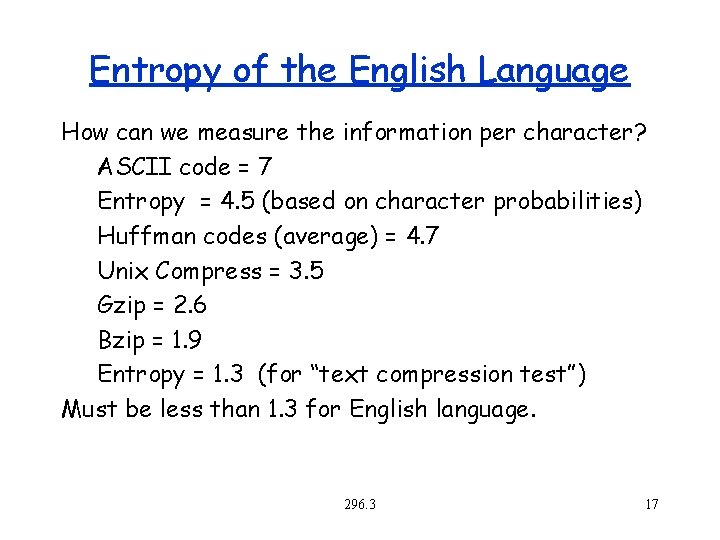
Entropy of the English Language How can we measure the information per character? ASCII code = 7 Entropy = 4. 5 (based on character probabilities) Huffman codes (average) = 4. 7 Unix Compress = 3. 5 Gzip = 2. 6 Bzip = 1. 9 Entropy = 1. 3 (for “text compression test”) Must be less than 1. 3 for English language. 296. 3 17
Shannon’s experiment Asked humans to predict the next character given the whole previous text. He used these as conditional probabilities to estimate the entropy of the English Language. The number of guesses required for right answer: From the experiment he predicted H(English) =. 6 -1. 3 296. 3 18
Compression Outline Introduction: Lossy vs. Lossless, Benchmarks, … Information Theory: Entropy, etc. Probability Coding: – Prefix codes and relationship to Entropy – Huffman codes – Arithmetic codes Applications of Probability Coding: PPM + others Lempel-Ziv Algorithms: LZ 77, gzip, compress, . . . Other Lossless Algorithms: Burrows-Wheeler Lossy algorithms for images: JPEG, MPEG, . . . Compressing graphs and meshes: BBK 296. 3 19
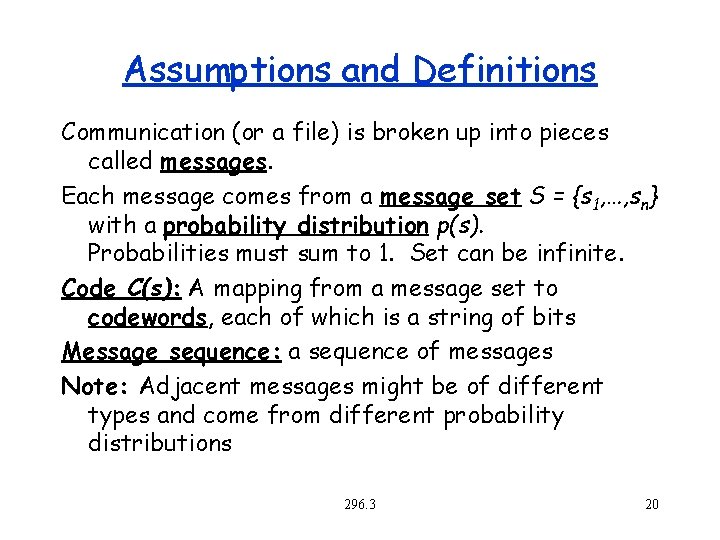
Assumptions and Definitions Communication (or a file) is broken up into pieces called messages. Each message comes from a message set S = {s 1, …, sn} with a probability distribution p(s). Probabilities must sum to 1. Set can be infinite. Code C(s): A mapping from a message set to codewords, each of which is a string of bits Message sequence: a sequence of messages Note: Adjacent messages might be of different types and come from different probability distributions 296. 3 20
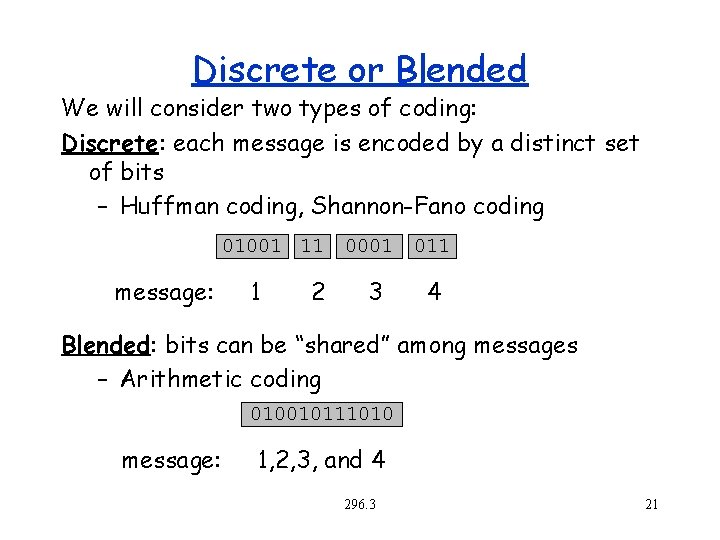
Discrete or Blended We will consider two types of coding: Discrete: each message is encoded by a distinct set of bits – Huffman coding, Shannon-Fano coding 01001 11 message: 1 2 0001 3 011 4 Blended: bits can be “shared” among messages – Arithmetic coding 010010111010 message: 1, 2, 3, and 4 296. 3 21
Uniquely Decodable Codes A variable length code assigns a bit string (codeword) of variable length to every message value e. g. a = 1, b = 01, c = 101, d = 011 What if you get the sequence of bits 1011 ? Is it aba, ca, or, ad? A uniquely decodable code is a variable length code in which bit strings can always be uniquely decomposed into its codewords. 296. 3 22
Prefix Codes A prefix code is a variable length code in which no codeword is a prefix of another codeword. e. g. , a = 0, b = 110, c = 111, d = 10 All prefix codes are uniquely decodable 296. 3 23
Prefix Codes: as a tree Can be viewed as a binary tree with message values at the leaves and 0 s or 1 s on the edges: 0 a 1 1 0 0 1 b c d a = 0, b = 110, c = 111, d = 10 296. 3 24
Some Prefix Codes for Integers Many other fixed prefix codes: Golomb, phased-binary, subexponential, . . . 296. 3 25
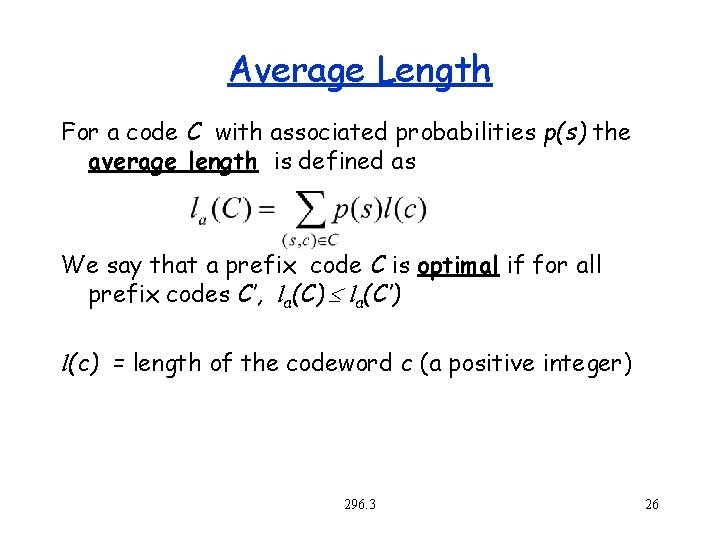
Average Length For a code C with associated probabilities p(s) the average length is defined as We say that a prefix code C is optimal if for all prefix codes C’, la(C) la(C’) l(c) = length of the codeword c (a positive integer) 296. 3 26
Relationship to Entropy Theorem (lower bound): For any probability distribution p(S) with associated uniquely decodable code C, Theorem (upper bound): For any probability distribution p(S) with associated optimal prefix code C, 296. 3 27
Kraft Mc. Millan Inequality Theorem (Kraft-Mc. Millan): For any uniquely decodable binary code C, Also, for any set of lengths L such that there is a prefix code C such that 296. 3 28
Proof of the Upper Bound (Part 1) Assign each message a length: We then have So by the Kraft-Mc. Millan inequality there is a prefix code with lengths l(s). 296. 3 29
Proof of the Upper Bound (Part 2) Now we can calculate the average length given l(s) And we are done. 296. 3 30
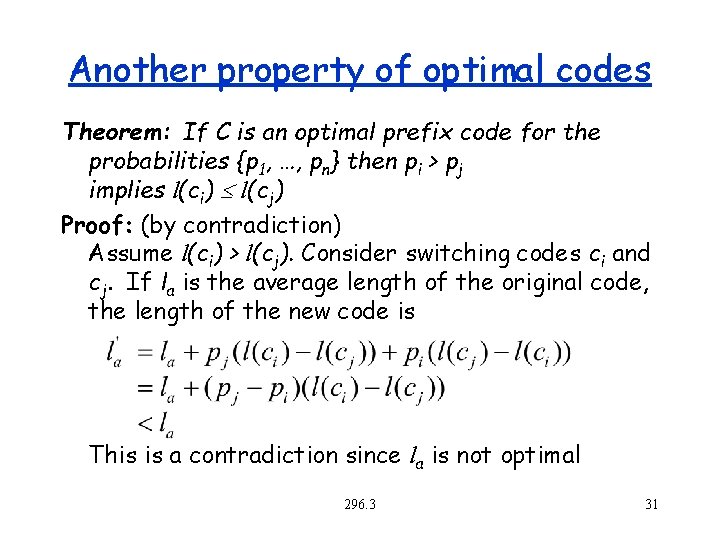
Another property of optimal codes Theorem: If C is an optimal prefix code for the probabilities {p 1, …, pn} then pi > pj implies l(ci) l(cj) Proof: (by contradiction) Assume l(ci) > l(cj). Consider switching codes ci and cj. If la is the average length of the original code, the length of the new code is This is a contradiction since la is not optimal 296. 3 31
Huffman Codes Invented by Huffman as a class assignment in 1950. Used in many, if not most, compression algorithms gzip, bzip, jpeg (as option), fax compression, … Properties: – Generates optimal prefix codes – Cheap to generate codes – Cheap to encode and decode – la = H if probabilities are powers of 2 296. 3 32
Huffman Codes Huffman Algorithm: Start with a forest of trees each consisting of a single vertex corresponding to a message s and with weight p(s) Repeat until one tree left: – Select two trees with minimum weight roots p 1 and p 2 – Join into single tree by adding root with weight p 1 + p 2 296. 3 33
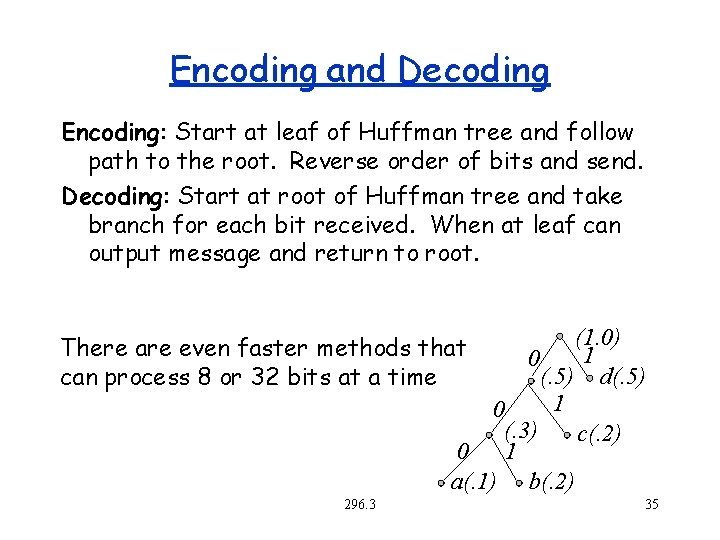
Example p(a) =. 1, p(b) =. 2, p(c ) =. 2, p(d) =. 5 a(. 1) (. 3) b(. 2) c(. 2) d(. 5) (1. 0) 1 0 (. 5) d(. 5) a(. 1) b(. 2) (. 3) c(. 2) 1 0 Step 1 (. 3) c(. 2) a(. 1) b(. 2) 0 1 Step 2 a(. 1) b(. 2) Step 3 a=000, b=001, c=01, d=1 296. 3 34
Encoding and Decoding Encoding: Start at leaf of Huffman tree and follow path to the root. Reverse order of bits and send. Decoding: Start at root of Huffman tree and take branch for each bit received. When at leaf can output message and return to root. (1. 0) 1 0 (. 5) d(. 5) 1 0 (. 3) c(. 2) 0 1 a(. 1) b(. 2) There are even faster methods that can process 8 or 32 bits at a time 296. 3 35
Huffman codes are “optimal” Theorem: The Huffman algorithm generates an optimal prefix code. Proof outline: Induction on the number of messages n. Base case n = 2 or n=1? Consider a message set S with n+1 messages 1. Least probable messages m 1 and m 2 of S are neighbors in the Huffman tree, by construction 2. Replace the two least probable messages with one message with probability p(m 1) + p(m 2) making new message set S’ 3. Can transform any optimal prefix code for S so that m 1 and m 2 are neighbors. 4. Cost of optimal code for S is cost of optimal code for S’ + p(m 1) + p(m 2) 5. Huffman code for S’ is optimal by induction 6. Cost of Huffman code for S is cost of optimal code for S’ + p(m 1) + p(m 2). 296. 3 36
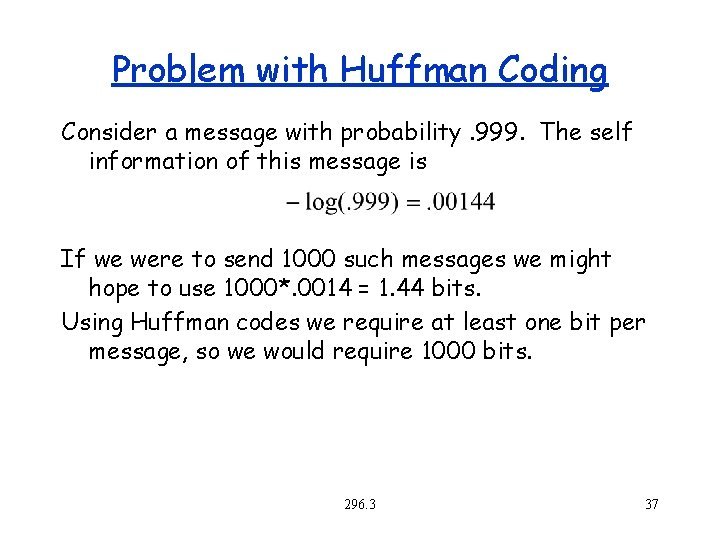
Problem with Huffman Coding Consider a message with probability. 999. The self information of this message is If we were to send 1000 such messages we might hope to use 1000*. 0014 = 1. 44 bits. Using Huffman codes we require at least one bit per message, so we would require 1000 bits. 296. 3 37
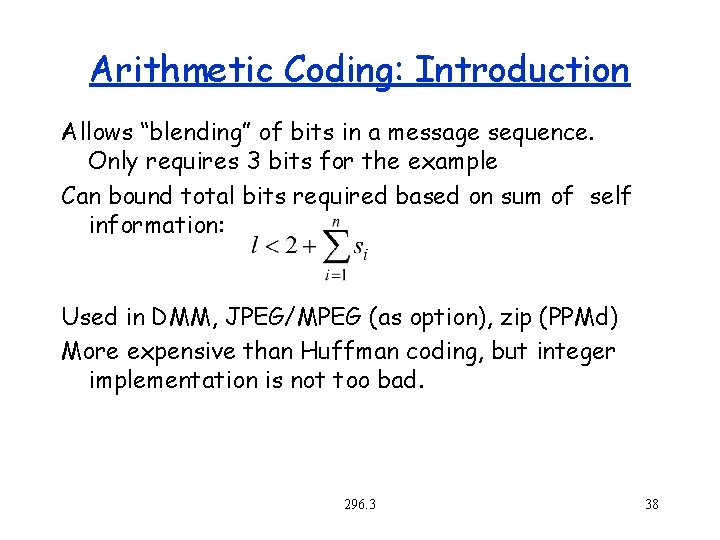
Arithmetic Coding: Introduction Allows “blending” of bits in a message sequence. Only requires 3 bits for the example Can bound total bits required based on sum of self information: Used in DMM, JPEG/MPEG (as option), zip (PPMd) More expensive than Huffman coding, but integer implementation is not too bad. 296. 3 38
Arithmetic Coding: message intervals Assign each probability distribution to an interval range from 0 (inclusive) to 1 (exclusive). e. g. 1. 0 c =. 3 0. 7 b =. 5 0. 2 0. 0 f(a) =. 0, f(b) =. 2, f(c) =. 7 a =. 2 The interval for a particular message will be called the message interval (e. g. , for b the interval is [. 2, . 7)) 296. 3 39
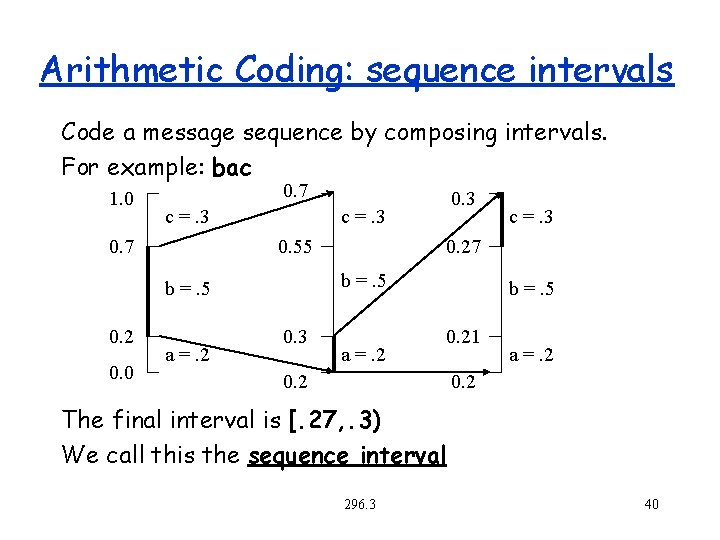
Arithmetic Coding: sequence intervals Code a message sequence by composing intervals. For example: bac 1. 0 0. 7 c =. 3 0. 55 0. 0 a =. 2 0. 3 c =. 3 0. 27 b =. 5 0. 2 0. 3 a =. 2 b =. 5 0. 21 0. 2 a =. 2 0. 2 The final interval is [. 27, . 3) We call this the sequence interval 296. 3 40
Arithmetic Coding: sequence intervals To code a sequence of messages with probabilities pi (i = 1. . n) use the following: bottom of interval size of interval Each message narrows the interval by a factor of pi. Final interval size: 296. 3 41
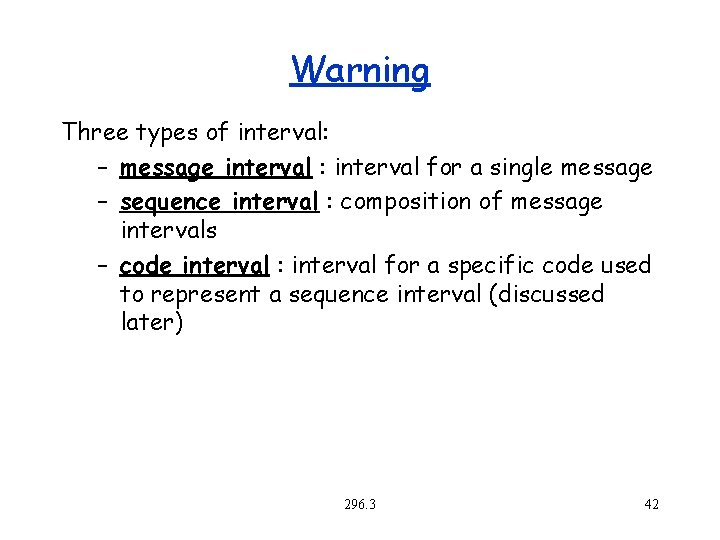
Warning Three types of interval: – message interval : interval for a single message – sequence interval : composition of message intervals – code interval : interval for a specific code used to represent a sequence interval (discussed later) 296. 3 42
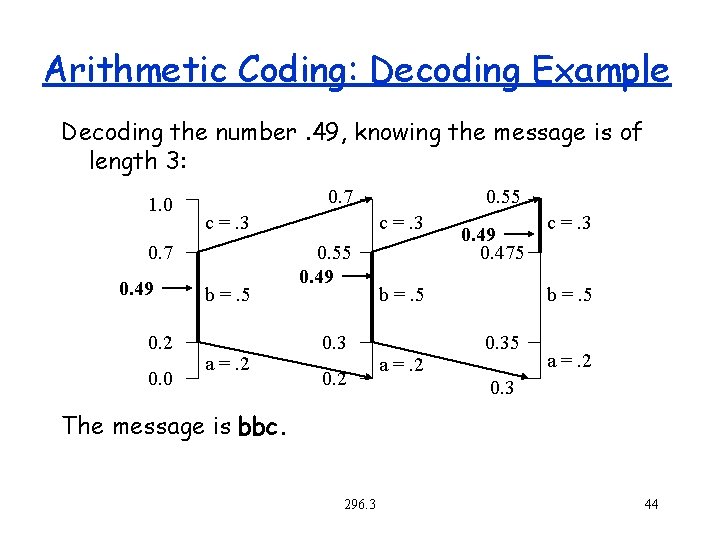
Uniquely defining an interval Important property: The sequence intervals for distinct message sequences of length n will never overlap Therefore: specifying any number in the final interval uniquely determines the sequence. Decoding is similar to encoding, but on each step need to determine what the message value is and then reduce interval 296. 3 43
Arithmetic Coding: Decoding Example Decoding the number. 49, knowing the message is of length 3: 1. 0 0. 7 c =. 3 0. 7 0. 49 0. 2 0. 0 b =. 5 a =. 2 0. 55 c =. 3 0. 55 0. 49 0. 3 0. 2 0. 49 0. 475 b =. 5 a =. 2 c =. 3 b =. 5 0. 35 a =. 2 0. 3 The message is bbc. 296. 3 44
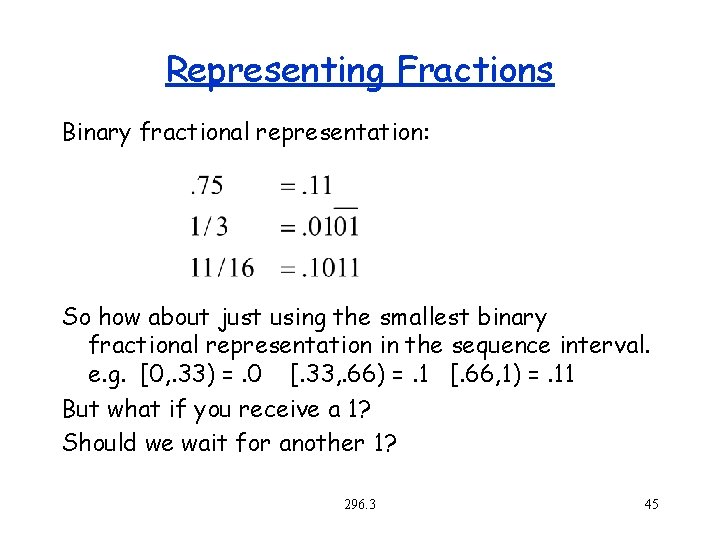
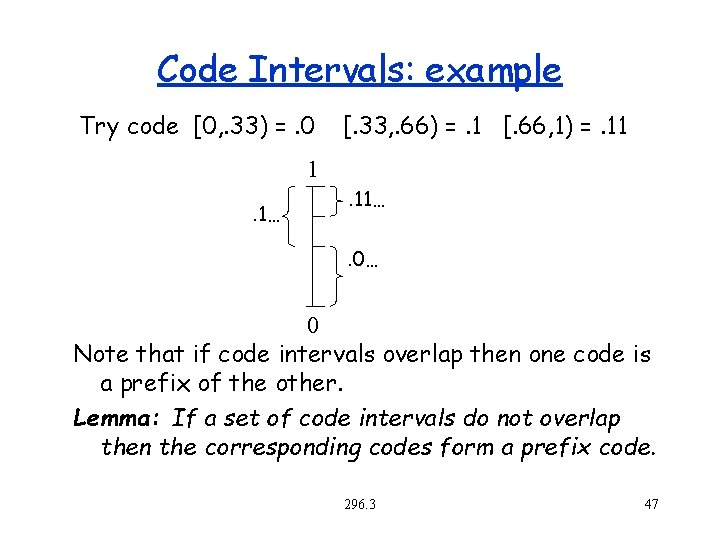
Representing Fractions Binary fractional representation: So how about just using the smallest binary fractional representation in the sequence interval. e. g. [0, . 33) =. 0 [. 33, . 66) =. 1 [. 66, 1) =. 11 But what if you receive a 1? Should we wait for another 1? 296. 3 45
Representing an Interval Can view binary fractional numbers as intervals by considering all completions. e. g. We will call this the code interval. 296. 3 46
Code Intervals: example Try code [0, . 33) =. 0 [. 33, . 66) =. 1 [. 66, 1) =. 11 1. 1… . 11…. 0… 0 Note that if code intervals overlap then one code is a prefix of the other. Lemma: If a set of code intervals do not overlap then the corresponding codes form a prefix code. 296. 3 47
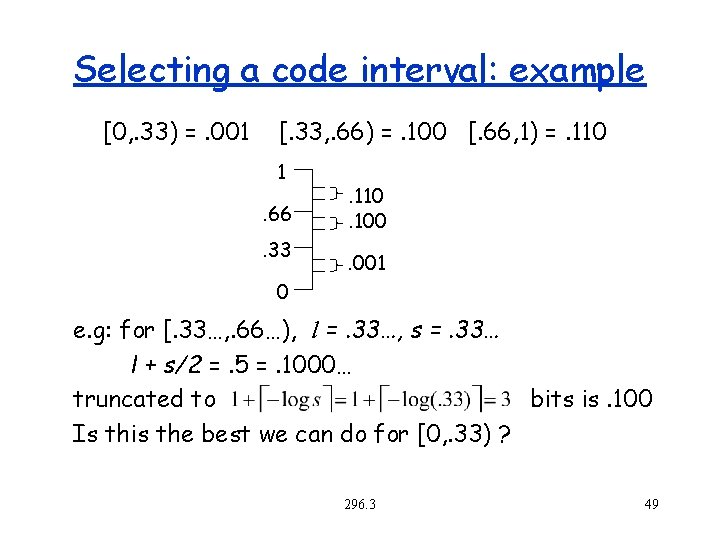
Selecting the Code Interval To find a prefix code find a binary fractional number whose code interval is contained in the sequence interval. . 79 Sequence Interval. 61 . 75 Code Interval (. 101) . 625 Can use the fraction l + s/2 truncated to bits 296. 3 48
Selecting a code interval: example [0, . 33) =. 001 [. 33, . 66) =. 100 [. 66, 1) =. 110 1. 66. 33 . 110. 100. 001 0 e. g: for [. 33…, . 66…), l =. 33…, s =. 33… l + s/2 =. 5 =. 1000… truncated to bits is. 100 Is this the best we can do for [0, . 33) ? 296. 3 49
Real. Arith Encoding and Decoding Real. Arith. Encode: Determine l and s using original recurrences Code using l + s/2 truncated to 1+ -log s bits Real. Arith. Decode: Read bits as needed so code interval falls within a message interval, and then narrow sequence interval. Repeat until n messages have been decoded. 296. 3 50
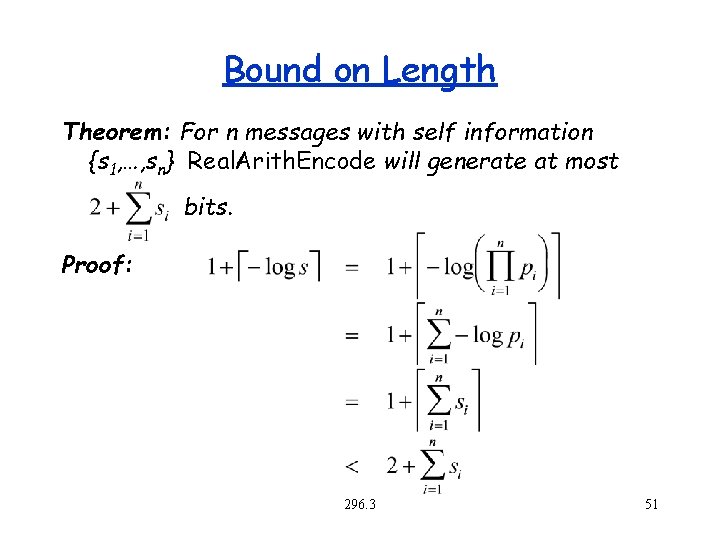
Bound on Length Theorem: For n messages with self information {s 1, …, sn} Real. Arith. Encode will generate at most bits. Proof: 296. 3 51
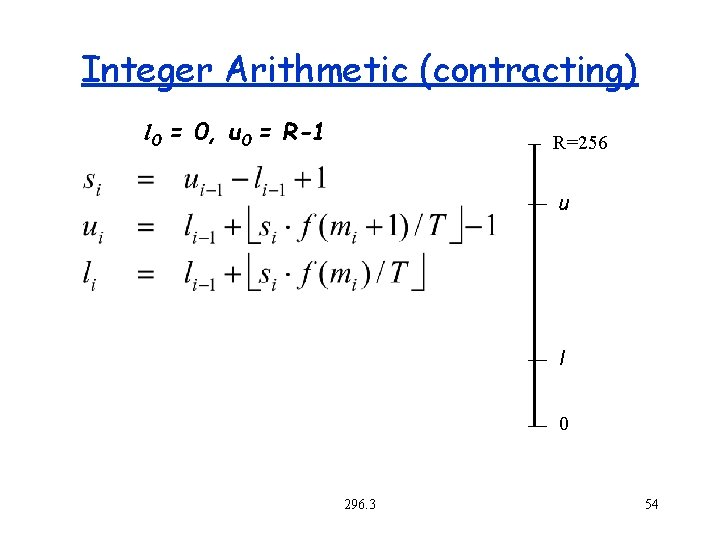
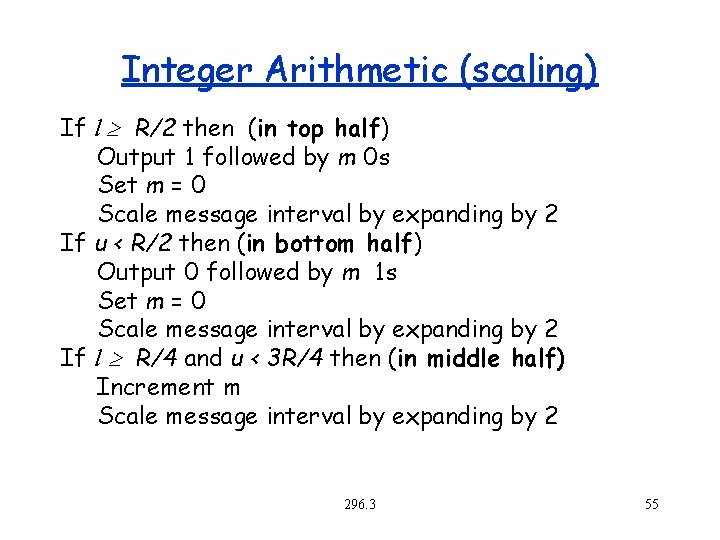
Integer Arithmetic Coding Problem with Real. Arith. Code is that operations on arbitrary precision real numbers is expensive. Key Ideas of integer version: Keep integers in range [0. . R) where R=2 k Use rounding to generate integer sequence interval Whenever sequence interval falls into top, bottom or middle half, expand the interval by factor of 2 This integer Algorithm is an approximation or the real algorithm. 296. 3 52
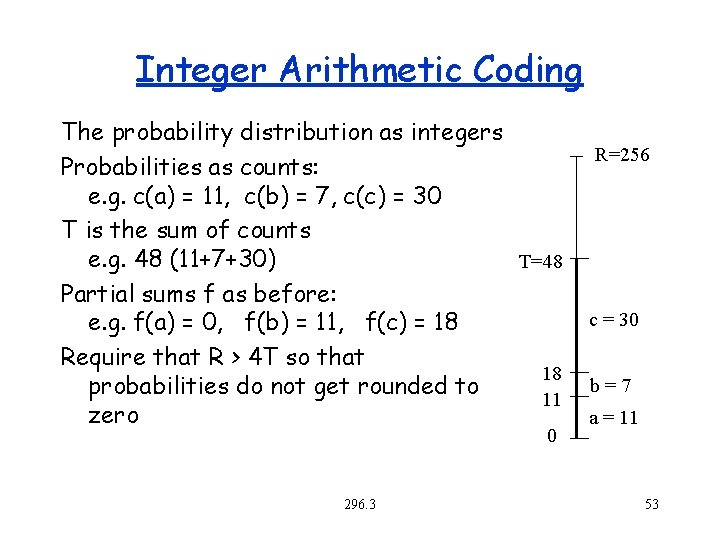
Integer Arithmetic Coding The probability distribution as integers Probabilities as counts: e. g. c(a) = 11, c(b) = 7, c(c) = 30 T is the sum of counts e. g. 48 (11+7+30) T=48 Partial sums f as before: e. g. f(a) = 0, f(b) = 11, f(c) = 18 Require that R > 4 T so that 18 probabilities do not get rounded to 11 zero 0 296. 3 R=256 c = 30 b=7 a = 11 53
Integer Arithmetic (contracting) l 0 = 0, u 0 = R-1 R=256 u l 0 296. 3 54
Integer Arithmetic (scaling) If l R/2 then (in top half) Output 1 followed by m 0 s Set m = 0 Scale message interval by expanding by 2 If u < R/2 then (in bottom half) Output 0 followed by m 1 s Set m = 0 Scale message interval by expanding by 2 If l R/4 and u < 3 R/4 then (in middle half) Increment m Scale message interval by expanding by 2 296. 3 55