
Algorithms HW 6 Willy Chang WeiShao Tang Problem
Algorithms HW 6 Willy Chang, Wei-Shao Tang
Problem 3. • Find an adequate loop invariant for the main while loop in the Partition procedure of the Quicksort algorithm, which is sufficient to show that after the execution of the last two assignment statements the array is properly partitioned by X[Middle]. • Please express the loop invariant as precisely as possible, using mathematical notation.
Problem 3 (Cont’d). • loop invariant guarantees the objective can be satisfied when procedure is done. • Objective: The array is properly partitioned by X[Middle]. • A good start could be writing the objective in mathematical notation.
![Problem 3 (Cont’d). Algorithm Partition (X, Left, Right) begin pivot : = X[Left]; L](http://slidetodoc.com/presentation_image_h2/d5bc1fb40eb33bda21d7709bed891551/image-4.jpg "Problem 3 (Cont’d). Algorithm Partition (X, Left, Right) begin pivot : = X[Left]; L")
Problem 3 (Cont’d). Algorithm Partition (X, Left, Right) begin pivot : = X[Left]; L : = Left; R : = Right; while L < R do while X[L] <= pivot and L <= Right do L : = L + 1; while X[R] > pivot and R >= Left do R : = R - 1; if L < R then swap(X[L], X[R]); Middle : = R; swap(X[Left], X[Middle]); end
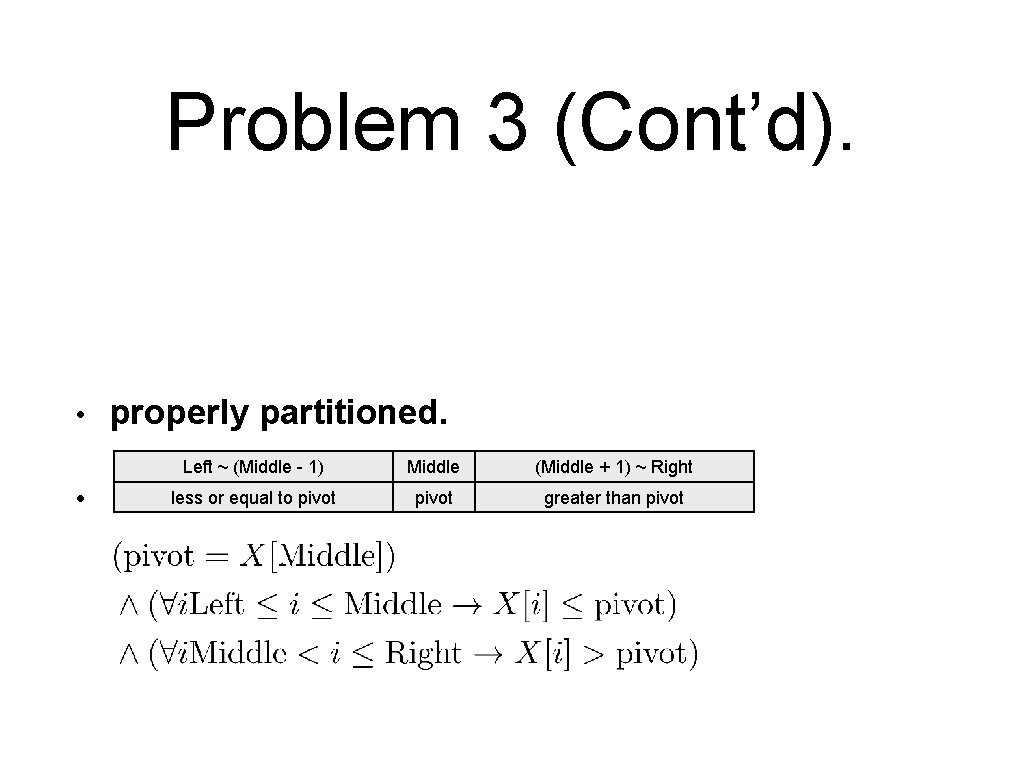
Problem 3 (Cont’d). • • properly partitioned. Left ~ (Middle - 1) Middle (Middle + 1) ~ Right less or equal to pivot greater than pivot
![Problem 3 (Cont’d). Algorithm Partition (X, Left, Right) begin pivot : = X[Left]; L](http://slidetodoc.com/presentation_image_h2/d5bc1fb40eb33bda21d7709bed891551/image-6.jpg "Problem 3 (Cont’d). Algorithm Partition (X, Left, Right) begin pivot : = X[Left]; L")
Problem 3 (Cont’d). Algorithm Partition (X, Left, Right) begin pivot : = X[Left]; L : = Left; R : = Right; while L < R do while X[L] <= pivot and L <= Right do L : = L + 1; while X[R] > pivot and R >= Left do R : = R - 1; if L < R then swap(X[L], X[R]); Middle : = R; swap(X[Left], X[Middle]); end
![Problem 3 (Cont’d). Algorithm Partition (X, Left, Right) begin pivot : = X[Left]; L](http://slidetodoc.com/presentation_image_h2/d5bc1fb40eb33bda21d7709bed891551/image-7.jpg "Problem 3 (Cont’d). Algorithm Partition (X, Left, Right) begin pivot : = X[Left]; L")
Problem 3 (Cont’d). Algorithm Partition (X, Left, Right) begin pivot : = X[Left]; L : = Left; R : = Right; while L < R do while X[L] <= pivot and L <= Right do L : = L + 1; while X[R] > pivot and R >= Left do R : = R - 1; if L < R then swap(X[L], X[R]); Middle : = R; swap(X[Left], X[Middle]); end That’s what holds right after the main while loop.
![Problem 3 (Cont’d). while L < R do while X[L] <= pivot and L](http://slidetodoc.com/presentation_image_h2/d5bc1fb40eb33bda21d7709bed891551/image-8.jpg "Problem 3 (Cont’d). while L < R do while X[L] <= pivot and L")
Problem 3 (Cont’d). while L < R do while X[L] <= pivot and L <= Right do L : = L + 1; while X[R] > pivot and R >= Left do R : = R - 1; if L < R then swap(X[L], X[R]);
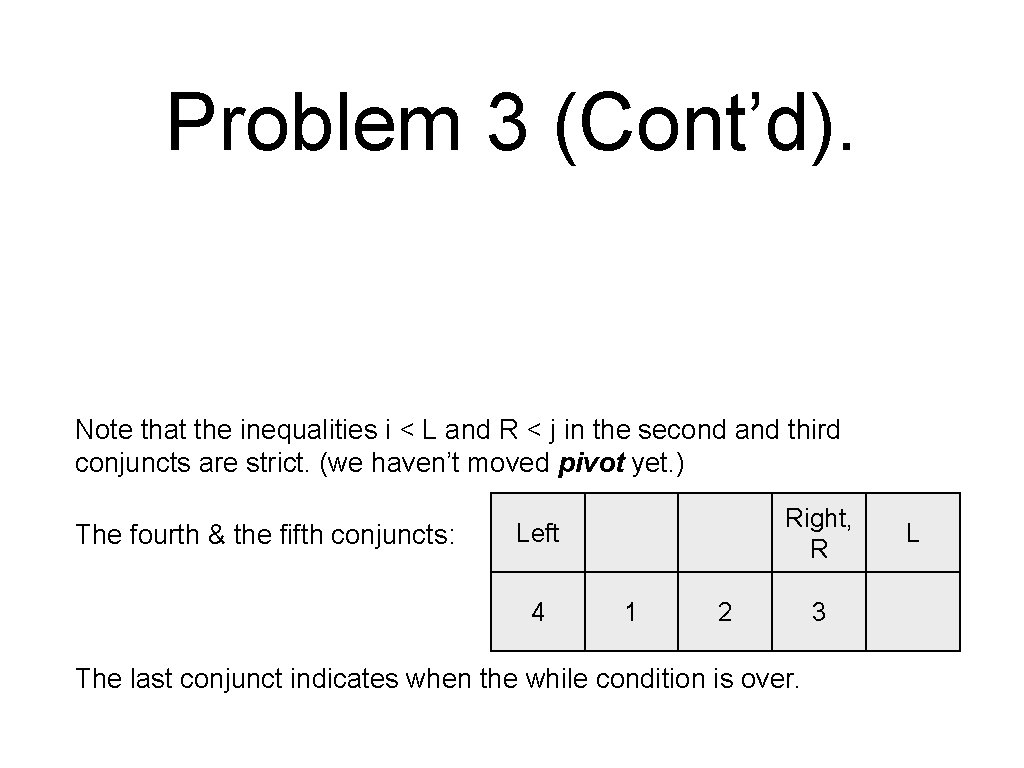
Problem 3 (Cont’d). Note that the inequalities i < L and R < j in the second and third conjuncts are strict. (we haven’t moved pivot yet. ) The fourth & the fifth conjuncts: Right, R Left 4 1 2 The last conjunct indicates when the while condition is over. 3 L
Problem 5. • You are given a set of n coins {C 1, C 2, C 3 … Cn}, among which at least n - 1 are identical "true" coins and at most one coin is "false". A false coin is either lighter or heavier than a true coin. Also, you are given a balance scale, which you may use to compare the total weight of any m coins with that of any other m coins. The problem is to find the "false" coin, or show that there is no such coin, by making some sequence of comparisons using the balance scale. • (a) For the case of n = 12, design a scheme to find the false coin (if there is one) with only three comparisons using the balance. Please use {C 1, C 2, C 3 … Cn} to identify the coins in your scheme. • (b) Prove that, when n = 12, it is not possible to find the false coin with just two comparisons, implying that using just three comparisons is optimal. (Hint: think about decision trees and how many possible outcomes there can be. )
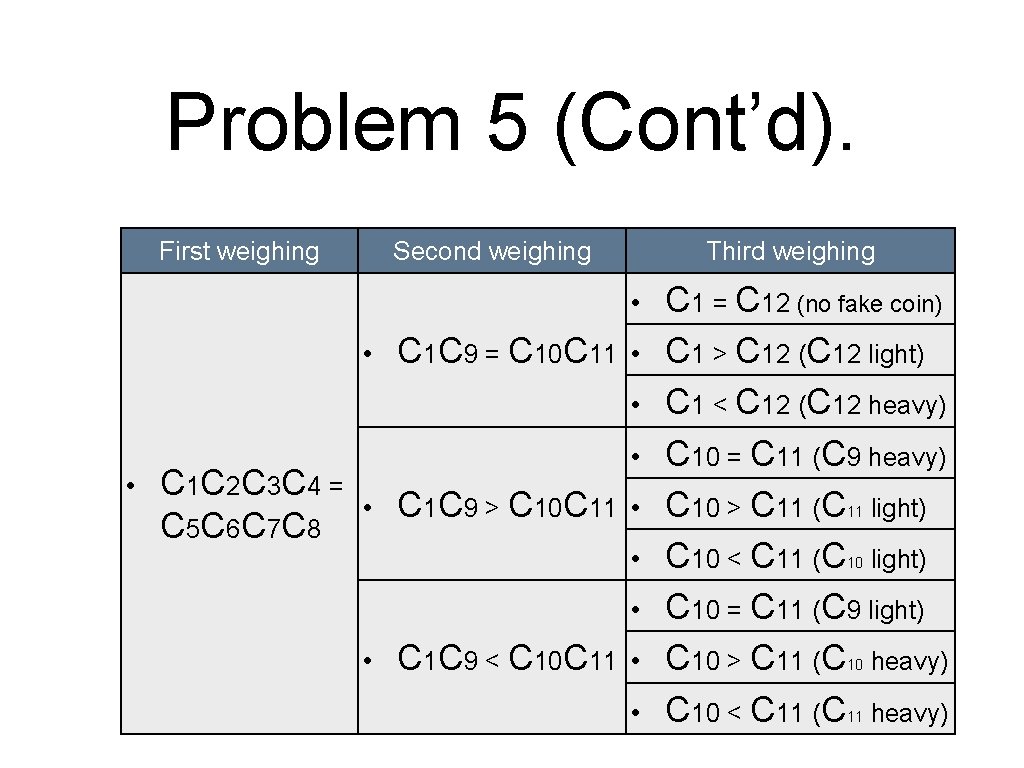
Problem 5 (Cont’d). First weighing Second weighing Third weighing • • C 1 C 9 = C 10 C 11 • • • C 1 C 2 C 3 C 4 = C 5 C 6 C 7 C 8 • • C 1 C 9 > C 10 C 11 • • C 1 C 9 < C 10 C 11 • • C 1 = C 12 (no fake coin) C 1 > C 12 (C 12 light) C 1 < C 12 (C 12 heavy) C 10 = C 11 (C 9 heavy) C 10 > C 11 (C 11 light) C 10 < C 11 (C 10 light) C 10 = C 11 (C 9 light) C 10 > C 11 (C 10 heavy) C 10 < C 11 (C 11 heavy)
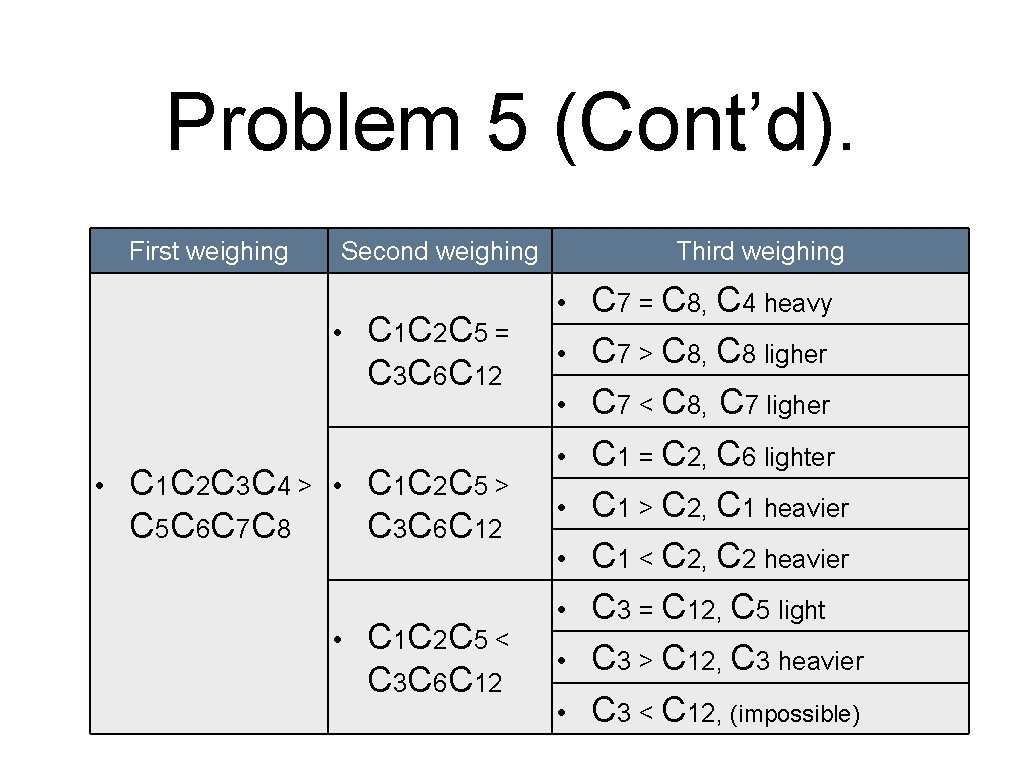
Problem 5 (Cont’d). First weighing Second weighing • • C 1 C 2 C 3 C 4 > C 5 C 6 C 7 C 8 • • C 1 C 2 C 5 = C 3 C 6 C 12 C 1 C 2 C 5 > C 3 C 6 C 12 C 1 C 2 C 5 < C 3 C 6 C 12 Third weighing • • • C 7 = C 8, C 4 heavy C 7 > C 8, C 8 ligher C 7 < C 8, C 7 ligher C 1 = C 2, C 6 lighter C 1 > C 2, C 1 heavier C 1 < C 2, C 2 heavier C 3 = C 12, C 5 light C 3 > C 12, C 3 heavier C 3 < C 12, (impossible)
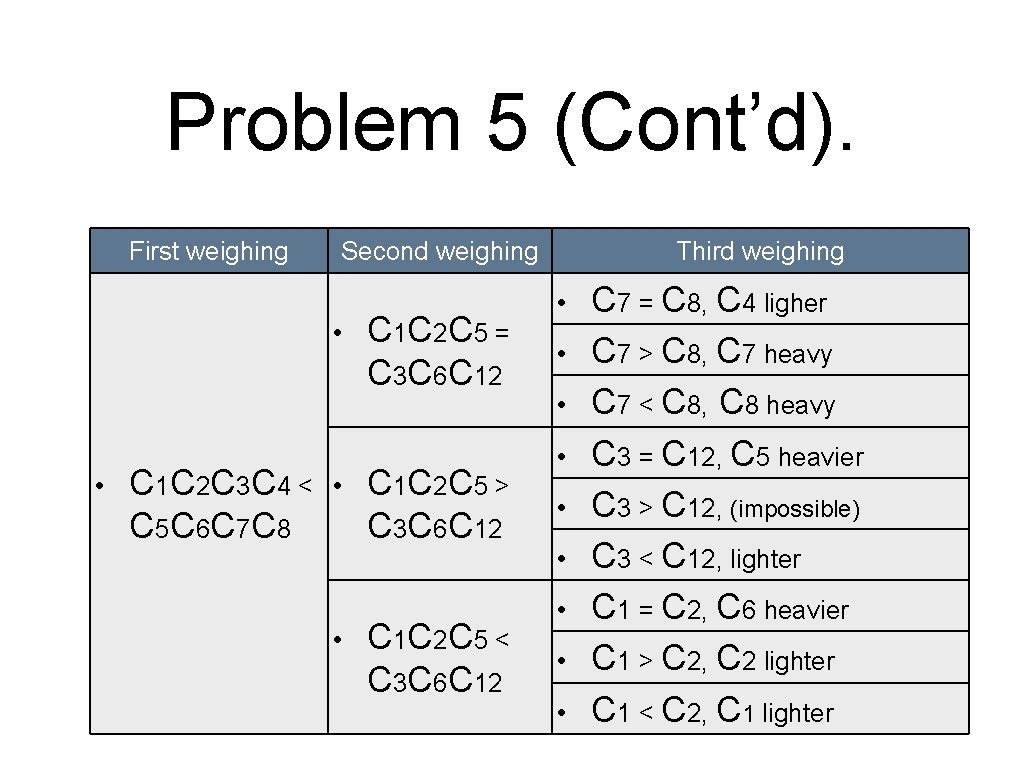
Problem 5 (Cont’d). First weighing Second weighing • • C 1 C 2 C 3 C 4 < C 5 C 6 C 7 C 8 • • C 1 C 2 C 5 = C 3 C 6 C 12 C 1 C 2 C 5 > C 3 C 6 C 12 C 1 C 2 C 5 < C 3 C 6 C 12 Third weighing • • • C 7 = C 8, C 4 ligher C 7 > C 8, C 7 heavy C 7 < C 8, C 8 heavy C 3 = C 12, C 5 heavier C 3 > C 12, (impossible) C 3 < C 12, lighter C 1 = C 2, C 6 heavier C 1 > C 2, C 2 lighter C 1 < C 2, C 1 lighter
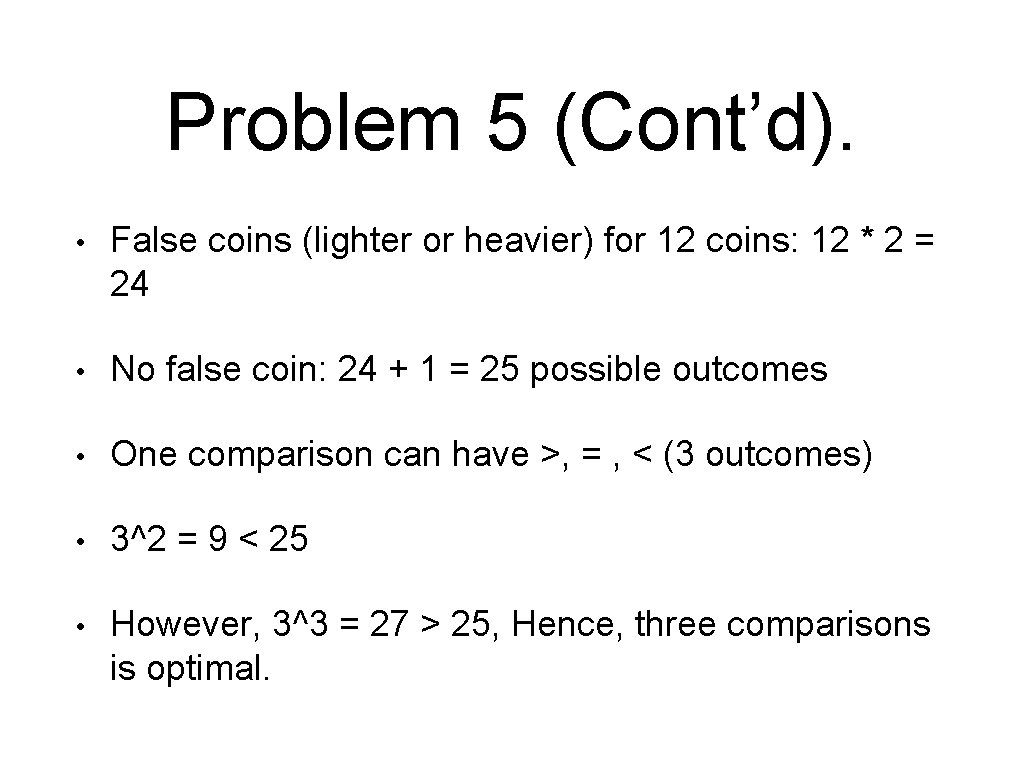
Problem 5 (Cont’d). • False coins (lighter or heavier) for 12 coins: 12 * 2 = 24 • No false coin: 24 + 1 = 25 possible outcomes • One comparison can have >, = , < (3 outcomes) • 3^2 = 9 < 25 • However, 3^3 = 27 > 25, Hence, three comparisons is optimal.
- Slides: 14