
ALGORITHMS FOR ULTRA PERIPHERAL COLLISIONS WITH THE ALICE
- Slides: 1
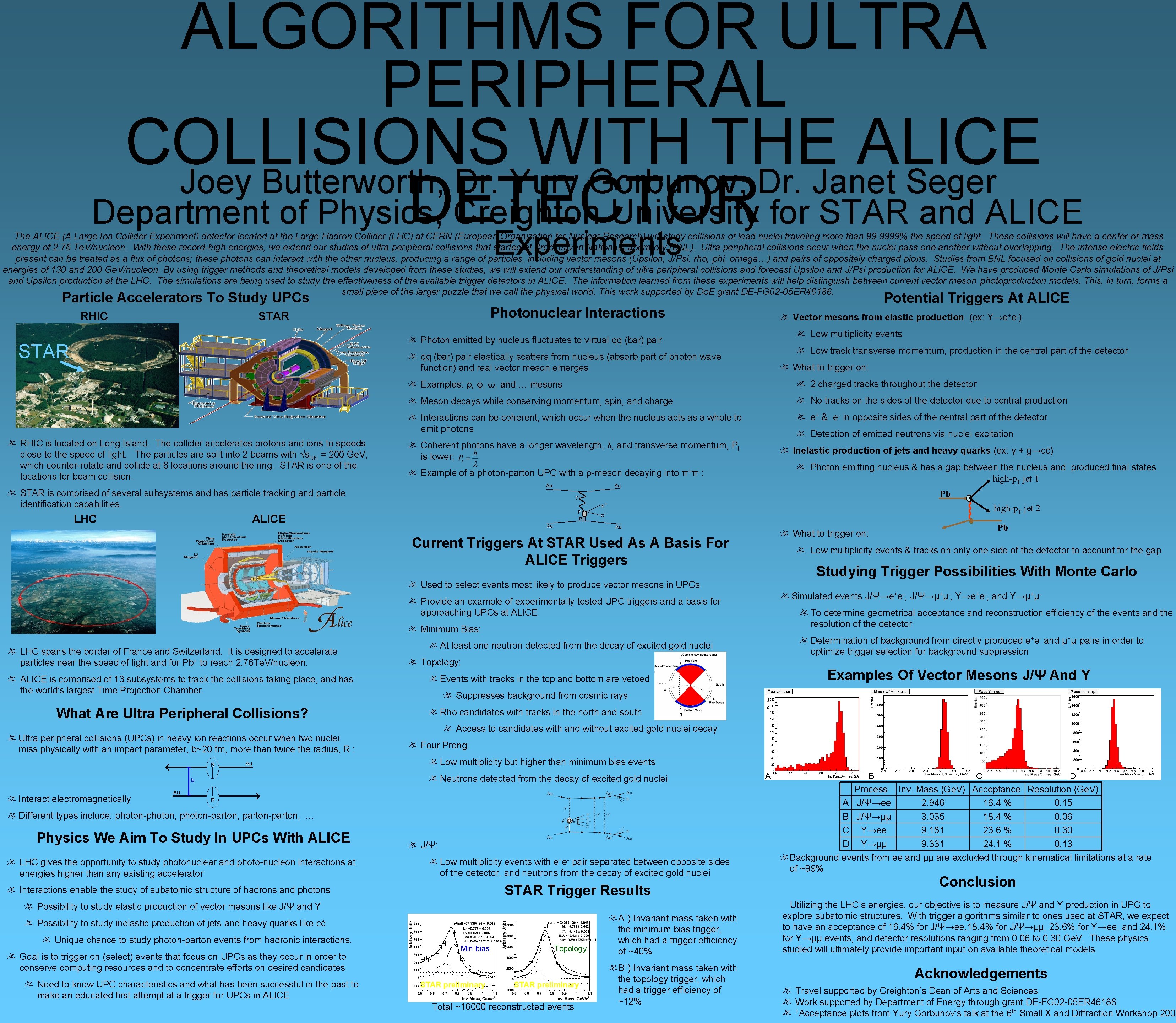
ALGORITHMS FOR ULTRA PERIPHERAL COLLISIONS WITH THE ALICE Joey Butterworth, Dr. Yury Gorbunov, Dr. Janet Seger DETECTOR Department of Physics, Creighton University for STAR and ALICE Experiments The ALICE (A Large Ion Collider Experiment) detector located at the Large Hadron Collider (LHC) at CERN (European Organization for Nuclear Research) will study collisions of lead nuclei traveling more than 99. 9999% the speed of light. These collisions will have a center-of-mass energy of 2. 76 Te. V/nucleon. With these record-high energies, we extend our studies of ultra peripheral collisions that started at Brookhaven National Laboratory (BNL). Ultra peripheral collisions occur when the nuclei pass one another without overlapping. The intense electric fields present can be treated as a flux of photons; these photons can interact with the other nucleus, producing a range of particles, including vector mesons (Upsilon, J/Psi, rho, phi, omega…) and pairs of oppositely charged pions. Studies from BNL focused on collisions of gold nuclei at energies of 130 and 200 Ge. V/nucleon. By using trigger methods and theoretical models developed from these studies, we will extend our understanding of ultra peripheral collisions and forecast Upsilon and J/Psi production for ALICE. We have produced Monte Carlo simulations of J/Psi and Upsilon production at the LHC. The simulations are being used to study the effectiveness of the available trigger detectors in ALICE. The information learned from these experiments will help distinguish between current vector meson photoproduction models. This, in turn, forms a small piece of the larger puzzle that we call the physical world. This work supported by Do. E grant DE-FG 02 -05 ER 46186. Particle Accelerators To Study UPCs RHIC Potential Triggers At ALICE Photonuclear Interactions STAR Vector mesons from elastic production (ex: Υ→e+e-) Low multiplicity events Photon emitted by nucleus fluctuates to virtual qq (bar) pair STAR Low track transverse momentum, production in the central part of the detector qq (bar) pair elastically scatters from nucleus (absorb part of photon wave function) and real vector meson emerges RHIC is located on Long Island. The collider accelerates protons and ions to speeds close to the speed of light. The particles are split into 2 beams with √s. NN = 200 Ge. V, which counter-rotate and collide at 6 locations around the ring. STAR is one of the locations for beam collision. What to trigger on: Examples: ρ, φ, ω, and … mesons 2 charged tracks throughout the detector Meson decays while conserving momentum, spin, and charge No tracks on the sides of the detector due to central production Interactions can be coherent, which occur when the nucleus acts as a whole to emit photons e+ & e- in opposite sides of the central part of the detector Detection of emitted neutrons via nuclei excitation Coherent photons have a longer wavelength, λ, and transverse momentum, Pt is lower; Example of a photon-parton UPC with a ρ-meson decaying into Inelastic production of jets and heavy quarks (ex: γ + g→cċ) Photon emitting nucleus & has a gap between the nucleus and produced final states high-p. T jet 1 π +π - : STAR is comprised of several subsystems and has particle tracking and particle identification capabilities. LHC Pb high-p. T jet 2 ALICE Pb What to trigger on: Current Triggers At STAR Used As A Basis For ALICE Triggers Low multiplicity events & tracks on only one side of the detector to account for the gap Studying Trigger Possibilities With Monte Carlo Used to select events most likely to produce vector mesons in UPCs Simulated events J/Ψ→e+e-, J/Ψ→μ+μ-, Υ→e+e-, and Υ→μ+μ- Provide an example of experimentally tested UPC triggers and a basis for approaching UPCs at ALICE To determine geometrical acceptance and reconstruction efficiency of the events and the resolution of the detector Minimum Bias: Determination of background from directly produced e+e- and μ+μ- pairs in order to optimize trigger selection for background suppression At least one neutron detected from the decay of excited gold nuclei LHC spans the border of France and Switzerland. It is designed to accelerate particles near the speed of light and for Pb+ to reach 2. 76 Te. V/nucleon. Topology: Examples Of Vector Mesons J/Ψ And Υ Events with tracks in the top and bottom are vetoed ALICE is comprised of 13 subsystems to track the collisions taking place, and has the world’s largest Time Projection Chamber. Suppresses background from cosmic rays What Are Ultra Peripheral Collisions? Rho candidates with tracks in the north and south Access to candidates with and without excited gold nuclei decay Ultra peripheral collisions (UPCs) in heavy ion reactions occur when two nuclei miss physically with an impact parameter, b~20 fm, more than twice the radius, R : Four Prong: Low multiplicity but higher than minimum bias events Neutrons detected from the decay of excited gold nuclei Interact electromagnetically Different types include: photon-photon, photon-parton, parton-parton, … Physics We Aim To Study In UPCs With ALICE J/Ψ: Low multiplicity events with e+e- pair separated between opposite sides of the detector, and neutrons from the decay of excited gold nuclei LHC gives the opportunity to study photonuclear and photo-nucleon interactions at energies higher than any existing accelerator STAR Trigger Results Interactions enable the study of subatomic structure of hadrons and photons Possibility to study elastic production of vector mesons like J/Ψ and Υ Possibility to study inelastic production of jets and heavy quarks like cċ Unique chance to study photon-parton events from hadronic interactions. Min bias Goal is to trigger on (select) events that focus on UPCs as they occur in order to conserve computing resources and to concentrate efforts on desired candidates Need to know UPC characteristics and what has been successful in the past to make an educated first attempt at a trigger for UPCs in ALICE A) STAR preliminary Topology B) STAR preliminary Total ~16000 reconstructed events A 1) Invariant mass taken with the minimum bias trigger, which had a trigger efficiency of ~40% B 1) Invariant mass taken with the topology trigger, which had a trigger efficiency of ~12% A B C D Process Inv. Mass (Ge. V) Acceptance Resolution (Ge. V) A J/Ψ→ee 2. 946 16. 4 % 0. 15 B J/Ψ→μμ 3. 035 18. 4 % 0. 06 C Υ→ee 9. 161 23. 6 % 0. 30 D Υ→μμ 9. 331 24. 1 % 0. 13 Background events from ee and μμ are excluded through kinematical limitations at a rate of ~99% Conclusion Utilizing the LHC’s energies, our objective is to measure J/Ψ and Υ production in UPC to explore subatomic structures. With trigger algorithms similar to ones used at STAR, we expect to have an acceptance of 16. 4% for J/Ψ→ee, 18. 4% for J/Ψ→μμ, 23. 6% for Υ→ee, and 24. 1% for Υ→μμ events, and detector resolutions ranging from 0. 06 to 0. 30 Ge. V. These physics studied will ultimately provide important input on available theoretical models. Acknowledgements Travel supported by Creighton’s Dean of Arts and Sciences Work supported by Department of Energy through grant DE-FG 02 -05 ER 46186 1 Acceptance plots from Yury Gorbunov’s talk at the 6 th Small X and Diffraction Workshop 2007