
Algorithms for Frequency Assignment Problems Feodor F Dragan
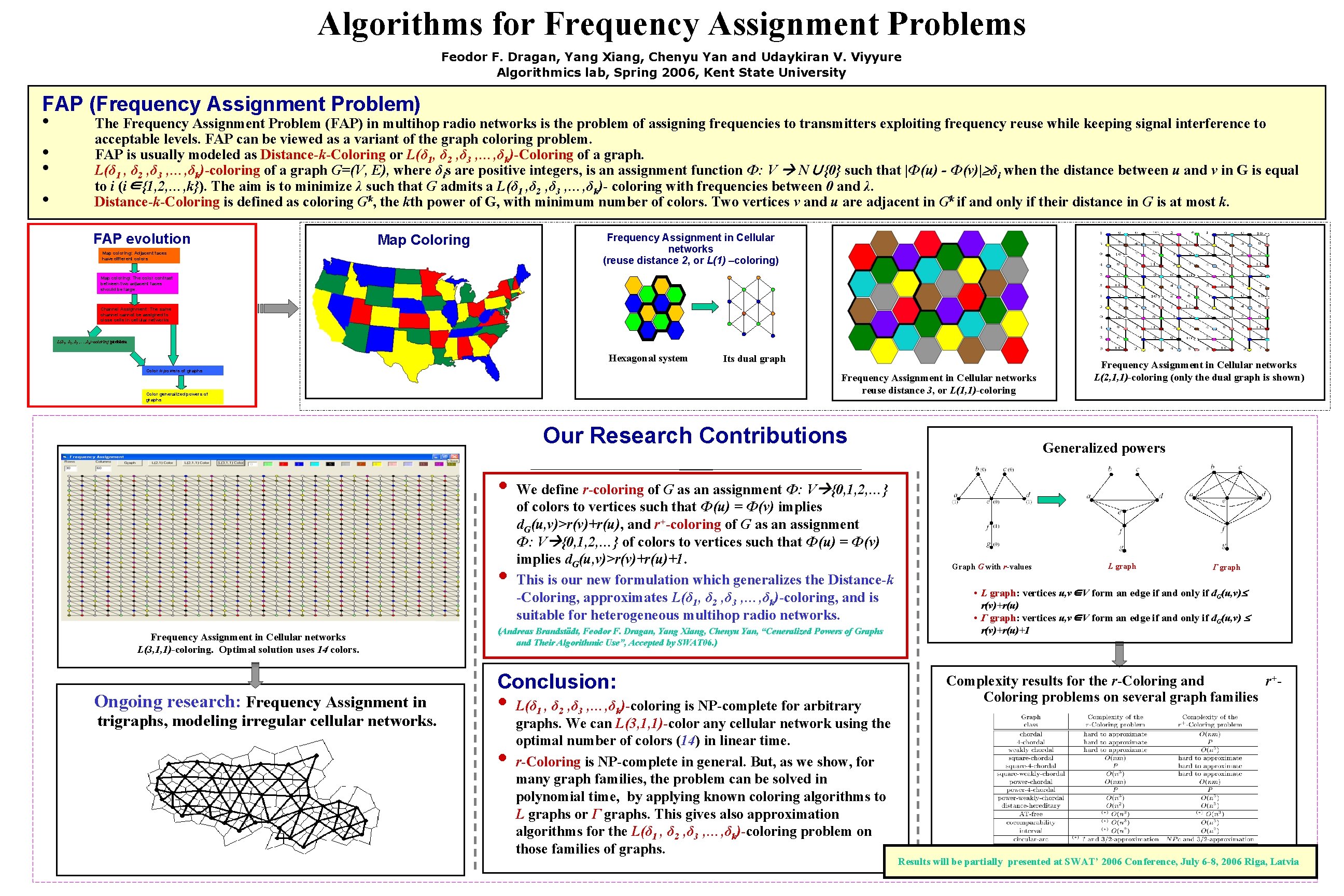
Algorithms for Frequency Assignment Problems Feodor F. Dragan, Yang Xiang, Chenyu Yan and Udaykiran V. Viyyure Algorithmics lab, Spring 2006, Kent State University FAP (Frequency Assignment Problem) • • The Frequency Assignment Problem (FAP) in multihop radio networks is the problem of assigning frequencies to transmitters exploiting frequency reuse while keeping signal interference to acceptable levels. FAP can be viewed as a variant of the graph coloring problem. FAP is usually modeled as Distance-k-Coloring or L(δ 1, δ 2 , δ 3 , …, δk)-Coloring of a graph. L(δ 1 , δ 2 , δ 3 , …, δk)-coloring of a graph G=(V, E), where δis are positive integers, is an assignment function Ф: V N∪{0} such that |Ф(u) - Ф(v)| δi when the distance between u and v in G is equal to i (i∈{1, 2, …, k}). The aim is to minimize λ such that G admits a L(δ 1 , δ 2 , δ 3 , …, δk)- coloring with frequencies between 0 and λ. Distance-k-Coloring is defined as coloring Gk, the kth power of G, with minimum number of colors. Two vertices v and u are adjacent in Gk if and only if their distance in G is at most k. FAP evolution Map Coloring Frequency Assignment in Cellular networks (reuse distance 2, or L(1) –coloring) Map coloring: Adjacent faces have different colors Map coloring: The color contrast between two adjacent faces should be large. Channel Assignment: The same channel cannot be assigned to close cells in cellular networks L(δ 1, δ 2 , δ 3 , …, δk)-coloring problem Hexagonal system Color k-powers of graphs Its dual graph Frequency Assignment in Cellular networks reuse distance 3, or L(1, 1)-coloring Color generalized powers of graphs Our Research Contributions Frequency Assignment in Cellular networks L(2, 1, 1)-coloring (only the dual graph is shown) Generalized powers • We define r-coloring of G as an assignment Ф: V {0, 1, 2, …} • Frequency Assignment in Cellular networks L(3, 1, 1)-coloring. Optimal solution uses 14 colors. Ongoing research: Frequency Assignment in trigraphs, modeling irregular cellular networks. of colors to vertices such that Ф(u) = Ф(v) implies d. G(u, v)>r(v)+r(u), and r+-coloring of G as an assignment Ф: V {0, 1, 2, …} of colors to vertices such that Ф(u) = Ф(v) implies d. G(u, v)>r(v)+r(u)+1. This is our new formulation which generalizes the Distance-k -Coloring, approximates L(δ 1, δ 2 , δ 3 , …, δk)-coloring, and is suitable for heterogeneous multihop radio networks. (Andreas Brandstädt, Feodor F. Dragan, Yang Xiang, Chenyu Yan, “Ceneralized Powers of Graphs and Their Algorithmic Use”, Accepted by SWAT 06. ) Conclusion: • L(δ , δ , …, δ )-coloring is NP-complete for arbitrary 1 • 2 3 Graph G with r-values L graph Γ graph • L graph: vertices u, v∈V form an edge if and only if d. G(u, v) r(v)+r(u) • Γ graph: vertices u, v∈V form an edge if and only if d. G(u, v) r(v)+r(u)+1 Complexity results for the r-Coloring and r+ Coloring problems on several graph families k graphs. We can L(3, 1, 1)-color any cellular network using the optimal number of colors (14) in linear time. r-Coloring is NP-complete in general. But, as we show, for many graph families, the problem can be solved in polynomial time, by applying known coloring algorithms to L graphs or Γ graphs. This gives also approximation algorithms for the L(δ 1 , δ 2 , δ 3 , …, δk)-coloring problem on those families of graphs. Results will be partially presented at SWAT’ 2006 Conference, July 6 -8, 2006 Riga, Latvia
- Slides: 1