
Algorithms for Constraint Satisfaction in User Interfaces Scott


![Algorithm is “partially optimal” Optimal in set of equations evaluated [*] – Under fairly](https://slidetodoc.com/presentation_image_h2/d5e7f9293fe6c17128bba94faf00a89d/image-62.jpg "Algorithm is “partially optimal” Optimal in set of equations evaluated [*] – Under fairly")



- Slides: 75
Algorithms for Constraint Satisfaction in User Interfaces Scott Hudson
Constraints (quick review) General mechanism for establishing and maintaining relationships between things layout is a good motivating example – several other uses in UI deriving appearance from data automated semantic feedback maintaining highlight & enable status multiple views of same data – 2
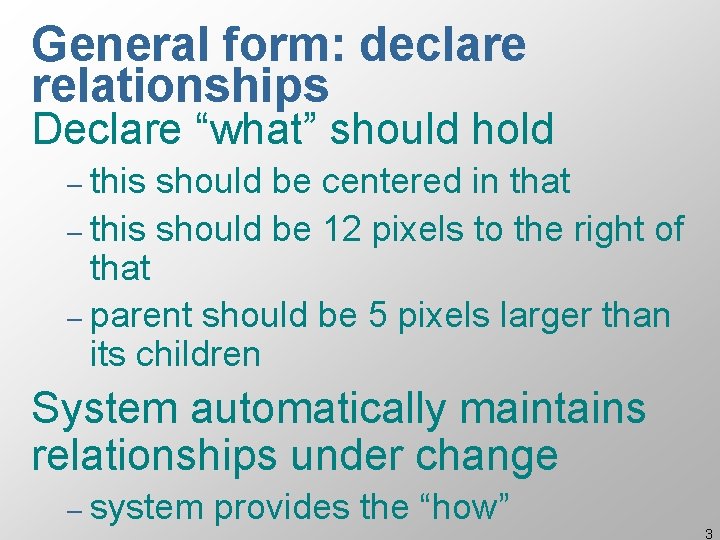
General form: declare relationships Declare “what” should hold – this should be centered in that – this should be 12 pixels to the right of that – parent should be 5 pixels larger than its children System automatically maintains relationships under change – system provides the “how” 3
You say what System figures out how A very good deal But sounds too good to be true 4
You say what System figures out how A very good deal But sounds too good to be true – It is: can’t do this for arbitrary things (unsolvable problem) Good news: this can be done if you limit form of constraints – limits are reasonable – can be done very efficiently 5
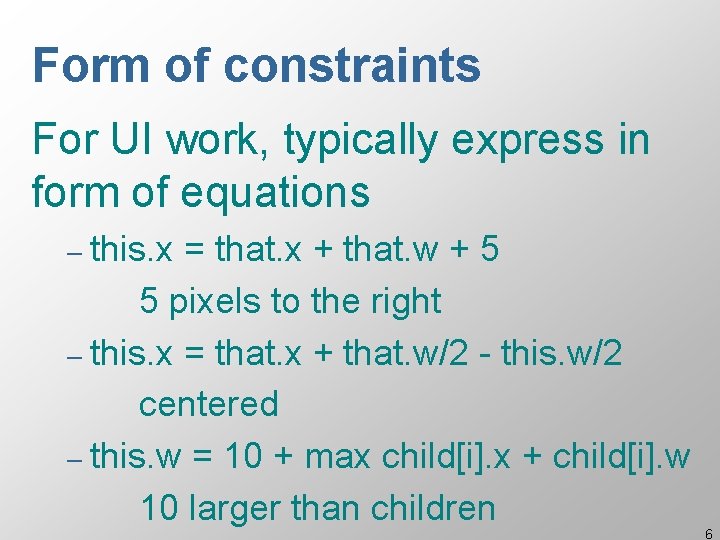
Form of constraints For UI work, typically express in form of equations – this. x = that. x + that. w + 5 5 pixels to the right – this. x = that. x + that. w/2 - this. w/2 centered – this. w = 10 + max child[i]. x + child[i]. w 10 larger than children 6
Power of constraints If something changes, system can determine effects – automatically – just change the object that has to change, the rest “just happens” • very nice property 7
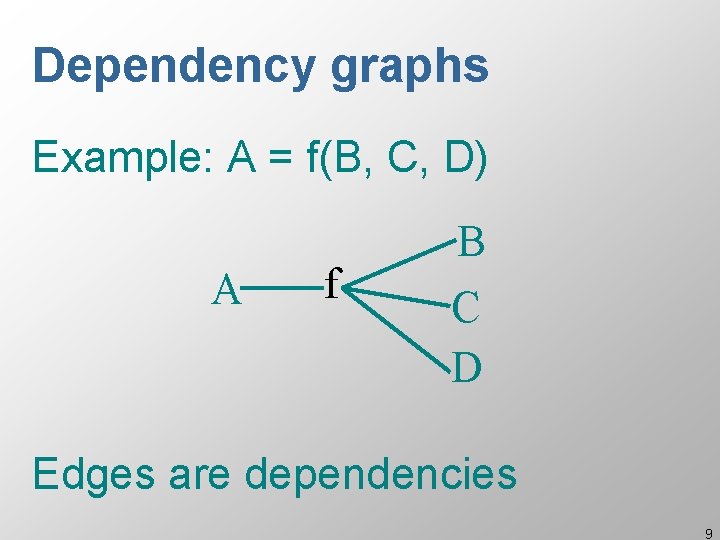
Dependency graphs Useful to look at a system of constraints as a “dependency graph” – graph showing what depends on what – two kinds of nodes (bipartite graph) variables (values to be constrained) constraints (equations that relate) 8
Dependency graphs Example: A = f(B, C, D) A f B C D Edges are dependencies 9
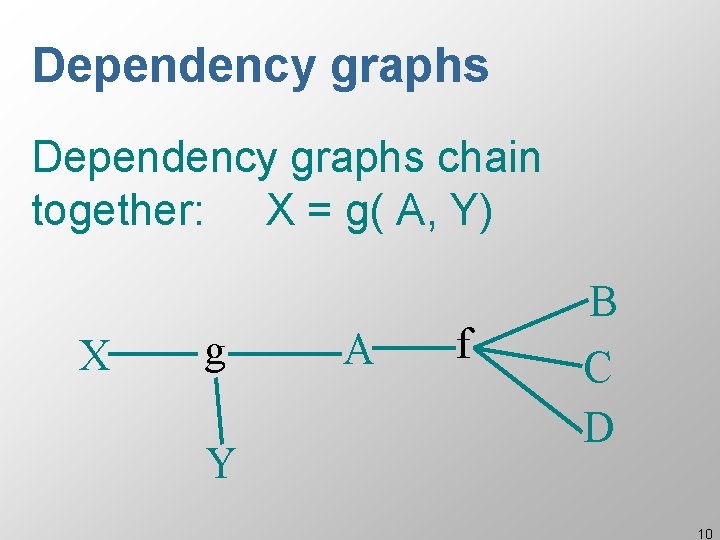
Dependency graphs chain together: X = g( A, Y) X g Y A f B C D 10
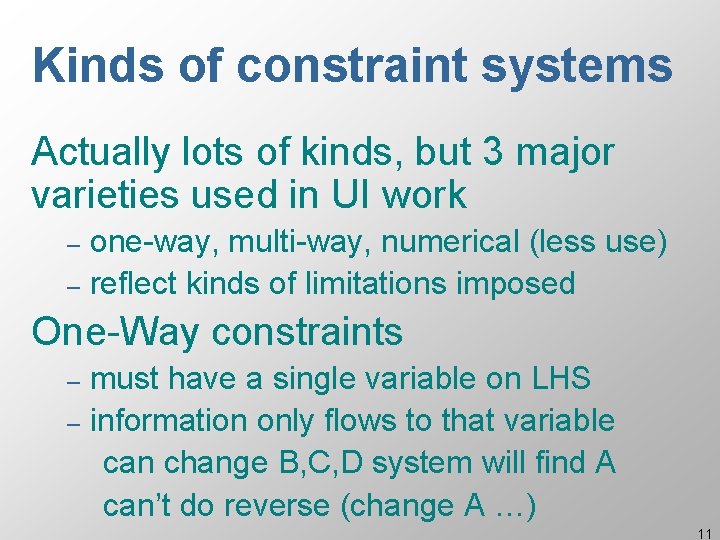
Kinds of constraint systems Actually lots of kinds, but 3 major varieties used in UI work one-way, multi-way, numerical (less use) – reflect kinds of limitations imposed – One-Way constraints must have a single variable on LHS – information only flows to that variable can change B, C, D system will find A can’t do reverse (change A …) – 11
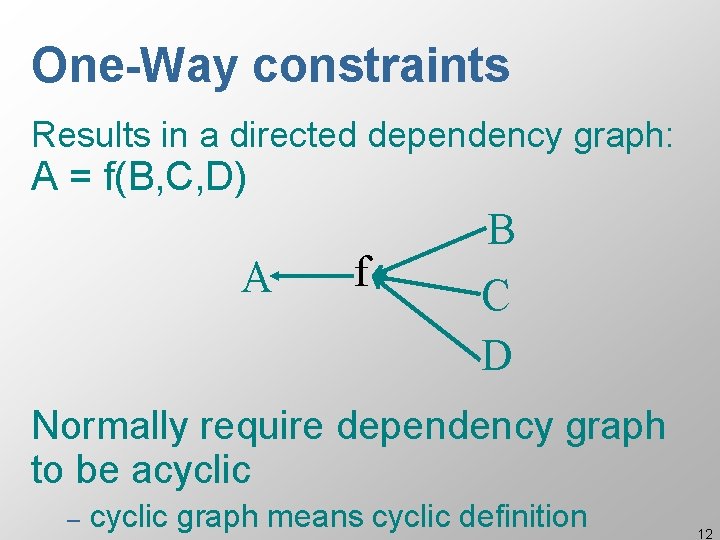
One-Way constraints Results in a directed dependency graph: A = f(B, C, D) A f B C D Normally require dependency graph to be acyclic – cyclic graph means cyclic definition 12
One-Way constraints Problem with one-way: introduces an asymmetry this. x = that. x + that. w + 5 – can move “that” (change that. x) but can’t move “this” 13
Multi-way constraints Don’t require info flow only to the left in equation – can change A and have system find B, C, D Not as hard as it might seem – most systems require you to explicitly factor the equations for them • provide B = g(A, C, D), etc. 14
Multi-way constraints Modeled as an undirected dependency graph No longer have asymmetry 15
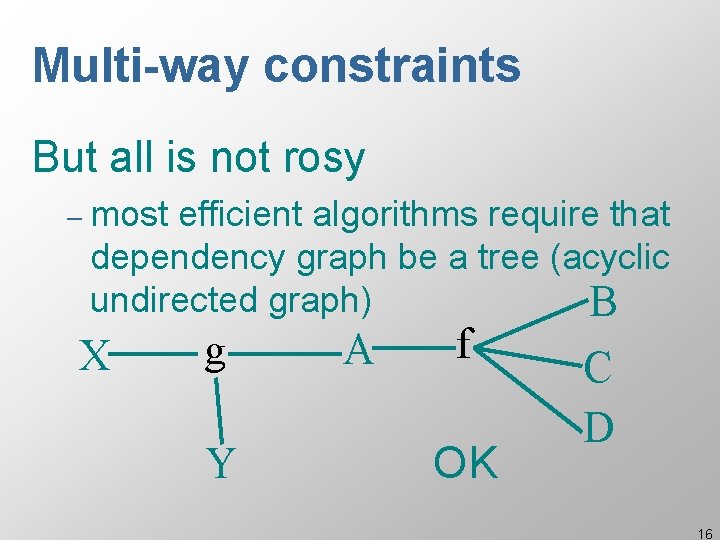
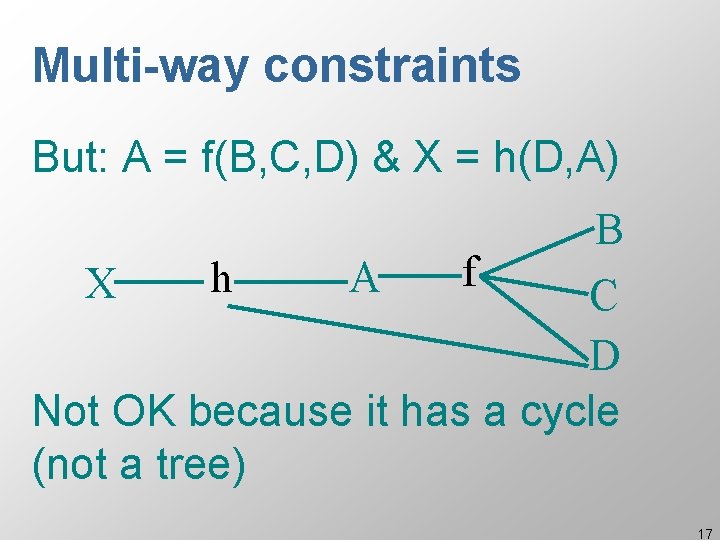
Multi-way constraints But all is not rosy – most efficient algorithms require that dependency graph be a tree (acyclic undirected graph) B X g Y A f OK C D 16
Multi-way constraints But: A = f(B, C, D) & X = h(D, A) X h A f B C D Not OK because it has a cycle (not a tree) 17
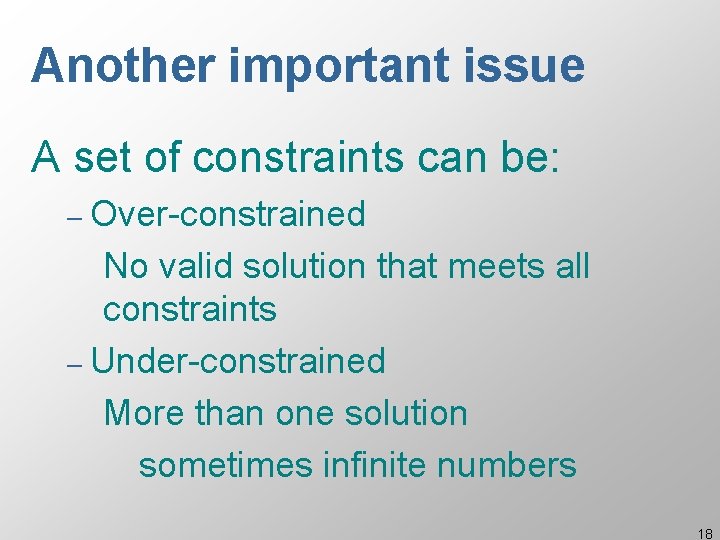
Another important issue A set of constraints can be: – Over-constrained No valid solution that meets all constraints – Under-constrained More than one solution sometimes infinite numbers 18
Over- and under-constrained Over-constrained systems – solver will fail – isn’t nice to do this in interactive systems – typically need to avoid this • need at least a “fallback” solution 19
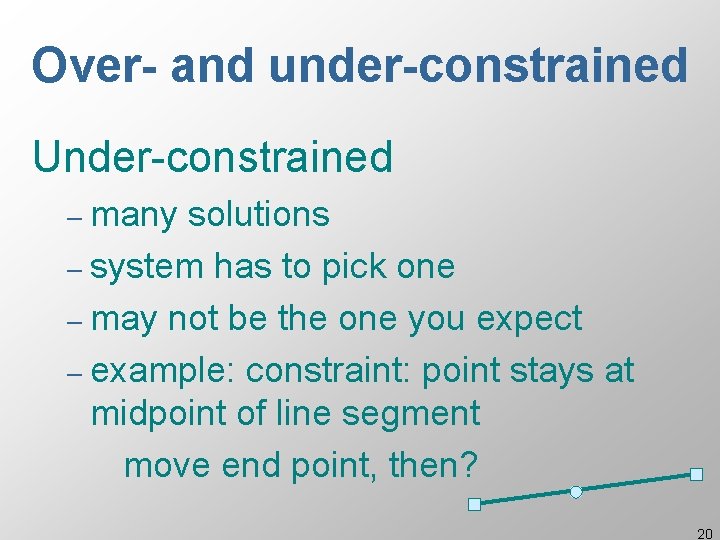
Over- and under-constrained Under-constrained – many solutions – system has to pick one – may not be the one you expect – example: constraint: point stays at midpoint of line segment move end point, then? 20
Over- and under-constrained Under-constrained – example: constraint: point stays at midpoint of line segment move end point, then? Lots of valid solutions move other end point collapse to one point etc. 21
Over- and under-constrained Good news is that one-way is never over- or under-constrained (assuming acyclic) – system makes no arbitrary choices – pretty easy to understand 22
Over- and under-constrained Multi-way can be either over- or under-constrained – have to pay for extra power somewhere – typical approach is to over-constrain, but have a mechanism for breaking / loosening constraints in priority order • one means: “constraint hierarchies” 23
Over- and under-constrained Multi-way can be either over- or under-constrained – unfortunately system still has to make arbitrary choices – generally harder to understand control 24
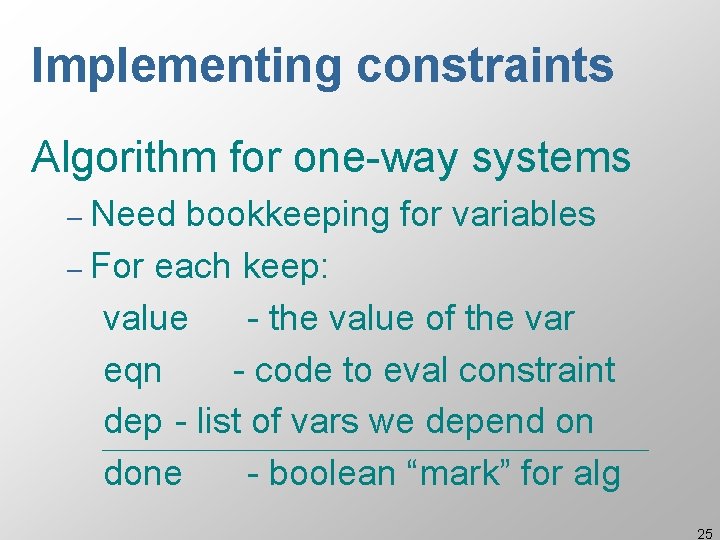
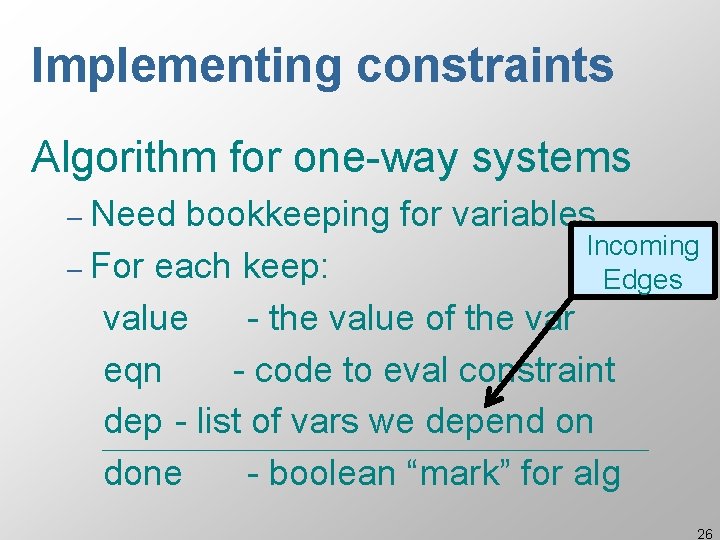
Implementing constraints Algorithm for one-way systems – Need bookkeeping for variables – For each keep: value - the value of the var eqn - code to eval constraint dep - list of vars we depend on done - boolean “mark” for alg 25
Implementing constraints Algorithm for one-way systems – Need bookkeeping for variables Incoming – For each keep: Edges value - the value of the var eqn - code to eval constraint dep - list of vars we depend on done - boolean “mark” for alg 26
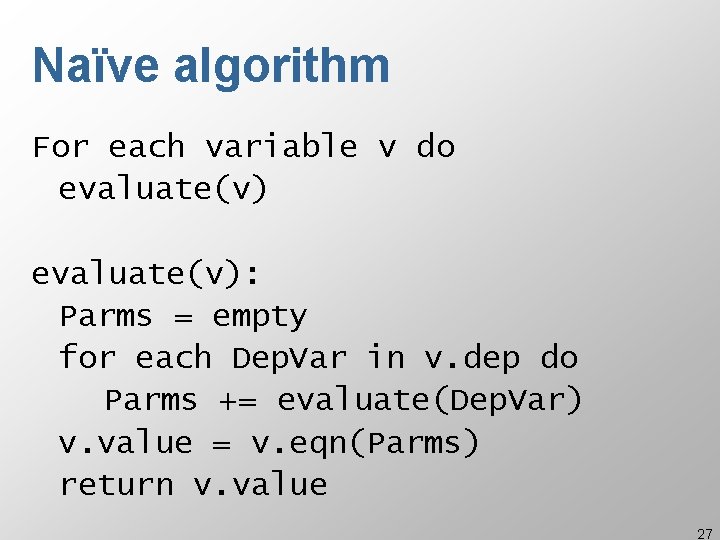
Naïve algorithm For each variable v do evaluate(v): Parms = empty for each Dep. Var in v. dep do Parms += evaluate(Dep. Var) v. value = v. eqn(Parms) return v. value 27
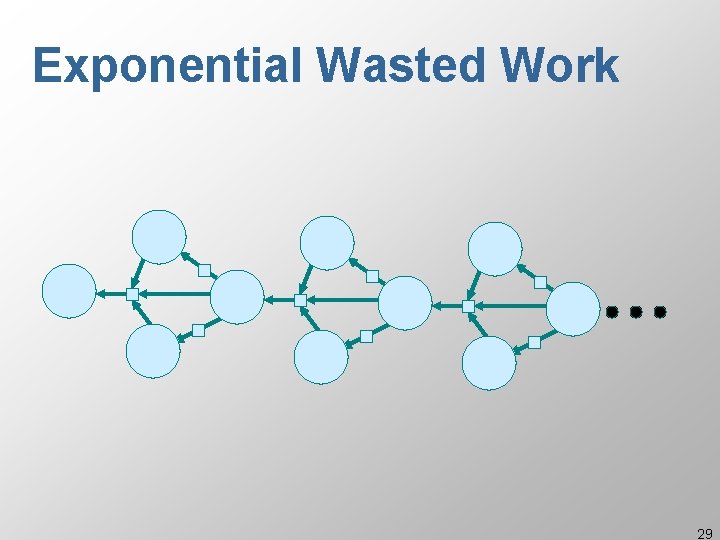
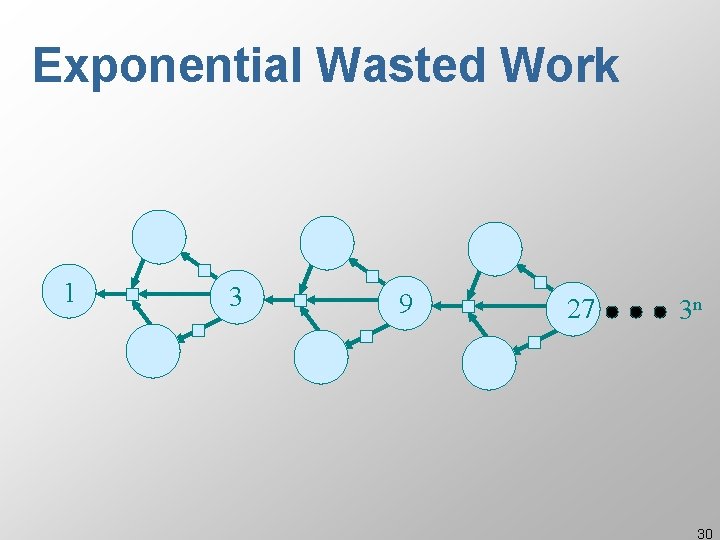
Why is this not a good plan? 28
Exponential Wasted Work 29
Exponential Wasted Work 1 3 9 27 3 n 30
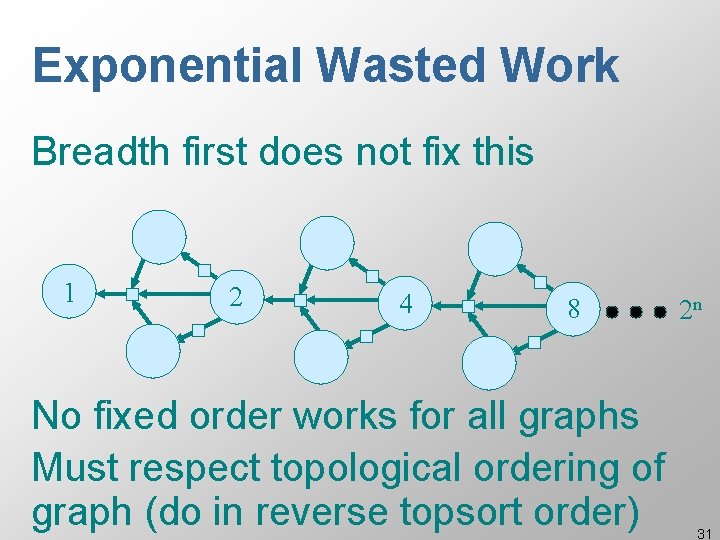
Exponential Wasted Work Breadth first does not fix this 1 2 4 8 No fixed order works for all graphs Must respect topological ordering of graph (do in reverse topsort order) 2 n 31
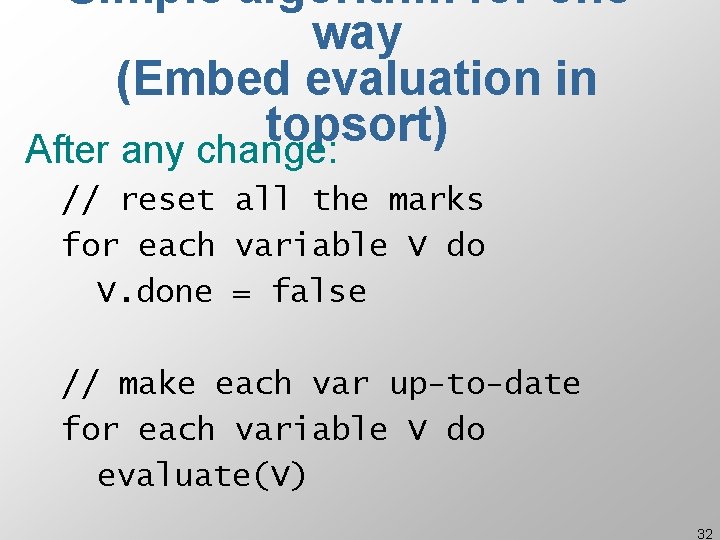
Simple algorithm for oneway (Embed evaluation in topsort) After any change: // reset all the marks for each variable V do V. done = false // make each var up-to-date for each variable V do evaluate(V) 32
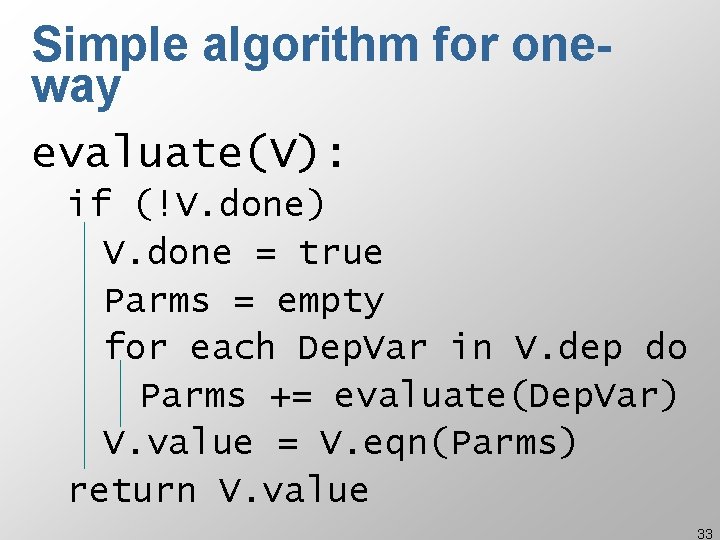
Simple algorithm for oneway evaluate(V): if (!V. done) V. done = true Parms = empty for each Dep. Var in V. dep do Parms += evaluate(Dep. Var) V. value = V. eqn(Parms) return V. value 33
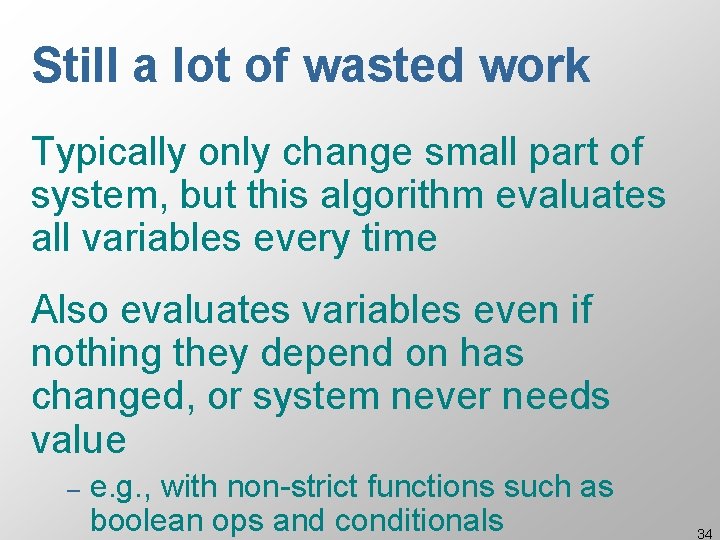
Still a lot of wasted work Typically only change small part of system, but this algorithm evaluates all variables every time Also evaluates variables even if nothing they depend on has changed, or system never needs value – e. g. , with non-strict functions such as boolean ops and conditionals 34
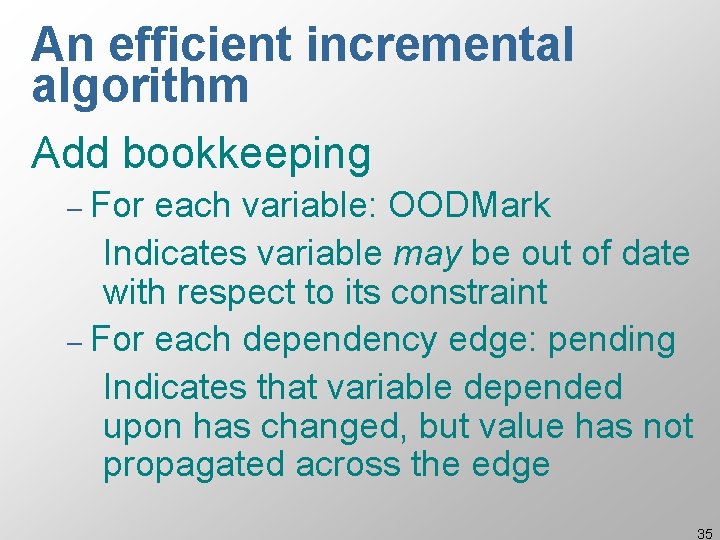
An efficient incremental algorithm Add bookkeeping – For each variable: OODMark Indicates variable may be out of date with respect to its constraint – For each dependency edge: pending Indicates that variable depended upon has changed, but value has not propagated across the edge 35
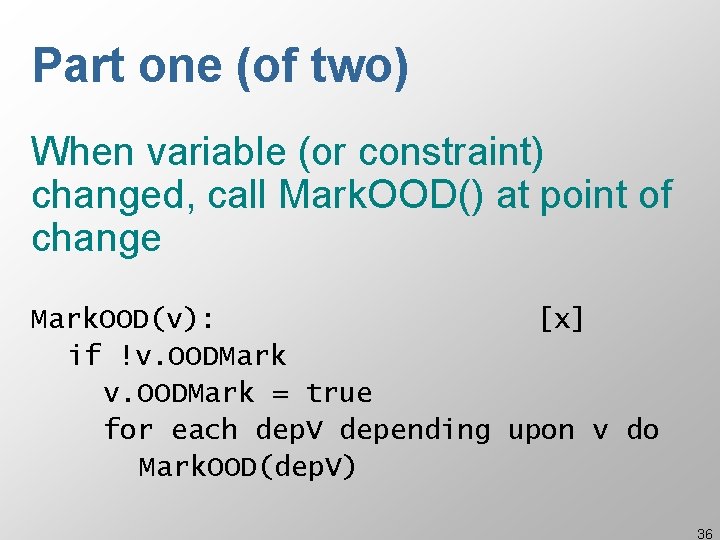
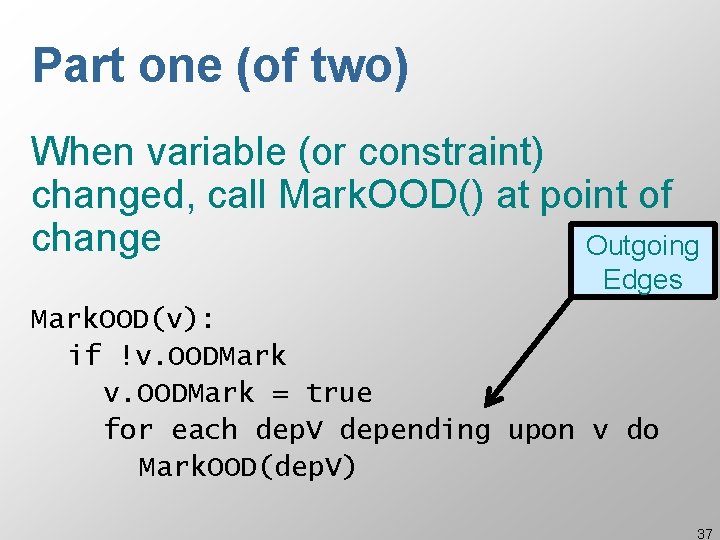
Part one (of two) When variable (or constraint) changed, call Mark. OOD() at point of change Mark. OOD(v): [x] if !v. OODMark = true for each dep. V depending upon v do Mark. OOD(dep. V) 36
Part one (of two) When variable (or constraint) changed, call Mark. OOD() at point of change Outgoing Edges Mark. OOD(v): if !v. OODMark = true for each dep. V depending upon v do Mark. OOD(dep. V) 37
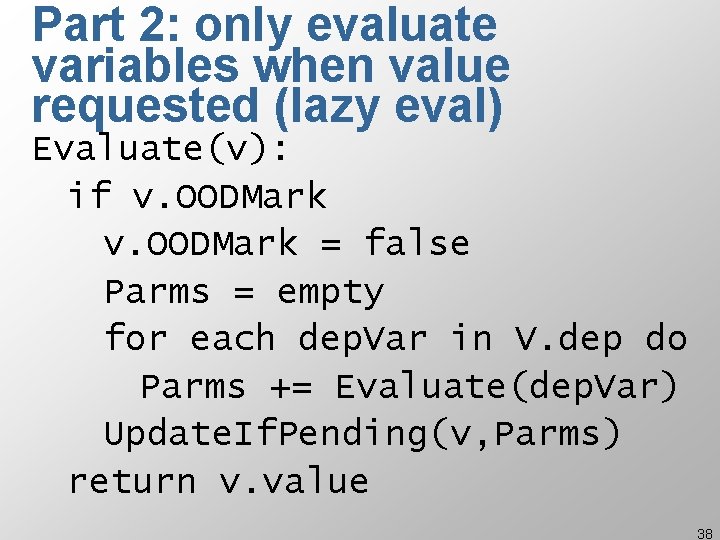
Part 2: only evaluate variables when value requested (lazy eval) Evaluate(v): if v. OODMark = false Parms = empty for each dep. Var in V. dep do Parms += Evaluate(dep. Var) Update. If. Pending(v, Parms) return v. value 38
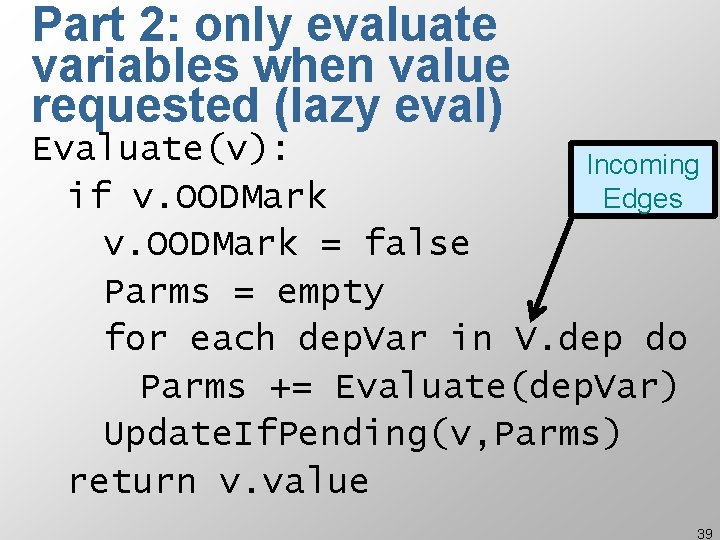
Part 2: only evaluate variables when value requested (lazy eval) Evaluate(v): Incoming Edges if v. OODMark = false Parms = empty for each dep. Var in V. dep do Parms += Evaluate(dep. Var) Update. If. Pending(v, Parms) return v. value 39
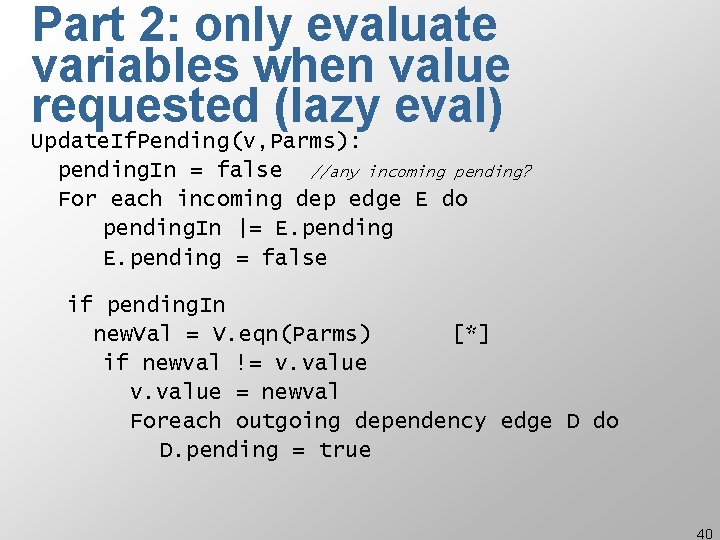
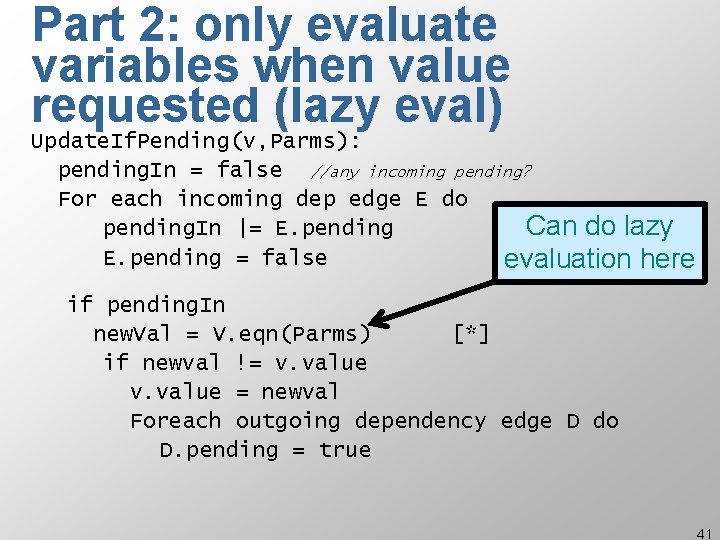
Part 2: only evaluate variables when value requested (lazy eval) Update. If. Pending(v, Parms): pending. In = false //any incoming pending? For each incoming dep edge E do pending. In |= E. pending = false if pending. In new. Val = V. eqn(Parms) [*] if newval != v. value = newval Foreach outgoing dependency edge D do D. pending = true 40
Part 2: only evaluate variables when value requested (lazy eval) Update. If. Pending(v, Parms): pending. In = false //any incoming pending? For each incoming dep edge E do Can do lazy pending. In |= E. pending = false evaluation here if pending. In new. Val = V. eqn(Parms) [*] if newval != v. value = newval Foreach outgoing dependency edge D do D. pending = true 41
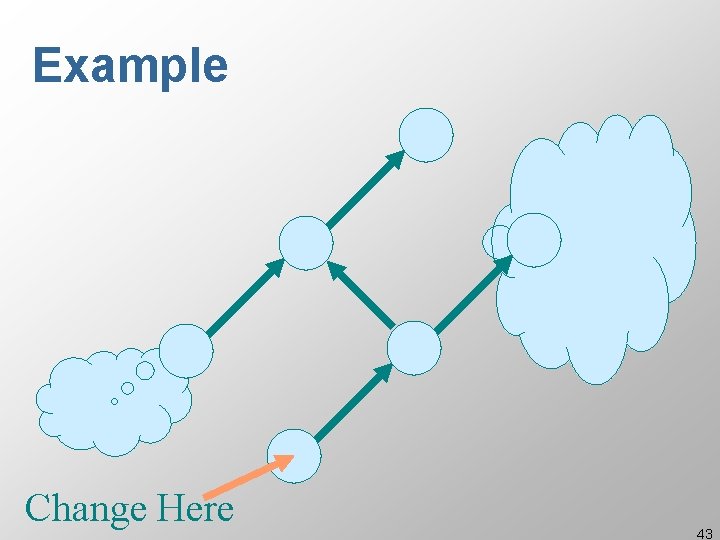
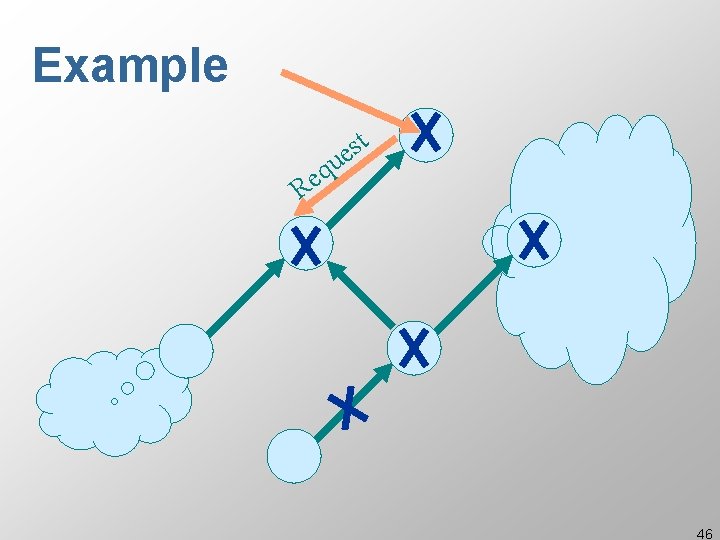
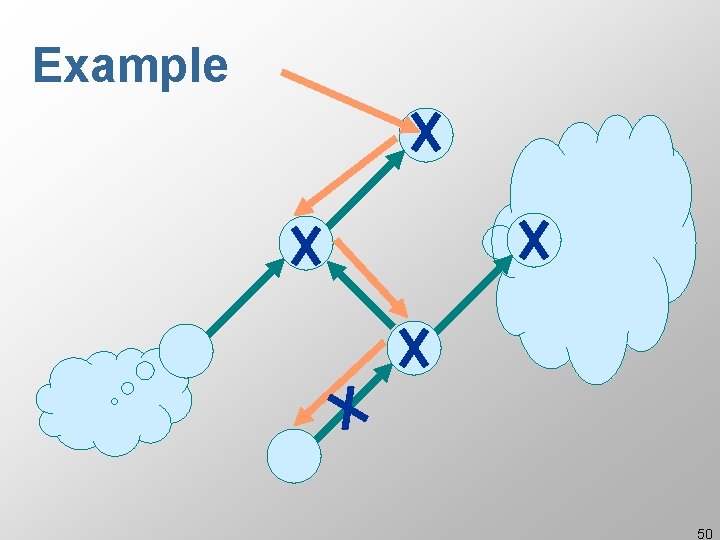
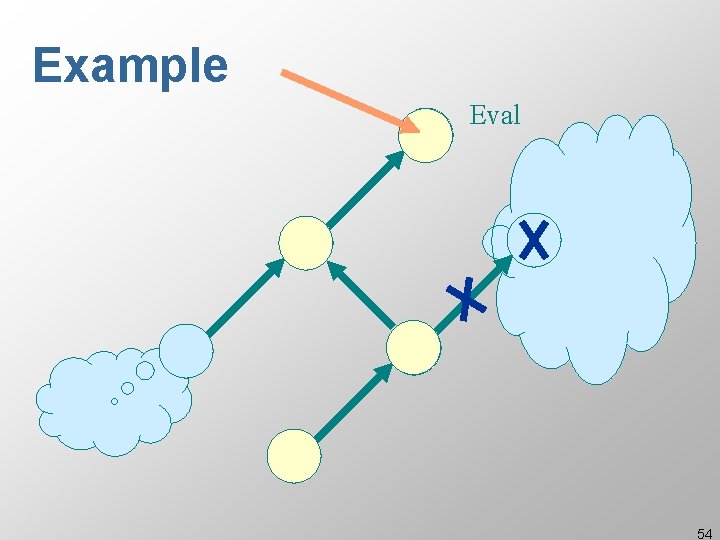
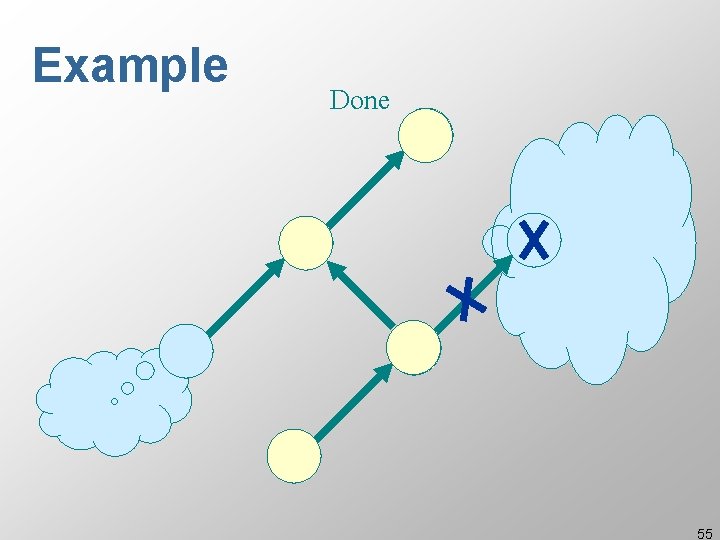
Example 42
Example Change Here 43
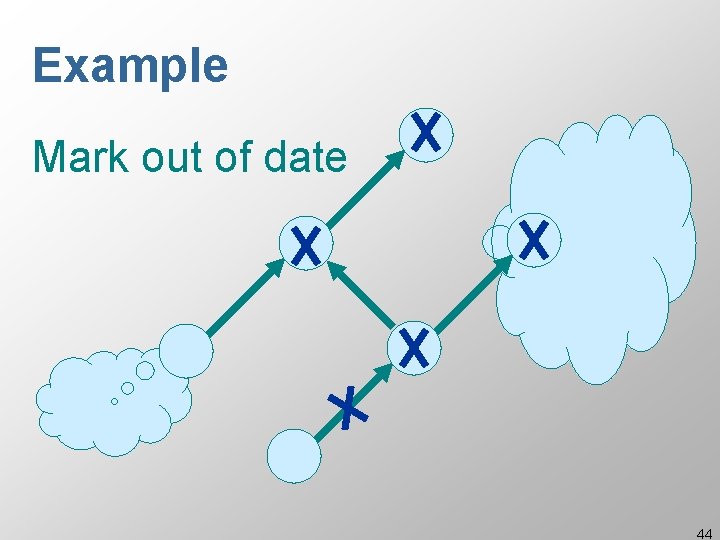
Example Mark out of date 44
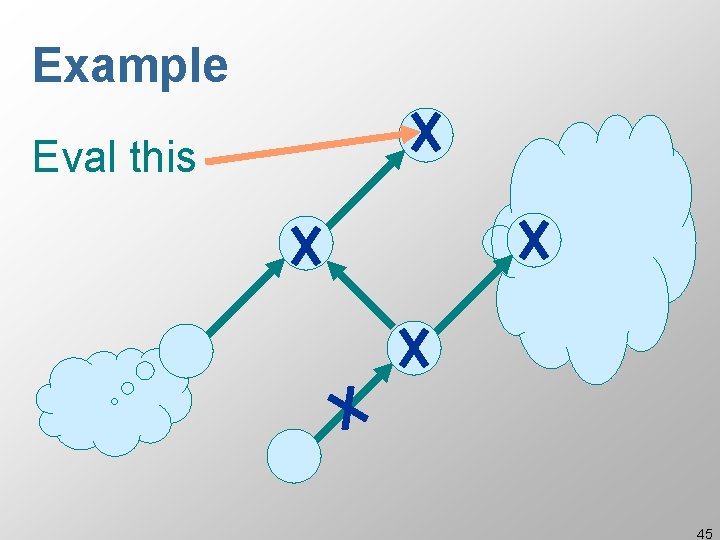
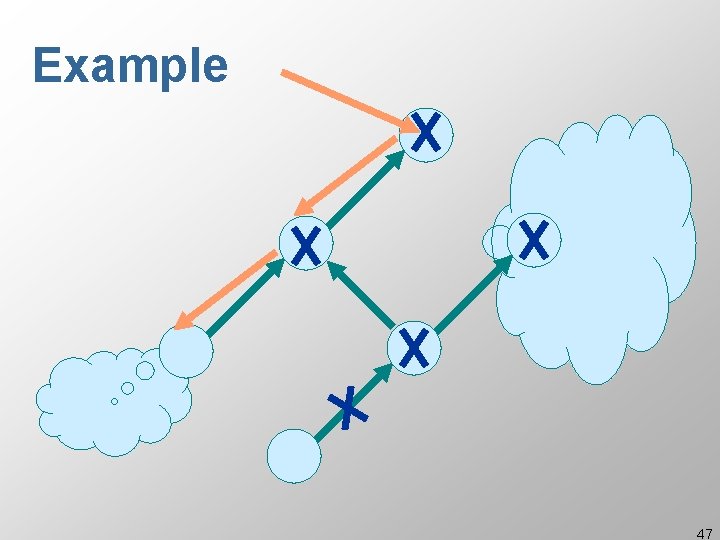
Example Eval this 45
Example t s e u q e R 46
Example 47
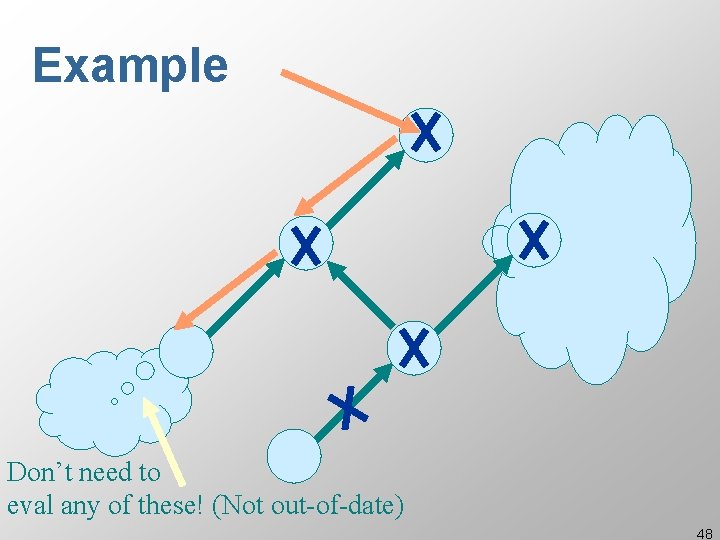
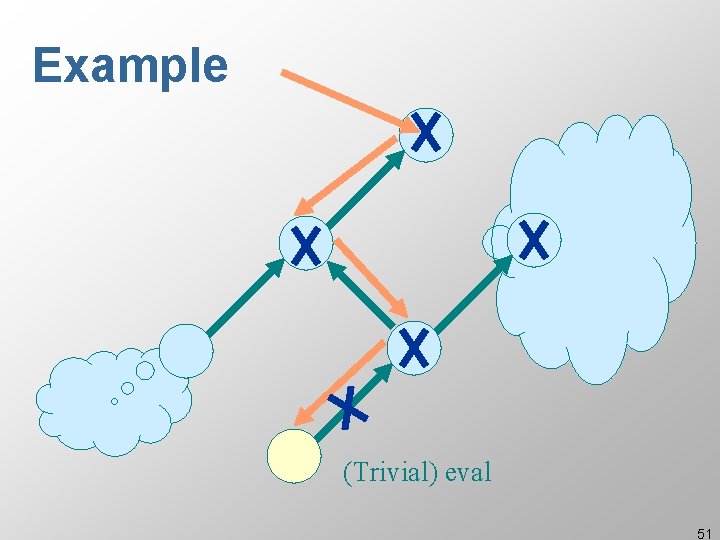
Example Don’t need to eval any of these! (Not out-of-date) 48
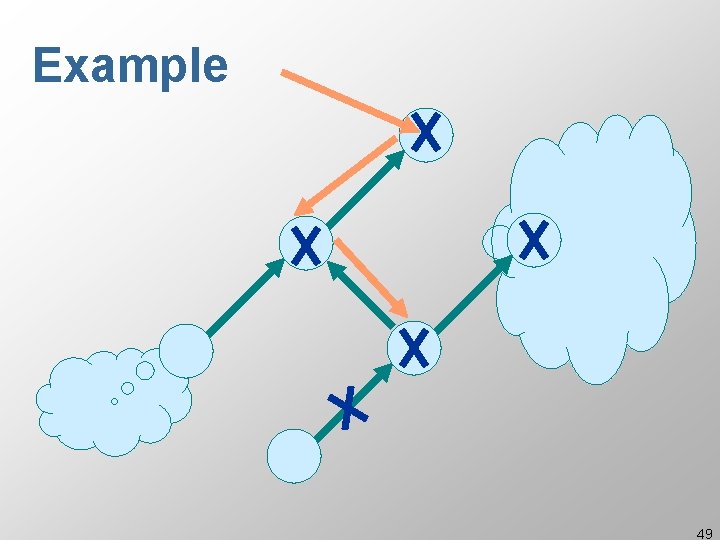
Example 49
Example 50
Example (Trivial) eval 51
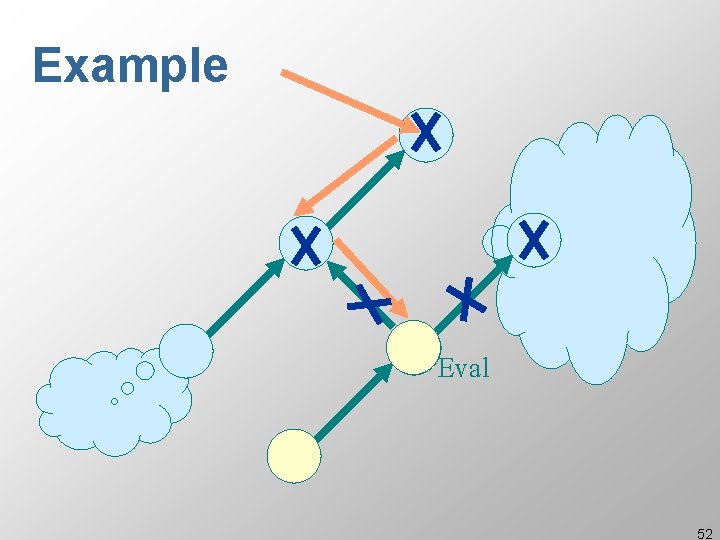
Example Eval 52
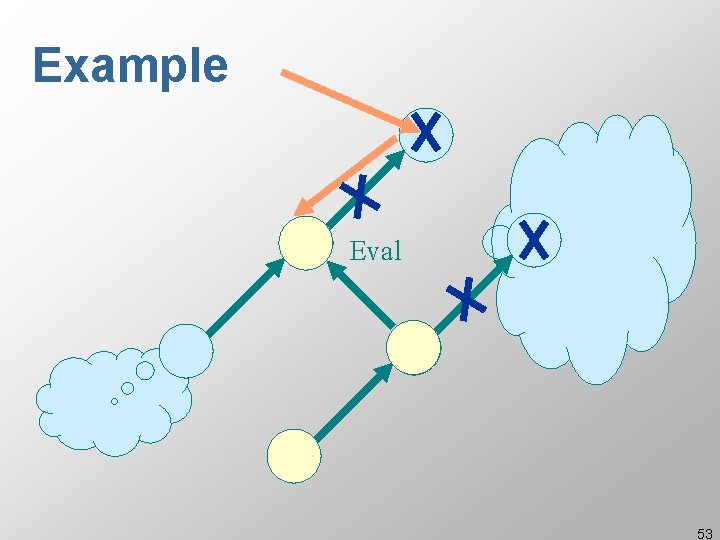
Example Eval 53
Example Eval 54
Example Done 55
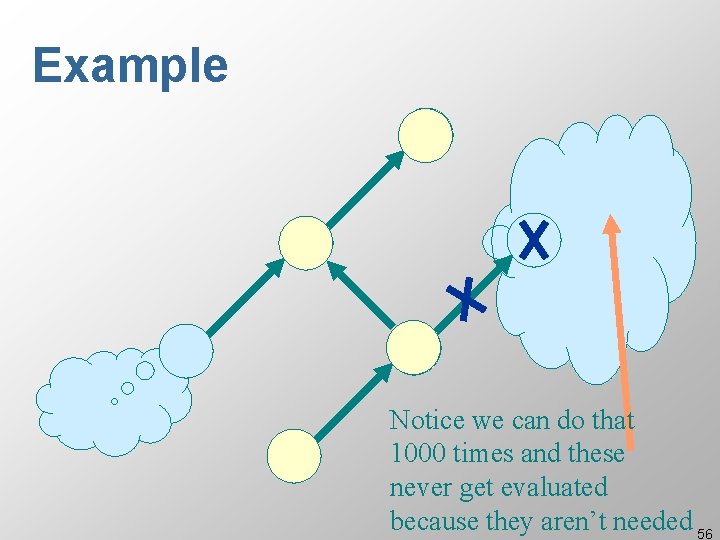
Example Notice we can do that 1000 times and these never get evaluated because they aren’t needed 56
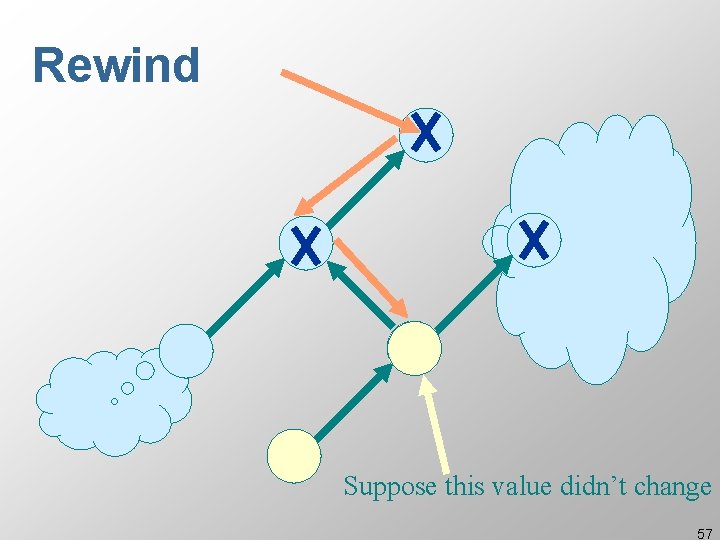
Rewind Suppose this value didn’t change 57
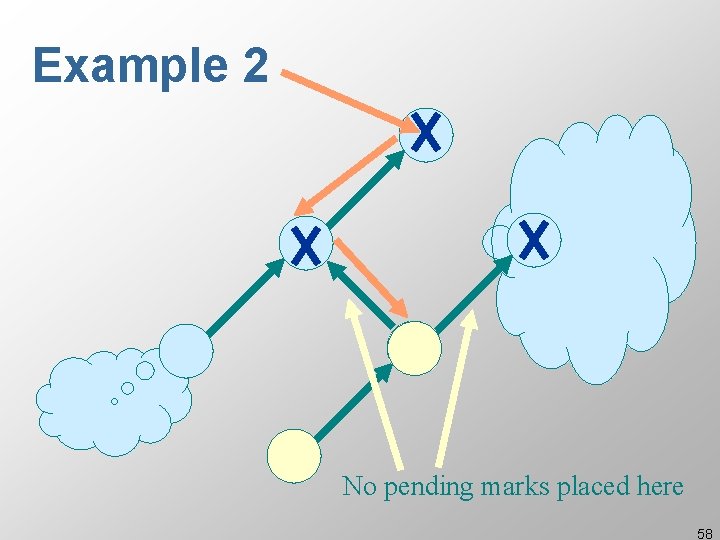
Example 2 No pending marks placed here 58
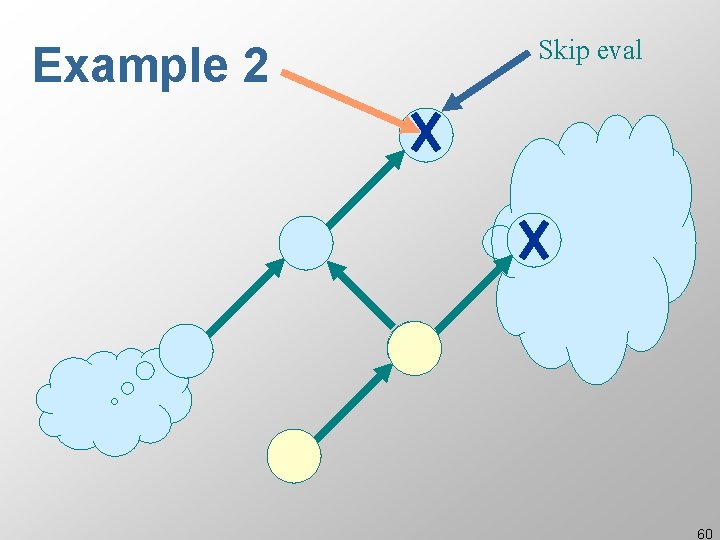
Example 2 Skip eval (and no outgoing pending marks) 59
Example 2 Skip eval 60
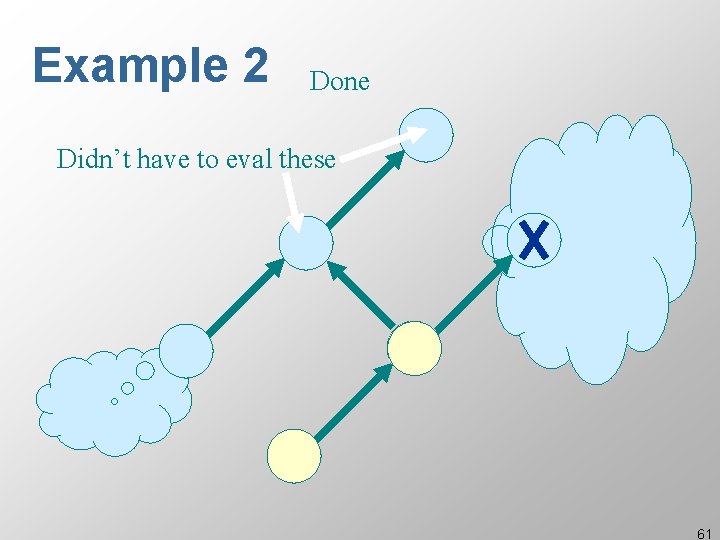
Example 2 Done Didn’t have to eval these 61
Algorithm is “partially optimal” Optimal in set of equations evaluated [*] – Under fairly strong assumptions Does non-optimal total work [x] “Touches” more things than optimal set during Mark_OOD phase Fortunately simplest / fastest part – Very close to theoretical lower bound – No better algorithm known – 62
Good asymptotic result, but also very practical Minimal amount of bookkeeping – Simple and statically allocated – Only local information Operations are simple Also has very simple extension to handling pointers and dynamic dependencies 63
Multi-way implementation Use a “planner” algorithm to assign a direction to each undirected edge of dependency graph Now have a one-way problem 64
The Delta. Blue incremental planning algorithm Assume “constraint hierarchies” Strengths of constraints – Important to allow more control when over or under constrained Force all to be over constrained, then relax weakest constraints Substantially improves predictability – Restriction: acyclic (undirected) dependency graphs only 65
A plan is a set of edge directions Assume we have multiple methods for enforcing a constraint – One per (output) variable – Picking method sets edge directions Given existing plan and change to constraints, find a new plan 66
Finding a new plan For added constraints – May need to break a weaker constraint (somewhere) to enforce new constraint For removed constraints – May have weaker unenforced constraints that can now be satisfied 67
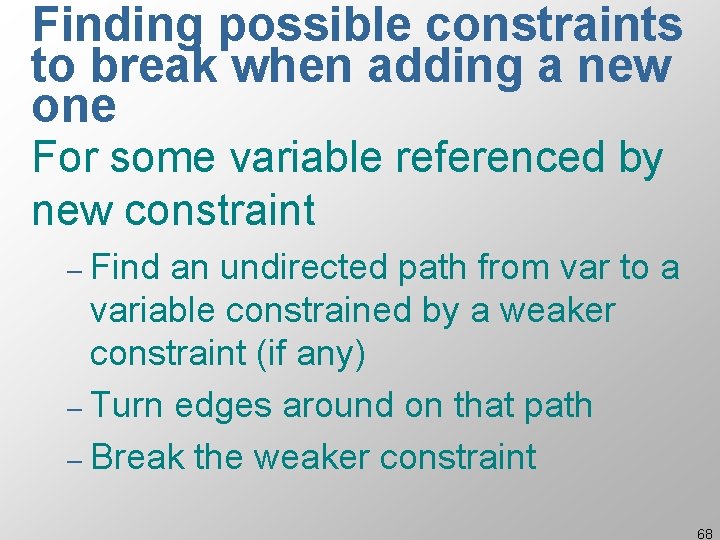
Finding possible constraints to break when adding a new one For some variable referenced by new constraint – Find an undirected path from var to a variable constrained by a weaker constraint (if any) – Turn edges around on that path – Break the weaker constraint 68
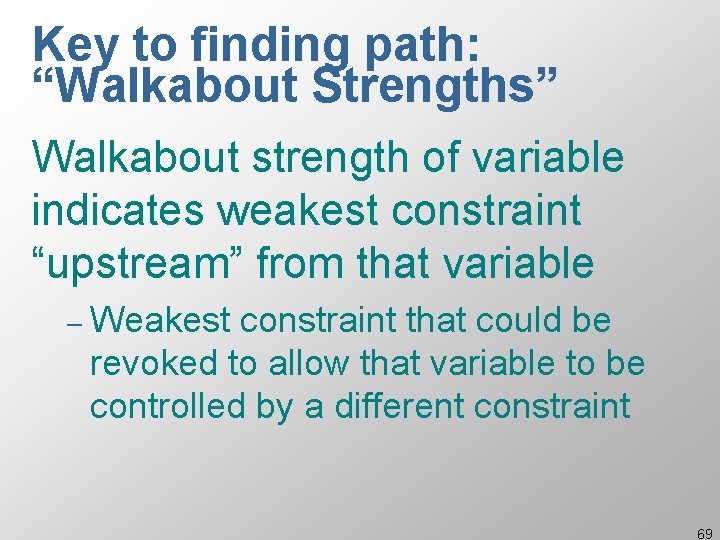
Key to finding path: “Walkabout Strengths” Walkabout strength of variable indicates weakest constraint “upstream” from that variable – Weakest constraint that could be revoked to allow that variable to be controlled by a different constraint 69
Walkabout strength of var V currently defined by method M of constraint C is: – Min of C. strength and walkabout strengths of variables providing input to M 70
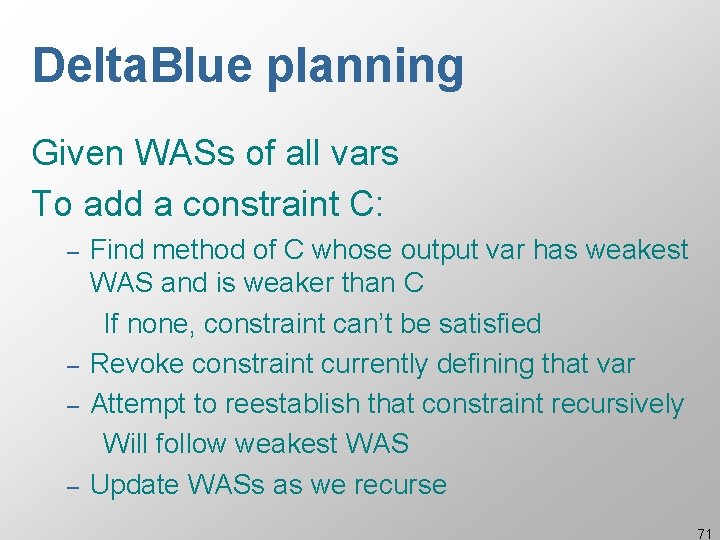
Delta. Blue planning Given WASs of all vars To add a constraint C: – – Find method of C whose output var has weakest WAS and is weaker than C If none, constraint can’t be satisfied Revoke constraint currently defining that var Attempt to reestablish that constraint recursively Will follow weakest WAS Update WASs as we recurse 71
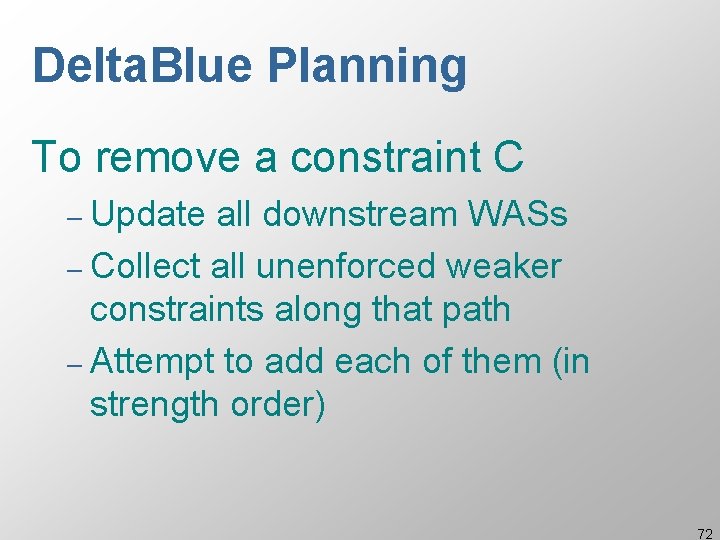
Delta. Blue Planning To remove a constraint C – Update all downstream WASs – Collect all unenforced weaker constraints along that path – Attempt to add each of them (in strength order) 72
Delta. Blue Evaluation A Delta. Blue plan establishes an evaluation direction on each undirected dependency edge Based on those directions, can then use a one-way algorithm for actual evaluation 73
References Optimal one-way algorithm http: //doi. acm. org/10. 1145/117009. 117012 Note: constraint graph formulated differently Edges in the other direction No nodes for functions (not bipartite graph) Delta. Blue http: //doi. acm. org/10. 1145/76372. 77531 74
75