
Algorithms for Classification Notes by Gregory Piatetsky Basic
Algorithms for Classification: Notes by Gregory Piatetsky
Basic methods. Outline: § Simplicity first: 1 R § Naïve Bayes 2

Classification § Task: Given a set of pre-classified examples, build a model or classifier to classify new cases. § Supervised learning: classes are known for the examples used to build the classifier. § A classifier can be a set of rules, a decision tree, a neural network, etc. § Typical applications: credit approval, direct marketing, fraud detection, medical diagnosis, …. . 3
Simplicity first § Simple algorithms often work very well! § There are many kinds of simple structure, eg: § § One attribute does all the work § All attributes contribute equally & independently § A weighted linear combination might do § Instance-based: use a few prototypes § Use simple logical rules Success of method depends on the domain witten&eibe 4
Inferring rudimentary rules § 1 R: learns a 1 -level decision tree § § I. e. , rules that all test one particular attribute Basic version § One branch for each value § Each branch assigns most frequent class § Error rate: proportion of instances that don’t belong to the majority class of their corresponding branch § Choose attribute with lowest error rate (assumes nominal attributes) witten&eibe 5
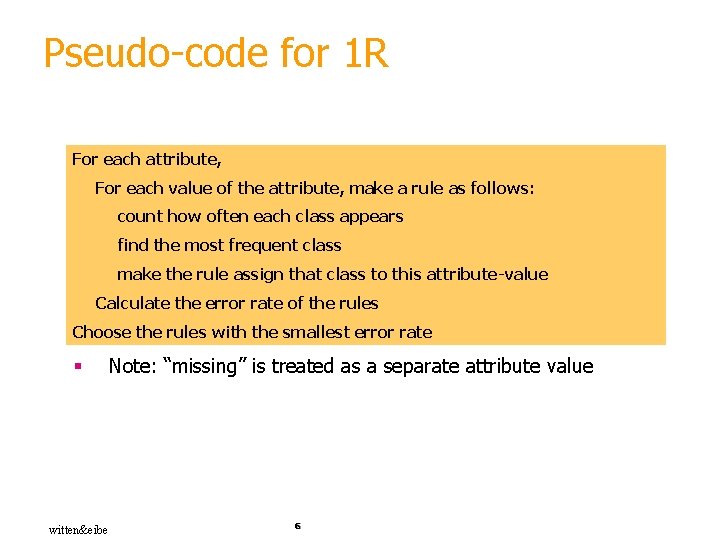
Pseudo-code for 1 R For each attribute, For each value of the attribute, make a rule as follows: count how often each class appears find the most frequent class make the rule assign that class to this attribute-value Calculate the error rate of the rules Choose the rules with the smallest error rate § witten&eibe Note: “missing” is treated as a separate attribute value 6
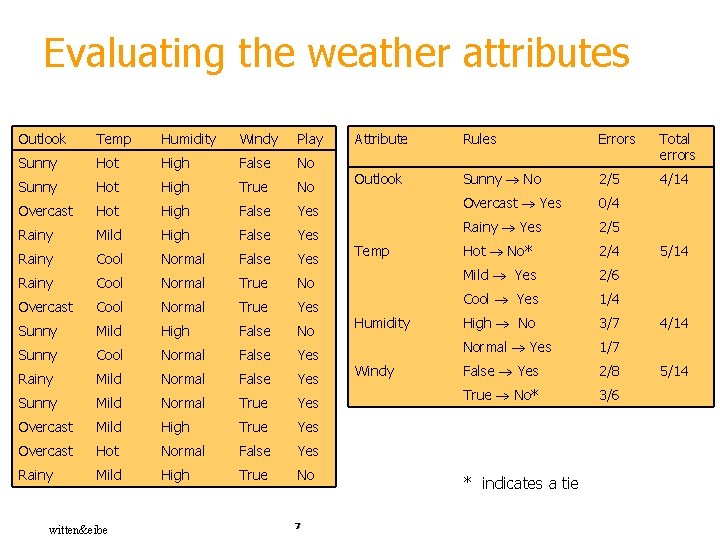
Evaluating the weather attributes Outlook Temp Humidity Windy Play Sunny Hot High False No Sunny Hot High True No Overcast Hot High False Yes Rainy Mild High False Yes Rainy Cool Normal True No Overcast Cool Normal True Yes Sunny Mild High False No Sunny Cool Normal False Yes Rainy Mild Normal False Yes Sunny Mild Normal True Yes Overcast Mild High True Yes Overcast Hot Normal False Yes Rainy Mild High True No witten&eibe 7 Attribute Rules Errors Total errors Outlook Sunny No 2/5 4/14 Overcast Yes 0/4 Rainy Yes 2/5 Hot No* 2/4 Mild Yes 2/6 Cool Yes 1/4 High No 3/7 Normal Yes 1/7 False Yes 2/8 True No* 3/6 Temp Humidity Windy * indicates a tie 5/14 4/14 5/14
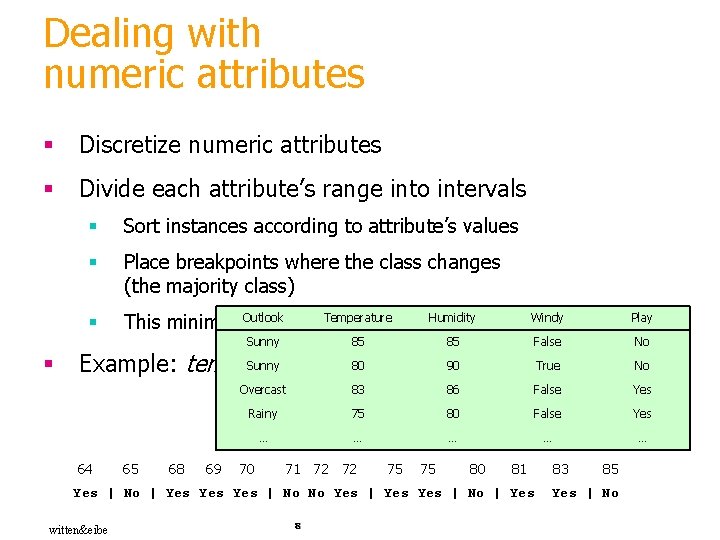
Dealing with numeric attributes § Discretize numeric attributes § Divide each attribute’s range into intervals § § Sort instances according to attribute’s values § Place breakpoints where the class changes (the majority class) § Outlook This minimizes the total. Temperature error Sunny Humidity Windy Play 85 False No True No 85 Sunny 80 weather 90 data Example: temperature from 64 65 68 69 Overcast 83 86 False Yes Rainy 75 80 False Yes … … … 70 71 72 72 75 75 80 81 Yes | No | Yes Yes | No No Yes | No | Yes witten&eibe 8 83 85 Yes | No
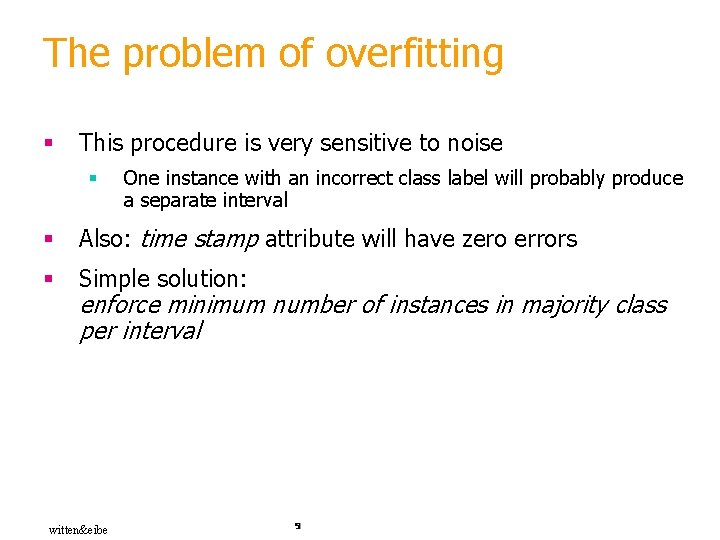
The problem of overfitting § This procedure is very sensitive to noise § One instance with an incorrect class label will probably produce a separate interval § Also: time stamp attribute will have zero errors § Simple solution: enforce minimum number of instances in majority class per interval witten&eibe 9
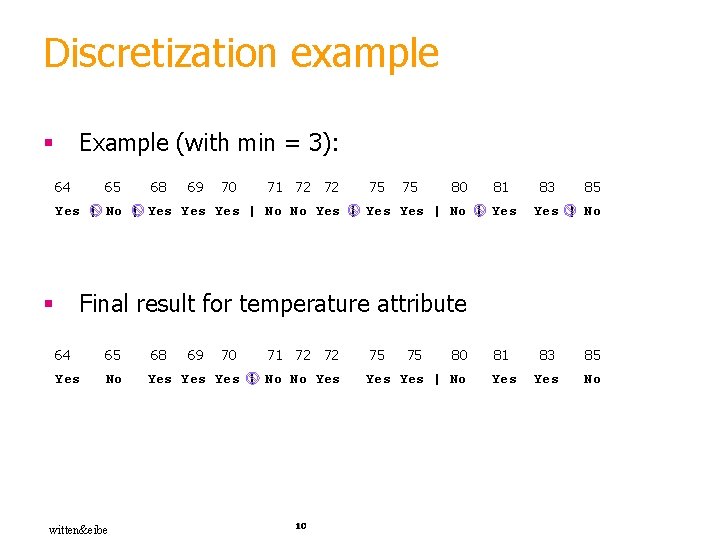
Discretization example Example (with min = 3): § 64 65 68 69 70 71 72 72 75 75 80 81 Yes | No | Yes Yes | No No Yes | No | Yes 83 85 Yes | No Final result for temperature attribute § 64 65 68 Yes No Yes Yes | No No Yes witten&eibe 69 70 71 72 72 10 75 75 80 Yes | No 81 83 85 Yes No
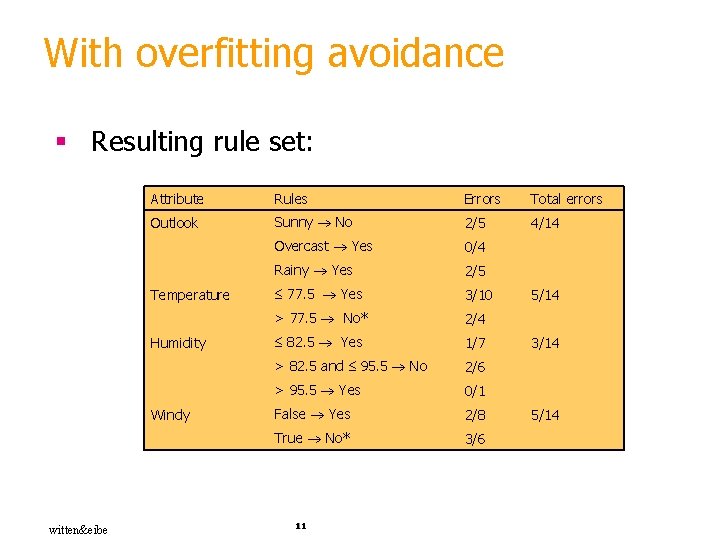
With overfitting avoidance § Resulting rule set: Attribute Rules Errors Total errors Outlook Sunny No 2/5 4/14 Overcast Yes 0/4 Rainy Yes 2/5 77. 5 Yes 3/10 > 77. 5 No* 2/4 82. 5 Yes 1/7 > 82. 5 and 95. 5 No 2/6 > 95. 5 Yes 0/1 False Yes 2/8 True No* 3/6 Temperature Humidity Windy witten&eibe 11 5/14 3/14 5/14
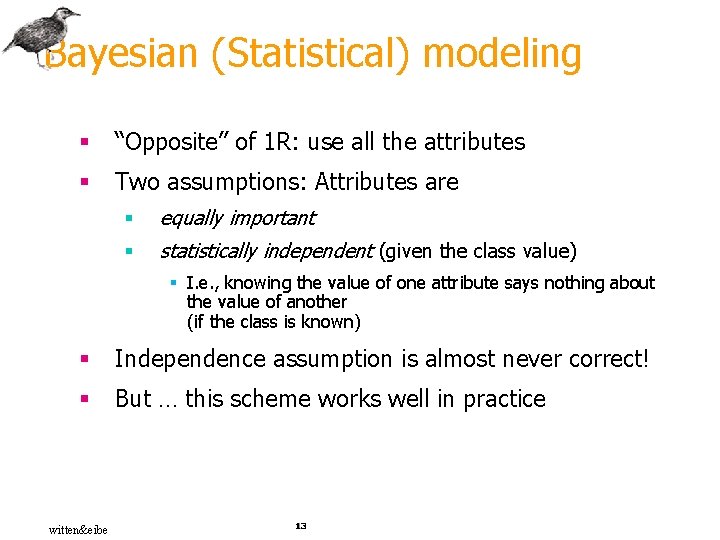
Bayesian (Statistical) modeling § “Opposite” of 1 R: use all the attributes § Two assumptions: Attributes are § equally important § statistically independent (given the class value) § I. e. , knowing the value of one attribute says nothing about the value of another (if the class is known) § Independence assumption is almost never correct! § But … this scheme works well in practice witten&eibe 13
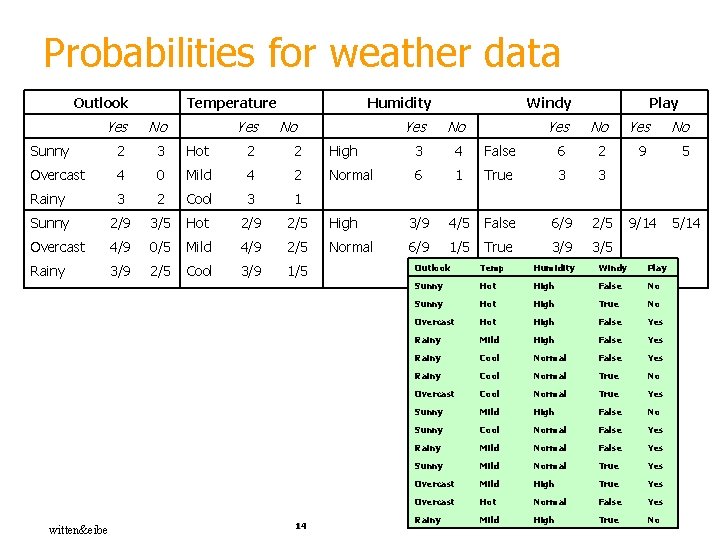
Probabilities for weather data Outlook Temperature Yes No Sunny 2 3 Hot 2 2 Overcast 4 0 Mild 4 2 Rainy 3 2 Cool 3 1 Sunny 2/9 3/5 Hot 2/9 2/5 Overcast 4/9 0/5 Mild 4/9 2/5 Rainy 3/9 2/5 Cool 3/9 1/5 witten&eibe Yes Humidity No 14 Windy Yes No High 3 4 Normal 6 High Normal Play Yes No False 6 2 9 5 1 True 3 3 3/9 4/5 False 6/9 2/5 9/14 5/14 6/9 1/5 True 3/9 3/5 Outlook Temp Humidity Windy Play Sunny Hot High False No Sunny Hot High True No Overcast Hot High False Yes Rainy Mild High False Yes Rainy Cool Normal True No Overcast Cool Normal True Yes Sunny Mild High False No Sunny Cool Normal False Yes Rainy Mild Normal False Yes Sunny Mild Normal True Yes Overcast Mild High True Yes Overcast Hot Normal False Yes Rainy Mild High True No
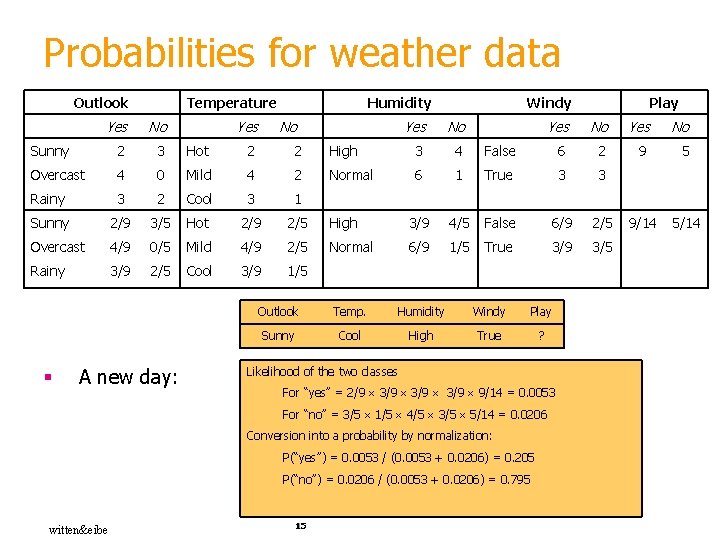
Probabilities for weather data Outlook Temperature Yes No Sunny 2 3 Hot 2 2 Overcast 4 0 Mild 4 2 Rainy 3 2 Cool 3 1 Sunny 2/9 3/5 Hot 2/9 2/5 Overcast 4/9 0/5 Mild 4/9 2/5 Rainy 3/9 2/5 Cool 3/9 1/5 § A new day: Yes Humidity No Windy Yes No High 3 4 Normal 6 High Yes No False 6 2 9 5 1 True 3 3 3/9 4/5 False 6/9 2/5 9/14 5/14 Normal 6/9 1/5 True 3/9 3/5 Outlook Temp. Humidity Windy Play Sunny Cool High True ? Likelihood of the two classes For “yes” = 2/9 3/9 9/14 = 0. 0053 For “no” = 3/5 1/5 4/5 3/5 5/14 = 0. 0206 Conversion into a probability by normalization: P(“yes”) = 0. 0053 / (0. 0053 + 0. 0206) = 0. 205 P(“no”) = 0. 0206 / (0. 0053 + 0. 0206) = 0. 795 witten&eibe Play 15
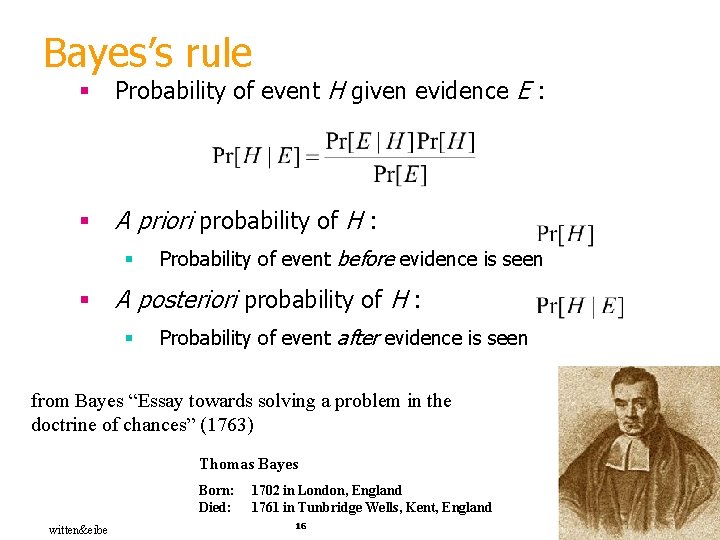
Bayes’s rule § Probability of event H given evidence E : § A priori probability of H : § § Probability of event before evidence is seen A posteriori probability of H : § Probability of event after evidence is seen from Bayes “Essay towards solving a problem in the doctrine of chances” (1763) Thomas Bayes Born: Died: witten&eibe 1702 in London, England 1761 in Tunbridge Wells, Kent, England 16
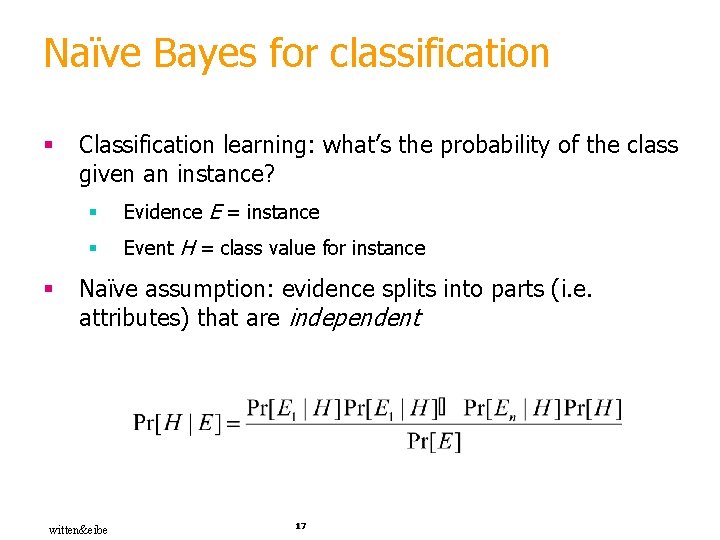
Naïve Bayes for classification § § Classification learning: what’s the probability of the class given an instance? § Evidence E = instance § Event H = class value for instance Naïve assumption: evidence splits into parts (i. e. attributes) that are independent witten&eibe 17
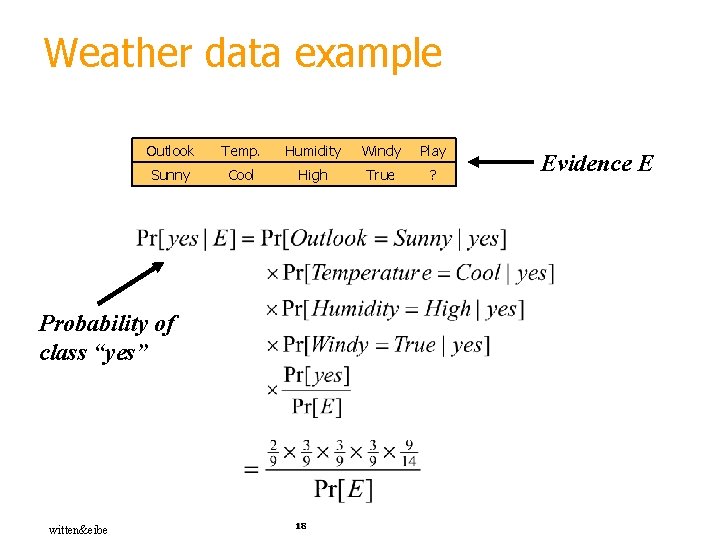
Weather data example Outlook Temp. Humidity Windy Play Sunny Cool High True ? Probability of class “yes” witten&eibe 18 Evidence E
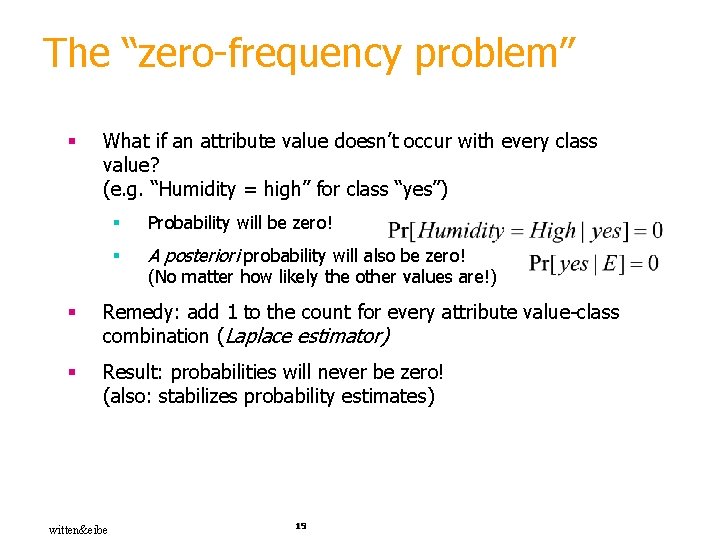
The “zero-frequency problem” § What if an attribute value doesn’t occur with every class value? (e. g. “Humidity = high” for class “yes”) § Probability will be zero! § A posteriori probability will also be zero! (No matter how likely the other values are!) § Remedy: add 1 to the count for every attribute value-class combination (Laplace estimator) § Result: probabilities will never be zero! (also: stabilizes probability estimates) witten&eibe 19
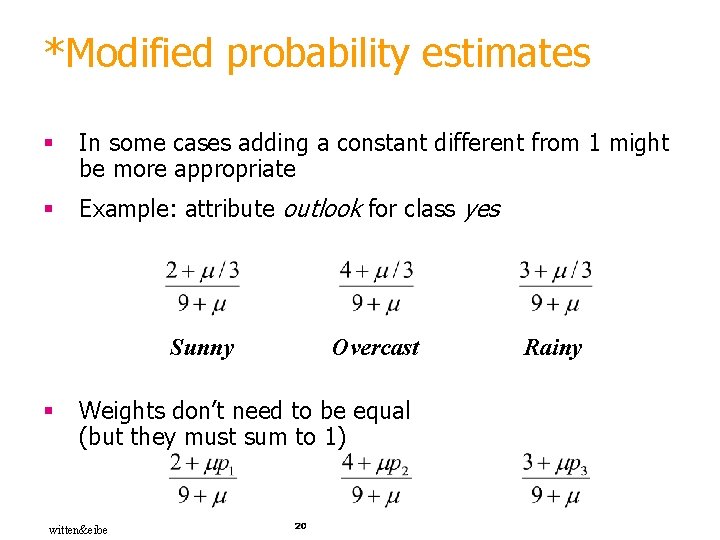
*Modified probability estimates § In some cases adding a constant different from 1 might be more appropriate § Example: attribute outlook for class yes Sunny § Overcast Weights don’t need to be equal (but they must sum to 1) witten&eibe 20 Rainy
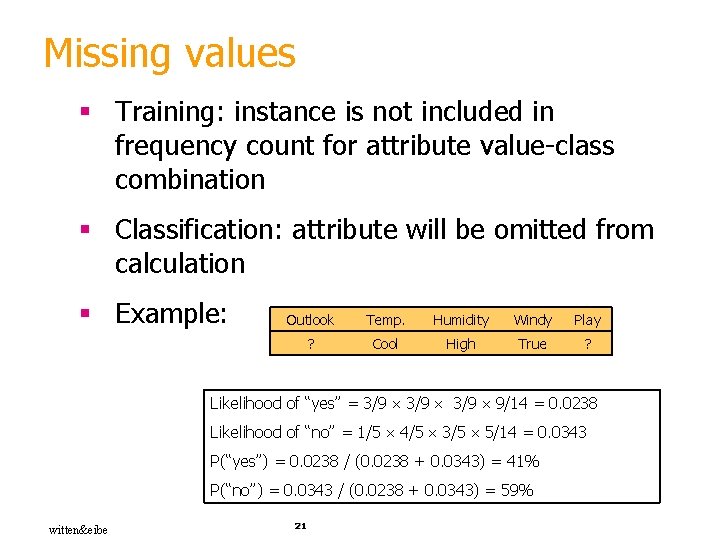
Missing values § Training: instance is not included in frequency count for attribute value-class combination § Classification: attribute will be omitted from calculation § Example: Outlook Temp. Humidity Windy Play ? Cool High True ? Likelihood of “yes” = 3/9 9/14 = 0. 0238 Likelihood of “no” = 1/5 4/5 3/5 5/14 = 0. 0343 P(“yes”) = 0. 0238 / (0. 0238 + 0. 0343) = 41% P(“no”) = 0. 0343 / (0. 0238 + 0. 0343) = 59% witten&eibe 21
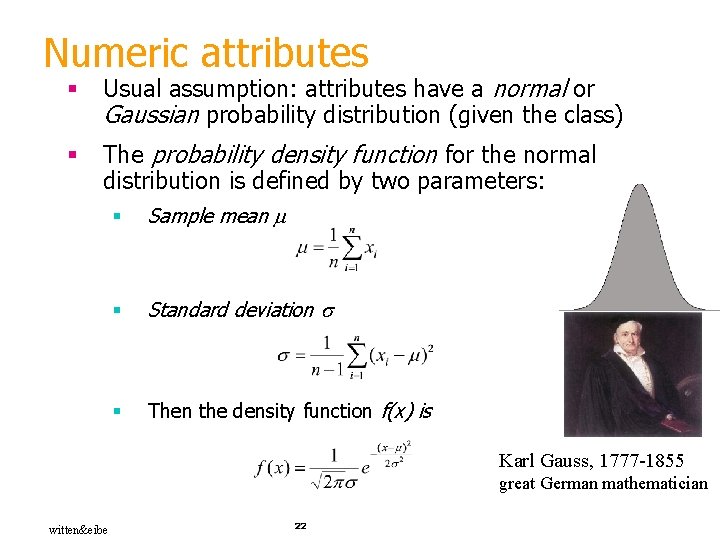
Numeric attributes § Usual assumption: attributes have a normal or Gaussian probability distribution (given the class) § The probability density function for the normal distribution is defined by two parameters: § Sample mean § Standard deviation § Then the density function f(x) is Karl Gauss, 1777 -1855 great German mathematician witten&eibe 22
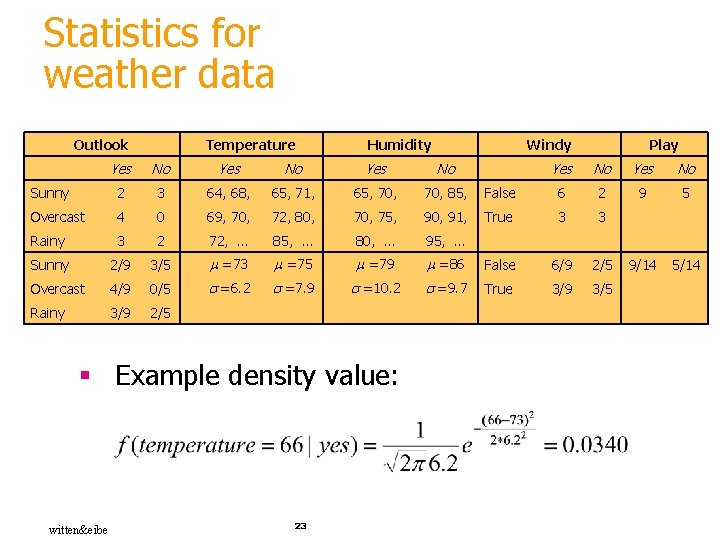
Statistics for weather data Outlook Temperature Humidity Windy Yes No Sunny 2 3 64, 68, 65, 71, 65, 70, 85, Overcast 4 0 69, 70, 72, 80, 70, 75, 90, 91, Rainy 3 2 72, … 85, … 80, … 95, … Sunny 2/9 3/5 =73 =75 =79 Overcast 4/9 0/5 =6. 2 =7. 9 =10. 2 Rainy 3/9 2/5 § Example density value: witten&eibe 23 Play Yes No False 6 2 9 5 True 3 3 =86 False 6/9 2/5 9/14 5/14 =9. 7 True 3/9 3/5
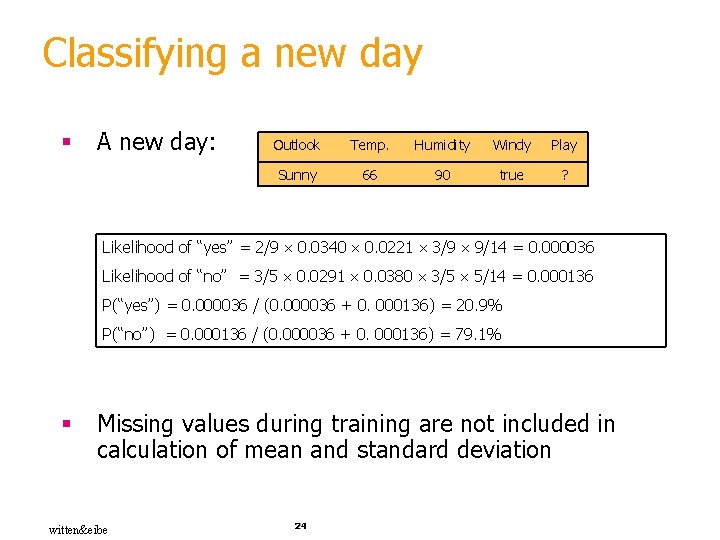
Classifying a new day § A new day: Outlook Temp. Humidity Windy Play Sunny 66 90 true ? Likelihood of “yes” = 2/9 0. 0340 0. 0221 3/9 9/14 = 0. 000036 Likelihood of “no” = 3/5 0. 0291 0. 0380 3/5 5/14 = 0. 000136 P(“yes”) = 0. 000036 / (0. 000036 + 0. 000136) = 20. 9% P(“no”) = 0. 000136 / (0. 000036 + 0. 000136) = 79. 1% § Missing values during training are not included in calculation of mean and standard deviation witten&eibe 24
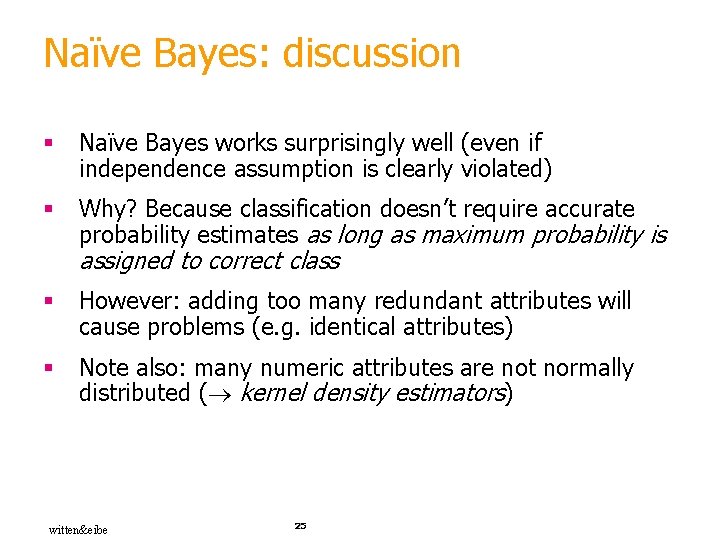
Naïve Bayes: discussion § Naïve Bayes works surprisingly well (even if independence assumption is clearly violated) § Why? Because classification doesn’t require accurate probability estimates as long as maximum probability is assigned to correct class § However: adding too many redundant attributes will cause problems (e. g. identical attributes) § Note also: many numeric attributes are not normally distributed ( kernel density estimators) witten&eibe 25
Naïve Bayes Extensions § Improvements: § select best attributes (e. g. with greedy search) § often works as well or better with just a fraction of all attributes § Bayesian Networks witten&eibe 26
Summary § One. R – uses rules based on just one attribute § Naïve Bayes – use all attributes and Bayes rules to estimate probability of the class given an instance. § Simple methods frequently work well, but … § Complex methods can be better (as we will see) 27
Classification: Decision Trees
Outline § Top-Down Decision Tree Construction § Choosing the Splitting Attribute § Information Gain and Gain Ratio 29
DECISION TREE § An internal node is a test on an attribute. § A branch represents an outcome of the test, e. g. , Color=red. § A leaf node represents a class label or class label distribution. § At each node, one attribute is chosen to split training examples into distinct classes as much as possible § A new case is classified by following a matching path to a leaf node. 30
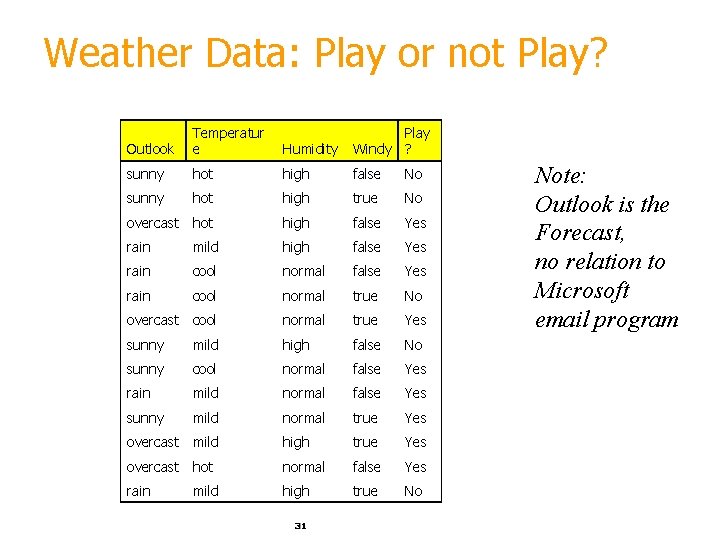
Weather Data: Play or not Play? Outlook Temperatur e Humidity Play Windy ? sunny hot high false No sunny hot high true No overcast hot high false Yes rain mild high false Yes rain cool normal true No overcast cool normal true Yes sunny mild high false No sunny cool normal false Yes rain mild normal false Yes sunny mild normal true Yes overcast mild high true Yes overcast hot normal false Yes rain high true No mild 31 Note: Outlook is the Forecast, no relation to Microsoft email program
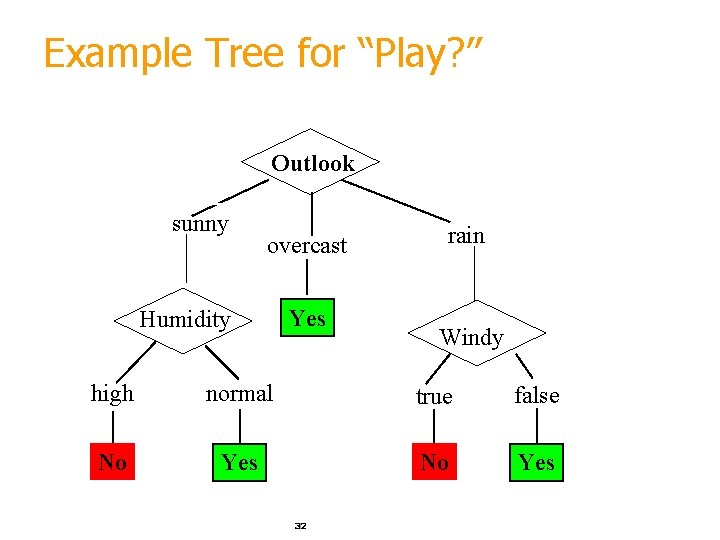
Example Tree for “Play? ” Outlook sunny overcast Humidity Yes rain Windy high normal true false No Yes 32
![Building Decision Tree [Q 93] § Top-down tree construction § At start, all training](http://slidetodoc.com/presentation_image_h2/509e9011b6949a1c2d30a679a85b15ed/image-32.jpg "Building Decision Tree [Q 93] § Top-down tree construction § At start, all training")
Building Decision Tree [Q 93] § Top-down tree construction § At start, all training examples are at the root. § Partition the examples recursively by choosing one attribute each time. § Bottom-up tree pruning § Remove subtrees or branches, in a bottom-up manner, to improve the estimated accuracy on new cases. 33
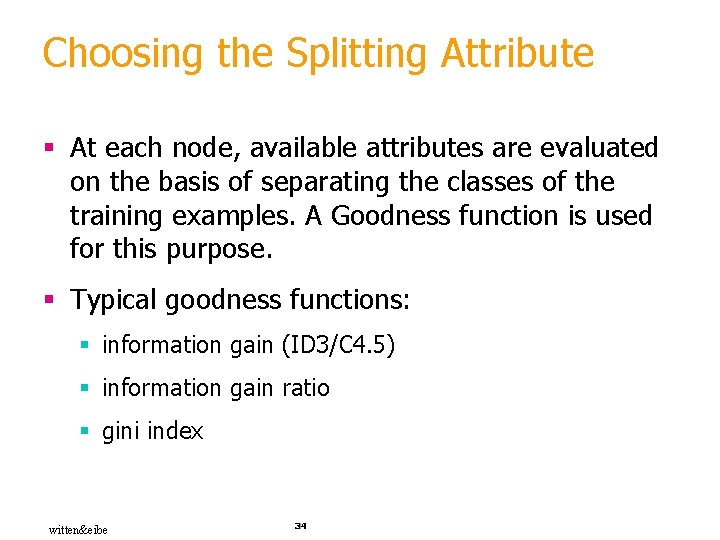
Choosing the Splitting Attribute § At each node, available attributes are evaluated on the basis of separating the classes of the training examples. A Goodness function is used for this purpose. § Typical goodness functions: § information gain (ID 3/C 4. 5) § information gain ratio § gini index witten&eibe 34
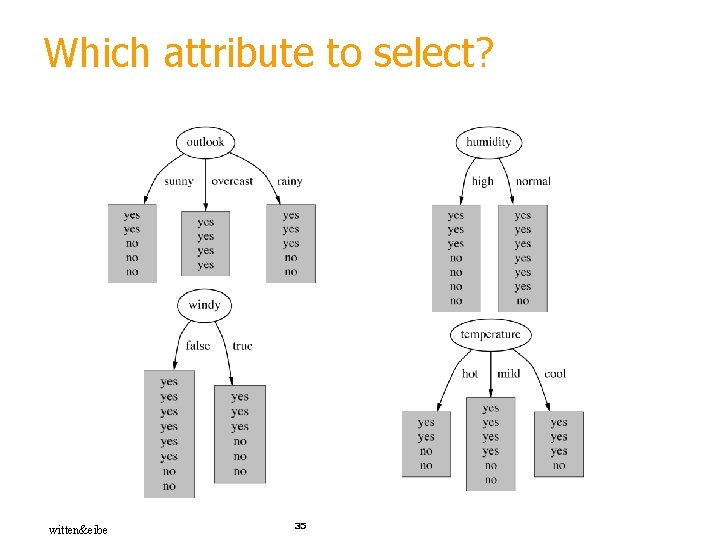
Which attribute to select? witten&eibe 35
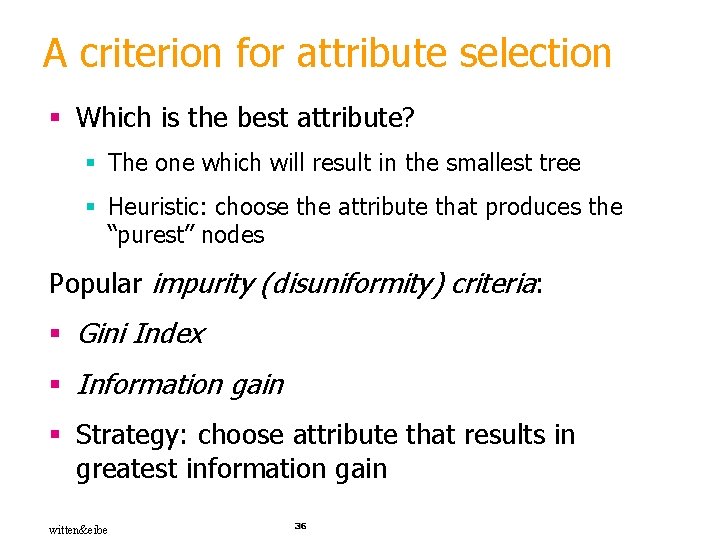
A criterion for attribute selection § Which is the best attribute? § The one which will result in the smallest tree § Heuristic: choose the attribute that produces the “purest” nodes Popular impurity (disuniformity) criteria: § Gini Index § Information gain § Strategy: choose attribute that results in greatest information gain witten&eibe 36
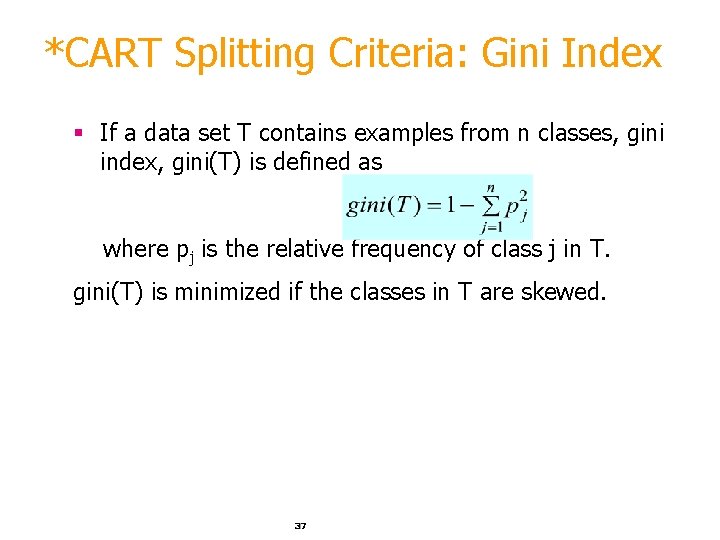
*CART Splitting Criteria: Gini Index § If a data set T contains examples from n classes, gini index, gini(T) is defined as where pj is the relative frequency of class j in T. gini(T) is minimized if the classes in T are skewed. 37
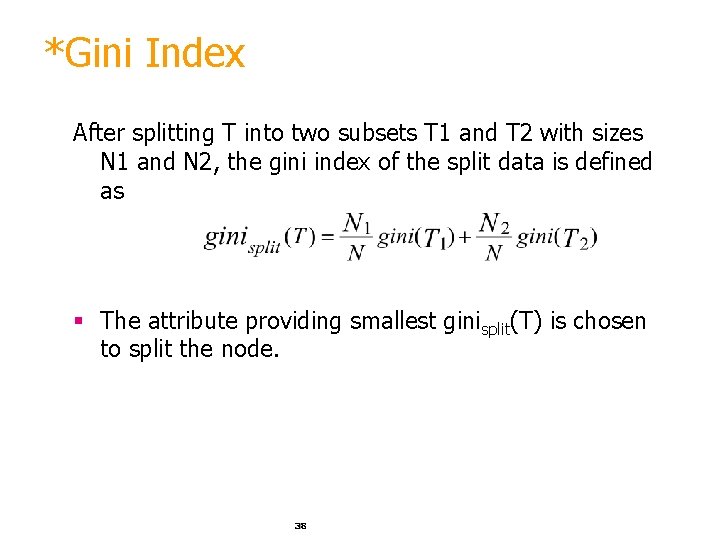
*Gini Index After splitting T into two subsets T 1 and T 2 with sizes N 1 and N 2, the gini index of the split data is defined as § The attribute providing smallest ginisplit(T) is chosen to split the node. 38
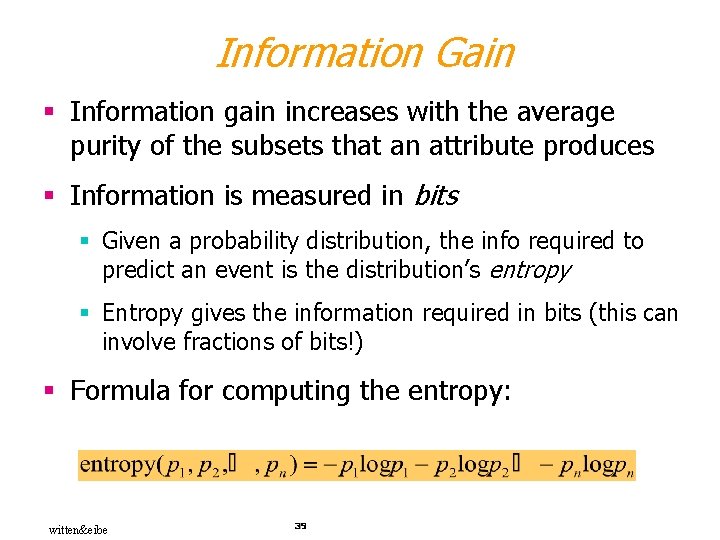
Information Gain § Information gain increases with the average purity of the subsets that an attribute produces § Information is measured in bits § Given a probability distribution, the info required to predict an event is the distribution’s entropy § Entropy gives the information required in bits (this can involve fractions of bits!) § Formula for computing the entropy: witten&eibe 39
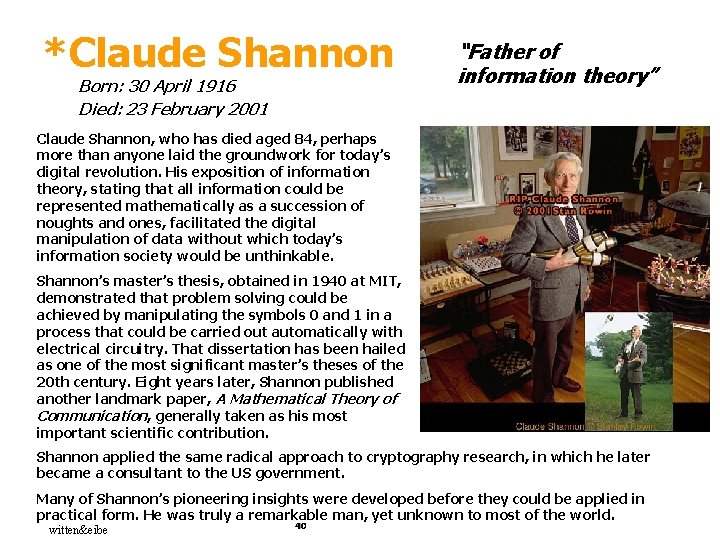
*Claude Shannon Born: 30 April 1916 Died: 23 February 2001 “Father of information theory” Claude Shannon, who has died aged 84, perhaps more than anyone laid the groundwork for today’s digital revolution. His exposition of information theory, stating that all information could be represented mathematically as a succession of noughts and ones, facilitated the digital manipulation of data without which today’s information society would be unthinkable. Shannon’s master’s thesis, obtained in 1940 at MIT, demonstrated that problem solving could be achieved by manipulating the symbols 0 and 1 in a process that could be carried out automatically with electrical circuitry. That dissertation has been hailed as one of the most significant master’s theses of the 20 th century. Eight years later, Shannon published another landmark paper, A Mathematical Theory of Communication, generally taken as his most important scientific contribution. Shannon applied the same radical approach to cryptography research, in which he later became a consultant to the US government. Many of Shannon’s pioneering insights were developed before they could be applied in practical form. He was truly a remarkable man, yet unknown to most of the world. witten&eibe 40
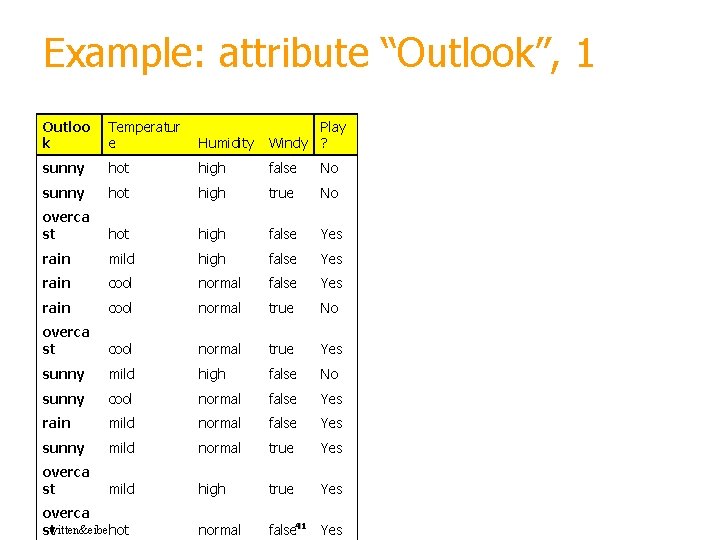
Example: attribute “Outlook”, 1 Outloo k Temperatur e Humidity Play Windy ? sunny hot high false No sunny hot high true No overca st hot high false Yes rain mild high false Yes rain cool normal true No overca st cool normal true Yes sunny mild high false No sunny cool normal false Yes rain mild normal false Yes sunny mild normal true Yes overca st mild high true Yes normal false 41 Yes overca witten&eibe hot st
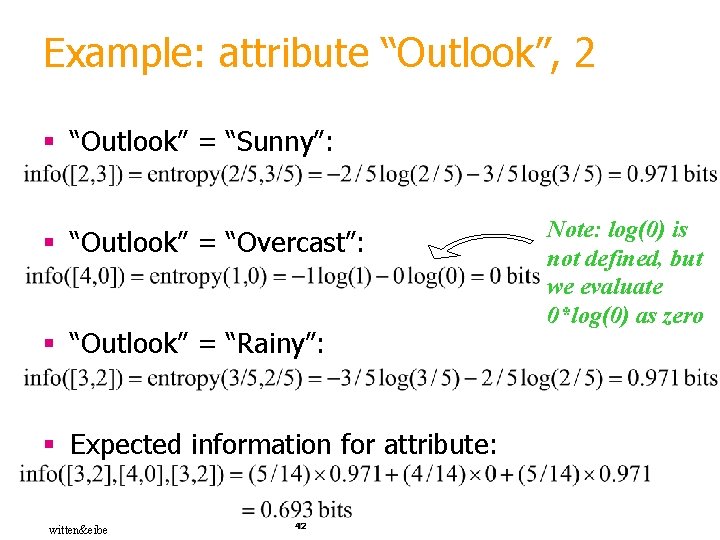
Example: attribute “Outlook”, 2 § “Outlook” = “Sunny”: § “Outlook” = “Overcast”: § “Outlook” = “Rainy”: § Expected information for attribute: witten&eibe 42 Note: log(0) is not defined, but we evaluate 0*log(0) as zero
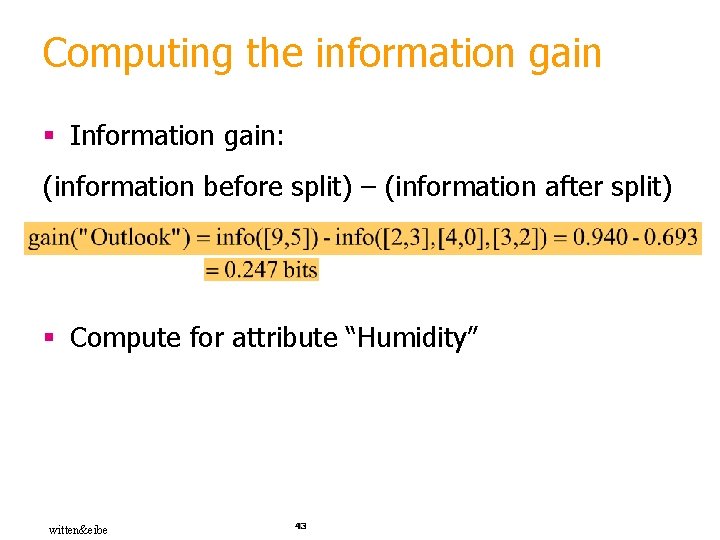
Computing the information gain § Information gain: (information before split) – (information after split) § Compute for attribute “Humidity” witten&eibe 43
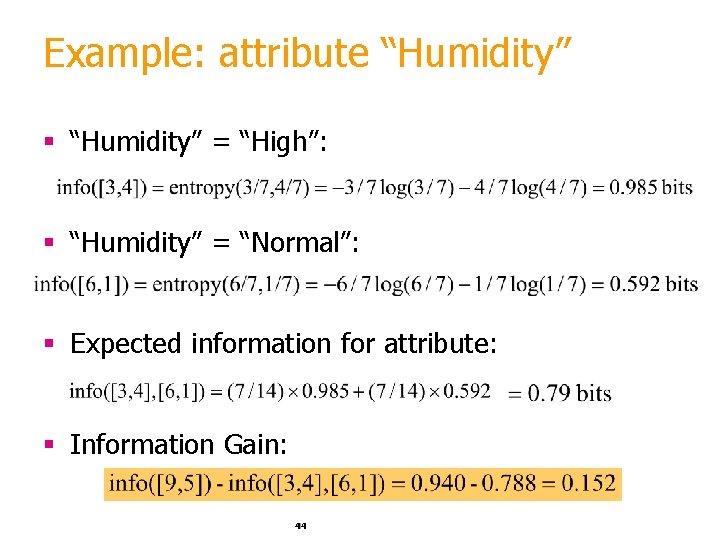
Example: attribute “Humidity” § “Humidity” = “High”: § “Humidity” = “Normal”: § Expected information for attribute: § Information Gain: 44
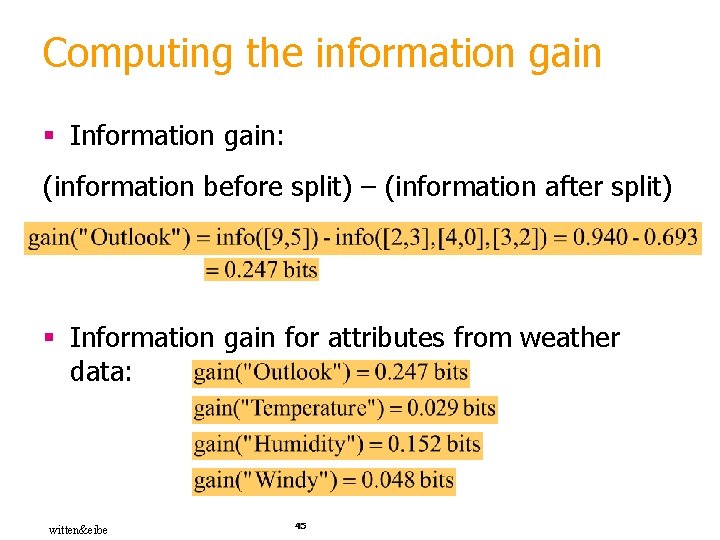
Computing the information gain § Information gain: (information before split) – (information after split) § Information gain for attributes from weather data: witten&eibe 45
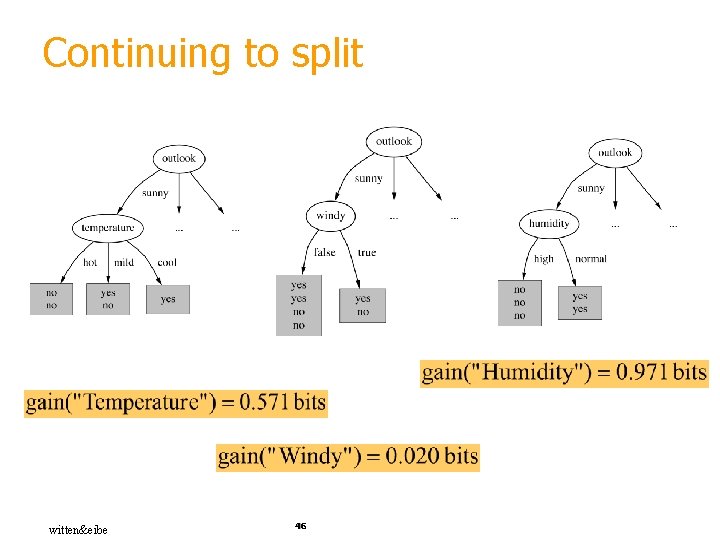
Continuing to split witten&eibe 46
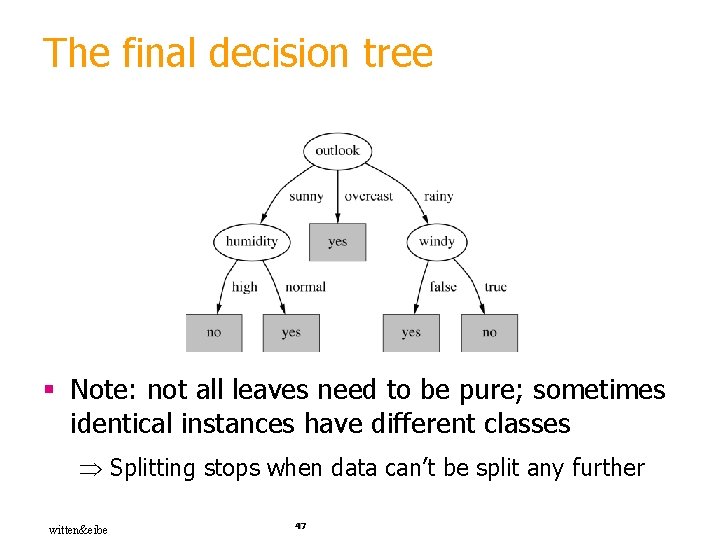
The final decision tree § Note: not all leaves need to be pure; sometimes identical instances have different classes Splitting stops when data can’t be split any further witten&eibe 47
Highly-branching attributes § Problematic: attributes with a large number of values (extreme case: ID code) § Subsets are more likely to be pure if there is a large number of values Information gain is biased towards choosing attributes with a large number of values This may result in overfitting (selection of an attribute that is non-optimal for prediction) witten&eibe 50
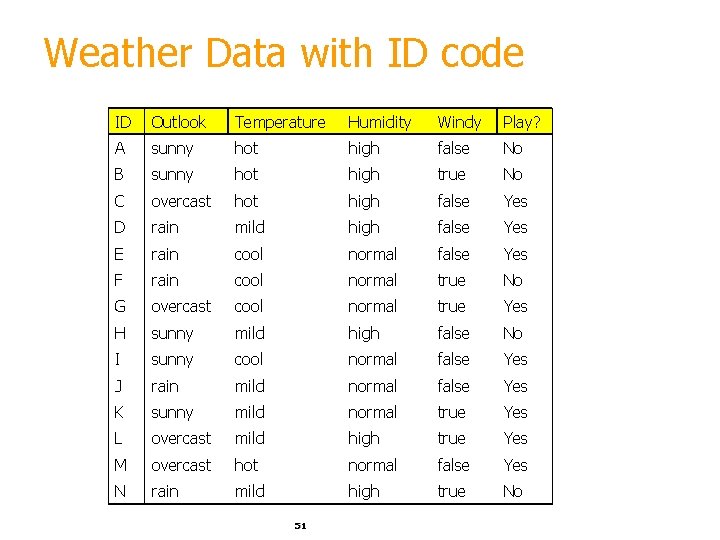
Weather Data with ID code ID Outlook Temperature Humidity Windy Play? A sunny hot high false No B sunny hot high true No C overcast hot high false Yes D rain mild high false Yes E rain cool normal false Yes F rain cool normal true No G overcast cool normal true Yes H sunny mild high false No I sunny cool normal false Yes J rain mild normal false Yes K sunny mild normal true Yes L overcast mild high true Yes M overcast hot normal false Yes N rain mild high true No 51
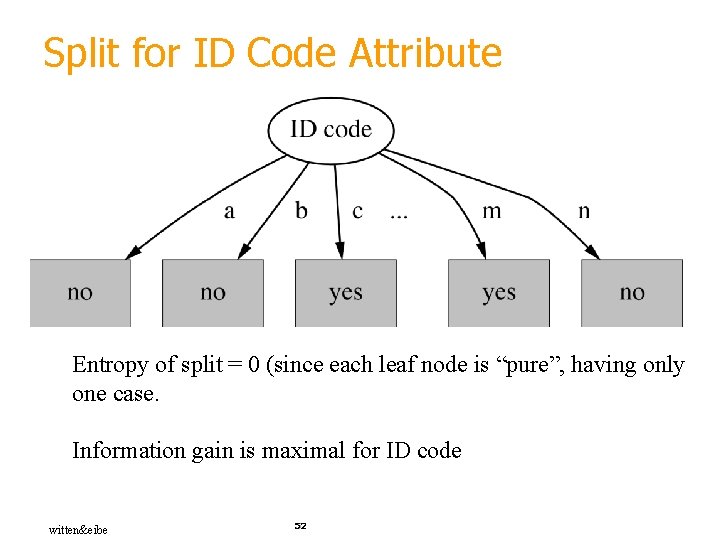
Split for ID Code Attribute Entropy of split = 0 (since each leaf node is “pure”, having only one case. Information gain is maximal for ID code witten&eibe 52
Gain ratio § Gain ratio: a modification of the information gain that reduces its bias on high-branch attributes § Gain ratio should be § Large when data is evenly spread § Small when all data belong to one branch § Gain ratio takes number and size of branches into account when choosing an attribute § It corrects the information gain by taking the intrinsic information of a split into account (i. e. how much info do we need to tell which branch an instance belongs to) witten&eibe 53
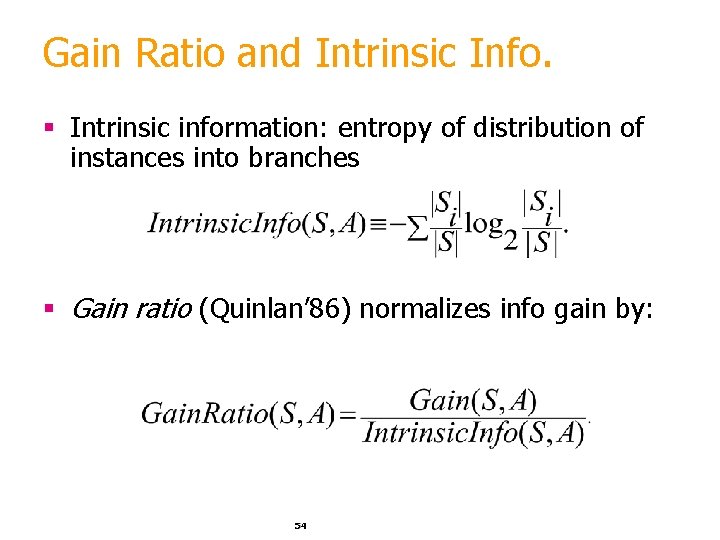
Gain Ratio and Intrinsic Info. § Intrinsic information: entropy of distribution of instances into branches § Gain ratio (Quinlan’ 86) normalizes info gain by: 54
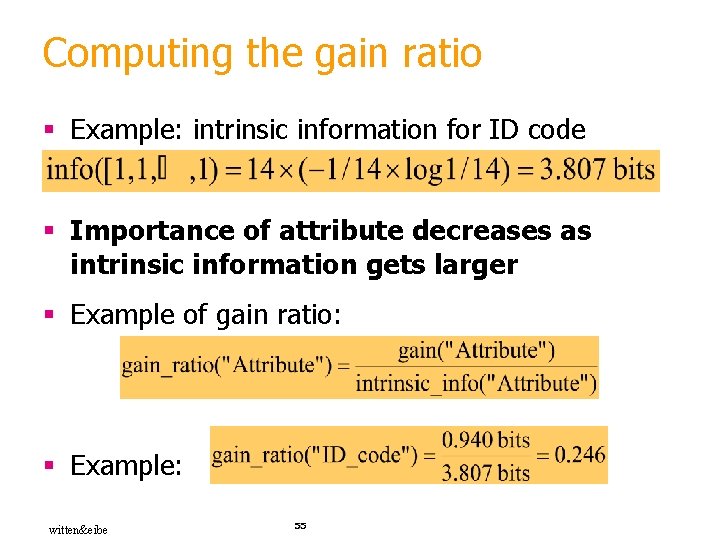
Computing the gain ratio § Example: intrinsic information for ID code § Importance of attribute decreases as intrinsic information gets larger § Example of gain ratio: § Example: witten&eibe 55
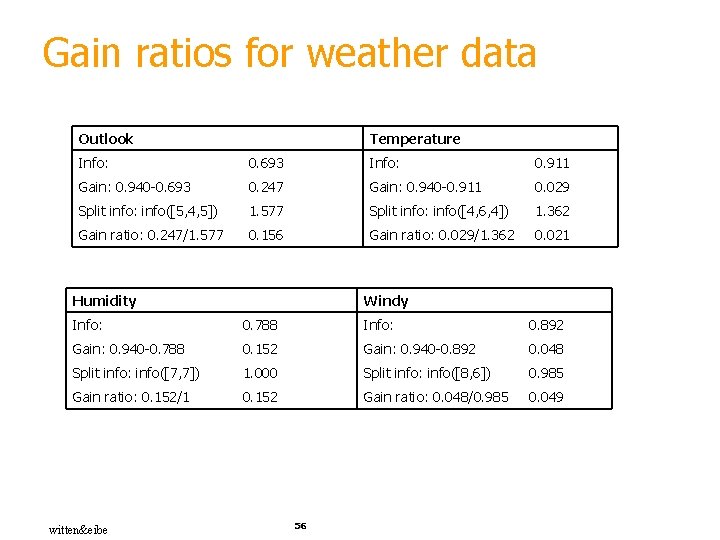
Gain ratios for weather data Outlook Temperature Info: 0. 693 Info: 0. 911 Gain: 0. 940 -0. 693 0. 247 Gain: 0. 940 -0. 911 0. 029 Split info: info([5, 4, 5]) 1. 577 Split info: info([4, 6, 4]) 1. 362 Gain ratio: 0. 247/1. 577 0. 156 Gain ratio: 0. 029/1. 362 0. 021 Humidity Windy Info: 0. 788 Info: 0. 892 Gain: 0. 940 -0. 788 0. 152 Gain: 0. 940 -0. 892 0. 048 Split info: info([7, 7]) 1. 000 Split info: info([8, 6]) 0. 985 Gain ratio: 0. 152/1 0. 152 Gain ratio: 0. 048/0. 985 0. 049 witten&eibe 56
Discussion § Algorithm for top-down induction of decision trees (“ID 3”) was developed by Ross Quinlan § Gain ratio just one modification of this basic algorithm § Led to development of C 4. 5, which can deal with numeric attributes, missing values, and noisy data § Similar approach: CART (to be covered later) § There are many other attribute selection criteria! (But almost no difference in accuracy of result. ) 57
Summary § Top-Down Decision Tree Construction § Choosing the Splitting Attribute § Information Gain biased towards attributes with a large number of values § Gain Ratio takes number and size of branches into account when choosing an attribute 58

Machine Learning in Real World: C 4. 5
Outline § Handling Numeric Attributes § Finding Best Split(s) § Dealing with Missing Values § Pruning § Pre-pruning, Post-pruning, Error Estimates § From Trees to Rules 60
Industrial-strength algorithms § § For an algorithm to be useful in a wide range of realworld applications it must: § Permit numeric attributes § Allow missing values § Be robust in the presence of noise § Be able to approximate arbitrary concept descriptions (at least in principle) Basic schemes need to be extended to fulfill these requirements witten & eibe 61
C 4. 5 History § ID 3, CHAID – 1960 s § C 4. 5 innovations (Quinlan): § permit numeric attributes § deal sensibly with missing values § pruning to deal with for noisy data § C 4. 5 - one of best-known and most widely-used learning algorithms § Last research version: C 4. 8, implemented in Weka as J 4. 8 (Java) § Commercial successor: C 5. 0 (available from Rulequest) 62
Numeric attributes § Standard method: binary splits § E. g. temp < 45 § Unlike nominal attributes, every attribute has many possible split points § Solution is straightforward extension: § § Evaluate info gain (or other measure) for every possible split point of attribute § Choose “best” split point § Info gain for best split point is info gain for attribute Computationally more demanding witten & eibe 63
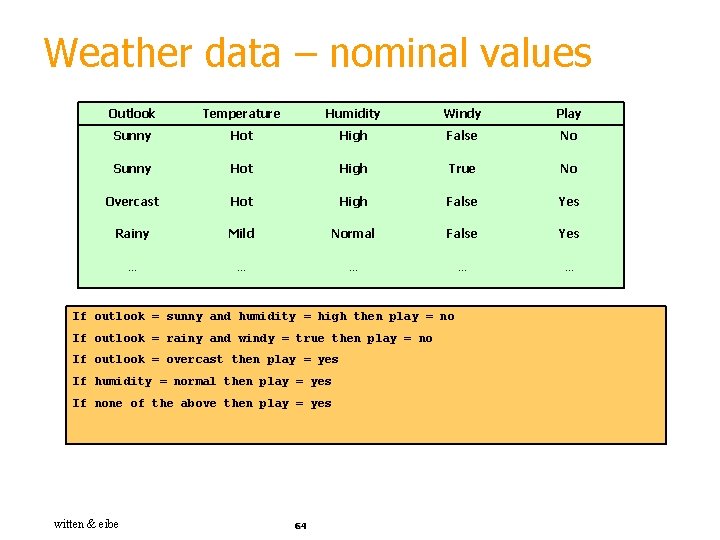
Weather data – nominal values Outlook Temperature Humidity Windy Play Sunny Hot High False No Sunny Hot High True No Overcast Hot High False Yes Rainy Mild Normal False Yes … … … If outlook = sunny and humidity = high then play = no If outlook = rainy and windy = true then play = no If outlook = overcast then play = yes If humidity = normal then play = yes If none of the above then play = yes witten & eibe 64
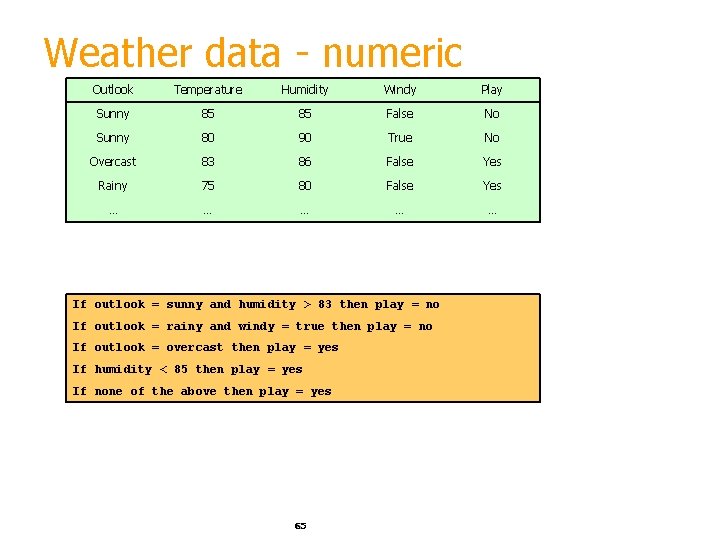
Weather data - numeric Outlook Temperature Humidity Windy Play Sunny 85 85 False No Sunny 80 90 True No Overcast 83 86 False Yes Rainy 75 80 False Yes … … … If outlook = sunny and humidity > 83 then play = no If outlook = rainy and windy = true then play = no If outlook = overcast then play = yes If humidity < 85 then play = yes If none of the above then play = yes 65
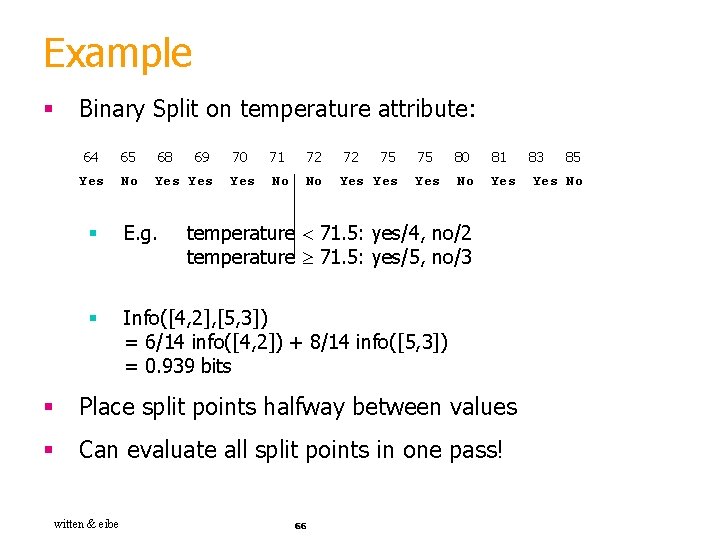
Example § Binary Split on temperature attribute: 64 65 68 69 Yes No Yes 70 71 72 72 75 Yes No No Yes 75 80 81 83 Yes No temperature 71. 5: yes/4, no/2 temperature 71. 5: yes/5, no/3 § E. g. § Info([4, 2], [5, 3]) = 6/14 info([4, 2]) + 8/14 info([5, 3]) = 0. 939 bits § Place split points halfway between values § Can evaluate all split points in one pass! witten & eibe 66 85
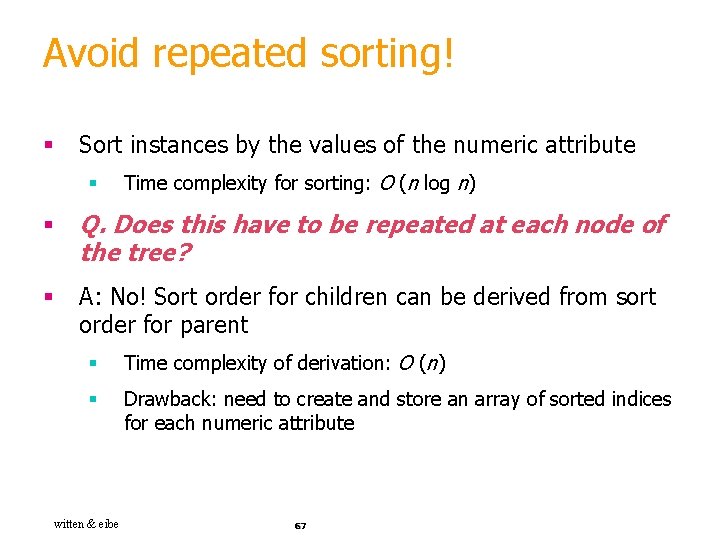
Avoid repeated sorting! § Sort instances by the values of the numeric attribute § Time complexity for sorting: O (n log n) § Q. Does this have to be repeated at each node of the tree? § A: No! Sort order for children can be derived from sort order for parent § Time complexity of derivation: O (n) § Drawback: need to create and store an array of sorted indices for each numeric attribute witten & eibe 67
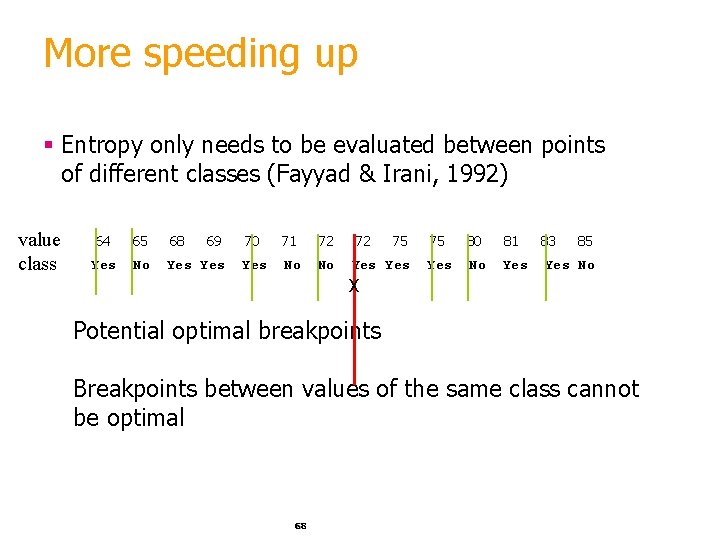
More speeding up § Entropy only needs to be evaluated between points of different classes (Fayyad & Irani, 1992) value class 64 65 68 69 Yes No Yes 70 71 72 72 75 Yes No No Yes 75 80 81 83 85 Yes No X Potential optimal breakpoints Breakpoints between values of the same class cannot be optimal 68
Binary vs. multi-way splits § Splitting (multi-way) on a nominal attribute exhausts all information in that attribute § § Nominal attribute is tested (at most) once on any path in the tree Not so for binary splits on numeric attributes! § Numeric attribute may be tested several times along a path in the tree § Disadvantage: tree is hard to read § Remedy: witten & eibe § pre-discretize numeric attributes, or § use multi-way splits instead of binary ones 69
Missing as a separate value § Missing value denoted “? ” in C 4. X § Simple idea: treat missing as a separate value § Q: When this is not appropriate? § A: When values are missing due to different reasons § Example 1: gene expression could be missing when it is very high or very low § Example 2: field Is. Pregnant=missing for a male patient should be treated differently (no) than for a female patient of age 25 (unknown) 70
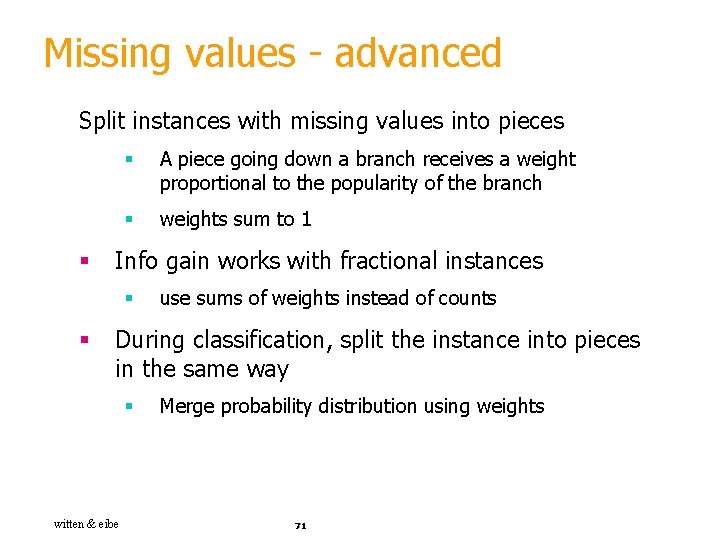
Missing values - advanced Split instances with missing values into pieces § § A piece going down a branch receives a weight proportional to the popularity of the branch § weights sum to 1 Info gain works with fractional instances § § use sums of weights instead of counts During classification, split the instance into pieces in the same way § witten & eibe Merge probability distribution using weights 71
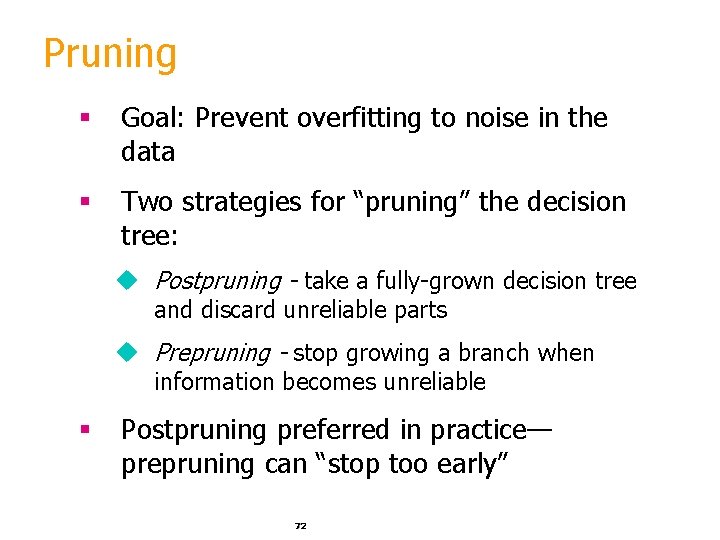
Pruning § Goal: Prevent overfitting to noise in the data § Two strategies for “pruning” the decision tree: u Postpruning - take a fully-grown decision tree and discard unreliable parts u Prepruning - stop growing a branch when information becomes unreliable § Postpruning preferred in practice— prepruning can “stop too early” 72
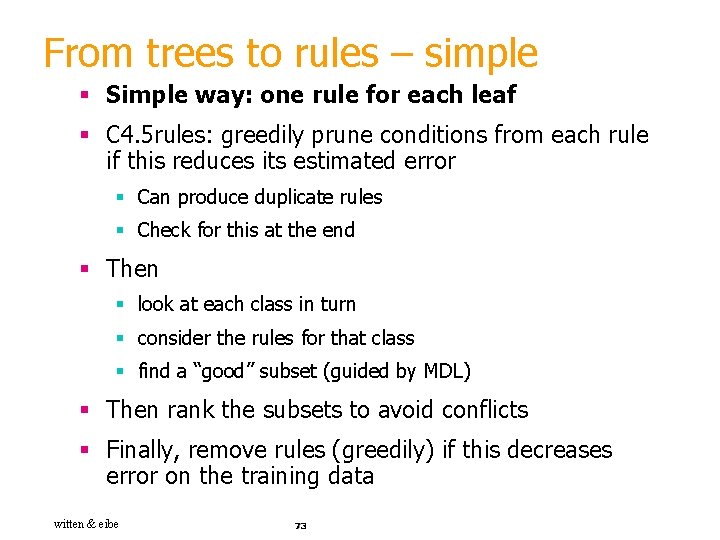
From trees to rules – simple § Simple way: one rule for each leaf § C 4. 5 rules: greedily prune conditions from each rule if this reduces its estimated error § Can produce duplicate rules § Check for this at the end § Then § look at each class in turn § consider the rules for that class § find a “good” subset (guided by MDL) § Then rank the subsets to avoid conflicts § Finally, remove rules (greedily) if this decreases error on the training data witten & eibe 73
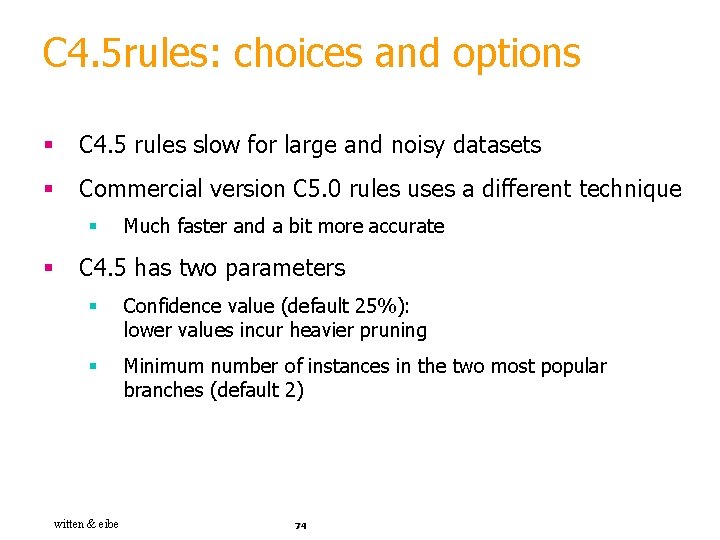
C 4. 5 rules: choices and options § C 4. 5 rules slow for large and noisy datasets § Commercial version C 5. 0 rules uses a different technique § § Much faster and a bit more accurate C 4. 5 has two parameters § Confidence value (default 25%): lower values incur heavier pruning § Minimum number of instances in the two most popular branches (default 2) witten & eibe 74
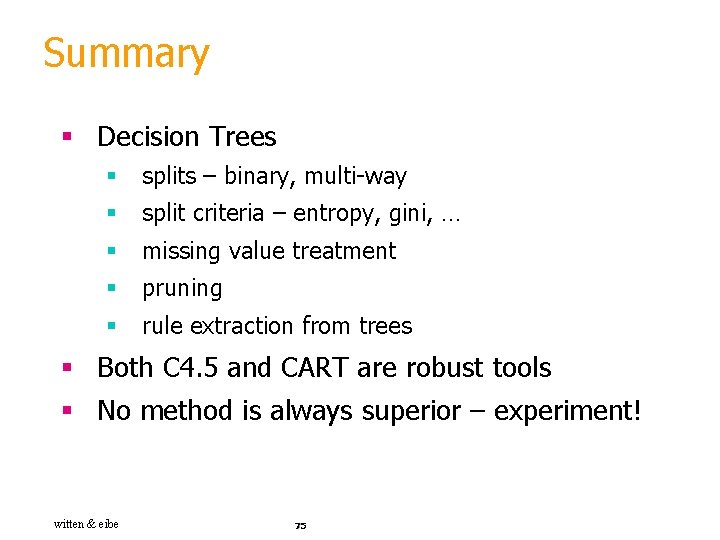
Summary § Decision Trees § splits – binary, multi-way § split criteria – entropy, gini, … § missing value treatment § pruning § rule extraction from trees § Both C 4. 5 and CART are robust tools § No method is always superior – experiment! witten & eibe 75
- Slides: 72