
Algorithms and Software for LargeScale Simulation of Reactive

- Slides: 28
Algorithms and Software for Large-Scale Simulation of Reactive Systems ________________ Ananth Grama Coordinated Systems Lab Purdue University ayg@cs. purdue. edu
Molecular Simulation Methods • Ab-initio methods (few approximations but slow) • DFT • CPMD • Electron and nuclei treated explicitly • Classical atomistic methods (more approximations) • Classical molecular dynamics • Monte Carlo • Brownian dynamics • No electronic degrees of freedom. Electrons are approximated through fixed partial charges on atoms. • Continuum methods (no atomistic details)
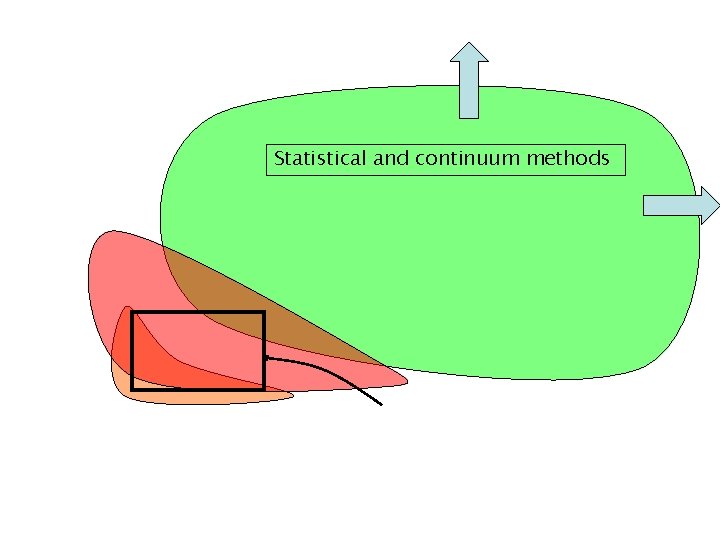
Statistical and continuum methods
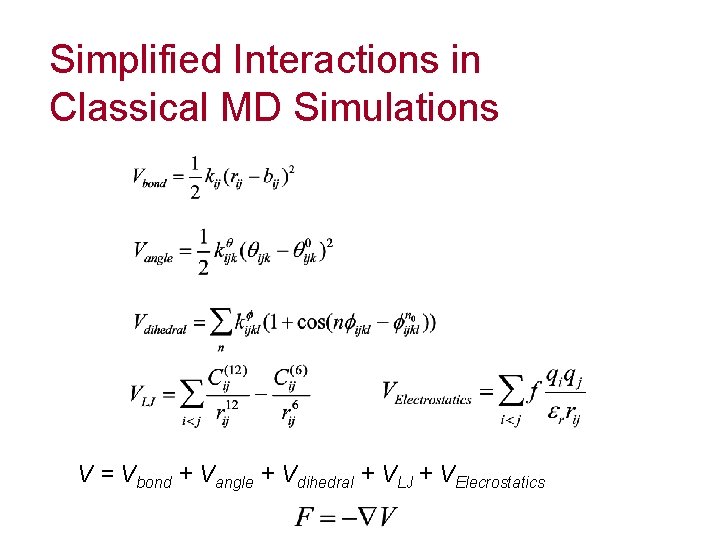
Simplified Interactions in Classical MD Simulations V = Vbond + Vangle + Vdihedral + VLJ + VElecrostatics
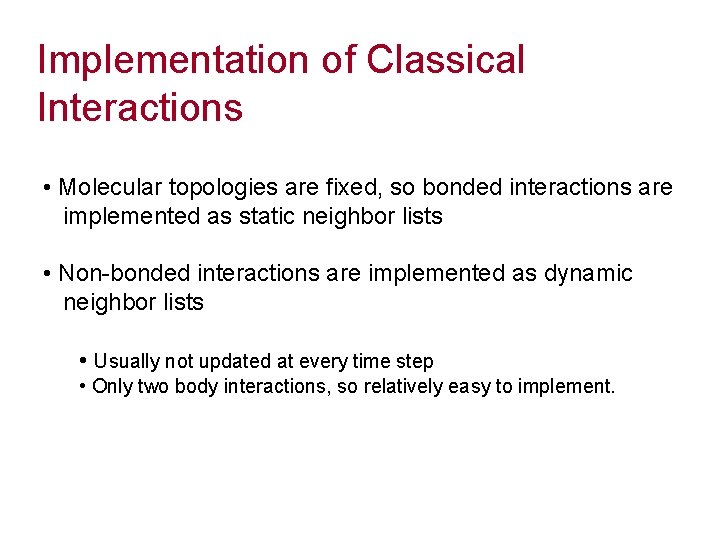
Implementation of Classical Interactions • Molecular topologies are fixed, so bonded interactions are implemented as static neighbor lists • Non-bonded interactions are implemented as dynamic neighbor lists • Usually not updated at every time step • Only two body interactions, so relatively easy to implement.
Reactive systems • Chemical reactions correspond to association and dissociation of chemical bonds • Classical simulations cannot simulate reactions • ab-initio methods calculate overlap of electron orbitals to model chemical reactions • Rea. X force field postulates a classical bond order interaction to mimic the association and dissociation of chemical bonds 1 1 van Duin et al , J. Phys. Chem. A, 105, 9396 (2001)
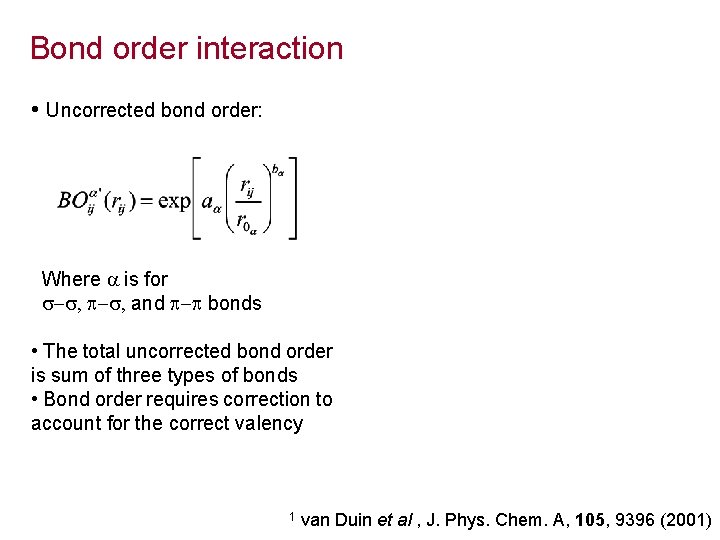
Bond order interaction • Uncorrected bond order: Where is for and bonds • The total uncorrected bond order is sum of three types of bonds • Bond order requires correction to account for the correct valency 1 van Duin et al , J. Phys. Chem. A, 105, 9396 (2001)
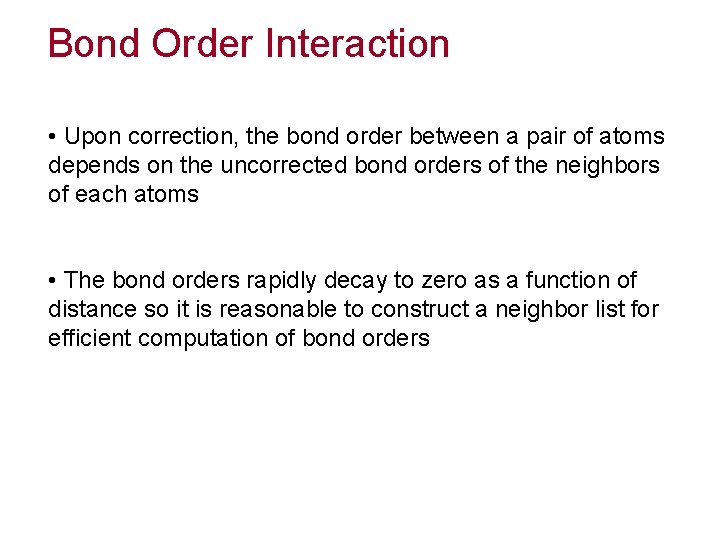
Bond Order Interaction • Upon correction, the bond order between a pair of atoms depends on the uncorrected bond orders of the neighbors of each atoms • The bond orders rapidly decay to zero as a function of distance so it is reasonable to construct a neighbor list for efficient computation of bond orders
Neighbor Lists for Bond Order • Efficient implementation critical for performance • Implementation based on an oct-tree decomposition of the domain • For each particle, we traverse down to neighboring octs and collect neighboring atoms • Has implications for parallelism (issues identical to parallelizing multipole methods)
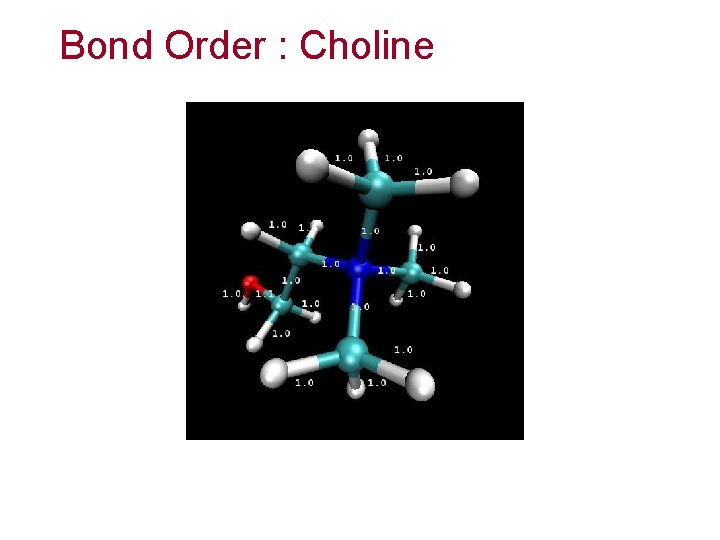
Bond Order : Choline
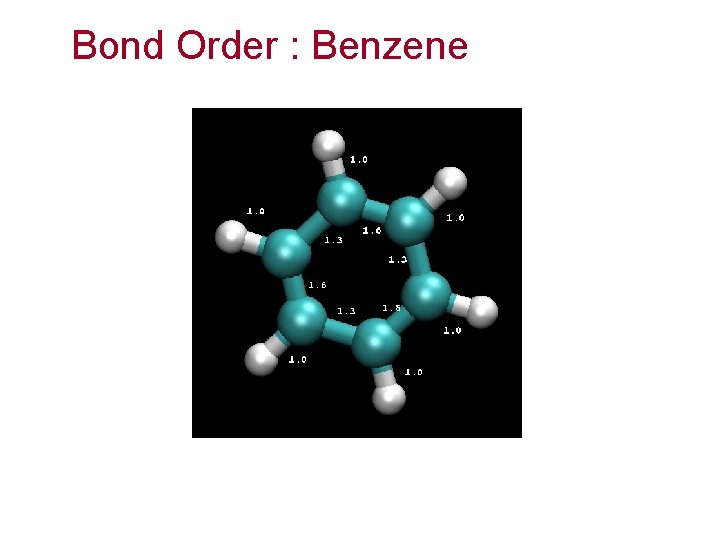
Bond Order : Benzene
Other Local Energy Terms • Other interaction terms common to classical simulations, e. g. , bond energy, valence angle and torsion, are appropriately modified and contribute to non-zero bond order pairs of atoms • These terms also become many body interactions as bond order itself depends on the neighbors and neighbor’s neighbors • Due to variable bond structure there are other interaction terms, such as over/under coordination energy, lone pair interaction, 3 and 4 body conjugation, and three body penalty energy
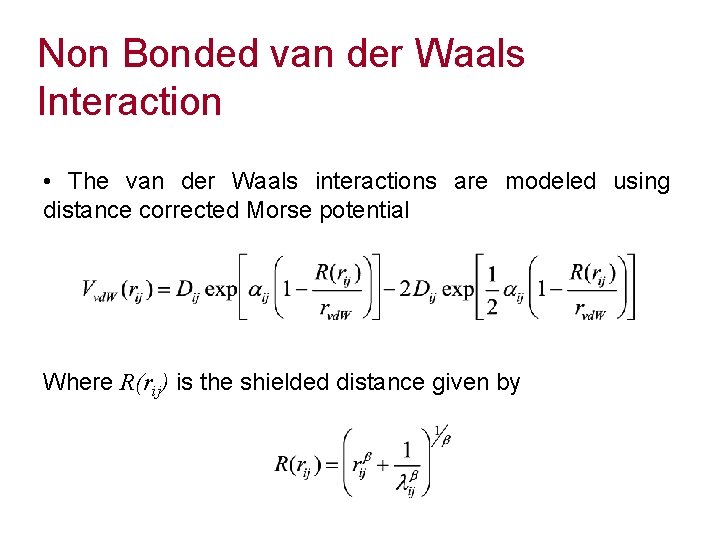
Non Bonded van der Waals Interaction • The van der Waals interactions are modeled using distance corrected Morse potential Where R(rij) is the shielded distance given by
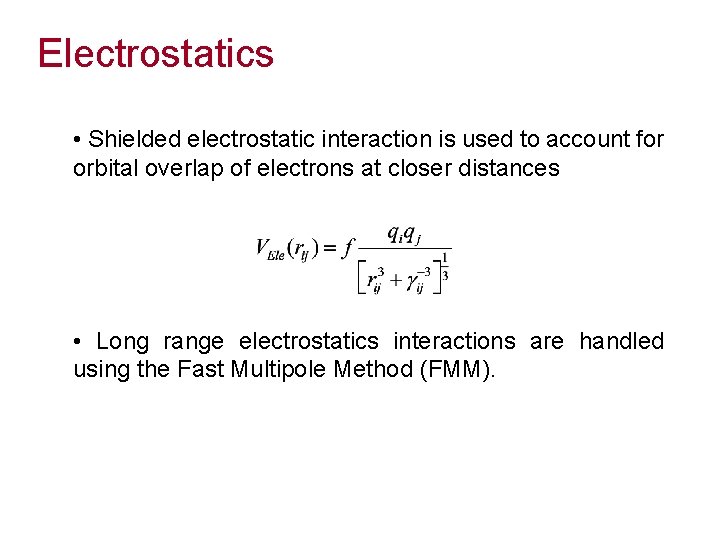
Electrostatics • Shielded electrostatic interaction is used to account for orbital overlap of electrons at closer distances • Long range electrostatics interactions are handled using the Fast Multipole Method (FMM).
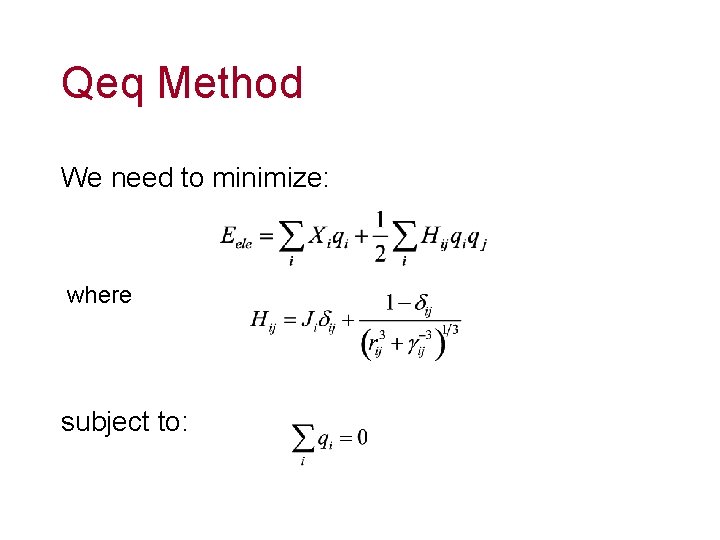
Charge Equilibration (QEq) Method • The fixed partial charge model used in classical simulations is inadequate for reacting systems. • One must compute the partial charges on atoms at each time step using an ab-initio method. • We compute the partial charges on atoms at each time step using a simplified approach call the Qeq method.
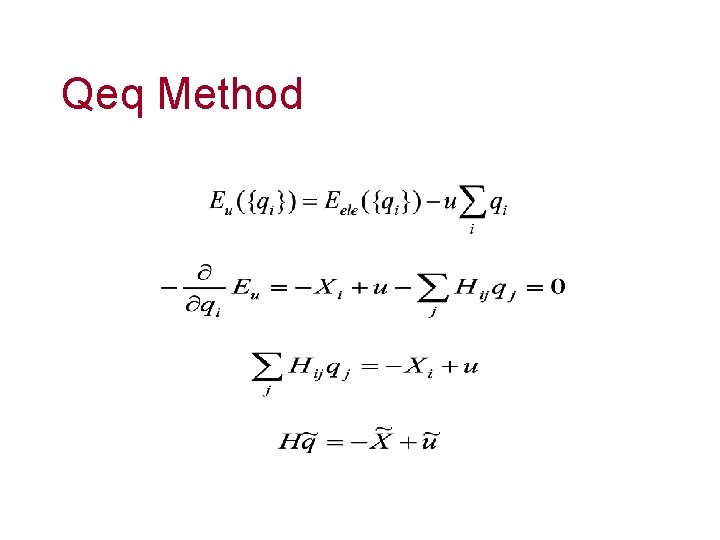
Charge Equilibration (QEq) Method • Expand electrostatic energy as a Taylor series in charge around neutral charge. • Identify the term linear in charge as electronegativity of the atom and the quadratic term as electrostatic potential and self energy. • Using these, solve for self-term of partial derivative of electrostatic energy.
Qeq Method We need to minimize: where subject to:
Qeq Method
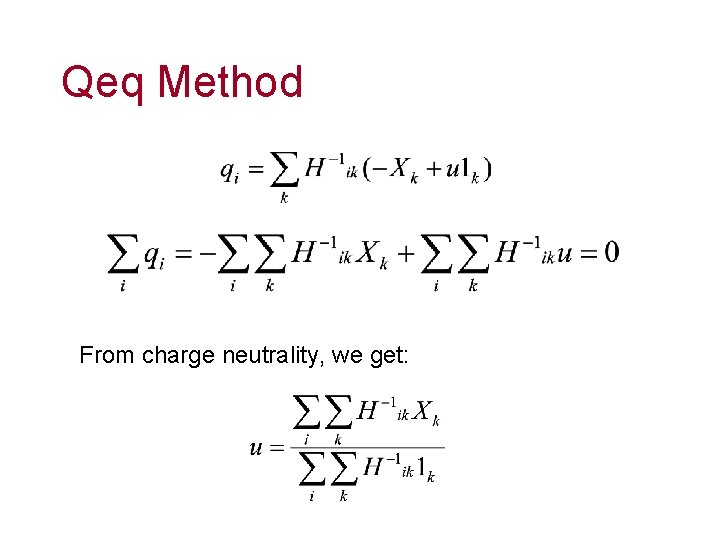
Qeq Method From charge neutrality, we get:
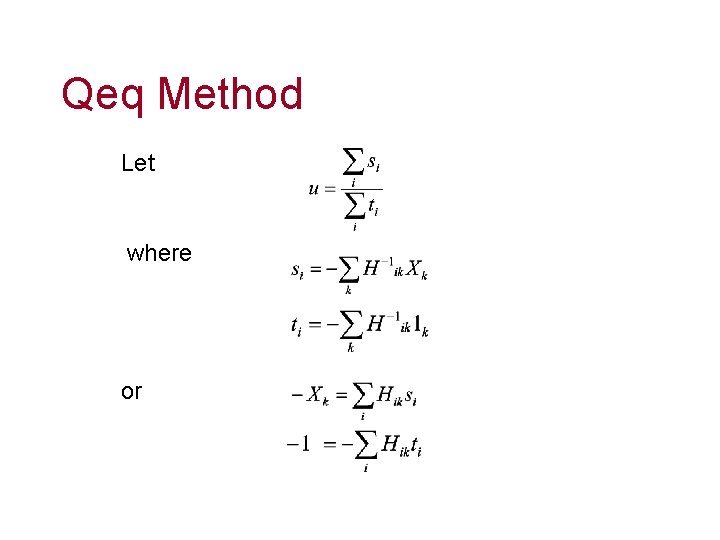
Qeq Method Let where or
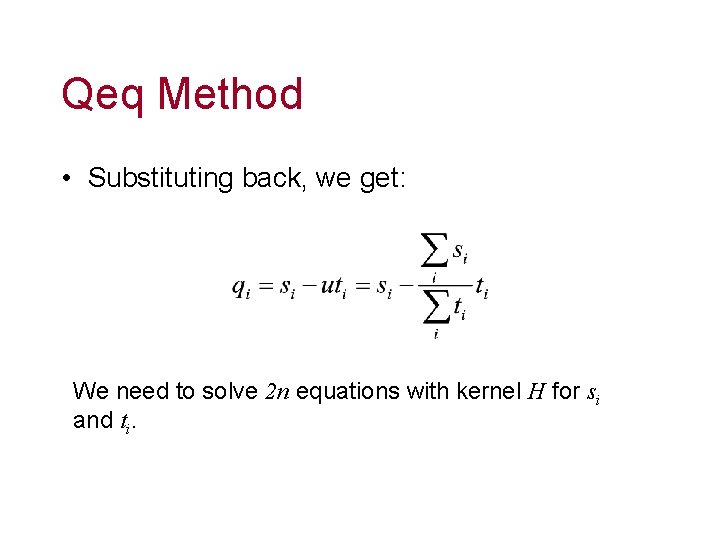
Qeq Method • Substituting back, we get: We need to solve 2 n equations with kernel H for si and ti.
Qeq Method • Observations: – – H is dense. The diagonal term is Ji The shielding term is short-range Long range behavior of the kernel is 1/r
Implementation, Performance, and Validation
Serial Performance: Scaling
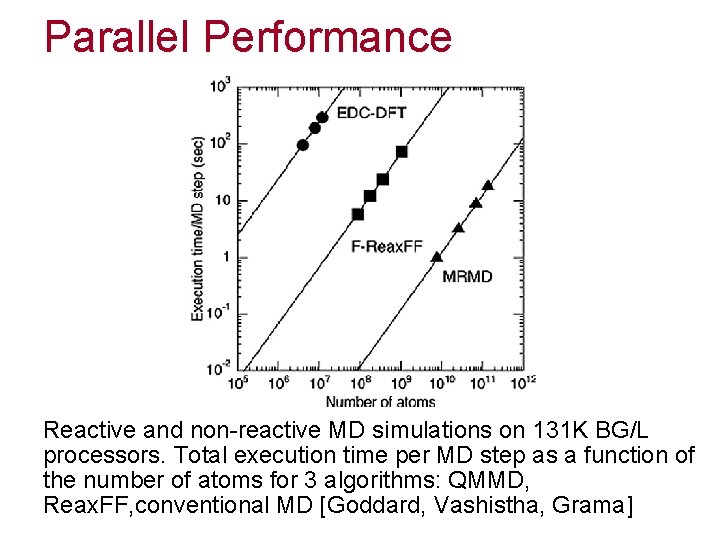
Parallel Performance Reactive and non-reactive MD simulations on 131 K BG/L processors. Total execution time per MD step as a function of the number of atoms for 3 algorithms: QMMD, Reax. FF, conventional MD [Goddard, Vashistha, Grama]
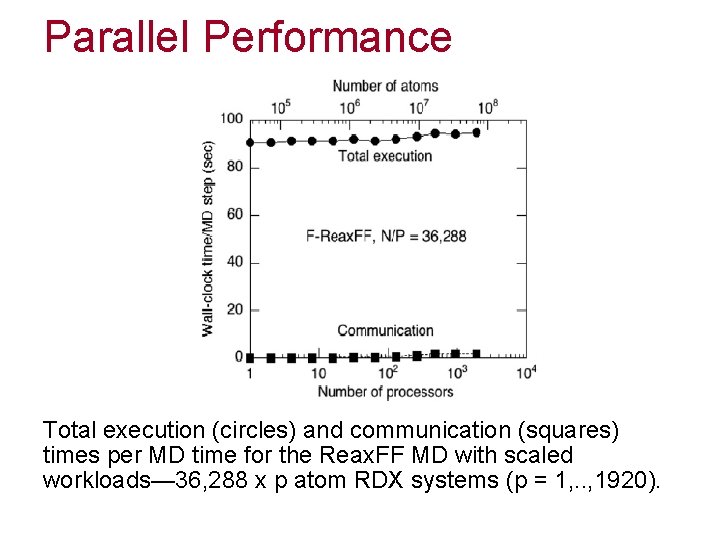
Parallel Performance Total execution (circles) and communication (squares) times per MD time for the Reax. FF MD with scaled workloads— 36, 288 x p atom RDX systems (p = 1, . . , 1920).
Current Development Efforts • Development and validation of parallel version of next generation Reax code. • Integration into LAMMPS.
Planned Development Efforts • Interface with conventional MD • Interface with continuum models • Validation in the context of surface contact for RF MEMS device