
Algorithmic Mechanism Design an Introduction VCGmechanisms for some




- Slides: 29
Algorithmic Mechanism Design: an Introduction VCG-mechanisms for some basic network optimization problems: The Minimum Spanning Tree problem Guido Proietti Dipartimento di Ingegneria e Scienze dell'Informazione e Matematica University of L'Aquila guido. proietti@univaq. it
Review n VCG-mechanism: pair M=<g, p> where n pi(g(r)) = - j≠i vj(rj, g(r-i)) + j≠i vj(rj, g(r)) VCG-mechanisms are truthful for utilitarian problems The classic shortest-path problem on (private-edge) graphs is utilitarian we showed an efficient O(m+n log n) time implementation of the corresponding VCG-mechanism: n g(r) = compute a shortest-path n pe(g(r)) = pays for the marginal utility of e (difference between the length of a replacement shortest path without e and g(r)) n n n g(r) = arg maxy X i vi(ri, y)
Another very well-known problem: the Minimum Spanning Tree problem INPUT: an undirected, weighted graph G=(V, E, w), w(e) R+ for any e E n n Recall: T is a spanning tree of G if: 1. 2. 3. n n T is a tree T is a subgraph of G T contains all the nodes of G OUTPUT: T=(V, ET) minimum spanning tree of G, namely having minimum total weight w(T)=e E w(e) T Fastest centralized algorithm costs O(m (m, n)) time
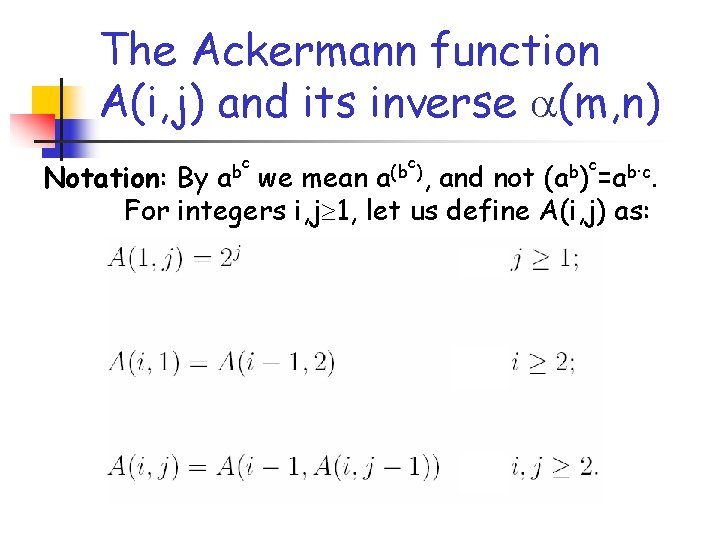
The Ackermann function A(i, j) and its inverse (m, n) ab c c a(b ), c b (a ) =ab·c. Notation: By we mean and not For integers i, j 1, let us define A(i, j) as:
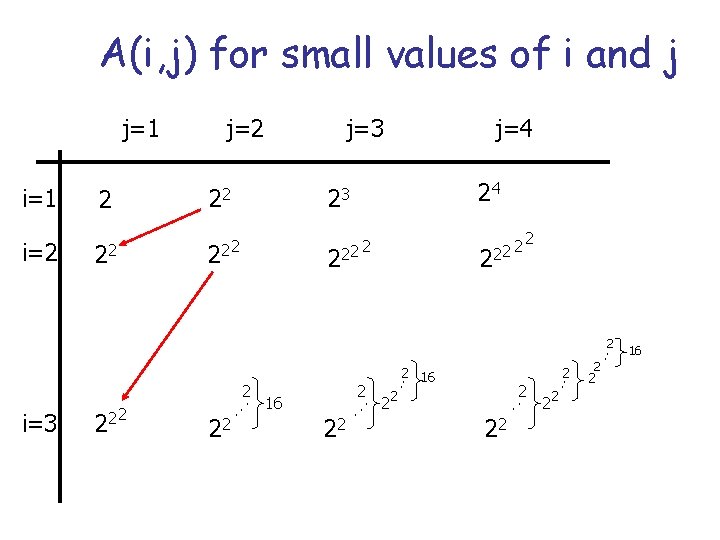
A(i, j) for small values of i and j j=1 j=2 i=1 2 22 i=2 22 22 2 i=3 22 2 22 j=3 j=4 24 23 2. 16. . 2 2 22 22 2. 2. . 2 22 2 2. . 16 22 22 2 2. . 16
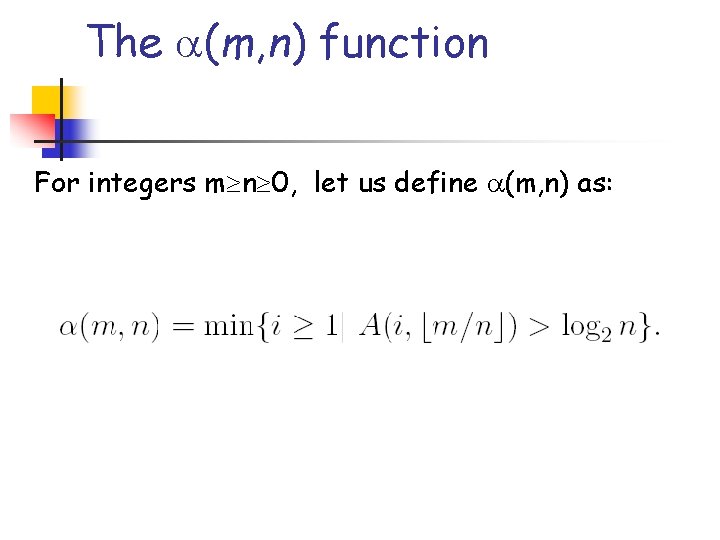
The (m, n) function For integers m n 0, let us define (m, n) as:
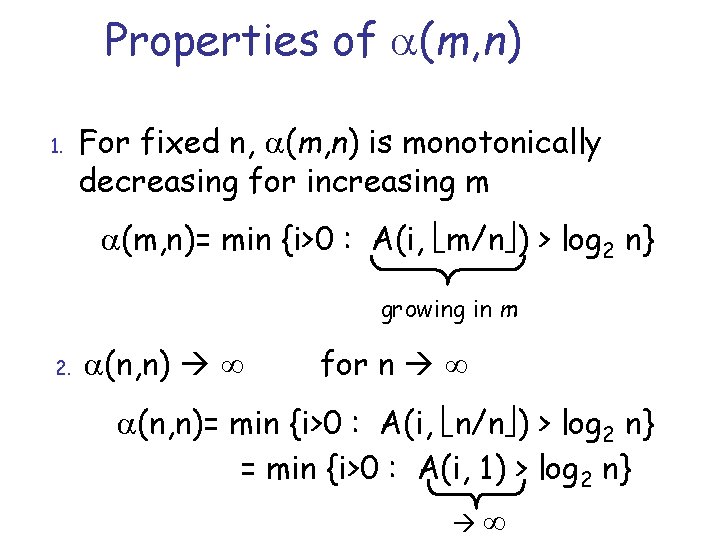
Properties of (m, n) 1. For fixed n, (m, n) is monotonically decreasing for increasing m (m, n)= min {i>0 : A(i, m/n ) > log 2 n} growing in m 2. (n, n) for n (n, n)= min {i>0 : A(i, n/n ) > log 2 n} = min {i>0 : A(i, 1) > log 2 n}
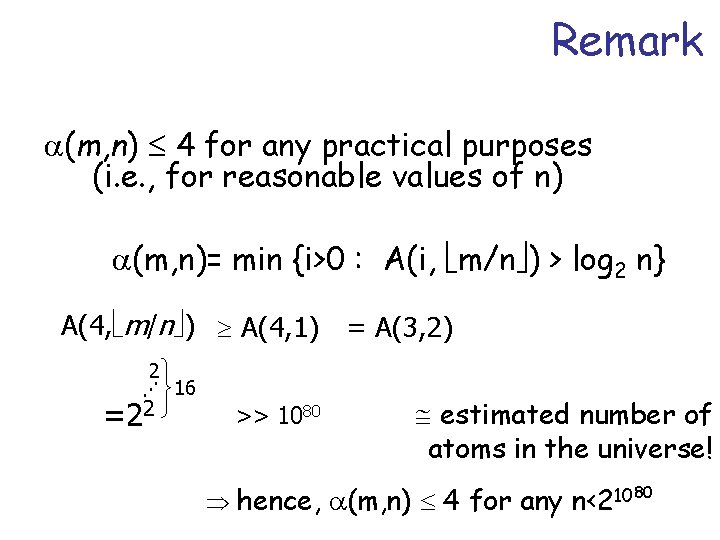
Remark (m, n) 4 for any practical purposes (i. e. , for reasonable values of n) (m, n)= min {i>0 : A(i, m/n ) > log 2 n} A(4, m/n ) A(4, 1) = A(3, 2) 2. . . 16 =22 >> 1080 estimated number of atoms in the universe! hence, (m, n) 4 for any n<21080
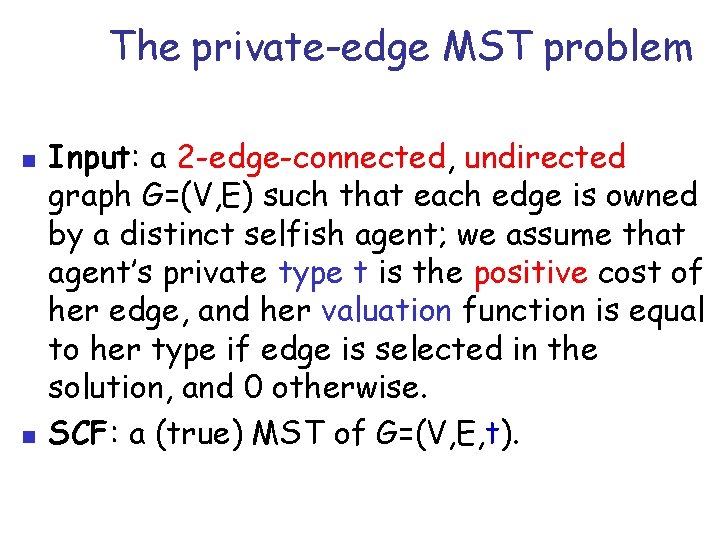
The private-edge MST problem n n Input: a 2 -edge-connected, undirected graph G=(V, E) such that each edge is owned by a distinct selfish agent; we assume that agent’s private type t is the positive cost of her edge, and her valuation function is equal to her type if edge is selected in the solution, and 0 otherwise. SCF: a (true) MST of G=(V, E, t).
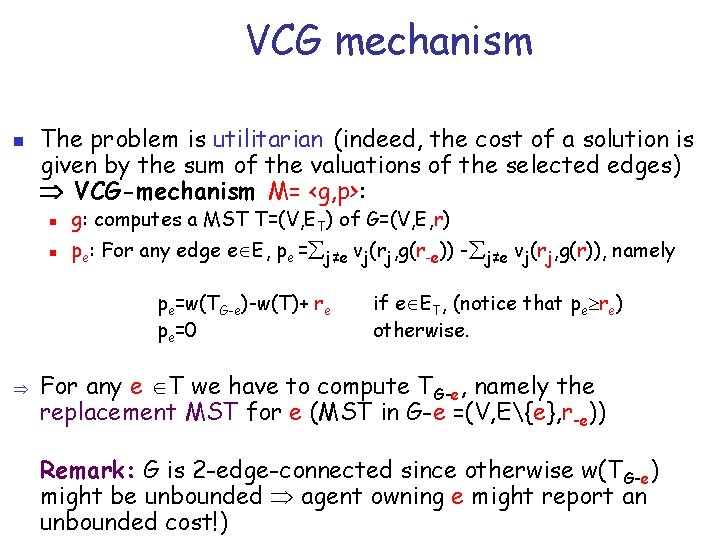
VCG mechanism n The problem is utilitarian (indeed, the cost of a solution is given by the sum of the valuations of the selected edges) VCG-mechanism M= <g, p>: n n g: computes a MST T=(V, ET) of G=(V, E, r) pe: For any edge e E, pe = j≠e vj(rj, g(r-e)) - j≠e vj(rj, g(r)), namely pe=w(TG-e)-w(T)+ re pe=0 if e ET, (notice that pe re) otherwise. For any e T we have to compute TG-e, namely the replacement MST for e (MST in G-e =(V, E{e}, r-e)) Remark: G is 2 -edge-connected since otherwise w(TG-e) might be unbounded agent owning e might report an unbounded cost!)
A trivial solution e T we compute an MST of G-e Time complexity: we pay O(m (m, n)) for each of the n-1 edges of the MST O(nm (m, n)) We will show an efficient solution costing O(m (m, n)) time!!!
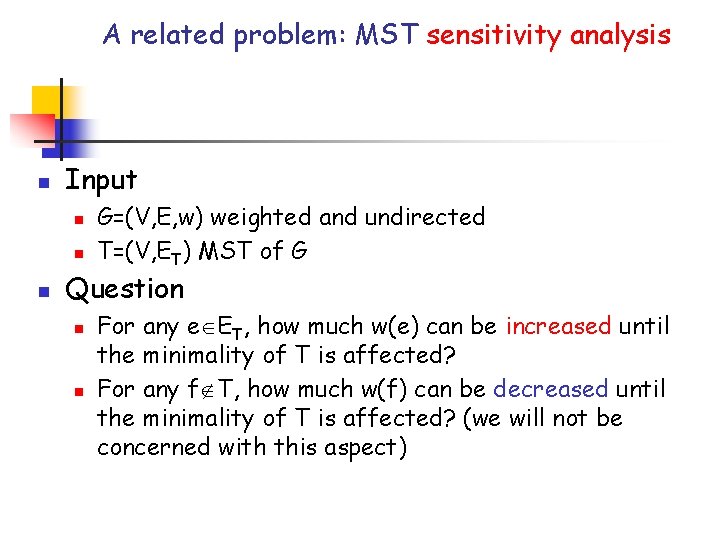
A related problem: MST sensitivity analysis n Input n n n G=(V, E, w) weighted and undirected T=(V, ET) MST of G Question n n For any e ET, how much w(e) can be increased until the minimality of T is affected? For any f T, how much w(f) can be decreased until the minimality of T is affected? (we will not be concerned with this aspect)
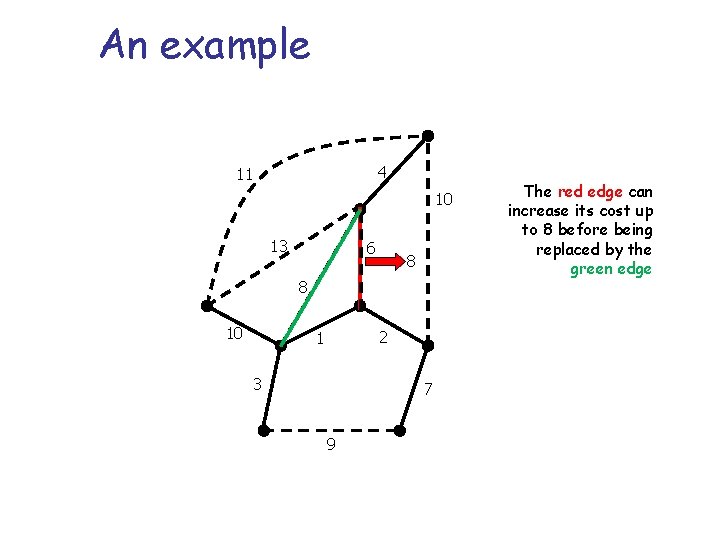
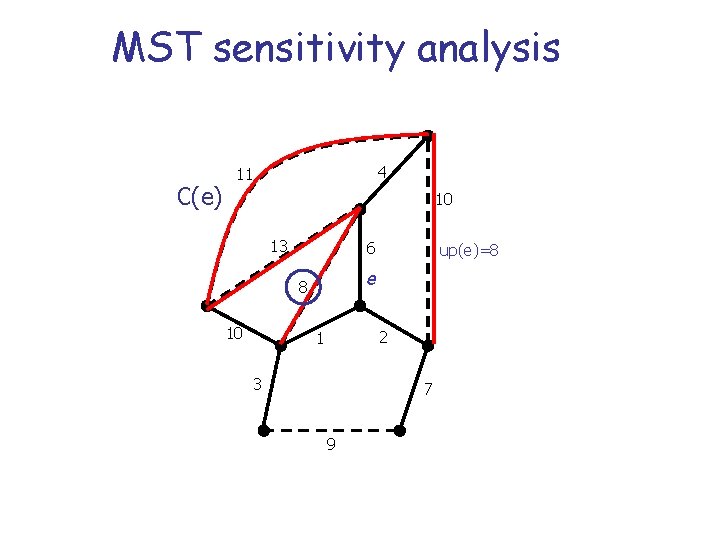
An example 4 11 10 13 6 8 8 10 2 1 3 7 9 The red edge can increase its cost up to 8 before being replaced by the green edge
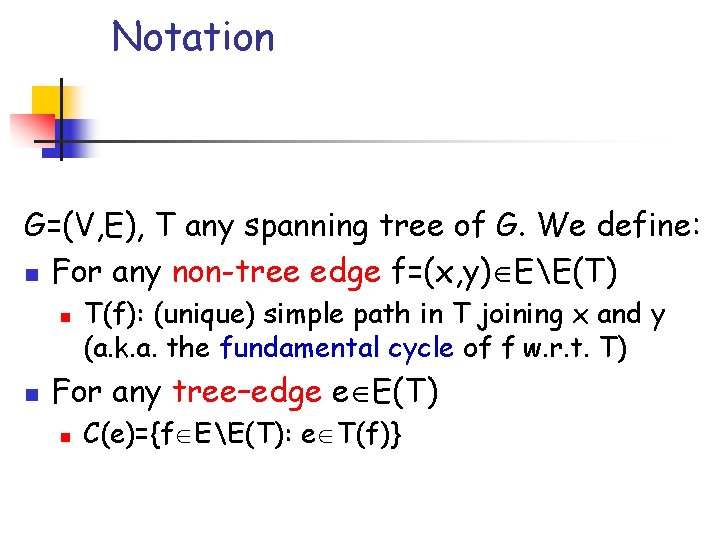
Notation G=(V, E), T any spanning tree of G. We define: n For any non-tree edge f=(x, y) EE(T) n n T(f): (unique) simple path in T joining x and y (a. k. a. the fundamental cycle of f w. r. t. T) For any tree–edge e E(T) n C(e)={f EE(T): e T(f)}
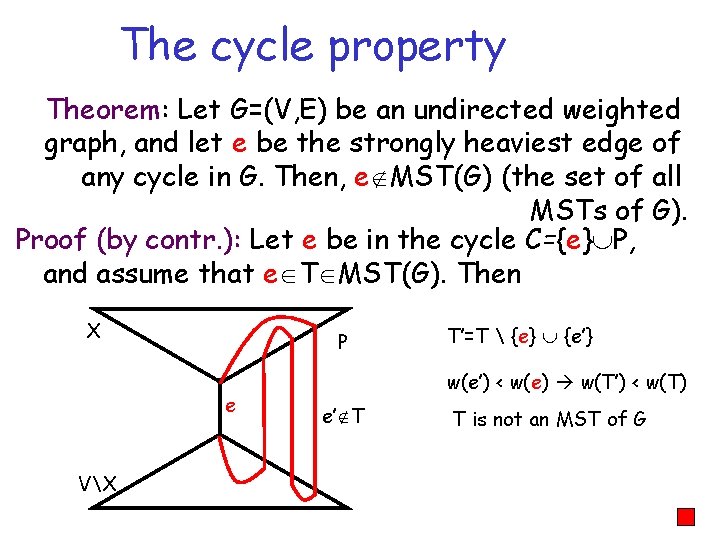
The cycle property Theorem: Let G=(V, E) be an undirected weighted graph, and let e be the strongly heaviest edge of any cycle in G. Then, e MST(G) (the set of all MSTs of G). Proof (by contr. ): Let e be in the cycle C={e} P, and assume that e T MST(G). Then X P e VX T’=T {e} {e’} w(e’) < w(e) w(T’) < w(T) e’ T T is not an MST of G
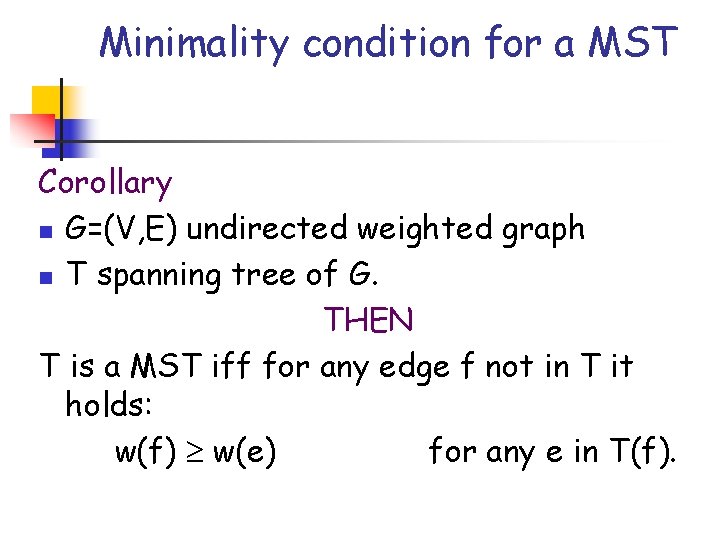
Minimality condition for a MST Corollary n G=(V, E) undirected weighted graph n T spanning tree of G. THEN T is a MST iff for any edge f not in T it holds: w(f) w(e) for any e in T(f).
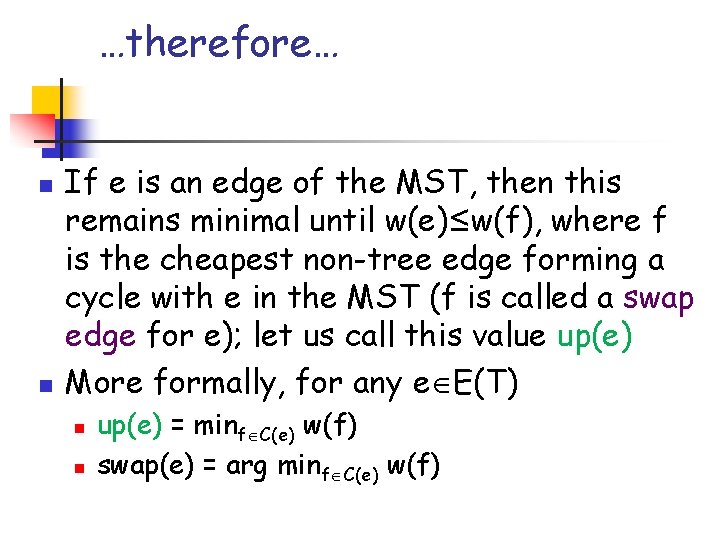
…therefore… n n If e is an edge of the MST, then this remains minimal until w(e)≤w(f), where f is the cheapest non-tree edge forming a cycle with e in the MST (f is called a swap edge for e); let us call this value up(e) More formally, for any e E(T) n n up(e) = minf C(e) w(f) swap(e) = arg minf C(e) w(f)
MST sensitivity analysis C(e) 4 11 10 13 6 e 8 10 up(e)=8 2 1 3 7 9
Remark Computing all the values up(e) is equivalent to compute a MST of G-e for any edge e in T; indeed w(TG-e)=w(T)-w(e)+up(e) In the VCG-mechanism, the payment pe of an edge e in the solution is exactly up(e)!! n
Idea of the efficient algorithm n n From the above observations, it is easy to devise a O(mn) time implementation for the VCGmechanism: just compute an MST of G in O(m (m, n)) time, and then e T compute C(e) and up(e) in O(m) time (can you see the details of this step? ) In the following, we show to boil down the overall complexity to O(m (m, n)) time by checking efficiently all the non-tree edges which form a cycle in T with e
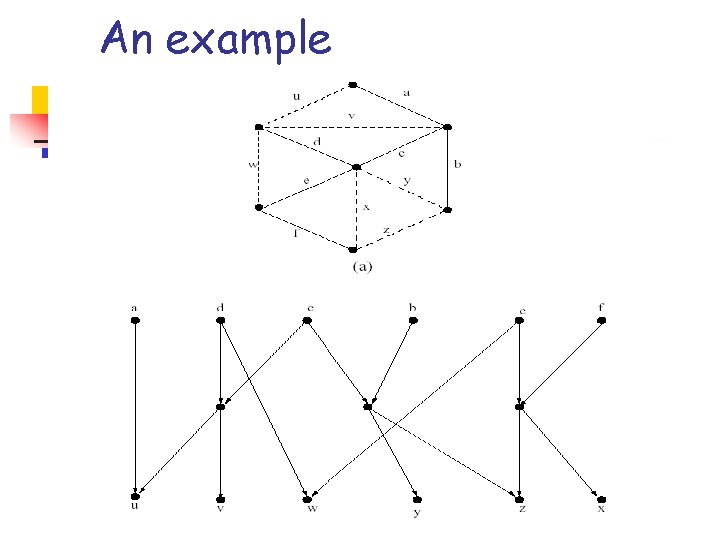
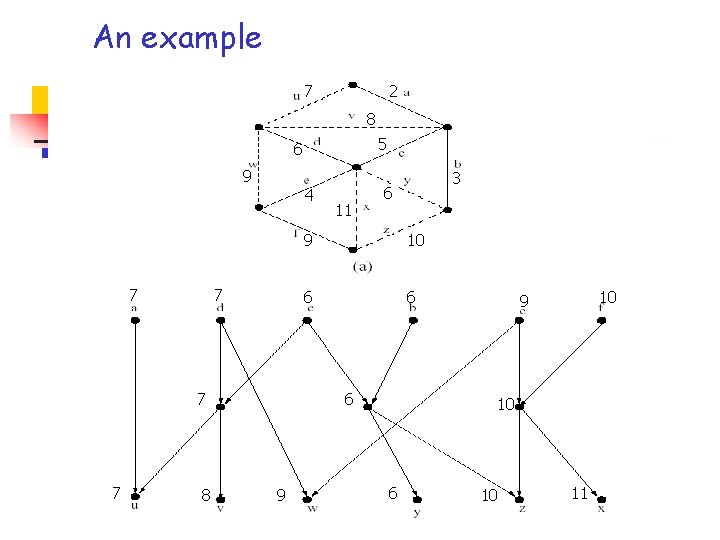
The Transmuter n n Given a graph G=(V, E, w) and a spanning tree T, a transmuter D(G, T) is a directed acyclic graph (DAG) representing in a compact way the set of all fundamental cycles of T w. r. t. G, namely {T(f) : f is not in T} D will contain: A source node (in-degree=0) s(e) for any edge e in T 2. A sink node (out-degree=0) t(f) for any edge f not in T 3. A certain number of auxiliary nodes of indegree=2 and out-degree not equal to zero. 1. n Fundamental property: there is a path in D from s(e) to t(f) iff e T(f)
An example
How to build a tranmuter n It has been shown that for a graph of n nodes and m edges, a transmuter contains O(m (m, n)) nodes and edges, and can be computed in O(m (m, n)) time: R. E. Tarjan, Application of path compression on balanced trees, J. ACM 26 (1979) pp 690 -715
Topological sorting n n n Let D=(N, A) be a directed graph. Then, a topological sorting of D is an order v 1, v 2, …, vn=|N| for the nodes s. t. for any (vi, vj) A, we have i<j. D has a topological sorting iff is a DAG A topological sorting, if any, can be computed in O(|N|+|A|) time (homework!).
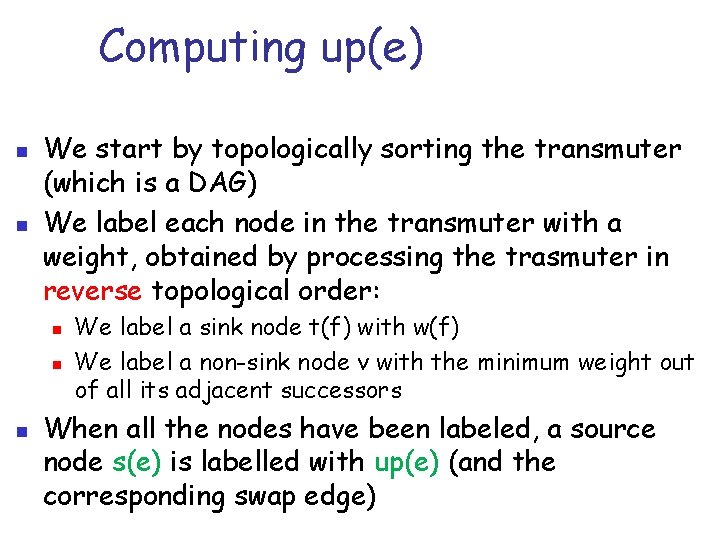
Computing up(e) n n We start by topologically sorting the transmuter (which is a DAG) We label each node in the transmuter with a weight, obtained by processing the trasmuter in reverse topological order: n n n We label a sink node t(f) with w(f) We label a non-sink node v with the minimum weight out of all its adjacent successors When all the nodes have been labeled, a source node s(e) is labelled with up(e) (and the corresponding swap edge)
An example 7 2 8 5 6 9 7 4 7 7 7 8 11 6 9 10 6 6 6 9 3 10 9 10 6 10 11
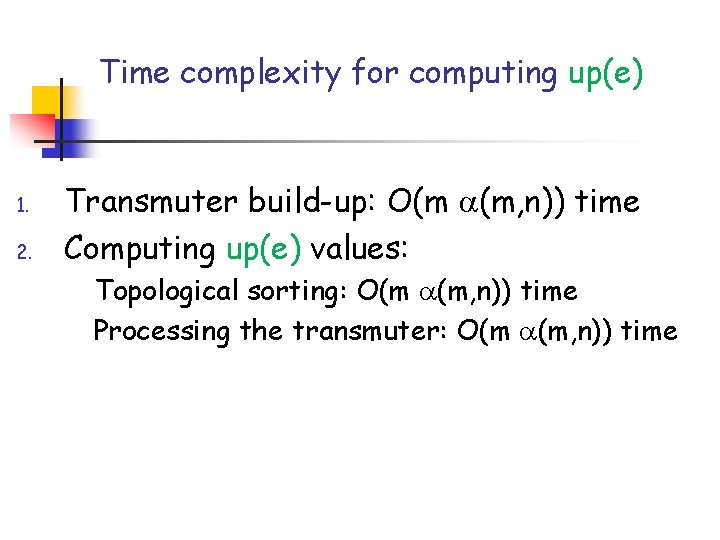
Time complexity for computing up(e) 1. 2. Transmuter build-up: O(m (m, n)) time Computing up(e) values: Topological sorting: O(m (m, n)) time Processing the transmuter: O(m (m, n)) time
Time complexity of the VCG-mechanism Theorem There exists a VCG-mechanism for the privateedge MST problem running in O(m (m, n)) time. Proof. Time complexity of g: O(m (m, n)) Time complexity of p: we compute all the values up(e) in O(m (m, n)) time.
Thanks for your attention! Questions?