
Algorithmic Game Theory Uri Feige Robi Krauthgamer Moni

Algorithmic Game Theory Uri Feige Robi Krauthgamer Moni Naor Lecture 9: Social Choice Lecturer: Moni Naor

Announcements • January: course will be 1300: -15: 00 – The meetings on Jan 7 th, 14 th and 21 st 2009
Regret Minimization Summary • Finding Nash equilibria can be computationally difficult • Not clear that agents would converge to it, or remain in one if there are several • Regret minimization is realistic: – There are efficient algorithms that minimize regret Weighted Majority Algorithm – It is locally computed, – Players improve by lowering regret – Converges at least in zero-sum games

Social choice or Preference Aggregation • Collectively choosing among outcomes – – – Elections, Choice of Restaurant Rating of movies Who is assigned what job Goods allocation Should we build a bridge? • Participants have preferences over outcomes • Social choice function aggregates those preferences and picks and outcome
Voting If there are two options and an odd number of voters • Each having a clear preference between the options Natural choice: majority voting • Sincere/Truthful • Monotone • Merging two sets where the majorities are in one direction keeps it. • Order of queries has no significance – trivial
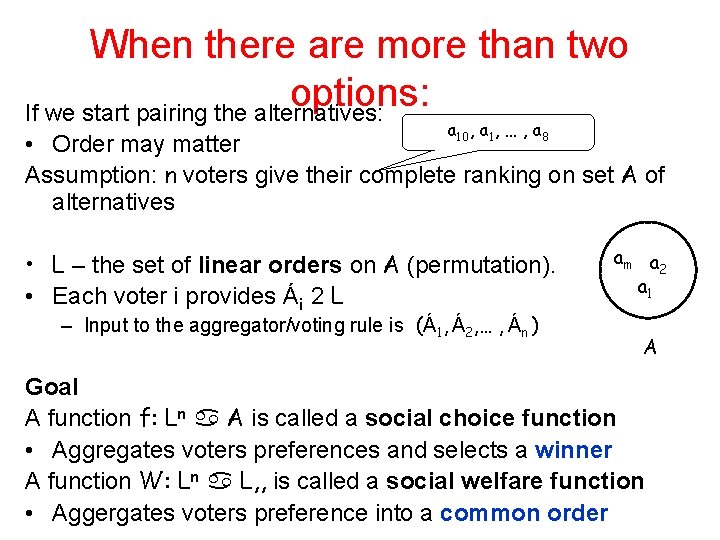
When there are more than two options: If we start pairing the alternatives: a 10, a 1, … , a 8 • Order may matter Assumption: n voters give their complete ranking on set A of alternatives • L – the set of linear orders on A (permutation). • Each voter i provides Ái 2 L – Input to the aggregator/voting rule is (Á1, Á2, … , Án ) am a 2 a 1 A Goal A function f: Ln A is called a social choice function • Aggregates voters preferences and selects a winner A function W: Ln L, , is called a social welfare function • Aggergates voters preference into a common order
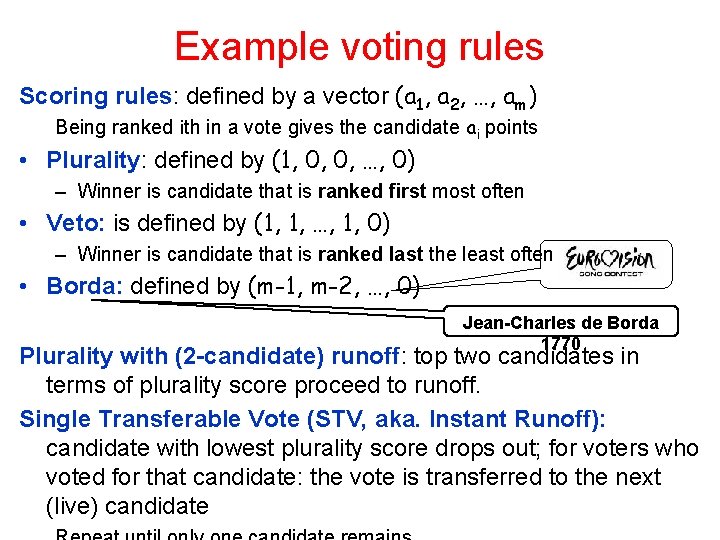
Example voting rules Scoring rules: defined by a vector (a 1, a 2, …, am) Being ranked ith in a vote gives the candidate ai points • Plurality: defined by (1, 0, 0, …, 0) – Winner is candidate that is ranked first most often • Veto: is defined by (1, 1, …, 1, 0) – Winner is candidate that is ranked last the least often • Borda: defined by (m-1, m-2, …, 0) Jean-Charles de Borda 1770 Plurality with (2 -candidate) runoff: top two candidates in terms of plurality score proceed to runoff. Single Transferable Vote (STV, aka. Instant Runoff): candidate with lowest plurality score drops out; for voters who voted for that candidate: the vote is transferred to the next (live) candidate
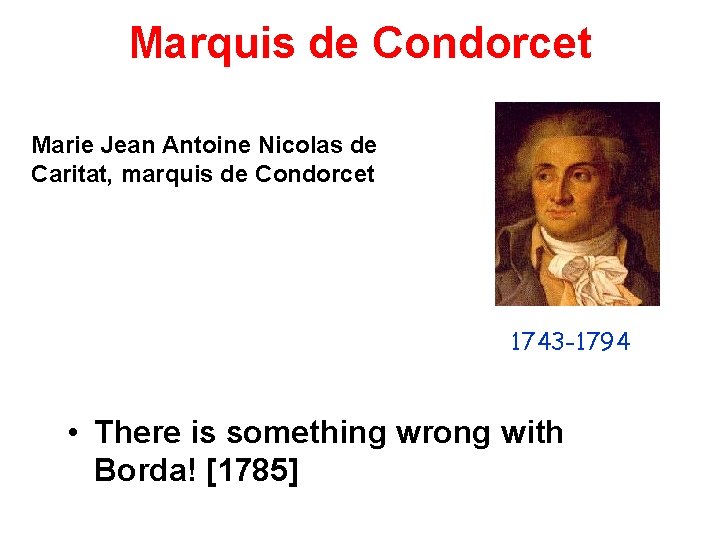
Marquis de Condorcet Marie Jean Antoine Nicolas de Caritat, marquis de Condorcet 1743 -1794 • There is something wrong with Borda! [1785]
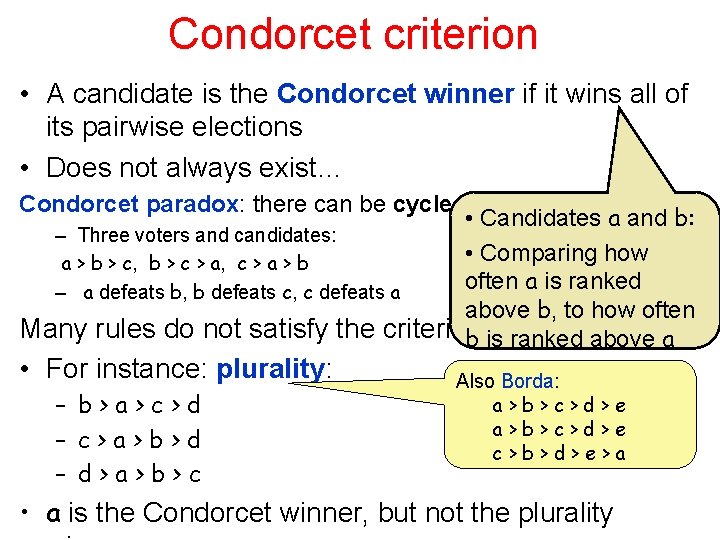
Condorcet criterion • A candidate is the Condorcet winner if it wins all of its pairwise elections • Does not always exist… Condorcet paradox: there can be cycles • Candidates a and b: – Three voters and candidates: • Comparing how a > b > c, b > c > a, c > a > b often a is ranked – a defeats b, b defeats c, c defeats a above b, to how often Many rules do not satisfy the criterion b is ranked above a • For instance: plurality: – b>a>c>d – c>a>b>d – d>a>b>c Also Borda: a>b>c>d>e c>b>d>e>a • a is the Condorcet winner, but not the plurality
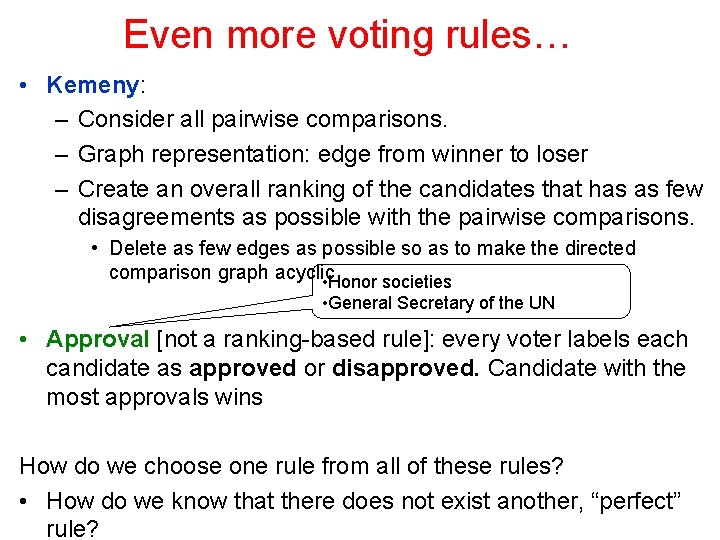
Even more voting rules… • Kemeny: – Consider all pairwise comparisons. – Graph representation: edge from winner to loser – Create an overall ranking of the candidates that has as few disagreements as possible with the pairwise comparisons. • Delete as few edges as possible so as to make the directed comparison graph acyclic • Honor societies • General Secretary of the UN • Approval [not a ranking-based rule]: every voter labels each candidate as approved or disapproved. Candidate with the most approvals wins How do we choose one rule from all of these rules? • How do we know that there does not exist another, “perfect” rule?
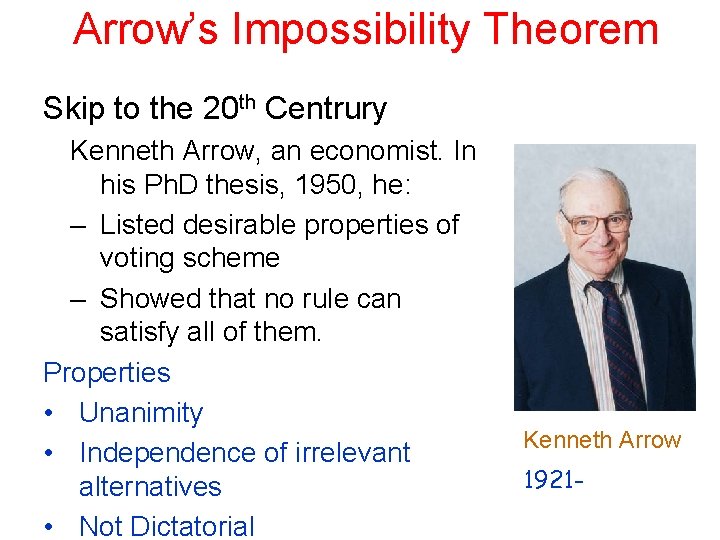
Arrow’s Impossibility Theorem Skip to the 20 th Centrury Kenneth Arrow, an economist. In his Ph. D thesis, 1950, he: – Listed desirable properties of voting scheme – Showed that no rule can satisfy all of them. Properties • Unanimity • Independence of irrelevant alternatives • Not Dictatorial Kenneth Arrow 1921 -
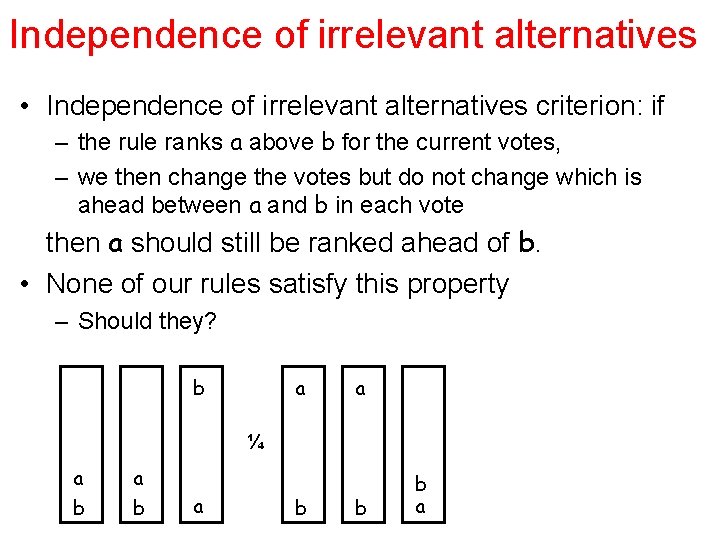
Independence of irrelevant alternatives • Independence of irrelevant alternatives criterion: if – the rule ranks a above b for the current votes, – we then change the votes but do not change which is ahead between a and b in each vote then a should still be ranked ahead of b. • None of our rules satisfy this property – Should they? b a a ¼ a b a b b b a
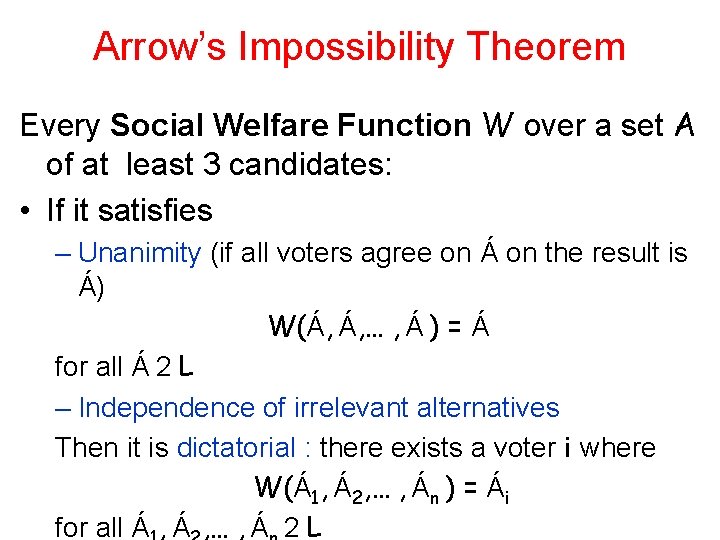
Arrow’s Impossibility Theorem Every Social Welfare Function W over a set A of at least 3 candidates: • If it satisfies – Unanimity (if all voters agree on Á on the result is Á) W(Á, Á, … , Á ) = Á for all Á 2 L – Independence of irrelevant alternatives Then it is dictatorial : there exists a voter i where W(Á1, Á2, … , Án ) = Ái for all Á , … , Á 2 L
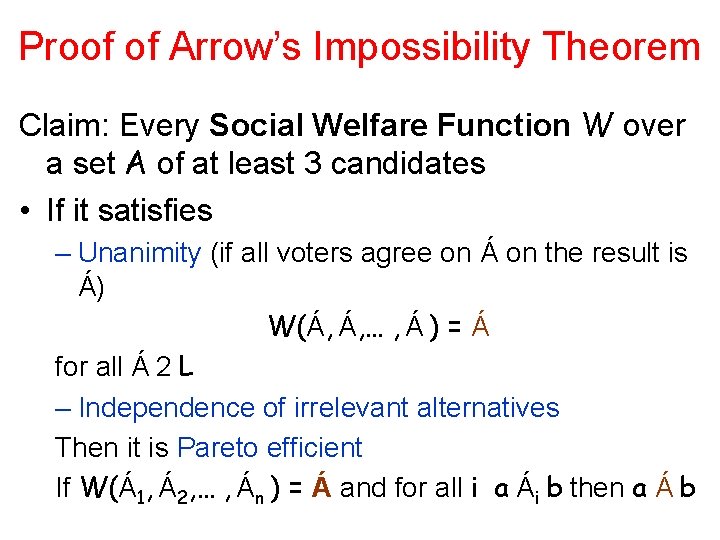
Proof of Arrow’s Impossibility Theorem Claim: Every Social Welfare Function W over a set A of at least 3 candidates • If it satisfies – Unanimity (if all voters agree on Á on the result is Á) W(Á, Á, … , Á ) = Á for all Á 2 L – Independence of irrelevant alternatives Then it is Pareto efficient If W(Á1, Á2, … , Án ) = Á and for all i a Ái b then a Á b
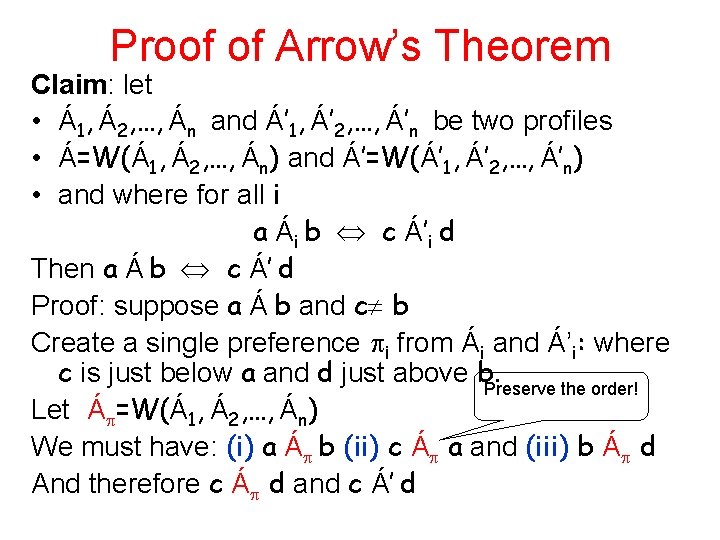
Proof of Arrow’s Theorem Claim: let • Á1, Á2, …, Án and Á’ 1, Á’ 2, …, Á’n be two profiles • Á=W(Á1, Á2, …, Án) and Á’=W(Á’ 1, Á’ 2, …, Á’n) • and where for all i a Ái b c Á’i d Then a Á b c Á’ d Proof: suppose a Á b and c b Create a single preference i from Ái and Á’i: where c is just below a and d just above b. Preserve the order! Let Á =W(Á1, Á2, …, Án) We must have: (i) a Á b (ii) c Á a and (iii) b Á d And therefore c Á d and c Á’ d
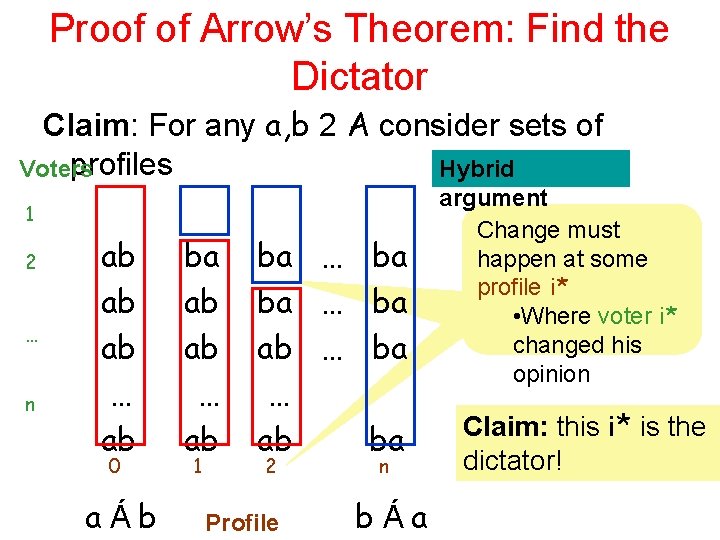
Proof of Arrow’s Theorem: Find the Dictator Claim: For any a, b 2 A consider sets of profiles Voters Hybrid 1 2 … n ab ab ab … ab 0 a Áb ba ab ab … ab 1 ba … ba ab … ba … ab ba 2 Profile n b Áa argument Change must happen at some profile i* • Where voter i* changed his opinion Claim: this i* is the dictator!
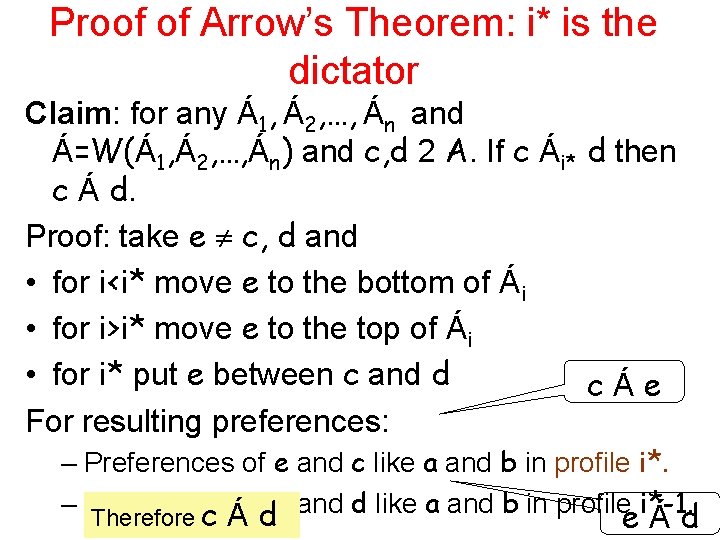
Proof of Arrow’s Theorem: i* is the dictator Claim: for any Á1, Á2, …, Án and Á=W(Á1, Á2, …, Án) and c, d 2 A. If c Ái* d then c Á d. Proof: take e c, d and • for i<i* move e to the bottom of Ái • for i>i* move e to the top of Ái • for i* put e between c and d cÁe For resulting preferences: – Preferences of e and c like a and b in profile i*. – Preferences of e and d like a and b in profile i*-1. Therefore c Á d eÁd
Is there hope for the truth? • At the very least would like our voting system to encourage voters to tell there true preferences
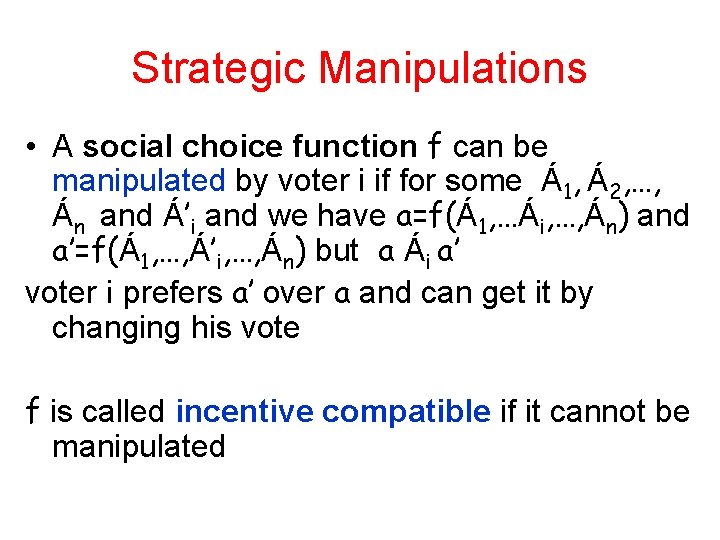
Strategic Manipulations • A social choice function f can be manipulated by voter i if for some Á1, Á2, …, Án and Á’i and we have a=f(Á1, …Ái, …, Án) and a’=f(Á1, …, Á’i, …, Án) but a Ái a’ voter i prefers a’ over a and can get it by changing his vote f is called incentive compatible if it cannot be manipulated
Gibbard-Satterthwaite Impossibility Theorem • Suppose there at least 3 alternatives • There exists no social choice function f that is simultaneously: – Onto • for every candidate, there are some votes that make the candidate win – Nondictatorial – Incentive compatible

Proof of the Gibbard-Satterthwaite Theorem Construct a Social Welfare function Wf based on f. Wf(Á1, …, Án) =Á where aÁ b iff f(Á1{a, b}, …, Án{a, b}) =b Keep everything in order but move a and b to top Lemma: if f is an incentive compatible social choice function which is onto A, then Wf is a social welfare function • If f is non dictatorial, then Wf also satisfies Unanimity and Independence of irrelevant

Proof of the Gibbard-Satterthwaite Theorem Claim: for all Á1, …, Án and any S ½ A we have f(Á1 S, …, Án. S, ) 2 S Keep everything in order but move elements of S to top Take a 2 S. There is some Á’ 1, Á’ 2, …, Á’n where f(Á’ 1, Á’ 2, …, Á’n)=a. Sequentially change Á’i to ÁSi • At no point does f output b 2 S. • Due to the incentive compatibility

Proof of Well Form Lemma • Antisymmetry: implied by claim for S={a, b} • Transitivity: Suppose we obtained contradicting cycle a Á b Á c Á a take S={a, b, c} and suppose a = f(Á1 S, …, Án. S) Sequentially change ÁSi to Ái{a, b} Non manipulability implies that f(Á1{a, b}, …, Án{a, b}) =a and b Á a. • Unanimity: if for all i b Ái a then (Á1{a, b}){a} =Á1{a, b} and f(Á1{a, b}, …, Án{a, b}) =a Will repeatedly use the claim to show

Proof of Well Form Lemma • Independence of irrelevant alternatives: if there are two profiles Á1, Á2, …, Án and Á’ 1, Á’ 2, …, Á’n where for all i bÁi a iff bÁ’i a, then f(Á1{a, b}, …, Án{a, b}) = f(Á’ 1{a, b}, …, Á’n{a, b}) by sequentially flipping from Ái{a, b} to Á’i{a, b} • Non dictator: preserved
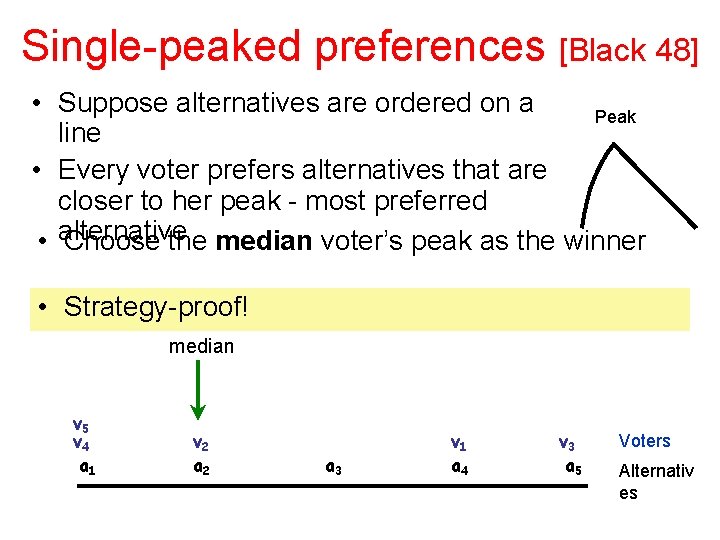
Single-peaked preferences [Black 48] • Suppose alternatives are ordered on a Peak line • Every voter prefers alternatives that are closer to her peak - most preferred • alternative Choose the median voter’s peak as the winner • Strategy-proof! median v 5 v 4 a 1 v 2 a 3 v 1 a 4 v 3 a 5 Voters Alternativ es
Computational issues • Sometimes computing the winner/aggregate ranking is hard – E. g. for Kemeny this is NP-hard – Is it still useful? • For some rules (e. g. STV), computing a successful manipulation is NP-hard – Is hardness of manipulation good? – Does it circumvent Gibbard-Satterthwaite? • Would like a stronger than NP-hardness • Preference elicitation: – May not want to force each voter to rank all candidates – Want to selectively query voters for parts of their ranking
- Slides: 26