
Algorithmic Analysis bit twiddling 1 pejorative An exercise
Algorithmic Analysis "bit twiddling: 1. (pejorative) An exercise in tuning (see tune) in which incredible amounts of time and effort go to produce little noticeable improvement, often with the result that the code becomes incomprehensible. " - The Hackers Dictionary, version 4. 4. 7 Algorithmic Analysis 1
Is This Algorithm Fast? • Problem: Given a problem, how fast does this code solve that problem? • Could try to measure the time it takes, but that is subject to lots of errors – multitasking operating system – speed of computer – language solution is written in • "My program finds all the primes between 2 and 1, 000, 000 in 1. 37 seconds. " – how good is this solution? Algorithmic Analysis 2
Grading Algorithms • What we need is some way to grade algorithms and their representation via computer programs for efficiency – both time and space efficiency are concerns – are examples simply deal with time, not space • The grades used to characterize the algorithm and code should be independent of platform, language, and compiler – We will look at C++ and Java examples as opposed to pseudocode algorithms Algorithmic Analysis 3
Big O • The most common method and notation for discussing the execution time of algorithms is "Big O" • Big O is the asymptotic execution time of the algorithm • Big O is an upper bound • It is a mathematical tool • Hide a lot of unimportant details by assigning a simple grade (function) to algorithms Algorithmic Analysis 4

Typical Functions Big O Functions Function Common Name N! factorial 2 N Exponential Nd , d > 3 Polynomial N 3 Cubic N 2 Quadratic N N N Square root N N log N N Linear N Root - n log N Logarithmic 1 Constant Algorithmic Analysis 5
Big O Functions • N is the size of the data set. • The functions do not include less dominant terms and do not include any coefficients. • 4 N 2 + 10 N – 100 is not a valid F(N). – It would simply be O(N 2) • It is possible to have two independent variables in the Big O function. – example O(M + log N) – M and N are sizes of two different, but interacting data sets Algorithmic Analysis 6
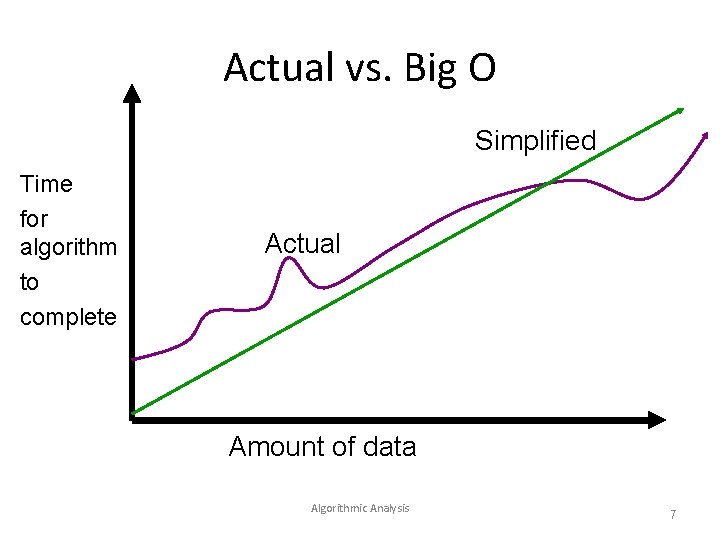
Actual vs. Big O Simplified Time for algorithm to complete Actual Amount of data Algorithmic Analysis 7
Formal Definition of Big O • T(N) is O( F(N) ) if there are positive constants c and N 0 such that T(N) < c. F(N) when N > N 0 – N is the size of the data set the algorithm works on – T(N) is a function that characterizes the actual running time of the algorithm – F(N) is a function that characterizes an upper bounds on T(N). It is a limit on the running time of the algorithm. (The typical Big functions table) – c and N 0 are constants Algorithmic Analysis 8
What it Means • T(N) is the actual growth rate of the algorithm – can be equated to the number of executable statements in a program or chunk of code • F(N) is the function that bounds the growth rate – may be upper or lower bound • T(N) may not necessarily equal F(N) – constants and lesser terms ignored because it is a bounding function Algorithmic Analysis 9

Yuck How do you apply the definition? Hard to measure time without running programs and that is full of inaccuracies Amount of time to complete should be directly proportional to the number of statements executed for a given amount of data Count up statements in a program or method or algorithm as a function of the amount of data Traditionally the amount of data is signified by the variable N Algorithmic Analysis 10
Counting Statements in Code • So what constitutes a statement? • Can’t I rewrite code and get a different answer, that is a different number of statements? • Yes, but the beauty of Big O is, in the end you get the same answer – remember, it is a simplification Algorithmic Analysis 11
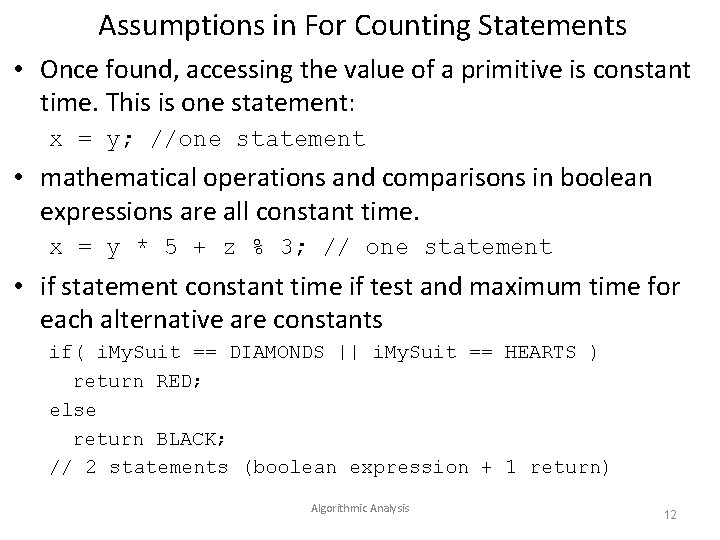
Assumptions in For Counting Statements • Once found, accessing the value of a primitive is constant time. This is one statement: x = y; //one statement • mathematical operations and comparisons in boolean expressions are all constant time. x = y * 5 + z % 3; // one statement • if statement constant time if test and maximum time for each alternative are constants if( i. My. Suit == DIAMONDS || i. My. Suit == HEARTS ) return RED; else return BLACK; // 2 statements (boolean expression + 1 return) Algorithmic Analysis 12
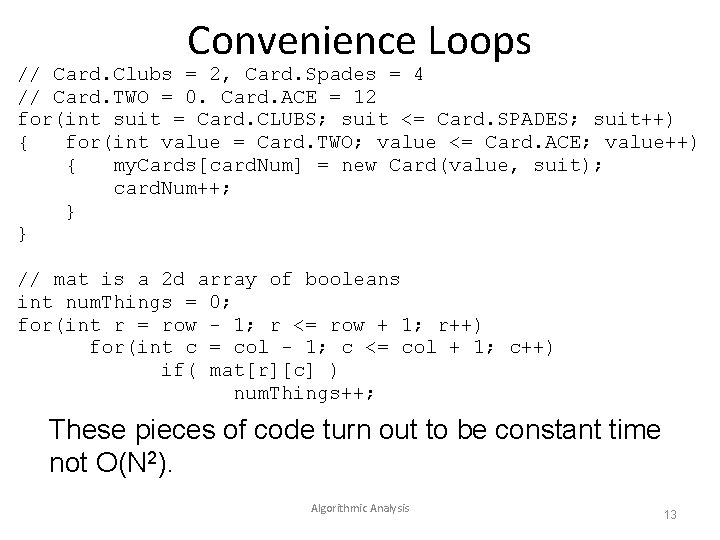
Convenience Loops // Card. Clubs = 2, Card. Spades = 4 // Card. TWO = 0. Card. ACE = 12 for(int suit = Card. CLUBS; suit <= Card. SPADES; suit++) { for(int value = Card. TWO; value <= Card. ACE; value++) { my. Cards[card. Num] = new Card(value, suit); card. Num++; } } // mat is a 2 d array of booleans int num. Things = 0; for(int r = row - 1; r <= row + 1; r++) for(int c = col - 1; c <= col + 1; c++) if( mat[r][c] ) num. Things++; These pieces of code turn out to be constant time not O(N 2). Algorithmic Analysis 13
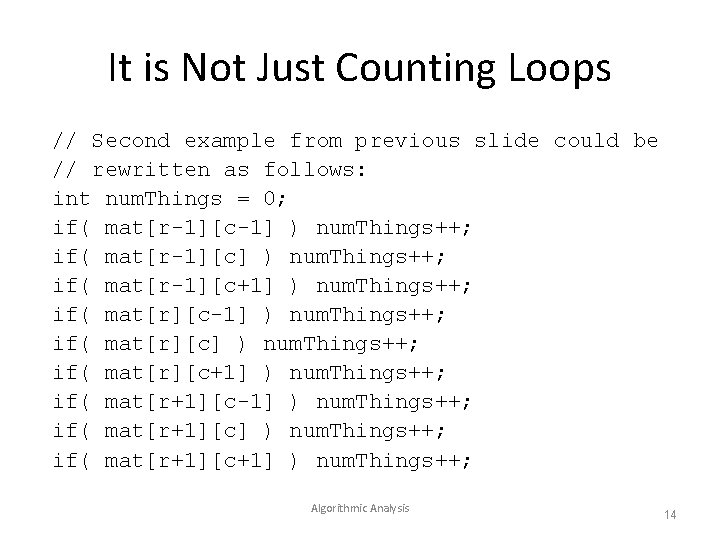
It is Not Just Counting Loops // Second example from previous slide could be // rewritten as follows: int num. Things = 0; if( mat[r-1][c-1] ) num. Things++; if( mat[r-1][c+1] ) num. Things++; if( mat[r][c-1] ) num. Things++; if( mat[r][c+1] ) num. Things++; if( mat[r+1][c-1] ) num. Things++; if( mat[r+1][c+1] ) num. Things++; Algorithmic Analysis 14
Dealing with other methods • What do I do about the method call Card(value, suit) ? • Long way – go to that method or constructor and count statements • Short way – substitute the simplified Big O function for that method. – if Card(int, int) is constant time, O(1), simply count that as 1 statement. Algorithmic Analysis 15
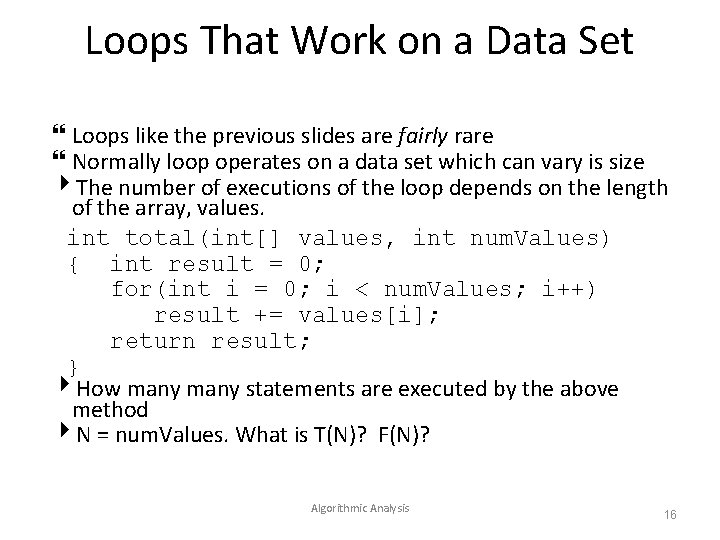
Loops That Work on a Data Set Loops like the previous slides are fairly rare Normally loop operates on a data set which can vary is size 4 The number of executions of the loop depends on the length of the array, values. int total(int[] values, int num. Values) { int result = 0; for(int i = 0; i < num. Values; i++) result += values[i]; return result; } 4 How many statements are executed by the above method 4 N = num. Values. What is T(N)? F(N)? Algorithmic Analysis 16
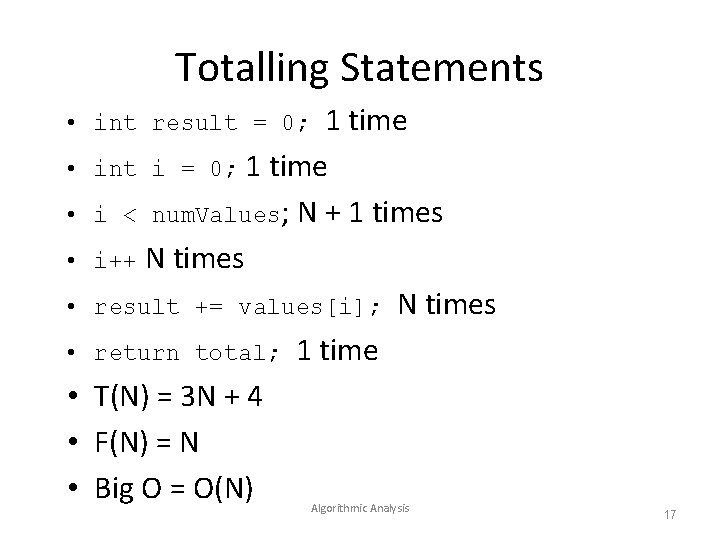
Totalling Statements 1 time • int i = 0; 1 time • i < num. Values; N + 1 times • i++ N times • result += values[i]; N times • return total; 1 time • T(N) = 3 N + 4 • F(N) = N • Big O = O(N) • int result = 0; Algorithmic Analysis 17
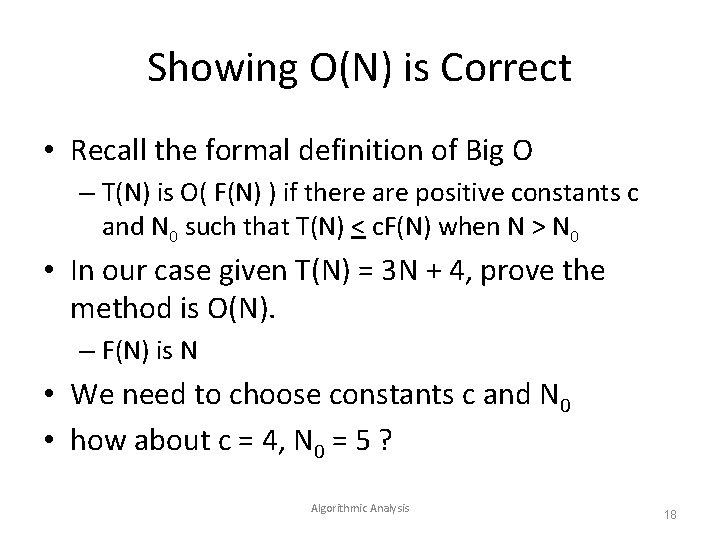
Showing O(N) is Correct • Recall the formal definition of Big O – T(N) is O( F(N) ) if there are positive constants c and N 0 such that T(N) < c. F(N) when N > N 0 • In our case given T(N) = 3 N + 4, prove the method is O(N). – F(N) is N • We need to choose constants c and N 0 • how about c = 4, N 0 = 5 ? Algorithmic Analysis 18
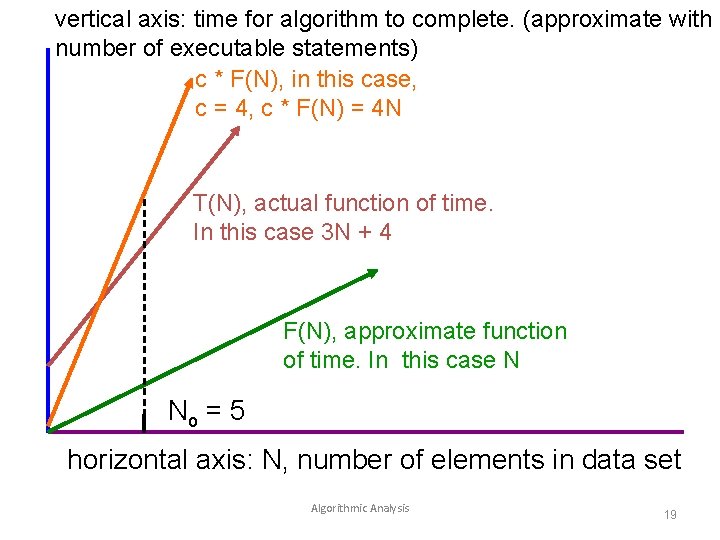
vertical axis: time for algorithm to complete. (approximate with number of executable statements) c * F(N), in this case, c = 4, c * F(N) = 4 N T(N), actual function of time. In this case 3 N + 4 F(N), approximate function of time. In this case N No = 5 horizontal axis: N, number of elements in data set Algorithmic Analysis 19
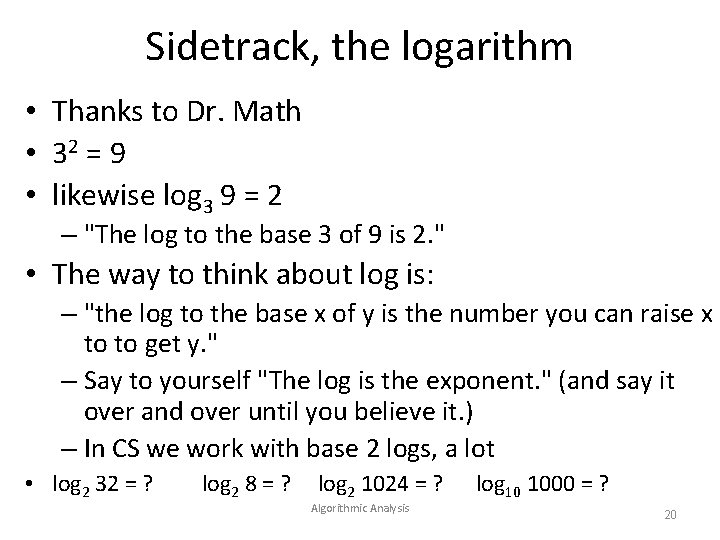
Sidetrack, the logarithm • Thanks to Dr. Math • 32 = 9 • likewise log 3 9 = 2 – "The log to the base 3 of 9 is 2. " • The way to think about log is: – "the log to the base x of y is the number you can raise x to to get y. " – Say to yourself "The log is the exponent. " (and say it over and over until you believe it. ) – In CS we work with base 2 logs, a lot • log 2 32 = ? log 2 8 = ? log 2 1024 = ? Algorithmic Analysis log 10 1000 = ? 20
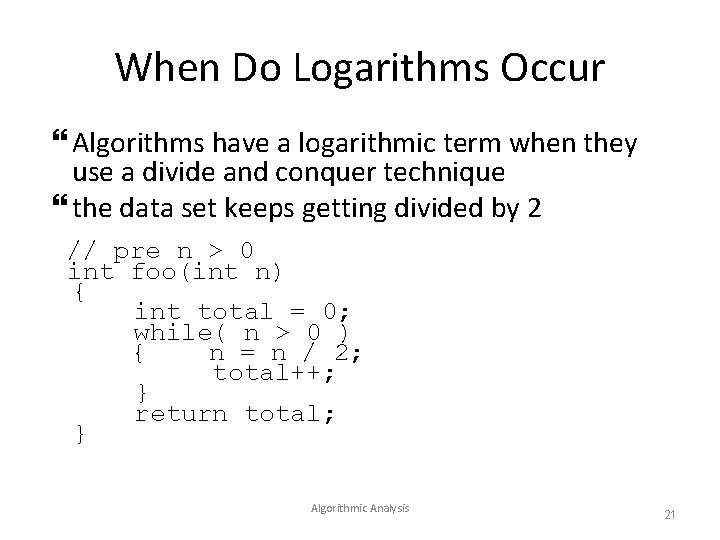
When Do Logarithms Occur Algorithms have a logarithmic term when they use a divide and conquer technique the data set keeps getting divided by 2 // pre n > 0 int foo(int n) { int total = 0; while( n > 0 ) { n = n / 2; total++; } return total; } Algorithmic Analysis 21
Quantifiers on Big O • It is often useful to discuss different cases for an algorithm • Best Case: what is the best we can hope for? – least interesting • Average Case (a. k. a. expected running time): what usually happens with the algorithm? • Worst Case: what is the worst we can expect of the algorithm? – very interesting to compare this to the average case Algorithmic Analysis 22
Best, Average, Worst Case To Determine the best, average, and worst case Big O we must make assumptions about the data set Best case -> what are the properties of the data set that will lead to the fewest number of executable statements (steps in the algorithm) Worst case -> what are the properties of the data set that will lead to the largest number of executable statements Average case -> Usually this means assuming the data is randomly distributed ◦ or if I ran the algorithm a large number of times with different sets of data what would the average amount of work be for those runs? Algorithmic Analysis 23
![Another Example double minimum(double[] values, int num. Values) { int n = num. Values;](http://slidetodoc.com/presentation_image_h2/97648c0bac8ab3942c9ce72c99b516a6/image-24.jpg "Another Example double minimum(double[] values, int num. Values) { int n = num. Values;")
Another Example double minimum(double[] values, int num. Values) { int n = num. Values; double min. Value = values[0]; for(int i = 1; i < n; i++) if(values[i] < min. Value) min. Value = values[i]; return min. Value; } • T(N)? F(N)? Big O? Best case? Worst Case? Average Case? • If no other information, assume asking average case Algorithmic Analysis 24
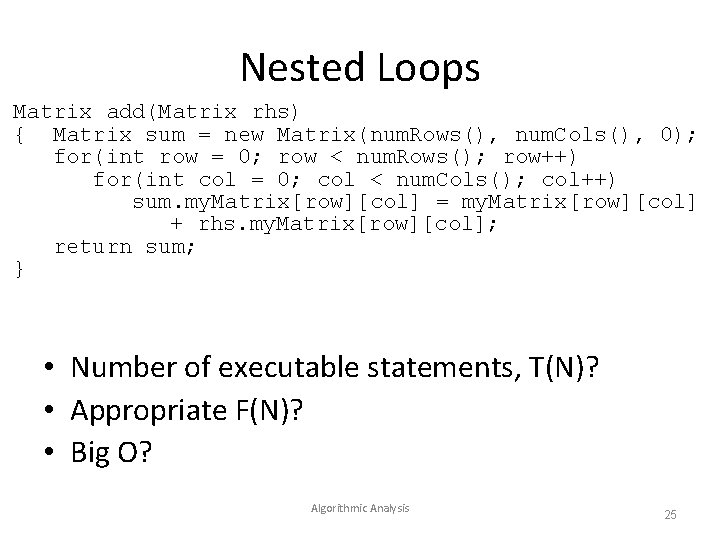
Nested Loops Matrix add(Matrix rhs) { Matrix sum = new Matrix(num. Rows(), num. Cols(), 0); for(int row = 0; row < num. Rows(); row++) for(int col = 0; col < num. Cols(); col++) sum. my. Matrix[row][col] = my. Matrix[row][col] + rhs. my. Matrix[row][col]; return sum; } • Number of executable statements, T(N)? • Appropriate F(N)? • Big O? Algorithmic Analysis 25
![Another Nested Loops Example • public void selection. Sort(double[] data) { int n =](http://slidetodoc.com/presentation_image_h2/97648c0bac8ab3942c9ce72c99b516a6/image-26.jpg "Another Nested Loops Example • public void selection. Sort(double[] data) { int n =")
Another Nested Loops Example • public void selection. Sort(double[] data) { int n = data. length; int min; double temp; for(int i = 0; i < n; i++) { min = i; for(int j = i+1; j < n; j++) if(data[j] < data[min]) min = j; temp = data[i]; data[i] = data[min]; data[min] = temp; }// end of outer loop, i } Number of statements executed, T(N)? Algorithmic Analysis 26
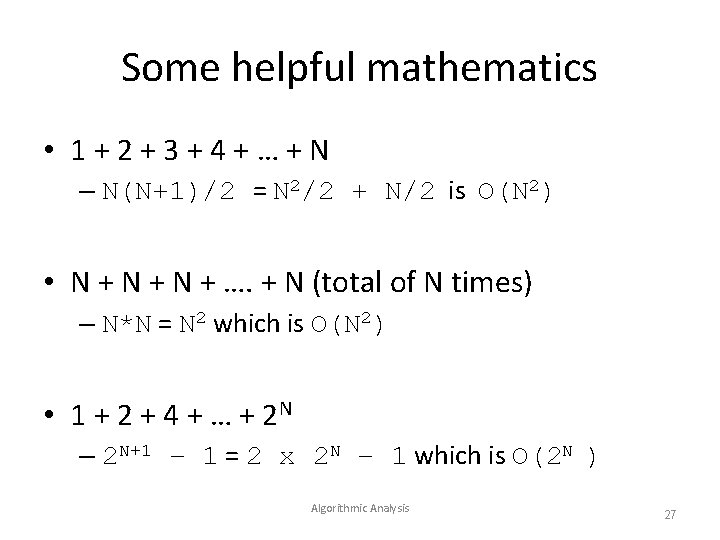
Some helpful mathematics • 1+2+3+4+…+N – N(N+1)/2 = N 2/2 + N/2 is O(N 2) • N + N + …. + N (total of N times) – N*N = N 2 which is O(N 2) • 1 + 2 + 4 + … + 2 N – 2 N+1 – 1 = 2 x 2 N – 1 which is O(2 N ) Algorithmic Analysis 27
![One More Example public int foo(int[] list){ int total = 0; for(int i =](http://slidetodoc.com/presentation_image_h2/97648c0bac8ab3942c9ce72c99b516a6/image-28.jpg "One More Example public int foo(int[] list){ int total = 0; for(int i =")
One More Example public int foo(int[] list){ int total = 0; for(int i = 0; i < list. length; i++){ total += count. Dups(list[i], list); } return total; } // method count. Dups is O(N) where N is the // length of the array it is passed What is the Big O of foo? Algorithmic Analysis 28
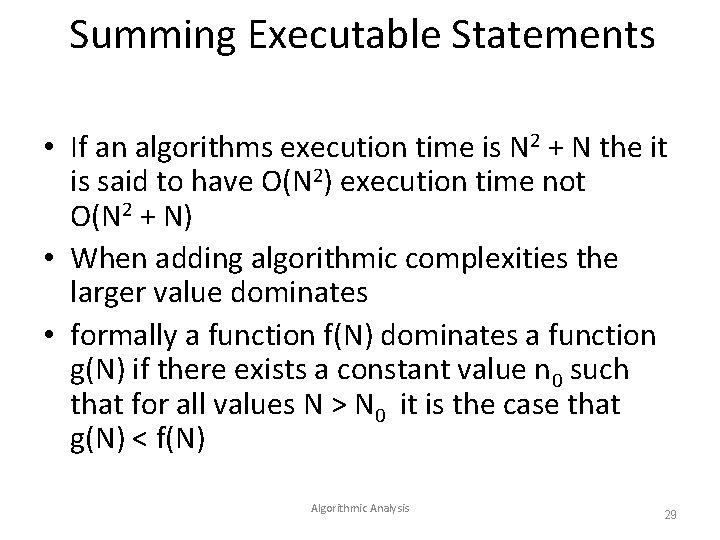
Summing Executable Statements • If an algorithms execution time is N 2 + N the it is said to have O(N 2) execution time not O(N 2 + N) • When adding algorithmic complexities the larger value dominates • formally a function f(N) dominates a function g(N) if there exists a constant value n 0 such that for all values N > N 0 it is the case that g(N) < f(N) Algorithmic Analysis 29
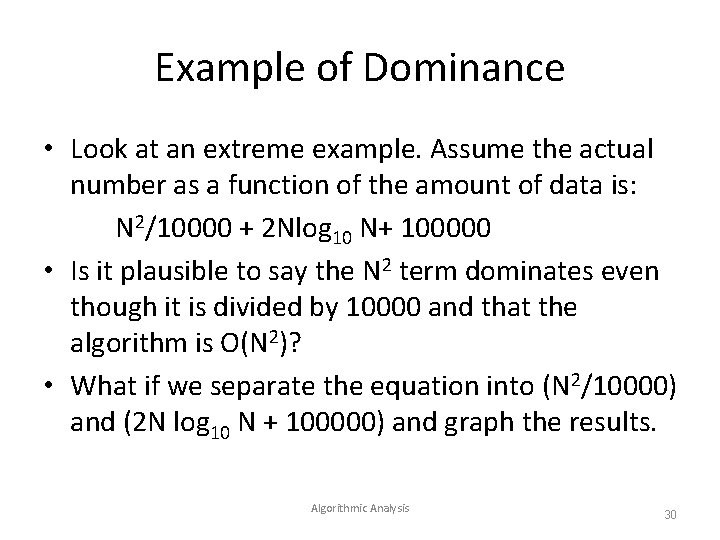
Example of Dominance • Look at an extreme example. Assume the actual number as a function of the amount of data is: N 2/10000 + 2 Nlog 10 N+ 100000 • Is it plausible to say the N 2 term dominates even though it is divided by 10000 and that the algorithm is O(N 2)? • What if we separate the equation into (N 2/10000) and (2 N log 10 N + 100000) and graph the results. Algorithmic Analysis 30
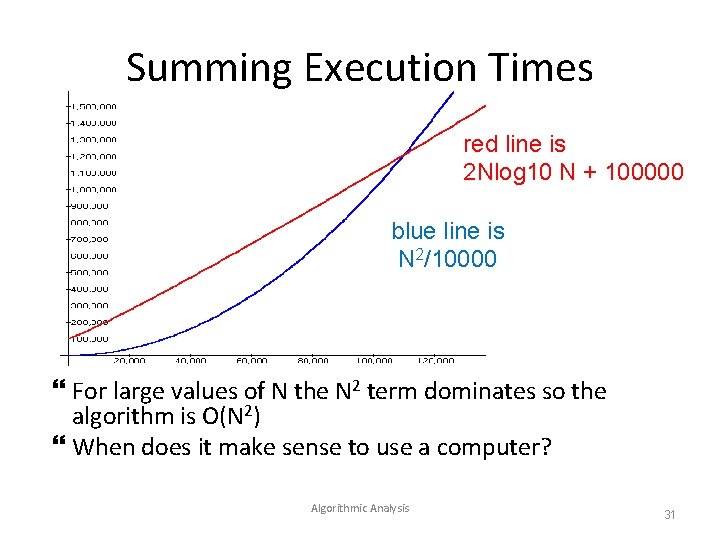
Summing Execution Times red line is 2 Nlog 10 N + 100000 blue line is N 2/10000 For large values of N the N 2 term dominates so the algorithm is O(N 2) When does it make sense to use a computer? Algorithmic Analysis 31
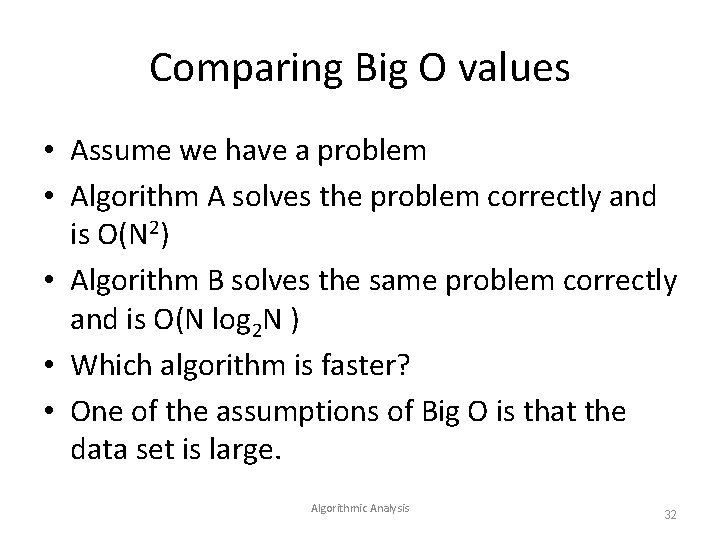
Comparing Big O values • Assume we have a problem • Algorithm A solves the problem correctly and is O(N 2) • Algorithm B solves the same problem correctly and is O(N log 2 N ) • Which algorithm is faster? • One of the assumptions of Big O is that the data set is large. Algorithmic Analysis 32
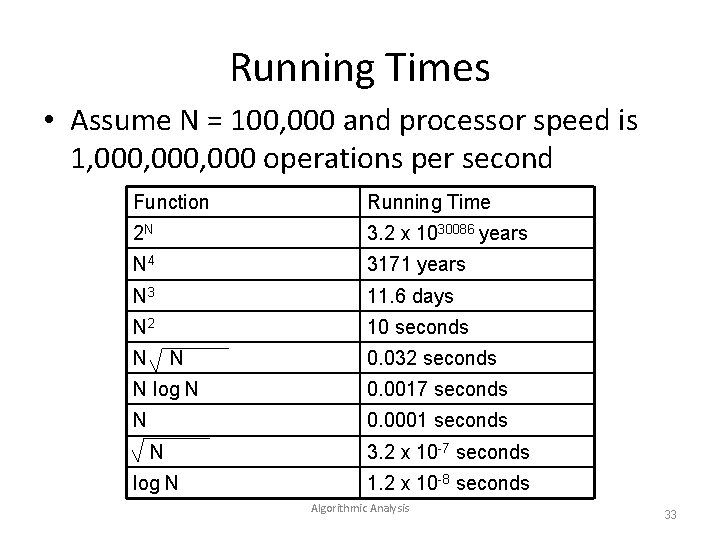
Running Times • Assume N = 100, 000 and processor speed is 1, 000, 000 operations per second Function Running Time 2 N 3. 2 x 1030086 years N 4 3171 years N 3 11. 6 days N 2 10 seconds N N 0. 032 seconds N log N 0. 0017 seconds N 0. 0001 seconds N 3. 2 x 10 -7 seconds log N 1. 2 x 10 -8 seconds Algorithmic Analysis 33
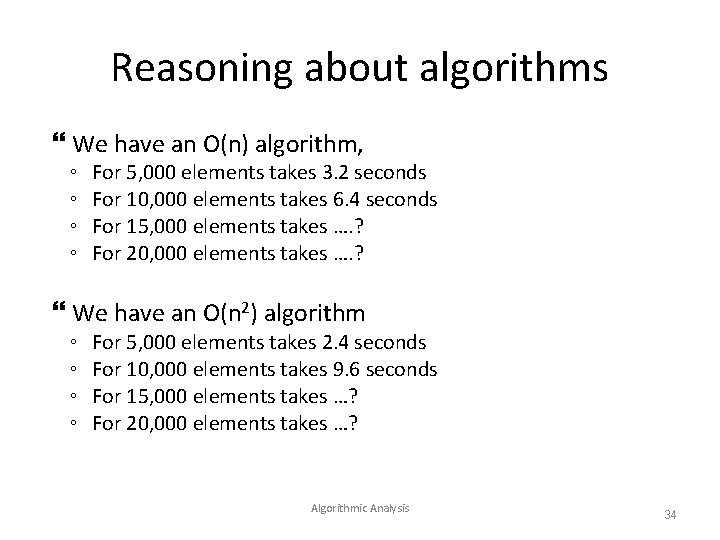
Reasoning about algorithms We have an O(n) algorithm, ◦ ◦ For 5, 000 elements takes 3. 2 seconds For 10, 000 elements takes 6. 4 seconds For 15, 000 elements takes …. ? For 20, 000 elements takes …. ? We have an O(n 2) algorithm ◦ ◦ For 5, 000 elements takes 2. 4 seconds For 10, 000 elements takes 9. 6 seconds For 15, 000 elements takes …? For 20, 000 elements takes …? Algorithmic Analysis 34
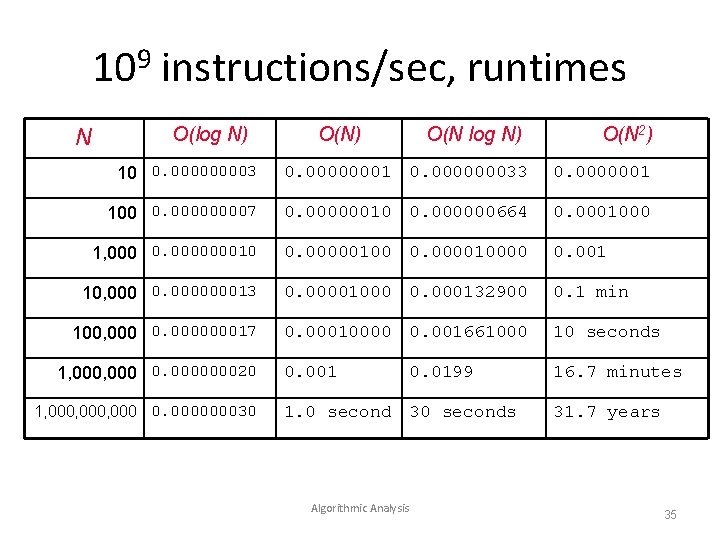
109 instructions/sec, runtimes N O(log N) O(N 2) 10 0. 00003 0. 00000001 0. 000000033 0. 0000001 100 0. 00007 0. 00000010 0. 000000664 0. 0001000 1, 000 0. 000000010 0. 00000100 0. 000010000 0. 001 10, 000 0. 000000013 0. 00001000 0. 000132900 0. 1 min 100, 000 0. 000000017 0. 00010000 0. 001661000 10 seconds 0. 001 16. 7 minutes 1, 000 0. 000000020 1, 000, 000 0. 000000030 0. 0199 1. 0 second 30 seconds Algorithmic Analysis 31. 7 years 35
Why Use Big O? • As we build data structures Big O is the tool we will use to decide under what conditions one data structure is better than another • Lots of trade offs – some data structures good for certain types of problems, bad for other types – often able to trade SPACE for TIME. – Faster solution that uses more space – Slower solution that uses less space Algorithmic Analysis 36
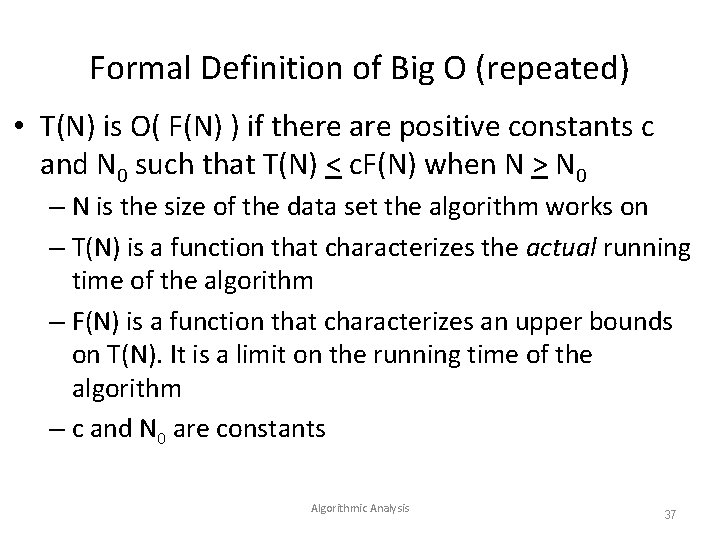
Formal Definition of Big O (repeated) • T(N) is O( F(N) ) if there are positive constants c and N 0 such that T(N) < c. F(N) when N > N 0 – N is the size of the data set the algorithm works on – T(N) is a function that characterizes the actual running time of the algorithm – F(N) is a function that characterizes an upper bounds on T(N). It is a limit on the running time of the algorithm – c and N 0 are constants Algorithmic Analysis 37
More on the Formal Definition There is a point N 0 such that for all values of N that are past this point, T(N) is bounded by some multiple of F(N) Thus if T(N) of the algorithm is O( N 2 ) then, ignoring constants, at some point we can bound the running time by a quadratic function. given a linear algorithm it is technically correct to say the running time is O(N 2). O(N) is a more precise answer as to the Big O of the linear algorithm ◦ thus the caveat “pick the most restrictive function” in Big O type questions. Algorithmic Analysis 38
What it All Means • T(N) is the actual growth rate of the algorithm – can be equated to the number of executable statements in a program or chunk of code • F(N) is the function that bounds the growth rate – may be upper or lower bound • T(N) may not necessarily equal F(N) – constants and lesser terms ignored because it is a bounding function Algorithmic Analysis 39
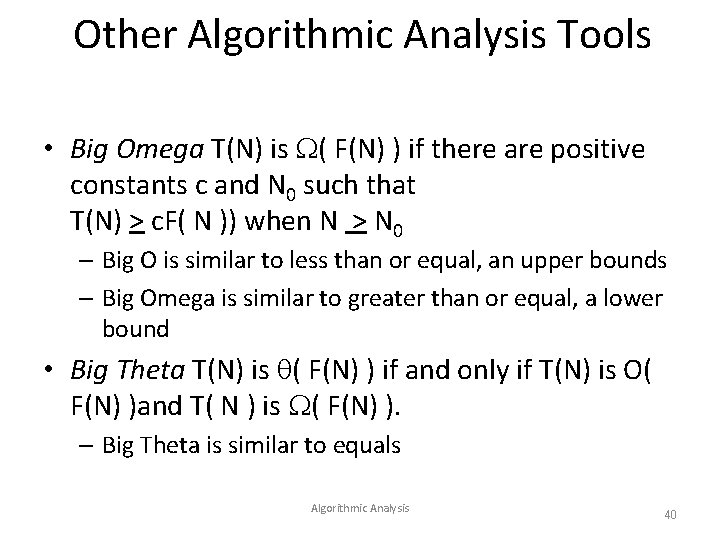
Other Algorithmic Analysis Tools • Big Omega T(N) is ( F(N) ) if there are positive constants c and N 0 such that T(N) > c. F( N )) when N > N 0 – Big O is similar to less than or equal, an upper bounds – Big Omega is similar to greater than or equal, a lower bound • Big Theta T(N) is ( F(N) ) if and only if T(N) is O( F(N) )and T( N ) is ( F(N) ). – Big Theta is similar to equals Algorithmic Analysis 40
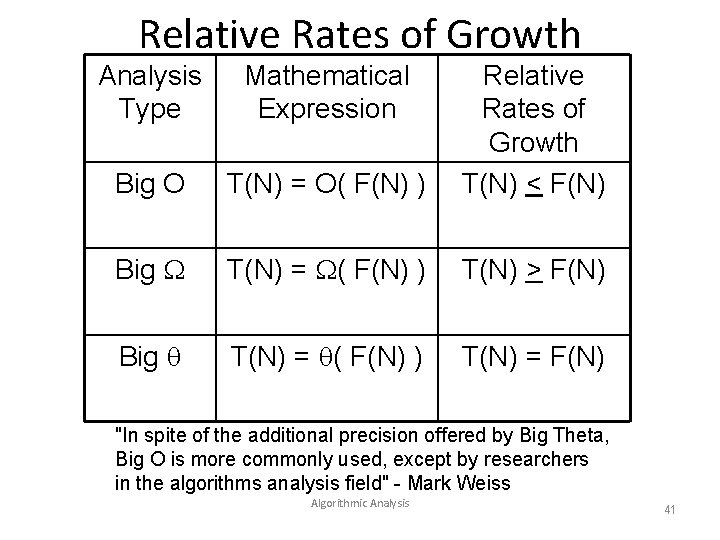
Relative Rates of Growth Analysis Type Mathematical Expression Big O T(N) = O( F(N) ) Relative Rates of Growth T(N) < F(N) Big T(N) = ( F(N) ) T(N) > F(N) Big T(N) = ( F(N) ) T(N) = F(N) "In spite of the additional precision offered by Big Theta, Big O is more commonly used, except by researchers in the algorithms analysis field" - Mark Weiss Algorithmic Analysis 41
Big O Space • Less frequent in early analysis, but just as important are the space requirements. • Big O could be used to specify how much space is needed for a particular algorithm Algorithmic Analysis 42
- Slides: 42