
Algorithm Working Group GPROF 2020 The 3 steps


- Slides: 14
Algorithm Working Group GPROF 2020
The 3 steps of GPROF • Create an a-priori database. This is critical whether we continue with Bayesian schemes or use AI/ML techniques. Everyone benefits from a robust (and documented) a-priori database of possible profiles. • Define ancillary data (e. g. sfc type & elevation, 2 m temperature, TPW, moisture convergence, etc) used to partition database or constrain retrieval • The retrieval mechanics – Bayesian in the case of GPROF
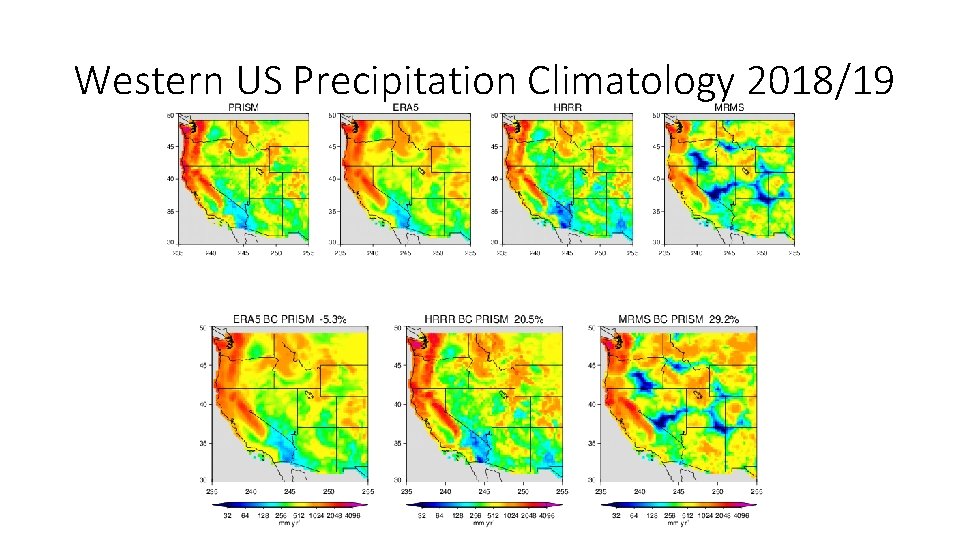
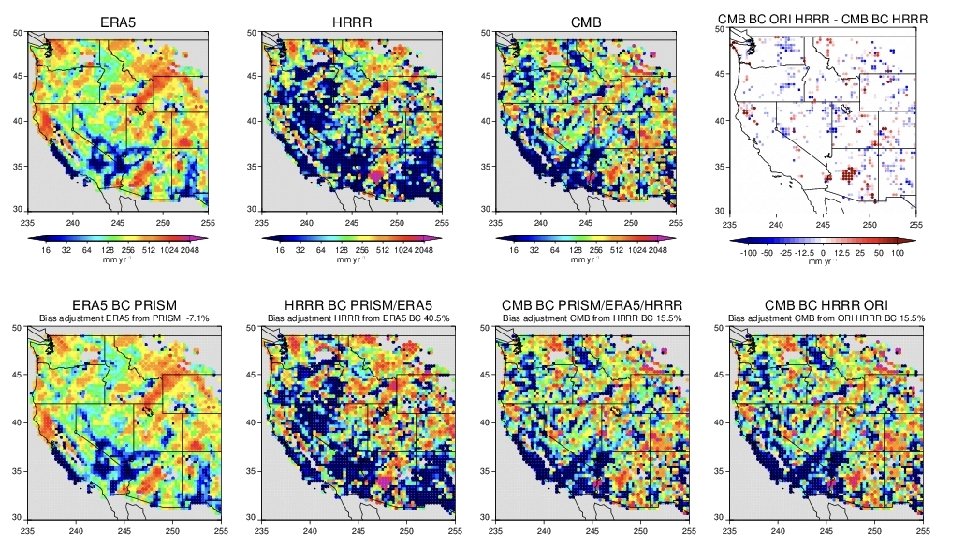
GPROF V 07: Database Changes w. eye on becoming routine with updates to Operational Products • For Land Ocean Database created from CMB ITE 733 (raining) and MIRS (non-raining) : Oct. 2018 – Sept. 2019 • For Snow-covered surfaces, use empirical databases from MRMS: March 2014 – April 2019 • At this meeting, learned that MRMS is releasing a new radar/HRRR snowfall product that does much better in the Mountain West. Will use that if available to us in time. • For Sea-ice, use empirical database with radiometer observations and ERA 5 precipitation : Oct. 2018 – Sept. 2019
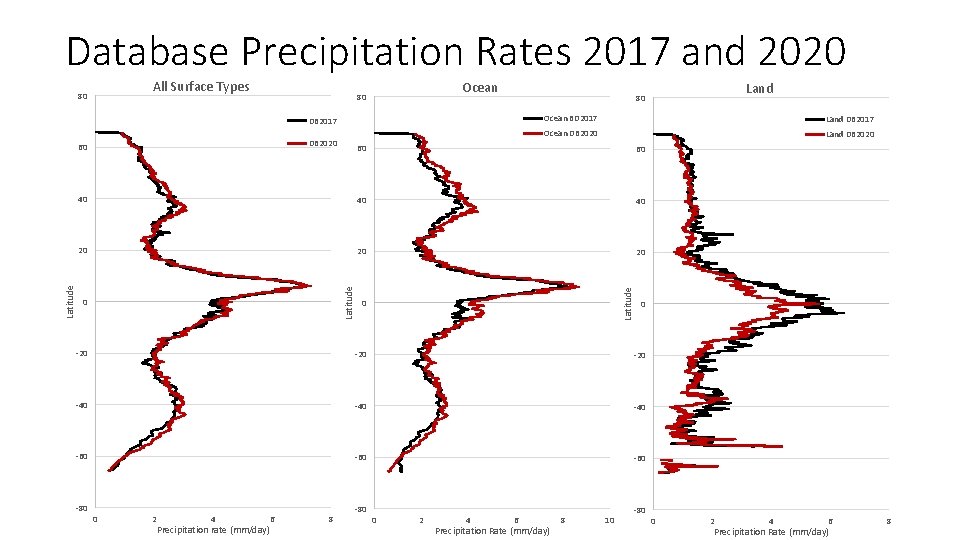
Database Precipitation Rates 2017 and 2020 All Surface Types 80 Ocean 80 DB 2017 DB 2020 Ocean BD 2017 Land DB 2017 Ocean DB 2020 Land DB 2020 60 40 40 40 20 20 20 0 Latitude 60 0 0 -20 -20 -40 -40 -60 -60 -80 0 2 4 6 Precipitation rate (mm/day) 8 -80 0 2 4 Land 80 6 Precipitation Rate (mm/day) 8 10 -80 0 2 4 6 Precipitation Rate (mm/day) 8
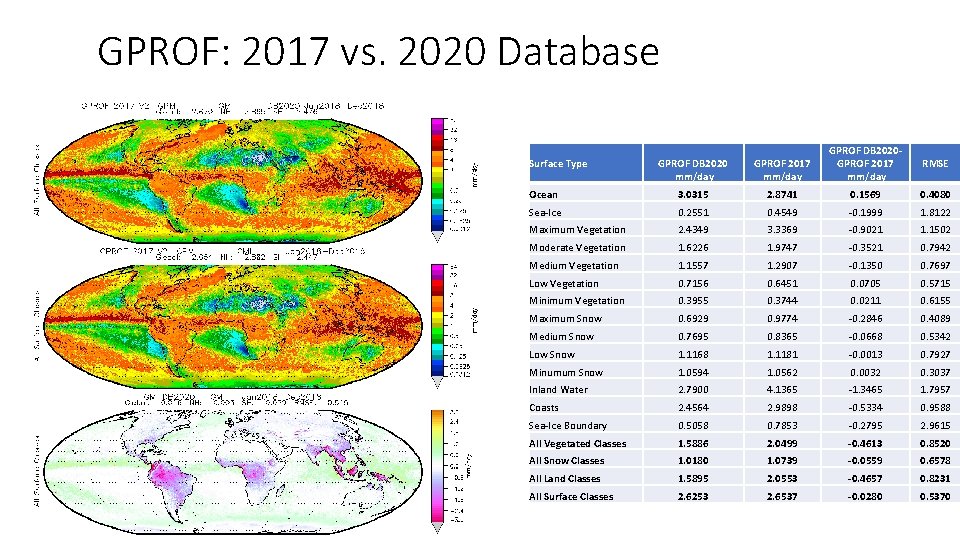
GPROF: 2017 vs. 2020 Database GPROF DB 2020 mm/day GPROF 2017 mm/day GPROF DB 2020 GPROF 2017 mm/day RMSE Ocean 3. 0315 2. 8741 0. 1569 0. 4080 Sea-Ice 0. 2551 0. 4549 -0. 1999 1. 8122 Maximum Vegetation 2. 4349 3. 3369 -0. 9021 1. 1502 Moderate Vegetation 1. 6226 1. 9747 -0. 3521 0. 7942 Medium Vegetation 1. 1557 1. 2907 -0. 1350 0. 7697 Low Vegetation 0. 7156 0. 6451 0. 0705 0. 5715 Minimum Vegetation 0. 3955 0. 3744 0. 0211 0. 6155 Maximum Snow 0. 6929 0. 9774 -0. 2846 0. 4089 Medium Snow 0. 7695 0. 8365 -0. 0668 0. 5342 Low Snow 1. 1168 1. 1181 -0. 0013 0. 7927 Minumum Snow 1. 0594 1. 0562 0. 0032 0. 3037 Inland Water 2. 7900 4. 1365 -1. 3465 1. 7957 Coasts 2. 4564 2. 9898 -0. 5334 0. 9588 Sea-Ice Boundary 0. 5058 0. 7853 -0. 2795 2. 9615 All Vegetated Classes 1. 5886 2. 0499 -0. 4613 0. 8520 All Snow Classes 1. 0180 1. 0739 -0. 0559 0. 6578 All Land Classes 1. 5895 2. 0553 -0. 4657 0. 8231 All Surface Classes 2. 6253 2. 6537 -0. 0280 0. 5370 Surface Type
The 3 steps of GPROF • Create an a-priori database. This is critical whether we continue with Bayesian schemes or use AI/ML techniques. Everyone benefits from a robust (and documented) a-priori database of possible profiles. • Define ancillary data (e. g. sfc type & elevation, 2 m temperature, TPW, moisture convergence, etc) used to partition database or constrain retrieval • The retrieval mechanics – Bayesian in the case of GPROF
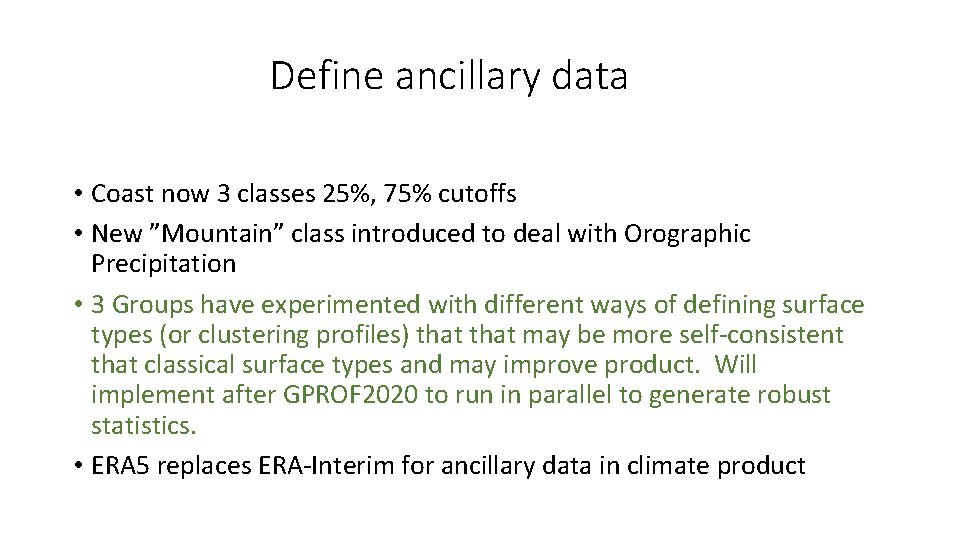
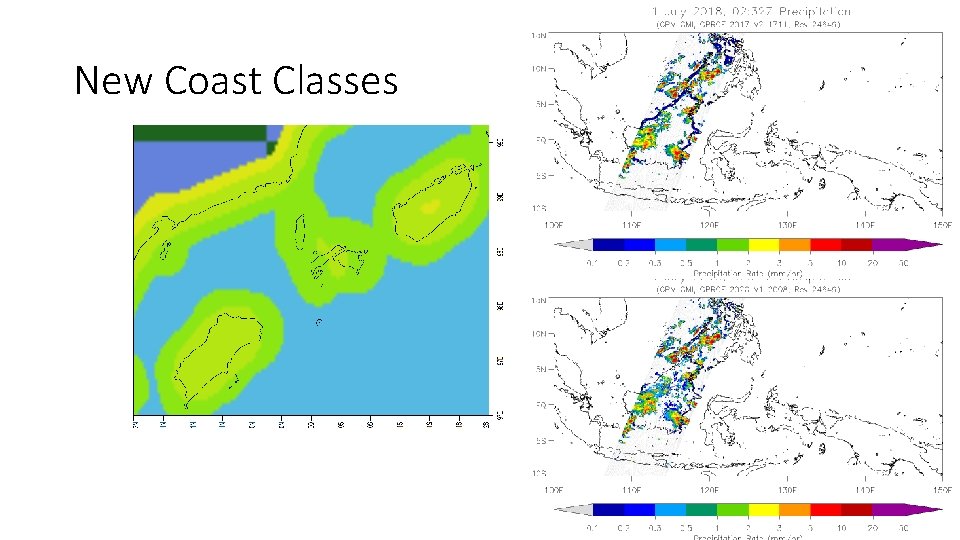
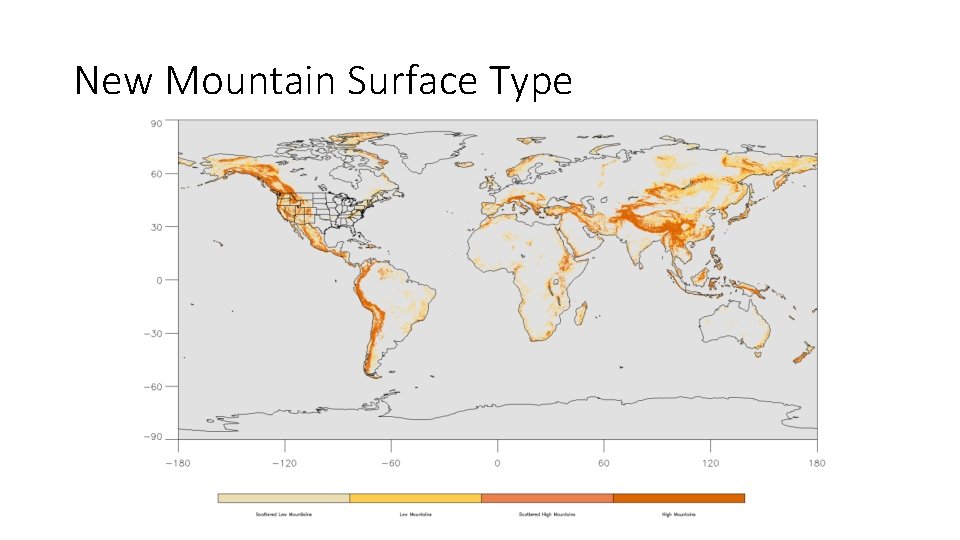
Define ancillary data • Coast now 3 classes 25%, 75% cutoffs • New ”Mountain” class introduced to deal with Orographic Precipitation • 3 Groups have experimented with different ways of defining surface types (or clustering profiles) that may be more self-consistent that classical surface types and may improve product. Will implement after GPROF 2020 to run in parallel to generate robust statistics. • ERA 5 replaces ERA-Interim for ancillary data in climate product
New Coast Classes
New Mountain Surface Type
Western US Precipitation Climatology 2018/19
The 3 steps of GPROF • Create an a-priori database. This is critical whether we continue with Bayesian schemes or use AI/ML techniques. Everyone benefits from a robust (and documented) a-priori database of possible profiles. • Define ancillary data (e. g. sfc type & elevation, 2 m temperature, TPW, moisture convergence, etc) used to partition database or constrain retrieval • The retrieval mechanics – Bayesian in the case of GPROF
GPROF V 07: Retrieval Changes • Yes/No rain flag using Bayesian POP • Phase discrimination (Sims and Liu, 2015) • Precipitation rate cutoffs and amended totals removed • Latent Heating added • Simon Pfreundschuh/Patrick Eriksson implementing a QRNN version with same database and ancillary/subsetting procedure • Lots of interest in Convolutional Neural Nets that may add textrure information in a consistent way across sensors to solve problem that Efi/Clement have identified.
GPROF V 07: Schedule • • 31 December 2020 Deliver GMI code to PPS 1 February 2020 Deliver any fixes of GMI and Constellation code to PPS 1 Mar 2021 L 2/L 3 GMI/TMI GPROF 1 Apr 2021 L 2/L 3 Radar L 1 C constellation 1 May 2021 Continue testing and making necessary fixes to ITE code L 2/L 3 Combined L 2/L 3 Constellation GPROF 1 Jun 2021 Begin V 07 reprocessing 1 August 2021 SLH/CSH 1 Sept 2021 IMERG V 07