
Algorithm Efficiency Chapter 10 Data Structures and Problem
Algorithm Efficiency Chapter 10 Data Structures and Problem Solving with C++: Walls and Mirrors, Carrano and Henry, © 2013
Contents • What Is a Good Solution? • Measuring the Efficiency of Algorithms Data Structures and Problem Solving with C++: Walls and Mirrors, Carrano and Henry, © 2013
What Is a Good Solution? • Criterion A solution is good if the total cost it incurs over all phases of its life is minimal. • Keep in mind, efficiency is only one aspect of a solution’s cost • Note: Relative importance of various components of a solution’s cost has changed since early days of computing. Data Structures and Problem Solving with C++: Walls and Mirrors, Carrano and Henry, © 2013
Measuring Efficiency of Algorithms • Comparison of algorithms should focus on significant differences in efficiency • Difficulties with comparing programs instead of algorithms § How are the algorithms coded? § What computer should you use? § What data should the programs use? Data Structures and Problem Solving with C++: Walls and Mirrors, Carrano and Henry, © 2013
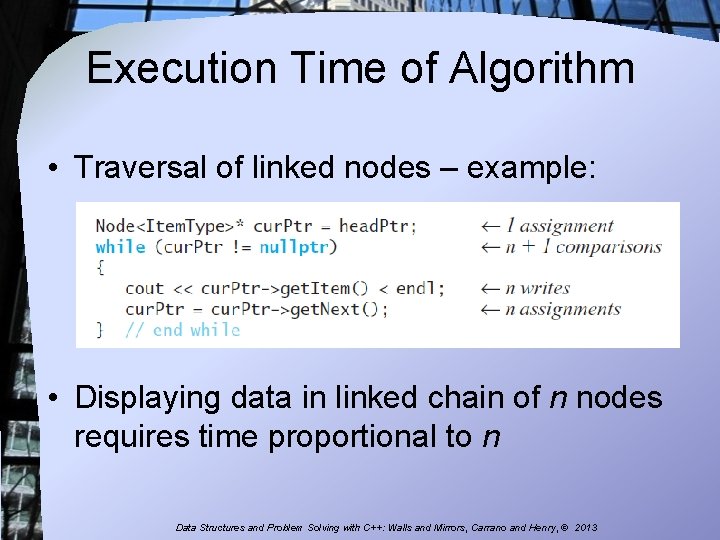
Execution Time of Algorithm • Traversal of linked nodes – example: • Displaying data in linked chain of n nodes requires time proportional to n Data Structures and Problem Solving with C++: Walls and Mirrors, Carrano and Henry, © 2013
Algorithm Growth Rates • Measure algorithm’s time requirement as a function of problem size • Compare algorithm efficiencies for large problems • Look only at significant differences. Data Structures and Problem Solving with C++: Walls and Mirrors, Carrano and Henry, © 2013
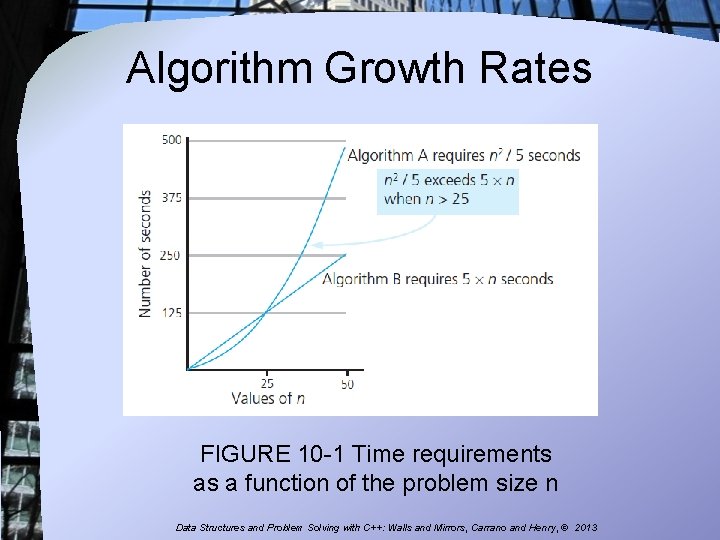
Algorithm Growth Rates FIGURE 10 -1 Time requirements as a function of the problem size n Data Structures and Problem Solving with C++: Walls and Mirrors, Carrano and Henry, © 2013
Analysis and Big O Notation • Definition: § Algorithm A is order f ( n ) • Denoted O( f ( n )) § If constants k and n 0 exist § Such that A requires no more than k f ( n ) time units to solve a problem of size n ≥ n 0. Data Structures and Problem Solving with C++: Walls and Mirrors, Carrano and Henry, © 2013
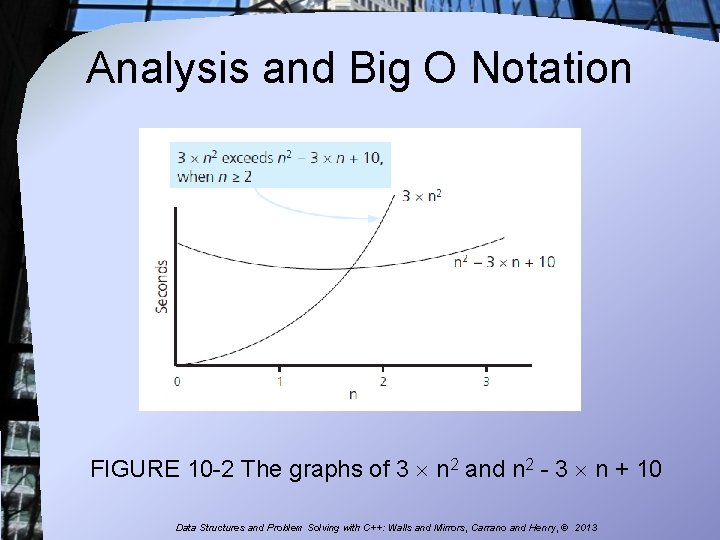
Analysis and Big O Notation FIGURE 10 -2 The graphs of 3 n 2 and n 2 - 3 n + 10 Data Structures and Problem Solving with C++: Walls and Mirrors, Carrano and Henry, © 2013
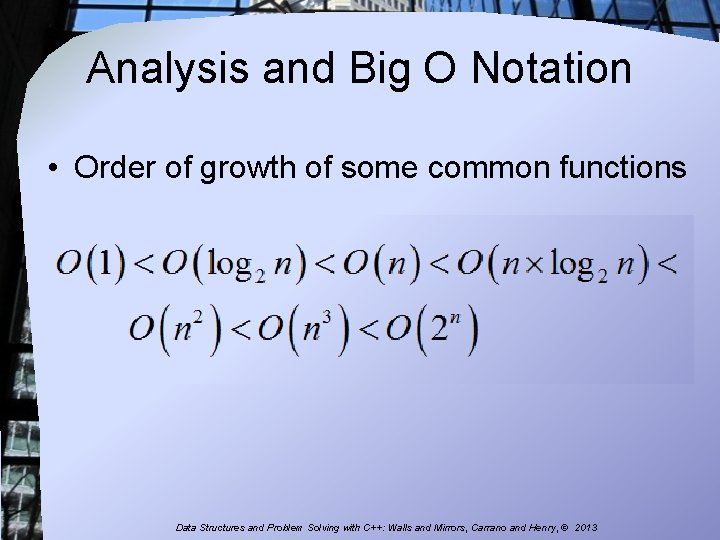
Analysis and Big O Notation • Order of growth of some common functions Data Structures and Problem Solving with C++: Walls and Mirrors, Carrano and Henry, © 2013
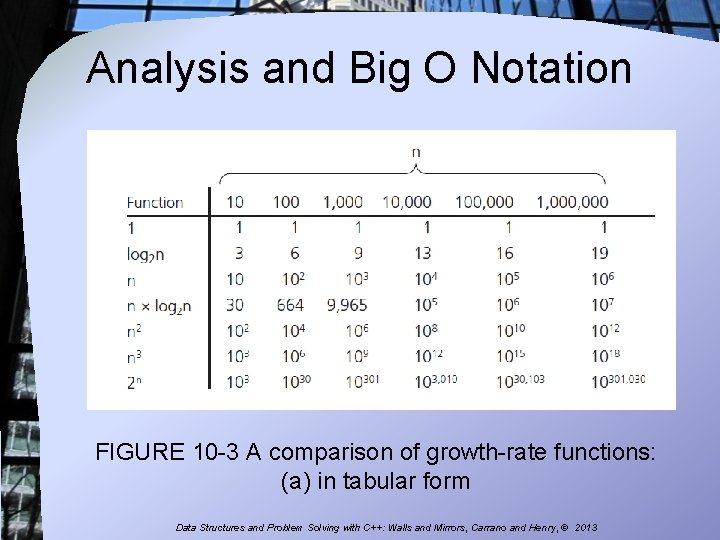
Analysis and Big O Notation FIGURE 10 -3 A comparison of growth-rate functions: (a) in tabular form Data Structures and Problem Solving with C++: Walls and Mirrors, Carrano and Henry, © 2013
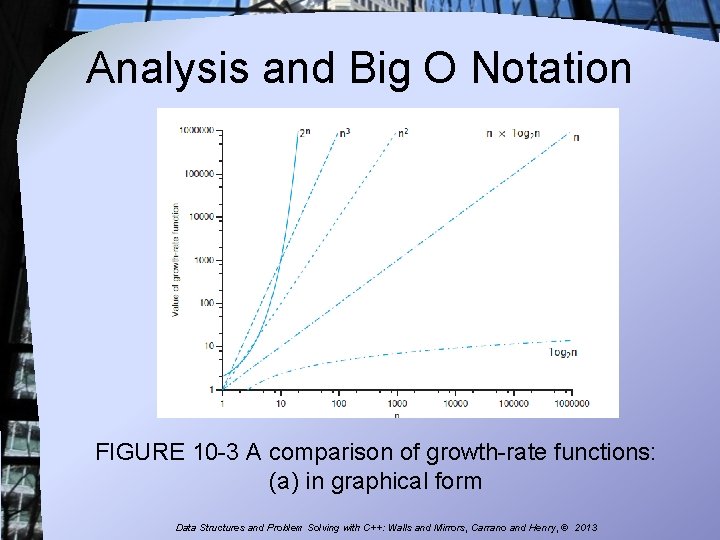
Analysis and Big O Notation FIGURE 10 -3 A comparison of growth-rate functions: (a) in graphical form Data Structures and Problem Solving with C++: Walls and Mirrors, Carrano and Henry, © 2013
Properties of Growth-Rate Functions • Ignore low-order terms • Ignore a multiplicative constant in the highorder term • O(f(n)) + O(g(n)) = O(f(n) + g(n)) • Be aware of worst case, average case Data Structures and Problem Solving with C++: Walls and Mirrors, Carrano and Henry, © 2013
Keeping Your Perspective • Array-based get. Entry is O(1) • Link-based get. Entry is O(n) • Consider how frequently particular ADT operations occur in given application • Some seldom-used but critical operations must be efficient Data Structures and Problem Solving with C++: Walls and Mirrors, Carrano and Henry, © 2013
Keeping Your Perspective • If problem size always small, ignore an algorithm’s efficiency • Weigh trade-offs between algorithm’s time and memory requirements • Compare algorithms for both style and efficiency Data Structures and Problem Solving with C++: Walls and Mirrors, Carrano and Henry, © 2013
Efficiency of Searching Algorithms • Sequential search § Worst case O(n) § Average case O(n) § Best case O(1) • Binary search of sorted array § Worst case O(log 2 n) § Remember required overhead for keeping array sorted Data Structures and Problem Solving with C++: Walls and Mirrors, Carrano and Henry, © 2013
End Chapter 10 Data Structures and Problem Solving with C++: Walls and Mirrors, Carrano and Henry, © 2013
- Slides: 17