
Algorithm design computational geometry Lecture 1 Overview Geometry
![Bentley’s interval tree • Given a set X of intervals in [1, n] (](https://slidetodoc.com/presentation_image_h/0a89414ee01cb8bc19986e6bd8a6fadd/image-10.jpg "Bentley’s interval tree • Given a set X of intervals in [1, n] (")
- Slides: 11
Algorithm design (computational geometry) Lecture 1 Overview
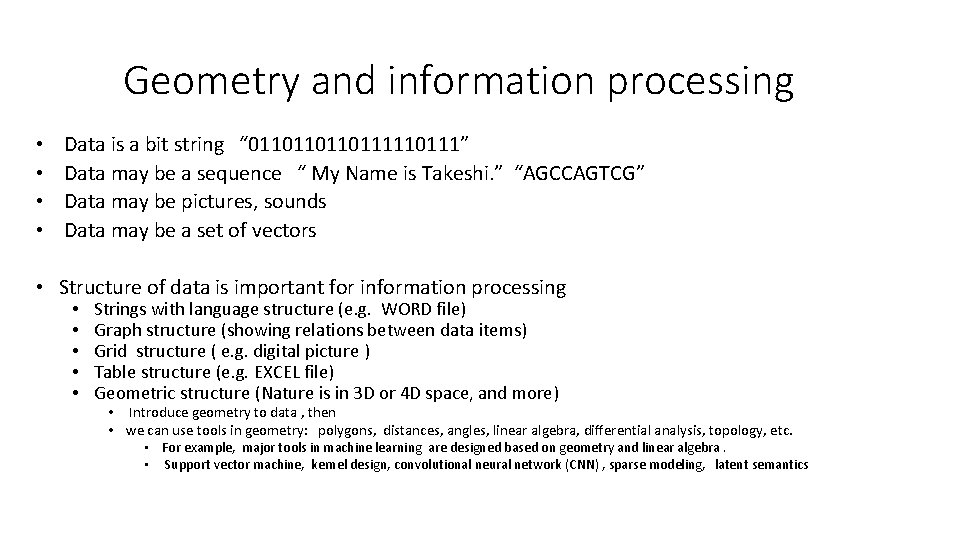
Geometry and information processing • • Data is a bit string “ 0110111110111” Data may be a sequence “ My Name is Takeshi. ” “AGCCAGTCG” Data may be pictures, sounds Data may be a set of vectors • Structure of data is important for information processing • • • Strings with language structure (e. g. WORD file) Graph structure (showing relations between data items) Grid structure ( e. g. digital picture ) Table structure (e. g. EXCEL file) Geometric structure (Nature is in 3 D or 4 D space, and more) • Introduce geometry to data , then • we can use tools in geometry: polygons, distances, angles, linear algebra, differential analysis, topology, etc. • For example, major tools in machine learning are designed based on geometry and linear algebra. • Support vector machine, kernel design, convolutional neural network (CNN) , sparse modeling, latent semantics
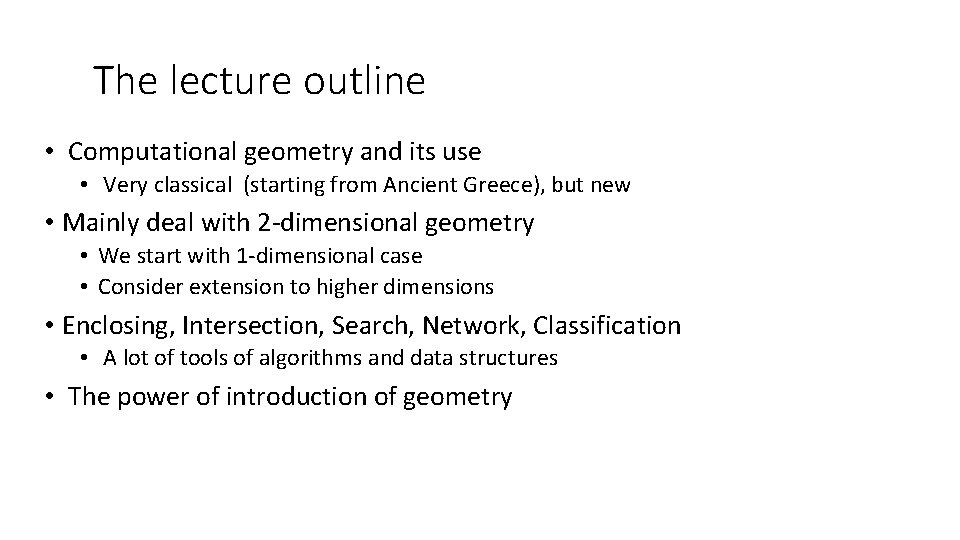
The lecture outline • Computational geometry and its use • Very classical (starting from Ancient Greece), but new • Mainly deal with 2 -dimensional geometry • We start with 1 -dimensional case • Consider extension to higher dimensions • Enclosing, Intersection, Search, Network, Classification • A lot of tools of algorithms and data structures • The power of introduction of geometry
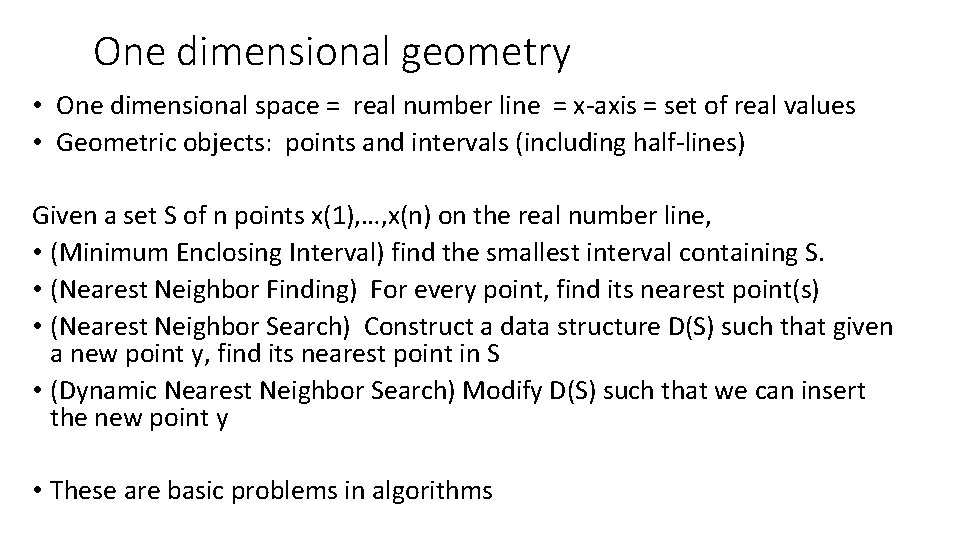
One dimensional geometry • One dimensional space = real number line = x-axis = set of real values • Geometric objects: points and intervals (including half-lines) Given a set S of n points x(1), …, x(n) on the real number line, • (Minimum Enclosing Interval) find the smallest interval containing S. • (Nearest Neighbor Finding) For every point, find its nearest point(s) • (Nearest Neighbor Search) Construct a data structure D(S) such that given a new point y, find its nearest point in S • (Dynamic Nearest Neighbor Search) Modify D(S) such that we can insert the new point y • These are basic problems in algorithms
You should know it! • Minimum Enclosing Interval: Find the smallest interval containing S. • I hope most of students can solve it at a glance. • What is the time complexity?
Two (or higher) dimensional extension of the minimum enclosing interval • Given a set S of points in a plane (or space), find the smallest XXXX containing all of S • XXXX may be • • • Disk Triangle Rectangle (x-aligned or not) Convex region Cone (called “nonnegative rank problem” in machine learning)
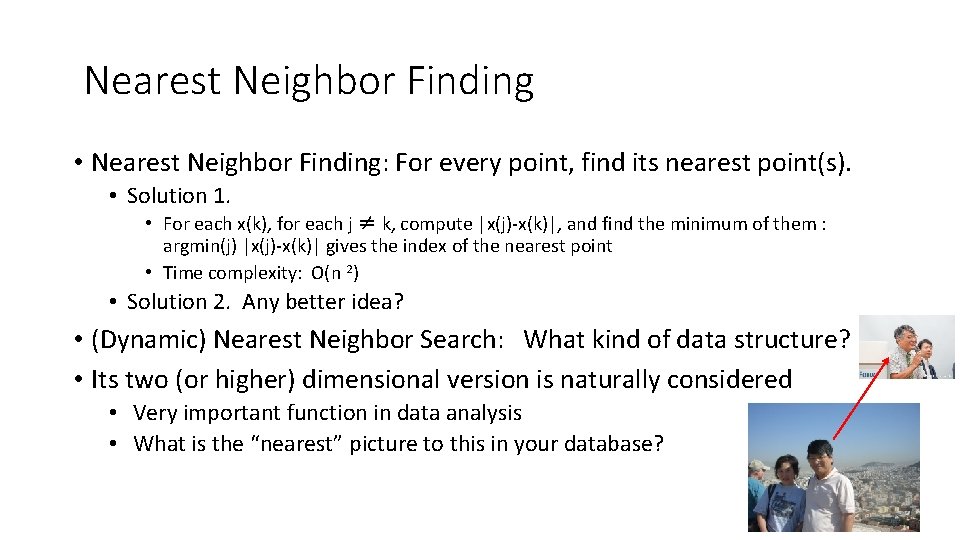
Nearest Neighbor Finding • Nearest Neighbor Finding: For every point, find its nearest point(s). • Solution 1. • For each x(k), for each j ≠ k, compute |x(j)-x(k)|, and find the minimum of them : argmin(j) |x(j)-x(k)| gives the index of the nearest point • Time complexity: O(n 2) • Solution 2. Any better idea? • (Dynamic) Nearest Neighbor Search: What kind of data structure? • Its two (or higher) dimensional version is naturally considered • Very important function in data analysis • What is the “nearest” picture to this in your database?
“Sorting” in geometry • Nearest neighbor search in 1 D is basically sorting and binary search • In one dimensional space, sorting is powerful • Given a point set S in an interval I, cut the interval by them, and report all the pieces • Given a point set S, connect all the points by using bonds with minimum total length • Given a point set S, for a given interval I, report the number of points in I • Given red points and blue points on the line, separate them into minimum number of uni-colored intervals • In two or higher dimensional space, you can imagine how these problems are extended.
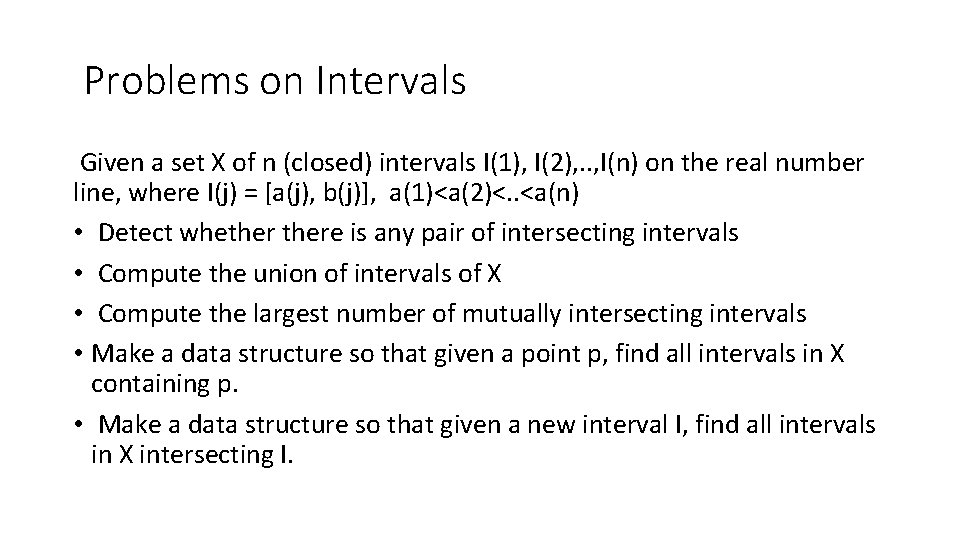
Problems on Intervals Given a set X of n (closed) intervals I(1), I(2), . . , I(n) on the real number line, where I(j) = [a(j), b(j)], a(1)<a(2)<. . <a(n) • Detect whethere is any pair of intersecting intervals • Compute the union of intervals of X • Compute the largest number of mutually intersecting intervals • Make a data structure so that given a point p, find all intervals in X containing p. • Make a data structure so that given a new interval I, find all intervals in X intersecting I.
Bentley’s interval tree • Given a set X of intervals in [1, n] ( interval I in X is in a form [ i, j ] of integral subintervals of [1, n] • Give a data structure D(X) on X to support • Find : given a new interval I, report all intervals intersecting I • Insert: Insert a new interval I to D(X) • Delete: Delete an interval I of X from D(X)
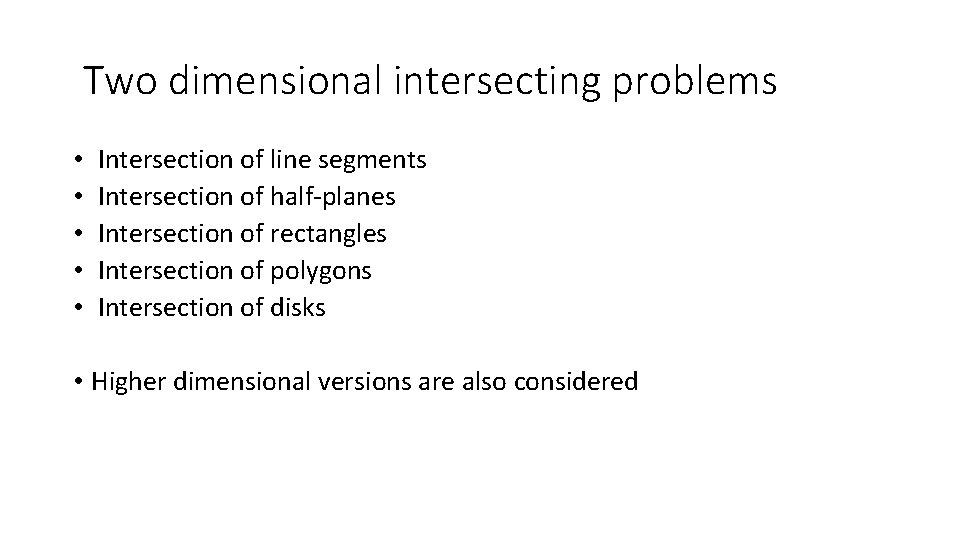
Two dimensional intersecting problems • • • Intersection of line segments Intersection of half-planes Intersection of rectangles Intersection of polygons Intersection of disks • Higher dimensional versions are also considered