
Algorithm Design and Analysis Victor Adamchik Lecture 14





- Slides: 35
Algorithm Design and Analysis Victor Adamchik Lecture 14 CS 15 -451 Feb 14, 2014 Spring 2014 Carnegie Mellon University Graph Algorithms - 4
Plan: Min-cost Spanning Tree Algorithms: - Prim’s (review) - Arborescence problem Kleinberg-Tardos, Ch. 4
Page’s Rank Page and Brin Billionaires Jon Kleinberg Nevanlinna Prize, 10 k euro
The Minimum Spanning Tree for Undirected Graphs Find a spanning tree of minimum total weight. The weight of a spanning tree is the sum of the weights on all the edges which comprise the spanning tree.
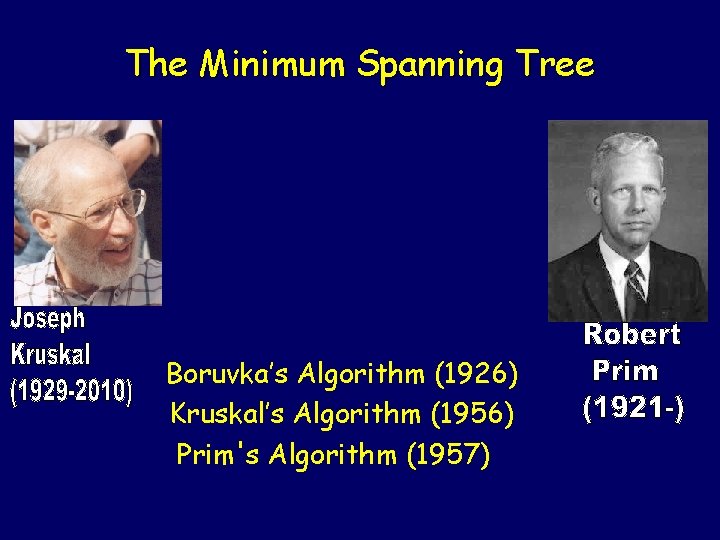
The Minimum Spanning Tree Boruvka’s Algorithm (1926) Kruskal’s Algorithm (1956) Prim's Algorithm (1957)
Prim's Algorithm Greedy algorithm that builds a tree one VERTEX at a time. First described by Jarnık in a 1929 letter to Boruvka. Rediscovered by Kruskal in 1956, by Prim in 1957, by Loberman and Weinberger in 1957, and finally by Dijkstra in 1958.
Prim's Algorithm algorithm builds a tree one VERTEX at a time. - Start with an arbitrary vertex as component C - Expand C by adding a new vertex having the minimum weight edge with exactly one end point in C. - Continue to grow the tree until C gets all vertices.
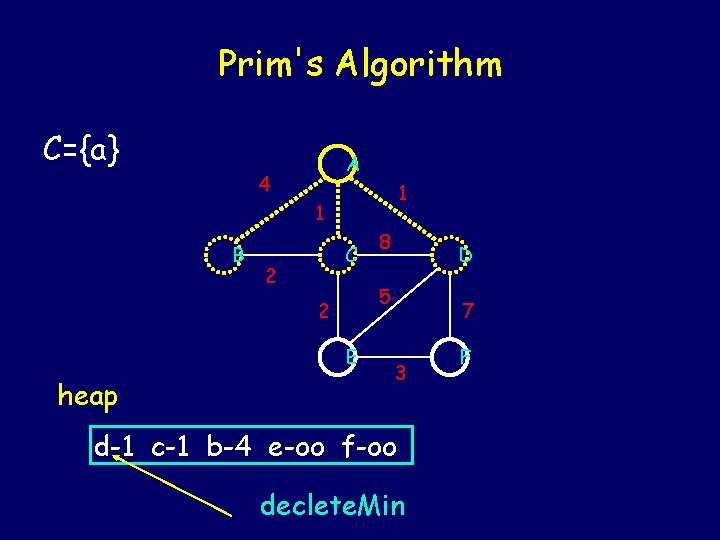
Prim's Algorithm C={a} A 4 1 1 B C 2 D 5 2 E heap 8 7 3 d-1 c-1 b-4 e-oo f-oo declete. Min F
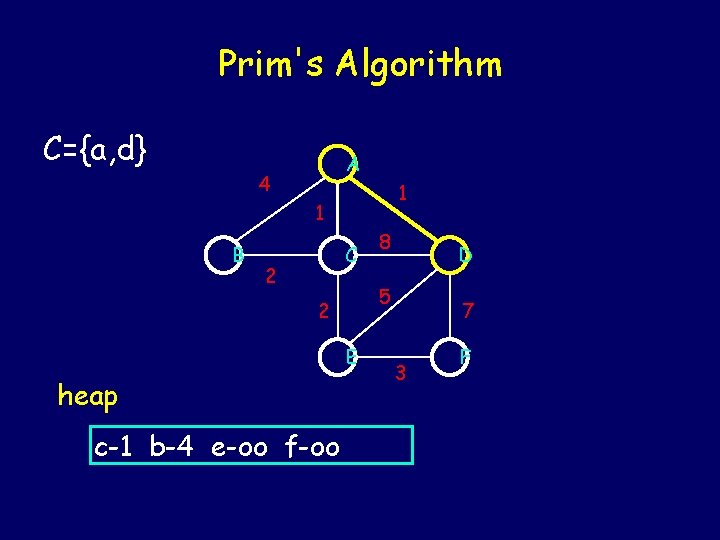
Prim's Algorithm C={a, d} A 4 1 1 B C 2 E c-1 b-4 e-oo f-oo D 5 2 heap 8 7 3 F
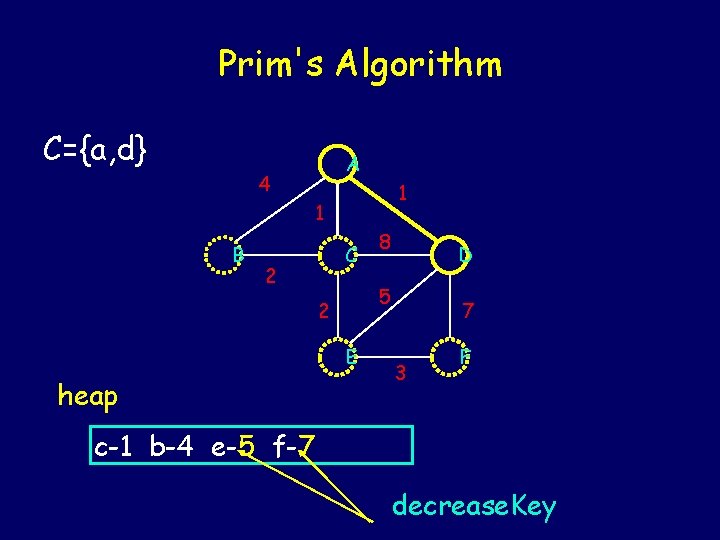
Prim's Algorithm C={a, d} A 4 1 1 B C 2 D 5 2 E heap 8 7 3 F c-1 b-4 e-5 f-7 decrease. Key
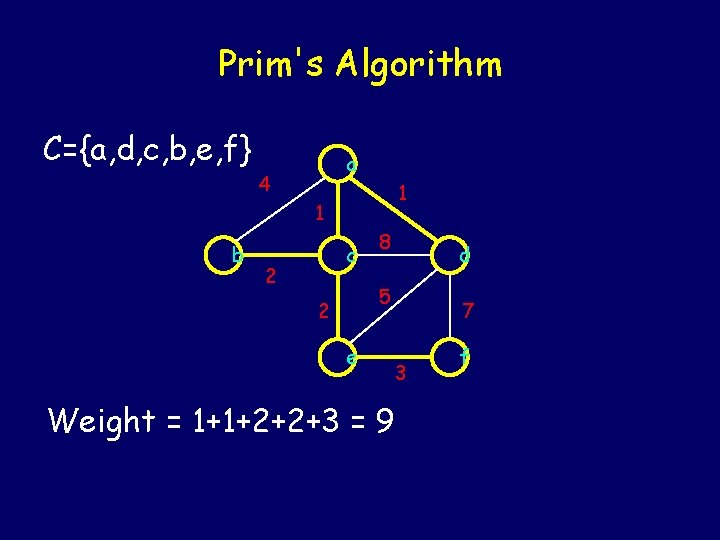
Prim's Algorithm C={a, d, c, b, e, f} a 4 1 1 b c 2 8 d 5 2 e 7 3 Weight = 1+1+2+2+3 = 9 f
Property of the MST Lemma: Let X be any subset of the vertices of G, and let edge e be the smallest edge connecting X to G-X. Then e is part of the minimum spanning tree.
What is the worst-case runtime complexity of Prim's Algorithm? We run delete. Min V times We update the queue E times O(V*log V + E*log V) delete. Min decrease. Key O(1) – Fibonacci heap
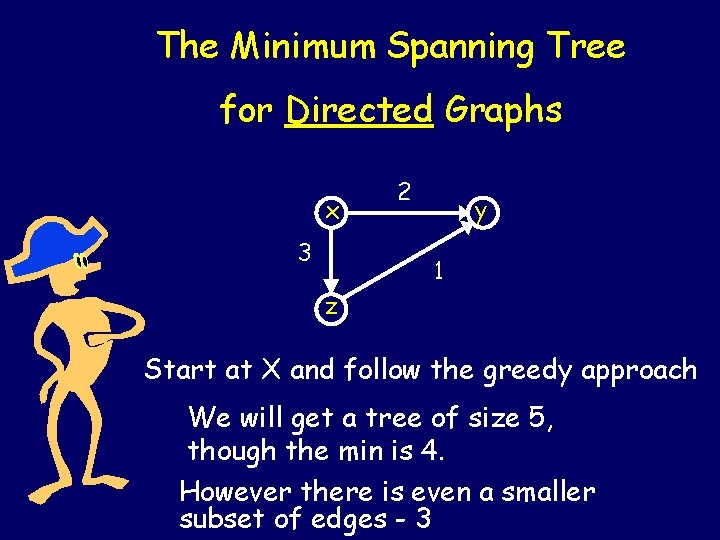
The Minimum Spanning Tree for Directed Graphs x 3 2 y 1 z Start at X and follow the greedy approach We will get a tree of size 5, though the min is 4. However there is even a smaller subset of edges - 3
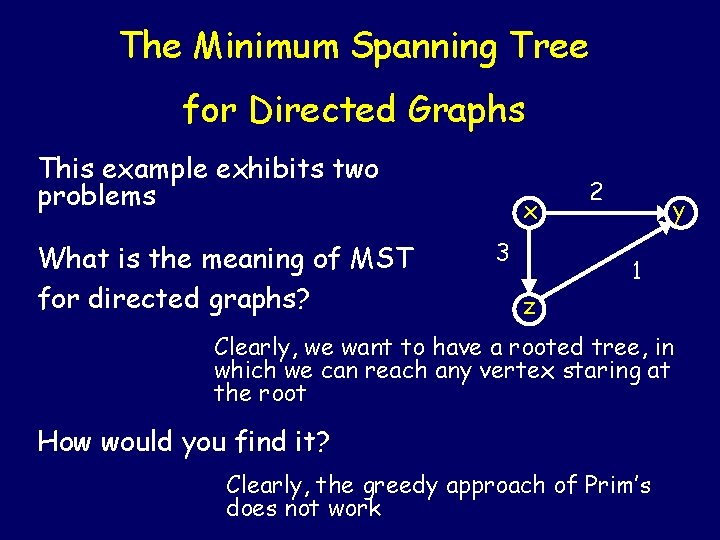
The Minimum Spanning Tree for Directed Graphs This example exhibits two problems What is the meaning of MST for directed graphs? x 3 2 y 1 z Clearly, we want to have a rooted tree, in which we can reach any vertex staring at the root How would you find it? Clearly, the greedy approach of Prim’s does not work
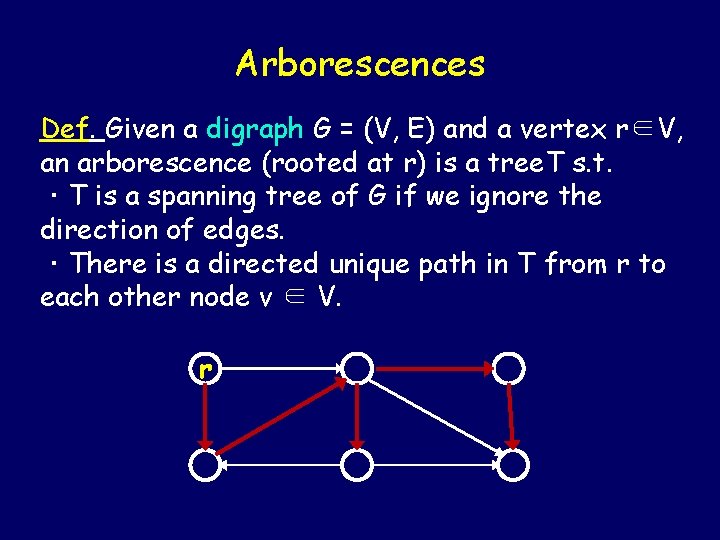
Arborescences Def. Given a digraph G = (V, E) and a vertex r∈V, an arborescence (rooted at r) is a tree. T s. t. ・T is a spanning tree of G if we ignore the direction of edges. ・There is a directed unique path in T from r to each other node v ∈ V. r
Given a digraph G, find an arborescence rooted at r (if one exists) Run DFS or BFS
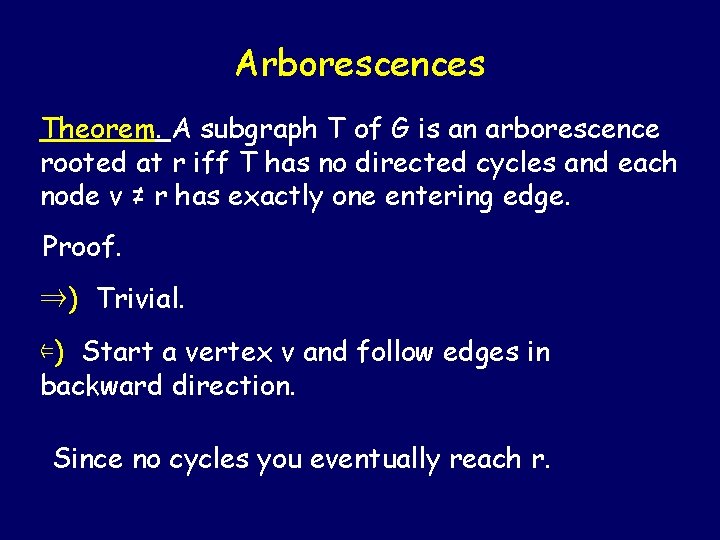
Arborescences Theorem. A subgraph T of G is an arborescence rooted at r iff T has no directed cycles and each node v ≠ r has exactly one entering edge. Proof. ⇒) Trivial. ⇐) Start a vertex v and follow edges in backward direction. Since no cycles you eventually reach r.
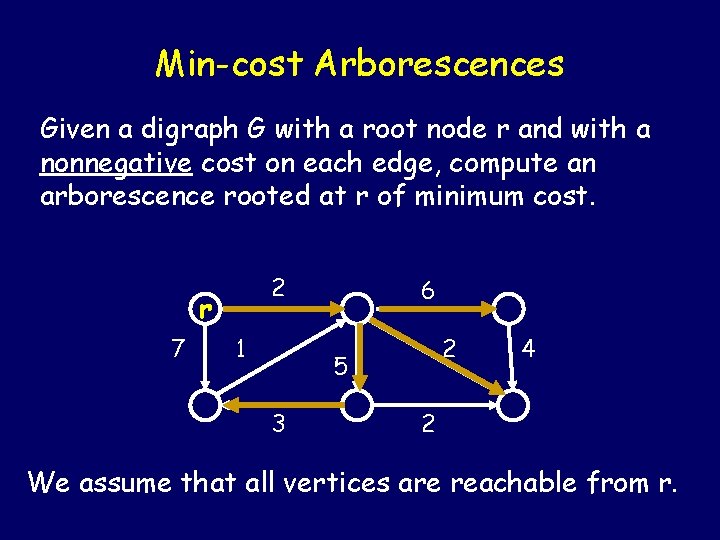
Min-cost Arborescences Given a digraph G with a root node r and with a nonnegative cost on each edge, compute an arborescence rooted at r of minimum cost. 2 r 7 1 6 2 5 3 4 2 We assume that all vertices are reachable from r.
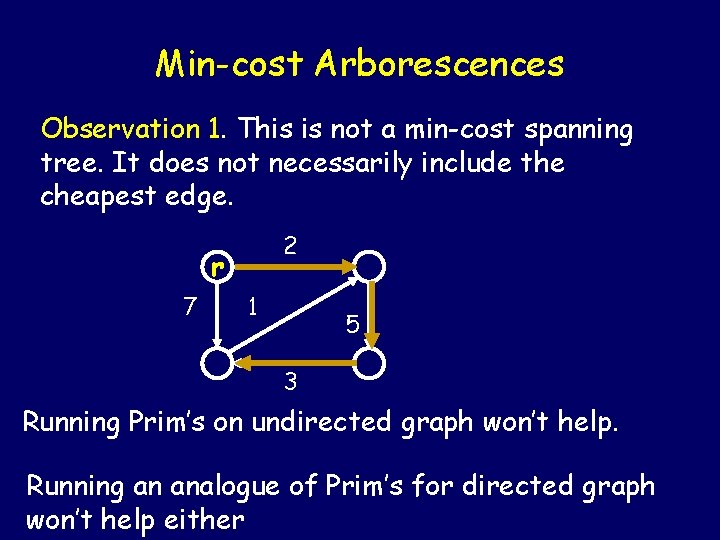
Min-cost Arborescences Observation 1. This is not a min-cost spanning tree. It does not necessarily include the cheapest edge. 2 r 7 1 5 3 Running Prim’s on undirected graph won’t help. Running an analogue of Prim’s for directed graph won’t help either
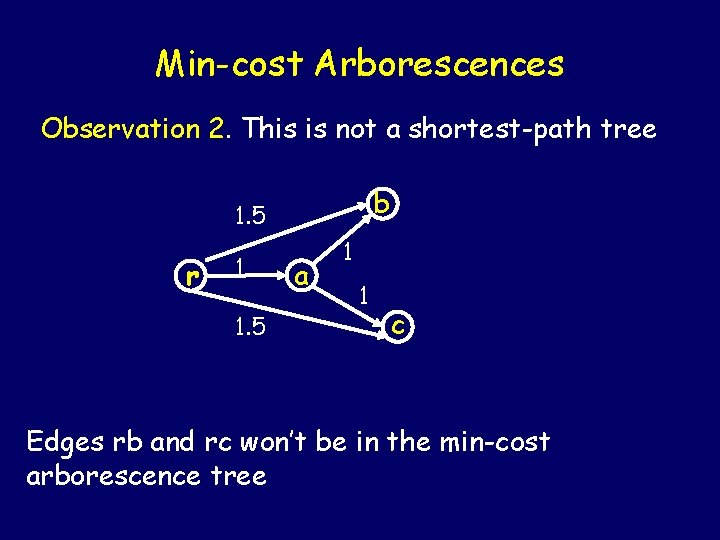
Min-cost Arborescences Observation 2. This is not a shortest-path tree b 1. 5 r 1 1. 5 a 1 1 c Edges rb and rc won’t be in the min-cost arborescence tree
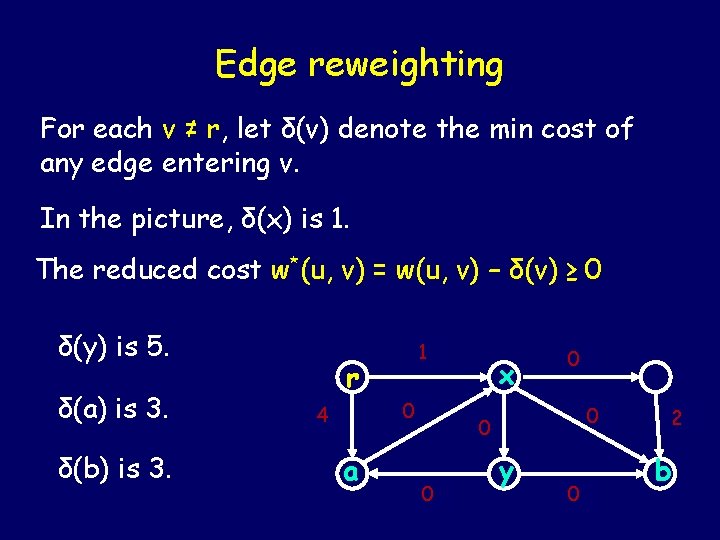
Edge reweighting For each v ≠ r, let δ(v) denote the min cost of any edge entering v. In the picture, δ(x) is 1. The reduced cost w*(u, v) = w(u, v) – δ(v) ≥ 0 δ(y) is 5. δ(a) is 3. δ(b) is 3. 12 r 10 4 7 a x 0 5 30 0 6 0 2 y 2 0 42 b
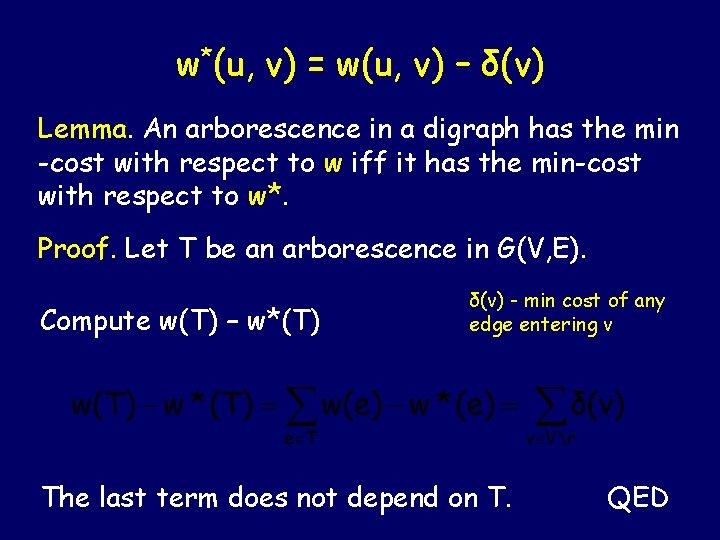
w*(u, v) = w(u, v) – δ(v) Lemma. An arborescence in a digraph has the min -cost with respect to w iff it has the min-cost with respect to w*. Proof. Let T be an arborescence in G(V, E). Compute w(T) – w*(T) δ(v) - min cost of any edge entering v The last term does not depend on T. QED
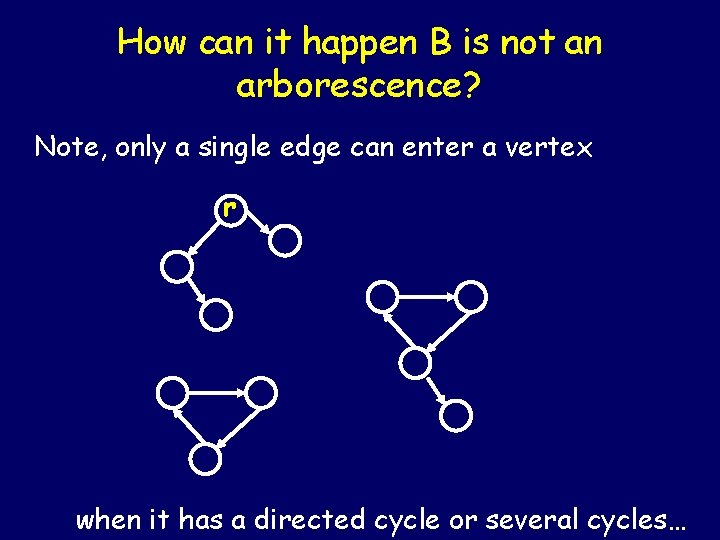
Algorithm: intuition Let G* denote a new graph after reweighting. For every v≠r in G* pick 0 -weight edge entering v. Let B denote the set of such edges. If B is an arborescence, we are done. Note B is the min-cost since all edges have 0 cost. If B is NOT an arborescence… When B is not an arborescence?
How can it happen B is not an arborescence? Note, only a single edge can enter a vertex r when it has a directed cycle or several cycles…
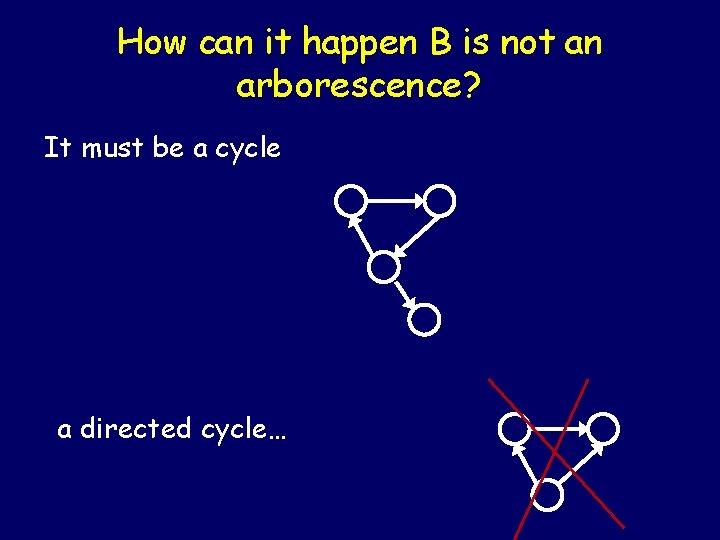
How can it happen B is not an arborescence? It must be a cycle a directed cycle…
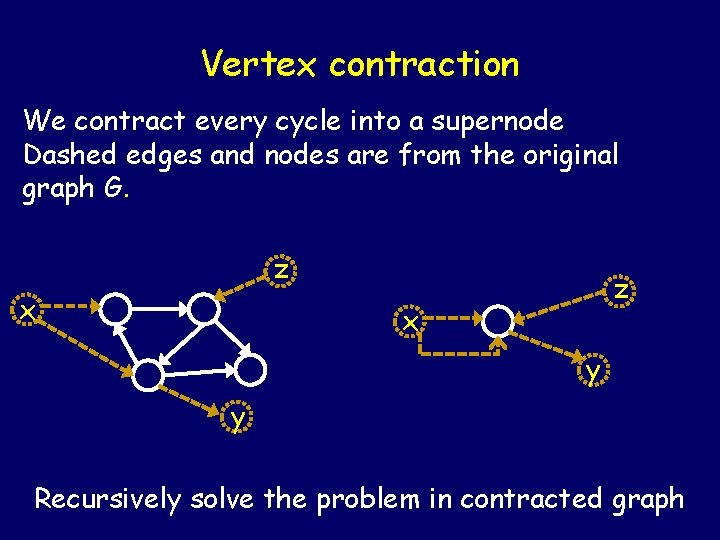
Vertex contraction We contract every cycle into a supernode Dashed edges and nodes are from the original graph G. z x y y Recursively solve the problem in contracted graph
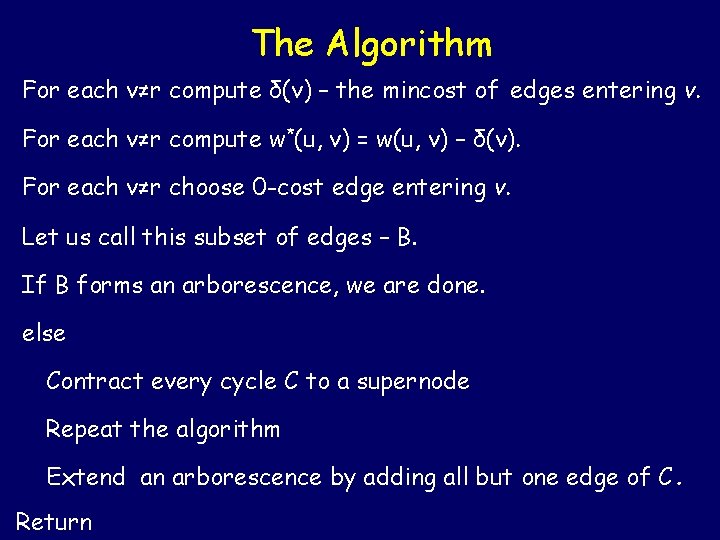
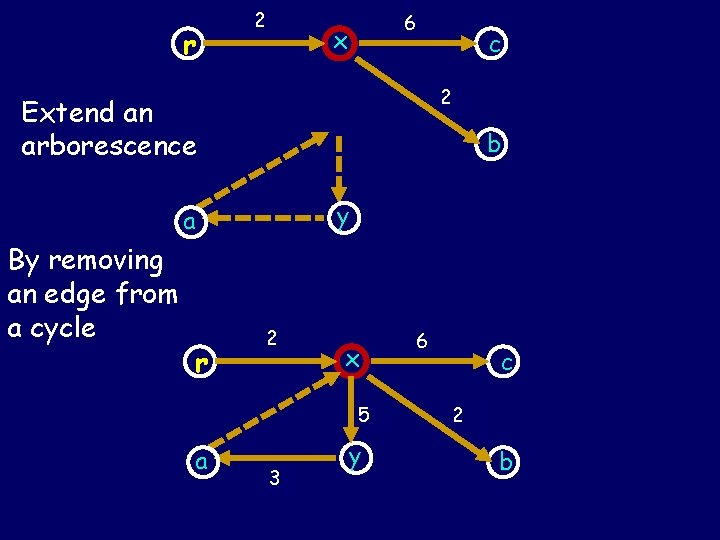
The Algorithm For each v≠r compute δ(v) – the mincost of edges entering v. For each v≠r compute w*(u, v) = w(u, v) – δ(v). For each v≠r choose 0 -cost edge entering v. Let us call this subset of edges – B. If B forms an arborescence, we are done. else Contract every cycle C to a supernode Repeat the algorithm Extend an arborescence by adding all but one edge of C. Return
Complexity At most V contractions (since each one reduces the number of nodes). Finding and contracting the cycle C takes O(E). Transforming T' into T takes O(E) time. Total - O(V E). Faster for Fibonacci heaps.
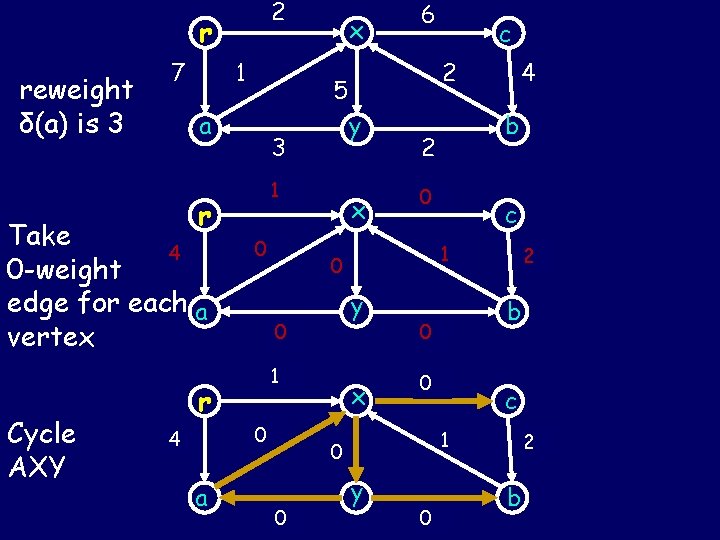
2 r reweight δ(a) is 3 7 1 12 r Cycle AXY 10 0 5 12 10 a x 30 r 4 7 y 3 30 4 b 2 0 6 c 12 y x 0 5 c 2 5 a Take 4 7 0 -weight edge for each a vertex x 6 b 2 0 0 6 c 12 y 2 0 42 42 b
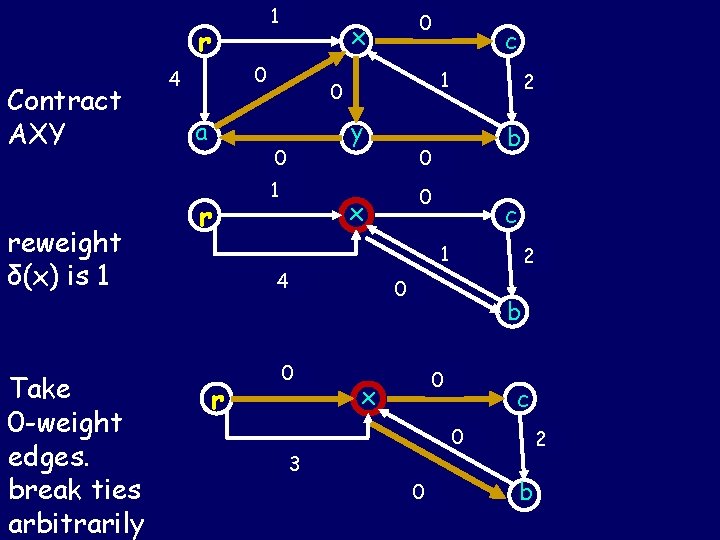
12 r Contract AXY reweight δ(x) is 1 Take 0 -weight edges. break ties arbitrarily x 10 4 7 a 0 5 30 r 12 y 3 42 b 2 0 0 6 x 0 2 c 12 4 r 0 6 0 42 b 0 6 x c 0 2 0 42 b
r 2 6 x 2 Extend an arborescence b y a By removing an edge from a cycle r 2 x 5 a c 3 y 6 c 2 b
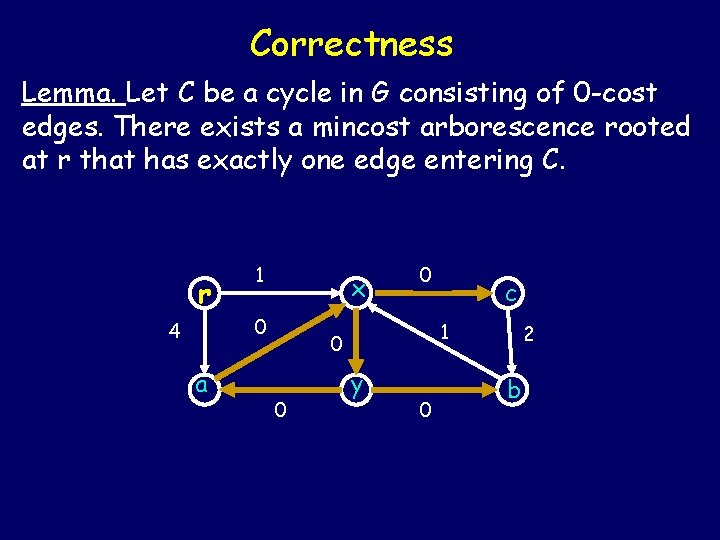
Correctness Lemma. Let C be a cycle in G consisting of 0 -cost edges. There exists a mincost arborescence rooted at r that has exactly one edge entering C. r 1 x 10 4 7 a 0 5 30 0 c 12 y 2 0 42 b
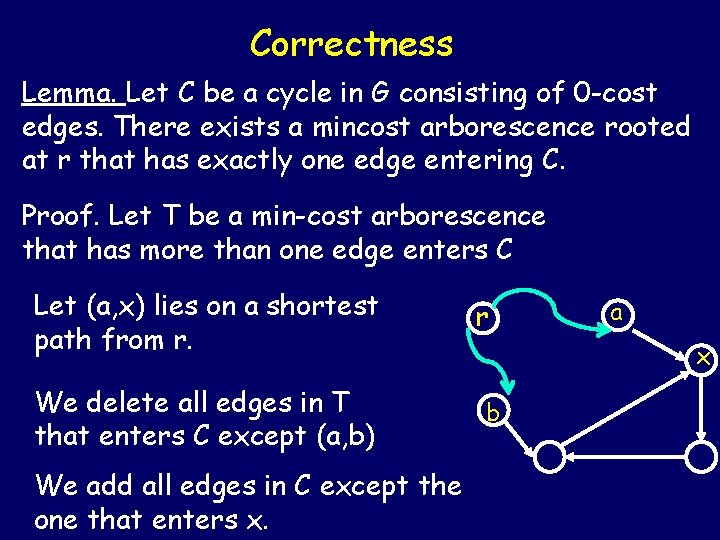
Correctness Lemma. Let C be a cycle in G consisting of 0 -cost edges. There exists a mincost arborescence rooted at r that has exactly one edge entering C. Proof. Let T be a min-cost arborescence that has more than one edge enters C Let (a, x) lies on a shortest path from r. We delete all edges in T that enters C except (a, b) We add all edges in C except the one that enters x. r a x b
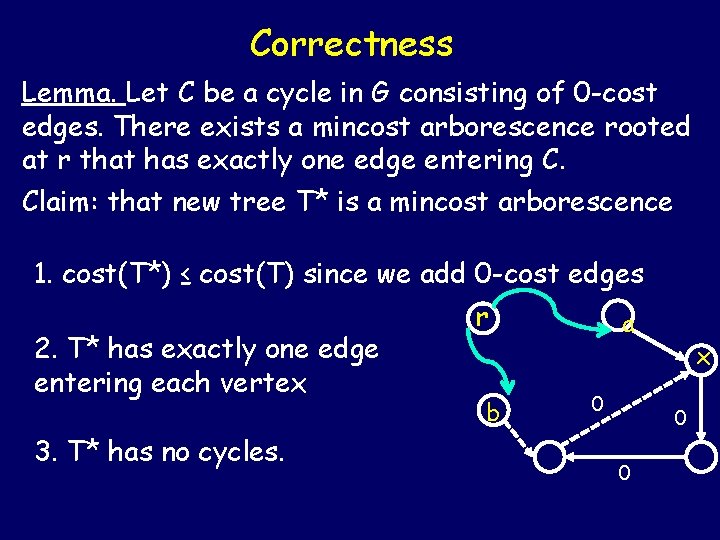
Correctness Lemma. Let C be a cycle in G consisting of 0 -cost edges. There exists a mincost arborescence rooted at r that has exactly one edge entering C. Claim: that new tree T* is a mincost arborescence 1. cost(T*) ≤ cost(T) since we add 0 -cost edges 2. T* has exactly one edge entering each vertex 3. T* has no cycles. r b a 0 x 0 0