
Algorithm Analysis and Big Oh Notation Courtesy of

Algorithm Analysis and Big Oh Notation Courtesy of Prof. Ajay Gupta (with updates by Dr. Leszek T. Lilien) CS 1120 – Fall 2012 Department of Computer Science Western Michigan University
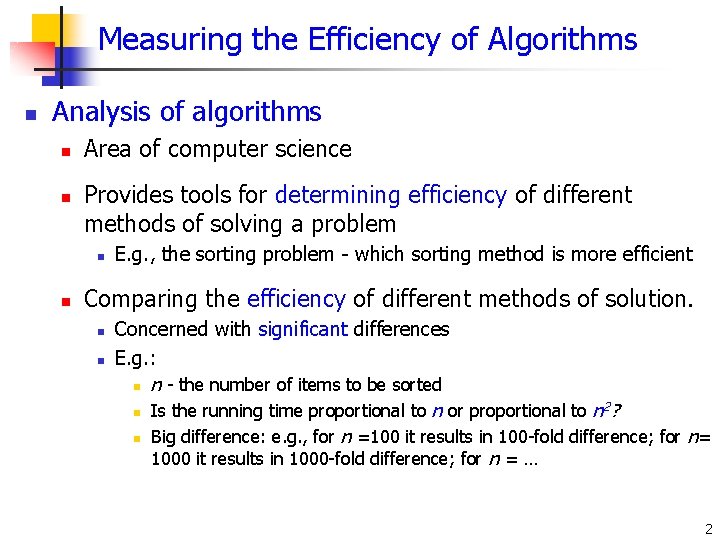
Measuring the Efficiency of Algorithms n Analysis of algorithms n n Area of computer science Provides tools for determining efficiency of different methods of solving a problem n n E. g. , the sorting problem - which sorting method is more efficient Comparing the efficiency of different methods of solution. n n Concerned with significant differences E. g. : n n - the number of items to be sorted 2 n Is the running time proportional to n or proportional to n ? n Big difference: e. g. , for n =100 it results in 100 -fold difference; for n= 1000 it results in 1000 -fold difference; for n = … 2
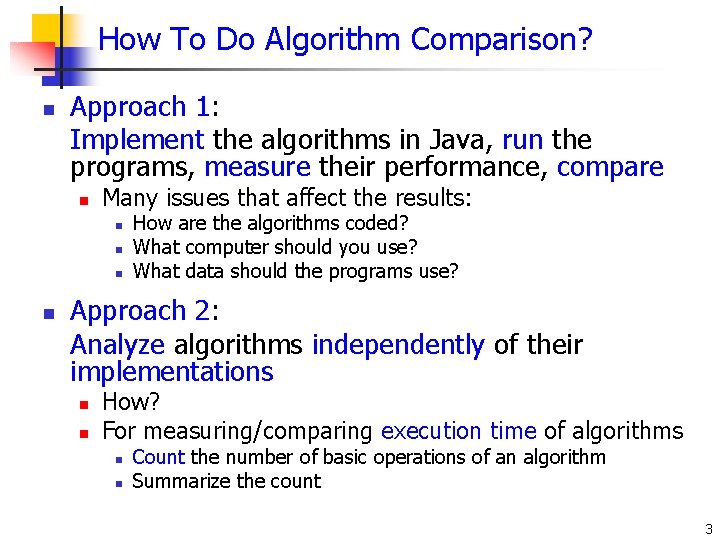
How To Do Algorithm Comparison? n Approach 1: Implement the algorithms in Java, run the programs, measure their performance, compare n Many issues that affect the results: n n How are the algorithms coded? What computer should you use? What data should the programs use? Approach 2: Analyze algorithms independently of their implementations n n How? For measuring/comparing execution time of algorithms n n Count the number of basic operations of an algorithm Summarize the count 3
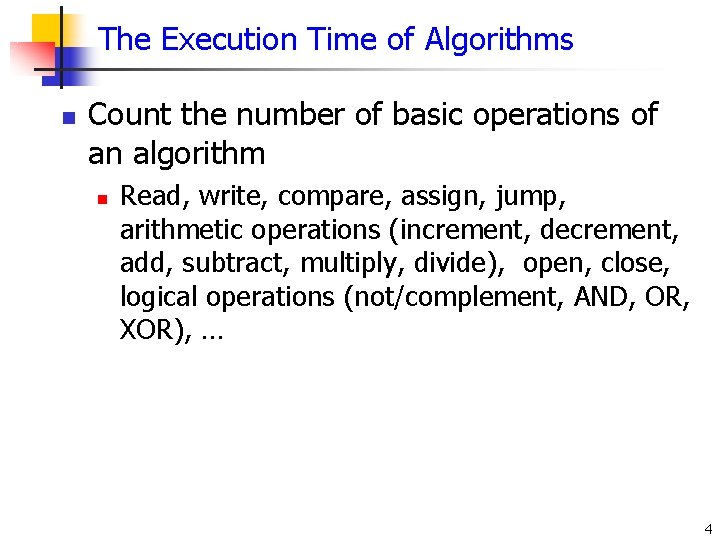
The Execution Time of Algorithms n Count the number of basic operations of an algorithm n Read, write, compare, assign, jump, arithmetic operations (increment, decrement, add, subtract, multiply, divide), open, close, logical operations (not/complement, AND, OR, XOR), … 4
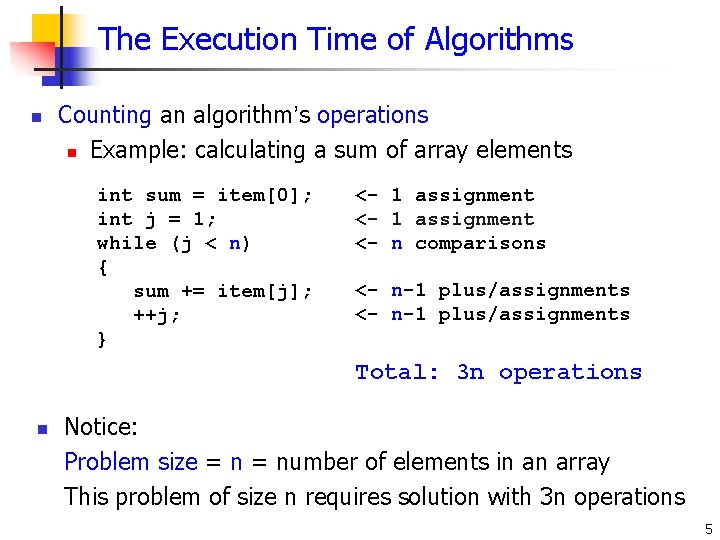
The Execution Time of Algorithms n Counting an algorithm’s operations n Example: calculating a sum of array elements int sum = item[0]; int j = 1; while (j < n) { sum += item[j]; ++j; } <- 1 assignment <- n comparisons <- n-1 plus/assignments Total: 3 n operations n Notice: Problem size = number of elements in an array This problem of size n requires solution with 3 n operations 5
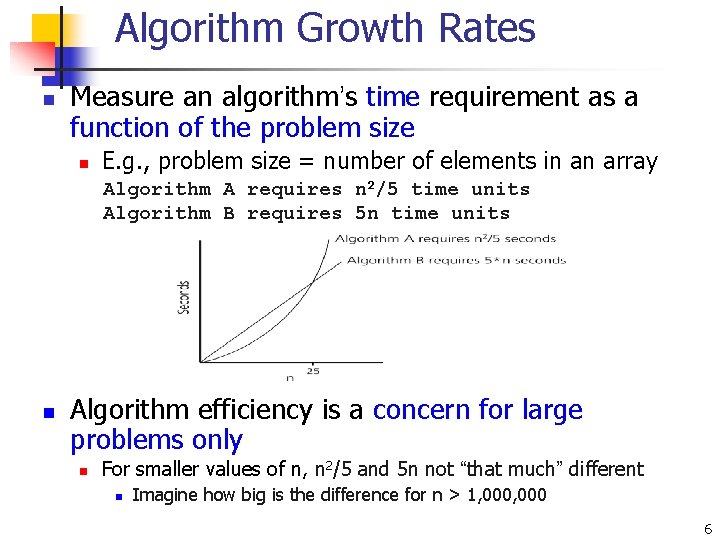
Algorithm Growth Rates n Measure an algorithm’s time requirement as a function of the problem size n E. g. , problem size = number of elements in an array Algorithm A requires n 2/5 time units Algorithm B requires 5 n time units n Algorithm efficiency is a concern for large problems only n For smaller values of n, n 2/5 and 5 n not “that much” different n Imagine how big is the difference for n > 1, 000 6

Common Growth-Rate Functions - I 7
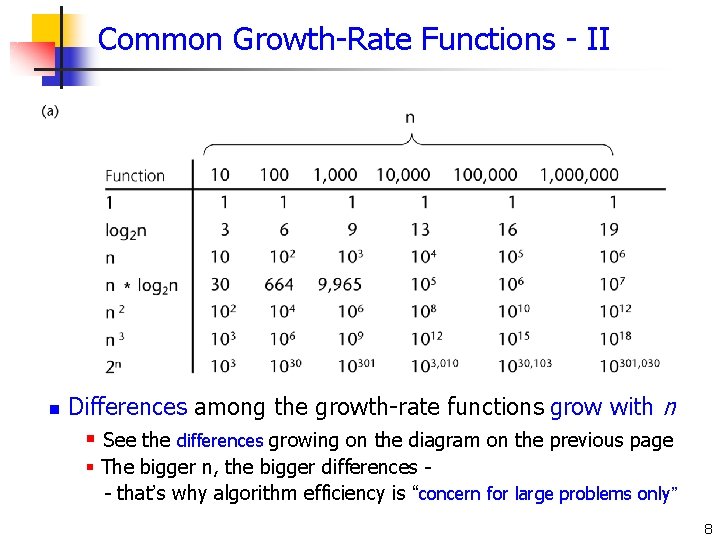
Common Growth-Rate Functions - II n Differences among the growth-rate functions grow with n § See the differences growing on the diagram on the previous page § The bigger n, the bigger differences - that’s why algorithm efficiency is “concern for large problems only” 8
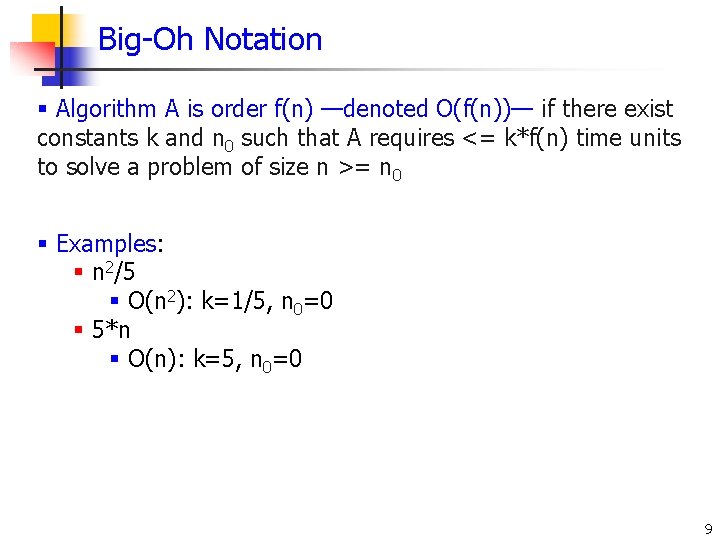
Big-Oh Notation § Algorithm A is order f(n) —denoted O(f(n))— if there exist constants k and n 0 such that A requires <= k*f(n) time units to solve a problem of size n >= n 0 § Examples: § n 2/5 § O(n 2): k=1/5, n 0=0 § 5*n § O(n): k=5, n 0=0 9
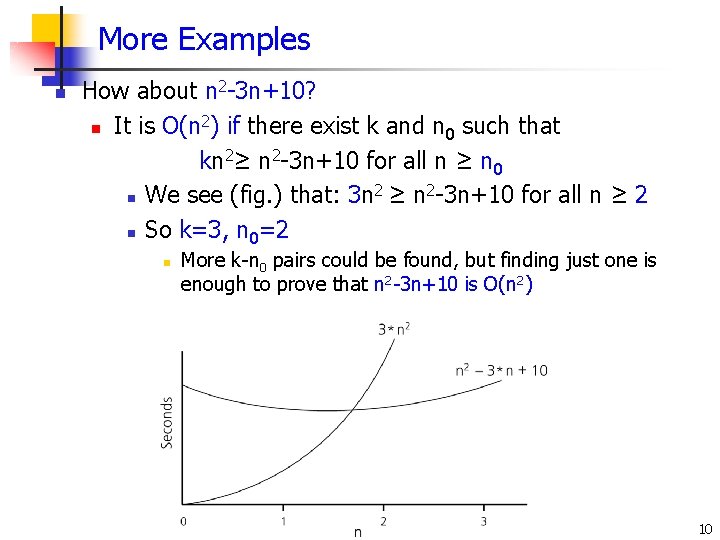
More Examples n How about n 2 -3 n+10? 2 n It is O(n ) if there exist k and n 0 such that kn 2≥ n 2 -3 n+10 for all n ≥ n 0 2 2 n We see (fig. ) that: 3 n ≥ n -3 n+10 for all n ≥ 2 n So k=3, n 0=2 n More k-n 0 pairs could be found, but finding just one is enough to prove that n 2 -3 n+10 is O(n 2) 10
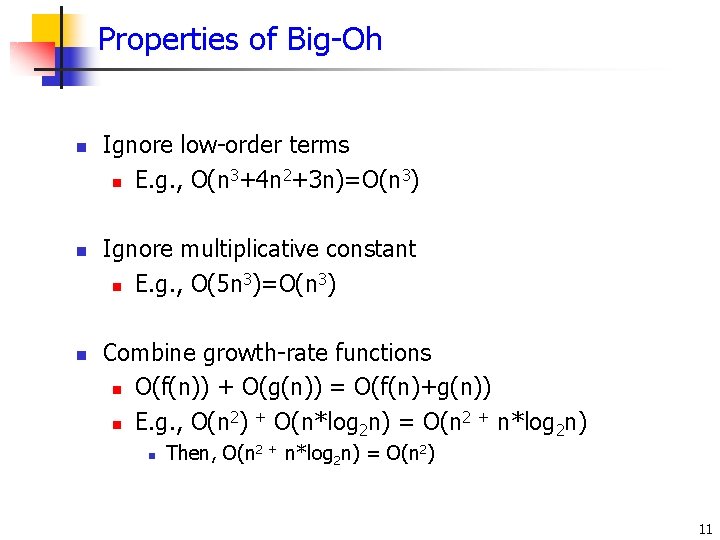
Properties of Big-Oh n n n Ignore low-order terms 3 2 3 n E. g. , O(n +4 n +3 n)=O(n ) Ignore multiplicative constant 3 3 n E. g. , O(5 n )=O(n ) Combine growth-rate functions n O(f(n)) + O(g(n)) = O(f(n)+g(n)) 2 + O(n*log n) = O(n 2 + n*log n) n E. g. , O(n ) 2 2 n Then, O(n 2 + n*log 2 n) = O(n 2) 11
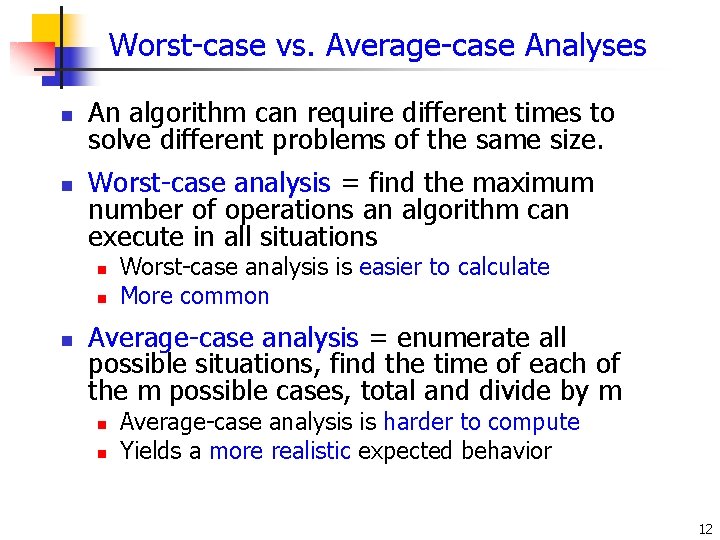
Worst-case vs. Average-case Analyses n n An algorithm can require different times to solve different problems of the same size. Worst-case analysis = find the maximum number of operations an algorithm can execute in all situations n n n Worst-case analysis is easier to calculate More common Average-case analysis = enumerate all possible situations, find the time of each of the m possible cases, total and divide by m n n Average-case analysis is harder to compute Yields a more realistic expected behavior 12
![Bigger Example: Analysis of Selection Sort values [ 0 ] 36 [1] 24 [2]](http://slidetodoc.com/presentation_image/c41518668073fd71268089e088cdb130/image-13.jpg "Bigger Example: Analysis of Selection Sort values [ 0 ] 36 [1] 24 [2]")
Bigger Example: Analysis of Selection Sort values [ 0 ] 36 [1] 24 [2] 10 [3] 6 [4] 12 Divides the array into two parts: already sorted, and not yet sorted. On each pass, finds the smallest of the unsorted elements, and swap it into its correct place, thereby increasing the number of sorted elements by one. 13
![Selection Sort: Pass One values [ 0 ] 36 [1] 24 [2] 10 [3]](http://slidetodoc.com/presentation_image/c41518668073fd71268089e088cdb130/image-14.jpg "Selection Sort: Pass One values [ 0 ] 36 [1] 24 [2] 10 [3]")
Selection Sort: Pass One values [ 0 ] 36 [1] 24 [2] 10 [3] 6 [4] 12 U N S O R T E D To find the smallest in UNSORTED: index. Min = 0 comp. 1: check if values[1] = 24 < values[index. Min] = 36 - yes => index. Min = 1 comp. 2: check if values[2] = 10 < values[index. Min] = 24 - yes => index. Min = 2 comp. 3: check if values[3] = 6 < values[index. Min] = 10 - yes => index. Min = 3 comp. 4: check if values[4] = 12 < values[index. Min] = 6 - NO Thus index. Min = 3; swap values[0] = 36 with values[index. Min] = 6 – see next slide 14
![Selection Sort: End of Pass One values [ 0 ] 6 [1] 24 [2]](http://slidetodoc.com/presentation_image/c41518668073fd71268089e088cdb130/image-15.jpg "Selection Sort: End of Pass One values [ 0 ] 6 [1] 24 [2]")
Selection Sort: End of Pass One values [ 0 ] 6 [1] 24 [2] 10 [3] [4] 36 12 SORTED U N S O R T E D 15
![Selection Sort: Pass Two values [ 0 ] 6 [1] 24 [2] 10 [3]](http://slidetodoc.com/presentation_image/c41518668073fd71268089e088cdb130/image-16.jpg "Selection Sort: Pass Two values [ 0 ] 6 [1] 24 [2] 10 [3]")
Selection Sort: Pass Two values [ 0 ] 6 [1] 24 [2] 10 [3] [4] 36 12 SORTED U N S O R T E D To find the smallest in UNSORTED: index. Min = 1 comp. 1: check if values[2] = 10 < values[index. Min] = 24 - yes => index. Min = 2 comp. 2: check if values[3] = 36 < values[index. Min] = 10 - NO comp. 3: check if values[4] = 12 < values[index. Min] = 10 - NO Thus index. Min = 2; swap values[1] = 24 with values[index. Min] = 10 – see next slide 16
![Selection Sort: End of Pass Two values [ 0 ] [1] 6 10 [2]](http://slidetodoc.com/presentation_image/c41518668073fd71268089e088cdb130/image-17.jpg "Selection Sort: End of Pass Two values [ 0 ] [1] 6 10 [2]")
Selection Sort: End of Pass Two values [ 0 ] [1] 6 10 [2] 24 [3] 36 [4] SORTED 12 U N S O R T E D 17
![Selection Sort: Pass Three values [ 0 ] [1] 6 10 [2] 24 [3]](http://slidetodoc.com/presentation_image/c41518668073fd71268089e088cdb130/image-18.jpg "Selection Sort: Pass Three values [ 0 ] [1] 6 10 [2] 24 [3]")
Selection Sort: Pass Three values [ 0 ] [1] 6 10 [2] 24 [3] 36 [4] SORTED 12 U N S O R T E D To find the smallest in UNSORTED: index. Min = 2 comp. 1: check if values[3] = 36 < values[index. Min] = 24 - NO comp. 2: check if values[4] = 12 < values[index. Min] = 24 - yes => index. Min = 4 Thus index. Min = 4; swap values[2] = 24 with values[index. Min] = 12 – see next slide 18
![Selection Sort: End of Pass Three values [ 0 ] 6 [1] 10 [2]](http://slidetodoc.com/presentation_image/c41518668073fd71268089e088cdb130/image-19.jpg "Selection Sort: End of Pass Three values [ 0 ] 6 [1] 10 [2]")
Selection Sort: End of Pass Three values [ 0 ] 6 [1] 10 [2] 12 [3] 36 [4] 24 S O R T E D UNSORTED 19
![Selection Sort: Pass Four values [ 0 ] 6 [1] 10 [2] 12 [3]](http://slidetodoc.com/presentation_image/c41518668073fd71268089e088cdb130/image-20.jpg "Selection Sort: Pass Four values [ 0 ] 6 [1] 10 [2] 12 [3]")
Selection Sort: Pass Four values [ 0 ] 6 [1] 10 [2] 12 [3] 36 [4] 24 S O R T E D UNSORTED To find the smallest in UNSORTED: index. Min = 3 comp. 1: check if values[4] = 24 < values[index. Min] = 36 - yes => index. Min = 4 Thus index. Min = 4; swap values[3] = 36 with values[index. Min] = 24 – see next slide 20
![Selection Sort: End of Pass Four values [ 0 ] 6 [1] 10 [2]](http://slidetodoc.com/presentation_image/c41518668073fd71268089e088cdb130/image-21.jpg "Selection Sort: End of Pass Four values [ 0 ] 6 [1] 10 [2]")
Selection Sort: End of Pass Four values [ 0 ] 6 [1] 10 [2] 12 [3] 24 [4] S O R T E D 36 21
![Selection Sort: How Many Comparisons? Values [ 0 ] 6 [1] 10 3 comparisons](http://slidetodoc.com/presentation_image/c41518668073fd71268089e088cdb130/image-22.jpg "Selection Sort: How Many Comparisons? Values [ 0 ] 6 [1] 10 3 comparisons")
Selection Sort: How Many Comparisons? Values [ 0 ] 6 [1] 10 3 comparisons starting with index. Min = 1 12 2 comparisons starting with index. Min = 2 [2] [3] [4] 24 36 4 comparisons starting with index. Min = 0 1 comparison starting with index. Min = 3 0 comparisons starting with index. Min = 4 + 3 + 2 + 1 + 0 comparisons In addition, we have <= 4 swaps 22
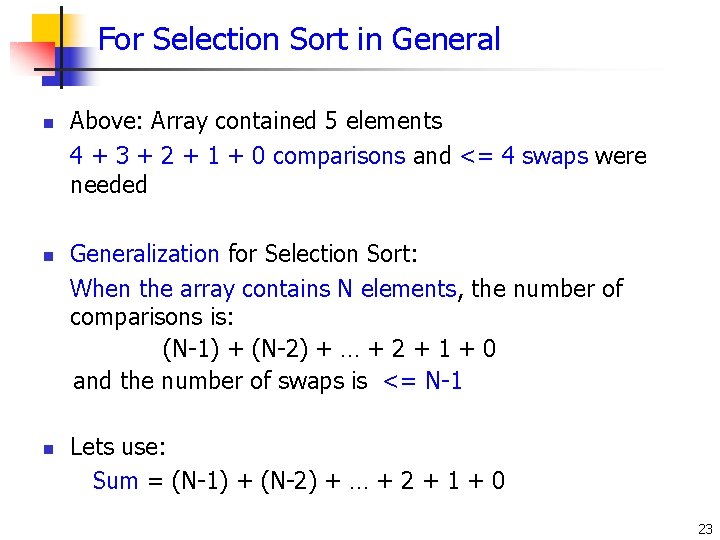
For Selection Sort in General n n n Above: Array contained 5 elements 4 + 3 + 2 + 1 + 0 comparisons and <= 4 swaps were needed Generalization for Selection Sort: When the array contains N elements, the number of comparisons is: (N-1) + (N-2) + … + 2 + 1 + 0 and the number of swaps is <= N-1 Lets use: Sum = (N-1) + (N-2) + … + 2 + 1 + 0 23
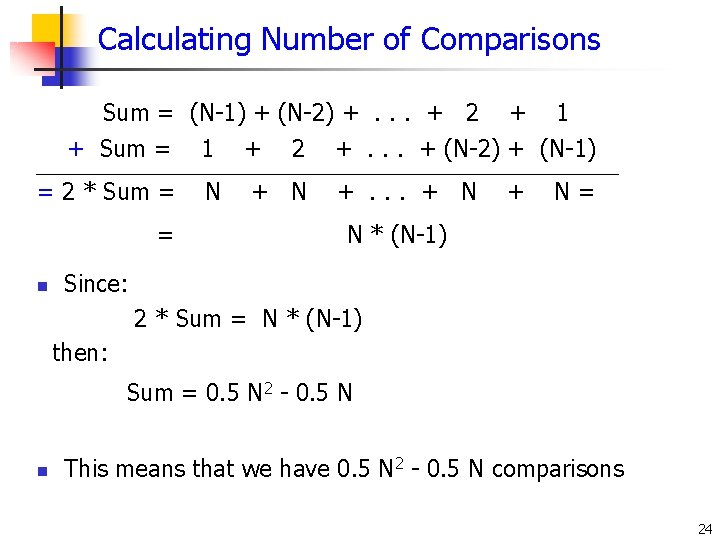
Calculating Number of Comparisons Sum = (N-1) + (N-2) +. . . + 2 + 1 + Sum = 1 + 2 +. . . + (N-2) + (N-1) = 2 * Sum = = n N +. . . + N= N * (N-1) Since: 2 * Sum = N * (N-1) then: Sum = 0. 5 N 2 - 0. 5 N n This means that we have 0. 5 N 2 - 0. 5 N comparisons 24
And the Big-Oh for Selection Sort is… § 0. 5 N 2 - 0. 5 N comparisons = O(N 2) comparisons N-1 swaps = O(N) swaps § This means that complexity of Selection Sort is O(N 2) § Because O(N 2) + O(N) = O(N 2) 25
![Pseudocode for Selection Sort void Selection. Sort (int[] values, int num. Values) // Post:](http://slidetodoc.com/presentation_image/c41518668073fd71268089e088cdb130/image-26.jpg "Pseudocode for Selection Sort void Selection. Sort (int[] values, int num. Values) // Post:")
Pseudocode for Selection Sort void Selection. Sort (int[] values, int num. Values) // Post: Sorts array values[0. . num. Values-1 ] // into ascending order by key value { int end. Index = num. Values - 1 ; for (int current=0; current<end. Index; current++) Swap (values, current, Min. Index(values, current, end. Index)); } 26
![Pseudocode for Selection Sort (contd) int Min. Index(int[] values, int start, int end) //](http://slidetodoc.com/presentation_image/c41518668073fd71268089e088cdb130/image-27.jpg "Pseudocode for Selection Sort (contd) int Min. Index(int[] values, int start, int end) //")
Pseudocode for Selection Sort (contd) int Min. Index(int[] values, int start, int end) // Post: Function value = index of the smallest value // in values [start]. . values [end]. { int index. Of. Min = start ; for(int index =start + 1 ; index <= end ; index++) if (values[index] < values [index. Of. Min]) index. Of. Min = index ; return index. Of. Min; } 27
- Slides: 27